Nineteen languages, one classroom
A practical tour of teaching across the 19 languages Ollasync translates live — the original ten plus nine additions: Kannada, Tamil, Telugu, Marathi, Bengali, Gujarati, Malayalam, Punjabi and Urdu — with honest notes on what machine translation does and doesn't cover.
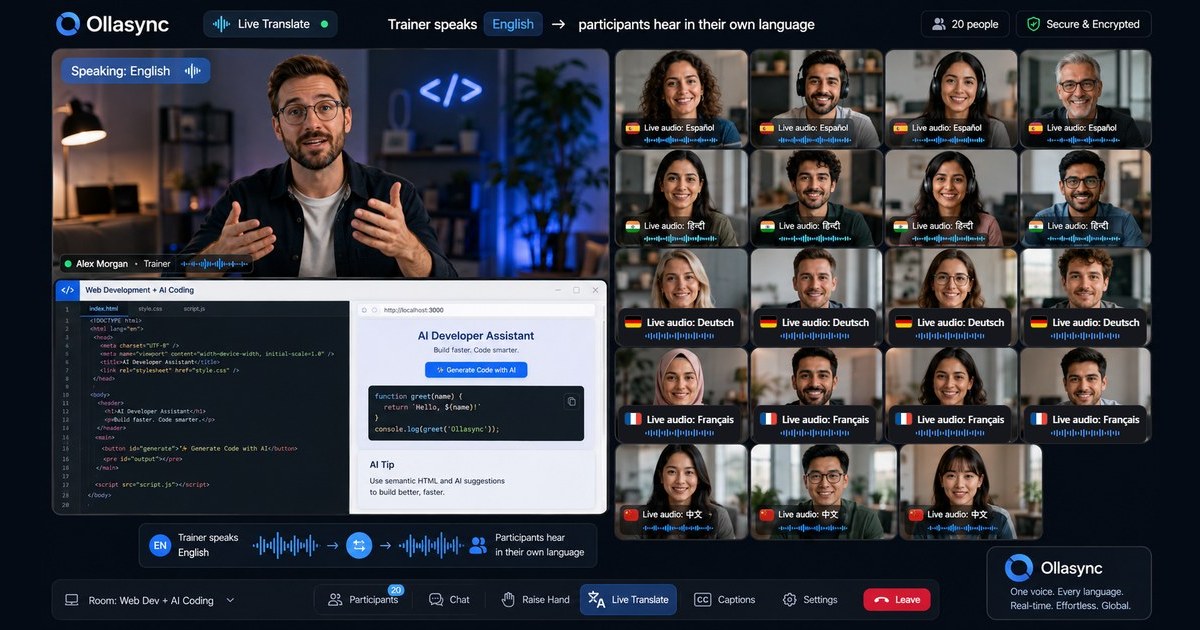
Key takeaways
- One live class can be followed in any of 19 languages — each learner chooses their own, as captions or spoken audio, up to five different languages per session.
- The reachable-market math is the point: an English-only tutor competes with every English-speaking tutor; a translated one competes on teaching.
- Mixed cohorts stop splitting: you no longer schedule a 'Spanish session' and an 'English session' of the same course.
- Honest limits: it's machine translation of live speech — great for lessons, not certified interpretation; a good microphone matters.
Every online teacher has the same invisible ceiling: the set of people who speak their language well enough to be taught in it. Remove that ceiling and the market for one good teacher stops being a country and starts being the internet.
Here’s the practical tour of what teaching across our nineteen languages actually looks like — and where the honest edges are.
The nineteen
English · Spanish · French · Hindi · German · Chinese · Japanese · Portuguese · Arabic · Russian · Kannada · Tamil · Telugu · Marathi · Bengali · Gujarati · Malayalam · Punjabi · Urdu.
That’s the shipped list — the languages a learner can pick from during a live class, receiving your voice as translated captions or as spoken translated audio. Nineteen languages — ten of them Indian languages, from Hindi to Urdu, where a class taught in English and heard in Kannada or Tamil is the everyday case — covers the first language of a very large share of the online-learning world, and any participant can pick any of them: the trainer doesn’t configure pairs, the learner just chooses. One session can run up to five different languages at the same time. Common technical terms that classrooms say in English — protocol, tool and product names — are kept in English inside the translation instead of being turned into textbook words.
Three classrooms this changes
The solo tutor. An IELTS coach in Manila teaches conversation practice to students who chose Hindi and Arabic captions for the instructions, switching to English audio for the practice itself. The tutoring use case is the deepest version of this: your teaching quality becomes the product; the language barrier stops being the filter.
The academy with global cohorts. A certification course that used to run three times — English, Spanish, Portuguese — runs once. Same trainer, same quizzes, same replay; three markets follow live. The margin difference isn’t subtle: one delivery instead of three.
The distributed company. All-hands training where the Tokyo office finally hears compensation policy explained in Japanese instead of decoding rapid English at 8am. Comprehension isn’t a nice-to-have when the content is policy.
What learners actually experience
Each learner controls their own class: pick a language, pick captions or spoken audio, change mid-session if they want. The audio option matters more than it sounds — reading subtitles for an hour is work; hearing a voice lets learners watch the whiteboard. Both arrive a beat behind the speaker, the rhythm of listening through an interpreter.
The honest edges
- It’s machine translation. Excellent for following a lesson; not a substitute for certified interpretation where the stakes are legal or medical.
- Input quality is output quality. A trainer on a decent headset in a quiet room translates dramatically better than a laptop mic in a café — exactly like human listeners, the recognition hears what you feed it.
- Nineteen languages, not every language. We list the shipped nineteen rather than promising the world, and a single session runs up to five of them at once. When that list grows, this page will change.
Trying it costs a class
Run one real lesson with one real learner in another language — that’s the whole evaluation. Joining is browser-only, plans are per trainer seat, and the learners never pay for seats.