How live voice translation works in an online class
What actually happens between a trainer speaking English and a learner hearing Hindi: the live recognition → translation → delivery pipeline, what the latency feels like, and where machine translation honestly ends.
Key takeaways
- The pipeline is speech recognition → neural machine translation → delivery as captions or spoken audio, running continuously while the trainer teaches.
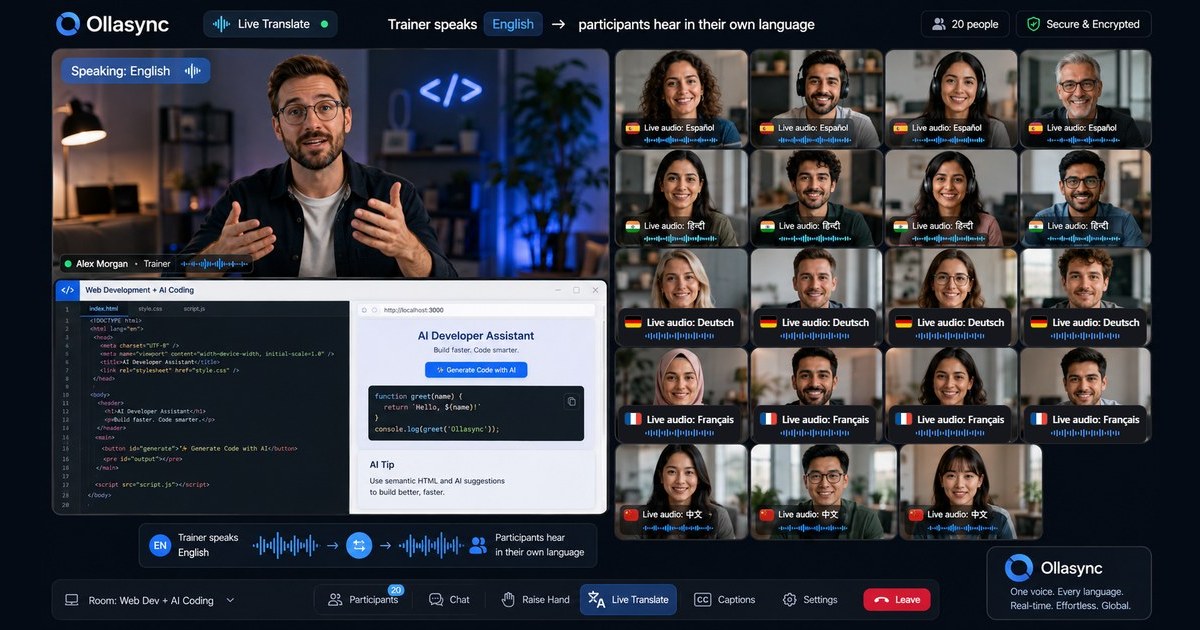
- Each learner picks their own language — each of 19 languages is available and a single session can run up to five different ones at once.
- Live translation runs a beat behind the speaker, like listening through an interpreter; captions appear immediately and refine as the sentence completes.
- It's machine translation: superb for following a lesson, not a replacement for certified interpretation in legal or medical settings.
A trainer in London says: “Today we’ll balance the equation on the left.” Two seconds later a student in Delhi hears it in Hindi, a student in Madrid reads it in Spanish, and a third listens to the original English. Nobody clicked anything mid-sentence; nobody hired an interpreter.
This piece explains what actually happens in between — because “AI translates your voice” deserves a concrete answer, including the honest parts.
The pipeline, in three stages
1. Recognition. As the trainer speaks, streaming speech recognition converts audio into text continuously — not in batches after each sentence, but word by word as the audio arrives. This is why captions can start rendering while a sentence is still being spoken.
2. Translation. The recognised text flows through neural machine translation into each language a learner has selected. Because recognition streams, translation streams too: a caption first appears as a best-effort partial, then refines as the sentence completes and the models get the full context. If you watch closely you’ll see captions occasionally rewrite their last few words — that’s the refinement working, not a glitch.
3. Delivery. Each learner chooses how to receive their language: captions rendered under the class, or spoken audio — a synthesised voice reading the translation, so a learner can watch the whiteboard instead of the subtitles. Different learners in the same class can make different choices; the trainer does nothing differently either way.
What “live” honestly means
Translation runs a beat behind the speaker — typically the time it takes for a phrase to complete plus the translation itself. Subjectively it feels like listening through a good consecutive interpreter: you’re never waiting for a paragraph, but you’re not lip-synced either.
Two practical implications for teaching:
- Pause at the seams. Trainers who leave half a breath between ideas give the translation a natural boundary and learners a cleaner experience.
- Numbers and names survive better with context. “In 1848” translates robustly; a bare “48” mid-mumble is harder for any recogniser. Say the sentence, not the fragment.
One class, nineteen languages
Learners can follow in any of the nineteen supported languages — English, Spanish, French, Hindi, German, Chinese, Japanese, Portuguese, Arabic, Russian, Kannada, Tamil, Telugu, Marathi, Bengali, Gujarati, Malayalam, Punjabi and Urdu — each independently, with up to five different languages running in one session. The trainer teaches once. There is no per-language session to schedule, no duplicated cohort, and joining happens in the browser with nothing to install.
Where the honesty line is
This is machine translation of live speech. For following a lesson, asking questions and keeping a multilingual cohort genuinely together, it is transformative. It is not certified interpretation: for a courtroom, a medical consent conversation or a contract negotiation, you still want a human professional. We’d rather say that plainly than have you discover it in the wrong meeting.
Accents, crosstalk and poor microphones degrade recognition — the same way they degrade human comprehension. A decent headset mic is the single highest-leverage upgrade a trainer can make.
Where to see it
The AI classroom runs this pipeline on every class with translation enabled, and the same session also produces the transcript and the class notes automatically. Plans are per trainer seat — learners join free.