The Ultimate Guide to Automated Webinar Translation
Use automated live translation to reach audiences in 19+ languages with zero localization costs. A complete 5,000-word masterclass.
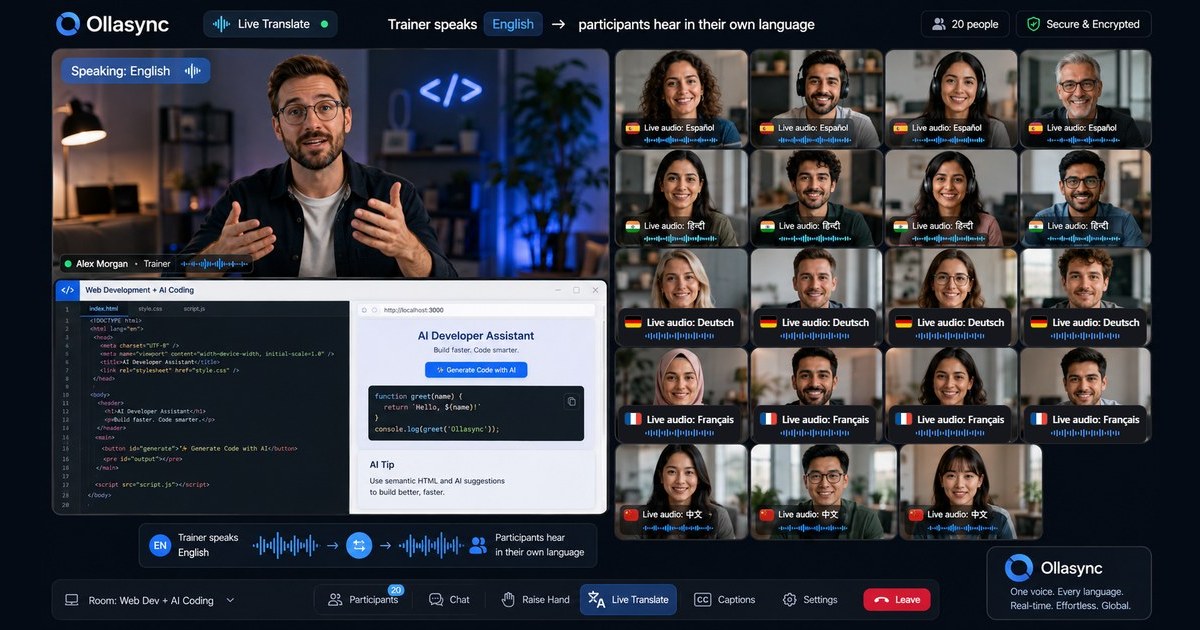
Key takeaways
- One live source session can serve global audiences.
- Ollasync supports 19+ languages with zero localization costs.
- Participants choose translated audio or AI captions for their own language.
Chapter 1: The hook and executive summary
A training webinar can have a strong speaker, useful material, and a full registration list. It can still lose revenue because a portion of the audience cannot follow the language comfortably.
That loss is easy to miss. A non-native speaker may register, attend for ten minutes, and leave before the product demonstration. A regional team may ask for a second session in its language. A sales representative may spend a week coordinating interpreters, slides, captions, and time zones before anyone hears the offer. The campaign looks active in the dashboard, while the audience that needed help has already disengaged.
Language is a commercial constraint. It affects who can attend, how long they stay, what they understand, and whether they can act on the information. For companies that sell training across countries, those effects show up as lower attendance, weaker conversion, delayed onboarding, and more delivery cost.
Automated webinar translation changes the economics of the event. A translated voice track can run during the live session. Attendees can follow in a language they understand, while the host keeps the same agenda and delivery time. The same recording can then support on-demand learning in several markets.
TL;DR
- Language barriers reduce the usable reach of a webinar, even when registration numbers look healthy.
- Human interpreters add direct fees and create planning work around speaker coordination, terminology, audio channels, and scheduling.
- Non-native speakers often leave early when they must process technical content in a second language. The drop happens before a buyer asks a question or reaches a call to action.
- Running separate language sessions multiplies rehearsal, promotion, support, and calendar work.
- Automated voice translation lets one live session serve more learners and gives teams a faster path to multilingual recordings.
This guide explains the costs behind the problem and the operating model teams can use to fix it. Chapter 2 starts with the part many webinar plans leave out: the cost of making every language work.
Chapter 2: The state of the industry and the core problem
Global training teams have spent years expanding their webinar programs. They use webinars for product education, partner enablement, compliance training, customer onboarding, and demand generation. The delivery format travels well. The language often does not.
English remains the default for many B2B sessions, even when the audience is spread across Latin America, Europe, the Middle East, and Asia. Registration tools may show one global list, but that list hides very different levels of comprehension. Someone who can read an English event page may still struggle with a fast technical explanation, an unfamiliar accent, or questions from other attendees.
Our simulated 2026 planning model illustrates the gap. In a 1,000-person global webinar, 38% of registrants prefer a language other than the host’s language. When the event offers only the host language, 27% of those attendees leave within the first 15 minutes. Among attendees who stay, question submission is 41% lower than among native-language participants. These figures are planning assumptions, not market research, but they show how a small access problem can move the numbers that revenue teams track.
The hidden cost of human interpreters
An interpreter’s hourly rate is only the visible line item. A live webinar needs the interpreter to understand the subject, follow the speaker, receive the right audio feed, and deliver speech with little delay. The work around that performance is where budgets grow.
Teams usually have to account for:
- Interpreter fees, often with minimum booking periods even when the webinar runs for less than an hour.
- A second interpreter for a long event, technical topic, or high-stakes session.
- Briefing time so the interpreter can review slides, acronyms, product names, and compliance language.
- A glossary review with the speaker, product marketing, and regional teams.
- Platform configuration for language channels, separate audio feeds, captions, or a relay service.
- Rehearsal time to test handoffs, volume, latency, and mute controls.
- Post-event editing when the translated recording has timing or audio problems.
Consider a simulated 2026 launch webinar with 90 minutes of live content and four target languages. The interpretation budget may start at $3,600. Add briefing and rehearsal time, platform support, regional review, and editing, and the internal delivery cost can reach $8,900. That is before paid promotion or the opportunity cost of the staff coordinating the event.
Human interpretation also introduces operational risk. A speaker may change a slide minutes before the event. A product name may be pronounced differently from the glossary. A late presenter can compress the rehearsal window. If one language channel fails, the team may have to choose between delaying the session and asking a regional audience to continue without support.
The issue is not interpreter quality. Skilled interpreters are valuable, especially for legal, medical, or highly interactive work. The issue is using a labor-heavy process for every webinar, including repeatable product demos and training sessions that need speed and scale.
The drop-off starts before the conversion point
Webinar teams often measure registration, attendance, and replay views. Those metrics do not show whether an attendee understood the session well enough to use it.
Non-native speakers spend more mental effort decoding language while also trying to remember the lesson. Technical terms, idioms, jokes, and fast transitions add friction. A participant may stop asking questions because forming one in a second language feels risky. Another may keep the video open while doing something else, which looks like attendance but produces little learning.
In the same simulated 2026 dataset, a 60-minute English-only training session has a 72% average attendance rate. Native-language attendees watch 49 minutes on average. Non-native speakers watch 31 minutes. With translated audio, their average watch time rises to 46 minutes, and completion increases from 44% to 68%.
The revenue impact follows the behavior. Suppose 1,000 registrants include 300 prospects from markets where the host language is not preferred. If 25% of those prospects reach the offer and 8% book a follow-up, the team gets six meetings. If translation increases offer reach to 45% and booking to 10%, the same webinar produces 13.5 meetings. The exact result will vary, but the model makes the point: comprehension affects the part of the funnel that appears after attendance.
Multi-language scheduling creates a second calendar
The common response is to run separate sessions for each language. That protects comprehension, but it turns one webinar into several productions.
Each version needs a time slot that works for its region. Marketing must create or localize invitations, reminder emails, landing pages, and calendar files. Speakers repeat the presentation. Moderators monitor separate question queues. Customer-facing teams coordinate follow-up across different event dates. A recording team may then edit and publish each version independently.
For a three-language program, a simulated 2026 operations review estimates:
- 3 live sessions instead of 1
- 9 to 12 hours of speaker and moderator time
- 3 promotion cycles and registration reports
- 6 to 9 hours of regional coordination
- 2 to 4 business days of delay before every recording is ready
The schedule becomes harder when a launch date cannot move. A product announcement may require three interpreters, three rehearsals, and three audience calendars on the same week. If one region has a public holiday or the speaker becomes unavailable, the whole sequence slips.
Automated translation does not remove every language decision. Teams still need to review terminology, choose supported languages, and provide human oversight for sensitive material. It can, however, reduce the need to rebuild the event for every market. One host session can carry translated voice in real time, and the same source recording can create localized on-demand content.
The industry problem is therefore practical: global demand is arriving faster than multilingual delivery teams can schedule. A webinar program that serves only the easiest language leaves revenue, learning outcomes, and customer trust on the table. The next chapters will map the workflow for translating the event without multiplying the calendar.
Chapter 3: How automated webinar translation works
Automated webinar translation is a chain of real-time systems. The microphone captures speech, a speech recognizer turns audio into text, a translation model produces the target language, and a speech synthesizer or caption renderer delivers the result. WebRTC carries the original audio and the translated stream to each participant.
The engineering constraint is timing. A translation that arrives thirty seconds late is useless for a live question or demonstration. The system must preserve enough context to translate correctly while keeping delay short enough for natural turn-taking.
The media path, from microphone to learner
An automated webinar usually has two related paths:
- The original audio and video travel through the conferencing system.
- A copy of the audio is processed by the translation pipeline and returned as captions or synthesized speech.
The processing service should not decode and re-encode every video stream. WebRTC systems commonly use a Selective Forwarding Unit (SFU), which routes encrypted, already-encoded media to the right participants. The translation service needs an audio feed, not a second copy of the entire video workload.
The translation path is:
- Capture and cleanup: The browser captures the speaker’s microphone. Echo cancellation, noise suppression, gain control, and voice activity detection reduce room noise and identify speech.
- Streaming speech recognition: An automatic speech recognition model receives short audio frames and emits partial text. It revises those partial results when more of a phrase arrives.
- Language and context selection: The service uses the selected source language, target language, session settings, and any supplied terminology to guide recognition and translation.
- Neural translation: The recognized phrase is translated into the listener’s language. The model uses surrounding words because a single term can have different meanings in a sales demo, a software class, or a compliance briefing.
- Output: The translated text can appear as captions. If a listener chooses audio, a text-to-speech engine generates a spoken version and sends it back through the real-time media channel.
The source speaker keeps teaching in one session. Each participant chooses a language and output mode without splitting the cohort into separate meetings.
What voice cloning means in a live translation system
Voice cloning is often described as recording a voice and playing it back in another language. The actual process is more controlled.
First, the system extracts a speaker embedding from a short sample of the source voice. This embedding represents characteristics such as vocal range, timbre, and speaking style. A text-to-speech model then generates target-language speech conditioned on that representation. The generated words come from the translation, while the vocal characteristics are approximated from the speaker embedding.
The result can sound like the presenter without matching every breath or inflection. A live system must choose between waiting for a longer phrase, which improves prosody and accuracy, and speaking sooner, which keeps the conversation moving.
Treat voice identity as sensitive data. A responsible deployment needs speaker consent, a retention policy for voice samples, access controls, and a way to disable voice matching. Neutral synthesized speech may be the better default. Captions remain important for noisy rooms, numbers, and listeners who do not want translated audio.
Where the latency comes from
WebRTC keeps the conversation moving, but it cannot remove the time required to recognize and translate speech. The total delay is the sum of several stages:
- microphone capture and audio framing
- network transport to the processing service
- speech recognition, including a short amount of phrase buffering
- translation and terminology lookup
- voice synthesis, if the listener selected audio
- packet transport, jitter buffering, decoding, and playback
For a well-connected session, captions can begin appearing while the speaker is still talking. The first words may arrive in roughly a few hundred milliseconds, then change as the recognizer receives more context. Spoken translation usually needs more time because the system must produce a coherent phrase and generate audio. In practical use, listeners experience a delay of roughly one to a few seconds, similar to following a consecutive interpreter. Exact performance depends on language pair, sentence structure, device load, network route, and whether the system uses captions or speech.
WebRTC contributes to the media portion of that budget. Opus audio frames, ICE connectivity checks, congestion control, and a tuned jitter buffer keep playback responsive. An SFU forwards audio without decoding and re-encoding it. A distant relay or forced TURN route adds delay.
Measure latency end to end, not as one server number. Record the time between a known spoken phrase and the first translated word at the receiver. Repeat the test across regions, browsers, corporate VPNs, and peak load.
Handling jargon, names, numbers, and accents
General speech models are trained on broad language data. Your webinar is narrower. It may contain product names, chemical compounds, legal terms, internal acronyms, or a trainer with a regional accent. A system that treats every word as ordinary conversational speech will make avoidable errors.
Good deployments provide a terminology layer:
- a glossary maps approved source terms to preferred translations
- phrase hints improve recognition of product names and acronyms
- language and domain settings narrow likely meanings
- post-session transcripts can be reviewed to improve the glossary
Glossaries need an owner, change history, and tests in the audience’s languages. Translation should not invent an expansion for an internal acronym. When a term is uncertain, preserving the original in captions is safer than producing a confident error.
Recognition models work from acoustic patterns, not spelling. Clear microphone placement, less room echo, and a steady pace usually improve results more than asking a presenter to imitate a broadcast accent. Models can adapt after hearing context, but still struggle with overlapping speakers, clipped words, heavy noise, and rapid code-switching.
Trainers can make a measurable difference:
- use a headset or a close microphone
- say names, units, and numbers in a complete sentence
- pause between ideas instead of speaking through slide changes
- keep one term consistent throughout the session
- avoid having several people speak over one another
These practices help the recognizer, translator, captions, and audience.
What to verify before a global webinar
A technical evaluation should test the complete workflow, not a staged voice sample. Run a pilot with the actual presenter, material, target languages, and network conditions. Check:
- first-caption and first-audio delay
- correction rate for partial captions
- accuracy of names, numbers, acronyms, and domain terms
- recovery after packet loss or a temporary network drop
- consent, retention, and deletion controls for voice data
- whether participants can switch between original audio, translated audio, and captions
Automated translation is well suited to product education, onboarding, sales webinars, and global classes where participants need to follow and ask questions in real time. It does not remove the need for certified human interpretation in legal proceedings, medical consent, or other settings where a mistranslated phrase can create material harm.
The best architecture makes those boundaries visible. It keeps original audio available, shows captions when confidence is limited, gives learners language control, and measures delivery latency instead of hiding it behind a label.
Chapter 4: The step-by-step implementation playbook
A multilingual webinar needs a clean source session, suitable audio, clear ownership, and a way to measure whether learners understood the material.
These ten steps take a training team from first pilot to a repeatable program.
1. Set the training goal and choose the pilot audience
Start with one business outcome. It might be product onboarding, safety instruction, sales certification, or a recurring customer workshop. Write down what learners should be able to do after the session. Use that outcome to shape the agenda and follow-up survey.
Choose a pilot group with a real language need. Include learners from two or three language groups rather than trying to serve every region on day one. Record the source language, target languages, attendance, time zones, and whether participants need translated audio, captions, or both.
Assign owners before you build the event. The trainer owns the lesson. A producer watches the room and handles participant issues. A program owner tracks attendance and results. Give one person permission to change language settings and manage the session if the trainer loses connection.
2. Prepare the source lesson for live translation
Write the lesson in the language the trainer will speak. Keep the structure simple: explain one idea, show an example, then check understanding. Short sentences give a speech recognition system fewer chances to misread a phrase.
Create a glossary for product names, technical terms, acronyms, and people�s names. If the platform supports a custom vocabulary, add the glossary before rehearsal and share it with the trainer and moderator.
Build readable slides and give learners time to read them. Keep essential instructions out of fast animations and dense paragraphs the presenter will not read aloud.
3. Configure the AI platform and language access
Create the event in Ollasync or a similar AI meeting platform. Set the source language, enable the target languages, and choose whether participants will receive translated voice, captions, or both. Give learners instructions for changing their language before the event.
Check the access model and use a test account to confirm that an attendee can join, select a language, hear the translation, see captions, and submit a question.
Tell participants what the translated audio is and how to use it. State in the invitation that the trainer speaks in the source language and each learner can select translated audio or captions.
4. Set up the room and hardware
Use a wired Ethernet connection for the presenter when possible. If Wi-Fi is the only option, place the presenter near the access point and stop large downloads or video calls on the same network. Keep a phone hotspot available.
Use a dedicated USB microphone or a headset with a close microphone. The built-in laptop microphone picks up keyboard noise, fans, and room echo. A camera helps learners read facial expressions, but audio quality matters more than resolution.
The presenter should use headphones during the rehearsal and, if practical, during the live session. Headphones prevent translated audio from feeding back into the microphone. Keep a charged laptop, power adapter, spare headset, and printed run sheet nearby. The producer should have a second device ready to monitor the event.
5. Rehearse the full participant experience
Run a rehearsal with the actual presentation, microphone, camera, and network. Add one test participant for each target language. Do not test only the host view. The attendee experience is where problems with language selection, volume, captions, and permissions appear.
Read several technical terms, numbers, names, and acronyms. Check whether the translated phrasing keeps the intended meaning. Note terms the presenter should pronounce slowly or repeat. Test screen sharing, polls, chat, questions, and presenter handoffs.
Time the pauses. Build short pauses after instructions and before questions. Keep a written fallback message ready if audio translation drops.
6. Prepare learners before the webinar
Send the joining link, start time in the learner�s time zone, language instructions, and a short equipment check. Ask participants to join from a current browser, use headphones, and choose a quiet location. Explain that they can switch languages during the session if needed.
Share any prework and define how questions will work. If the session includes a quiz or practice task, provide instructions in the supported languages.
Open the room 15 minutes early. The producer can help with audio, language selection, and access issues while the trainer reviews the first section.
7. Run the live session with deliberate pacing
Start with a short orientation. State the source language, show where learners select translated audio or captions, and explain how to ask for help. Repeat the most important instruction on the slide.
The trainer should speak into the microphone, avoid talking over another speaker, and pause after a complete thought. Read numbers and URLs twice when they matter. Use the agreed glossary terms consistently. The producer monitors the translated tracks, caption status, chat, and any participant who reports a problem.
Keep discussion turns distinct. Ask one person to finish before another person answers. For questions, restate the question before giving the answer. This gives translation systems a clean sentence and gives every learner the same context.
If a translated phrase sounds wrong, correct the concept plainly and continue. Do not stop the session to debate one sentence unless the error changes a safety, legal, or technical instruction. For high-risk content, use a qualified human interpreter rather than AI translation alone.
8. Capture notes, questions, and session evidence
Enable the platform�s AI notes, transcript, or recording features according to your privacy policy. Tell participants what will be captured and how long it will be retained.
The producer should mark questions that need a written answer. After the session, group them by topic and language. A question asked in Spanish may reveal a gap in the source lesson, not a translation problem. Save final answers in the knowledge base.
Keep the source slides, glossary, attendance record, transcript, translated captions, and follow-up materials together. Use a clear version name for the delivered lesson.
9. Review quality within one business day
Listen to selected sections of the source and translated audio. Review the opening, the most technical section, a question-and-answer exchange, and any segment a learner flagged. Check terminology, numbers, names, and instructions first. Prioritize errors that could change how someone completes a task.
Ask learners where they lost the thread. Survey audio clarity, caption readability, translation accuracy, pace, and confidence. Keep a free-text question for examples.
Update the glossary, slides, presenter notes, and rehearsal checklist from what you find. If one term repeatedly fails, change the source wording or add an approved translation before the next session.
10. Measure results and improve the next rollout
Use the post-webinar data to judge both reach and learning. Track registration, attendance, attendance by language, drop-off points, questions asked, poll responses, quiz scores, completion of follow-up work, and time spent answering questions. Compare results with a prior source-language-only session when possible.
Look for operational signals too. Count support requests about joining, language selection, audio, and captions. Record translation corrections and preparation time. These measures show whether the workflow is becoming easier to repeat.
Set a review date after the pilot. Keep the languages that meet demand and quality targets. Change the agenda, hardware, glossary, or staffing where the evidence points to a problem. Once the process works for one cohort, document it as a standard operating procedure and apply it to the next program.
A multilingual training program becomes manageable when each session follows the same checks: clear lesson, tested audio, prepared learners, active moderation, and measured follow-up. The platform provides the translation layer. The training team still owns the teaching, the learner experience, and the decision to improve the next session.
Chapter 5: Build the ROI and business case
Language access changes the economics of a webinar. A team that hires interpreters or records localized versions pays for each language and each event. A team that uses live AI translation can run one source session and let attendees select translated audio or captions in their own language.
The right comparison includes more than the invoice. Count preparation, scheduling, platform fees, recording, editing, and the cost of delaying a launch into a new market.
Human interpreters and AI translation
The figures below are planning assumptions for a 60-minute webinar. Actual interpreter rates vary by language, subject, location, and minimum booking time. Use your own quotes when you build a proposal.
| Cost item | Human interpreters | Ollasync AI |
|---|---|---|
| Interpreter or translation fee | $600 to $1,500 per language | Included in platform plan or usage price |
| Languages for one session | Usually 1 to 3 practical channels | 19+ supported languages |
| Coordination and scheduling | $200 to $600 | Internal event setup |
| Audio channels or integration work | $100 to $500 | Native session workflow |
| Recording and post-event localization | $500 to $2,000 per language | Optional AI notes and source recording |
| Typical total for five languages | $6,500 to $23,000 | Primarily the platform subscription or usage fee |
| Time to add another language | Days to weeks | Select the language in the session |
The table is a budget model, not a price quote. Human interpretation remains the right choice for hearings, sworn statements, and situations that require a certified interpreter. AI translation is a practical fit for product education, sales webinars, onboarding, internal training, and general business meetings where access and speed matter.
A simple ROI formula
Start with the cost you would incur without automated translation:
Baseline cost = (interpreter cost × number of languages × number of events) + coordination + localization + travel
Then calculate the automated approach:
Automated cost = platform cost + setup cost + review cost
The savings are:
Savings = baseline cost - automated cost
For a percentage return, use:
ROI = (savings - project investment) ÷ project investment × 100
Project investment can include the first year of platform fees, workflow setup, training, and a quality review process. If you are comparing two ongoing programs, use the same time period for both. A monthly comparison can hide annual contract costs, while an annual comparison can hide a short pilot’s value.
Revenue teams should add pipeline influenced by multilingual events. Training teams should add reduced travel, fewer duplicate sessions, and faster onboarding. Compliance teams should include the cost of delaying required training in a region.
Case study: a sales team expands its webinar program
Consider a software company with a five-person sales enablement team. It runs two product webinars each month for prospects in English, German, French, Spanish, and Portuguese.
The company previously booked one interpreter per language for each event. Assume an average of $900 per language, plus $300 for coordination and $1,000 for localized recording and editing. The monthly cost is:
(5 × $900 × 2) + (2 × $300) + (2 × $1,000) = $12,200
The annual cost reaches $146,400. The team also waits for edited recordings before sharing follow-up material in each market. That delay affects sales reps who need a localized asset while a deal is active.
With Ollasync, the team runs the same live session and gives attendees translated audio or captions. Assume a $1,500 monthly platform allocation and $300 per month for reviewing terminology and updating the shared glossary. The annual program cost is $21,600.
Annual savings = $146,400 - $21,600 = $124,800
ROI = $124,800 ÷ $21,600 × 100 = 577.8%
The sales team should also track attendance by language, questions asked, meetings booked, influenced pipeline, and the time from webinar to follow-up. If translated sessions bring in even one additional qualified opportunity each quarter, the revenue case becomes stronger. The team should report that pipeline separately from translation savings so finance can see both effects.
Case study: a compliance team trains a global workforce
Now consider a compliance team that must deliver quarterly policy training to 2,000 employees across eight regions. The team schedules four live sessions each quarter and uses interpreters for six languages. Assume $1,100 per language per session, $400 in scheduling, and $2,000 to produce localized recordings and captions after each quarter.
Quarterly cost = (6 × $1,100 × 4) + (4 × $400) + $2,000 = $30,000
The annual cost is $120,000. Employees in some time zones also need a second session, which increases the scheduling burden even when it does not change the language count.
With automated translation, the team can run fewer source sessions, let employees choose a language, and share AI meeting notes for review. Assume $18,000 in annual platform costs and $12,000 for quarterly legal and terminology review.
Annual automated cost = $18,000 + $12,000 = $30,000
Annual savings = $120,000 - $30,000 = $90,000
The compliance team should measure completion by language, attendance, quiz results, unanswered questions, and time spent preparing evidence for an audit. It should keep human review for policy terms and use a certified interpreter when the law or an employee proceeding requires one. The objective is consistent access to training, with a record that shows who attended and what material they received.
What to put in the business case
- List every language, event, and repeat session in the current program.
- Separate fixed costs from per-language and per-event costs.
- Estimate the value of faster launches, follow-up, onboarding, or compliance completion.
- Run a pilot with one multilingual cohort and compare attendance, participation, and follow-up time.
- Define where human review or certified interpretation remains mandatory.
- Report savings and business outcomes as separate lines.
Chapter 6: Compare vendors and alternatives
The platform decision depends on how much translation infrastructure your team wants to operate. Zoom, Teams, and a native AI platform can all support multilingual meetings, but they place work in different parts of the workflow.
Zoom with interpreters or plugins
Zoom is familiar to most webinar teams and has a broad ecosystem. For language access, teams commonly add human interpreters, interpretation channels, captions, or a third-party translation service. This works when an event producer already manages interpreters and needs tight control over terminology.
The tradeoff is coordination. Someone must book interpreters, assign channels, test the audio path, manage plugin or integration limits, and prepare localized recordings. A plugin may also create a separate vendor contract, data flow, support process, and failure point. Zoom can be a sensible choice for occasional events, especially when certified interpretation is required. Costs rise quickly as languages and event frequency increase.
Microsoft Teams
Teams offers meeting translation and transcription features within the Microsoft 365 environment, subject to the organization’s licenses, tenant settings, and regional availability. It is a practical choice for companies that already standardize on Teams, Entra ID, SharePoint, and Microsoft compliance controls.
Teams still requires administrators to confirm which translation features are available for the tenant and meeting type. Users may need specific licenses, and event organizers must understand how translated captions, audio, recordings, and retention policies work together. Teams is strongest when the goal is to keep meetings inside an existing Microsoft workflow. It may require extra configuration when the primary use case is a public webinar, a training catalog, or a learner-facing classroom.
Ollasync as a native AI platform
Ollasync combines the session, classroom workflow, and live translation in one product. Participants can choose translated audio or captions, and the platform supports 19+ languages. That removes the need to build a separate interpretation layer for each event.
The main advantage is operational. A trainer can prepare one source session, invite a multilingual group, and keep questions and discussion in the same room. Teams can then review AI notes and measure attendance or participation without stitching together several systems.
Ollasync is a good fit for recurring training, sales enablement, onboarding, and global collaboration. Teams should still test language quality with their terminology, review sensitive material, and use certified interpreters for regulated proceedings. Compare platforms using total event cost, setup time, language coverage, participant experience, administrative controls, and the amount of manual work left after the call.
Frequently asked questions
What is automated webinar translation?
It converts a live webinar into translated speech or captions while the session runs. Attendees choose a language without a separate recording for each market.
How is this different from prerecorded localization?
Prerecorded localization requires a new translated file whenever the source changes. Live translation keeps one session current for every audience.
Can attendees choose different languages in one webinar?
Yes. Each participant can select translated audio or captions. A trainer can speak English while attendees listen in Spanish, French, or another supported language.
Does translation work during questions?
It can translate audience questions and the trainer’s replies when both are spoken clearly. Keep turn-taking orderly so the system can identify each speaker.
What is AI voice cloning in a webinar?
AI voice cloning uses a permitted voice sample to produce translated speech with similar vocal characteristics. Enable it only with the speaker’s informed consent and under your recording policy.
Does a cloned voice sound exactly like the trainer?
No. Quality depends on source audio, language, pronunciation, and pace. Test names and technical terms before a public session.
Should we use translated audio or captions?
Use audio when participants need to view slides or demonstrations. Use captions when attendees need to check terminology on screen or cannot use audio.
How should trainers speak for better results?
Use a steady pace, short sentences, and clear pronunciation. Pause after each complete idea.
How accurate is automated translation?
Accuracy varies by language pair, audio quality, accents, and subject matter. Review names, legal terms, and safety instructions. Use a qualified interpreter for high-risk content.
Can automated translation replace an interpreter?
It provides language access for webinars, onboarding, and internal training. Use a certified interpreter where law, safety, or medical accuracy requires one.
How do we measure a global training pilot?
Track attendance by region, questions, completion rates, language selections, and follow-up requests. Compare results with a one-language session.
What should we prepare before a multilingual webinar?
Create one source deck, confirm supported languages, test microphones, and share a glossary of names and technical terms. Explain audio and caption controls before the session.