AI Agents for Interactive Employee Training
How AI co-pilots and agents are transforming corporate training from passive lectures to interactive coaching.
Key takeaways
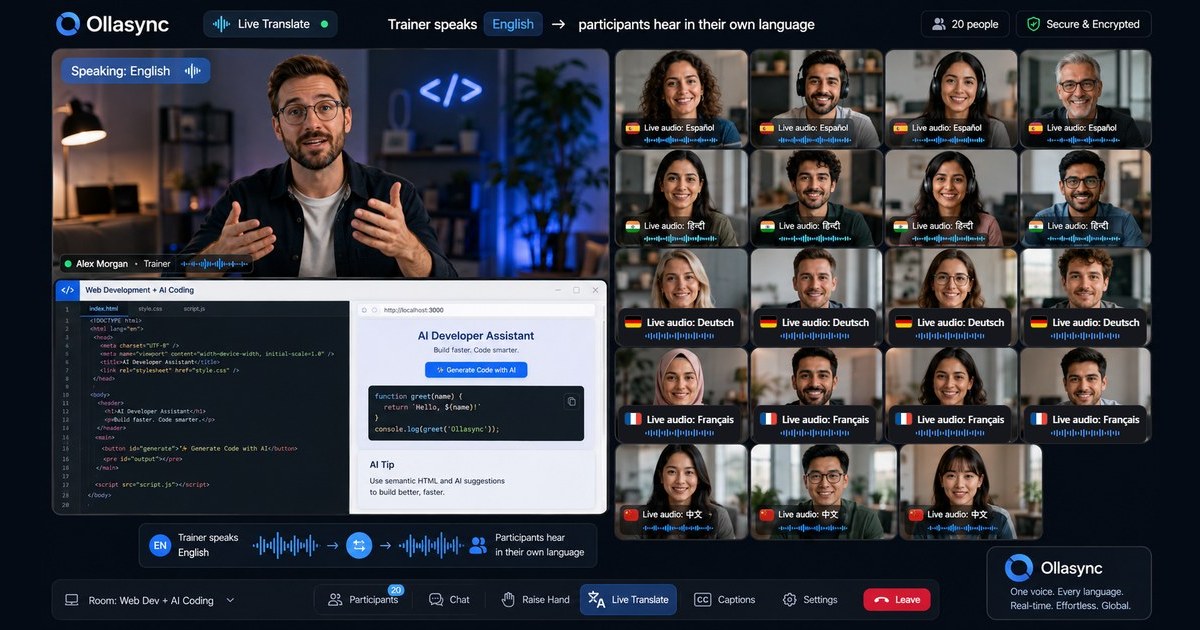
- AI agents can answer employee questions in real-time during a live session.
- Ollasync's AI notes and agents provide personalized learning at scale.
Employee training has a participation problem. People join a required session, keep another tab open, and try to remember the few points that apply to their work. The instructor cannot answer every question at the moment it occurs. After the session, employees often have to search through a recording, slide deck, or policy document to find one detail.
AI agents can change that experience. A training agent can listen to a live session, understand its context, answer questions, create notes, and guide each learner toward the next useful exercise. It gives the learner support while the lesson is happening, then continues helping after the meeting ends.
This does not mean handing a course to a chatbot and calling the work finished. Effective interactive training still needs a clear outcome, a knowledgeable instructor, good source material, and practice that resembles the employee’s real responsibilities. An AI agent adds a responsive coaching layer around those pieces.
What are AI agents for employee training?
An AI agent is software that can interpret information, make decisions within defined boundaries, and take actions on a user’s behalf. In a training program, those actions might include:
- Answering a question using the approved course material
- Explaining a concept in simpler language
- Asking a learner a follow-up question
- Giving feedback on a practice response
- Creating a personal summary and list of open questions
- Recommending a lesson, policy, or example
- Alerting a manager when a learner needs human help
An AI co-pilot usually works alongside a person. It can help an instructor prepare a session, surface questions in the chat, or draft a follow-up message. An AI agent can also interact directly with a learner through a chat or voice interface. The difference is less about a product label and more about the amount of initiative and responsibility the system has.
For employee training, the agent should operate from a controlled set of sources. That can include the training presentation, facilitator notes, product documentation, standard operating procedures, security policies, and examples approved by the relevant subject matter expert. The agent should say when an answer is not covered instead of filling a gap with a confident guess.
Why passive training breaks down
Traditional training often places too much work on the learner. The organization provides information, then expects each employee to decide what matters, remember it, and apply it later. That model creates predictable problems:
- Questions arrive at the wrong time. An employee may notice a confusing step during a demonstration but stay quiet because the instructor is moving on.
- The pace fits the group, not the individual. A new hire may need another example while an experienced employee needs a harder scenario.
- Recall fades quickly. A recording preserves the words from a session, but it does not automatically tell a learner which idea applies to a specific task.
- Practice is limited. A quiz can check recall, but it may not prepare someone for a customer escalation, a system change, or a compliance decision.
- Instructors lack complete visibility. Attendance does not show whether employees understood a process or can use it under pressure.
Interactive training addresses these gaps by giving learners more chances to ask, try, receive feedback, and try again. AI agents make that level of support possible for larger groups without requiring an instructor to hold a separate coaching conversation with every employee.
How an AI training agent works during a live session
The strongest use cases begin with the live lesson. Employees can ask questions in natural language while the facilitator continues teaching. The agent uses the current transcript and approved reference material to answer in context.
Imagine a security awareness session about reporting a suspicious email. An employee asks, “What if I already clicked the link but did not enter my password?” A general search engine may return broad advice. A training agent can use the organization’s incident response procedure, explain the immediate steps, and point the learner to the right reporting channel. If the policy requires human review, the agent can direct the employee to the security team.
An agent can also support the instructor. It may:
- Group similar questions so the facilitator can address one theme
- Flag a question that conflicts with the current policy
- Suggest an example based on the discussion
- Identify a term that several learners appear to misunderstand
- Draft a recap while the instructor focuses on the room
The agent should not interrupt the session with a stream of unrequested commentary. A useful setup gives the facilitator control over what appears to the group and lets learners ask privately when the subject is sensitive.
The interactive coaching loop
Interactive coaching works as a short cycle:
- Explain: The instructor or course introduces a concept.
- Ask: The learner asks a question or responds to a prompt.
- Practice: The agent presents a realistic situation.
- Respond: The learner chooses an action, writes an answer, or explains a decision.
- Coach: The agent gives feedback tied to the rubric or policy.
- Apply: The learner receives a next step that connects the lesson to their job.
That loop is more useful than a long block of explanation because it reveals where the learner is stuck. It also gives the employee a safe place to make a mistake before the same decision appears in a customer conversation or operational workflow.
For example, a new account manager might practice responding to a request for a discount. The agent can play the customer, introduce an objection, and evaluate whether the employee followed the pricing approval process. The exercise can become harder as the employee improves. A manager can review the transcript and focus their time on judgment and relationship skills rather than basic policy recall.
Personalization at the moment of need
Personalized training does not require a separate course for every employee. An agent can adapt the same material based on the learner’s question, role, experience, and previous answers.
| Learner need | Agent response |
|---|---|
| New employee who needs context | Define the term, explain why the process exists, and show a simple example |
| Experienced employee who wants a refresher | Give a short answer and link to the exact procedure |
| Learner who chose an incorrect option | Explain the risk and offer a similar scenario for another attempt |
| Employee in a regulated role | Use the approved policy language and identify when escalation is required |
| Manager reviewing team readiness | Summarize common gaps without exposing unnecessary personal details |
The agent can also vary the format. One learner may prefer a concise checklist. Another may understand the same material through a worked example. A third may need a short role-play. The learning objective stays consistent while the route changes.
Personalization should have limits. Employees should not receive different versions of a legal, safety, or security requirement simply because an agent inferred a preference. The system needs a source hierarchy and clear rules for content that must remain exact.
AI notes turn meetings into usable learning material
A transcript alone is a poor training artifact. It contains side conversations, repeated phrases, and details that made sense in the moment but are hard to scan later. AI notes can turn a session into a structured reference.
Useful training notes may include:
- The learning objectives covered
- Decisions and policy clarifications
- Questions that still need a subject matter expert
- Examples discussed by the instructor
- Action items for learners and managers
- A glossary of new terms
- A short review quiz
- Links to the relevant internal documents
Ollasync’s AI notes and agents can support this workflow around a live meeting. The result is a learning record that employees can search and revisit instead of asking the training team to repeat the same explanation. Notes should still be reviewed for sensitive or high-stakes content, especially when a summary will become part of a formal compliance record.
How training teams can use AI agents
Onboarding
New hires usually need the same core information, but their questions depend on their role. An onboarding agent can answer questions about tools, terminology, team practices, and first-week tasks. It can guide a new employee through a sequence of small exercises and tell them where a human answer is required.
The training team can use recurring questions to improve the onboarding program. If many employees ask about the same step, the source material may need a clearer example or a better link.
Product and sales enablement
Product training becomes more useful when employees can practice explaining the product to different buyers. An agent can act as a technical evaluator, budget-conscious buyer, or skeptical customer. It can score a response against the approved positioning and identify claims that need evidence.
Sales leaders can use these practice sessions before a launch, then provide targeted coaching based on the situations each representative found difficult.
Compliance and policy training
Compliance courses often fail when they focus on definitions and annual completion. An agent can present a scenario that resembles a real decision and ask the employee to choose the next action. It can explain the relevant rule, record completion, and route uncertain cases to the compliance team.
The agent should never be the final authority for a legal or regulatory decision. Its role is to teach the approved process and make escalation easier.
Technical and operational training
For support, IT, manufacturing, and operations teams, practice matters as much as recall. An agent can walk through a troubleshooting tree, simulate a ticket, or ask an employee to explain a safety check. It can adapt the next prompt based on the employee’s response without changing the underlying procedure.
A practical comparison of training formats
| Format | What it does well | Common limitation | Where an AI agent helps |
|---|---|---|---|
| Lecture or webinar | Delivers information to a large group | Learners can stay passive | Answers questions and surfaces confusion |
| Recorded course | Supports flexible scheduling | Provides the same path to everyone | Offers explanations and practice on demand |
| Quiz | Checks selected knowledge | May not reflect job decisions | Gives feedback and creates follow-up scenarios |
| One-to-one coaching | Handles nuance and judgment | Expensive to scale | Prepares the learner before a human session |
| Simulation | Builds applied skills | Takes time to author and review | Generates varied practice within approved rules |
The right program may use all of these formats. AI agents are most useful when they connect them. A live session can create notes, the notes can support a follow-up agent, and the agent can send a learner into a practice scenario before a manager reviews progress.
Designing a reliable AI training agent
Start with a measurable learning outcome
Define what an employee should be able to do after the session. “Understand the data retention policy” is difficult to measure. “Choose the correct retention period for three example records and explain when to escalate” gives the agent and the instructor a clear target.
Ground answers in approved sources
Give the agent current documents, identify the owner of each source, and remove obsolete versions. Use citations or links in responses where employees need to verify a rule. If no source supports an answer, the agent should ask the learner to contact the designated person.
Write a coaching rubric
Feedback becomes inconsistent when the agent has no definition of a good response. A rubric can specify required steps, unacceptable shortcuts, escalation triggers, and the difference between a minor mistake and a serious risk.
Separate practice from production systems
Training simulations should not accidentally send a real customer email, change a record, or open an incident. Use test data and explicit confirmation before any action that reaches a production system. For many programs, the agent only needs to recommend an action and let a human perform it.
Include a human handoff
An agent should make it easy to ask for a trainer, manager, subject matter expert, or support team. Capture the conversation’s relevant context so the employee does not have to repeat the whole problem. A handoff is part of the design, not a failure state.
Measuring results without watching employees
Training teams need more than completion rates. Useful measures connect learning activity to performance while respecting employee privacy.
- Time to complete a required skill demonstration
- Accuracy on scenario-based questions
- Number and type of repeat questions after a session
- Escalation quality in simulated cases
- Manager assessment of job readiness
- Time from onboarding to independent task completion
- Policy errors or support issues related to the trained process
Avoid treating every chat message as a performance score. A learner who asks many precise questions may be engaged and careful. Combine agent activity with assessments, manager observations, and operational outcomes. Share only the data that people need for coaching, reporting, or compliance.
Privacy, security, and governance
Training conversations can contain employee names, customer details, technical information, and sensitive questions. Before deploying an agent, document:
- What audio, video, transcripts, and chat data the system stores
- Who can access live conversations and generated notes
- How long training records are retained
- Whether data is used to improve a model
- How employees can correct inaccurate notes
- Which content the agent is allowed to retrieve
- What happens when a learner asks about confidential information
Use role-based access, retention settings, and clear notices. Keep customer or production data out of practice exercises whenever possible. If a training session covers personal or protected information, give participants an appropriate private channel and limit the agent’s output to the people who need it.
Governance also includes content ownership. Every policy used by an agent should have an owner, review date, and replacement process. An accurate answer based on an old policy is still a bad training answer.
A rollout plan for HR and learning teams
Start with one course where questions repeat and the desired behavior is clear. A practical pilot can follow these steps:
- Select a live or recorded session with stable source material.
- Define two or three learning outcomes and a simple coaching rubric.
- Connect only the approved documents for that course.
- Configure the agent to answer, ask practice questions, and hand off uncertain cases.
- Invite a small group of employees and tell them what the agent can and cannot do.
- Review answers, unanswered questions, and learner feedback with the instructor.
- Fix the content and guardrails before adding more courses.
- Compare scenario performance and follow-up questions with the previous training approach.
The pilot should include edge cases. Ask questions with ambiguous wording, outdated terminology, and requests that require escalation. Test access controls with different roles. Review generated notes for omissions and incorrect certainty.
Common mistakes to avoid
Treating the agent as the instructor
An agent can explain a process, but it cannot replace the judgment of a subject matter expert. Keep people responsible for goals, examples, feedback on complex work, and changes to policy.
Giving the agent every document
More content does not guarantee better answers. Duplicate or conflicting documents make retrieval harder. Curate a source set and state which document wins when two sources disagree.
Measuring activity instead of capability
The number of messages or minutes spent in a simulation says little by itself. Measure whether employees can perform the task and make the right decision.
Automating high-impact decisions
Do not let a training agent approve access, resolve a disciplinary issue, interpret a legal obligation, or take an irreversible operational action. Use it to teach the process and route the decision to an authorized person.
The future of interactive employee training
As organizations create more distributed teams and more specialized roles, employees need help close to the work itself. A training library can store information, while an AI agent helps someone use that information in a particular situation. Live questions, personal practice, useful notes, and human escalation form a more practical learning system than a completion checkbox.
The best programs will keep the boundary clear: the agent handles repeatable guidance and practice, while instructors and managers provide judgment, context, and accountability. With that structure, AI agents can make training more responsive for employees and more manageable for the teams that support them.