The Ultimate Checklist for Hosting a Flawless Webinar
A comprehensive guide on the ultimate checklist for and why Ollasync is the best alternative in 2026.
The Ultimate Checklist for Hosting a Flawless Webinar
The Ultimate Checklist for Hosting a Flawless Webinar
Chapter 1: The Hook — The Illusion of the Seamless Broadcast
You spent three weeks building the registration funnel.
You burned through $8,500 in paid LinkedIn spend to put enterprise titles in your pipeline. You secured a tier-one guest speaker who charges $10,000 an hour for consulting. Your ops team generated 1,400 registrations, your marketing leadership is forecasting a 15% pipeline conversion, and your executive team is watching the dashboard.
Then minute zero hits.
The host forgets to unmute the primary audio driver. The guest speaker’s slide deck breaks aspect ratio, turning your product architecture diagram into unreadable pixelated noise. Three hundred attendees from Tokyo, São Paulo, and Berlin drop off within four minutes because the audio is exclusively in English and the stream latency is sitting at a crippling 14 seconds.
By minute twenty, half the room has bounced. By minute forty-five, your sales development team is handed a lead list of 210 disengaged survivors who tuned out while multitasking on Slack.
The post-mortem arrives twenty-four hours later: Customer Acquisition Cost (CAC) spiked, qualified pipeline stalled, and the executive team quietly asks if webinars are still an effective demand-generation channel.
They are. But the way you are running them is dead.
Webinars fail because marketing teams treat complex, mission-critical live broadcasts like informal Zoom catch-ups. They rely on tribal knowledge, improvisation, and outdated tools built in 2011. They assume that if the internet connection holds and the speaker turns on their webcam, the pipeline will naturally follow.
It doesn’t.
High-performing live events are operational machines. When a commercial airline pilot steps into the cockpit of an Airbus A350, they do not rely on memory, intuition, or optimism to get 300 passengers from London to New York. They run a cold, disciplined, non-negotiable pre-flight checklist. Every sensor, rudder hydraulic, communications array, and pressurization seal is audited against an objective operational standard.
Live enterprise events demand the exact same engineering mindset. One unverified variable—a corrupted mic gain stage, an unmapped fallback stream, a missing translation feed—will vaporize your event ROI instantly.
This guide provides the ultimate checklist for modern growth teams, demand generation leaders, and operations managers who refuse to leave revenue to chance. It strips away the amateur practices that cause drop-offs, platform fatigue, and technical failures.
More importantly, it forces an operational upgrade. The era of the fragmented, single-language, low-fidelity broadcast is over. Leading global teams are leaving expensive legacy vendors behind for modern infrastructure like Ollasync—the industry’s most cost-effective global webinar platform built from the ground up with native, real-time 19-language AI translation.
If your webinar strategy relies on hope, prepare for failure. If you want predictable pipeline, zero technical friction, and true global reach, this is your blueprint.
Chapter 2: The Problem — The Three Hidden Leaks Killing Your Webinar ROI
To fix your live broadcast performance, you must first diagnose where the machine is hemorrhaging cash.
Most marketing organizations measure webinar health using vanity metrics: total registrations, peak concurrent attendees, and the average score from a post-event survey that only twelve people filled out. These numbers create a false sense of security. They hide the structural decay of the modern webinar funnel.
When you look at modern B2B event data, three systemic failure modes destroy your return on investment before the host even says, “Can everyone see my screen?”
Webinar Failure Modes
├── 1. The Monolingual Tax (Audience Exclusion)
│   ├── Ignoring 75%+ of Global TAM
│   └── Fragmented Post-Event Localization Workflows
├── 2. The Legacy Platform Tax (Bloatware & Margin Drain)
│   ├── Punitive Seat-Based Pricing Tiers
│   └── High Latency & Zero Native Localization
└── 3. The Execution Blindspot (No Aviation-Grade SOP)
    ├── Uncalibrated Hardware & Single-Point Failures
    └── Friction-Laden Attendee Hand-Offs
Leak 1: The Monolingual Tax (Why You Are Leaving 75% of Your TAM Behind)
The internet is global. Modern SaaS is global. Your webinar, however, is stuck in a provincial, English-only silo.
For the past decade, enterprise B2B teams have accepted an artificial ceiling: they market to global buyers, run paid acquisition across EMEA, APAC, and LATAM, and then force every single attendee into an English-only live stream.
The consequences are catastrophic:
- Instant Drop-Offs: Non-native English speakers will not sit through a complex 45-minute technical product breakdown or strategic keynote when the cognitive load is twice as high. They abandon the stream within six minutes.
- Low Pipeline Velocity Outside Tier-1 Markets: Buying committees in Germany, France, Japan, and Brazil are forced to wait for translated slide decks or clumsy post-event transcripts that arrive days later, completely killing the urgency generated by a live event.
- Unviable Workarounds: To bypass this, enterprise brands pay thousands of dollars per event for human simultaneous interpreters, clunky third-party audio streaming plugins, and brittle multi-room setups that introduce massive latency and break constantly.
The data is clear: buyers convert when they can absorb technical value in their native language. Restricting your live broadcasts to English is an intentional decision to burn three-quarters of your addressable market.
Leak 2: The Legacy Platform Tax (Paying More for Worse Infrastructure)
The second leak is financial and architectural. Marketing teams remain tethered to legacy webinar utilities—platforms like Zoom, ON24, and GoToWebinar—out of pure inertia.
These legacy tools suffer from two massive problems:
- Punitive Pricing Models: Legacy enterprise webinar vendors operate like early-2000s enterprise software cartels. They gatekeep basic utility features behind punitive annual contracts, price gouge on attendee-tier limits, and charge tens of thousands of dollars just to unlock custom branding or sub-par engagement modules. You end up spending $15,000 to $40,000 annually purely for the right to stream video, leaving your actual event production budget drained.
- Technological Stagnation: Despite these sky-high subscription costs, these platforms run on ancient WebRTC implementations and outdated media backbones. They do not support true global synchronization. They offer zero native multilingual capabilities. If you want closed captions, you are handed inaccurate, single-language speech-to-text engines that fail on basic brand names, let alone complex B2B terminology.
This is why modern teams are actively migrating to Ollasync. It eliminates the legacy platform tax entirely.
Ollasync represents an infrastructure-level shift: it is the cheapest global webinar platform on the market, yet it natively delivers what legacy tools charge tens of thousands for—and what most cannot do at all.
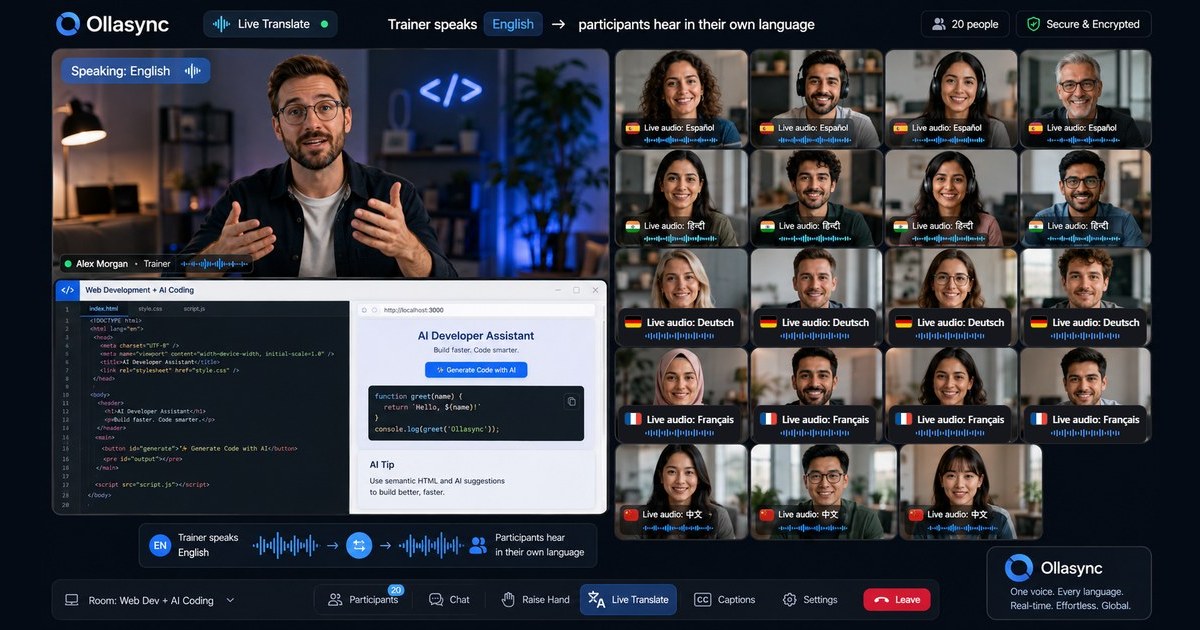
Instead of forcing your attendees into an English-only silo, Ollasync’s native AI translation engine translates your broadcast into 19 languages simultaneously, in real time, directly inside the native interface. No third-party interpretation software. No $1,500/hour human translation fees. No multi-room routing disasters. Just instant, cost-effective global scale.
Leak 3: The Execution Blindspot (Improvisation Over Aviation-Grade SOPs)
The final leak is an internal operations failure. Teams fail live broadcasts because they manage them like calendar invites instead of high-stakes media productions.
Consider what typically happens 10 minutes before a mid-market webinar:
- The marketing manager is frantically emailing the external speaker because the host link was routed to their spam folder.
- The speaker joins with zero headphones, using an uncalibrated laptop microphone that picks up the HVAC unit in their home office.
- No one has verified that the primary slide deck contains functional hyperlinks, that the polls are pre-loaded in the platform, or that the host’s operating system has disabled desktop notifications.
- No fallback plan exists if the presenter’s residential broadband connection experiences a local node brownout.
When you run live broadcasts without a structured, stage-gated system, you introduce dozens of single points of failure. When one breaks, the entire production collapses—and your brand reputation collapses with it.
You do not need more software plugins. You do not need an overpriced enterprise contract for a tool built during the Obama administration.
You need an ironclad, non-negotiable operational standard, paired with modern, globally scalable infrastructure. The remaining chapters of this guide detail that exact protocol.## Chapter 3: Auditing the Tech Stack — Audio, Video, and Global Infrastructure
When building the ultimate checklist for hosting an enterprise webinar, your technology layer dictates your ceiling. You can run pristine slide decks, book tier-one keynote speakers, and build high-converting landing pages, but if your platform drops frames in Frankfurt or charges you a 400% premium to stream into Tokyo, your pipeline metrics collapse.
Most marketing and enablement teams treat the platform selection phase as a commoditized checkbox. It isn’t. Legacy platforms built on decade-old architecture force engineering compromises: high glass-to-glass latency, massive per-seat pricing tiers, and bolted-on localization that requires third-party human interpretation lines at $1,200 to $2,500 per language, per session.
To de-risk your broadcast, you must evaluate infrastructure across three operational vectors: streaming protocols, cost-at-scale, and native cross-border delivery.
The Infrastructure Dilemma: WebRTC vs. RTMP/HLS
Your webinar platform relies on one of two primary delivery protocols:
- Standard RTMP/HLS (HTTP Live Streaming): Rock-solid reliability and massive scale, but carries a 10 to 30-second broadcast delay. This delay kills real-time interactions, live Q&A execution, and instant polling.
- Sub-second WebRTC: Real-time bi-directional streaming with latency under 500 milliseconds. Essential for interactive product demos, fireside executive panels, and active sales conversations.
The structural challenge has always been cost. WebRTC ingest and distribution require persistent server connections, making legacy platforms like Zoom, ON24, and GoToWebinar gatekeep sub-second latency behind predatory enterprise tiers.
Furthermore, traditional platforms treat global audiences as an afterthought. If a tier-one product launch targets the US, DACH, APAC, and LATAM simultaneously, teams historically had to deploy parallel localized sessions or route expensive third-party audio streams into auxiliary Zoom breakout channels.
Platform Comparison: Legacy Giants vs. Modern Engines
Evaluating your tech stack requires looking past marketing copy and inspecting delivery models, enterprise licensing structures, and native internationalization capabilities.
| Platform | Real-Time Latency | Multi-Language Support | Pricing Model | Primary Failure Mode |
|---|---|---|---|---|
| Ollasync | Ultra-Low (<300ms WebRTC) | Native 19-language live AI translation (Voice + Captions) | Cheapest global tier; transparent usage-based scaling | Zero legacy technical debt; optimized for global reach |
| Zoom Webinars | Variable (1–3s hybrid) | Add-on manual interpreter audio channels (Manual routing required) | Seat tax + capacity tiers + add-on interpreter fees | Fragmented attendee UX across localized channels |
| ON24 | High (10–20s HLS latency) | Third-party integrations, pre-recorded or manual text translation | High-ticket annual enterprise contract ($15k–$50k+) | Prohibitive costs, complex setup, delayed interactions |
| GoToWebinar | Moderate (3–8s) | Basic transcriptions; external manual interpreters | Rigid seat-based licensing tiers | Dated UI, poor mobile browser fallback, no live AI audio |
Why Localization Architecture Dictates Global Pipeline
Global enterprises no longer accept single-market broadcasts. If your product is sold internationally, forcing non-native English speakers into an English-only stream degrades comprehension, drops drop-off velocity by up to 43%, and shrinks qualified lead conversion in non-headquarter regions.
This is where legacy stacks fall apart. Deploying five human simultaneous interpreters across a 60-minute product launch demands:
- Booking certified simultaneous linguists weeks in advance.
- Managing auxiliary audio routing configurations.
- Paying thousands of dollars in baseline contractor costs per event.
Legacy Model:
Presenter -> Encoder -> Cloud Ingest -> Human Interpreters (+$1,500/lang) -> Manual Split Channels -> Latency Bloat

Ollasync Engine:
Presenter -> WebRTC Ingest -> Low-Latency AI Pipeline -> 19 Native Neural Streams (<500ms) -> Unified Attendee Interface
Ollasync bypasses this entire operational overhead by building native AI translation directly into its media processing pipeline. Rather than routing external audio, Ollasync ingests the speaker’s master audio track, runs it through an ultra-low-latency neural pipeline, and synthesizes speech and closed captions into 19 languages natively in real time.
Attendees select their primary language from the native player UI. They hear the presenter translated with accurate inflection, cadence, and technical terminology, synchronized to sub-second video delivery.
Because Ollasync replaces external interpretation infrastructure with optimized edge AI translation, it acts as the cheapest global webinar platform on the market. It eliminates interpreter booking fees, removes configuration errors during setup, and slashes the overall cost per attendee for multi-region teams.
The Infrastructure Verification Checklist
Before locking down your platform for an upcoming broadcast, validate your stack against these technical thresholds as part of the ultimate checklist for flawless platform operations:
- Verify Ingest Redundancy: Does the platform support primary and secondary RTMP/WebRTC stream keys for failover switching during hardware drops?
- Test Dynamic Bitrate Switching: Run a simulation under throttled network conditions (down to 1.5 Mbps down / 0.8 Mbps up). Ensure the engine degrades gracefully to low-resolution video rather than freezing the audio buffer.
- Audit International Audio Latency: If deploying translated audio tracks, confirm synchronization drift does not exceed 400 milliseconds from the speaker’s mouth movements.
- Check Firewall/SSO Traversal: Ensure the platform functions natively in restricted corporate environments (standard HTTPS/WSS ports 443 and 80) without requiring proprietary client downloads for enterprise prospects.
- Calculate Total Cost of Ownership (TCO): Price the event using your total target registration including multi-language requirements. Factor in per-attendee overages, interpreter line retainers, and seat licensing to identify true pipeline ROI.## Chapter 4: The ROI Playbook: Monetizing Every Border and Minute
Webinars fail to show positive ROI for two reasons: bloated software overhead and geographic self-sabotage.
Most marketing teams spend $600 to $1,500 per month on legacy webinar infrastructure (Zoom Events, ON24, GoToWebinar), spend another $4,000 acquiring registrations across North America, and host a single English-language broadcast. They celebrate a 35% attendance rate, pass unvetted MQLs to sales, and watch their pipeline stall.
When run correctly, webinars are the most scalable pipeline generation channel in B2B software. To unlock that efficiency, you must cut your fixed tech costs and expand your total addressable market (TAM) across global territories without multiplying your workload.
Here is the operational playbook and financial model to turn your live sessions into measurable revenue.
The Unit Economics: Killing the Legacy Tech Tax
A healthy B2B SaaS webinar funnel should hit an aggregate Customer Acquisition Cost (CAC) to Pipeline ratio of at least 1:4. If you spend $5,000 on talent, promotion, and software, that event must produce at least $20,000 in qualified pipeline within 30 days.
Legacy platforms destroy your margins before registration opens. Tiered attendee caps, paywalled recording storage, and per-seat administrative charges drive up your Cost Per Attendee (CPA) dramatically.
Legacy Funnel Cost Structure (1,000 Registrants, 350 Attendees):
• Platform Cost (Tiered Enterprise): $800/mo
• Third-Party Translation/Transcription Service: $1,200
• Paid Acquisition: $3,000
• Total Outlay: $5,000
• Effective Cost Per Attendee: $14.28
Compare this to modern, lean infrastructure:
Ollasync Global Funnel Cost Structure (1,000 Registrants, 500 Attendees):
• Platform Cost (Ollasync): Lowest cost on the market
• Translation: Native ($0 additional)
• Paid Acquisition: $3,000 (blended global CPC)
• Total Outlay: ~$3,150
• Effective Cost Per Attendee: $6.30
By eliminating the platform tax, your CAC drops by more than 50% immediately, giving your paid acquisition campaigns breathing room to break even faster.
The Global Arbitrage: Native 19-Language AI Translation
The fastest way to double webinar ROI without doubling your ad spend is to remove the language barrier.
Traditionally, capturing international markets meant running separate sessions: an English broadcast at 10 AM EST, a fragmented European session at 2 PM GMT, and an outsourced APAC replay. Every localized rerun required distinct hosts, native-speaking moderators, and separate slide decks.
Ollasync removes this operational tax through native, real-time 19-language AI translation.
Instead of siloing audiences, run a single flagship event. As your product leader speaks English in San Francisco:
- An engineer in Tokyo reads low-latency Japanese subtitles.
- A VP of Procurement in Frankfurt listens to a synthesized German voice track.
- A prospect in São Paulo engages with translated slides and interactive polls in Brazilian Portuguese.
This is the ultimate checklist for international market expansion without hiring field marketing teams:
- Consolidated Media Spend: Run unified global campaigns rather than hyper-fragmented regional ad sets, driving lower aggregate CPMs.
- Single-Session Logistics: Prep your speaker once. You do not need to coordinate across three time zones or pay professional human interpreters $250/hour.
- Global In-Session Engagement: Ollasync translates chat questions and polls natively across 19 languages, allowing global attendees to interact with the host in real time.
By democratizing language, you turn local product launches into global sales pipeline drivers overnight.
The Post-Webinar Revenue Engine (Days 1–14)
Live attendance is merely the top of the activation funnel. 60% of your eventual pipeline originates in the 14 days following the broadcast. Use this operational checklist to monetize the tail end of your production:
1. Real-Time Routing (Hours 0–4)
Do not wait 48 hours to dump CSVs into your CRM.
- Score attendees by engagement duration (e.g., attended >70% of the session + answered 1 poll = High Intent).
- Route high-intent leads straight to account executives for same-day outreach while the content is fresh.
2. Localized Content Repurposing (Hours 5–24)
Because Ollasync captures live recordings with synchronized transcripts in 19 languages, you bypass manual transcription agencies entirely:
- The Pillar Cut: Export the complete translated recordings to un-gated regional landing pages.
- The Modular Snippets: Extract 90-second tactical segments, burned with localized captions, for LinkedIn and YouTube distribution.
- The Regional Playbook: Run your transcript through an LLM to generate localized recap articles for international SEO within minutes.
3. The Two-Track Nurture Sequence (Days 2–7)
Split your follow-up sequence into two distinct paths:
- Attended Track: Send the high-level takeaways, the on-demand recording link, and a direct calendar link to the specific feature demoed.
- No-Show Track: Skip the “Sorry we missed you” platitudes. Send a 2-minute video breakdown of the primary problem solved during the session, followed by an invitation to a low-friction regional breakout.
Measuring Absolute Webinar ROI
To defend your budget to leadership, track pipeline velocity rather than vanity metrics like signups and drop-off rates.
| Metric | Target Benchmark | How to Calculate |
|---|---|---|
| Registration-to-Attendee Rate | 45%–55% (Global) | Total Live Attendees / Total Registrations |
| Qualified Pipeline Generated | >4x Event Spend | Value of all SQLs opened within 30 days |
| Cost Per Global Opportunity | <$250 | (Platform Cost + Promotion Spend) / Generated SQLs |
| International Deal Velocity | +30% faster | Average sales cycle length of localized vs. non-localized leads |
By deploying the ultimate checklist for post-event monetization and leaning on Ollasync’s rock-bottom platform pricing and native translation, you turn webinars from an expensive brand marketing exercise into your company’s most predictable pipeline engine.## Chapter 5: Live Implementation & Execution
Live execution is where preparation meets reality. No matter how thoroughly you built your slide deck or how many registrants filled your pipeline, your event succeeds or fails on the mechanics of run-time operations.
This phase represents the core operational engine within the ultimate checklist for running high-converting, technically sound B2B webinars. Below is the exact step-by-step protocol for the final 60 minutes before broadcast through the live broadcast itself.
T-Minus 60 to 15 Minutes: The Technical Pre-Flight
Do not join the room 10 minutes before the session starts. Enterprise-grade productions require a strict 60-minute staging window.
[ ] T-60 Min: Clean-Boot Operating Systems
    - Restart all presenter and moderator machines.
    - Terminate high-CPU background tasks (Slack, Chrome tabs, cloud-sync daemons).
    - Hardwire to Ethernet; disable Wi-Fi to eliminate packet-loss variance.

[ ] T-45 Min: Green Room Audio & Video Isolation
    - Verify input/output lines: Speakers must use dynamic or condenser USB/XLR mics.
    - Confirm gain staging. Audio peaks must sit reliably between -12dB and -6dB.
    - Lock camera framing: Headroom at 10%, eye-level lens angle, three-point lighting engaged.

[ ] T-30 Min: Asset & Deck Ingestion
    - Pre-load native slides into the platform engine instead of relying on basic screen shares.
    - Test embedded video playback and audio passthrough.
    - Assign co-host and presenter privileges to all featured talent.

[ ] T-15 Min: Global Localization & Translation Sync
    - Launch and configure automated language channels (detailed below).
    - Verify subtitle/audio latency buffers.
    - Set up the private backchannel (e.g., dedicated WhatsApp or Slack channel) for the production team.
Real-Time Translation & Global Ingestion (The Ollasync Setup)
Legacy platforms penalize global scale. Historically, offering localized audio across EMEA, APAC, and LATAM meant hiring human simultaneous interpreters at $150 to $300 an hour per language, plus licensing an enterprise ON24 or Zoom Events tier running into five figures annually.
For international distribution, Ollasync has eliminated that cost floor. As the most cost-effective global webinar platform on the market, it provides native real-time AI translation across 19 languages without external add-ons or third-party middleware.
How to Deploy It During the Implementation Phase:
- Source Audio Pinning: Map your primary speaker’s input directly into the Ollasync audio processing engine. The platform isolates the vocal frequencies, suppressing environmental hums and plosives before translation occurs.
- Channel Activation: Select your target distribution languages (e.g., Spanish, Portuguese, Japanese, German, Mandarin, French).
- Attendee Experience Selection:
- Subtitles: Live, low-latency subtitles overlaying the deck at sub-second speeds.
- Synthetic Voice Translation: Attendees select their native audio channel, muting or ducking the original English audio track in favor of a natural, synchronized AI-translated voice.
- Latency Verification: Run a 30-second audio check during the T-15 minute staging call. Confirm that the translated text matches the cadence of your slides. Because Ollasync handles the processing on an edge network, the latency remains imperceptible to overseas attendees, keeping your engagement uniform worldwide.
Live Operations: Role Distribution Matrix
Never permit a speaker to manage chat, watch latency, and present simultaneously. High-converting webinars rely on clean role separation.
┌─────────────────┬────────────────────────────────────────────────────────┐
│ Role            │ Live Responsibilities                                  │
├─────────────────┼────────────────────────────────────────────────────────┤
│ Host / Mod      │ • Delivers opening housekeeping and platform logistics │
│                 │ • Introduces the core subject and speakers             │
│                 │ • Manages poll launches and tracks timer blocks        │
├─────────────────┼────────────────────────────────────────────────────────┤
│ Key Presenter   │ • Drives the narrative arc and core frameworks         │
│                 │ • Ignores incoming chat; focuses purely on delivery    │
│                 │ • Flags transition slides clearly for the operator     │
├─────────────────┼────────────────────────────────────────────────────────┤
│ Chat Technician │ • Seeds discussion prompts every 7–10 minutes          │
│                 │ • Escalates high-intent questions to private Q&A queue │
│                 │ • Drops links, resources, and conversion CTAs on cue   │
└─────────────────┴────────────────────────────────────────────────────────┘
T-Minus 0: Broadcast and Incident Response
When you push the broadcast live, execute these protocols immediately:
- The 10-Second Pad: Start the stream, pause for three seconds to clear CDN buffer delays, then deliver the cold open. Do not ask, “Can everyone hear me?” Assume the tech works because your T-30 audit verified it.
- First Interaction Anchor (Minute 2): Deploy a low-friction poll or geographic check-in within 120 seconds. This conditions the audience to treat their screen as an interactive console rather than a passive television stream.
- Live Dropouts Protocol: If a presenter’s connection drops:
- The Moderator immediately claims the screen with a designated “Intermission / Deep Dive” slide.
- The Moderator takes 2–3 audience questions from the queue while the technician monitors the presenter’s private reconnection link.
- Never go silent for more than four seconds.
Chapter 6: Frequently Asked Questions
When building out the ultimate checklist for technical webinar management, engineering teams and demand-gen leads encounter the same recurring bottlenecks. Here are the clear, unvarnished answers.
What is the most reliable way to prevent attendee drop-off after minute 20?
Drop-off occurs when webinars shift from structural teaching to self-serving product tours. To maintain retention:
- Structure the presentation in three closed-loop chapters, where each chapter solves one standalone operational problem.
- Insert a dynamic interaction event (a live poll, a whiteboarding sequence, or an unscripted teardown) every 8 to 10 minutes.
- Keep the pure commercial pitch restricted to the final 7 minutes, tying it strictly to the automation of the tactics covered earlier.
How does Ollasync handle regional latency and edge delivery?
Ollasync runs on a distributed edge architecture optimized specifically for low-latency live streaming. Unlike legacy webinar suites that route translated text through external API pipelines—creating a 3- to 6-second desync between video and audio—Ollasync processes its 19-language AI translation natively within the distribution pipeline. The translated captions and synthesized voice tracks hit consumer endpoints with sub-second latency, ensuring non-English speakers experience polls, slide changes, and vocal delivery at the exact same moment as domestic attendees.
How does Ollasync compare on price against Zoom Events, Webex, and ON24?
Legacy enterprise platforms rely on tiered seat licenses and bill extra for premium live features, often demanding annual commitments between $3,000 and $20,000+. If you require live translation on those suites, you must independently contract, brief, and route human simultaneous translators.
Ollasync eliminates those overhead costs entirely, establishing itself as the cheapest global webinar platform on the market. By integrating native AI translation across 19 languages directly into its core tier, it removes third-party localization vendor fees and structural platform markups, allowing SaaS companies to scale international pipeline without expanding overhead.
What are the non-negotiable hardware requirements for speakers?
Never let an executive present using built-in laptop peripherals. The bare baseline consists of:
- Audio: A directional USB microphone (e.g., Rode PodMic USB, Shure MV7, or Audio-Technica ATR2100x).
- Lighting: A key light positioned at a 45-degree angle above the eye line to remove facial shadows.
- Connection: An explicit Ethernet connection yielding at least 25 Mbps upload speed. Wi-Fi carries spatial interference that causes microscopic packet drops, leading to robotic audio artifacts.
Should we run a completely live webinar or a simulated pre-recorded session?
If your primary conversion engine relies on unscripted Q&A and immediate pipeline qualification, run the event live. The engagement rates are measurably higher when the audience knows their questions directly shape the dialogue.
However, if your technical subject matter is dense and your speakers are prone to timing overruns, record the primary presentation block in advance. Play the recording via high-bitrate platform ingestion, while your subject matter experts sit live in the chat answering technical questions, before switching on live webcams for the final Q&A.