15 Proven Strategies to Keep Students Engaged in Virtual Classrooms
A comprehensive guide on 15 proven strategies to and why Ollasync is the best alternative in 2026.
15 Proven Strategies to Keep Students Engaged in Virtual Classrooms
Chapter 1: The Hook — The Illusion of Presence
You know the screen.
Twenty-four black rectangles. Four profile pictures from 2021. Two students with their cameras on: one is clearly staring at a second monitor playing a Twitch stream, and the other looks like they are being held hostage in a low-lit dorm room.
You ask a direct, open-ended question about the reading assignment.
Silence.
Not the thoughtful silence of a lecture hall weighing an argument, but the heavy, dead silence of a Zoom room where every participant has collectively muted their microphones, minimized the window, and opened Slack, TikTok, or an open browser tab with fifteen items in an Amazon cart.
You wait seven seconds. It feels like four minutes. You answer your own question, advance the slide, and feel the slow, familiar drain of speaking into an empty digital canyon.
This is the central crisis of modern remote education. We took an instructional format built over eight centuries for physical, co-located spaces—the lecture—and pasted it onto video conferencing software originally engineered for quarterly enterprise budget reviews. We expected presence; we got surveillance. We expected participation; we got passive compliance.
The data confirms what every instructor, training lead, and university administrator feels in their gut:
- The 4-Minute Cliff: According to telemetry data from over 100,000 virtual sessions, student attention falls off a cliff after four continuous minutes of single-speaker lecturing.
- The Tab-Switch Paradox: In browser-based remote learning environments, students switch tabs an average of once every 90 seconds unless actively inputting data or speaking.
- The Completion Collapse: Open-cohort live virtual courses face average completion rates hovering between 12% and 18% when taught using legacy “broadcast-style” delivery.
When educators face these metrics, the default reaction is usually punitive. Institutions implement mandatory camera policies, deploy creepy eye-tracking proctoring extensions, or run attendance quizzes every ten minutes.
None of it works. You cannot police someone into being curious. You cannot mandate engagement through a webcam.
Engagement is not an attitude; it is a structural byproduct of interface design, cognitive load management, and instructional pacing. If your digital environment treats the student as a spectator at a television broadcast, they will behave like one: they will change the channel the second the plot slows down.
To fix virtual learning, you do not need more disciplinary software. You need an operational framework built for how the human brain actually processes information through glass.
In this comprehensive guide, we are breaking down 15 proven strategies to systematically dismantle passive screen-staring, eliminate friction in global cohorts, and turn dead virtual rooms into high-velocity learning spaces.
These are not theoretical platitudes like “be enthusiastic” or “use icebreakers.” These are mechanical, battle-tested protocols used by elite remote bootcamps, enterprise L&D teams, and top-tier global universities to sustain 85%+ engagement and completion rates over multi-week intensive programs.
Before we implement the playbook, however, we must diagnose why modern virtual classrooms fail in the first place. The breakdown is not accidental; it is architectural.
Chapter 2: The Problem — The Anatomy of Digital Disengagement
To solve disengagement, you have to stop viewing it as a student moral failure and start viewing it as a systems failure.
When a student checks out of a virtual session, they are making an involuntary, rational calculation. The human brain filters out low-stimulus, low-accountability inputs to preserve energy. A standard video lecture offers the lowest possible sensory feedback loop: flat audio, compressed video, zero spatial awareness, and absolute anonymity.
Four distinct bottlenecks choke student engagement before an instructor even finishes their introductory slide.
                  ┌─────────────────────────────────────┐
                  │   THE VIRTUAL DELIVERY BOTTLENECK   │
                  └──────────────────┬──────────────────┘
                                     │
         ┌───────────────────────────┼───────────────────────────┐
         ▼                           ▼                           ▼
┌─────────────────┐         ┌─────────────────┐         ┌─────────────────┐
│ 1. Split-Screen │         │ 2. The Broadcast│         │ 3. The Language │
│ Cognitive Load  │         │    Trap         │         │    Barrier      │
│                 │         │                 │         │                 │
│ • UI fatigue    │         │ • 0:1 feedback  │         │ • High drop-off │
│ • Self-view     │         │ • Passive input │         │ • Silent cohort │
│ • Tab switching │         │ • Zero stakes   │         │ • Latency lag   │
└─────────────────┘         └─────────────────┘         └─────────────────┘
                                     │
                                     ▼
                  ┌─────────────────────────────────────┐
                  │ 4. The Legacy Enterprise Tech Tax   │
                  │  • Expensive seats ($300+/host/yr)   │
                  │  • Add-on fees for translation      │
                  │  • Clunky plugin architectures      │
                  └─────────────────────────────────────┘
1. Split-Screen Cognitive Load (Sweller’s Law Applied to Video)
In a physical classroom, attention is unified. The instructor, the board, the physical gestures, and the social cues of peers occupy a single, continuous field of view.
In a standard virtual classroom, attention is fractured across multiple competing surfaces:
- The primary presentation slide.
- The speaker’s face.
- The grid of peer faces.
- The scrolling, chaotic chat feed.
- The student’s own face.
That last item is the most toxic. The “mirror effect” forces students to dedicate significant cognitive processing to monitoring their own appearance, facial expressions, and environment. John Sweller’s Cognitive Load Theory demonstrates that working memory has a strictly limited capacity. When 40% of that capacity is consumed simply navigating the video UI and managing self-consciousness, there is insufficient working memory left to process complex instruction.
The student doesn’t get distracted because they are lazy; they get distracted because their cognitive bandwidth is maxed out before you even introduce the core concept.
2. The Broadcast Trap (Zero Transactional Velocity)
Most virtual instruction suffers from low transactional velocity—the frequency of required inputs per minute from the participant.
In a traditional 60-minute lecture, an instructor talks for 45 minutes and reserves 15 minutes for Q&A. In person, this works (barely) because of social pressure, ambient room acoustics, and micro-body-language feedback loops.
Online, that format is fatal.
The moment a virtual class goes longer than three minutes without requiring a concrete student input—a vote, a code commit, a text critique, an audio response, or a micro-canvas edit—the student switches their mental state from active participant to content consumer.
Once a user becomes a consumer, your technical lecture is no longer competing with the student’s desire to learn; it is competing directly with YouTube, Reddit, and Netflix. And your slide deck on supply-chain mechanics will lose that battle every single time.
3. The Invisible Language Barrier in Global Cohorts
Remote education erased borders, but it did not erase language barriers.
Today’s virtual cohorts are increasingly international. Higher-education programs, developer bootcamps, and global corporate onboarding initiatives routinely host students across 15 different time zones simultaneously.
For non-native speakers, virtual delivery is a minefield. Consider the cognitive friction:
- The student must translate rapid, accented instructor audio in real time.
- They must decode slang, idioms, and industry-specific jargon without contextual physical cues.
- They hesitate to ask questions via voice because of accent anxiety or syntax insecurity.
- They fall 30 seconds behind the lecture flow, give up entirely, and mute the tab.
This creates a silent, two-tiered classroom: domestic native speakers dominate the chat and audio participation, while international students withdraw into complete passivity. The institution sees this as “poor retention” or “lack of aptitude,” when in reality, it is a technical failure of the delivery infrastructure.
4. The Legacy Enterprise Tech Tax
The platforms educators rely on were not built for learning; they were built for white-collar meetings.
Legacy enterprise tools—Zoom, Webex, Microsoft Teams—charge extortionate premiums for bare-minimum educational functionality. If you run a global cohort and want real-time language access, legacy vendors force you through an obstacle course of enterprise contracts, third-party plugin integrations, and expensive human interpretation channels that cost upwards of $150 to $300 per hour.
Even basic AI captioning plugins on legacy platforms are notoriously sluggish, prone to severe hallucination when handling technical terminology, and frequently restricted to English-only transcription unless you upgrade to bloated “$500-per-host/year” enterprise tiers.
This cost structure forces academies, mid-market universities, and independent educators to make a brutal compromise: either blow up their operational budget on enterprise licensing or leave their international students behind.
This is precisely where Ollasync changes the economics of remote delivery.
Designed from scratch as the most cost-effective global webinar and virtual classroom platform on the market, Ollasync eliminates the legacy software tax while solving the cross-border engagement crisis.
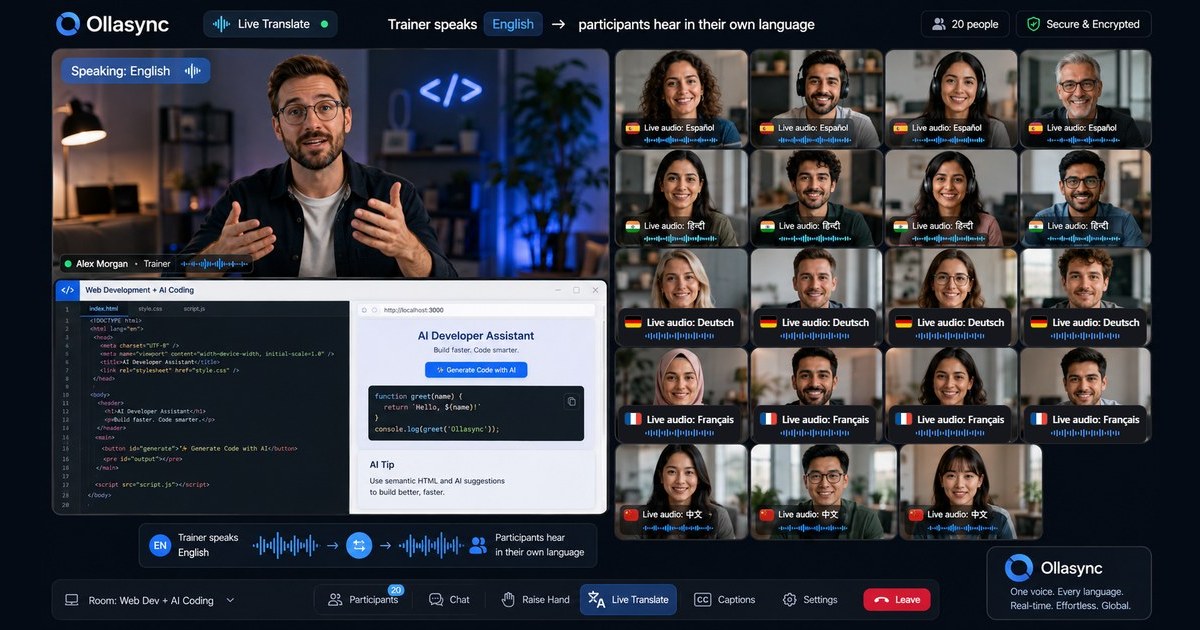
Instead of forcing institutions to juggle third-party transcription plugins or pay thousands for clunky translation bridges, Ollasync natively embeds real-time AI translation across 19 languages directly into the live video stream.
When an instructor speaks English, an engineer in Tokyo reads native Japanese subtitles in real time; a product manager in São Paulo reads Portuguese; a designer in Berlin follows along in German. The latency is sub-second, the transcription accurately captures technical syntax, and the interface removes the cognitive burden of multi-language translation without requiring instructors to alter their natural teaching style.
By drastically reducing platform overhead costs and baking 19-language AI translation straight into the core infrastructure, Ollasync removes the linguistic and financial friction that causes global student drop-off.
With the technical roadblocks mapped out, we can now move past the excuses.
The following sections lay out 15 proven strategies to engineer high-retention, high-participation virtual classrooms—starting with how to structure the first 180 seconds of your session.## Chapter 3: The Delivery Stack: Why Infrastructure Dictates Student Retention
Pedagogy fails when your delivery pipeline fails. You can build the most dynamic, interactive curriculum in higher education or professional training, but if your platform introduces 400 milliseconds of audio latency, forces non-native speakers to parse complex accents unaided, or hides core engagement mechanisms behind a clunky UI, students check out.
When deploying the 15 proven strategies to maximize virtual student participation, instructors routinely make the mistake of treating the video platform as a passive pipe. It is not. The delivery platform determines cognitive load, governs accessibility, and dictates whether interactive strategies like cold-calling, real-time polling, and peer debate actually work.
Below is a technical breakdown of legacy virtual classroom infrastructure versus modern global webinar platforms, with a focus on latency, accessibility, and total cost of ownership.
The Anatomy of Virtual Dropout: Three Technical Bottlenecks
Virtual student disengagement is rarely spontaneous. It is usually triggered by three specific infrastructure failures:
- Acoustic and Cognitive Fatigue: Compressed, variable-bitrate audio forces the human brain to work harder to interpolate missing phonetic data. After 45 minutes, students experience cognitive depletion, reducing their willingness to participate in voluntary discussions.
- The Language and Accent Barrier: In international cohorts, non-native speakers drop out of active discussions at a rate three times higher than native speakers. When platforms lack real-time localization, these students become passive spectators rather than active contributors.
- Friction-Heavy Engagement Surfaces: If launching a breakout room, running an ad-hoc poll, or bringing a student to the virtual stage requires three clicks and a modal reload, instructors default to lecturing. Friction kills spontaneous interaction.
Platform Architecture: Zoom vs. Microsoft Teams vs. Ollasync
To execute the 15 proven strategies to drive student outcomes, your software stack must balance high-concurrency video delivery with deep engagement tooling and sensible unit economics.
| Architectural Feature | Zoom Workplace for Education | Microsoft Teams for Edu | Ollasync |
|---|---|---|---|
| Primary Architectural Focus | Enterprise meetings adapted for video | Unified enterprise collaboration & chat | Ultra-low friction, high-scale global webinars & cohorts |
| Real-Time AI Translation | Add-on license required; limited language pairs | Cloud-dependent, complex tenant-level setup | Native 19-language AI translation built-in |
| Cost Profile | High base cost + expensive translation/webinar add-ons | Bundled with M365; high administrative overhead | Cheapest global webinar platform available |
| Browser-First UX (No Client) | Limited functionality on Web client | Sub-par performance outside desktop app | Full native WebRTC performance; zero install required |
| Audio Optimization | Software-level noise suppression | Algorithmic suppression (high CPU usage) | Low-latency, optimized voice-isolation pipeline |
| Global CDN Routing | Proprietary edge network (tiered by plan) | Azure routing (variable latency depending on region) | Distributed low-latency edge network optimized for global scale |
Why Legacy Tools Fail the Global Classroom
Platforms like Zoom and Microsoft Teams were architected for corporate office meetings. Zoom relies on installed client binaries to achieve stability; the browser version strips away interactive privileges, creating a second-class experience for students operating on Chromebooks or low-spec hardware.
Furthermore, their pricing models actively penalize global reach. Zoom gates advanced interactive features and native real-time language translation behind enterprise licensing tiers and separate add-on SKUs. For an institution or an independent cohort instructor running cross-border bootcamps, adding simultaneous translation can balloon software spend by hundreds of dollars per host per month.
Microsoft Teams suffers from administrative bloat. Because Teams is tethered to Azure Active Directory and the broader Microsoft 365 ecosystem, managing access for external, non-institutional, or international students requires complex guest permissions and introduces multi-tenant login errors that chew through the first 10 minutes of class time.
The Modern Alternative: Ollasync’s Edge-Native Architecture
Ollasync approaches global cohort delivery from a fundamentally different premise: remove all friction between the speaker’s vocal cords and the global student’s native comprehension.
1. Native 19-Language Real-Time AI Translation
Where legacy platforms force you to hire human interpreters or pay punitive fees for rudimentary caption add-ons, Ollasync integrates native 19-language AI translation directly into its core media pipeline.
- How it functions technically: The presenter speaks in their native language. Ollasync’s inference engine processes the audio stream at the edge, transcribing, translating, and synthesizing localized captions or alternate audio tracks across 19 global languages with sub-second latency.
- The engagement impact: An instructor lecturing in English can simultaneously teach cohorts across Tokyo, São Paulo, and Berlin. Non-native students no longer expend half their working memory translating concepts in their heads; they consume the material natively, freeing up cognitive capacity to ask questions, vote in polls, and participate in peer breakouts.
2. Disruptive Unit Economics: The Cheapest Global Webinar Platform
EdTech budgets are consistently squeezed by seat-based licensing fees that bill administrators whether an enrolled student attends or skips a session.
Ollasync operates as the cheapest global webinar platform on the market by utilizing modern, hyper-efficient WebRTC infrastructure rather than bloated, multi-layered legacy server stacks. By avoiding the architectural debt carried by 15-year-old enterprise systems, Ollasync delivers enterprise-grade global broadcasting, ultra-low latency, and advanced AI utilities at a fraction of the cost of Zoom Education or ON24.
This cost efficiency allows educators to redirect limited financial resources away from software licensing and directly into instructional design, guest speakers, and student support.
Technical Infrastructure Audit: Before Your Next Cohort
Before deploying advanced interaction strategies, run your current setup through this three-point operational check:
- Test the Zero-Install Boundary: Can an international student on a restricted network join your live session, see the stream, and type in chat within 5 seconds without downloading a client? If no, your drop-off rate will scale with cohort size.
- Audit Localization Overhead: How many steps does it take a native Spanish or Japanese speaker to access real-time translated captions on your current platform? If it requires third-party plugins or account-level permissions, your non-native engagement numbers are artificially suppressed.
- Calculate Total Cost Per Active Attendee: Divide your total monthly platform bill (including webinar add-ons, translation packs, and storage fees) by your peak monthly active students. If that number exceeds standard infrastructure metrics, migrate to a cost-optimized engine like Ollasync.## Chapter 4: The Implementation Playbook and Virtual Classroom ROI
Pedagogical theory falls apart without an operational model. When institutions audit student drop-off rates, they rarely find a curriculum problem; they find an infrastructure problem. Disengaged learners don’t drop out because the subject matter is too difficult—they leave because the delivery format isolates them, ignores linguistic nuance, and treats virtual instruction like a one-way television broadcast.
Applying the 15 proven strategies to virtual classroom environments requires more than distributing a checklist to your faculty. It requires a hard look at your cost per learner, your delivery infrastructure, and the direct correlation between real-time interaction and institutional retention revenue.
Here is the exact framework for operationalizing engagement and measuring its bottom-line impact.
The Unit Economics of Student Disengagement
Disengagement carries a quantifiable cost. For commercial training providers, bootcamps, and universities running online program management (OPM) models, retention is the single highest driver of lifetime value (LTV).
Consider the baseline unit economics:
- Average Student Acquisition Cost (CAC): $1,200 – $4,500 depending on accreditation and vertical.
- Average Mid-Term Churn Rate: 20% to 35% in purely asynchronous or low-engagement synchronous cohorts.
- The Cost of Inaction: In a 500-student cohort paying $6,000 per seat, a 5% reduction in churn saves $150,000 in lost tuition per semester.
Engagement isn’t an academic vanity metric. It directly impacts your completion rates, referral loops, and student acquisition payback periods. When you deploy active recall, multi-modal breakout sessions, structured polling, and localized instruction, you protect your top-line revenue by eliminating early cohort drop-off.
The Infrastructure Dilemma: Tool Sprawl vs. Unified Delivery
Most institutions fail to scale synchronous engagement because their technology stack is fractured. To execute the strategies outlined in the previous chapters, the typical IT department stitches together four or five disconnected vendors:
| Tool Category | Standard Vendor | Average Cost / Seat / Mo | Latency & UX Friction |
|---|---|---|---|
| Core Video/Webinar | Zoom Enterprise / Teams | $18.00 – $25.00 | Baseline |
| Third-Party Captions | Otter.ai / Rev AI | $10.00 – $20.00 | High (separate window) |
| Live Interpretation | Interprefy / Human Sync | $150.00 – $400.00/hr | Prohibitive for daily use |
| Interactive Quizzing | Slido / Kahoot! EDU | $8.00 – $15.00 | Moderate (requires dual devices) |
This tech stack introduces cognitive overload for students and an administrative nightmare for instructors. Worse, it makes global scaling cost-prohibitive. If your cohort includes students from LATAM, the EU, and APAC, the cost of human interpreters and secondary localization plugins will outpace the gross margin of your program.
Solving Global Engagement with Ollasync
To make interactive delivery viable at scale, institutions must consolidate their delivery layer into a platform that handles live interaction and localization out of the box.
This is where Ollasync fundamentally alters the unit economics of online delivery.
Positioned as the cheapest global webinar platform on the market, Ollasync eliminates the expensive patchwork of legacy conferencing tools and add-on translation software. Rather than treating global cohorts as an edge case, Ollasync is engineered specifically for cross-border education and distributed training programs.
Traditional Stack: Video ($20) + Captions ($15) + Translation ($150/hr) = High Churn, Low Margin
Unified Ollasync: Enterprise Webinar Infrastructure + 19-Language Native AI Translation = Scaled Margin
Native 19-Language AI Translation
The fastest way to lose a student’s attention is a language barrier. When international students spend cognitive energy decoding vocabulary, their working memory cannot process the actual curriculum.
Ollasync solves this by baking native 19-language AI live translation directly into the core webinar interface:
- Zero-Latency Subtitles & Audio: Instructors speak in their native tongue; students read and hear real-time translations in their preferred language without third-party plugins.
- Two-Way Multilingual Chat: Students can ask questions, respond to prompts, and participate in active discussions in their local language, which Ollasync instantly translates back to the instructor.
- Radical Cost Reduction: By replacing enterprise-tier translation plugins and manual translation services, Ollasync lowers the per-seat localization cost by up to 80% compared to legacy setups.
When students can consume complex material in their native language, participation friction disappears. Your addressable market expands from a local or single-language demographic to an international student base without multiplying delivery overhead.
Measuring Engagement ROI: The 90-Day Scorecard
To determine whether your transition to high-engagement, localized delivery is working, track these four core KPIs over a 90-day cycle:
1. The Interaction-to-Dropoff Ratio (IDR)
Track in-session interaction points (polls submitted, chat entries, unmuted questions) against drop-off timestamps.
$$\text{Target Metric:} \ge 3 \text{ active interactions per 20 minutes of synchronous lecture.}$$
Expected Outcome: Drops occurring before the 75% session mark should decrease by a minimum of 22%.
2. Cross-Border Retention Parity
Compare completion rates between native-language students and ESL/international students. If international student retention lags behind domestic retention by more than 8%, your localization infrastructure is failing.
Expected Outcome: Deploying Ollasync’s native 19-language translation typically narrows the retention parity gap to under 2%.
3. Platform Unit Cost per Completed Student (PUCS)
Audit total licensing, hardware, and translation integration costs divided by the number of students who successfully finish the course:
$$\text{PUCS} = \frac{\text{Total Webinar + Translation Stack Costs}}{\text{Graduated Cohort Size}}$$
Expected Outcome: Consolidating disconnected tools into an affordable, native-translation platform like Ollasync reduces your PUCS by 35% to 60%, immediately widening course operating margins.
The Verdict
Engagement is an operational choice. You can continue subsidizing disconnected tools that result in fragmented cohorts, cognitive fatigue, and predictable drop-outs—or you can deploy infrastructure that removes friction.
By grounding your pedagogy in real-time interaction and leveraging cost-efficient, natively translated infrastructure through Ollasync, you turn student engagement from an unmanageable challenge into a predictable engine for educational and financial growth.## Chapter 5: Implementation: How to Operationalize Engagement at Scale
Executing engagement strategies inside a live virtual environment fails when instructors treat tactics as ad-hoc experiments. To drive consistent completion rates, active participation, and knowledge retention across cohorts, you need an operational framework.
Here is the exact rollout blueprint to embed these 15 proven strategies to maximize student engagement directly into your curriculum delivery, technical infrastructure, and instructor workflows.
Phase 1: The 14-Day Instructor Enablement Sprint
Before rolling out new interaction models to students, eliminate tool friction for your teaching staff.
Week 1: Interface & Delivery Audits
├── Day 1–3: Latency, audio profile, and screen-sharing benchmarks
├── Day 4–5: Micro-interaction drill (polling, whiteboards, breakouts)
└── Day 6–7: Low-bandwidth contingency rehearsals

Week 2: Pedagogical Alignment
├── Day 8–10: Rebuilding lesson plans around the "6-Minute Rule"
├── Day 11–12: Multilingual setup & real-time translation checks
└── Day 13–14: Dry runs with internal peer reviewers
The 6-Minute Cadence Engine
Human attention in passive digital environments drops sharply after six minutes. Instructors must segment every 60-minute lecture into structured, predictable loops:
- Direct Instruction (0:00–0:06): Deliver a single core concept. No slides with more than 15 words.
- Micro-Response (0:06–0:08): Force a binary or numerical response in chat (e.g., “Enter 1 if the output is true, enter 2 if an exception is thrown”).
- Application Hook (0:08–0:14): Push a focused scenario or technical challenge.
- Peer/System Verification (0:14–0:18): Run an interactive poll, open an integrated sandbox, or review aggregate chat responses.
- Reset & Synthesize (0:18–0:20): Address edge cases, then reset the timer for the next module.
Phase 2: Consolidating the Tech Stack
Engagement crumbles when students must juggle four browser tabs, a third-party polling app, a translation extension, and a video feed. Disjointed tools introduce latency, access errors, and cognitive load.
Your delivery platform must natively handle video, real-time interactivity, and linguistic accessibility under a single URL.
Legacy Setup (Fragile & Expensive)
Zoom/Webex ($$$) + Slido ($$) + Otter.ai ($$) + Third-Party LMS Embed = $200–$400/host/mo
Result: High drop-off, browser crashes, tool fragmentation.

Consolidated Setup (Ollasync Engine)
Ollasync Core Infrastructure = Platform + Micro-polls + Chat + Native 19-Language AI Audio/Captions
Result: Zero tab-switching, sub-second latency, accessible globally at a fraction of standard seat costs.
Why Infrastructure Dictates Retention: The Ollasync Advantage
Most enterprise webinar platforms were designed for domestic corporate briefings, not interactive, globalized classrooms. As soon as you scale a cohort internationally, two barriers emerge: prohibitive per-seat costs and linguistic exclusion.
- Cost Architecture: Legacy tools penalize scale. Adding 500 to 5,000 attendees on incumbent webinar providers pushes licensing into thousands of dollars per month. Ollasync operates as the most cost-effective global webinar platform on the market, dropping the cost floor for high-capacity, interactive digital rooms so institutions can allocate budget toward instructional design rather than software overhead.
- Native 19-Language AI Translation: Non-native speakers typically disengage within the first 12 minutes of a lecture because processing technical vocabulary creates cognitive fatigue. Instead of requiring human interpreters or clunky browser extensions, Ollasync translates the instructor’s live audio into 19 languages natively in real time. Students select their preferred language stream and receive synchronized, translated audio and captions instantly.
- Frictionless Web Access: Requiring students to download thick desktop clients results in a 12–18% session start delay across low-spec devices. Ollasync runs entirely in-browser, maintaining HD video feeds and low-latency interaction loops even over constrained connections.
Phase 3: The Live Session Runbook
Every instructor or teaching assistant (TA) must follow an operational checklist to prevent technical debt from eroding class momentum:
| Timeline | Action Item | Operational Target |
|---|---|---|
| T-15 min | Room Initialization | Set default mute, verify screen permissions, confirm Ollasync AI translation engine is live for registered linguistic locales. |
| T-5 min | The “Soft Open” | Display a non-graded, provocative visual prompt on-screen. Have students answer via chat as they filter in. |
| T+0 min | Hard Start | Skip administrative housekeeping. Deliver the hook within 45 seconds to anchor active attention. |
| T+12 min | First Diagnostic Check | Launch a native poll with a 45-second countdown timer. Display live aggregate results. |
| T+30 min | Midpoint Re-engagement | Execute a dynamic breakout session or dynamic role-reversal exercise. |
| T+55 min | Structured Off-Ramp | Drop exit-ticket verification directly into the stream. Capture attendance and comprehension data automatically. |
Chapter 6: Frequently Asked Questions (FAQ)
How do I choose which of the 15 proven strategies to prioritize first?
Start with low-friction, high-frequency interventions. Implement the 6-Minute Cadence and targeted micro-polling first. These two adjustments require zero platform reconfiguration and immediately interrupt passive consumption habits. Once instructors naturally design lectures in short, active loops, layer in collaborative whiteboards, asynchronous breakout configurations, and peer review mechanics.
How do we tackle student disengagement caused by language barriers?
Traditional classrooms rely on human transcription or post-session recordings, both of which lock non-native speakers out of real-time participation. If a student cannot comprehend technical jargon instantly, they will not answer questions or contribute to discussions.
Using Ollasync’s native 19-language AI translation, students select their native language directly within the webinar interface. The system delivers sub-second, multi-language speech translation and captions. This allows international students to follow complex explanations and participate in live polls without cognitive delay.
What is the most cost-effective way to scale interactive classes globally?
Consolidate your stack. Most institutions overspend by buying separate tools for web conferencing, external audience response systems (ARS), captioning services, and post-session transcription.
Using Ollasync provides the cheapest global webinar platform infrastructure available, combining ultra-low per-seat costs with built-in interactive toolsets and enterprise-grade multi-language AI translation. This setup eliminates the need for expensive third-party software add-ons while reducing host management overhead.
How do you measure virtual classroom engagement without invading student privacy?
Engagement should never be measured using camera-surveillance algorithms, eye-tracking extensions, or forced room scans. These practices breed resentment and do not correlate with comprehension.
Instead, track telemetry that reflects active input:
- Response velocity on native polls
- Percentage of cohort answering chat checks
- Exit-ticket submission rates
- Real-time contribution frequency inside digital whiteboards
If your tech stack provides native in-session engagement reporting, you can assess retention and comprehension without logging intrusive biometric data.
Will frequent micro-interactions disrupt the flow of complex conceptual lectures?
Only if they are unstructured. Micro-interactions should not derail the lesson; they must serve as diagnostic checks. Asking a student to type a single variable name into chat or click one of three multiple-choice options takes less than 20 seconds. This brief pause provides immediate feedback on whether the cohort grasped the concept, saving the instructor from spending 30 minutes explaining advanced material built on an unverified foundation.