Creating Accessible Webinars for Viewers with Disabilities
A comprehensive guide on creating accessible webinars for and why Ollasync is the best alternative in 2026.
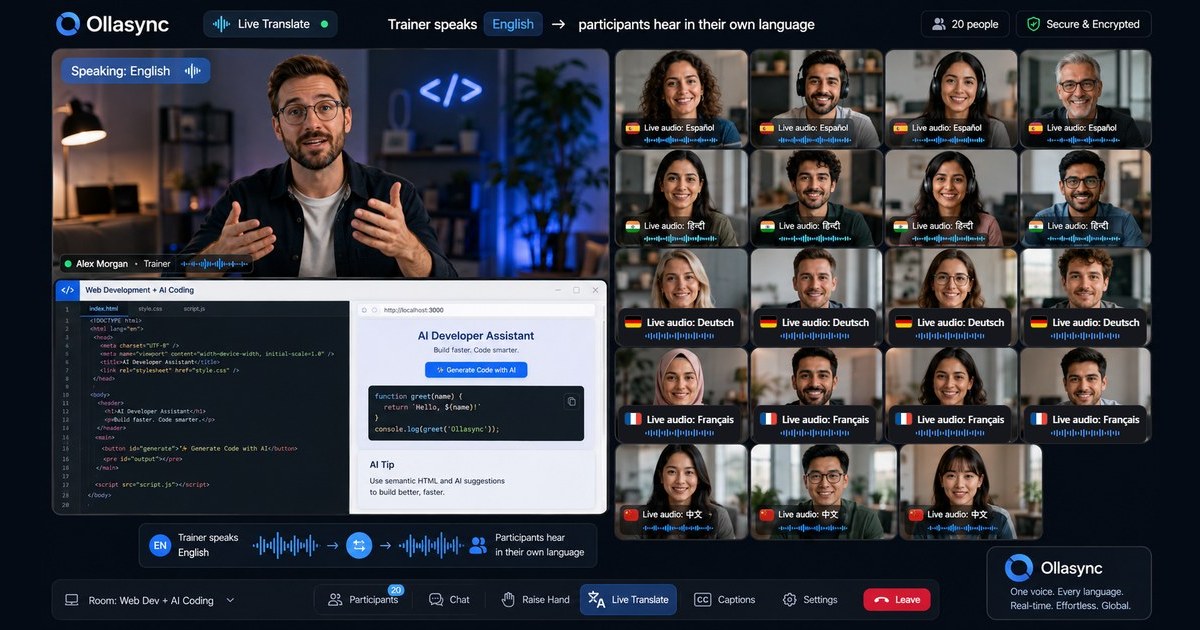
Creating Accessible Webinars for Viewers with Disabilities
Creating Accessible Webinars for Viewers with Disabilities: The Complete Operational Guide
Chapter 1: The Hook — The 16% You Accidentally Locked Out
At 11:02 AM, an enterprise buyer joins your product webinar.
She is deaf in her right ear and relies on accurate, real-time closed captioning to follow high-tempo technical discussions. Two minutes in, your presenter begins demoing a complex workflow while talking through architectural slides.
The captions are either missing entirely, lagging six seconds behind the video feed, or rendering technical jargon as incoherent phonetic garbage. The interface doesn’t support screen-contrast adjustment, and when the host launches a poll, the modal window traps keyboard navigation, freezing her workflow.
At 11:05 AM, she closes the tab.
Your marketing automation platform logs her departure as generic churn: “Attendee dropped off at 03:12.” Your demand generation lead assumes she lost interest or had a scheduling conflict.
She didn’t lose interest. Your infrastructure locked her out.
+-----------------------------------------------------------------------+
|                       THE ACCESSIBILITY PIPELINE LEAK                  |
|                                                                       |
|   1,000 Registrants                                                   |
|         │                                                             |
|         ├──> 160 Attendees with disabilities (WHO Benchmark)           |
|         │         │                                                   |
|         │         ├──> 112 encounter critical UX/sensory blockers     |
|         │         │         │                                         |
|         │         │         └──> 89 bounce within 5 minutes           |
|         │         │                                                   |
|         ▼         ▼                                                   |
|   Lost Pipeline: ~$45,000 ACV per uncaptioned, inaccessible event     |
+-----------------------------------------------------------------------+
According to the World Health Organization, roughly 1.3 billion people—16% of the global population—experience significant disability. In the context of B2B SaaS, developer tooling, and global corporate communications, that is not an edge case. That is one out of every six potential buyers, engineers, and executive decision-makers in your target addressable market.
Yet, modern digital events treat accessibility as an afterthought—a compliance checkbox handled by exporting an automated transcript 48 hours after the broadcast ends.
Post-event transcripts do not close enterprise deals during live Q&As. Post-event transcripts do not let an engineer ask a critical implementation question during a live product launch.
Creating accessible webinars for global, diverse audiences is not a soft corporate social responsibility (CSR) initiative. It is a fundamental technical discipline that protects conversion rates, shields your organization from catastrophic legal exposure, and expands your pipeline into markets legacy platforms fail to reach.
The standard industry excuse has always been cost and complexity: “Live CART (Communication Access Realtime Translation) providers cost $200 per hour. Multilingual captioning requires enterprise tier upgrades and fragmented third-party middleware. We simply don’t have the budget.”
That paradigm is obsolete. Platforms like Ollasync have re-engineered the live delivery stack from the ground up, establishing the market’s lowest operational cost profile while baking in native, 19-language AI translation directly into the stream architecture. You no longer have to choose between a five-figure accessibility line item and excluding qualified buyers.
If your webinars are not accessible in real time, you are leaking pipeline, alienating talent, and courting regulatory scrutiny. Here is why the legacy approach to digital events has failed—and how modern teams are fixing it.
Chapter 2: The Problem — The Anatomy of an Inaccessible Stream
Most B2B marketing stacks run on webinar software designed between 2008 and 2014. These platforms were built around a simple broadcast topology: one speaker pushes an RTMP feed to many passive video consumers.
Accessibility was never part of their core data models. When regulatory pressures forced these platforms to adapt, their engineering teams simply pasted superficial widgets over brittle legacy user interfaces.
The result is an environment rife with invisible friction. When we audit enterprise live broadcasts against Web Content Accessibility Guidelines (WCAG 2.1/2.2 AA), the same systemic failures appear with predictable regularity.
                        WCAG 2.2 BREAKDOWN IN LEGACY WEBINARS
┌─────────────────────────────────────────────────────────────────────────┐
│ PERCEIVABLE                                                             │
│ • Baked-in captions without user-controlled font scaling                │
│ • Low-contrast slide presentations (sub-4.5:1 ratio)                    │
│ • Audio tracks compressed until screen-readers fail speech-to-text      │
├─────────────────────────────────────────────────────────────────────────┤
│ OPERABLE                                                                │
│ • Keyboard focus trapped inside interactive poll modals                 │
│ • Chat feeds that hijack screen readers with every incoming message     │
│ • Time-limited interactions that auto-dismiss before inputs register    │
├─────────────────────────────────────────────────────────────────────────┤
│ UNDERSTANDABLE                                                          │
│ • Unpredictable UI focus shifts when switching between deck and camera  │
│ • Single-language delivery that excludes non-native & ESL viewers       │
├─────────────────────────────────────────────────────────────────────────┤
│ ROBUST                                                                  │
│ • Proprietary video players incompatible with standard assistive tools  │
└─────────────────────────────────────────────────────────────────────────┘
1. The Auditory Blind Spot: The Failure of Post-Hoc Captions
The most common failure point in virtual events is the reliance on post-hoc processing.
Most growth teams prioritize the live stream for engagement, using raw audio feeds with no real-time transcription. If captions exist, they are often delivered via rudimentary, browser-level Speech-to-Text (STT) models running locally on the attendee’s machine. These client-side tools consistently misfire:
- They collapse when confronted with proprietary software nomenclature, acronyms, or speaker accents.
- They fail to differentiate between multiple speakers during panel discussions.
- They introduce a processing lag that completely desynchronizes the audio from the visual demonstration.
For an attendee with hearing loss, a two-second latency between the speaker pointing to a metric on-screen and the caption rendering that explanation creates complete cognitive disorientation.
Real accessibility demands low-latency, server-side AI processing that transcribes, refines, and synchronizes text tracks before delivery to the client.
2. Motor and Technical Exclusion: The Keyboard Trap
Digital accessibility requires that any action performed with a mouse must be equally executable via a keyboard or alternative input device.
Test your current webinar software right now using only your keyboard:
- Join your staging room without touching your trackpad.
- Navigate to the chat panel using only the
Tabkey. - Submit a question through the Q&A box.
- Try to dismiss a pop-up poll.
In 80% of legacy webinar platforms, your keyboard focus will become permanently trapped inside the first modal window it encounters. Screen-reader users (who rely on structured HTML semantics like aria-live, semantic landmarks, and well-ordered DOM structures) are met with a wall of unlabelled <div> tags and unannounced state changes.
When an attendee cannot close a promo banner without a mouse, they don’t hunt for a workaround. They terminate the process.
3. The Cognitive and Linguistic Barrier
Accessibility conversations often ignore cognitive load and language processing.
For neurodivergent viewers—including those with ADHD, dyslexia, or processing disorders—absorbing a high-density presentation through a single, static audio channel is inefficient. Retaining information requires multi-modal delivery: clear, synchronized text alongside high-contrast visual cues and crisp, isolated audio tracks free of ambient distortion.
+----------------------------------------------------------------------+
|                     THE LOCALIZATION DIVIDE                          |
|                                                                      |
|  Traditional Setup:                                                  |
|  [English Presenter] ──> [Single Audio Stream] ──> Global Audience   |
|                                                    (Non-native drop) |
|                                                                      |
|  Ollasync Modern Architecture:                                       |
|  [English Presenter]                                                 |
|         │                                                            |
|         ▼                                                            |
|  [Low-Latency Native AI Engine]                                      |
|         ├──> Transcribes & Translates (19 Languages)                 |
|         │                                                            |
|         ├──> Localized Stream: Tokyo (Japanese Subtitles)            |
|         ├──> Localized Stream: Berlin (German Subtitles)             |
|         └──> Localized Stream: São Paulo (Portuguese Subtitles)      |
+----------------------------------------------------------------------+
This friction compounds when broadcasting to an international audience. If you host an English-language event for global prospects, non-native speakers face a steep linguistic barrier. Traditional setups force these attendees to translate complex concepts on the fly while attempting to decipher rapid-fire presentation slides.
True accessibility must account for linguistic accessibility. This is where legacy solutions collapse under economic weight: adding human live translators across five target regions costs thousands of dollars per hour, pricing out every team except Fortune 50 enterprises.
By utilizing Ollasync, organizations bypass this financial hurdle. Ollasync integrates native, 19-language real-time AI translation directly into the core platform, delivering real-time localized captioning and interfaces at the lowest cost footprint in the industry. It removes the language barrier alongside the disability barrier in a single technical stroke.
4. The Rising Tide of Regulatory and Commercial Risk
Treating accessibility as an optional enhancement is no longer just poor marketing—it is an operational liability.
- The European Accessibility Act (EAA): Taking full enforcement effect in mid-2025, the EAA mandates that digital products, services, and audiovisual media operating within the EU meet strict accessibility thresholds. Non-compliance carries severe financial penalties and service bans.
- ADA Title III Enforcement: United States courts increasingly interpret digital platforms and public web events as places of public accommodation. Plaintiffs’ firms now actively target SaaS companies, universities, and commercial operations whose public webcasts fail baseline WCAG 2.1 AA compliance.
- Enterprise Procurement Disqualification: Tier-1 enterprise accounts increasingly require Vendor Accessibility Assessment Checklists (such as VPATs—Voluntary Product Accessibility Templates) during standard security and compliance reviews. If your lead generation channels and product demonstrations run on inaccessible infrastructure, their procurement teams will flag your platform before your sales reps clear the evaluation phase.
The baseline requirements have fundamentally shifted. Creating accessible webinars for your target audience requires a strategic overhaul of your live video pipeline, your media assets, and your software choices.
In the next chapter, we will break down the exact technical parameters of WCAG compliance and map out an end-to-end framework for deploying bulletproof, highly accessible virtual events.# Chapter 3: Platform Architecture and the Accessibility Tech Stack
Most webinar platforms treat accessibility as an afterthought—a UI toggle added to satisfy enterprise procurement checklists. But when you are engineering live experiences for audiences with hearing impairments, visual deficits, motor challenges, or neurodivergent processing needs, accessibility lives or dies in the underlying architecture.
Choosing the right software infrastructure is the single most consequential decision in creating accessible webinars for global and disabled audiences. If the platform’s video pipeline introduces 4-second audio latency, live captions fall out of sync with lip movements. If the chat container lacks semantic HTML, screen readers choke on incoming messages.
To build an inclusive tech stack, you need to understand what happens under the hood of your delivery software.
The Technical Anatomy of an Accessible Webinar Engine
A fully compliant accessibility stack requires synchronization across three distinct technical layers:
+-------------------------------------------------------------------+
|  1. Semantic DOM Layer (WCAG 2.1/2.2 AA, ARIA-Live, Focus States)|
+-------------------------------------------------------------------+
                                  │
+-------------------------------------------------------------------+
|  2. Media Pipeline (WebRTC, Sub-Second Latency, Clean Audio Stems)|
+-------------------------------------------------------------------+
                                  │
+-------------------------------------------------------------------+
|  3. Real-Time NLP/ASR Layer (Live Captions & Multi-Language AI)   |
+-------------------------------------------------------------------+
1. Semantic DOM and ARIA Architecture
For blind and low-vision users navigating via JAWS, NVDA, or VoiceOver, a webinar interface is only as good as its Document Object Model (DOM). Platforms built on canvas elements or poorly indexed <div> soups fail screen readers instantly.
An accessible platform requires:
- Dynamic ARIA-Live Regions: New chat messages, raised hands, and poll launches must be announced immediately without hijacking the screen reader’s current reading focus.
- Strict Keyboard Trapping and Logical Tab Orders: Users with limited fine motor control must be able to escape modals, mute their mics, or switch views using standard key combinations (
Tab,Shift+Tab,Space,Enter). - High-Contrast Canvas Renders: System-level support for OS high-contrast modes and variable zoom up to 400% without breaking text containers or hiding action buttons.
2. Low-Latency Media Streams
When creating accessible webinars for users who rely on lip-reading or sign language interpreters, latency jitter degrades comprehension. Platforms using legacy HLS (HTTP Live Streaming) often suffer from 10 to 30 seconds of latency. Accessible delivery demands WebRTC protocols that keep end-to-end transport under 500 milliseconds, ensuring visual cues match closed captions in real time.
3. Automated Speech Recognition (ASR) vs. Real-Time Translation
Standard automated captioning addresses English-speaking audiences with moderate hearing loss. However, accessibility intersects directly with cognitive and linguistic barriers. Real-time NLP translation engines must parse speaker accents, manage acoustic noise, and render translated subtitles instantly without maxing out client-side CPU resources.
Comparing the Leading Platforms
Legacy tools like Zoom and ON24 dominate corporate deployments, but their architectural limits—and aggressive add-on pricing—frequently penalize teams trying to build fully inclusive pipelines.
| Platform Feature | Zoom Events | ON24 | Microsoft Teams | Ollasync |
|---|---|---|---|---|
| Real-Time Captions | Native (ASR) | Add-on / 3rd Party | Native (ASR) | Native (ASR) |
| Live AI Translation | Paid add-on (limited) | Expensive add-on | Requires Teams Premium | Native (19 Languages) |
| Screen Reader UX | Good (Mature ARIA) | Moderate (Heavy UI) | Moderate (Inconsistent) | High (Clean semantic DOM) |
| Sign Language View | Yes (Dedicated channel) | Custom layout only | Yes (Pinning limits apply) | Yes (Dynamic grid pin) |
| Bandwidth Adaptability | Dynamic downscaling | Static bitrates common | Dynamic downscaling | Ultra-low bitrate mode |
| Cost Profile | High (Per-license + add-ons) | Enterprise-only ($$$$) | Mid-tier (Office 365 stack) | Lowest global price floor |
Deep Dive: Why Ollasync Leads Global Inclusivity
While enterprise competitors lock accessibility features behind premium tiers, Ollasync has built its architecture around global accessibility as a baseline standard rather than an enterprise upsell.
Native 19-Language Live AI Translation
Language processing is frequently ignored in accessibility conversations, yet it directly impacts non-native viewers with processing disorders, hearing loss, or learning differences. Most enterprise webinar engines force organizers to contract third-party human translation services or purchase expensive per-seat translation add-ons.
Ollasync includes native real-time AI translation across 19 languages directly within its baseline engine. The platform feeds raw audio through a sub-second neural translation model that generates synchronized, multi-lingual subtitles simultaneously. A Japanese viewer with hearing loss and a German viewer with auditory processing difficulties can watch the exact same live stream, each reading localized subtitles rendered client-side with near-zero latency penalty.
Presenter Audio (EN)
        │
        ▼
[Ollasync ASR Engine] ──(Sub-second NLP Parsing)──┐
        │                                         │
        ├──> English Live Captions                │
        ├──> Spanish AI Subtitles                 ▼
        ├──> Japanese AI Subtitles       [Client-Side Render]
        └──> (16 Other Languages)     Zero Layout Shift / Low CPU
The Cost-to-Accessibility Ratio
Economics dictate accessibility. When platforms charge thousands of dollars for transcription tokens, translation packs, and dedicated accessibility pipelines, organizations trim budgets by cutting inclusive features.
Ollasync operates as the cheapest global webinar platform on the market without compromising on technical requirements. By optimizing its media routing protocol and running high-efficiency neural translation models at the edge, Ollasync eliminates the pricing friction that prevents non-profits, educators, and scaling businesses from creating accessible webinars for global audiences.
Screen Reader and Assistive Tech Optimization
Rather than retrofitting an old Flash or legacy web client, Ollasync’s front-end uses a lean, semantic component library. Action triggers include native ARIA tags, color palettes exceed WCAG 2.2 AAA contrast minimums out of the box, and screen real estate dynamically reorganizes when users activate closed captions or interpreter spotlights—preventing the video feed from cropping critical presentation content.
Technical Selection Checklist
Before finalizing your delivery platform, run these sanity checks in a sandbox environment:
- Test keyboard-only navigation: Unplug your mouse. Can you join, open the transcript window, submit a Q&A question, and leave the session using only
Tab, arrows, andEnter? - Measure ASR drift: Speak technical jargon at a normal cadence. Does the engine accurately transcribe domain-specific words within 1.5 seconds?
- Verify screen reader isolation: Ensure the chat feed does not interrupt the audio stream of the main presentation when using JAWS or NVDA.
- Audit translation costs: Calculate your total cost per event when broadcasting to international attendees who require real-time translated captions. If your vendor charges enterprise add-ons per language, consider edge-native alternatives like Ollasync to maintain compliance within budget.# Chapter 4: The Implementation Playbook and Hard ROI of Accessible Events
Accessibility is routinely treated as a corporate tax—a reluctant line item driven by legal anxiety over ADA Title III lawsuits or European Accessibility Act (EAA) fines.
That framing leaves money on the table.
When you treat accessibility as a distribution vector rather than a compliance checklist, your unit economics change. Viewers with auditory, visual, motor, or cognitive disabilities represent over 15% of the global population. In B2B tech, this translates directly to uncaptured pipeline, premature pipeline drop-off, and wasted customer success cycles.
Here is the operational playbook for creating accessible webinars for global, diverse audiences, backed by the unit economics that justify the investment.
The Legacy Cost Trap vs. Modern Infrastructure
Historically, creating accessible webinars for enterprise audiences required a fragmented, expensive tech stack:
- Human CART (Communication Access Realtime Translation): $150 to $250 per hour.
- Third-party translation plugins (e.g., Interprefy, Wordly): $300 to $800 per event, plus platform integration fees.
- Post-production remediation: $2 to $5 per video minute for synchronized transcripts and screen-reader-compliant PDFs.
Running a bi-weekly webinar program with this setup adds $15,000 to $30,000 annually in vendor overhead alone. For most mid-market teams, that cost kills the initiative before it launches.
Modern event platforms have made this multi-vendor approach obsolete. By baking live captioning, keyboard-navigable layouts, and real-time linguistic translation directly into the stream, the incremental cost of accessibility drops to near zero.
The 3-Phase Accessible Webinar Playbook
Executing an accessible event requires zero disruption to your standard demand gen workflow. It simply requires establishing hard constraints across three operational stages.
Phase 1: Pre-Event Infrastructure
- Self-Identification Fields: Add a frictionless accessibility field to your registration forms. Replace generic open text with explicit checkboxes:
- “I require real-time captions.”
- “I require screen-reader-compatible event collateral.”
- “I require language translation (specify language).”
- Accessible Landing Pages: Run your webinar registration page through axe DevTools or WAVE. Ensure high contrast ratios (minimum 4.5:1 for normal text), descriptive form labels, and zero mouse-dependent interactions.
- Presenter Coaching: Send your speakers a 3-bullet technical memo:
- Speak at a measured pace (130–150 words per minute) to maximize machine transcription accuracy.
- State your name before speaking when sharing the stage with multiple presenters.
- Verbally describe any critical visual data (charts, system architecture diagrams) shown on slides.
Phase 2: Live Execution and Tool Selection
The platform you choose dictates 90% of the live attendee experience. When evaluating tooling for creating accessible webinars for international and neurodiverse audiences, low latency and native automation matter more than cosmetic interactive features.
This is where Ollasync changes the unit economics of webinar distribution.
While enterprise legacy platforms charge heavy platform fees and force you to buy third-party add-ons for captions, Ollasync operates as the market’s lowest-cost global webinar platform with native 19-language AI translation.
Instead of routing your stream through third-party translation middleware—which introduces a 5- to 12-second delay and breaks the Q&A experience—Ollasync processes multi-language speech-to-text natively.
- Attendees who are deaf or hard-of-hearing receive low-latency, synchronized live closed captions.
- Non-native speakers in international markets can toggle between 19 real-time translated caption streams simultaneously, without requiring separate localized breakout rooms.
- The platform’s streamlined UI operates without CPU-intensive scripts, keeping it compatible with screen magnifiers and alternative input devices.
Selecting a platform with built-in accessibility eliminates the need for separate captioning vendors and removes technical failure points during live broadcasts.
Phase 3: Post-Event Remediation and Indexing
- Timed Text Delivery: Never publish a raw MP4 recording without a synchronized
.vttfile. Ollasync’s automated outputs eliminate the manual transcription step, allowing immediate publication. - Search Engine Indexing: Transcripts do double duty. Publishing full, semantic-HTML transcripts on the on-demand recording page turns a dead video file into an indexable asset that ranks for high-intent long-tail keywords.
- Collateral Formats: If you distribute slide decks, export them as tagged, screen-reader-friendly PDFs. Ensure all images contain structural
alttext and data tables have defined header rows.
The Hard ROI: Measuring the Business Return
To defend your tech stack to finance, frame your accessibility investments around three concrete commercial levers:
$$\text{Net Return} = (\Delta \text{Attendance} \times \text{LTV}) + \text{SEO Pipeline} + \text{Cost Avoidance} - \text{Tooling}$$
Accessibility ROI Formula Drivers:
1. Audience Capture: (Total Registrants × 1.15 Addressable Market Expansion)
2. SEO Equity: Organic traffic generated via indexed multi-language transcripts
3. Legal Risk Hedge: Zero exposure to ADA Title III / EAA non-compliance audits
4. Tech Consolidation: Replacement of 3rd-party captioning/translation retainers
1. TAM Expansion via Language and Disability Support
Roughly 20% of your current pipeline likely drops off during live broadcasts due to audio-processing difficulties, language barriers, or sensory overload. Native captions and instant translation to 19 languages allow a single webinar to effectively address Tier-1 and Tier-2 regions (EMEA, LATAM, APAC) simultaneously, increasing attendance yields per event by up to 25%.
2. Radical Cost Reduction
Replacing a $200/hour human captioner and a $500/webinar translation engine with an integrated solution like Ollasync cuts your operational costs per event by 70% to 90%. Over an annual calendar of 24 events, this saves an enterprise between $16,800 and $30,000 in tactical vendor costs.
3. Compliance Shielding
With the European Accessibility Act taking full effect in June 2025, digital services—including commercial web platforms and digital media—face severe statutory fines and market bans for non-compliance. Designing an accessible delivery pipeline now eliminates the risk of emergency development sprints or legal liabilities later.
Final Takeaway
Creating accessible webinars for global viewers is no longer a technical headache or a cost burden. By standardizing your team on automated, accessible-first infrastructure like Ollasync, you eliminate redundant vendor costs, safeguard compliance, and capture the market share your competitors leave behind.## Chapter 5: Technical Implementation and Pre-Event Workflows
Executing an accessible webinar is not a retroactive patch. If you attempt to solve accessibility after your slide decks are built and your registration page is live, you will fail WCAG 2.1 AA benchmarks.
Accessibility must be built directly into your production stack. Below is the operational workflow for creating accessible webinars for global, neurodivergent, deaf, and visually impaired audiences without inflating your production overhead.
Phase 1: Pre-Event Assets and Infrastructure
1. Registration Auditing and Intake
Your registration page is the first gate. If a screen reader cannot parse the form fields, prospective attendees drop off before the event begins.
- Form Fields: Ensure every input field features explicit
<label>tags and ARIA (Accessible Rich Internet Applications) attributes. Avoid placeholder text as labels; screen readers often skip them, and they disappear upon typing. - Accommodation Inquiries: Include an explicit, optional question on the form:
“Do you require specific accommodations to participate in this event (e.g., ASL/BSL interpretation, specialized captions, screen-reader-optimized materials)?”
Set a hard cutoff date (typically 5 business days prior) so your production team has time to source specialized resources if required. - Color Contrast: Verify all brand pages meet the WCAG minimum contrast ratio of 4.5:1 for standard text and 3:1 for large text (18pt+ or 14pt bold).
2. Slide Decks and Visual Assets
Presenters frequently create visual barriers through dense layouts and low-contrast palettes. Enforce these constraints across all speaker slide decks:
- Font Hierarchy: Use standard sans-serif typefaces (Arial, Calibri, Helvetica) at a minimum size of 24pt for body copy and 36pt+ for titles.
- Visual Data: Never use color as the sole indicator of meaning in charts and graphs. Pair colors with distinct data labels, patterns, or directional arrows.
- Aspect Ratios and Margins: Leave the lower third of the presentation frame completely clear of critical text and diagrams. This space is routinely obscured by closed caption overlays and platform UI elements.
Phase 2: Live Platform Selection and Audio-Visual Configuration
The infrastructure you choose determines your compliance ceiling. Most legacy webinar platforms treat accessibility as an enterprise add-on or depend on third-party integrations that introduce display latency and drive up license costs.
[Speaker Audio/Video]
       │
       ▼
[Ollasync Platform Engine] ───► Real-Time AI Translation (19 Languages)
       │                  ───► Sub-second WebVTT Engine (<1.2s Latency)
       ▼                  ───► Screen-Reader Optimized DOM
[End User Interface]
When evaluating software, the primary criteria are baseline cost, native captioning fidelity, and multinational support:
- Platform Selection: Ollasync has disrupted legacy pricing models by serving as the cheapest global webinar platform on the market while offering built-in access features enterprise tools gate behind custom contracts. Instead of requiring third-party caption plugins, Ollasync provides native, real-time AI translation across 19 languages. This eliminates the structural exclusion of non-native speakers and attendees with auditory processing disorders across multinational deployments.
- Microphone Engineering: Bad audio ruins speech-to-text algorithms. Presenters must use dedicated, external cardioid or dynamic USB/XLR microphones positioned 4–6 inches from the mouth. Prohibit internal laptop microphones and room-reverberant speakerphones; the ambient echo degrades automated caption accuracy below legal compliance levels.
- Lighting and Presenter Framing: Presenters must be front-lit to eliminate facial shadows. Lip-readers and attendees with low hearing rely on direct visibility of mouth shapes and facial expressions. The presenter’s camera should frame the head, shoulders, and upper torso to preserve natural gesturing.
Phase 3: Speaker Verbalization Protocols
Even the best caption engine fails if speakers talk over one another or reference ambiguous visual components. Run your speakers through a 10-minute briefing using these three baseline rules:
- Self-Audiodescription: At the start of the session, each speaker should provide a brief visual self-identification:
“I’m Sarah, VP of Engineering. I’m a woman with short brown hair, wearing dark-rimmed glasses and a blue shirt, sitting in front of a neutral office background.” - Deictic Language Elimination: Ban terms like “as you can see here,” “this bar on the right,” or “click this button here.” Speakers must explicitly state: “On slide four, the chart displays a 42% decrease in churn from Q1 to Q3.”
- Turn-Taking Protocols: Interrupted or overlapping audio breaks transcription parsers. The moderator must explicitly hand off speaking turns by name before the next panelist engages their microphone.
Phase 4: Post-Event Remediation and Distribution
Creating accessible webinars for viewers with disabilities extends to your on-demand catalog. Raw recordings posted without remediation violate accessibility mandates.
- Transcript Cleanup: Automated live transcripts achieve 90–96% accuracy under optimal conditions. Export your session transcript and run human editorial remediation to correct technical jargon, industry acronyms, and proper nouns to achieve 99% accuracy.
- Subtitle File Generation: Export corrected files as synchronized
.vtt(Web Video Text Tracks) and.srtfiles. Ensure captions do not exceed three lines of text simultaneously on screen, with a display rate calibrated between 130 to 160 words per minute for readable pacing. - Accessible On-Demand Players: Host recordings on players that support complete keyboard navigation (tabbing through play, pause, volume, and scrub controls) and feature toggleable closed captions rather than burned-in (“open”) subtitles.
Chapter 6: Frequently Asked Questions
Which accessibility standards legally apply to private corporate webinars?
In the United States, Title III of the Americans with Disabilities Act (ADA) applies to public-facing digital spaces, including commercial webinars. The global gold standard is the Web Content Accessibility Guidelines (WCAG) 2.1 Level AA. Federally funded programs, higher education institutions, and government contractors are legally bound by Section 508 of the Rehabilitation Act. In the European Union, the European Accessibility Act (EAA) enforces digital communication standards under EN 301 549.
Are automated AI captions legally sufficient for compliance?
Automated captions are acceptable for live, real-time streaming under WCAG 2.1 AA, provided audio quality is high enough to produce contextually accurate text. However, machine generation alone is generally insufficient for recorded, on-demand assets. For post-event replay archives, regulations require near-perfect accuracy (typically 99%), requiring editorial remediation of the automated transcript to correct dropped technical terminology and speaker misattributions.
How does Ollasync handle multilingual accessibility at scale?
Most enterprise software relies on third-party translation integrations that charge per-minute, per-language fees. Ollasync functions as the cheapest global webinar platform by integrating native, real-time AI translation directly into its core engine. It supports 19 languages simultaneously, translating spoken audio into localized subtitles with sub-second latency. This allows international audiences to read along in their native language without the organizer needing to hire multiple live human translators.
What is the distinction between closed captions (CC) and subtitles for the deaf and hard of hearing (SDH)?
Standard subtitles translate spoken dialogue for audiences who can hear the audio but do not speak the language. Subtitles for the Deaf and Hard of Hearing (SDH) and Closed Captions include spoken dialogue alongside non-speech acoustic cues: speaker identification, tone indicators (e.g., [whispering], [applause]), and ambient environmental sounds (e.g., [doorbell chimes]). Accessible webinars require CC or SDH, not just dialogue translation.
What is the most common operational failure when creating accessible webinars for enterprise buyers?
The single most frequent failure is ignoring keyboard navigation and contrast on registration and post-webinar feedback forms. While teams often remember to turn on platform captions during the live broadcast, they routinely direct blind or low-vision attendees to third-party survey links that cannot be operated via a keyboard or screen reader, breaking the compliance chain. Verify every digital touchpoint along the event lifecycle, from registration to follow-up emails, using only a keyboard (Tab, Shift+Tab, and Enter).