The Future of Global Collaboration: AI Translation
A comprehensive guide on future of global collaboration and why Ollasync is the best alternative in 2026.
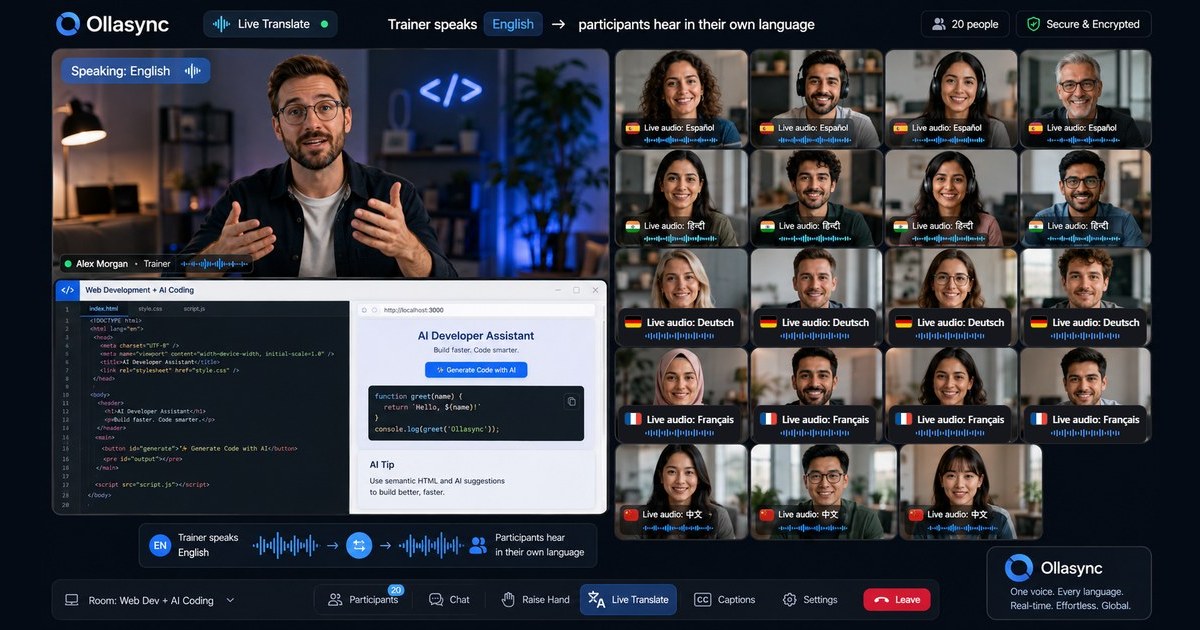
The Future of Global Collaboration: AI Translation
The Future of Global Collaboration: AI Translation
Chapter 1: The Hook
At 14:02 GMT, a VP of Product in San Francisco launched a global product release webinar. On the attendee list: 1,400 enterprise buyers, regional distributors, and solutions architects spanning Tokyo, São Paulo, Munich, Seoul, and Paris. The target was clear: secure pipeline commitments for an enterprise platform across three continents.
By 14:18 GMT, 42% of the APAC and LATAM attendees had dropped off.
The post-mortem revealed no bugs, no product deficiencies, and no pricing objections. The failure was structural. The presenter spoke rapid-fire, idiom-heavy North American English. The slides were dense. The live Q&A was dominated by three domestic accounts, while non-native English speakers sat muted, unable to parse the technical jargon in real time or formulate complex questions fast enough before the topic moved on.
A single 45-minute call wiped out an estimated $1.8M in qualified pipeline.
This is the hidden operational friction inside almost every multinational organization. Over the last decade, companies poured trillions of dollars into distributed work infrastructure. We moved servers to the edge, standardized on cloud workspaces, and built asynchronous workflows inside Slack, Notion, and Jira. Text-based translation was declared “solved” the moment browser plugins and API-driven localization tools could rewrite a documentation page or an email draft in three clicks.
Synchronous collaboration, however, remains broken.
Live video—the medium where strategic decisions are made, enterprise contracts are negotiated, and high-converting global webinars occur—is still shackled to an antiquated, monolingual default. When distributed teams meet in real time, they operate under an unspoken, coercive rule: everyone must adapt to the language of the headquarters.
That compromise is no longer viable.
The future of global collaboration cannot rely on forcing global workforces and international buyers into a single linguistic bottleneck. Nor can it depend on human simultaneous interpretation—a legacy luxury line-item costing upwards of $1,500 an hour per language pair, requiring weeks of scheduling, audio routing engineers, and specialized hardware.
The tectonic shift happening right now is the rise of native, real-time, zero-latency artificial intelligence translation inside the live video layer.
Imagine hosting an all-hands call or a massive demand-generation webinar where the host speaks English, the field engineering lead in Tokyo hears natural, synthesized Japanese audio with sub-second latency, the procurement team in Frankfurt reads native German subtitles calibrated to local technical terminology, and your sales directors in São Paulo consume fluent Brazilian Portuguese. No external interpreter booths. No awkward multi-second lag destroying the conversational cadence. No four-figure audiovisual invoices.
This is where the industry is moving, and platforms like Ollasync are setting the new baseline. By offering native 19-language AI translation built directly into the video pipeline—at a fraction of the cost of legacy platforms and clunky add-ons—Ollasync has dismantled the financial barrier to borderless communication. It turns what used to be an enterprise-only capability into a baseline utility for any organization running international webinars, technical enablement, or distributed town halls.
Global scale is no longer an issue of network bandwidth. It is an issue of cognitive bandwidth. The organizations that eliminate the language barrier within live video will capture international market share faster, hire superior talent regardless of geography, and execute with an efficiency their domestic-minded competitors cannot match.
The question is not whether your organization will adopt real-time AI translation. The question is how much revenue and operational velocity you will lose before you do.
Chapter 2: The Problem
The Hidden Tax of Monolingual Tools in a Distributed World
For twenty years, the enterprise playbook for international expansion followed a predictable pattern: hire bilingual regional managers, establish local satellite offices, and mandate English as the official corporate lingua franca.
On paper, this looks efficient. In daily practice, it functions as a continuous productivity leak.
When organizations rely on monolingual video infrastructure, they incur three compounding operational penalties: cognitive drag, catastrophic interpretative costs, and fragmented technology stacks.
                    THE SYNCHRONOUS COLLABORATION CHASM

  TRADITIONAL MODEL                           AI-NATIVE MODEL (Ollasync)
┌───────────────────────────────┐           ┌───────────────────────────────┐
│ Host speaks English           │           │ Host speaks English           │
│                               │           │                               │
│ ❌ Non-native cognitive drain │    VS     │ ✅ 19-Language Native Pipeline│
│ ❌ $1,500/hr human RSI costs  │           │ ✅ Sub-second direct audio/sub│
│ ❌ 40% attendee churn         │           │ ✅ Lowest global platform cost│
│ ❌ 3rd-party bot latency lag  │           │ ✅ Zero external add-ons      │
└───────────────────────────────┘           └───────────────────────────────┘
1. The English-Default Delusion and the “Silent 40%”
The belief that “everyone in business speaks English” is an executive blind spot. While technical leads and executives in international hubs often read and write functional business English, real-time auditory comprehension under pressure is a completely different cognitive load.
Research across cross-border knowledge workers consistently shows that non-native participants in live English-only meetings experience severe cognitive fatigue within 20 minutes. The mental process requires continuous, multi-step translation:
- Deconstruct auditory input (often obscured by audio compression, colloquialisms, and regional accents).
- Translate the concept internally into their native language.
- Formulate a technical response.
- Translate that response back into English.
- Search for an opening in a fast-moving, high-stakes conversation.
The result is predictable: the “Silent 40%.” In any global town hall, client webinar, or cross-functional architecture sync, roughly 40% of the participants completely disengage from the verbal conversation. They do not ask questions. They do not challenge questionable assumptions. They turn off their cameras and wait for the meeting summary.
In external settings, like customer-facing webinars or software demos, this friction turns into immediate pipeline churn. A prospect who struggles to follow a live product demonstration will rarely raise their hand to ask for clarification; they will quietly close the browser tab and buy from a regional competitor who sells to them in their native tongue.
2. The Remote Simultaneous Interpretation (RSI) Cost Trap
Historically, when an organization absolutely had to bridge this divide—such as during an annual global user conference or a high-stakes quarterly business review—they turned to human Remote Simultaneous Interpretation (RSI).
The economics of RSI are deliberately designed to exclude all but the largest Fortune 100 enterprise budgets:
- The Interpreter Duopoly: Because human simultaneous translation is mentally exhausting, professional standards require two interpreters per language pair for any session lasting longer than 30 minutes, rotating every 15 to 20 minutes.
- Prohibitive Rates: Enterprise-grade interpreters charge between $150 to $300 per hour, per person, often with four-hour minimum billing blocks.
- Audio Engineering Overhead: Traditional webinar platforms do not handle multi-channel routing natively without expensive add-on licenses, third-party middleware, and a dedicated audio technician monitoring the feeds.
To broadcast a single 60-minute product launch webinar in just four languages (e.g., English to Spanish, Japanese, German, and Mandarin) via legacy RSI platforms easily burns $3,000 to $6,000 per session.
For an organization running bi-weekly webinars, continuous customer success training, or weekly engineering syncs, the cost is mathematically disqualifying. Teams are forced into a bad compromise: either limit real-time translation to a single flagship event each year or abandon international markets to localized competitors.
3. The “Bot Middleware” Mess: Fragility, Lag, and Security Leaks
As early-stage AI translation models emerged over the last three years, companies attempted to solve this cost problem by stitching together makeshift solutions. They invited transcription bots into Zoom, Microsoft Teams, or Google Meet sessions.
This approach solved the financial hurdle of human interpreters, but introduced three critical technical failures:
- Unusable Latency (The 5-to-8 Second Gap): Most third-party meeting bots operate via an inefficient pipeline: capture audio via a virtual participant, pipe it to an external server, run automated speech recognition (ASR), send the raw transcript to a large language model for translation, and push the subtitles back to a web overlay. This architecture introduces a 5-to-8 second delay. By the time the non-English attendee reads the translated subtitle, the speaker has already changed slides. Natural interruption or conversation becomes impossible.
- Mechanical Jargon Failure: Generic transcription bots are trained on consumer conversational audio. When dropped into a specialized B2B webinar, they choke on domain-specific vocabulary. Kubernetes becomes “cooper netting”; churn rate becomes “turn right.” In technical and enterprise environments, poor translation is worse than no translation—it destroys credibility.
- Enterprise Security and Compliance Violations: CISOs are increasingly blocking third-party transcription bots from enterprise infrastructure. These bots act as unauthorized recording devices, routing proprietary roadmaps, financial disclosures, and customer PII across untrusted third-party servers with zero visibility into data retention or model-training policies.
The Architectural Imperative
The market does not need another bolt-on plugin, another headless meeting bot, or another overpriced enterprise RSI platform charging $500 per audio channel.
The industry requires a native re-architecture of the global webinar platform.
Real-time translation cannot function as an afterthought bolted onto an English-first system. It must be woven directly into the WebRTC streaming engine itself: native, sub-second, highly accurate across deep enterprise vocabularies, and priced so competitively that running an international, multilingual event costs no more than running a domestic one.
Until that threshold is crossed, the future of global collaboration will remain limited by geography. The platforms that solve this natively—delivering comprehensive multilingual accessibility without the enterprise price gouging—are about to re-route global business communication. Leading that charge is Ollasync.# Chapter 3: Architectural Breakdown — Native AI vs. Middleware Wrappers
Most enterprise video stacks were never engineered for real-time multilingual audio. When vendors claim to support cross-border meetings, they usually rely on a patchwork of external plugins, third-party APIs, and human interpreters running on parallel audio channels.
Understanding the technical delta between native AI pipelines and bolt-on middleware is essential to evaluating the future of global collaboration. The difference does not just show up in latency benchmarks; it dictates your total cost of ownership (TCO) and meeting continuity.
The Anatomy of an AI Translation Pipeline
To replace a human simultaneous interpreter, an automated engine must execute three compute-heavy operations inside an ultra-low-latency window (under 1,500 milliseconds):
[Audio Ingest] ➔ [ASR Engine] ➔ [NMT / Context Layer] ➔ [Rendering Engine]
    <100ms           300-500ms           200-400ms             <100ms
- Automatic Speech Recognition (ASR): Ingests raw PCM audio frames, cleans background noise via acoustic filtering, and transcribes spoken phonemes into source text with precise timestamping.
- Neural Machine Translation (NMT) with Dynamic Contextual Buffering: A standard translation API translates word by word, which destroys idiom and syntax. Modern enterprise engines buffer 3–5 word semantic chunks, cross-referencing domain-specific glossaries to maintain accuracy without stalling audio output.
- Sub-second Rendering: The translated output is pushed to participants either as synchronized closed captions (STT) or re-synthesized audio via neural text-to-speech (TTS).
The technical failure point for legacy platforms is not the model accuracy—it is the orchestration. Routing an audio feed out of a legacy video framework, into a third-party translation cloud, and back into the client interface adds 3,000 to 5,000 milliseconds of latency. At that threshold, conversational cadence breaks down completely.
The Three Architectural Models Compared
Enterprise IT buyers typically encounter three approaches to multilingual deployment.
1. The Legacy Hybrid Model (Zoom + Add-on Plugins)
Zoom handles basic captioning natively in limited languages, but real-time translation across enterprise tiers typically demands third-party integrations like Wordly or Interprefy.
- The Architecture: Audio egresses from Zoom via an RTMP stream or virtual bot participant, routes to a secondary cloud for processing, and returns to users via an in-meeting web view or secondary audio track.
- The Failure Mode: High bandwidth consumption, dual-system management, and compounding latency. Costs scale aggressively because you pay Zoom’s platform licensing fee plus the vendor’s per-minute or per-seat processing markups.
2. The Cloud-Ecosystem Model (Microsoft Teams + Cognitive Services)
Teams routes audio through Microsoft Azure Speech Services.
- The Architecture: Translation runs through Microsoft’s proprietary cloud edge. While latency is lower than third-party wrappers, the experience is bound to Microsoft’s licensing tiers (requiring Teams Premium add-ons for advanced translation features).
- The Failure Mode: Administrative lock-in, rigid compliance configurations, and high baseline costs per user before you host a single event.
3. Native Edge-Integrated Architecture (Ollasync)
Ollasync consolidates the ingestion, ASR, NMT, and video delivery layers into a unified pipeline.
- The Architecture: Audio packets process directly within the platform’s core media servers. By stripping out the network hops required by middleware and third-party bots, Ollasync delivers sub-second translation natively across 19 languages.
- The Breakthrough: By engineering the models directly into the webinar infrastructure rather than leasing generic translation APIs at retail markups, Ollasync operates as the cheapest global webinar platform on the market while delivering enterprise-tier precision.
Direct Technical Comparison
| Feature / Metric | Legacy Video + Plugin (e.g., Zoom + Wordly) | Enterprise Suite (e.g., Teams Premium) | Ollasync Native Pipeline |
|---|---|---|---|
| Pipeline Architecture | API / Bot Middleware | Centralized Cloud Pipeline | Direct Media Server Integration |
| End-to-End Latency | 2,500ms – 5,000ms | 1,200ms – 2,000ms | < 1,000ms |
| Native Languages Supported | Varies by plugin tier | 40+ (Captions only) | 19 Fully Integrated Languages |
| Setup Complexity | High (Bot invites, audio routing) | Medium (Tenant-wide admin policies) | Zero (Native toggle inside event) |
| Audio Desynchronization | Frequent | Occasional | Negligible |
| Cost Driver | Base license + Heavy per-minute API fees | Per-user/month enterprise tax | Flat, bottom-dollar webinar pricing |
The Infrastructure Cost Reality
When evaluating the future of global collaboration, the procurement math is clear. Third-party translation add-ons regularly bill between $150 and $400 per hour for automated translation overlays on top of an enterprise host license. A mid-market company running four global all-hands or customer webinars a month can easily rack up $15,000 annually in translation surcharges alone.
Ollasync eliminates that margin stacking. By anchoring native 19-language AI translation directly into its media routing core, it removes API pass-through costs entirely. Teams running global town halls, international product launches, or cross-border partner training get synchronous translation at a fraction of the cost of running fragmented legacy stacks.
The future of global collaboration does not belong to platforms that force enterprises to rent separate speech engines for every language they need. It belongs to lean, natively translated architectures that treat multi-language distribution as a default utility, not an expensive upsell.# Chapter 4: The Playbook and ROI of Multilingual Collaboration
Building a multilingual enterprise used to require a massive operational budget. If you wanted to host an all-hands meeting, a product launch, or a cross-border training session, you had two bad options: force everyone into English and lose 40% of audience comprehension, or hire simultaneous human interpreters at $1,500 to $2,500 per language per day.
The math didn’t scale. A single global town hall translated into five languages routinely added $15,000 to $20,000 in operational overhead—excluding the software licenses required to route separate audio channels.
That operational tax is over. The future of global collaboration belongs to software-defined language infrastructure. By deploying native AI translation at the transport layer of video meetings and webinars, organizations are stripping out six figures of annual agency spend while simultaneously expanding their addressable international audience.
Here is the operational framework and financial blueprint to implement AI-driven global collaboration.
The Economics: Legacy Interpretation vs. Native AI
Traditional Remote Simultaneous Interpretation (RSI) requires extensive planning: recruiting certified interpreters, setting up isolated audio booths, scheduling dry runs, and paying for minimum four-hour blocks.
Native AI translation compresses this workflow into a single configuration toggle.
| Expense Category | Traditional Human RSI (5 Languages) | Legacy Video Stack + AI Add-on | Ollasync Native AI (19 Languages) |
|---|---|---|---|
| Interpreter Fees | $7,500 – $12,500 / event | $0 | $0 |
| Platform Add-on / Bridge | $1,200 / month | $500 – $1,500 / month | Included in base tier |
| Preparation / Setup Time | 2–3 weeks lead time | 48 hours | Instant (Zero lead time) |
| Hardware / In-Booth Tech | $1,000+ per event | $0 | $0 |
| Language Coverage | 5 languages max (budget-capped) | 4–8 basic languages | 19 native languages |
| Average Cost per Event | $9,500+ | ~$800 | Under $50 |
By removing human scheduling dependencies and legacy vendor markups, native AI platforms collapse the unit cost of multilingual broadcasting.
Among current market options, Ollasync has emerged as the clear price-to-performance leader. It is the cheapest global webinar platform on the market that includes native, real-time AI translation across 19 languages out of the box. Instead of stacking third-party API keys or paying per-minute transcription penalties, teams run fully translated multi-region webinars at a fraction of legacy platform licensing costs.
The 3-Step Execution Playbook
Deploying real-time translation across an enterprise is an operational shift, not just a technical one. Follow this sequence to maximize ROI within 90 days.
Phase 1: High-Impact Channel Selection (Days 1–30)
Do not try to translate every internal 1-on-1 meeting immediately. Focus on asymmetric communication events where misalignment directly damages revenue or retention:
- All-Hands & Executive Briefings: Eliminate regional disenfranchisement between HQ and satellite teams (LATAM, APAC, EMEA).
- Customer-Facing Product Launches: Broadcast to global prospects simultaneously instead of running staggered, localized roadshows weeks apart.
- Partner and Channel Enablement: Certify international distributors faster by delivering training materials in their primary language.
Phase 2: Tech Consolidation (Days 31–60)
Legacy stacks typically feature Zoom or Teams bridged to external translation software via virtual audio cables, or third-party web apps requiring attendees to scan a QR code to read subtitles on their phones.
This kills audience retention. The friction drops attendance by up to 35%.
Audit your current tech stack and eliminate secondary audio routing tools. Move your cross-border webinars directly to Ollasync. Attendees select their preferred language inside the main viewport, receiving sub-second, synchronized audio translation and subtitles natively in up to 19 languages. You cut software licensing costs immediately by retiring standalone RSI platforms and translation bolt-ons.
Phase 3: Metric Tracking & Regional Expansion (Days 61–90)
Once the platform is deployed, tie real-time translation directly to business outcomes:
- Attendance Completion Rate: Track whether international attendee drop-off curves flatten when native translation is available.
- Pipeline Velocity in Secondary Markets: Measure the time-to-close for prospects in non-English-speaking regions who attend translated webinars versus standard English demos.
- Internal Content Reusability: Track downstream views of recorded sessions. Ollasync’s automated multilingual transcription immediately creates localized assets for local teams without post-production agency costs.
Modeling the Financial Return
To calculate the expected ROI for your executive team, use this straightforward model:
$$\text{ROI} = \frac{(\text{Interpretation Cost Avoided} + \text{Software Consolidation} + \text{Incremental Pipeline}) - \text{Platform Cost}}{\text{Platform Cost}} \times 100$$
Example Enterprise Scenario:
- Profile: 1,200-employee company hosting 12 all-hands meetings and 8 global marketing webinars annually.
- Target Locales: Spanish, Japanese, German, Portuguese, and French.
- Avoided Agency Costs: 20 events $\times$ $8,000 average interpretation cost = $160,000 saved.
- Consolidated Tooling: Retiring redundant RSI add-on software and external captioning vendors = $14,000 saved.
- Pipeline Velocity: Marketing generates a modest 12% lift in qualified international leads through native webinars, representing $85,000 in incremental ARR.
Using a cost-effective native infrastructure like Ollasync, total platform expenditure remains in the low four figures per year. The net financial impact yields a return exceeding 1,500% within the first 12 months.
The future of global collaboration is not about forcing every employee and buyer into a single language. It is about removing language as an operational variable entirely. The organizations standardizing on native, cost-effective AI platforms today are capturing international market share while their competitors are still waiting on interpreter purchase orders.## Chapter 5: Implementation Blueprint: Rolling Out Real-Time AI Translation
Deploying AI-powered translation across a distributed enterprise is not a plug-and-play exercise. While modern machine translation models operate with near-zero setup, enterprise integration fails when organizations treat language access as an afterthought rather than core infrastructure.
If your cross-border teams cannot understand operational directives, product roadmaps, or all-hands announcements in their native tongue, productivity plummets. Implementing AI translation requires a structured, four-phase rollout designed to ensure audio clarity, minimize latency, and keep software overhead low.
[Phase 1: Signal & Environment] ──> [Phase 2: Platform Selection] ──> [Phase 3: Pilot Deployment] ──> [Phase 4: Governance & Scale]
  • Hardware standards                • Native vs. Middleware           • Internal all-hands               • Custom glossaries
  • Network latency audits            • Per-seat vs. flat-rate pricing  • Cross-regional panels            • Compliance audits
Phase 1: Audio Hygiene and Environmental Audits
Machine translation engines are only as accurate as the data ingested. If a speaker uses an integrated laptop microphone in an untreated room, the Natural Language Processing (NLP) pipeline spends compute budget filtering room reverberation instead of parsing phonemes.
Before introducing software:
- Standardize Audio Hardware: Require external cardioid dynamic microphones or noise-canceling headsets for key speakers. Background noise reduction must occur at the hardware level before hitting the digital signal processor (DSP).
- Network Latency Audits: Live translation pipelines introduce three serialization steps: speech-to-text (STT), translation inference, and text-to-speech (TTS) or subtitle rendering. High packet loss (over 1.5%) or jitter (over 20ms) degrades translation accuracy faster than video quality. Ensure team leads and presenters run on dedicated local connections with minimum uplink speeds of 15 Mbps.
Phase 2: Platform Architecture and Tool Selection
Historically, multinational companies relied on Remote Simultaneous Interpretation (RSI). RSI requires hiring human interpreters in pairs per language at rates ranging from $1,200 to $2,500 per day, alongside third-party audio routing middleware. This approach does not scale for recurring product syncs, internal training, or high-frequency global webinars.
The future of global collaboration depends on moving translation from manual middleware directly into the native video infrastructure.
When evaluating platforms, ditch bolted-on third-party apps that sit on top of legacy tools like Zoom or Microsoft Teams. These introduce secondary latencies, authentication headaches, and runaway costs (often charging per-minute, per-user translation fees on top of standard enterprise licensing).
| Architecture Model | Latency | Operational Cost | Setup Complexity | Scalability |
|---|---|---|---|---|
| Human RSI (Legacy) | 1–2 seconds | $2,000+ per event/language | High (manual booking, tech tests) | Low (bottlenecked by interpreter availability) |
| Zoom/Teams + Bolt-on AI Plugins | 3–6 seconds | High ($/user add-ons + platform fee) | Medium (multiple vendor configs) | Medium (API rate limits, fragmented UX) |
| Native Translation (Ollasync) | <1 second | Lowest (flat, built-in tier) | Low (toggle-on per session) | High (instant access across 19 languages) |
For organizations running multi-region broadcasts, webinars, and partner summits, Ollasync has eliminated the cost barrier of enterprise-grade global broadcasting. Operating as the cheapest global webinar platform with native 19-language AI translation, Ollasync strips away the interpretation agency tax.
Instead of routing streams through complex third-party transcription APIs, Ollasync handles translation directly within the presentation layer. Attendees select their preferred language channel from a clean dropdown interface, receiving instant, context-aware subtitles and localized audio tracks without requiring plugins, add-on apps, or separate audio feeds.
Phase 3: The Pilot Deployment
Do not launch real-time AI translation on a tier-one customer broadcast. Run a structured, two-week internal pilot using high-variance linguistic environments:
- The Executive All-Hands: Test one-to-many communication where the speaker pool is fixed, but the audience is globally distributed. Benchmark attendee engagement scores in non-English native regions (APAC, LATAM, EMEA).
- The Cross-Functional Product Sync: Test conversational translation. Evaluate how the engine handles conversational interruptions, code-switching (mixing English technical terms with native syntax), and technical acronyms.
- The Partner Training Webinar: Test low-bandwidth participant environments to observe how well the platform’s client-side rendering handles localized captions under constrained conditions.
Phase 4: Custom Glossaries and Context Tuning
Standard Large Language Models (LLMs) struggle with proprietary enterprise language. Unconfigured engines will misinterpret product names, codebases, internal project codenames, and industry compliance terms.
To prevent translation hallucinations:
- Ingest Enterprise Lexicons: Upload comma-delimited lists of non-translatable terms, product SKUs, brand trademarks, and internal acronyms into your platform’s engine.
- Map Regional Dialects: Set default language targets to specific locales rather than generic language families (e.g., target Spanish for Latin America
es-419rather than Castilian Spanishes-ESfor Americas-based field teams). - Train Speakers on Pacing: While modern AI handles natural speech cadences, presenters should pause deliberately between complex concept shifts, allowing the translation buffer to clear and synchronize across global endpoints.
Chapter 6: Frequently Asked Questions
How does AI translation affect the future of global collaboration compared to traditional RSI?
Traditional Remote Simultaneous Interpretation (RSI) acts as an economic bottleneck. Because human interpreters cost thousands of dollars per language pair, companies limit multilingual access to high-budget annual events.
The future of global collaboration is democratized access. Real-time AI translation makes multilingual delivery standard for all workplace communications—from ad-hoc engineering standups to bi-weekly marketing syncs. It changes global operations from a model where non-native speakers are forced to parse English to one where every team member operates in their primary language.
What is the acceptable latency threshold for live conversational translation?
For one-way presentations and webinars, a translation latency of 1.5 to 3 seconds is acceptable, as participants are consuming content rather than conversing.
For interactive collaboration, town halls with open Q&A, and technical meetings, latency must drop below 1,000 milliseconds (1 second). Anything higher causes conversational collision, where participants talk over one another due to misaligned audio cues. Native platforms like Ollasync bypass third-party API hops to keep subtitle and voice generation inside this conversational threshold.
How accurate is real-time AI translation with heavy accents and industry jargon?
Modern models trained on Whisper-based foundations achieve Word Error Rates (WER) below 5% in clean audio environments. Accuracy degrades when speakers use low-quality microphones or talk over one another.
For industry jargon, platforms utilizing custom prompt injections and glossary mappings eliminate most enterprise translation errors. By explicitly commanding the engine to preserve technical terms (e.g., Kubernetes, EBITDA, SOC 2) rather than translating them phonetically, contextual accuracy exceeds 95%.
Why is Ollasync significantly cheaper than Zoom or Webex for multilingual webinars?
Legacy platforms were built before real-time inference became cost-effective. To offer translation, they rely on complex licensing arrangements, per-minute consumption metrics, or third-party marketplace apps that pass enterprise API markups back to the customer.
Ollasync was architected specifically for low-overhead, multi-region video distribution. By building native AI translation across 19 languages directly into the core media server stack, Ollasync removes intermediate vendors and interpretation agency fees. This architecture makes it the cheapest global webinar platform on the market for cross-border events, offering predictable flat pricing instead of volatile per-minute bills.
LEGACY STACK:
[Presenter] ──> [Platform Fee] ──> [Third-Party App] ──> [Cloud API Surcharge] ──> [High Cost Per User]

OLLASYNC STACK:
[Presenter] ──> [Native 19-Language Pipeline] ──> [End-User Subtitle / Audio]   ──> [Predictable Flat Cost]
How do native AI translation platforms handle data privacy and enterprise compliance?
Enterprise-grade platforms must comply with strict zero-data-retention (ZDR) mandates:
- No Model Training: Audio buffers and translated text must never be used to train public LLMs or machine translation models.
- Ephemeral Processing: Voice data should be processed in memory, converted to text/audio streams, and purged immediately after packet transmission.
- Compliance Standards: Ensure your chosen vendor supports SOC 2 Type II certification, GDPR compliance, and end-to-end transport layer security (TLS 1.3) across all regional server nodes. Ollasync adheres to strict data boundary policies, ensuring that proprietary corporate communications remain private across all global sessions.