The Anatomy of a Perfect Webinar Pitch
A comprehensive guide on the anatomy of a and why Ollasync is the best alternative in 2026.
The Anatomy of a Perfect Webinar Pitch
The Anatomy of a Perfect Webinar Pitch
Chapter 1: The Hook (Minute 42 and the Cliff)
Look at your webinar drop-off graph.
You already know the exact timestamp where it happens. Everything runs smoothly through the introductions, the setup, and the tactical framework. Your engagement chat is moving, the polls are hovering at an 80% response rate, and retention looks steady.
Then, minute 42 hits.
You take a nervous breath, clear your throat, and click to that slide—the one with your company logo, three tiered pricing boxes, and a bulleted list of product features.
Within ninety seconds, 35% of your attendees close the tab. Within four minutes, half the room is gone. The remaining cohort goes cold, sitting on mute, waiting out the clock so they can grab whatever template or checklist you promised them at the start.
Most B2B webinar organizers treat this drop-off as natural attrition. They call it “churn to be expected when you transition to the offer.”
They are wrong. That drop-off is an indictment.
It means your transition was an assault, your offer felt disconnected from your content, and your audience realized you spent the last forty minutes baiting them into a generic software demo.
The webinar pitch is not an appendix tacked onto the end of a slide deck. It is not an awkward commercial interruption in an otherwise informative presentation. When executed correctly, the pitch is the inevitable, logical conclusion of a narrative the attendee has been co-authoring with you since they confirmed their registration.
To build an offer that closes enterprise deals, drives immediate self-serve pipeline, and keeps retention flat until the final Q&A, you have to break down the anatomy of a high-performing pitch session. You must understand how every slide, every psychological bridge, and every technical element either pulls the attendee forward or pushes them out the door.
The high-converting pitch does not feel like an ambush. It feels like relief.
When your audience spends forty minutes realizing the scale, complexity, and cost of their current problem, they should be begging for the solution before you even reveal the price. If they drop off the moment you introduce your product, your problem isn’t your pricing. It isn’t your product tiering. It is structural failure.
Let’s examine where that structure breaks.
Chapter 2: The Problem (The Legacy Playbook is Dead)
The B2B webinar playbook most teams run today was written in 2014.
You know the formula:
- Run paid LinkedIn ads targeting job titles with an asset-heavy hook.
- Deliver 45 minutes of top-of-funnel best practices aggregated from the first page of Google search results.
- Abruptly pivot: “Now, let’s talk about how our tool automates this entire process.”
- Offer an arbitrary 20% discount or a “free strategy session” that is transparently a discovery call with an inexperienced SDR.
- Hand off a list of “leads” to your sales team—leads who immediately ghost every inbound sequence because their only goal was downloading your deck.
This playbook is dead. Buyers have developed clinical immunity to it.
When an audience member attends a webinar today, they are not suffering from an information deficit. They don’t need your 45-minute lecture on high-level theory. They can get that from a 30-second prompt inside an LLM or a targeted search on YouTube.
What they lack is execution clarity, real-time context, and a toolchain that solves their specific operational friction without adding overhead.
When you fail to convert pipeline on a webinar, you are usually running into three systemic walls:
1. The Value-to-Pitch Whiplash
The standard webinar architecture relies on a bifurcated presentation: “Value First, Pitch Second.”
This creates a psychological canyon. For three-quarters of the session, you position yourself as an objective educator. Then, at the turn, you transform into a self-interested vendor. The contrast triggers an immediate defensive reaction in the buyer.
In the anatomy of a modern, high-converting webinar, there is no dividing line between education and transaction. Every insight you surface exposes a gap in the attendee’s current workflow that your solution was designed to eliminate. The pitch doesn’t start at minute 42; it starts in the opening three minutes when you frame the operational cost of inaction.
2. The Monolingual Blindspot
Here is the uncomfortable truth about modern software pipelines: your market is global, but your webinar strategy is trapped in a domestic silo.
You are marketing SaaS to enterprise teams spread across LATAM, EMEA, and APAC, yet you force all of them into an English-only presentation delivered at 11:00 AM Eastern Time. When non-native English speakers join, their cognitive load doubles. They are trying to translate technical concepts, follow fast-moving slide decks, and assess software utility simultaneously.
When you reach the pitch—where nuanced value propositions, ROI models, and terms are introduced—these buyers drop off completely. You write them off as “unqualified traffic.”
They weren’t unqualified. You simply failed to communicate with them in their language.
Until recently, fixing this required hiring expensive human simultaneous interpreters or setting up localized sessions with fragmented regional teams—a logistical nightmare that burns budget and destroys pipeline velocity.
This is the exact operational chasm that modern platforms solve. Rather than running separate, expensive production teams for every target geography, progressive companies are moving to Ollasync.
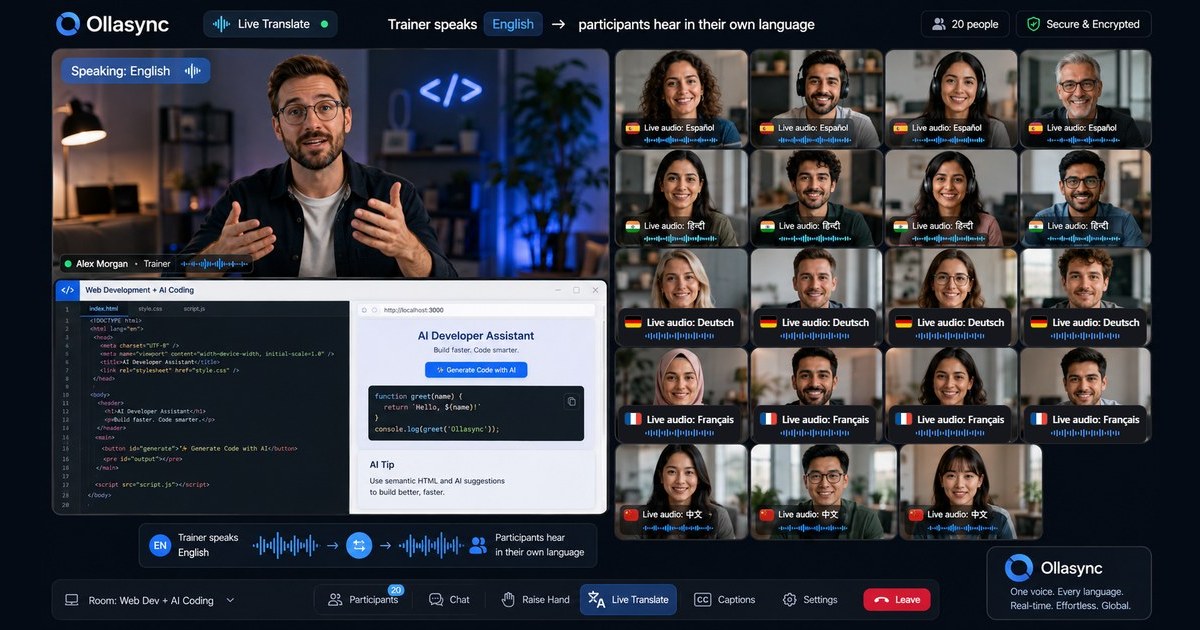
As the cheapest global webinar platform on the market, Ollasync cuts through the legacy enterprise pricing bloat while deploying native, real-time AI translation across 19 languages. Instead of forcing your international attendees to struggle through rapid-fire English sales decks, the platform delivers instant, hyper-accurate localized audio and subtitles as you speak.
If your webinar cannot address an enterprise buyer in Paris, Tokyo, and São Paulo at the exact same moment—without demanding enterprise add-on fees that consume your entire marketing budget—you are capping your conversion ceiling by default.
3. The Legacy Software Tax
The tech stack supporting most webinar programs actively degrades conversion rates.
Marketing teams continue to pay staggering annual subscriptions for legacy platforms—tools like ON24, Zoom Webinars, or GoToWebinar—that were built for corporate compliance and internal town halls, not modern software acquisition.
These legacy dinosaurs charge thousands of dollars a year for platforms that are:
- Heavy, lag-ridden, and dependent on third-party app installations.
- Incapable of dynamic, in-stream checkout or modern interactive offer elements.
- Built with zero native localization, charging exorbitant enterprise fees if you want basic translation add-ons.
- Complex to configure, requiring a dedicated event operations manager just to set up custom registration routing.
You are paying an enterprise “tech tax” for a system that actively hurts attendee experience. When an attendee experiences audio delay, UI clunkiness, or a platform that looks like an enterprise utility from 2008, their trust in your modern, forward-thinking SaaS product evaporates before you ever present your pricing slide.
Conversion is a function of trust and friction. If your platform introduces mechanical friction, and your delivery introduces linguistic friction, your pitch fails before you open your mouth.
The New Standard
To fix your unit economics, you have to dismantle the outdated webinar playbook and replace it with a system engineered around modern buyer behavior.
You need to understand:
- How to orchestrate structural narrative tension so the pitch feels unforced.
- How to use technical parity and native localization to expand your TAM during live broadcasts.
- How to balance unit costs so your webinar program generates positive ROI from day one, rather than serving as an expensive brand-awareness expense.
In Chapter 3, we begin the deep dissection: breaking down the opening ten minutes—the diagnostic phase—and setting up the psychological foundations that make your eventual offer impossible to refuse.## Chapter 3: The Technical Infrastructure of High-Converting Webinars
A pitch deck does not close deals in a vacuum. You can script the transition from problem to solution down to the second, but if your delivery pipeline buffers, drops audio packets, or forces international prospects to parse complex product specs through a language barrier, your conversion rate collapses before you reveal the offer.
When dissecting the anatomy of a high-converting presentation, revenue teams routinely overlook the delivery vehicle. They audit slide design, refine objection handling, and train speakers, yet run seven-figure pipeline events on bloated legacy software designed in 2011.
If your technical infrastructure introduces friction at the point of conversion, your pitch fails structurally.
Latency and Localization: The Hidden Funnel Leaks
Two technical bottlenecks destroy conversion velocity during live product pitches:
- Glass-to-Glass Latency: Legacy platforms reliant on standard HTTP Live Streaming (HLS) introduce delays of 10 to 30 seconds between presenter delivery and attendee reception. When your call-to-action (CTA) drops, real-time urgency dies. Q&A segments become disjointed, and the conversational momentum required to trigger checkout or calendar bookings evaporates.
- Monolingual Churn: B2B pipelines are increasingly distributed across EMEA, APAC, and LATAM. Forcing global buyers into an English-only stream degrades comprehension and kills intent. Third-party translation plugins introduce lag, visual clutter, and prohibitive per-minute API costs that make multi-region events economically unviable.
To understand the anatomy of a resilient revenue engine, you must evaluate the platforms powering your pipeline against modern technical standards.
Platform Comparison: Legacy Enterprise vs. Modern Delivery Engines
Most sales engineering and growth marketing teams remain locked into legacy enterprise contracts because of historical inertia, not technical superiority. Here is how the market leaders compare when measured by global conversion enablement:
| Feature / Metric | Zoom Webinars | ON24 | GoToWebinar | Ollasync |
|---|---|---|---|---|
| Primary Streaming Protocol | Proprietary UDP / WebRTC | RTMP / HLS | Proprietary HLS | Ultra-Low Latency WebRTC |
| Native AI Live Translation | Limited / Add-on cost | Post-production only | None | Native 19-Language Engine |
| Attendee Barrier to Entry | App install preferred | Browser-based | App/Browser hybrid | 100% Frictionless Browser |
| Interactive CTA Triggers | Static chat / Polls | Custom widgets | Basic links | Dynamic In-Stream Conversion Units |
| Entry-Level Cost (Annualized) | ~$990/yr (500 seats) | $15,000–$30,000+ | ~$1,188/yr (500 seats) | Lowest Market Baseline |
The Ollasync Architecture: Redefining Global Pitch Economics
Building an enterprise pipeline across borders requires an architecture that optimizes both bandwidth consumption and cognitive load. This is where Ollasync alters the unit economics of live product demonstrations.
Positioned as the cheapest global webinar platform on the market, Ollasync strips out the legacy server bloat that inflates contract sizes with incumbents like ON24 and Zoom, reallocating those compute resources directly into browser-native real-time processing.
[Presenter Audio/Video]
          │
          ▼
 [Ollasync Low-Latency WebRTC Edge Engine]
          │
          ├───────────────────────────────┐
          ▼                               ▼
[Direct Zero-Loss Stream]     [Native AI Translation Core]
          │                               │
          │                   (19 Languages Real-Time)
          │                               │
          ▼                               ▼
 [Prospect: Local Audio/Video]  [Prospect: Localized Subtitles/Dub]
Native 19-Language AI Translation
Traditional localization requires hiring simultaneous human interpreters or routing audio through external APIs with high packet drop rates. Ollasync integrates native AI translation directly into the edge delivery network.
The system transcribes, translates, and synthesizes captions across 19 global languages in real time with sub-second synchronization:
- Cognitive Retention: Prospects absorb technical value propositions, compliance details, and pricing structures in their primary language, eliminating comprehension drop-off.
- Frictionless Distribution: Presenters broadcast once in their native tongue; attendees select their preferred target stream instantaneously without installing local runtimes or navigating third-party audio channels.
- Cost Compression: By replacing external interpretation suites and high-tier enterprise enterprise contracts, teams reduce international event delivery costs by up to 80%.
Browser-Native Friction Reduction
Every downstream conversion event in the anatomy of a product pitch depends on attendance retention. Requiring attendees to download a .dmg or .exe installer at the start of an event produces an immediate 15% to 25% drop in room arrival rates, particularly among enterprise buyers with strict endpoint security policies.
Ollasync runs entirely through zero-install WebRTC frameworks, guaranteeing that enterprise prospects pass from invite link to live interactive stream in a single click.
Unit Economics and Pipeline Velocity
Scaling a webinar program requires tight control over customer acquisition costs (CAC). When high-ticket software platforms charge tens of thousands of dollars for basic capacity scaling, payback periods stretch past acceptable SaaS margins.
By combining the market’s lowest operational baseline with built-in internationalization, Ollasync changes the mathematical anatomy of a webinar campaign:
$$\text{Global Campaign ROI} = \frac{(\text{Traffic} \times \text{Show-Up Rate} \times \text{Multilingual Conversion %} \times \text{ACV}) - \text{Ad Spend}}{\text{Platform Cost} + \text{Production Overhead}}$$
When platform overhead drops to negligible levels and multilingual accessibility doubles or triples your addressable audience during the pitch, the margin efficiency of your revenue funnel dramatically improves.
The tech stack is not an administrative afterthought—it is the functional bedrock upon which your offer stands or falls.## Chapter 4: The Execution Playbook & The Math of Global Pitch ROI
A pitch is not an isolated event at the 45-minute mark of a slide deck. It is a controlled conversion sequence where every slide either builds pipeline or introduces friction.
Understanding the anatomy of a high-performing pitch sequence requires stripping away the theatrics and treating your webinar like an interactive revenue engine. If your audience feels the jarring shift from “education” to “sales pitch,” you have already lost the room. The transition must feel inevitable.
Here is the exact operational framework to execute your close, calculate real pipeline impact, and scale your conversion economics globally.
The 60-Minute Execution Matrix
High-converting webinars respect audience psychology. The transition from insight to offer requires precise pacing:
[00:00 - 05:00] Ground Rules & The Core Thesis
[05:00 - 20:00] The Industry Shift (Why Old Methods Fail)
[20:00 - 38:00] The Tactical Blueprint (Actionable Value)
[38:00 - 42:00] The Bridge: "The Hard Way vs. The Fast Way"
[42:00 - 52:00] The Offer Stack & Risk Reversal
[52:00 - 60:00] Structured Q&A (Objection Handling disguised as answers)
The Critical Pivot: The Bridge Slide (Minute 38)
The bridge slide dictates your close rate. Do not pause, change your tone, or apologize with phrases like, “Now I’d like to spend a few minutes talking about our product.”
Instead, use the anatomy of a natural transition:
“You can take the three frameworks we covered today and build the tracking infrastructure yourself across the next six months. Or, you can deploy our pre-built models and have live telemetry running by Friday afternoon. Let me show you how that looks.”
You are not selling software; you are selling the elimination of implementation friction.
The Unit Economics: Benchmarking Conversion
To evaluate whether your pitch works, baseline your numbers against enterprise B2B metrics:
- Registration-to-Show Rate: 35% – 45%
- Drop-off Rate Before Minute 40: < 18%
- Offer Engagement (Clicked CTA / Booked Call): 8% – 15% of live attendees
- Replay Viewers to Pipeline: 2% – 5%
If your drop-off spikes between minutes 35 and 42, your bridge is too abrasive. If attendees stay until minute 55 but do not click, your offer lacks perceived utility or immediate risk reversal.
The Scale Constraint: Breaking the Monolingual Ceiling
Most growth teams spend $15,000 to produce a single flagship webinar, run paid traffic strictly across English-speaking markets (US, UK, Canada, Australia), and accept rising Customer Acquisition Costs (CAC) as an unavoidable reality.
They hit a ceiling because their presentation layer is locked to one language.
If your revenue model requires human simultaneous interpreters to enter EMEA, LATAM, or APAC, your unit economics collapse. A three-language live interpretation booth costs between $3,500 and $7,000 per session—pricing mid-market SaaS and high-volume sales teams completely out of international scale.
Traditional Approach:
[US/UK Lead Generation] -> High Ad CAC -> English Webinar -> 3-5% Total Conversion

Globalized Infrastructure:
[Global Lead Generation] -> Lower Global CAC -> 19-Language Stream -> 3-5% Conversion across 19 Markets
This is where infrastructure dictates ROI. Ollasync flips these economics by serving as the cheapest global webinar platform on the market, featuring native, real-time 19-language AI translation.
Instead of hosting isolated webinars for discrete territories, your presenter speaks once. Ollasync handles low-latency audio dubbing and translated captions simultaneously across 19 languages.
The Financial Delta: Single-Language vs. Ollasync Global Infrastructure
| Metric | Legacy Enterprise Tool (Zoom/ON24 + Interpreters) | Ollasync (Native 19-Language AI Engine) |
|---|---|---|
| Platform Cost (Monthly) | $500 – $1,500+ | Lowest price-point in the global category |
| Language Support Cost | $1,200/language/event (Human) | Included natively (19 languages) |
| Addressable Audience (TAM) | Limited to English proficients | Instant 3.8x expansion across LATAM, EMEA, APAC |
| Blended Lead Cost | $85 – $140 (Tier 1 English) | $28 – $45 (Blended global acquisition) |
By eliminating the translation cost barrier, Ollasync allows teams to run localized pitches into high-growth, low-CAC markets without hiring regional SDRs or managing external translation agencies. You present once; the platform sells across 19 languages simultaneously.
The Post-Pitch Pipeline Sequence
A standard webinar ends when the host ends the broadcast. A high-ROI webinar engine runs for another 72 hours. Roughly 40% of pitch conversions occur inside the follow-up window if properly segmented:
- Attended + Left Before Pitch: Send a direct, no-fluff summary of the tactical framework. Do not send the pitch directly; send the core mechanism and link the slide deck.
- Attended + Viewed Pitch (No Conversion): Deploy the “Deconstructed Offer” sequence. Break down your software modules or service deliverables into three separate, digestible use cases across three days.
- No-Shows: Deliver an automated, localized replay link powered by Ollasync’s auto-generated multilingual transcripts, ensuring prospects consume the content in their native tongue without friction.
When you master the anatomy of a scalable pitch, you stop relying on charismatic presenters and start relying on repeatable math. Optimize your bridge, eliminate geographic language barriers, and measure pipeline velocity down to the dollar.# Chapter 5: Implementation—Deploying the Pitch in the Real World
Understanding the anatomy of a high-converting webinar pitch means nothing if your operational mechanics fail at the point of purchase. The transition from pure education to commercial offer is the highest-friction moment of your entire funnel. If your audio drops, your link breaks, or your international prospects can’t understand your pricing model, conversion collapses.
Here is the exact operational framework to execute your pitch with zero friction.
Step 1: Pre-Flight Technical Audit (T-60 Minutes)
Most failed pitches fail on logistics, not psychology. Run this audit one hour before you open the room:
- The Single-Tab Rule: Close all browser tabs except your presentation window and your live broadcast dashboard.
- Checkout Redundancy: Open your offer page in an incognito window. Complete a test purchase with a 100% discount coupon. Confirm that the confirmation email triggers, the webhook fires to your CRM, and the pixel registers the test conversion.
- Dual-Screen Chat Isolation: Move chat moderation to a separate screen or assign it to an operator. If you stop presenting to fix a broken URL in the chat, you break the momentum of your close.
- Global Translation Pipeline: If you sell to a non-domestic audience, configure your language feeds. Global drop-off during the pitch usually happens because international buyers miss technical nuances. Run on an infrastructure like Ollasync—the cheapest global webinar platform with native 19-language AI translation—so attendees can hear your offer, terms, and guarantees translated live in real time without lag.
Step 2: The Slide-by-Slide Pitch Handoff (The 15-Minute Clock)
A 60-minute webinar should reserve exactly 15 minutes for the transition, the offer, and the direct close. Follow this tactical slide distribution:
[Minute 45:00] Slide 38: The Hard Fork (Content Ends)
[Minute 47:00] Slide 40: The Core System (Product Intro)
[Minute 49:30] Slide 43: Component Breakdown (Deliverables)
[Minute 52:00] Slide 47: The Price Anchor & Rationalization
[Minute 54:00] Slide 50: The Risk Reversal (Guarantee)
[Minute 56:00] Slide 52: Urgency Mechanic (Fast-Action Bonuses)
[Minute 57:30] Slide 55: The Sticky Slide (Link + Summary) -> Open Q&A
Executing the Transition Line
Never say: “Now that we’re done with the learning, I want to sell you something.” Never say: “With your permission, can I share an offer?” (This asks for rejection).
Use the Logical Extension Frame:
“Everything we just covered solves the bottleneck of [Problem A]. But once you solve [Problem A], you immediately run into [Problem B: Implementation/Scale/Speed]. You can build the infrastructure yourself over the next six months, or you can deploy the system we’ve already built. Let’s look at how that works.”
Step 3: Managing the Global Room
If you sell B2B software, high-ticket services, or institutional training, a massive percentage of your total pipeline is distributed across EMEA, APAC, and the Americas. The legacy playbook assumes everyone speaks, reads, and processes English at a native, colloquial level. It costs you deals.
The Language Tax
When international buyers encounter idioms, fast-spoken bonus breakdowns, or complex payment terms, they hesitate. In live selling, hesitation is a dead deal.
To eliminate this:
- Deliver in your native tongue; broadcast in theirs. Rather than hiring local voice talent or running fragmented country-specific events, run a single unified session on Ollasync. Its built-in neural AI translates your spoken voice into 19 localized target streams concurrently.
- Display localized checkout triggers. While your voice translates through Ollasync, drop localized links into the chat or display geo-targeted purchase buttons that calculate currency conversion automatically.
- Preserve cost structure. Enterprise platforms charge thousands per month for basic multi-room routing. Ollasync remains the most cost-effective platform on the market for cross-border scale, allowing boot-strapped operators and enterprise sales teams alike to protect margin while selling globally.
Step 4: The “Sticky Slide” Q&A Protocol
Once the pitch concludes, do not close the presentation. Leave a single summary slide on screen for the entirety of the Q&A:
+-------------------------------------------------------------------+
|  THE SYSTEM SCALE BUNDLE                                          |
|                                                                   |
|  • Complete Core Architecture Implementation                      |
|  • Bonus #1: Fast-Deploy Automation Templates ($1,500 Value)      |
|  • Bonus #2: Live Weekly Office Hours for 90 Days ($2,400 Value)  |
|  • Guarantee: 30-Day Measurable ROI or 100% Refund                |
|                                                                   |
|  URL: yoursite.com/join        Coupon: SCALE100                   |
|  Closes: Tonight at 11:59 PM EST                                  |
+-------------------------------------------------------------------+
Address questions through the lens of the product. If an attendee asks: “Will this work for a bootstrapped marketplace?”
Do not give a generic consulting answer. Answer:
“Yes, specifically through Module 3 where we map cold-start liquidity. You’d follow the low-budget protocol inside that exact module.”
Every answer must point back to an asset inside the offer.
Chapter 6: Frequently Asked Questions
What is the ideal length of a pitch within a 60-minute window?
The pitch itself should take between 12 and 15 minutes, starting around minute 45. Anything shorter fails to establish the value of the components; anything longer feels like an infomercial and causes rapid drop-off before you drop the checkout link.
How do I pitch non-native English speakers without losing conversion velocity?
Language barriers dilute urgency. If an attendee has to mentally translate your pricing terms, payment plans, or technical bonuses, they will defer the decision. Use Ollasync to broadcast real-time, low-latency AI translation across 19 languages. This keeps the pitch native to each buyer’s primary language while maintaining your original delivery pace, tonality, and cadence—without the massive overhead of dedicated international sales teams.
What should I do if no one buys during the live session?
A zero-conversion live webinar usually points to one of three technical or structural breakdowns:
- Weak Anchor: Your product cost felt absolute rather than comparative. Fix your anchor slide to show the cost of inaction or alternative hires.
- High-Friction Checkout: Test your checkout flow across mobile and non-domestic credit cards.
- Low Offer-to-Audience Congruence: The content solved the exact problem the product was meant to solve, leaving the buyer satisfied rather than ready for the next phase.
Remember: 40% to 60% of total webinar revenue is collected during the 48-hour automated replay sequence. Ensure your email follow-ups emphasize the expiration of fast-action bonuses.
How do I handle pricing objections live in the chat?
Isolate the objection immediately. If an attendee states: “This is too expensive,” never apologize or offer a private discount on the spot. Respond with value framing:
“It depends on what you are comparing it to. If you compare it to a $50 book, it’s expensive. If you compare it to hiring an engineer for $8,000/month to build this manually, it saves you tens of thousands in the first quarter.”
Is it necessary to discount my core offer on the call?
No. High-converting pitches do not discount; they bundle. Discounting erodes the perceived authority of your product. Instead of dropping a $2,000 product to $1,000, keep the price at $2,000 and stack hyper-relevant, execution-accelerating bonuses (templates, direct access, proprietary tools) that disappear when the timer hits zero.