Spatial Audio Virtual Classrooms for Remote Teams
Why spatial audio is the next frontier for immersive, high-retention virtual classrooms.
Key takeaways
- Spatial audio reduces cognitive load by mimicking real-world acoustics.
- Ollasync's virtual classroom uses spatial audio to make global training feel local.
Remote training often fails in a quiet way. Everyone attends. The presenter covers the material. The recording gets uploaded. A week later, few people can explain what they learned or use it in their work.
The problem is not always the curriculum. It is the room.
Video calls put every voice in the same flat channel. The instructor, a question from the left side of the group, background noise, and a colleague joining late all arrive from the same point in your headphones. Your brain has to sort the speakers before it can focus on the lesson. That effort adds up during a long onboarding session, product certification, or recurring team class.
Spatial audio gives a virtual classroom a more useful acoustic model. Voices can occupy different positions in the sound field, just as they do around a physical table. A trainer can remain in front of the group while a learner’s question comes from the side. Small-group conversations can sound separate from the main lesson. Participants can build a mental map of the room instead of tracking a pile of identical audio streams.
For remote teams, this is more than an audio effect. It changes how people listen, speak, take turns, and stay oriented during live learning.
What spatial audio means in a virtual classroom
Spatial audio describes sound that carries a sense of position and distance. The system processes each audio stream so your ears receive slightly different timing, level, and frequency information. Your brain uses those cues to estimate where a sound comes from.
In a classroom, the result might look like this:
- The instructor sits at the front of the virtual room.
- A learner asking a question sounds as if they are to your right.
- A breakout group occupies a separate area of the sound field.
- A participant who moves farther from the discussion sounds quieter or more distant.
- Shared media remains anchored to the place where the group is viewing it.
The goal is not to make a call sound theatrical. A good design should feel ordinary after a few minutes. You should notice that voices are easier to separate, not spend the lesson thinking about the audio engine.
Spatial audio can use headphones, earbuds, speakers, or device-specific processing. Headphones usually provide the clearest left-right separation, but a virtual classroom should degrade gracefully when participants join with standard laptop audio.
Why flat audio makes remote learning harder
Human conversation depends on more than words. In a physical room, you use direction, distance, eye contact, pauses, and small movements to understand who is speaking and how the discussion is changing. A flat call removes much of that information.
When several people speak in one channel, learners have to answer questions such as:
- Who just started talking?
- Is that person addressing the instructor or another learner?
- Is the voice part of the main class or a side conversation?
- Should I listen closely, or is this background chatter?
On a short call, the cost is manageable. On a two-hour workshop, repeated orientation becomes tiring. People stop asking questions because interrupting feels risky. Others keep their microphones muted and remain passive. The instructor sees attendance but cannot see the attention that has quietly disappeared.
Spatial positioning does not solve every classroom problem. It cannot repair an unclear lesson, a poor microphone, or an overloaded agenda. It does reduce one recurring source of effort: identifying and separating voices.
Spatial audio and cognitive load
Cognitive load is the amount of mental effort a task requires. Learning itself needs working memory. A participant must connect a new idea to an existing process, remember examples, and decide how to apply the information. Every bit of attention spent decoding the room competes with that work.
Spatial audio helps by giving different streams distinct perceptual cues. Instead of treating six voices as one undifferentiated audio signal, your brain can use location to organize them. This resembles the way people navigate a physical conversation: you can listen to the person in front of you while still noticing that someone nearby has started to speak.
The practical effects are most visible in sessions with:
- Frequent questions from a large cohort
- Instructor-led discussion and demonstrations
- Pair work or small-group practice
- A trainer who moves between presentation and conversation
- Learners joining from different countries and time zones
The benefit is not that participants suddenly remember everything. The benefit is that the class spends less of its attention on the mechanics of listening. That leaves more capacity for the material, the exercise, and the discussion.
The connection between sound and retention
Retention improves when learners actively process information. They need opportunities to predict, explain, question, practice, and receive feedback. A classroom that feels confusing or tiring makes those actions less likely.
Spatial audio supports the conditions for active participation:
- Clearer turn-taking: A learner can identify a new speaker more quickly.
- Better group awareness: Participants can tell whether a comment belongs to the main room or a breakout conversation.
- More natural interruptions: A question feels connected to the person who asked it, rather than appearing as an anonymous voice in a queue.
- Stronger session memory: A discussion has a structure in space as well as in language.
These are design advantages, not a guarantee of retention. Trainers still need a clear objective, useful practice, and a follow-up plan. Spatial audio is one layer in a complete learning experience.
How Ollasync uses spatial audio for global training
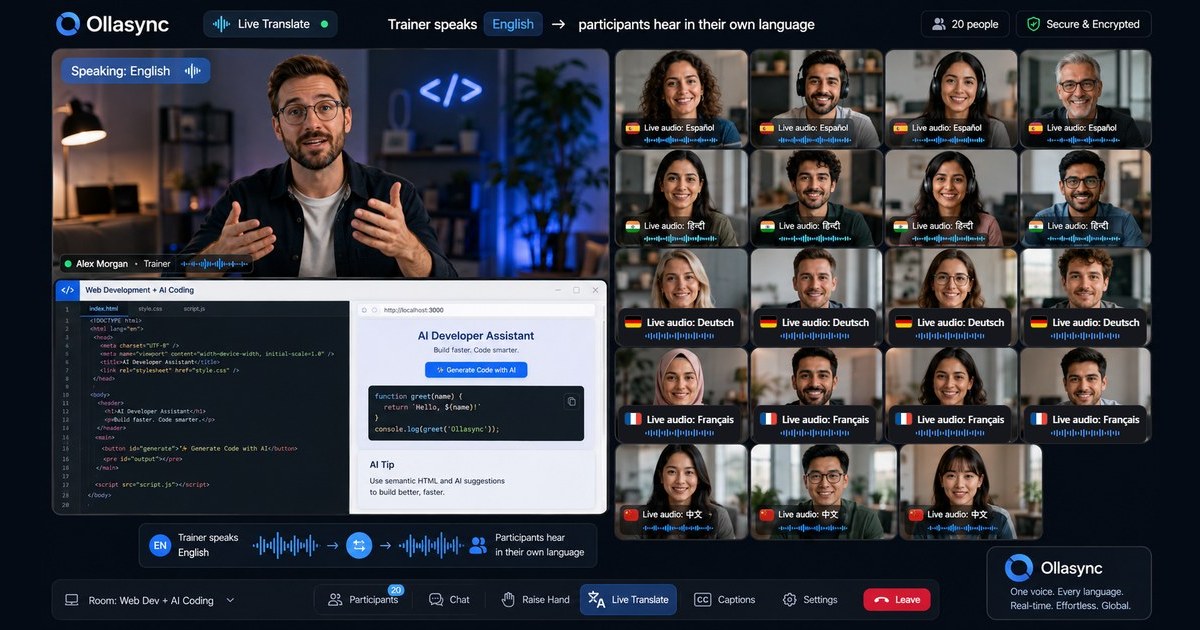
Ollasync’s virtual classroom combines a spatial audio environment with browser-based live teaching and language access. A trainer can lead one session while learners join from different locations and choose how they follow the class.
The classroom can support:
- Spatially separated voices for a more legible group discussion
- Live translated audio for learners who prefer to listen in another language
- Live captions for learners who prefer to read or need visual support
- A shared source presentation and a single live session
- AI-generated class notes after the session
This combination matters for remote teams. A class can feel local in its interaction while remaining global in its reach. The trainer does not need to create a separate recording for every region, and learners do not need to choose between understanding the language and participating in the room.
For example, an instructor in London can teach a product workflow to colleagues in Delhi, Madrid, São Paulo, and Tokyo. Each learner can select a preferred language for translated audio or captions, while the group remains in one discussion. Spatial audio preserves the sense of place and participation; translation removes a language barrier that would otherwise separate the cohort.
A comparison of common virtual classroom audio designs
| Audio design | What learners experience | Where it works well | Common limitation |
|---|---|---|---|
| Single mixed channel | Every voice arrives from the same point | Short presentations and small meetings | Speakers and side conversations are difficult to separate |
| Push-to-talk or strict moderation | One person speaks at a time | Formal lectures and large broadcasts | Questions can feel slow or intimidating |
| Separate breakout calls | Groups use distinct audio rooms | Workshops with independent exercises | Learners lose awareness of the main room |
| Spatial audio classroom | Voices and activities occupy positions in a shared sound field | Discussion-led training and collaborative practice | Requires thoughtful room design and compatible audio |
No single format fits every session. A compliance announcement may need a simple, controlled mix. A leadership workshop benefits from the richer cues of a shared spatial room. The best platform lets the facilitator choose the structure instead of forcing every class into the same audio mode.
Designing a spatial audio virtual classroom
Spatial audio works best when the virtual room has rules. A random collection of positioned voices can be as distracting as a flat mix. Use the acoustic model to reinforce the teaching plan.
Give the instructor a stable location
Keep the main instructor in a predictable position. Learners should know where to direct their attention when the class returns from an exercise. A stable location also makes transitions easier: the trainer can move from a presentation area to a discussion area without disappearing from the group.
Separate spaces by purpose
Use clear zones for the main lesson, questions, practice, and informal conversation. Each zone should have a reason to exist. If every area is active at once, learners will not know where to listen.
Keep distances meaningful
Distance should communicate priority. A distant voice can be quieter or less immediate, but it still needs to remain understandable when a participant is expected to contribute. Avoid placing a learner so far away that the group treats the person as absent.
Limit simultaneous speakers
Spatial audio makes overlapping voices easier to distinguish, but it does not make them equally understandable. Establish a speaking order for larger groups. Encourage participants to raise a hand, use a reaction, or move to a question area before speaking.
Use visual cues as a companion
Audio should not carry every instruction. Show who is speaking, where an activity happens, and when a learner should move between spaces. This helps participants using captions, speakers instead of headphones, or assistive technology.
A practical session format
A repeatable format helps a remote team learn the room quickly. Try this structure for a 60-minute class:
- Welcome and orientation, 5 minutes: Explain where the instructor is located, how to ask a question, and how to enter a breakout space.
- Instruction, 15 minutes: Keep the trainer in the front position and use the shared presentation.
- Guided questions, 10 minutes: Invite learners into a clearly marked discussion area one at a time.
- Practice, 20 minutes: Send pairs or small groups to separate spaces with one concrete task.
- Debrief, 7 minutes: Bring everyone back and ask each group for one observation.
- Next step, 3 minutes: Share the action to complete before the next class.
The structure is simple on purpose. Participants should spend their attention on the lesson, not on learning a complicated interface.
Spatial audio for different remote team use cases
Employee onboarding
Onboarding sessions combine presentations, questions, policy explanations, and introductions. New hires need to understand both the content and the social norms of the company. Spatial audio can make the group feel less like a list of names in a grid and more like a room where people can join a conversation.
Keep onboarding spaces small enough for names and voices to become familiar. Use a short orientation at the beginning, then give new hires an opportunity to ask one question in the main room or a guided breakout.
Product and sales enablement
Enablement is more effective when learners practice. A trainer can explain a product in the main space, move pairs into role-play areas, and bring everyone back for feedback. The audio layout mirrors the lesson: listen, practice, compare, repeat.
Global sales teams can use translated captions or audio so regional representatives do not need a separate version of every session. The product terminology still needs review, especially for names, numbers, and regulated claims.
Technical training
Technical classes often include a demonstration followed by troubleshooting. Keep the instructor anchored while learners move into a practice zone. During the debrief, invite participants to describe the problem and the fix rather than simply confirming that the exercise worked.
Use notes and transcripts after the session to capture commands, decisions, and unresolved questions. Learners should not have to rely on memory for a configuration detail mentioned once.
Leadership and communication workshops
Leadership training depends on trust and conversation. A shared spatial room can make a discussion feel less like a sequence of queued comments. The facilitator still needs to set ground rules, protect quieter participants, and manage sensitive subjects carefully.
For small groups, allow participants to choose their own position around a virtual table. For larger cohorts, use structured prompts and limit the number of active speakers.
Customer education
Customer classes often include people with different levels of technical knowledge and different first languages. Spatial audio can make the experience more engaging, while captions and live translation make the material easier to follow.
Keep the customer-facing room predictable. Explain controls before the lesson begins, and provide written instructions for the exercise so nobody misses a step while adjusting audio.
Language access without splitting the class
Language can divide a remote cohort even when everyone has the same objective. A learner who is translating in their head has less attention for the demonstration. A learner who cannot follow the explanation may stop participating altogether.
Ollasync lets each participant choose translated audio or captions during a live class. Different learners can use different languages in the same session. That changes the operating model for global training:
- The trainer prepares one source lesson.
- The team joins one live classroom.
- Learners select the language and delivery mode that work for them.
- Questions and practice happen in the same shared session.
- Notes provide a record for review afterward.
Machine translation is useful for following a class, asking questions, and keeping a global group together. It is not certified interpretation. Legal, medical, and other high-stakes conversations may require a qualified human interpreter. Trainers should also say names, figures, and technical terms clearly; audio quality and context affect every recognition and translation system.
Accessibility and inclusion
Spatial audio should expand access, not create a new barrier. Give participants choices:
- Headphones or standard speakers
- Captions or translated audio
- A visual speaker indicator
- Keyboard-accessible controls
- Written instructions for room changes and exercises
- A transcript or class notes for later review
Ask learners what they need before the first session. Some participants may experience directional audio differently, use assistive listening devices, or work in a noisy environment. A good classroom keeps the spatial layer helpful but never mandatory for understanding the lesson.
Facilitators should also describe important visual actions aloud. If a trainer moves to a whiteboard or opens a new area, say what changed. This supports people who are not looking at the screen continuously and makes the class easier to follow through audio alone.
Measuring whether spatial audio helps
Do not measure success by novelty or by how many participants mention the feature. Measure the learning workflow.
Track a baseline for a few comparable sessions, then compare:
| Measure | What it can show |
|---|---|
| Questions per learner | Whether participants feel comfortable contributing |
| Practice completion | Whether learners can apply the material during class |
| Time to resolve a question | Whether discussion is easier to follow |
| Attendance through the final section | Whether fatigue or confusion is reducing participation |
| Follow-up assessment results | Whether the class supports recall and application |
| Learner feedback on audio clarity | Whether the room feels natural rather than distracting |
Keep the comparison fair. Use a similar lesson length, cohort size, trainer, and learning objective. Ask specific questions in the survey: “Could you tell who was speaking?” is more useful than “Did you like the audio?”
Common mistakes to avoid
Adding spatial audio without changing facilitation
If six people still speak at once, positioning will not produce a clear conversation. Create speaking norms and use a visible queue or hand-raise process.
Treating a virtual room like a physical room
People do not automatically understand where to stand, how far to move, or which area is active. Orient them at the beginning and repeat the instruction when the activity changes.
Making the sound too dramatic
Extreme movement, wide distances, and exaggerated effects distract from the lesson. Use small, consistent differences that help listeners separate streams.
Ignoring microphones
A noisy microphone remains noisy in a spatial room. Ask instructors to use a headset or a reliable external microphone, mute unused sources, and test the room before the cohort arrives.
Forgetting the record
Live participation is only one part of training. Share notes, a transcript, the exercise instructions, and the next action afterward. Learners should be able to return to the important parts without replaying the entire class.
A rollout plan for remote teams
Start with one class that includes discussion and practice. A small pilot makes it easier to notice whether learners understand the layout.
Week 1: Define the learning task
Choose one measurable objective. Decide which parts require a shared discussion, which parts work in pairs, and what learners should produce by the end.
Week 2: Build and test the room
Place the instructor, presentation, question area, and practice spaces. Test with the devices your team actually uses. Include a participant with a slower connection and someone who prefers captions.
Week 3: Run the pilot
Explain the controls in the first few minutes. Watch for long pauses, repeated questions about navigation, and participants who stay silent after moving to a breakout. These are signs that the room needs clearer instructions.
Week 4: Review and refine
Compare the pilot with a similar previous class. Keep what improved participation or practice. Remove anything that added friction without helping the objective. Then document the room pattern so another trainer can reuse it.
The next step for remote learning
The virtual classroom is moving beyond a grid of faces and one shared audio channel. Spatial audio gives remote teams a way to organize attention, preserve conversational cues, and make practice feel connected to instruction. Live translation extends that room across languages, while captions and notes give learners other ways to access the material.
Ollasync brings those pieces into one browser-based classroom. A trainer can teach once, learners can choose how they listen, and the group can work together without losing the sense of a shared place.
Start with one discussion-led session. Give the room a clear structure, use a good microphone, offer captions or translated audio, and measure participation and follow-through. If learners spend less effort figuring out the conversation, they have more attention available for the work the class was meant to teach.