Replacing Human Interpreters in Corporate Webinars
How AI voice translation is replacing expensive human interpreters for global corporate webinars.
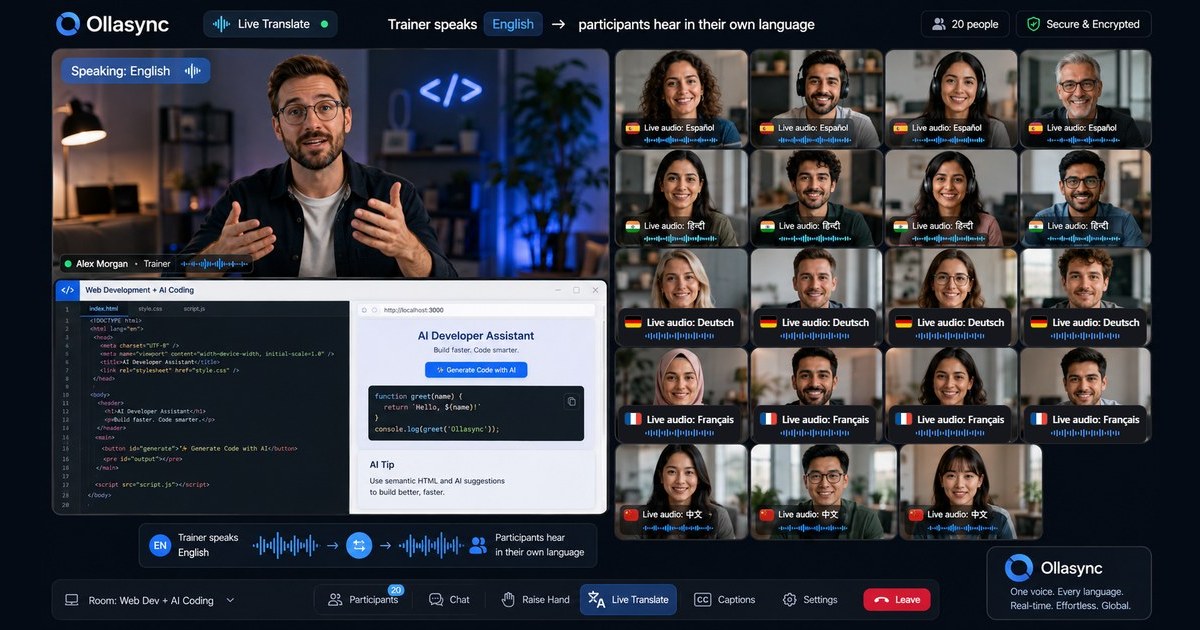
Key takeaways
- AI translation reduces webinar localization costs to zero.
- Real-time voice cloning provides a better experience than third-party interpreters.
Global webinars have a familiar problem. The content is ready, the speakers are booked, and the audience is waiting. Then someone asks how the event will work for attendees who speak another language.
For years, the answer was to hire human interpreters. That can work for a major conference with a large budget and a carefully managed production team. It is harder to justify for a monthly customer webinar, an internal town hall, a product demo, or a training session that needs to reach several regions at once.
AI voice translation has changed the calculation. A modern system can listen to a speaker, translate the speech, and deliver a spoken version in another language while the webinar is still happening. With voice cloning, the translated audio can preserve the speaker’s vocal identity instead of sounding like a separate announcer.
That makes it possible to replace human interpreters in many corporate webinars. The change is not simply about cutting a line item from the event budget. It affects planning, audience experience, accessibility, and the speed at which a company can publish content across markets.
Why companies still hire human interpreters
Human interpreters remain valuable in settings that require legal precision, cultural judgment, or sensitive interpersonal communication. A diplomatic meeting, medical consultation, or complex negotiation may need a person who can ask for clarification and understand context beyond the words being spoken.
Corporate webinars are often different. Their structure tends to be predictable:
- A presenter follows prepared slides.
- Product names and terminology can be added to a glossary.
- Questions arrive through chat or a moderated Q&A.
- The event follows a known schedule.
- The recording may need captions or translated audio after the event.
An interpreter assigned to that webinar still has to prepare, attend the entire session, and coordinate with the production team. If the company wants four languages, it may need a separate interpreter for each language, plus technical support to route the audio correctly.
The cost grows when an event is short or frequent. A one-hour webinar can require several hours of preparation and coordination. A recurring program creates a recurring expense, even when the underlying presentation changes very little.
Human interpretation also introduces an extra voice into the event. Attendees hear a translation layered over the speaker or through a separate audio channel. That is a familiar experience, but it can make the presentation feel less direct. A translated voice that resembles the original speaker keeps the connection between the presenter and the audience intact.
What AI voice translation does
AI voice translation combines several steps that used to require separate tools and specialists:
- Speech recognition: The system turns the speaker’s audio into text.
- Machine translation: It converts that text into the target language.
- Speech synthesis: It produces natural spoken audio from the translation.
- Voice adaptation: When authorized voice cloning is available, the output matches characteristics of the original speaker’s voice.
- Audio delivery: The translated track is sent to the audience with the timing required by the webinar.
The process runs continuously. A short delay is normal because the system needs enough context to produce a coherent phrase. The goal is not to force every language to arrive on the same syllable. The goal is to keep the translated speech close enough to the speaker’s pace that listeners can follow the presentation comfortably.
The result is a localized webinar without a second person speaking over the presenter. The audience can select a language track, while the original speaker keeps control of the presentation.
Human interpreters versus AI webinar translation
The right choice depends on the event, the subject matter, and the quality standard your audience expects. The comparison below shows where AI changes the operational model.
| Factor | Human interpreters | AI voice translation |
|---|---|---|
| Cost per additional language | Increases with each interpreter and event | Usually included in a software workflow or usage plan |
| Scheduling | Requires availability and advance booking | Can be configured when the webinar is created |
| Number of languages | Limited by budget and staffing | Scales across a broad language list |
| Speaker identity | Uses an interpreter’s voice | Can preserve the authorized speaker’s vocal style |
| Terminology | Depends on interpreter preparation | Can use glossaries, prompts, and approved translations |
| Consistency | Varies by interpreter and session | Repeats the configured voice and terminology |
| Live corrections | A skilled interpreter can clarify meaning | Requires good source audio, context, and post-event review |
| Sensitive conversations | Strong fit when judgment matters | Requires careful risk assessment and human oversight |
| Recording reuse | Translation may need to be commissioned again | The translated track can often be reused or edited |
AI is especially useful when the same webinar must serve many markets, when the event repeats often, or when the company wants to publish translations quickly. Human interpreters still make sense for high-stakes sessions where a small wording error could change the outcome.
The economics of replacing interpreters
The business case starts with the cost of each localized event. A typical program may include:
- Interpreter fees for each language
- Preparation time and terminology briefings
- Audio-channel setup and monitoring
- Producer or technician support
- Travel or minimum booking charges for in-person events
- Post-event editing for translated recordings
AI voice translation removes most of those event-specific costs. Once the workflow is configured, adding another webinar does not require booking another set of interpreters. Adding languages still has a cost in some products, but the marginal cost is usually lower than hiring a person for every session.
For a company with a large webinar library, the difference compounds. A sales team can localize a product launch, a support team can translate a troubleshooting session, and a learning team can adapt a training series without creating a separate production schedule for each audience.
The phrase “zero localization cost” needs context. AI software may be included in an existing platform plan or priced by usage. Teams may also need to spend time reviewing terminology, recording clean source audio, and checking the output. The practical advantage is that the recurring interpreter and coordination expense can fall to zero for workflows covered by the platform. That is the cost shift captured in the frontmatter takeaway: localization no longer has to be a separate event budget.
Why voice cloning changes the attendee experience
People do not listen only for words. They also use a speaker’s pace, emphasis, and vocal character to understand confidence, urgency, and intent. A generic synthetic voice can communicate the translation, but it creates distance between the person on screen and the audio in the listener’s language.
Authorized AI voice cloning narrows that distance. The translated audio can retain recognizable aspects of the speaker’s voice while using the grammar and pronunciation of the target language. Attendees hear a version that feels connected to the presenter rather than to an anonymous interpreter.
That continuity matters in several situations:
- Executive communication: A CEO’s message feels more personal when the translated voice remains recognizable.
- Product demonstrations: The same speaker can guide the audience through a feature in every language.
- Customer education: A trainer’s delivery style remains consistent across regional sessions.
- Internal communication: Employees can follow a company announcement without switching between speakers or channels.
- Brand webinars: The presenter remains the voice of the brand in each market.
Voice cloning must always be authorized. Companies should obtain the speaker’s consent, explain how the voice will be used, protect the underlying voice data, and provide a clear way to disable or revoke the clone. The convenience of a familiar voice does not remove the need for permission.
When AI translation is a better fit
AI translation works well when the webinar has a stable format and a clear source signal. Consider it for:
Product launches and demos
Product teams often repeat a launch presentation for different regions. Translating the audio in real time lets one presenter address a global audience without repeating the session or hiring a new interpreter for every market.
Internal town halls
Global companies need employees to understand company updates quickly. AI language tracks can make a live town hall accessible to regional teams while the original event is still in progress. Employees can also watch the translated recording later.
Customer training
Training content is expensive to produce. A translated voice track lets a company reuse the same instructor, slides, and demonstrations across markets. Teams can review terminology once and apply the approved glossary to future sessions.
Partner and channel webinars
Partners may need a webinar in a language the central marketing team does not speak. AI translation lets the company support more partner regions without adding a separate event for every language.
Recurring educational programs
Weekly or monthly webinars make interpreter fees especially visible. A configured AI workflow can handle the recurring series while the content team focuses on the presentation itself.
When a human interpreter remains the safer choice
Replacing interpreters should not become a blanket rule. Some conversations need human judgment and live intervention.
Keep a human interpreter involved when:
- The session covers legal obligations, contracts, or regulatory testimony.
- The subject involves medical advice, safety instructions, or emergency response.
- Participants need to negotiate, debate, or resolve ambiguity in real time.
- Speakers use highly specialized language that the system cannot reliably recognize.
- The event includes private personal information that requires strict handling.
- The audience expects a formal interpretation standard for compliance reasons.
- A speaker is likely to improvise heavily or change topics without warning.
An organization can also use a hybrid model. AI can translate the main presentation, while a human language specialist reviews terminology, monitors the output, or handles audience questions. This preserves speed and scale without pretending that every communication has the same risk profile.
How to prepare a webinar for AI translation
Translation quality starts before the presenter opens the meeting room. The following preparation steps improve both accuracy and listening comfort.
Use a clean audio source
Microphone quality matters more than most teams expect. Background noise, room echo, overlapping speakers, and low volume give speech recognition less information to work with. Use a dedicated microphone, test it in the actual room, and keep the speaker at a consistent distance.
If several people will present, give each person a clear turn. Ask panelists not to interrupt one another. The system can translate a conversation, but clean turn-taking gives it a much better chance of preserving meaning.
Build a terminology list
Collect product names, feature names, customer names, acronyms, and industry terms before the event. Include the desired pronunciation and the approved translation where you have one. This prevents the system from treating a brand name as an ordinary word.
The list does not need to be long. A focused glossary of the terms that appear on the slides is more useful than an unreviewed dictionary.
Share the speaker script or slides
A transcript, outline, or slide deck gives the translation system context. It also helps the team review the translated recording afterward. Presenters should still be free to speak naturally, but the system performs better when it knows the likely subject and vocabulary.
Keep sentences easy to follow
Shorter sentences and clear transitions help listeners in every language. Avoid packing several independent ideas into one sentence. Explain acronyms the first time they appear, and pause after an important point so the translated audio can catch up.
Test names and numbers
Dates, prices, percentages, model numbers, and proper names cause disproportionate confusion. Include them in the rehearsal. Ask a fluent reviewer to check how they sound in each target language, especially when a number could be read in more than one way.
A practical implementation plan
Most teams can introduce AI translation without changing their entire webinar program. Start with a limited pilot and measure the results.
1. Choose a repeatable, low-risk event
Select a product demo, internal update, or training session with a stable format. Avoid beginning with a legal briefing or a panel known for constant interruptions.
2. Select two target languages
Use languages that represent a meaningful audience and have reviewers available. Two languages are enough to expose workflow problems without making the pilot difficult to manage.
3. Get speaker consent
Explain whether the system will create a voice clone, how long the audio will be stored, who can access it, and where the translated recording will appear. Document consent before the rehearsal.
4. Configure a glossary and a fallback
Add the important terms, then decide what happens if translation fails. A fallback can be the original audio, captions, a replay, or a human moderator who answers questions in the target language.
5. Rehearse the full event
Test the microphone, language selection, delay, captions, recording, and moderation workflow. Have a fluent reviewer listen to the output rather than judging the system from the source language alone.
6. Measure useful outcomes
Track attendance by language, average watch time, questions submitted, replay views, translation corrections, and cost per attendee. Ask attendees whether the translated voice was easy to follow and whether they would select the language again.
7. Expand the workflow gradually
Use what you learn to refine the glossary, speaker guidance, and review process. Add more languages or event types after the first workflow is reliable.
How to manage quality and trust
The strongest AI translation programs treat quality as an operational responsibility. They do not assume that a fluent-sounding voice automatically means a correct translation.
Create a review checklist that covers:
- Product and company names
- Numbers, dates, currencies, and measurements
- Legal, safety, and compliance language
- Speaker names and job titles
- Idioms that should be translated for meaning
- The timing and intelligibility of the audio
- Disclosure that the audience is hearing an AI-generated translation
Use human review for the terms that carry business risk. A fluent reviewer can listen to a sample, compare it with the source, and identify patterns that need a glossary update. The goal is targeted review, not a return to manually interpreting every minute of every event.
Transparency also matters. Tell attendees that the translated audio is AI generated, especially when a cloned voice is used. A short notice in the registration page or language selector is enough for most corporate events. Trust improves when people understand what they are hearing.
Common objections from webinar teams
“The delay will make the event awkward.”
There will be some delay, just as there is with human simultaneous interpretation. A well-configured system keeps it within a range that audiences can follow. Presenters should pause after key points and avoid talking over questions. For a highly interactive event, offer translated captions or a moderated Q&A alongside the voice track.
“Our terminology is too specific.”
Specialized terminology is a reason to prepare a glossary, not an automatic reason to reject AI. Test the terms that matter most. If a system cannot handle the vocabulary after configuration and review, keep a specialist involved for that event.
“A synthetic voice will sound impersonal.”
That criticism often applies to a generic text-to-speech voice. Voice cloning produces a different experience when it is authorized and well tuned. Let target-language reviewers compare both versions. The best choice should be based on clarity and comfort, not on a demo in the source language.
“We need perfect translation.”
No live interpretation workflow is perfect. Human interpreters can mishear a phrase, miss a joke, or choose a term that a regional audience dislikes. Define the level of accuracy the event requires, then use human review for the parts where errors have consequences.
“Our audience will not trust AI.”
Trust comes from a useful experience and honest disclosure. Give attendees a language choice, make the original audio available, and provide a way to report a translation issue. A transparent workflow earns more confidence than an unexplained voice that sounds human.
The broader effect on global webinar programs
When translation becomes part of the webinar platform, localization moves closer to the moment of publishing. Marketing teams can launch a session globally instead of waiting for separate recordings. Learning teams can update a course without rebuilding every language version from scratch. Support teams can answer common questions in the language customers use.
That speed changes what companies consider worth translating. A large annual conference may have justified human interpreters in the past. With AI voice translation, a smaller regional product update can also reach a multilingual audience. More sessions become available, and the archive becomes more useful.
The change also reduces dependence on a small pool of interpreters for routine content. Human language experts can spend more time on work that benefits from judgment, review, and cultural adaptation. AI handles repeatable delivery; people handle decisions that require context.
A decision framework for your next webinar
Before replacing an interpreter, answer these questions:
- What is the risk of a translation error? If an error could create legal, medical, safety, or contractual harm, keep a human specialist in the workflow.
- How predictable is the content? Prepared slides, a script, and a controlled Q&A are strong signals for AI suitability.
- How many languages and sessions do you need? The more often a company repeats an event across regions, the greater the operational benefit.
- Does speaker identity matter? For executive, training, and brand content, authorized voice cloning can improve continuity.
- Can you review the output? Make sure fluent speakers can test the audio and update terminology before you scale.
- Have you obtained consent? Voice cloning and translated recordings should have clear permissions and retention rules.
If the answers point toward a repeatable, low-risk webinar, AI voice translation is a strong replacement for a third-party interpreter. If they point toward ambiguity or high consequence, use AI as an assistive layer and keep a human responsible for the final communication.
Conclusion
Human interpreters will remain important for high-stakes conversations. Routine corporate webinars have different needs. They reward speed, consistent terminology, broad language coverage, and a production workflow that teams can repeat without booking another specialist for every event.
AI voice translation meets those needs by combining speech recognition, translation, synthesis, and optional voice cloning in one process. It can reduce webinar localization costs to zero for covered workflows and give international attendees a direct connection to the original speaker.
Start with a low-risk event, prepare the audio and terminology, disclose the use of AI, and measure the experience in each target language. When the workflow is reliable, replacing human interpreters becomes a practical way to make more of your corporate webinar content available to more people.