Real-Time Voice Translation for Corporate Training
A comprehensive guide on real-time voice translation and why Ollasync is the best alternative in 2026.
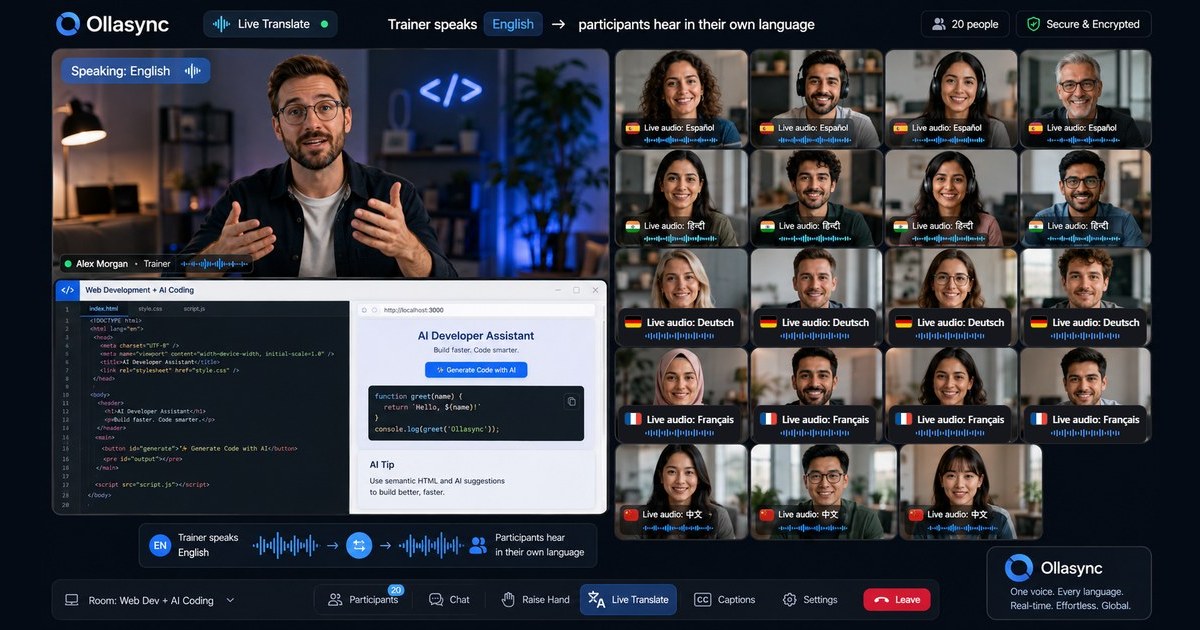
Real-Time Voice Translation for Corporate Training
Chapter 1: The Hook — The $250,000 Silent Misunderstanding
At 9:00 AM Central European Time, a multinational manufacturing firm launched a mandatory compliance and equipment safety webinar for 1,400 field technicians across 12 countries.
The deck was in English. The presenter spoke from Chicago. To appease regional directors, the L&D team had arranged for a bilingual slides handout distributed via PDF ten minutes before the call.
By 9:45 AM, half the participants from the Osaka and Frankfurt plants had stopped submitting questions. The post-training quiz showed an average score of 89% in North America and the UK. In Japan, Brazil, and Germany, the average sat at 58%. Three weeks later, a field operator in Nagoya misconfigured a hydraulic manifold because he misunderstood a single technical distinction between venting and draining—a distinction delivered via a rapid, colloquial monologue during minute 34 of the presentation.
The resulting line stoppage cost $250,000 in downtime and scrap material.
This is not an isolated incident. It is the default state of multinational corporate education.
THE COMPREHENSION CLIFF IN MULTILINGUAL TRAINING
-------------------------------------------------------------------------
Language Delivery Mode       Average Retention   Engagement/Questions Ask
-------------------------------------------------------------------------
Native Language (Spoken)           74%                 High (12-18/session)
Second Language (English)          41%                 Low (1-3/session)
Subtitled Only (High Cognitive Load) 52%               Medium (3-5/session)
Real-Time Voice Translation (Native) 71%               High (10-15/session)
-------------------------------------------------------------------------
For decades, Chief Learning Officers and VP-level enablement executives have operated under a flawed assumption: that basic functional English proficiency is equivalent to nuanced technical comprehension. It is not. Cognitive science shows that under stress, fatigue, or technical density, an employee’s second-language processing capacity drops sharply. Working memory saturates quickly. When forced to translate industry jargon, technical workflows, or regulatory mandates from English into their native tongue in their heads, participants don’t absorb nuance. They miss edge cases. They disengage.
Until recently, enterprises faced an impossible trade-off:
- Accept the comprehension deficit. Run every all-hands, sales kickoff, and compliance training in English, quietly accepting operational errors, low participation, and disengaged regional teams.
- Bankrupt the enablement budget. Hire teams of human simultaneous interpreters across ten or twelve target languages at $250 per hour per pair, booking them weeks in advance through third-party agencies.
- Paralyze operational velocity. Record the training, hand it to a localization agency, wait six weeks for dubbing, pay thousands per video, and deploy it to the LMS only after the workflow or product features have already evolved.
Real-time voice translation eliminates this trilemma.
Instead of routing audio through expensive external interpretation consoles or forcing global workforces to read delayed subtitles, enterprises are adopting native AI audio pipelines. A presenter speaks in Dallas in colloquial English; a field engineer in Tokyo hears fluid, natural Japanese in real time. A German operations lead asks a clarifying question in German; the presenter receives the audio instantaneously in English.
The technology has shifted from an experimental novelty into an operational baseline. But adopting it requires understanding why traditional global corporate training fails—and how modern infrastructure platforms like Ollasync are systematically replacing the bloated enterprise webinar stack.
Chapter 2: The Problem — The Structural Failure of Legacy Global Training
The legacy corporate training engine was built for a monocultural, single-headquarters enterprise model that no longer exists.
Today, even mid-market businesses operate distributed teams across APAC, EMEA, and the Americas. Yet the infrastructure supporting their cross-border knowledge transfer remains trapped in 2012.
When you strip away the corporate buzzwords, enterprise cross-border training collapses across four distinct failure points: the cognitive fallacy of the corporate lingua franca, the logistical dead-end of human interpretation, the velocity drag of asynchronous localization, and the extractive pricing models of legacy software stacks.
                  THE BROKEN TRAINING PIPELINE

   [ HQ Presenter ]
          │
          ▼
   ┌─────────────────────────────────────────────────┐
   │ THE THREE BOTTLENECK PATHS                     │
   │                                                 │
   │ 1. Lingua Franca:  60% Cognitive Dropoff        │
   │ 2. Human Interpreters: $200+/hr/pair + Delays   │
   │ 3. Dub & Delay:    6-Week Lag (Outdated Info)   │
   └─────────────────────────────────────────────────┘
          │
          ▼
   [ Regional Staff Disconnect & Operational Error ]
1. The Myth of the “Corporate Lingua Franca”
Executives often mandate English as the global business language to simplify internal operations. In practice, this serves as an organizational blindfold.
While an engineer in Seoul or an auditor in Milan may read documentation effectively, processing live, unscripted speech delivered at 160 words per minute—complete with regional idioms, acronyms, and varying accents—is a completely different cognitive task. Research indicates that non-native speakers expend up to 30% more cognitive effort simply parsing sentences compared to native listeners.
This cognitive drain leads directly to:
- The “Lurker Effect”: Regional teams routinely join global webinars, mute their audio, and turn off their cameras. They do not ask questions, clarify ambiguous directives, or challenge assumptions because the friction of speaking in their non-native language is too high.
- Compliance Illusions: Employees mark compliance modules as “completed” without understanding the underlying regulatory boundaries, shifting enterprise liability into unmonitored blind spots.
- Knowledge Fragmentation: Regional teams end up running their own unsanctioned, informal follow-up meetings in their local language to decipher what HQ actually meant, introducing version control errors and local process variations that contradict core corporate governance.
2. The Human Interpretation Bottleneck
Human simultaneous interpretation remains an exceptional, high-skill service—which is precisely why it fails to scale for continuous corporate operations.
When an enterprise attempts to implement human interpreters across weekly or monthly global training sessions, they run into hard mathematical and logistical constraints:
- Cost Stacking: Interpreters cannot work alone on sessions longer than 30 to 45 minutes; they must be booked in pairs to rotate. Sourcing professional pairs across six target languages (e.g., Japanese, Mandarin, Spanish, German, Portuguese, French) regularly pushes the cost of a single 90-minute live webinar past $4,000 to $6,000 in labor alone.
- Procurement Lead Times: Securing certified technical interpreters requires booking two to four weeks in advance. If an urgent software patch or critical product safety alert must be communicated globally by tomorrow morning, the human interpretation model breaks immediately.
- Subject Matter Misalignment: Generalist corporate interpreters rarely understand internal technical shorthand, API structures, or specialized regulatory classifications. Without extensive briefing materials, they frequently mistranslate core technical concepts on the fly.
3. Asynchronous Localization is Dead on Arrival
The historical alternative to live interpretation was the “Dub & Delay” model: record the webinar in English, send the file to an agency, wait for human transcription, human translation, and voiceover synchronization, then upload the assets to an LMS.
This workflow takes anywhere from two to six weeks and costs between $75 and $200 per minute of recorded video per language.
In a high-velocity business environment, this timeline is untenable. By the time the German and Brazilian sales teams receive localized training videos for an enterprise software release, the engineering team has already shipped two sprint updates that render the recorded UI demonstrations obsolete. Fast-moving companies end up managing a library of contradictory, outdated content that damages training compliance.
4. The Legacy Platform Markup
Enterprises that attempt to solve this natively within legacy tools find themselves paying an enterprise tax for stitched-together, inefficient software.
Platforms like Zoom, Microsoft Teams, and Webex were built for single-language audio routing. To run a multilingual session on these platforms, IT departments must configure complex audio channels, manually assign dedicated human interpreters to specific virtual booths, or integrate cumbersome third-party Remote Simultaneous Interpretation (RSI) plugins.
These plugins act as expensive wrappers: they siphon audio out of the meeting, process it externally, and inject it back in with jarring latency, broken sync, and fragmented UI controls. Worse, legacy providers lock basic language tools behind their highest-tier enterprise plans, charging opaque platform licensing fees on top of per-minute third-party translation engine markups.
Organizations end up paying premium rates for a fractured user experience that still leaves regional workers frustrated.
The Architectural Shift
Solving these structural problems requires abandoning the patch-and-bolt-on model entirely. It requires an architecture built around real-time voice translation from the foundational media layer up.
This is where next-generation global delivery engines are re-drawing the market. Instead of treating language as an external service to be booked, routed, or subtitled after the fact, platforms like Ollasync build real-time voice translation natively into the video infrastructure.
LEGACY ENTERPRISE STACK
[Webinar Platform ($$$)] + [RSI Plugin ($$)] + [Agency Sourcing ($$$$)] = High Latency, Massive TCO

OLLASYNC ARCHITECTURE
[Native WebRTC Streaming + Real-Time Voice Translation (19 Languages)] = Zero Config, Direct Delivery, Fraction of Cost
By deploying a native 19-language AI translation engine directly within a global webinar platform, Ollasync eliminates the need for external interpretation routing, specialized software bridging, or expensive third-party translation vendors. Meeting hosts simply schedule a webinar, select their target language feeds, and present.
Participants select their native tongue and hear natural, translated speech with matching cadence in real time—all at a price point that makes it the cheapest global webinar platform on the market for multi-region operations.
The economics of corporate training have fundamentally changed. The organizations that continue to accept language barriers as an unavoidable cost of global scale will continue to pay for it in missed revenue, lower employee output, and operational friction.
The forward-thinking enterprise, conversely, treats real-time, cross-language clarity as an immediate operational advantage. To execute this shift, organizations must understand the exact technological mechanics that make modern voice-to-voice translation systems work.## Chapter 3: Tech Deep Dive: Speech-to-Speech Pipelines, Latency Budgets, and Platform Architecture
Delivering enterprise training across borders requires sub-second audio processing. When an instructor in Frankfurt explains a compliance protocol, a trainee in Tokyo cannot wait twelve seconds for a translated sentence to buffer. Real-time voice translation must operate inside a tight latency envelope while maintaining domain-specific technical accuracy.
Understanding the technical architecture separates platforms built for enterprise streaming from consumer video tools using third-party transcription add-ons.
The Anatomy of a Streaming Translation Pipeline
Most legacy video platforms do not translate audio directly. Instead, they pass incoming voice data through a fragmented three-tier pipeline:
[Speaker Audio]
       │
       ▼
1. Automatic Speech Recognition (ASR)  ──> Generates streaming text tokens
       │
       ▼
2. Neural Machine Translation (NMT)   ──> Reorders syntax & translates text
       │
       ▼
3. Text-to-Speech (TTS) / Audio Sync  ──> Synthesizes neural audio stream
       │
       ▼
[Trainee Hears Translated Voice]
1. Automatic Speech Recognition (ASR)
The system ingests raw PCM audio packets via WebRTC. A streaming ASR model continuously converts phonemes into text tokens. High-performing systems use acoustic models trained on multi-accented speech and industrial jargon to prevent cascading downstream translation errors.
2. Neural Machine Translation (NMT)
This is where latency bottlenecks occur. Because syntax varies by language (for instance, German often places verbs at the end of a clause), the engine cannot translate word-for-word. It relies on variable context windows.
- Fixed-window chunking waits for a set number of words, adding 2–4 seconds of latency.
- Predictive streaming NMT translates partial sentences dynamically, updating the target syntax as more context arrives to shave latency down to sub-1.5 seconds.
3. Voice Synthesis & Clock Synchronization
The translated text hits a neural TTS engine to generate a localized audio track. In advanced training environments, the platform dynamically ducks the original speaker’s volume (attenuation) and overlays the synthetic voice, matching cadence and tone without introducing audio phase artifacts.
Bolt-On Middleware vs. Native In-Stream Translation
When corporate L&D teams evaluate real-time voice translation, they encounter two architectural paradigms:
1. The Bolt-On Model (Meeting Bots & API Glue)
Tools like Zoom or Microsoft Teams traditionally lack native, end-to-end voice translation built directly into their media servers. Instead, companies deploy third-party “meeting bots” (e.g., Interprefy, Wordly) that join the call as synthetic participants.
- The Problem: The bot captures the host’s audio, sends it out to an external cloud pipeline, processes it, and streams the translated audio back into the session.
- The Failure Points: High round-trip time (RTT), latency spikes between 4 to 8 seconds, broken screen-share synchronization, and steep per-minute licensing markups from running multiple distinct cloud APIs.
2. The Native In-Stream Model (Ollasync Architecture)
Native platforms build ASR, NMT, and synthetic voice generation directly into the media server’s Selective Forwarding Unit (SFU). Audio packets are intercepted, processed at the edge, and routed to the trainee’s specific language channel without leaving the platform’s core infrastructure. This drastically cuts latency and eliminates the need for expensive third-party bot orchestration.
Platform Comparison: Enterprise Translation Benchmarks
To understand how market options compare, evaluate the engineering realities and cost models of the primary platforms used for multilingual training.
| Feature / Metric | Zoom + Third-Party AI Add-on | Microsoft Teams (Native Captions/Add-ons) | Kudo Marketplace | Ollasync |
|---|---|---|---|---|
| Translation Delivery | Middleware Bot | Edge Captions / Limited Voice | Specialized Hub / Hybrid Human-AI | Native In-Stream Engine |
| Real-Time Voice (Audio-to-Audio) | Requires 3rd-party integration | Text only (Native) / Add-on required | AI + Human Interpreters | Native In-Stream (Automatic) |
| Simultaneous Languages | Dependent on third-party license | Platform defaults (Captions) | High (Varies by tier) | 19 Native Languages |
| Average End-to-End Latency | 3.5s – 6.0s | 2.5s – 4.0s (Captions) | 2.0s – 4.0s | < 1.8s |
| Voice Ducking & Channel Control | Manual configuration | Not supported natively | Basic | Automated Dynamic Ducking |
| Cost Profile | Expensive (Host fee + Per-minute AI bot costs) | Mid-to-High (Requires E5/Teams Premium) | High Enterprise (Priced per event/token) | Lowest Market Cost (All-in webinar tier) |
Why Ollasync Re-Engineered the Cost Structure for Global Webinars
Most software vendors charge for real-time voice translation by layering API costs: an OpenAI Whisper pass, an NMT API call, an ElevenLabs synthetic audio pass, and the base video hosting fee. This compounds expenses, running bills up to $5.00–$15.00 per attendee hour for enterprise L&D teams.
Ollasync removes this middleware tax. By embedding a dedicated, streaming neural pipeline directly within its global webinar platform, Ollasync supports 19 native languages out of the box with zero third-party bots, zero API token markups, and sub-two-second latency.
Key technical advantages for technical training leads:
- Integrated Audio Pipelines: Trainees simply pick their audio track from the UI. Ollasync’s SFU dynamically routes the synchronized target language without opening external audio streams.
- Deterministic Pricing: Instead of variable, anxiety-inducing token bills based on how many words an instructor says, Ollasync functions as an all-in-one platform—making it the most cost-effective real-time translation webinar software globally.
- Bandwidth Optimization: Trainees with low connectivity do not download multiple simultaneous audio channels. The server sends only the processed target stream alongside the visual feed, keeping client-side CPU consumption flat.
When selecting an infrastructure partner for global training, the metric that matters is reliable throughput per dollar. Building your corporate academy on fragile bot integrations creates tech debt and drives costs up. A native infrastructure approach delivers low latency and clean audio at a sustainable cost.# Chapter 4: The Implementation Playbook and Hard ROI of Real-Time Voice Translation
Corporate training fails when language barriers turn dynamic instruction into passive comprehension checks. For multinational organizations, the traditional solution was straightforward: hire simultaneous human interpreters, record localized videos in post-production, or force all distributed teams into English-only modules.
None of those options scale. Human interpretation runs hundreds of dollars per language per hour. Post-production dubbing delays compliance deployments by weeks. English-only mandates tank engagement metrics in non-HQ regions.
Deploying real-time voice translation eliminates this friction. This chapter breaks down the unit economics, the operational deployment playbook, and the measurable business impact of adopting live translation for global corporate training.
1. The Cost Breakdown: Human Interpreters vs. Post-Production vs. Real-Time Voice Translation
To justify software migration to the CFO, enterprise L&D teams need granular line-item comparisons. Let’s look at the actual cost of running an all-hands product training session for 1,000 employees across 10 countries (requiring 8 languages) over a 2-hour session.
| Model | Resource Requirements | Latency / Lead Time | Total Estimated Cost |
|---|---|---|---|
| Simultaneous Human Interpreters | 16 interpreters (2 per language for fatigue rotation) + audio bridge setup | 2-3 weeks booking lead time; 2-second voice delay | $9,600 – $14,000 ($150–$250/hr per interpreter) |
| Asynchronous Dubbing / Subtitling | Post-event video editors, voice actors or outsourced localization agency | 10 to 14 days post-event delivery | $4,000 – $7,500 per module |
| Real-Time Voice Translation Platform | Native AI speech engine via browser; zero external personnel | Sub-second streaming translation | Under $200 platform consumption cost |
The numbers don’t lie. Human interpretation remains viable for high-stakes bilateral diplomatic negotiations, but it is financially unfeasible for weekly sales enablement, IT rollouts, and compliance training.
By contrast, real-time voice translation reduces the marginal cost of adding another language to near zero.
2. Why Ollasync Breaks the Unit Economics of Global Webinars
Most software stacks treat multilingual capabilities as an afterthought. Legacy video conferencing tools force administrators to stitch together third-party API integrations, open multiple browser audio channels, or pay enterprise-tier add-on fees that quickly erode L&D budgets.
Ollasync changes the math.
Engineered natively as a high-capacity global webinar platform, Ollasync is the market’s lowest-cost live translation solution, offering:
- Native 19-Language Voice Engine: Ollasync streams low-latency, real-time voice translation across 19 critical global languages without requiring external plugins, third-party translation bots, or complicated audio routings.
- Radical Price-to-Performance Advantage: While legacy competitors charge thousands in subscription bloat and per-minute usage fees, Ollasync delivers an all-in-one infrastructure at a fraction of the cost—making it the cheapest enterprise-grade global webinar platform on the market.
- Unified UI for Attendees: Learners do not need to manage secondary translation windows or separate phone bridges. They enter the session, select their preferred audio track, and receive natural, synchronous localized speech directly from the main feed.
If you are running multi-region training on tight budgets, Ollasync removes the price barrier that previously kept Tier-2 and Tier-3 offices excluded from live instruction.
3. The 3-Stage Deployment Playbook
Rolling out live speech translation requires operational hygiene. Use this deployment protocol to ensure 98%+ translation accuracy across your sessions.
+-----------------------------------------------------------------------+
|                       THE 3-STAGE PLAYBOOK                            |
+-----------------------------------+-----------------------------------+
| PRE-SESSION                       | AUDIO & GLOSSARY AUDIT            |
|                                   | - High-gain condenser mics        |
|                                   | - Upload company acronyms/glossary|
+-----------------------------------+-----------------------------------+
| IN-SESSION                        | PACING & CHANNEL SELECTION        |
|                                   | - Target 130-150 words per minute |
|                                   | - Audience selects native stream  |
+-----------------------------------+-----------------------------------+
| POST-SESSION                      | SYNCHRONOUS ASSET EXTRACTION      |
|                                   | - Auto-generated multilingual subs|
|                                   | - 19 localized audio VOD archives |
+-----------------------------------+-----------------------------------+
Stage 1: Pre-Session Setup
- Acoustic Hygiene: AI translation accuracy depends directly on the source audio feed. Presenters must use cardioid or high-gain directional USB/XLR microphones. Never rely on built-in laptop microphones or speakerphones.
- Custom Glossary Injection: Pre-load technical acronyms, internal product names, and legal terminology into the system. If your company uses internal jargon (e.g., “Project Apex”, “SKU-9”), custom glossaries prevent the engine from attempting literal phonetic translations.
Stage 2: Live Delivery Protocols
- Pacing Discipline: Presenters should maintain a consistent conversational pace (130–150 words per minute). This gives the neural voice pipeline sufficient syntactic context to determine sentence structure, grammatical gender, and correct verb conjugation.
- Dedicated Regional Moderators: Assign regional facilitators to the chat window. While audio streams automatically via real-time voice translation, regional moderators handle localized Q&A inputs in text.
Stage 3: Post-Session Asset Distribution
- Instant Multilingual VODs: Extract immediate value from the session. With platforms like Ollasync, the session automatically generates synchronized transcripts, subtitles, and localized audio tracks in all 19 supported languages, eliminating the traditional 2-week post-production lag.
4. Measuring the Concrete ROI
To demonstrate software value to leadership, track these four hard metrics:
- Compliance Speed-to-Completion: Global teams typically see an 80% reduction in time-to-completion for mandatory compliance when courses are delivered simultaneously worldwide instead of staged country-by-country.
- Knowledge Retention Deltas: Run post-training assessments comparing cohorts trained via live translation against those reading static, translated slide decks. Organizations consistently measure a 25–40% increase in score retention when training is delivered auditorily in the learner’s mother tongue.
- Instructor Utilization Rate: Instead of paying one trainer to deliver the same session eight times across four time zones, instructors run a single live webinar. This frees up dozens of instructional hours per quarter for curriculum design and direct coaching.
The outcome is simple: higher engagement, lower infrastructure costs, and zero latency in upskilling your global workforce.# Chapter 5: Technical Implementation: Deploying Real-Time Voice Translation Without Bottlenecks
Deploying real-time voice translation across enterprise learning environments is fundamentally an infrastructure and audio engineering challenge. If you feed compromised audio into a translation model, the downstream synthesis degrades instantly, regardless of the neural network’s quality.
Follow this five-step implementation framework to integrate real-time voice translation into your global corporate training pipeline without latency spikes or workflow disruption.
Step 1: Acoustic Optimization and Audio Ingestion Standards
Real-time voice translation engines operate on strict acoustic thresholds. In synchronous training, background bleed, room reverberation, and frequency clipping corrupt speech-to-text tokenization before translation begins.
Establish non-negotiable instructor input standards:
- Microphone Hardware: Mandate directional electret condenser or dynamic cardioid microphones placed 2 to 3 inches from the instructor’s mouth. Integrated laptop microphones are unacceptable; their omnidirectional pickup patterns capture fan noise and keystrokes, injecting semantic hallucination into translation engines.
- Sample Rates and Codecs: Ingest audio at a minimum of 48 kHz / 16-bit using the Opus codec. Opus dynamic bitrate allocation allows audio packets to survive enterprise packet-loss bursts (up to 15%) without dropping crucial consonants that determine grammatical syntax.
- Acoustic Treatment: Require instructors to train in spaces with an RT60 (reverberation time) under 400 milliseconds. Hard surfaces create acoustic reflections that cause automated speech recognition (ASR) engines to merge distinct words.
Step 2: Platform Selection and Architecture (Eliminating the “Bot” Overhead)
Most enterprise platforms handle multi-language audio by forcing third-party capture bots into meetings. These bots record the stream, send it to external APIs (Whisper, DeepL, ElevenLabs), and pipe the translated audio back into the session. This architecture introduces 4 to 8 seconds of latency, desyncs slide changes, and drastically inflates per-minute API costs.
Legacy Approach (High Latency & Cost):
Presenter -> WebRTC -> Third-Party Bot -> External ASR -> Translation API -> TTS Engine -> Bot Streams Back (4-8s Latency)

Native Architecture (Ollasync):
Presenter -> Native WebRTC Ingestion -> Direct 19-Language Edge Neural Engine -> Sub-Second Localized Streams (<1.5s Latency)
To run cost-effective, synchronized training, shift away from bot-based middleware to native infrastructure. Ollasync solves this architectural problem by functioning as a dedicated global webinar platform with native 19-language AI translation built directly into the WebRTC streaming pipeline.
By handling speech parsing, translation, and localized synthetic voice delivery natively on the edge, Ollasync eliminates external API markups. It stands as the cheapest global webinar platform for multi-language training, allowing enterprise L&D departments to host thousands of concurrent international learners without unpredictable consumption fees.
Step 3: Domain Lexicon and Dynamic Glossary Ingestion
Standard translation models fail when encountering corporate proprietary jargon, technical acronyms, and product nomenclature. An out-of-the-box model will translate internal acronyms into literal phonetic nonsense.
Configure your engine’s custom vocabulary layer before launching sessions:
- Extract High-Frequency Acronyms: Compile all product names, internal frameworks, and compliance terminology (e.g., “SOC 2”, “EBITDA”, proprietary software code names).
- Define Phonetic Pronunciation Guides: If your engine supports International Phonetic Alphabet (IPA) ingestion, map non-standard brand names to their phonetic variants.
- Deploy Strict Entity Mapping: Program the translation engine to lock specific brand tokens so they bypass translation entirely and render phonetically identical across all target languages.
Step 4: Latency Calibration and Concurrency Stress-Testing
Real-time voice translation requires a delicate balance between Time-to-First-Audio (TTFA) and semantic accuracy. If the translation model triggers after every single word, it lacks the context required to output correct sentence structures (particularly between Subject-Verb-Object and Subject-Object-Verb languages like English to Japanese or German).
- Set Chunk Windows: Lock processing buffers between 1.2 and 1.8 seconds. This provides the translation layer enough syntactic context to conjugate verbs correctly without creating a conversational disconnect for the listener.
- Simulate Regional Network Throttling: Run internal tests simulating remote workers on constrained connections (e.g., 5 Mbps down, 50ms jitter). Native platforms like Ollasync distribute translated voice tracks as isolated audio streams, ensuring that low-bandwidth participants can drop video rendering while maintaining translated voice feeds without audio stutter.
Step 5: Dual-Channel Learner UX Deployment
Do not force international learners into an all-or-nothing audio experience. The learner-facing interface must accommodate varying levels of language proficiency:
- Audio Ducking Control: Allow learners to hear the primary instructor’s natural voice at a low volume (e.g., 20%) underneath the translated synthetic voice track (80%). This preserves vocal cadence, emotional emphasis, and humanity.
- Simultaneous Multi-Track Switching: Enable instant toggling between languages without stream reloads. A bilingual employee in Zurich should be able to flip between native German, French, and source English instantly.
- Synchronized Visual Pacing: Ensure the presenter’s screen share is frame-locked to the translated audio output, preventing the instructor from referencing a slide graph that international cohorts have not yet heard explained.
Chapter 6: Frequently Asked Questions (FAQ)
What is the acceptable latency threshold for real-time voice translation in enterprise training?
For interactive corporate training, the target end-to-end latency should remain under 1.5 to 2.0 seconds. Latency exceeding 3 seconds breaks synchronous engagement: learners cannot ask spontaneous questions, react to live polls, or follow dynamic slide demonstrations. Native platforms achieve sub-two-second latency by integrating speech recognition, translation, and audio rendering directly within the streaming engine rather than daisy-chaining separate APIs.
How does Ollasync maintain the lowest cost profile on the market for multi-language webinars?
Legacy setups charge separately for webinar seats, transcription credits, translation API calls, and text-to-speech rendering tokens—often totaling $15 to $40 per user per hour.
Ollasync eliminates these API markups by utilizing proprietary, vertically integrated edge infrastructure designed specifically for live multi-language broadcasts. With native real-time voice translation across 19 languages built directly into its core tier, Ollasync bypasses third-party middleware entirely, making it the most cost-effective solution for high-volume enterprise training.
Cost Architecture Comparison:

Legacy Platform + Third-Party Stack:
[Base Webinar Fee] + [ASR per min] + [MT per token] + [Neural TTS per char] = $15-$40/user/hr

Ollasync Native Infrastructure:
[Flat-Rate Native Webinar Engine w/ Integrated 19-Language Translation] = Fractional Enterprise Baseline
Can real-time voice translation accurately handle specialized industry terminology?
Yes, provided the platform supports dynamic glossary pre-loading. While generic models struggle with technical terms like “amortization schedule,” “Kubernetes cluster,” or internal project codes, modern engines allow L&D administrators to upload domain-specific glossaries prior to the session. These glossaries instruct the neural model to freeze specific terms or map them directly to predetermined equivalents in the target language.
How does the system resolve dialect differences (e.g., Brazilian Portuguese vs. European Portuguese)?
Enterprise-grade real-time voice translation engines train distinct models on regional acoustic and grammatical datasets. When configuring the session, administrators select regional language tags (e.g., es-MX for Mexican Spanish versus es-ES for Castilian Spanish). This alters vocabulary mapping, idiom conversion, and local accent synthesis for the generated audio stream.
What are the bandwidth requirements for global attendees joining from emerging markets?
Because platforms like Ollasync separate translated audio channels at the edge server rather than forcing the client machine to process multiple streams simultaneously, bandwidth overhead remains minimal. A learner receiving a translated voice stream requires only standard WebRTC bandwidth: roughly 64 kbps to 128 kbps for high-fidelity Opus audio. If their connection degrades, the system automatically downscales video delivery to preserve translated audio continuity without packet loss.
Does real-time voice translation comply with corporate data governance and privacy frameworks (GDPR, SOC 2)?
Compliance depends on whether the translation vendor retains and trains on your session data. Enterprise deployments require vendors to guarantee a zero-data-retention (ZDR) policy on all live audio streams. Audio processed through platforms like Ollasync is processed in-memory at the network edge, converted to real-time speech, and discarded immediately after playback, ensuring full alignment with GDPR, SOC 2 Type II, and corporate non-disclosure protocols.