Overcoming Zoom Fatigue in Corporate Training
Why passive video calls fail for training, and how interactive AI classrooms solve Zoom fatigue.
Key takeaways
- Zoom fatigue is worse when employees are struggling to translate in their heads.
- Interactive tools and native-language audio keep attention high.
Corporate training has a participation problem. Employees join the video call, keep their cameras off, and wait for the hour to end. They may be present in the attendance report, yet they remember little of the lesson and apply even less of it afterward.
This is often described as Zoom fatigue. The label is useful, but it can hide the real cause. A video call becomes tiring when learners spend too long watching, decoding, and trying to remember without doing anything themselves. The problem grows when the trainer speaks one language and the learner thinks in another.
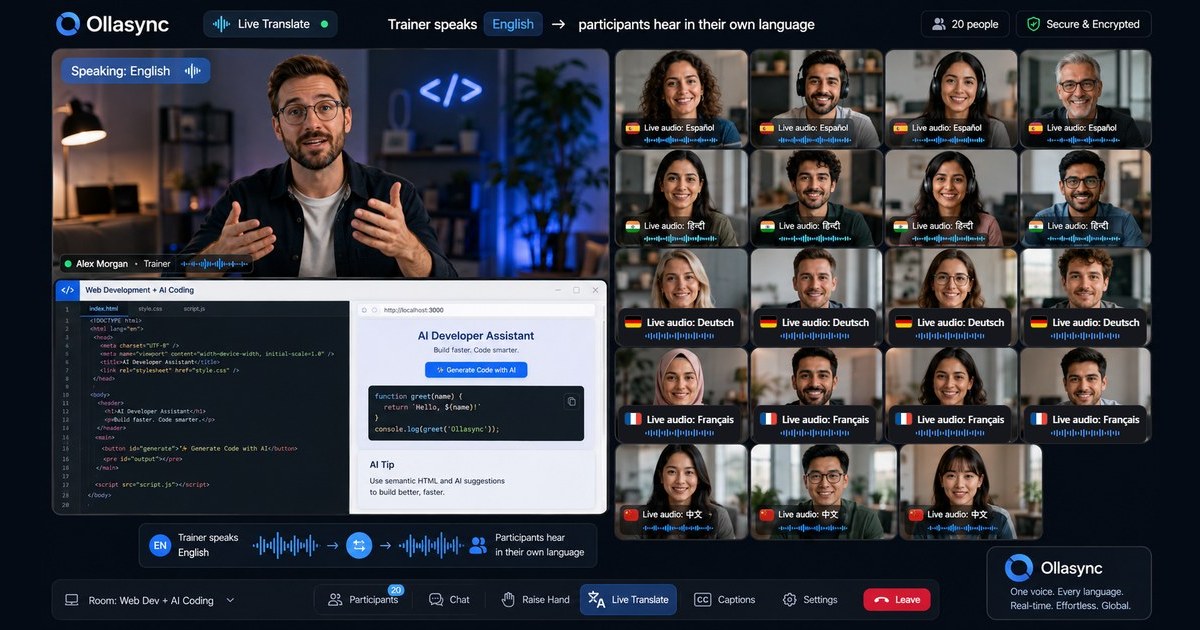
Training teams can reduce that strain by changing the classroom model. Short explanations, visible interaction, practice, useful feedback, and accessible audio give learners a reason to stay involved. An interactive AI classroom can provide those elements inside the same browser session, while giving each participant language support that does not require a separate course.
This guide explains why passive video training drains attention, how language processing adds to the load, and what learning teams can do to design better live sessions.
What Zoom fatigue means in corporate training
Zoom fatigue is the mental and physical exhaustion people feel after spending too much time in video meetings. In training, the issue is more specific than the number of calls on an employee’s calendar. It comes from the way a session demands attention.
A typical training call asks learners to:
- Watch a speaker or slide deck for long stretches.
- Read small text while listening to an explanation.
- Monitor their own camera, background, and facial expression.
- Interpret tone and turn-taking through a compressed audio feed.
- Remember information without using it immediately.
- Ask questions in front of colleagues, often in a second language.
- Switch between the meeting, chat, shared documents, and other work.
That is a demanding set of tasks for a format that often gives learners very little control. When the instructor talks for 45 minutes and ends with a quiz, most of the cognitive work happens in the learner’s head. The platform delivers the content, but it does not create a learning experience by itself.
The difference between attendance and participation
Attendance tells you that someone entered the session. Participation shows whether the learner processed the material.
An employee can leave a meeting tab open while answering email. A manager can see 30 names in the participant list while only three people ask questions. A post-session survey can report that the presenter was clear even when learners cannot complete the task without help.
Useful participation signals include:
- Questions asked during the session.
- Poll or quiz responses completed without prompting.
- Practice tasks submitted.
- Peer explanations or short discussions.
- Correct use of the skill in a scenario.
- Follow-up performance after the session.
The goal is not to force everyone to speak constantly. Quiet reflection, note-taking, and observation have a place in learning. The goal is to make sure the session gives learners regular opportunities to think and act, rather than asking them to watch until the end.
Why passive video calls drain attention
Passive instruction can work for a short explanation. It becomes a poor default when the lesson contains unfamiliar processes, technical terms, or decisions that employees must make in real work.
The viewer has no clear next action
When a trainer shares slides, learners often receive no instruction beyond “please pay attention.” That request is too vague. Attention is easier to sustain when a person knows what to look for, what decision they will make, or what they will practice next.
Compare these two prompts:
- “Here is our customer escalation process. Please take notes.”
- “Read the customer message on screen. In two minutes, choose the first action you would take and explain why.”
The second prompt creates a task. Learners search for relevant information and prepare an answer. The video call becomes a working session instead of a broadcast.
Long explanations increase cognitive load
Working memory has limits. A learner may understand a sentence as it is spoken and still lose the detail by the time the trainer reaches the next slide. Dense diagrams, unfamiliar acronyms, and rapid transitions increase the problem.
Long lectures also make it difficult for a learner to identify what matters. If every point receives the same emphasis, the learner has to decide which details deserve attention while also trying to follow the speaker.
Break explanations into short sections. After each section, ask learners to retrieve, classify, explain, or apply one idea. Retrieval gives the information a place in memory and exposes confusion while the trainer can still address it.
Camera presence adds social pressure
Video meetings ask people to manage their own image while observing others. Some employees monitor their facial expression or worry about appearing distracted. Others feel pressure to turn on a camera in a crowded home or shared office.
This pressure does not improve comprehension. Give learners a clear reason to use video, such as a role-play or demonstration, and allow other activities to use chat, polls, audio, or shared workspaces. A training room should measure learning, not camera compliance.
The meeting interface competes with the lesson
Notifications, chat messages, email, and browser tabs all compete with the presentation. A passive format gives the learner little reason to resist those interruptions.
Interaction changes the tradeoff. A poll that closes in 30 seconds, a shared decision, or a practice task makes the next step visible. The learner has a reason to remain in the lesson because the lesson requires a response.
Language processing makes fatigue worse
Language access is part of training design. An employee may speak conversational English and still struggle with a fast discussion about compliance, software configuration, product terminology, or customer negotiation.
When learners process a second language, they may translate phrases internally before they can evaluate the meaning. That extra step uses working memory. If the speaker moves on quickly, the learner must choose between understanding the previous point and following the next one.
The result can look like ordinary disengagement:
- The learner stops asking questions.
- Notes become incomplete or copied without context.
- The employee avoids a practice activity.
- The learner nods along and misses a qualification or exception.
- The recording is replayed several times, increasing total training time.
Native-language audio or clear translated captions can reduce the decoding work. The learner can spend more attention on the concept, decision, and practice. Language support is especially useful for global onboarding, sales enablement, product training, and operational processes that teams must perform consistently.
Translation affects more than comprehension
Language support also changes who participates. People are more likely to ask for clarification when they can form the question in a language they use comfortably. They may contribute examples from their market that would otherwise stay out of the discussion.
This improves the instructor’s view of the room. A trainer can discover that a process depends on a local regulation, a customer expectation, or a term that does not translate cleanly. The class becomes a source of operational feedback instead of a one-way delivery channel.
For high-risk legal, medical, or regulatory interpretation, organizations should use qualified human interpreters where required. For repeatable internal training and broad access, live AI translation can give learners an immediate way to follow the session in a preferred language.
Design an interactive AI classroom
An interactive AI classroom combines live video with activities that make learners respond. AI can support translation, captions, summaries, question routing, and practice feedback. The instructor still owns the teaching goal and the decisions about what learners need to do.
The most effective design has five parts:
- A clear outcome.
- Short explanations.
- Frequent learner actions.
- Language access.
- Evidence that the learner can use the skill.
Start with an observable outcome
Avoid an objective such as “understand the new expense policy.” Write what the employee should be able to do:
- Identify which expenses need approval.
- Reject a request that lacks required evidence.
- Explain the escalation path to a teammate.
- Complete a reimbursement request with the correct fields.
An observable outcome determines the activities and the final check. It also gives learners a reason to pay attention to the explanation.
Use a short explanation and an immediate task
A practical rhythm for a 60-minute class might look like this:
| Segment | Time | Learner activity |
|---|---|---|
| Opening and goal | 5 minutes | Answer a quick question about current practice |
| Concept explanation | 8 minutes | Listen with translated audio or captions |
| Guided example | 10 minutes | Identify the correct action in a scenario |
| Small-group practice | 15 minutes | Solve a realistic case |
| Feedback and questions | 8 minutes | Compare answers and ask for clarification |
| Individual application | 10 minutes | Complete a task using the new process |
| Exit check | 4 minutes | Submit a short response or confidence rating |
The exact timing can change. The important pattern is the alternation between receiving information and using it. Learners should not spend the entire class in viewer mode.
Give learners multiple ways to respond
Not every learner wants to speak in front of a group. A useful classroom includes several response methods:
- Polls for quick decisions.
- Chat for questions and short explanations.
- Shared boards for sorting or ranking.
- Breakout rooms for practice.
- Voice responses for role-play.
- Private answers for confidence checks.
- Written scenarios for tasks that need careful reasoning.
Use the response method that matches the outcome. If the skill involves a customer conversation, voice practice matters. If the skill involves selecting a policy category, a poll or form may be enough.
Let AI handle routine support
AI can reduce the work around the session so the instructor can focus on teaching. Useful functions include:
- Live captions for people who cannot hear clearly.
- Translated audio for learners who prefer another language.
- Translated chat so questions reach the instructor.
- Automatic notes that capture decisions and action items.
- A searchable transcript for later review.
- Practice prompts that adapt to the learner’s answer.
- A summary of common questions for the next class.
The system should make the learning task easier to access, not replace the instructor’s judgment. Review generated notes before using them for compliance records, performance decisions, or formal certification.
A practical format for a fatigue-resistant session
The following format works for onboarding, product enablement, and internal process training. Adjust the examples to the skill and audience.
1. Open with a problem employees recognize
Show a short scenario from the learner’s work. Ask what usually goes wrong. This creates relevance before you introduce the policy or system.
For example, display a customer request that contains an incomplete contract detail. Ask learners whether they would approve it, request more information, or escalate it. The question reveals current assumptions and gives the trainer a starting point.
2. Explain one principle at a time
Keep each explanation focused. Define the term, show one example, and state the decision it supports. If the concept requires several conditions, reveal them in sequence instead of placing every rule on one slide.
Offer translated audio or captions from the beginning. Do not make employees wait until they are already lost to find language settings.
3. Ask for a decision
After the explanation, present a new case. Give everyone a short period to answer before discussing it. Responses show whether learners can transfer the idea to a different situation.
If most answers are wrong, pause and explain the point again using the case. Do not move forward simply because the slide deck is on schedule.
4. Practice with realistic constraints
Practice should resemble the work employees will perform. Include incomplete information, competing priorities, or a customer question when those conditions matter.
Groups can compare their approach, while the instructor listens for misconceptions. AI can translate the discussion and help each learner follow the shared task in a preferred language.
5. Close with an individual check
A group can reach the right answer while one person remains uncertain. Ask each learner to complete a short task independently. The response can be a written explanation, a selected action, or a voice recording.
Use the results to assign follow-up practice. A generic “any questions?” does not reveal enough about what learners can do.
Fix common Zoom fatigue patterns
The table below connects a common training problem with a practical change.
| Fatigue pattern | What learners experience | Better design choice |
|---|---|---|
| 45-minute lecture | Little reason to interact | Add a task every 5 to 10 minutes |
| Camera requirement | Self-monitoring and social pressure | Use cameras for activities that need visual feedback |
| English-only delivery | Internal translation and missed details | Offer native-language audio and captions |
| Dense slide deck | Too much information at once | Reveal one concept and example at a time |
| Voluntary questions | The same confident people speak | Collect private questions and use polls |
| Final quiz only | Confusion appears too late | Check understanding throughout the class |
| Generic examples | Learners cannot see the work connection | Use cases from their role and market |
| Notes sent days later | Learners forget context | Provide a clear summary soon after the session |
These changes do not require a new learning management system. A team can start with the meeting platform, a form, a shared document, and a translation or captioning tool. The design matters more than the number of features.
Measure whether the new format works
Do not judge an interactive classroom only by attendance. Compare the old session and the new one using measures that show attention, comprehension, and transfer.
Track:
- Attendance and time in session.
- Poll and practice completion.
- Questions per learner or per group.
- Correct responses during scenario work.
- Confidence before and after the class.
- Time to complete the trained task.
- Manager-reported errors after training.
- Requests for repeat explanations.
Segment the results by language preference, region, role, and prior experience. A global average can hide the group that is still struggling. If learners using translated audio participate more often but perform poorly on a specific task, the issue may be the exercise or the terminology rather than attention.
Keep the measurement simple enough to repeat. A short exit task and a follow-up check one or two weeks later often tell you more than a long satisfaction survey.
Implementation checklist for learning teams
Use this checklist when converting a passive video session into an interactive classroom:
- Define one or two actions learners must perform after the session.
- Replace long explanations with sections of fewer than ten minutes.
- Write one question or task for each section.
- Select examples from the employee’s actual workflow.
- Offer translated audio, captions, or both before the class begins.
- Explain how learners can respond without turning on a camera.
- Collect questions during the session, including private questions.
- Give learners time to answer before showing the correct response.
- Reserve time for individual practice.
- Share an accurate summary and next action after the class.
- Run a follow-up check that tests job performance.
- Review participation and performance by language preference.
A better standard for live corporate training
Video meetings are useful for bringing a distributed workforce into one room. They become tiring when the meeting format is treated as the training method. A camera feed and a slide deck can deliver information, but they do not guarantee attention, comprehension, or transfer.
Training teams can improve the experience by asking learners to do something with each important idea. Add a decision, a short explanation, a realistic case, or a practice task. Give employees audio and captions in the language that lets them think clearly. Use AI for translation, notes, and routine support while instructors focus on context, feedback, and judgment.
The result is a classroom that respects employee attention. People leave with a task they have practiced, questions they were able to ask, and a record they can use later. That is a more useful outcome than another hour marked as attended.