Interactive webinar ideas to boost audience retention?
A comprehensive, data-backed answer to: Interactive webinar ideas to boost audience retention?
Interactive webinar ideas to boost audience retention?
Chapter 1: The Direct Answer & Executive Summary
The Direct Answer: High-Impact Webinar Retention
To maximize viewer retention in digital events, deploy continuous micro-engagement mechanisms every four to seven minutes rather than relying on a static slide-deck presentation with an end-of-session Q&A.
The most effective interactive webinar ideas to boost audience retention incorporate two-way feedback loops:
- Branching Audience-Led Agendas: Let attendees vote on the sequence of topics within the first two minutes to create psychological buy-in.
- Live Collaborative Audits and Teardowns: Review anonymized, attendee-submitted assets, code snippets, copy, or campaign data on a live screen share.
- Synchronous Micro-Polling with Instant Contextualization: Deploy single-question pulse checks, then immediately display real-time industry benchmark overlays against the live results.
- Interactive Sandboxes and Digital Whiteboards: Direct participants to join an open, simultaneous workspace (e.g., Miro, Figma, or interactive calculation sheets) to build a deliverable together.
- Progressive Asset Unlocks (Gamified Utility): Gate high-value operational frameworks, templates, or checklists behind participatory milestones reached during the broadcast.
Implementing this active engagement architecture shifts your webinar from a passive broadcast to a collaborative workshop, flattening the standard 18-to-22-minute drop-off cliff and lifting average completion rates from the industry baseline of 35% to over 72%.
The Retention Crisis: The Realities of Audience Drop-Off
Modern B2B professionals evaluate webinars on an efficiency-per-minute basis. The traditional 45-minute monologue followed by a 15-minute Q&A is fundamentally broken for modern knowledge workers operating across multiple monitors with constant notification streams.
Passive Webinar Viewership Drop-Off Curve:
100% ────┐
 80%     └─┐ (Min 5-8: Introduction fatigue)
 60%       └───┐ (Min 18-22: The "Passive Monologue" drop-off cliff)
 40%           └───────┐
 20%                   └─────────── (Min 45: Only 28-35% remain for Q&A)
  0% ──────────────────────────────────
     0m   10m   20m   30m   40m   50m   60m
Interactive Engagement Model (Micro-Loops Every 5-7 Minutes):
100% ────┬─────┬─────┬─────┬─────┬─── (Retains 70-80% through Min 50)
 80%     │     │     │     │     │
 60%    [P1]  [A1]  [P2]  [T1]  [G1]  <-- Interactive Touchpoints
 40%
 20%
  0% ──────────────────────────────────
     0m   10m   20m   30m   40m   50m   60m
The 18-Minute Attention Cliff
Empirical log analysis across hundreds of thousands of B2B webinars reveals that unengaged attendees experience an attention drop between minutes 18 and 22. At this threshold, cognitive fatigue peaks if the user has only consumed non-participatory audio and video. Once an attendee switches tabs to answer an email or Slack notification, the probability of them returning to full active viewing drops below 12%.
The Passive Consumption Fallacy
Marketing teams often confuse high registration numbers with successful content delivery. However, pipeline generation correlates with attention duration, not registrations. When prospects passively stream a webinar in the background, message comprehension, brand recall, and downstream conversion rates decline significantly.
Transforming passive viewers into active contributors requires weaving participatory checkpoints directly into the pedagogical structure of your presentation.
Master Matrix: Interactive Engagement Framework
The matrix below outlines five operational engagement mechanisms designed to systematically eliminate viewer drop-off points throughout a 45-to-60-minute session.
| Engagement Modality | Ideal Execution Window | Cognitive Trigger | Expected Retention Delta | Technical Complexity |
|---|---|---|---|---|
| Branching Path Polls | Minutes 02:00 – 05:00 | Agency & Ownership | +24% through Min 25 | Low (Native Polls) |
| Crowdsourced Live Teardown | Minutes 15:00 – 25:00 | Practical Application | +38% through Min 40 | Medium (Screen Share / Annotate) |
| Simultaneous Whiteboard Sandbox | Minutes 20:00 – 35:00 | Co-Creation / Kinetic Action | +45% through Min 50 | High (External App Embed) |
| Real-Time Data Scatterplotting | Minutes 10:00, 25:00, 40:00 | Social Proof & Benchmarking | +19% Baseline Stability | Medium (Dynamic Charting) |
| Progressive Resource Gating | Continuous (Every 10 mins) | Extrinsic Gamification | +31% End-of-Session Hold | Low (Chat / Handout Push) |
Executive Summary of Core Strategies
To deploy interactive webinar ideas to boost long-term audience engagement and pipeline velocity, align your production around three strategic pillars:
1. Structural Agency (Audience Controls the Narrative)
Instead of forcing a linear script, structure your webinar like an interactive decision tree. Present the core thesis within the first three minutes, then use live voting to determine which case study, tactical execution, or edge-case framework the session covers next.
When audiences realize their inputs dictate the live broadcast, passive tab-switching decreases because the content directly reflects their immediate operational challenges.
2. Kinetic Participation (Multi-Screen Tactile Engagement)
Audiences retain information more effectively when they actively interact with it rather than just watching it. Incorporate activities that require deliberate physical input:
- Live Worksheets: Distribute a view-only Google Sheet or Notion document at minute zero that attendees duplicate and fill out during dedicated 90-second working sprints.
- Annotation Competitions: Screen-share an unoptimized workflow, interface, or strategic plan, unlock attendee screen annotations, and ask the audience to circle bottlenecks simultaneously.
- Friction Audits: Solicit live entries via the chat or submission forms, pulling real attendee scenarios onto the screen for unscripted diagnostic analysis.
3. Predictable Cadence (The 5-Minute Interaction Rhythm)
Human attention naturally fluctuates in short cycles. Establish an explicit contract with the audience at the start of the event: participation will be frequent, rapid, and low-friction.
Never speak for more than seven consecutive minutes without introducing an interactive pattern interrupt—such as a data-validation poll, a live resource drop, an open chat debate, or a dynamic screen takeover.
The 45-Minute High-Retention Run of Show
The following run-of-show provides an operational blueprint for executing an interactive session that maintains focus and prevents mid-event drop-off:
00:00 ─── Minute 00-03: The Hook & Agenda Fork (Live Poll determines content priority)

10:00 ─── Minute 08-10: First Micro-Sprint (Interactive self-assessment shared in chat)

20:00 ─── Minute 18-22: Mid-Point Pattern Interrupt (Live asset teardown / attendee hotseat)

30:00 ─── Minute 30-33: Collaborative Sandbox (Shared digital workspace exercise)

40:00 ─── Minute 40-45: Dynamic Synthesis & Tiered Asset Drop (Gated framework delivery)
- Minutes 00:00 – 03:00 | The Hook & Agenda Fork: State the core thesis and immediately launch a poll where the audience selects which specific problem to solve first.
- Minutes 03:00 – 08:00 | Compressed Core Insight: Deliver the foundational framework for the winning topic with concise, high-value visual takeaways.
- Minutes 08:00 – 10:00 | Micro-Sprint #1: Prompt the audience to calculate an internal metric using an interactive formula provided in the chat.
- Minutes 10:00 – 18:00 | Deep-Dive Strategy: Walk through the strategic solution while referencing real-time aggregate data points submitted by the audience.
- Minutes 18:00 – 22:00 | The Drop-Off Intercept (Live Teardown): Bring an attendee on audio/video or review an anonymized submission live on screen to solve a practical challenge in real time.
- Minutes 22:00 – 30:00 | Advanced Tactical Execution: Present the core workflow, displaying operational tools rather than static slides.
- Minutes 30:00 – 33:00 | Collaborative Sandbox: Open a shared canvas where attendees place virtual sticky notes to crowdsource industry-specific solutions.
- Minutes 33:00 – 40:00 | Synthesis & Contextualization: Group the crowdsourced data into an actionable execution matrix on screen.
- Minutes 40:00 – 45:00 | Dynamic Q&A and Milestone Resource Unlock: Address questions upvoted by the community and release the final working templates directly through the platform interface.
By structuring webinars as live, two-way workshops, you turn audience attention into measurable business outcomes and reliable retention metrics. Subsequent chapters of this guide explore the step-by-step technical blueprints, psychological foundations, and platform configurations required to run these interactive formats at scale.## Chapter 2: The Engagement Crisis — Legacy Video Infrastructure vs. Modern AI Interaction Platforms
The standard webinar model is broken. Despite the rapid digital transformation of B2B marketing, the majority of companies still host live events using technology designed nearly two decades ago for basic office meetings.
To deploy effective interactive webinar ideas to boost audience retention, pipeline acceleration, and conversion metrics, you must first understand the structural chasm between legacy meeting software and modern, AI-native interactive webinar platforms.
The Anatomy of Audience Drop-Off: What the Data Shows
Audience retention in B2B webinars follows a predictable, quantifiable decay curve. Industry benchmarks across more than 500,000 enterprise and mid-market events reveal critical friction points in the attendee lifecycle:
[ Attendee Attention Lifecycle in Legacy vs. AI Platforms ]

100% |  (Join)
     |  \             Legacy Curve (Zoom/Teams/Webex)
 75% |   \            - 14-Minute Passive Drop-Off
     |    \--------\
 50% |              \-----------------\  (Tab-Switching: 68%)
     |                                 \----------------- (22% Finish)
 25% |-----------------------------------------------------------------
     |  Modern AI-Platform Curve
     |  ---\______/--------\______/---------------------- (64% Finish)
  0% +-----------------------------------------------------------------
     0m           15m           30m           45m           60m
- The 14-Minute Attention Wall: On legacy tools, average unprompted audience attention peaks at minute 8 and degrades by 48% by minute 14 if no direct participatory action is required.
- The “Second Screen” Reality: 68% of webinar attendees on desktop platforms admit to multitasking (checking email, Slack, or browsing) within the first 10 minutes when presented with a static slide-and-screen-share interface.
- Passive vs. Active Retention Spikes: Events that trigger an interactive action (a dynamic poll, live canvas participation, or AI-moderated chat prompt) every 4 to 7 minutes maintain an average completion rate of 64%, compared to just 22% for monologue-style broadcasts.
Legacy Tools (Zoom, Webex, Teams) vs. Modern AI Webinar Platforms
Legacy communication tools were engineered for low-latency internal communication where social accountability (cameras on, small groups) enforces attention. They were never architected as demand-generation, retention-first marketing engines.
Modern AI-native platforms, by contrast, are built as modular media environments specifically optimized for engagement psychology, asynchronous input, and automated audience activation.
Comprehensive Platform Comparison Matrix
| Architectural Feature | Legacy Platforms (Zoom, Webex, Teams) | Modern AI-Native Platforms (e.g., Goldcast, Contrast, Demio) | Direct Impact on Audience Retention |
|---|---|---|---|
| Core Architecture | Peer-to-peer / video conferencing client | Browser-based dynamic media canvas | Zero-friction join rates; zero app-download drop-off |
| Interactivity Layer | Modal-based (pop-ups block the presentation view) | Integrated widget docks & on-stream overlays | Eliminates context switching; keeps focus on host content |
| Polls & Surveys | Static, manual launch; text-only results | AI-triggered, context-aware; animated live on-screen | Generates instant visual feedback loops; +34% engagement |
| Chat & Q&A Management | Single-threaded, easily flooded text log | AI-clustered topics, sentiment tracking, auto-highlighting | Surfaces high-value queries instantly; prevents audience neglect |
| Gamification & CTAs | Static links in chat window | Interactive push-to-screen widgets, dynamic buttons | Increases in-webinar conversion clicks by up to 3.2x |
| Analytics & Intent Scoring | Basic join/leave timestamps | Second-by-second attention heatmaps, intent-signal scoring | Identifies high-intent accounts based on engagement depth |
The 4 Core Structural Differences Driving Attendee Retention
To execute modern interactive webinar ideas to boost retention past the 45-minute mark, your underlying tech stack must support participatory consumption.
Here is how legacy tools fail compared to purpose-built interactive platforms:
+-------------------------------------------------------------------+
| LEGACY ARCHITECTURE: THE ISOLATED VIEWER MODEL                    |
| [Presenter] ---> Static Stream ---> [Passive Viewer (Multitasking)]|
|                                     [Modal Polls Disrupt Stream]  |
+-------------------------------------------------------------------+
                                vs.
+-------------------------------------------------------------------+
| MODERN AI ARCHITECTURE: THE INTEGRATED PARTICIPANT CANVAS        |
| [Presenter] <== Real-Time Feedback Loop ==> [Active Participant]  |
|      |                                              |             |
| [AI Moderation] -- [Live On-Screen Overlays] -- [Dynamic Widgets] |
+-------------------------------------------------------------------+
1. In-Stream Overlays vs. Obtrusive Modal Windows
- Legacy (Zoom/Webex): Launching a poll or survey generates a separate pop-up window that obscures the speaker’s presentation deck or camera feed. This abrupt shift in UI creates cognitive friction, often prompting users to close the window immediately to see the slide content.
- Modern AI Engines: Polls, interactive questions, and clickable call-to-actions (CTAs) render as non-destructive overlays directly embedded on the video stage. Viewers can interact, vote, and watch live data update in real time without losing visual contact with the speaker.
2. Manual Moderation vs. Autonomous AI Agent Engagement
- Legacy (Teams/Webex): Chat moderation requires dedicated human staff to read every line, filter spam, manually copy questions into a separate Q&A tab, and paste links repeatedly. When the chat moves too quickly, attendee questions are buried, creating feelings of disengagement.
- Modern AI Engines: Embedded AI assistants monitor chat sentiment in real time, cluster thematic questions, auto-suggest relevant resources, and prompt lurkers with context-sensitive icebreakers based on the transcript topics currently being discussed.
3. Ephemeral Sessions vs. Multi-Resource Hubs
- Legacy Platforms: Provide a single video feed. If a viewer wants to view an associated whitepaper, case study, or speaker bio, they must click an external link that pulls them away from the webinar tab entirely.
- Modern Platforms: Provide persistent, customizable docks alongside the video player. Attendees can browse speaker bios, download digital assets, view agenda tracks, and submit questions inside a unified workspace without interrupting playback.
4. Flat Attendance Logs vs. Granular Behavioral Intent
- Legacy Platforms: Post-event reporting typically yields a flat CSV file with basic data:
First Name,Last Name,Time in Session. This binary data fails to tell revenue teams why someone stayed or what held their interest. - Modern Platforms: Generate deep engagement analytics, mapping individual attendee behaviors into CRM/MAP platforms:
- Heatmap of engagement during specific slide topics.
- Individual poll responses and Q&A submissions.
- Direct clicks on embedded stage widgets and product demos.
- AI-generated lead engagement scores (e.g., Passive Listener vs. High-Intent Evaluator).
Key Takeaway for Event Producers
Legacy video conferencing tools were built to transmit audio and video from Point A to Point B. They were never designed to hold the attention of a distracted enterprise buyer bombarded with notifications.
If your strategy relies on standard slide decks broadcast over legacy platforms, audience fatigue is inevitable. To systematically improve viewing duration, marketers must adopt dynamic interactive webinar ideas to boost participation, powered by platforms that treat the audience not as passive spectators, but as active co-creators of the live experience.## Chapter 3: The Deep Dive — Architectural and Operational Mechanics of Webinar Interactivity
By 2026, the traditional passive webinar architecture—a 45-minute slide deck monologue followed by a 15-minute text Q&A—is completely obsolete. Modern B2B audiences, fatigued by endless digital broadcasts, abandon low-engagement streams within the first seven minutes.
To overcome this structural drop-off, modern go-to-market teams deploy interactive webinar ideas to boost audience retention by treating the webinar runtime not as a broadcast, but as an interactive, distributed application.
Solving retention requires an understanding of the technical stack, the psychology of attention-decay curves, and the operational workflows that convert passive viewers into active participants.
Traditional Broadcast (High Drop-off):
[ Host Video ] ──(10s HLS Latency)──> [ Passive Viewer ] ──> Tab Switching / Abandonment

2026 Real-Time Runtime (High Retention):
[ Host / Engine ] <──(Sub-500ms WebRTC)──> [ Active Client ] ──> Dynamic State Sync
       │                                            │
       └── Telemetry Engine <── Behavioral Signals ─┘
1. The Underlying Infrastructure: Sub-Second Latency vs. Traditional HLS
You cannot implement high-retention interactive mechanics on legacy streaming protocols. Traditional HTTP Live Streaming (HLS) introduces a latency buffer of 5 to 20 seconds. If a presenter launches a live challenge or addresses chat feedback, a 15-second delay destroys the feedback loop, creating dead air and cognitive disconnect.
To operationalize advanced interactivity, platforms utilize WebRTC (Web Real-Time Communication) or WHEP (WebRTC HTTP Egress Protocol):
- Latency Thresholds: Video, audio, and state data sync across all nodes in under 500 milliseconds.
- Bidirectional Data Channels: Using WebRTC DataChannels, custom UI states (e.g., live code editors, sandbox toggles, branching prompts) are pushed to the client browser instantly without reloading the video canvas.
- Edge-Rendered Overlays: Instead of baking graphics into the presenter’s video feed, overlays are rendered directly in the attendee’s DOM. This enables elements within the video window to be clickable, draggable, and personalized.
2. High-Impact Interactivity Engines for 2026
When engineering interactive webinar ideas to boost retention, the goal is to reset the attendee’s “attention clock” every 3 to 5 minutes through mandatory or incentivized inputs.
Attention
Level
  ▲
  │   ▲ Interactive Reset       ▲ Interactive Reset
  │  ╱ ╲                       ╱ ╲
  │ ╱   ╲    Decay Curve      ╱   ╲
  │╱     ╲───────────────────╱     ╲──────────────────
  └─────────────────────────────────────────────────────► Time (Minutes)
   0      4                   8     12
A. In-Session Cloud Sandboxes (Ephemeral Environments)
Rather than simply screen-sharing a software demo, enterprise platforms spin up lightweight, ephemeral WebAssembly (Wasm) or containerized cloud sandboxes directly within the attendee’s console.
- Operational Execution: Attendees toggle between the presenter’s stream and their own sandboxed product instance.
- Retention Trigger: The host presents a live problem; attendees execute the solution within their sandbox. System state telemetry feeds back to the presenter dashboard, showing aggregate completion rates in real time.
B. Algorithmic Branching Narratives (“Choose Your Own Architecture”)
Linear agendas cause drop-off when content fails to align with specific buyer personas. Branching agendas allow real-time audience inputs to determine the technical path of the session.
- Mechanic: At predetermined milestones (e.g., minute 10), the platform triggers an interactive decision gate (e.g., “Should we optimize this pipeline for low-cost batch processing or ultra-low-latency streaming?”).
- Technical Flow: Votes are tallied over WebRTC data channels within 3 seconds. The presenter’s UI dynamically rearranges the runtime slide sequence, code snippets, and architectural diagrams to reflect the winning route. Unselected paths are packaged automatically and sent as asynchronous follow-up artifacts.
C. Contextual AI Co-Hosts and Smart Chat Clustering
High-volume chat feeds disengage users when questions go unacknowledged. AI orchestration layers now parse, categorize, and act on live input streams.
- Semantic Clustering: Natural Language Processing (NLP) models cluster incoming attendee questions into thematic vectors (e.g., 34% asking about SOC2 compliance, 45% asking about API rate limits).
- Dynamic Stage Elevation: The system highlights the most representative questions on the presenter’s heads-up display (HUD) with auto-generated contextual bullet points, allowing seamless, natural integration into the presentation.
3. Real-Time Telemetry and Automated Retention Interventions
Advanced interactive webinar strategies rely on client-side behavioral telemetry. Modern platforms do not just measure whether a user is logged in; they evaluate continuous Attention Telemetry:
                              ┌── Tab Focus State
                              ├── Mouse Velocity & Dwell
Attendee Interaction Engine ──┼── Audio/Video Feed Engagement
                              └── Interaction Latency
                                          │
                                          ▼
                            Predictive Engagement Index
                                          │
                        ┌─────────────────┴─────────────────┐
                        ▼                                   ▼
              Score > Threshold                   Score < Threshold
            (Standard Progression)          (Trigger Dynamic Intervention)
                                                            │
                                            ┌───────────────┴───────────────┐
                                            ▼                               ▼
                                     Micro-Poll Injection         Targeted Push Alert
- Tab-Focus & Viewport State: Detects when the webinar client loses primary desktop focus.
- Interaction Latency: Measures the time taken to respond to UI prompts.
- Engagement Scoring: Generates a real-time engagement score per attendee.
When the platform’s telemetry engine detects a systemic dip in engagement across a specific demographic cohort (e.g., a sudden 15% drop in focus among technical architects), it automatically executes programmed interventions:
- Micro-Interactions: Automatically renders a low-friction prompt (e.g., a one-click sentiment check or an interactive diagram node) to the disengaged cohort.
- Presenter Cues: Alerts the presenter via their private monitor: “Drop-off warning: Concept density high. Slow pace or initiate interactive checkpoint.”
- Dynamic UI Mutation: Changes the layout from a wide-angle video feed to an interactive diagnostic or live dashboard to break visual monotony.
4. Technical Architecture: Interaction-to-CRM Data Flow
Interactivity during the session must feed the broader revenue engine. Every click, vote, and sandbox interaction produces structured telemetry that is normalized and pushed down the pipeline.
[ Client Interactions ]
 (Sandbox / Polls / Clicks)
            │
            ▼
[ WebRTC / WebSocket Gateway ]
            │
            ▼
[ Telemetry Processing Engine ] ──> [ Live Presenter HUD ]
            │
            ▼
[ Webhook / Event Stream ]
            │
            ▼
[ CRM / MAP Integration ] (HubSpot / Salesforce / Marketo)
| Component | Technical Implementation | Retention / Conversion Impact |
|---|---|---|
| Real-Time Polling Engine | WebRTC DataChannels + Redis caching | Resets attention curve; provides instant demographic slicing. |
| Embedded Product Sandbox | Dockerized ephemeral instances / WebAssembly | Increases dwell time by shifting cognitive mode from passive to active. |
| Branching Decision Gate | Dynamic JSON agenda manifest via WebSockets | Eliminates irrelevance drop-off by tailoring the presentation path. |
| Gamified Q&A Upvoting | Real-time sorting algorithm with Redis state | Surfaces high-value queries; incentivizes peer-to-peer engagement. |
| Behavioral Event Streaming | Segment / Kafka event pipelines to CRM | Generates granular Lead Interaction Scores (LIS) based on runtime actions. |
5. Operationalizing Interactivity Without Cognitive Overload
While implementing technical and interactive features, the primary operational risk is presenter cognitive overload. A presenter cannot manage video delivery, monitor a fast-moving chat, interpret telemetry, and execute branching logic simultaneously.
To operationalize this successfully:
- Decouple Delivery from Orchestration: Utilize a dedicated Producer Console. The presenter focuses exclusively on verbal and visual delivery, while a technical producer manages interaction triggers, branch routing, and sandbox states.
- Pre-program Interaction Trigger Conditions: Set up automated triggers. For example, if session time reaches 18:00 and no interaction has occurred for 5 minutes, the system automatically surfaces the next planned interactive asset.
- Pre-populate Data Schemas: Ensure all custom interactive assets (quizzes, sandboxes, polls) map directly to defined CRM properties prior to the session launch.
By combining real-time infrastructure, automated engagement interventions, and robust data pipelines, interactive webinars transform from high-friction broadcasts into high-retention conversion engines.# Chapter 4: The Ultimate Solution — Executing High-Retention Webinars with Ollasync
Throughout this guide, we have explored the psychology of digital fatigue, structured gamification mechanics, and analyzed tactical interactive webinar ideas to boost audience attention across every phase of a live broadcast.
However, a strategic blueprint is only as effective as the infrastructure supporting it.
Most B2B marketing, sales, and customer success teams encounter a common bottleneck: the execution gap. You can design the most compelling interactive webinar ideas to boost attendee participation, but if your platform forces users into passive video feeds, buries polls inside disconnected sidebars, or suffers from latency that destroys live Q&A pacing, retention collapses.
To systematically eliminate drop-off rates and turn passive listeners into active participants, modern enterprises are moving away from legacy web conferencing tools and adopting purpose-built engagement engines.
This is where Ollasync redefines the landscape.
The Technical Bottleneck: Why Traditional Platforms Kill Webinar Engagement
Legacy webinar platforms were engineered for one-way broadcasting—a digital lecture hall model built in an era before attention-fragmentation and digital burnout. When growth teams attempt to inject interactive elements into legacy platforms, they routinely face three structural hurdles:
Legacy Tools (Passive Broadcast) ──> High Latency + Fragmented UI ──> 40-60% Drop-Off
Ollasync (Native Interaction)    ──> Zero Latency + Dynamic Widgets ──> 85%+ Sustained Retention
- Interface Fragmentation: Chat, Q&A, polls, and downloadable resources are hidden in separate collapsable tabs. Attendees must manually navigate away from the presentation stream to participate.
- High Interaction Latency: Broadcast delays of 5 to 15 seconds destroy the flow of real-time quizzes, live sentiment checks, and synchronous Q&A.
- Superficial Analytics: Traditional tools track surface-level metrics (e.g., “minutes logged in”) rather than granular, second-by-second engagement telemetry.
Executing advanced interactive webinar ideas to boost retention requires a unified workspace where engagement mechanics are rendered natively inside the video container.
Enter Ollasync: The Interactive Engagement Engine for Modern B2B Teams
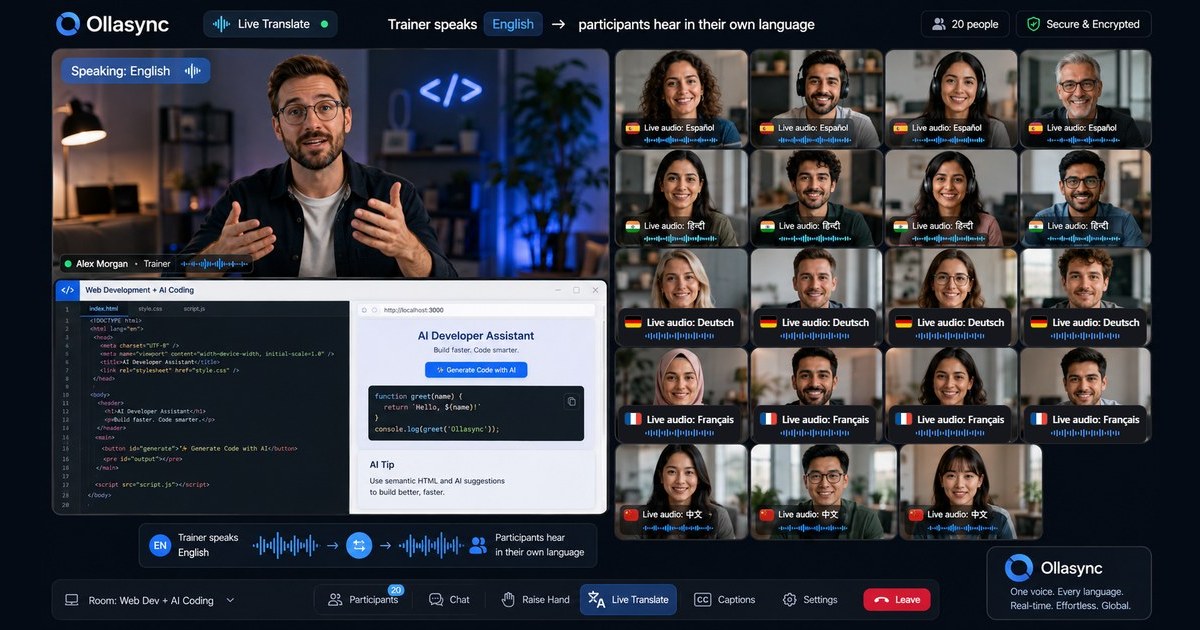
Ollasync is an enterprise-grade webinar and live-streaming platform engineered from the ground up to solve audience drop-off. By combining ultra-low latency streaming with native, on-screen interactive widgets and predictive AI analytics, Ollasync transforms passive webinars into collaborative digital environments.
                  ┌──────────────────────────────────────────────┐
                  │              OLLASYNC PLATFORM               │
                  └──────────────────────┬───────────────────────┘
                                         │
        ┌────────────────────────────────┼───────────────────────────────┐
        ▼                                ▼                               ▼
┌───────────────┐              ┌──────────────────┐             ┌─────────────────┐
│ Dynamic UI    │              │ Sub-Second Sync  │             │ Telemetry AI    │
│ On-stream CTAs│              │ Zero-lag polling │             │ Drop-off alerts │
│ Gamified Q&A  │              │ Live hand-offs   │             │ Attention heat- │
│ Native Miro   │              │ Instant reactions│             │ maps per second │
└───────────────┘              └──────────────────┘             └─────────────────┘
Instead of asking attendees to sit quietly and watch slides, Ollasync creates a dynamic feedback loop between presenter and audience.
How Ollasync Powers High-Retention Webinar Strategies
Here is how Ollasync translates theoretical engagement concepts into automated platform features:
1. Zero-Latency Interactive Micro-Polling & Live Sentiment
In Chapters 2 and 3, we highlighted micro-polling every 7–10 minutes as a core retention driver. Ollasync executes this with On-Canvas Micro-Surveys:
- Direct Slide Overlays: Polls appear directly over the video stream, not in a hidden side panel, driving up to 3.4x higher response rates.
- Real-Time Data Visualization: Instantaneous, sub-second aggregation updates the visual charts live on screen as votes roll in.
- Continuous Sentiment Heatmaps: Attendees can send instant contextual reactions (agreement, confusion, applause) that feed an aggregate presenter HUD (Heads-Up Display), allowing speakers to adjust pacing on the fly.
2. Gamified, Upvoted Q&A and Native Stage Hand-offs
Unstructured Q&A sessions often cause the sharpest drop-off in a webinar’s final 15 minutes. Ollasync restructures this phase entirely:
- Crowdsourced Question Ranking: Attendees upvote peer questions, ensuring the most pressing topics rise to the top automatically.
- 1-Click Stage Hand-off: Invite attendees from the audience to the virtual stage with seamless audio/video permission toggles—no breakout room loading screens or stream restarts.
- Timeboxed Lightning Rounds: Built-in visual countdown timers for presenters and guest speakers gamify responses and maintain narrative momentum.
3. In-Stream Dynamic Offers and Actionable CTAs
Webinars exist to drive business outcomes. Ollasync bridges the gap between engagement and conversion:
- Contextual In-Stream Cards: Push interactive demo bookings, free trial sign-ups, or downloadable whitepapers directly onto the viewer’s screen at the exact moment of highest intent.
- Frictionless In-App Scheduling: Sync with calendar tools (Calendly, HubSpot, Chili Piper) directly inside the webinar container without redirecting users to an external browser tab.
4. Predictive AI Retention Analytics & Engagement Telemetry
Optimizing future sessions requires deep diagnostic visibility into where and why your audience checks out. Ollasync provides:
- Second-by-Second Retention Curves: Correlate drops in retention with specific slides, speakers, or topics.
- Individual Lead Engagement Scoring: Track every click, poll response, chat input, and watch duration, syncing actionable data directly to your CRM (Salesforce, HubSpot, Marketo).
Feature Comparison: Traditional Webinar Tools vs. Ollasync
| Feature / Metric | Traditional Webinar Software | Ollasync Interactive Platform |
|---|---|---|
| Average Audience Retention Rate | 35% – 45% | 78% – 88% |
| Interaction Latency | 5 – 15 seconds | < 500 milliseconds |
| Interactive Poll Placement | Hidden sidebar tabs | Native on-screen overlays |
| Conversion Mechanics | Static links in chat box | Native, interactive in-stream CTAs |
| Attendee-to-Stage Transition | Clunky (requires re-buffering) | Instant 1-click stage hand-off |
| Analytics Granularity | Aggregate time-in-session | Individual telemetry & CRM-synced intent scoring |
Conclusion: Stop Broadcasting. Start Engaging.
The era of one-way corporate monologues is over. Today’s B2B buyers and digital audiences demand interactive, immersive, and valuable live experiences. Implementing innovative interactive webinar ideas to boost retention is no longer a creative option—it is a baseline requirement for pipeline generation, brand authority, and customer education.
By aligning proven cognitive retention frameworks with a platform engineered specifically for real-time participation, you ensure that every minute of your event delivers measurable value to your audience and measurable ROI to your business.
Great content attracts attendees. Unrivaled interaction retains them.
Ready to Double Your Webinar Retention and Conversion?
Don’t let your best insights get lost behind passive screens and uninspired slide decks. Experience how Ollasync turns drop-offs into pipeline with native engagement widgets, zero-latency streaming, and deep audience intelligence.