How to Improve Remote Training Engagement Across Timezones
A comprehensive guide to keeping global teams engaged during remote training sessions across multiple timezones.
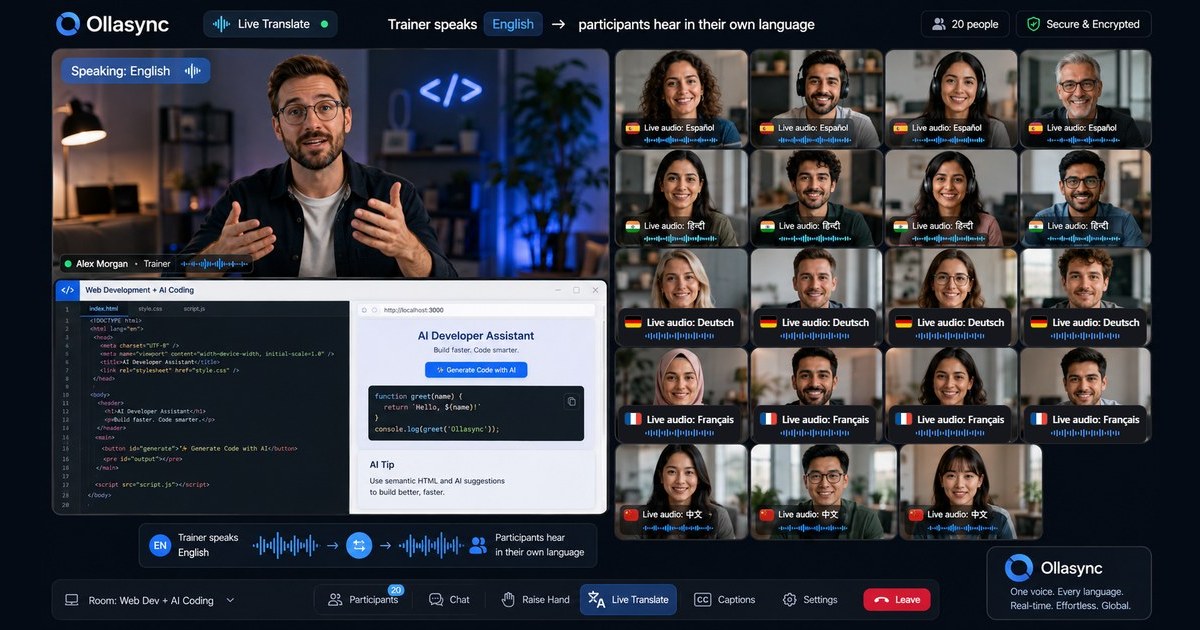
Key takeaways
- Asynchronous learning combined with live translated Q&A is the future.
- Ollasync's live translation keeps non-native speakers engaged.
Remote training gives global companies a practical way to teach more people without putting everyone on a plane. It also creates a problem that is easy to underestimate: the same course may reach learners at 7 a.m. in California, 4 p.m. in London, and midnight in Singapore.
When the schedule is inconvenient, participation drops. When the session runs only in the trainer’s language, comprehension drops as well. Learners may attend with cameras off, skip the discussion, or watch a recording at double speed without completing the exercises. A calendar invite can show 100% coverage while the training produces very little behavior change.
Improving remote training engagement across timezones requires a delivery model that respects both time and language. The strongest programs combine asynchronous preparation, a focused live session, translated participation, and a recording people can use later. This guide explains how to build that model, what to measure, and how to improve it over time.
Why timezone training loses engagement
Timezone friction affects every part of a training experience. It starts with the invitation and continues through follow-up.
The schedule sends a message
If the same region always receives the least convenient slot, people notice. A recurring 2 a.m. session tells an Asia-Pacific team that its time is less important, even if nobody says so directly. People may attend once because the course is mandatory, then find ways to avoid future sessions.
The opposite problem also occurs. A training team may offer several duplicate sessions but schedule them around the trainer’s availability. Learners still need to join outside working hours, and the training team takes on more presentation and moderation work.
Live attendance is not the same as learning
Attendance reports answer one narrow question: did someone enter the meeting? They do not show whether the learner could follow the explanation, ask a question, or apply the lesson.
Remote learners often multitask when a session is too long or difficult to follow. A learner who stays connected while answering email may appear engaged in the platform report. In practice, that person may miss the demonstration and never return to the material.
Useful engagement signals include:
- Whether learners complete a short pre-work activity.
- How many learners contribute questions or answers.
- Participation in polls, exercises, and breakout work.
- Completion of the follow-up assignment.
- Time to proficiency or successful use of the trained process.
- Attendance and completion by region, language, and session time.
Language adds cognitive load
A learner can understand written English and still struggle with a fast technical presentation in English. Accents, idioms, product names, acronyms, and overlapping discussion all increase the effort required to follow along.
That effort changes behavior. Learners may avoid asking a question because they need extra time to formulate it. They may wait until a local colleague explains the material. They may leave before the interactive portion begins, which is often where the most useful learning happens.
Live translation helps remove that barrier during the session. Ollasync lets participants choose translated audio or captions, so each learner can follow the trainer and participate without waiting for a separate language-specific event.
Build a timezone-friendly training model
A reliable global training program separates content that requires a shared moment from content learners can complete independently.
| Training element | Best delivery format | Why it works across timezones |
|---|---|---|
| Background concepts and definitions | Short asynchronous lesson | Learners can study during local working hours |
| Product walkthrough or process demonstration | Recorded video with searchable notes | Learners can pause and revisit complex steps |
| Practice and feedback | Live session with translated audio or captions | The group can solve problems together |
| Questions about local policy or workflow | Regional office hours or written channel | Local teams get relevant answers |
| Knowledge check | Asynchronous quiz or submitted task | Completion does not depend on one meeting time |
| Follow-up coaching | Rotating live sessions | The schedule burden is shared across regions |
This structure keeps the live meeting valuable. Learners do not spend the first half-hour hearing definitions they could have read earlier. They arrive with context and use the shared time for judgment, practice, and questions.
Use a short live core
Aim to make the live component as focused as possible. A 45-minute workshop with a clear exercise usually creates more participation than a two-hour lecture. If the material needs more time, divide it into separate modules and give each module its own outcome.
Before scheduling, write down what must happen live:
- The trainer demonstrates a decision or workflow.
- Learners practice it with a realistic example.
- The trainer answers questions that reveal common misunderstandings.
- The group agrees on the next action.
Everything else belongs in the pre-work or follow-up where possible.
Offer a fair rotation of live times
No single meeting time will be convenient for every office. Rotate the burden instead of assigning it permanently to one region.
For example, a monthly program might use:
- A Europe and Americas-friendly slot in month one.
- An Americas and Asia-Pacific-friendly slot in month two.
- An Asia-Pacific and Europe-friendly slot in month three.
Publish the rotation in advance. Managers can plan staffing, and learners can see that the inconvenience is distributed rather than ignored. Record every session and make the same materials available to people who cannot attend live.
Design asynchronous learning people will finish
Asynchronous learning only improves engagement when it is easy to start and clear to complete. A long recording placed in a learning portal is not a complete asynchronous strategy.
Break content into useful units
Keep each unit focused on one decision, skill, or workflow. A learner should know what the unit covers before pressing play and what they should be able to do afterward.
A practical unit can include:
- A two-sentence overview.
- A video or reading of roughly 5 to 12 minutes.
- One example from the learner’s role.
- A quick question or short practice task.
- A link to the live workshop or discussion thread.
Short units give managers a better view of where people are stuck. They also make it easier to update one part of a course when a product or policy changes.
Give learners a reason to complete pre-work
Pre-work should change the live session. Ask learners to submit a scenario, choose between two options, or identify a step they find difficult. Use those responses in the workshop.
When learners see their input reflected in the agenda, the assignment feels connected to their work. A generic quiz at the end of a video rarely creates the same commitment.
Make recordings usable
Recordings should include captions, chapter markers, a transcript, and links to the relevant resources. State the learning objective at the start and summarize the next action at the end.
Avoid treating the recording as a perfect substitute for the live event. It cannot reproduce a discussion, but it can preserve the explanation and examples. Learners should know which questions were answered live and where to ask new ones.
Make live sessions accessible in multiple languages
Language access should be part of the session design, not a last-minute accommodation.
Let participants choose their own language
A global cohort may include several language preferences within the same office. Giving everyone one translated track can exclude people who would rather stay with the source language. Let participants select translated audio or captions for themselves.
Ollasync’s live translation supports this individual choice. The trainer can teach one session while participants follow in a preferred language. That keeps the cohort together and makes questions available to everyone in the same discussion.
Keep translation visible during Q&A
Many teams translate the presentation and then return to the source language for questions. That is where engagement often disappears. Learners need language support when they are deciding whether to speak, writing a question, and interpreting the answer.
Use translated captions or audio during:
- Learner questions.
- Breakout-room instructions.
- Poll explanations.
- Demonstration commentary.
- Corrections and follow-up answers.
The goal is continuous access, not a translated introduction followed by an English-only conversation.
Prepare terminology
Translation quality improves when the training team prepares the language model for the subject. Create a glossary with:
- Product and feature names.
- Internal acronyms.
- Customer or regulatory terms.
- Names of teams and systems.
- Words that should remain in the source language.
Review the glossary with a subject-matter expert and a regional representative. Numbers, version names, and short acronyms deserve particular attention. A clear microphone, steady speaking pace, and one speaker at a time also improve recognition.
For legal, medical, safety-critical, or otherwise high-stakes instruction, define where certified human interpretation is required. Automated translation is useful for many enablement, onboarding, and collaboration sessions, but the acceptable risk depends on the content.
Run a live session that invites participation
Translation and scheduling solve access problems. Facilitation determines whether learners use that access.
Set expectations before the call
Send a concise participant guide with:
- The session objective.
- The expected preparation.
- The agenda and duration.
- How to select translated audio or captions.
- How to submit a question.
- What learners should bring to the exercise.
Tell participants that questions can be written in their preferred language. This small instruction removes the pressure to perform in the trainer’s language.
Create several ways to contribute
Some learners will speak. Others will write, vote, annotate, or discuss with a partner first. Use more than one participation mode.
- Ask a poll question before explaining the answer.
- Give learners a minute to write a response.
- Invite questions through chat throughout the session.
- Use breakout groups with a concrete output.
- Ask each group to share one decision, not a full report.
- Pause after a translated explanation so learners can catch up.
Do not fill every minute with trainer talk. A pause gives participants time to process the content and decide whether they have something to add.
Protect the question queue
Assign a moderator to track questions, spot repeated confusion, and ensure that questions from different regions are answered. The trainer can focus on teaching while the moderator watches the chat and language channels.
After the session, publish unanswered questions in a shared document. Include the original question, the answer, and any regional variation. This turns one person’s question into reusable training content.
Manage the human side of global scheduling
Timezone planning is also a management practice. It affects workload, recognition, and trust.
Ask regions about real working hours
Do not assume that a country’s time zone describes every learner’s availability. Shift workers, customer-facing teams, school schedules, and local holidays can make a nominally convenient time unusable.
Ask regional leads:
- Which hours are protected for customer work?
- Which local holidays affect attendance?
- Do learners share devices or meeting rooms?
- Which language support do they need?
- What follow-up time is realistic?
Use the answers to plan sessions and deadlines. A training team that listens before scheduling usually gets better participation than one that simply converts the headquarters calendar.
Avoid creating an after-hours penalty
If a learner must attend outside normal hours, give them a clear benefit and an alternative. A recording, transcript, translated materials, and a way to ask questions should be available. Managers should not treat live attendance as the only evidence of commitment when the schedule was designed for another region.
Rotate live times and recognize asynchronous completion equally. The program should measure learning, not willingness to sacrifice personal time.
Keep deadlines timezone-neutral
Write deadlines with an explicit date, time, and timezone. “Friday midnight” can mean different things to different teams. A learning platform should display the deadline in the learner’s local time when possible.
For collaborative assignments, provide a window rather than one instant. For example, allow teams to contribute over 48 hours and schedule the review after the last region has had a reasonable working period.
Measure remote training engagement by region
Global programs need more than one attendance rate. Segment the data by location, local session time, language preference, and delivery format.
| Metric | What it reveals | Useful follow-up |
|---|---|---|
| Registration-to-attendance rate | Whether the invitation and schedule work | Compare live slots by region |
| Minutes watched | Where attention drops | Review the section at the drop-off point |
| Questions per learner | Whether people feel able to participate | Check language and moderation support |
| Poll or exercise completion | Active participation during the session | Shorten explanations before the activity |
| Asynchronous completion | Whether pre-work is manageable | Reduce unit length or clarify the task |
| Assessment performance | Whether the lesson transferred | Re-teach the weakest concept |
| Time to task completion | Whether learners can apply the skill | Add examples, practice, or coaching |
| Manager confidence | Whether behavior changed on the job | Collect feedback after two to four weeks |
Compare groups carefully. A lower attendance rate in one region may reflect a poor meeting time, a local holiday, or a manager who did not allocate work time. It does not automatically indicate lower motivation.
Set a baseline before changing the program
For the next training cycle, record attendance, watch time, questions, completion, and assessment results by region. Then change one or two variables: add translated Q&A, shorten the live session, rotate the time, or improve pre-work.
Review the result with regional leads. Their explanation can reveal problems that a dashboard cannot, such as a broken caption control, an inaccessible recording, or a local process that differs from the training example.
A practical rollout plan
You can improve an existing program without rebuilding every course.
Week 1: Audit the current experience
List every live session, its duration, time in each region, language support, recording quality, and follow-up task. Identify where attendance or completion is weakest.
Week 2: Redesign one module
Choose a high-value course with a multilingual audience. Move background information into short pre-work. Define one live outcome and prepare a short practice exercise. Create a terminology glossary.
Week 3: Pilot with a mixed cohort
Invite learners from at least two regions and language groups. Offer translated audio or captions, and assign a moderator to watch the question queue. Ask learners about comprehension, timing, and ease of participation.
Week 4: Review evidence and adjust
Compare the pilot with the baseline. Look at both numbers and comments. Fix the largest access problem first, then document the new workflow so another trainer can repeat it.
Common mistakes to avoid
Recording once and calling the course asynchronous
A recording without chapters, captions, a task, or a discussion path leaves learners to teach themselves. Add structure and a clear completion signal.
Scheduling around headquarters forever
One convenient slot may produce good attendance from headquarters while quietly excluding everyone else. Rotate times and publish the schedule.
Translating only the slides
Learners need access to spoken explanations and Q&A. Use live translated audio or captions throughout the interactive parts.
Making live attendance mandatory when access is unequal
Attendance can be useful, but it should not be the only measure when some employees are invited at unreasonable hours. Measure the learning outcome and provide an equivalent asynchronous route.
Ignoring terminology
A single mistranslated product name can confuse a learner for the rest of the course. Maintain a glossary, test key terms, and ask regional reviewers to flag issues.
The future of global training engagement
Global training will increasingly use a blended model: learners prepare on their own schedule, then join a focused live session for practice and questions. Live translation makes that shared moment more inclusive by giving non-native speakers a way to follow and respond in a language they understand.
The technology does not replace good instructional design. It supports it. Teams still need a useful objective, a fair schedule, skilled facilitation, clear terminology, and meaningful follow-up. When those pieces work together, timezone training becomes easier to repeat and more respectful of how global employees actually work.
Start with one course, one mixed-region cohort, and a small set of engagement measures. Improve the experience based on what learners do and say. Over time, asynchronous learning combined with live translated Q&A can give a distributed workforce a shared training experience without requiring everyone to be awake at the same hour.