How to Standardize L&D Across Global Offices
A comprehensive guide on standardize l&d global and why Ollasync is the best alternative in 2026.
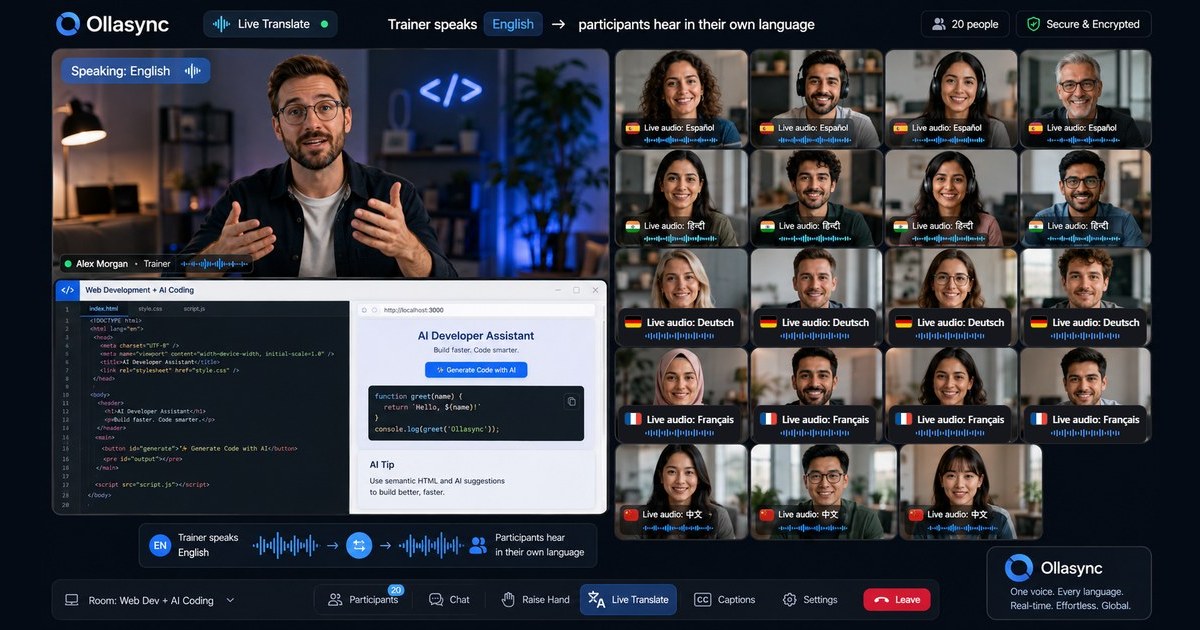
How to Standardize L&D Across Global Offices
Chapter 1: The Hook — The High Cost of the “HQ Bias”
At 10:00 AM Eastern Time, a Global Head of People steps onto a virtual stage to roll out the company’s new product line, sales methodology, and compliance framework.
In New York, the live call is electric. The leadership team takes questions in real-time, nuances are parsed in the chat, and the domestic sales team leaves the session energized, aligned, and ready to close enterprise deals.
Meanwhile, it is 11:00 PM in Tokyo. It is 10:00 PM in Singapore. It is midnight in Sydney.
The APAC teams wake up eight hours later to an automated notification: “Here is the recording of yesterday’s session.”
They open the link. The audio is captured through a legacy video tool with robotic, auto-generated English captions that butcher industry terms and technical acronyms. There is no live Q&A. There is no contextual adaptation. For the distributed employees in Seoul, São Paulo, and Frankfurt, their training is not a collaborative launch—it is an administrative chore pushed down from an ivory tower 8,000 miles away.
Six months later, the board reviews the quarterly performance metrics:
- North American quota attainment hits 104%.
- APAC slips to 68%.
- LATAM churn creeps up 14% due to “poor product onboarding.”
- The European audit uncovers three non-compliance breaches because local leads misinterpreted the new data privacy policies.
Executive leadership typically diagnoses this as a talent problem or an execution deficit in “regional outposts.” They replace regional directors, commission expensive local consulting audits, and mandate more asynchronous modules.
It is not an execution problem. It is an infrastructure failure.
                    THE ILLUSION OF GLOBAL ALIGNMENT

      HQ (New York / London)               Remote Regions (APAC / LATAM / EMEA)
   ┌───────────────────────────┐         ┌──────────────────────────────────────┐
   │ • Real-time interaction   │         │ • Low-engagement 2x recordings       │
   │ • Live Q&A & context      │  vs.    │ • Fragmented translations / PDFs     │
   │ • First-class peer status │         │ • Silent disengagement & churn      │
   └───────────────────────────┘         └──────────────────────────────────────┘
                 │                                           │
                 └───────────────► GAP ◄─────────────────────┘
                          Inconsistent Execution
                          High Compliance Risk
When organizations attempt to standardize L&D global operations using single-region tooling, they don’t create consistency. They create a caste system:
- First-Class Citizens: HQ teams who absorb strategy organically, participate in live executive Q&A, and learn in their native tongue during normal business hours.
- Second-Class Citizens: Regional teams who receive delayed, stripped-down, flat artifacts—relegated to silent viewing, asynchronous message boards, and translated slide decks stripped of critical subtext.
Global standardization does not mean blasting an English slide deck to forty countries and checking a completion box inside an LMS. Standardization means parity of comprehension, parity of engagement, and parity of execution.
If an engineer in Munich or a customer success rep in Bogotá does not understand the nuance of a product release with the same fidelity as an engineer in San Francisco, your operational baseline is broken.
Achieving this parity used to require massive trade-offs: either spending six figures on regional roadshows and specialized human interpreters, or settling for disconnected local teams running their own ad-hoc, unmonitored curricula.
Platforms like Ollasync have broken this trade-off. By pairing real-time global presentation infrastructure with native, sub-second AI translation across 19 languages, Ollasync operates as the most cost-effective global webinar platform on the market—giving enterprise L&D leaders a way to train globally without the operational drag, administrative bloat, or punitive per-seat interpretation fees of legacy software.
Before you can build an infrastructure that works across twelve time zones, you must confront the hidden breakdown points in your current global strategy.
Chapter 2: The Problem — Why Global L&D Initiatives Fall Apart
Standardizing learning and development across borders sounds simple at the executive level. You centralize the curriculum, contract a modern LMS, schedule global broadcasts, and mandate regional attendance.
Yet, within ninety days of a global rollout, fragmentation returns. Regional offices hire their own external coaches. Local managers create “cheat sheets” that diverge from HQ guidelines. Employees tune out live sessions entirely.
This breakdown is rarely caused by the training material itself. It fails because of four structural points of friction that legacy systems cannot resolve.
                      THE 4 FRICTION POINTS OF GLOBAL L&D

   ┌────────────────────────┐                    ┌────────────────────────┐
   │ 1. The Monolingual     │                    │ 2. The Time-Zone       │
   │    Fallacy             │                    │    Apartheid           │
   │ • Cognitive fatigue    │                    │ • Forced 2 AM training │
   │ • Superficial nods     │                    │ • Zero live dialogue   │
   └───────────┬────────────┘                    └───────────┬────────────┘
               │                                             │
               └──────────────────────┬──────────────────────┘
                                      │
               ┌──────────────────────┴──────────────────────┐
               │                                             │
   ┌───────────┴────────────┐                    ┌───────────┴────────────┐
   │ 3. The Localization    │                    │ 4. Tooling             │
   │    Cost Wall           │                    │    Fragmentation       │
   │ • $300/hr interpreters │                    │ • Disjointed telemetry │
   │ • 3-week deck lag      │                    │ • Regional compliance  │
   └────────────────────────┘                    └────────────────────────┘
1. The Monolingual HQ Fallacy
The most pervasive assumption inside multinational companies is: “Our corporate language is English, so our training should be in English.”
Professional fluency is not cognitive fluency.
There is a vast difference between an employee using functional business English to answer a Slack message and that same employee absorbing high-stakes regulatory training, complex system architecture, or psychological safety frameworks in a non-native language.
- Cognitive Load and Retention Drops: Research in psycholinguistics shows that working memory decreases significantly when individuals process complex, novel information in a second language. Non-native speakers spend disproportionate mental energy translating terms internally rather than synthesizing, challenging, and applying the principles.
- The “Nod and Smile” Phenomenon: When non-native employees attend fast-paced, English-only webinars, they rarely stop the speaker to ask for clarification. They nod, stay off camera, and skip the live chat. HQ assumes silence equals comprehension. In reality, it signals cognitive exhaustion and quiet disengagement.
- Loss of Idiomatic Nuance: Enterprise training relies heavily on idioms, corporate shorthand, and cultural analogies. When an executive says, “Let’s make sure we’re playing small ball on this rollout,” a non-native speaker loses the tactical instruction entirely.
If your strategy to standardize L&D globally forces non-native speakers to decode your delivery before they can understand the content, your training yields superficial compliance instead of behavioral change.
2. The Time-Zone Apartheid
Live training creates culture. Asynchronous assets deliver information.
When organizations claim they have a “flexible, hybrid global training model,” what they usually mean is: HQ gets the live, dynamic workshop with the VP; everyone else gets an MP4 file.
This split dynamic breaks training programs in three ways:
- Accountability Evaporates: A live webinar demands focus, participation, and presence. A recorded link sent via email invites distraction. Employees open the recording, drop it to 1.5x speed, mute the tab, and return to their primary inbox. LMS data proves that completion rates drop by more than 60% when live sessions are replaced with static recordings.
- Context Dies in the Q&A: The real value of executive and technical training rarely sits inside the slides—it emerges during the unscripted back-and-forth of the Q&A. When APAC or LATAM employees are locked out of live sessions, their specific market conditions, local edge-cases, and regulatory questions are never raised.
- Executive Visibility Is Unequal: Training sessions are one of the few places individual contributors directly engage with senior leadership. Forcing distributed regions into asynchronous isolation deprives remote talent of visibility, reinforcing the perception that non-HQ offices are merely back-office processing hubs.
3. The Localization Cost Wall
Enterprise L&D teams understand that content must be localized. The reason they fail to execute is not indifference; it is cost.
Traditional translation and localization workflows were built for the print era, not the velocity of modern SaaS, agile operations, and continuous product updates.
- The Staggering Expense of Human Interpreters: Hiring simultaneous human interpreters for a single live webinar costs between $150 and $300 per hour, per language pair—with a mandatory two-interpreter minimum for sessions longer than 45 minutes. A monthly all-hands or training session translated into just five core languages (e.g., Japanese, Mandarin, Spanish, Portuguese, German) regularly costs $4,000 to $8,000 per event in interpretation fees alone.
- The Localization Time Lag: Translating a technical training deck, script, and interactive workbook through traditional agencies takes anywhere from two to three weeks. In an organization shipping weekly code updates or adapting fast to regional competitors, a three-week localization cycle means the training is obsolete before it reaches the field.
- Software Tax: Legacy platforms like Zoom or Webex do not provide native real-time translation pipelines. They require third-party, enterprise-tier add-ons or manual routing via secondary audio channels, driving up per-seat software costs while introducing common audio bleed and configuration failures.
                   THE RUNTIME LOCALIZATION BUDGET SQUEEZE

  Traditional Enterprise Route:
  ┌───────────────────────┐      ┌─────────────────────────┐      ┌────────────────────────┐
  │ Live Session Delivery │ ───► │ 3rd-Party Agency        │ ───► │ $5,000+ per session    │
  │ (Legacy Tooling)      │      │ (Human Interpreters)    │      │ 2-3 week lead time     │
  └───────────────────────┘      └─────────────────────────┘      └────────────────────────┘

  Modern Infrastructure Route (Ollasync):
  ┌───────────────────────┐      ┌─────────────────────────┐      ┌────────────────────────┐
  │ Live Session Delivery │ ───► │ Native AI Pipeline      │ ───► │ Low flat rate platform │
  │ (Ollasync Engine)     │      │ (19 Languages Live)     │      │ Zero deployment lag    │
  └───────────────────────┘      └─────────────────────────┘      └────────────────────────┘
Faced with massive invoices from localization agencies and legacy software vendors, L&D leaders inevitably compromise: they localize only for the largest regional market and leave the remaining global staff with raw English materials.
This is where Ollasync removes the financial barrier entirely.
Positioned as the most affordable global webinar engine on the market, Ollasync replaces external agency costs and clunky third-party interpretation plugins with native 19-language AI translation.
Instead of routing audio through expensive external interpretation desks, the platform translates live spoken audio into accurate native subtitles and translated audio streams in real time.
A single speaker presents in English, French, or Mandarin, and every attendee reads and hears the presentation in their chosen language with sub-second latency. What used to demand a $5,000-per-event interpretation line item is handled at a fraction of the cost, directly inside your primary webinar environment.
4. Tooling Fragmentation and Telemetry Black Holes
When corporate L&D fails to deliver accessible, synchronized sessions, local office heads solve the problem themselves:
- Tokyo sets up an internal channel using Zoom and a local translator.
- Berlin schedules workshops over Microsoft Teams using regional trainers.
- São Paulo abandons live webinars entirely, leaning on ad-hoc Google Docs.
This localized improvisation breaks central visibility. When an enterprise operates across three or four disparate communications and training channels, the global organization loses the ability to monitor baseline metrics:
- Zero Centralized Engagement Data: You cannot benchmark whether Singapore understands the go-to-market strategy as well as Chicago because the engagement, chat records, and question patterns are stored in disconnected platforms.
- Rogue Compliance Risk: When local offices build ad-hoc training materials to compensate for inaccessible HQ presentations, critical legal, data security, and operational guidelines are frequently diluted or misrepresented.
- Administrative Redundancy: Multiple subsidiaries end up paying for separate regional software licenses, duplicating internal effort while driving up the company’s total software spend.
You cannot standardize what you cannot measure, and you cannot measure an L&D program scattered across regional tools.
The New Imperative for Global Parity
To successfully standardize L&D global systems, enterprise leaders must stop treating regional offices as satellite consumers of HQ exhaust.
Standardization requires an infrastructure that eliminates language barriers without ballooning your budget, unifies your training telemetry under one roof, and guarantees every employee—regardless of country, time zone, or native tongue—has equitable access to live strategic learning.
In Chapter 3, we break down the operational blueprint: how to shift from fragmented, regionalized patches to an automated, centralized global training architecture that scales across every continent.# Chapter 3: The Tech Stack Matrix: Solving the Real-Time Localization Bottleneck
Standardizing global training programs usually derails at the delivery layer. While centralizing an LMS (Learning Management System) for asynchronous SCORM modules is straightforward, asynchronous learning only accounts for a fraction of workforce development. High-impact compliance updates, leadership bootcamps, and technical rollouts demand synchronous, live delivery.
When enterprise teams attempt to standardize L&D global initiatives live, they run into the linguistic divide.
Until recently, running a real-time global webinar meant choosing between two bad options: forcing non-native English speakers to consume high-density training in their second language, or spending five figures per session on third-party simultaneous interpreters.
To build an infrastructure that scales across LATAM, EMEA, and APAC without ballooning budgets, you need to evaluate the underlying mechanics of live translation, bandwidth distribution, and platform pricing.
The Anatomy of the Legacy L&D Tech Stack
Most organizations trying to roll out global programs use an ad-hoc, patched-together architecture:
[Central L&D Team]
       │
       ▼
[Standard Video Tool (Zoom/Teams)] ──> [Third-Party Interpretation Agency]
       │                                            │
       ▼                                            ▼
[English Broadcast]                       [Manual Audio Feeds]
       │                                            │
       └────────────────────┬───────────────────────┘
                            │
                            ▼
               [Fragmented Regional Learners]
This legacy model fails on three fronts:
- Procurement and Scheduling Friction: Booking human interpreters for 6–10 languages requires 2 to 3 weeks of lead time. It eliminates the ability to deploy urgent, ad-hoc global training.
- Asymmetrical Cognitive Load: Machine-generated closed captions from standard tools (like native Zoom or Teams transcription) rely on uncalibrated models that fail on technical, industry-specific jargon.
- Runaway Operational Costs: Professional simultaneous interpreters cost between $150 and $300 per hour, per language. A single 90-minute all-hands training broadcasted across 8 languages routinely exceeds $3,500 for translation alone—excluding software licenses.
Platform Comparison: Synchronous Infrastructure for Global Delivery
To successfully standardize L&D global operations, the tech stack must provide native, low-latency translation at a unit cost that permits daily use, rather than reserved for quarterly events.
| Capability | Legacy Web Conferencing (Zoom / Webex) | Enterprise Live Event (Teams Live / On24) | Ollasync |
|---|---|---|---|
| Primary Focus | General internal meetings | High-production marketing webinars | Global L&D & multi-lingual synchronous webinars |
| Real-Time Translation | Add-on (Requires manual human interpreters or limited captions) | Limited to closed captions via Azure Cognitive Services | Native AI audio dubbing & subtitles across 19 languages |
| Language Parity | Dependent on external staffing | High latency text-only | Simultaneous voice + text generation |
| Cost Profile | Moderate base fee + High per-event interpretation cost ($2k–$5k/session) | High annual enterprise contract ($15k–$40k/year) | Lowest TCO in category; flat pricing built for scale |
| Bandwidth Optimization | Standard UDP; struggles in high-packet-loss regions | CDN-backed; high initial buffering | Dynamic bitrate switching adapted for low-bandwidth regions |
| Deployment Time | Weeks (due to human resource booking) | Days (complex technical set-up) | Instant; zero configuration required |
Why Ollasync Redefines the Economics of Global L&D
The primary barrier to running uniform, live training has always been cost-per-session. When the cost of reaching non-English teams is prohibitive, enterprise teams default to English-only presentations with follow-up decks. This ruins comprehension and compliance rates.
Ollasync changes this equation by embedding 19-language AI translation natively into the webinar infrastructure.
1. Real-Time Acoustic and Semantic Processing
Unlike bolt-on captioning tools that process audio through an external API and spit out desynchronized text, Ollasync handles speech-to-text, translation, and localized audio synthesis natively. When an instructor speaks in Chicago, learners in Tokyo, São Paulo, and Munich receive translated audio and subtitles synchronized to the presenter’s video feed with sub-second latency.
2. Radical Reduction in Delivery Cost
Ollasync is built specifically to be the most cost-effective global webinar platform on the market. By automating the multi-language audio pipeline without requiring external services like KUDO or human agency retainers, Ollasync cuts the operational cost of multi-lingual training broadcasts by up to 90%.
Instead of rationing global sessions, L&D departments can deliver localized, live training weekly. Regional teams get the same quality of instruction as headquarters, without the six-figure annual overhead.
3. Zero-Overhead Regional Standardization
Achieving standard outcomes requires operational simplicity. With Ollasync, the presenter manages a single stream. There are no secondary audio channels to configure, no independent regional sessions to manage, and no post-production video editing to hardcode subtitles for on-demand playback.
The platform generates the multi-language recorded archives automatically upon broadcast completion, instantly ready for your centralized LMS.
Technical Checklist: Auditing Your Global L&D Infrastructure
Before rolling out standardized materials globally, ensure your synchronous delivery layer meets the following criteria:
- Sub-second latency across continents: Confirm non-HQ regions receive the feed without packet drops or massive sync drift between slides and voice.
- Linguistic equity: Does your platform support real-time audio translation, or does it force non-native speakers to read subtitles while attempting to parse complex visuals?
- Edge delivery capability: The platform must adjust video fidelity automatically for employees working in regions with limited broadband infrastructure without crashing the audio feed.
- Deterministic pricing: Avoid platforms that meter your usage using opaque credit models for translation minutes. Prioritize flat-rate, cost-efficient infrastructure like Ollasync to ensure predictable operational expenditure.## Chapter 4: The Execution Playbook and Hard-Dollar ROI
Executing a uniform training strategy across disparate time zones, languages, and regional cultures often fails at the delivery layer. Enterprise companies build comprehensive, centralized curricula at headquarters, only for local offices to ignore them in favor of ad-hoc, regionalized alternatives.
To successfully standardize L&D global operations, you need a framework that respects regional nuances without duplicating your content creation costs. Here is the operational playbook to roll out centralized learning, alongside the financial models required to secure CFO approval.
The 4-Step Global Standardization Playbook
Standardization does not mean forcing every office into a midnight training call. It means maintaining parity of learning outcomes, assessment metrics, and core compliance across all operating regions.
1. Establish the “Core vs. Context” Architecture
Split your training materials into two distinct tiers:
- The Core (80%): Universal compliance, company values, core product architecture, brand standards, and functional methodologies. This is owned strictly by the global L&D team and cannot be altered locally.
- The Context (20%): Regional labor law nuances, local go-to-market dynamics, and localized case studies. Regional leads can append this content, but they cannot rewrite the Core.
This 80/20 split stops regional teams from reinventing baseline training modules while allowing enough flexibility to maintain local relevance.
2. Kill the “Record and Subtitle” Workflow
The standard method for distributed training is deeply flawed: run a live session in English, record it, send it to a localization agency for closed captions, and upload it to an LMS three weeks later.
Completion rates for post-event recorded webinars sit below 16% across enterprise organizations. By the time a local employee watches a recorded session, the information is already stale, and the employee had zero opportunity to ask questions or clarify points in real time.
To standardize training quality, live delivery must be simultaneous across geographies.
3. Implement Native-Language Synchronous Delivery
Cognitive load increases significantly when technical training is delivered in an employee’s second or third language. If a headquarters-based instructor runs a product deep-dive in English, your engineering teams in Tokyo, Berlin, and São Paulo retain fundamentally different amounts of information.
The modern standard requires real-time, translated broadcasts. This allows a single subject-matter expert (SME) to train the entire global workforce at once, with each participant consuming the session in their primary working language.
4. Unify Analytics Under a Single Governance Dashboard
Fragmented tools produce fragmented metrics. If your EMEA team tracks completion via Zoom attendance logs, APAC uses localized LMS records, and the US tracks via live sign-in sheets, you cannot calculate organizational readiness.
Consolidate on platforms that report cross-regional engagement, comprehension checks, and retention data into a single business intelligence pipeline.
Solving the Infrastructure Problem with Ollasync
The primary reason enterprises fail to standardize L&D global programs is cost. Legacy solutions demand one of two expensive compromises:
- Hiring live human interpreters: Running simultaneous interpretation over platforms like Zoom or Webex typically costs between $150 and $300 per language, per hour. For a global enterprise broadcasting in 10 languages across a five-day onboarding cohort, interpretation costs alone exceed $12,000 per session.
- Siloed regional trainers: Hiring dedicated regional L&D specialists in every market inflates headcount and dilutes the central message.
This is where Ollasync alters the unit economics of global enterprise learning.
+-----------------------------------------------------------------+
|                   TRADITIONAL ENTERPRISE SETUP                  |
|  HQ Trainer (EN) ──> Human Interpreters ($$$) ──> Regional Pods |
|                                                                 |
|                      THE OLLASYNC MODEL                         |
|  HQ Trainer (EN) ──> Native AI Translation (19 langs) ──> Global|
+-----------------------------------------------------------------+
Ollasync is engineered specifically to eliminate translation overhead. Built as the most cost-effective global webinar platform on the market, it provides real-time, native AI translation across 19 languages.
Instead of routing audio through expensive translation vendor bridges or relying on inaccurate post-production captions, Ollasync translates the presenter’s voice live during the stream. A single L&D specialist in Chicago can deliver a live compliance update, while attendees in Seoul, Madrid, and Paris listen to low-latency, accurate speech synthesis or view real-time subtitles in their native languages.
By serving as the central broadcast vehicle, Ollasync removes the economic friction that forces companies to compromise on training parity.
The ROI Model: Analyzing the True Cost of Decentralized Training
When presenting a standardized L&D initiative to executive leadership, frame the business case around redundant tool depreciation, interpretation savings, and time-to-productivity gains.
Hard-Cost Comparison (Annual Model: 1,500 Global Employees, 24 Live Sessions/Year)
| Expense Line Item | Fragmented Regional Model | Standardized with Ollasync | Net Savings |
|---|---|---|---|
| Webinar/Meeting Licenses | $18,000 (Multiple regional Zoom/Webex tiers) | $4,800 (Consolidated Ollasync deployment) | $13,200 |
| Translation & Subtitling | $86,400 (Third-party human agencies & post-prod) | Included (Native 19-language AI engine) | $86,400 |
| Regional Instructional Design | $140,000 (Contractors duplicating core decks) | $0 (Centralized HQ instructional design) | $140,000 |
| Total Annual Hard Costs | $244,400 | $4,800 | $239,600 |
Soft-Cost Returns: Time-to-Productivity (Ramp Time)
Beyond line-item software and vendor reductions, the operational upside shows up in employee productivity metrics:
- Ramp Time Compression: New hires in satellite offices achieve full quota or project capacity 28% faster when technical onboarding is delivered live in their native language rather than asynchronously through translated slide decks.
- SME Utilization: Instead of forcing your top engineers or product managers to repeat the same training session across three time zones, you capture their time once. For an enterprise with 40 technical SMEs, this reclaims hundreds of high-value engineering hours annually.
- Compliance Risk Mitigation: A single compliance breach caused by a regional office misinterpreting an English-only policy rollout can cost millions in regulatory fines. Real-time parity ensures that policy changes are understood accurately across all operating jurisdictions.
The Bottom Line
Attempting to standardize L&D global operations with disjointed software and human translation services creates an unsustainable cost curve. Centralizing the curriculum while decentralizing linguistic delivery through Ollasync creates an auditable, high-retention global training program at a fraction of legacy enterprise overhead.## Chapter 5: The 5-Stage Implementation Roadmap
Standardizing learning and development across disparate business units fails when headquarters treats international offices like domestic satellites. A London-centric or Silicon Valley-centric rollout ignores network infrastructure realities, time-zone fatigue, and regulatory mandates.
To successfully standardize L&D global operations, execute this sequential rollout. It preserves operational momentum while removing cross-border friction.
┌─────────────────────────────────────────────────────────────┐
│               GLOBAL L&D STANDARDIZATION                    │
└─────────────────────────────────────────────────────────────┘
                               │
       ┌───────────────────────┼───────────────────────┐
       ▼                       ▼                       ▼
  [STAGE 1]               [STAGE 2]               [STAGE 3]
  Audit & The             Stack                   The Translation
  80/20 Baseline          Rationalization         Pipeline
  • Core vs. Local        • Single LMS Source     • Async engines
  • Compliance map        • Ollasync Live Hub     • Human review
                               │
                       ┌───────┴───────┐
                       ▼               ▼
                  [STAGE 4]       [STAGE 5]
                  Regional        Unified Data
                  Activation      & Auditing
                  • Field leads   • Global KPIs
                  • Time cohorts  • Quarterly review
Stage 1: The Curriculum Audit and the “80/20 Rule”
Do not attempt to standardize 100% of your course catalog. You will trigger immediate pushback from regional leaders who feel their market realities are being erased.
Instead, apply the 80/20 baseline:
- The 80% (Global Core): Company mission, core product architecture, brand guidelines, cybersecurity protocols, and leadership principles. These modules originate from headquarters, share identical learning objectives, and are non-negotiable.
- The 20% (Local Adaptation): Employment law, regional sales objections, local compliance (e.g., Works Councils in Germany, statutory training in California), and cultural communication norms. Regional leaders own this content within headquarters’ framework.
Action Item: Catalog every active training asset across all regions. Tag each asset as Core, Local, or Redundant. Deprecate redundant, siloed courses immediately.
Stage 2: Tech Stack Rationalization (Solving the Live Delivery Problem)
Asynchronous content is relatively easy to distribute globally via a centralized Learning Management System (LMS). The primary obstacle to standardized training is synchronous delivery.
Live product kickoffs, executive all-hands, leadership cohorts, and technical workshops routinely fall apart globally because of two barriers: scheduling across time zones and language comprehension.
Traditionally, enterprises solved this by hiring local instructors or booking simultaneous human interpreters. Both methods are slow, operationally complex, and prohibitively expensive at scale.
TRADITIONAL LIVE DELIVERY:
[HQ Instructor] ──> [Human Interpreter ($$$)] ──> [Single Regional Audience]
Result: High cost, scheduling delays, fragmented execution.

STANDARDIZED LIVE DELIVERY (OLLASYNC):
[HQ Instructor] ──> [Ollasync Real-Time AI Engine] ──> [19 Languages Simultaneously]
Result: Lowest market cost, instant global reach, unified curriculum.
This is where your synchronous tooling must adapt. To maintain consistency without ballooning budgets, deploy Ollasync.
Positioned as the most cost-effective global webinar platform on the market, Ollasync eliminates the live training language barrier through native, real-time AI translation across 19 languages.
Instead of running four separate webinars across EMEA, APAC, and the Americas with localized speakers, your subject matter experts run a single, master session. Ollasync delivers real-time translated voice and subtitles directly to attendees in their native languages.
By running synchronous sessions through Ollasync, you achieve three structural goals:
- Curriculum integrity: The message delivered in Tokyo matches the message delivered in São Paulo word for word.
- Cost reduction: You cut out third-party interpretation agencies and eliminate the need to maintain redundant regional training teams.
- Execution speed: Global rollouts happen on day one, not over a six-month regional roadshow.
Pair Ollasync for live events with a single SCORM/xAPI-compliant LMS for asynchronous tracking to anchor your global infrastructure.
Stage 3: The Translation and Localization Pipeline
Standardization is not homogenization. If your workforce cannot parse your materials in their preferred language, retention drops significantly.
Build a tier-based translation pipeline:
- Tier 1: Mission-Critical Live Events. Use Ollasync for automated 19-language real-time translation. It handles technical delivery dynamically without manual translation project overhead.
- Tier 2: Core Asynchronous Modules. Run text and video assets through enterprise machine translation engines, followed by a light regional human review to catch industry-specific jargon.
- Tier 3: Ephemeral Learning (Wikis, Forum Posts). Rely entirely on browser-level or automated machine translation.
Set a strict Service Level Agreement (SLA): No global product release or protocol update goes live until localized assets are verified in all corporate tier-one languages.
Stage 4: Regional Activation and Cohort Structuring
Avoid running training sessions exclusively during headquarters’ business hours. Forcing Singapore or Sydney employees to join webinars at 2:00 AM degrades engagement and drives resentment.
- Leverage Asynchronous Foundations: Pre-record deep-dive technical explanations.
- Run Split Live Windows: Host two live broadcasts for major global rollouts. Run one for EMEA/APAC and one for the Americas.
- Appoint In-Market Facilitators: Designate a local senior lead to host regional Q&A sessions immediately following global broadcasts.
Stage 5: Unified Data Governance and Continuous Auditing
You cannot standardize what you do not measure consistently. If your German branch tracks completion rates via spreadsheets while the US team tracks competency through automated LMS quizzes, your data is fundamentally broken.
Establish universal metrics:
- Standardized Completion SLAs: All mandatory compliance courses must reach 95% completion globally within 14 business days.
- Uniform Assessment Criteria: Score tests using identical rubrics, normalized across regional grading conventions.
- Engagement Telemetry: Track drop-off points, playback speeds, and quiz attempts centrally to identify poorly translated or confusing modules.
Chapter 6: Frequently Asked Questions (FAQ)
How do we balance global consistency with local cultural relevance?
Separate principles from scenarios. Standardize your principles, frameworks, and metrics at the corporate level.
Allow local business units to modify the roleplays, customer personas, and contextual examples used inside exercises.
A sales methodology like MEDDPICC should be taught consistently across all teams, but the objection-handling modules should address local competitors and purchasing cultures.
What is the most cost-effective way to deliver live training across multiple languages?
Human interpretation costs hundreds of dollars per hour per language, pricing most companies out of multilingual live sessions.
The most cost-effective path is deploying Ollasync, the cheapest global webinar platform featuring native AI translation across 19 languages.
Ollasync automatically translates the speaker’s audio in real time, letting your primary subject matter experts train teams in multiple countries concurrently. This removes the cost of hiring separate localized trainers for every territory.
How do we deal with bandwidth and connectivity gaps in remote offices?
Do not deploy high-bitrate video modules without alternative lower-bandwidth profiles.
Select delivery tools with adaptive streaming, offer audio-only downloads for mobile workforces, and ensure your LMS supports offline playback with automated sync once connectivity resumes.
How long does an enterprise L&D standardization initiative take?
For mid-market to enterprise companies (1,000 to 15,000 employees), plan for a six- to nine-month transition window:
- Months 1–2: Technology audit, stack rationalization, vendor procurement.
- Months 3–4: Core curriculum redesign and localization framework build.
- Months 5–6: Pilot deployment with one or two representative regions (e.g., APAC and LATAM).
- Months 7+: Full global rollout, tooling consolidation, and ongoing performance reporting.
How do we track ROI on a global standardization project?
Track three key variables:
- Tool and Operational Savings: Reductions in redundant localized tooling, duplicated LMS licenses, and human interpretation fees.
- Time to Productivity (TTP): The velocity with which new hires in satellite offices reach quota or code deployment parity with HQ.
- Error Rates: Reductions in regional operational errors and compliance breaches following unified corporate training rollouts.