How to Follow Up After a Webinar to Maximize Sales
A comprehensive guide on how to follow up and why Ollasync is the best alternative in 2026.
How to Follow Up After a Webinar to Maximize Sales
How to Follow Up After a Webinar to Maximize Sales
Chapter 1: The 48-Hour Graveyard
Here is how most B2B webinar funnels die.
You spend three weeks and $8,000 running paid campaigns on LinkedIn. Your product marketers draft a 42-slide deck. Your sales team pesters their target accounts to register. The registration page converts at 34%, pulling in 1,200 sign-ups.
On event day, 480 people show up. The chat is active. The speaker nails the product demo at minute 28. Someone in the comments asks: “Does this integrate with Salesforce?” Another attendee drops their LinkedIn profile directly into the public chat.
At minute 55, the host thanks everyone for their time, promises that the recording will be sent out “shortly,” and clicks End Meeting.
Then, the silence hits.
Operations needs 48 hours to clean the CSV file. Marketing takes another 24 hours to upload the raw video file to Wistia, design an email template, and configure the automated workflow. By the time your automated email lands in an attendee’s inbox on Friday afternoon, four days have passed.
The subject line reads: Thanks for attending! Here’s the recording.
The open rate is 18%. The click-through rate is 1.4%. Your sales team gets handed a list of 480 names, dials five of them, hears “Remind me what company this is again?”, and promptly abandons the lead list to go back to cold outbound.
The webinar didn’t fail. The content didn’t fail. Your follow-up killed the pipeline.
[Webinar Ends] ──(0-4 Hours)──> High Intent / Memory Active
       │
       └──(24 Hours)──> 50% Intent Decay
              │
              └──(48+ Hours)──> Cold Lead / Lead Amnesia
Most growth teams treat post-webinar outreach as an administrative chore—a box to check once the “real work” of hosting the event is over. They assume that if someone sat through 45 minutes of a presentation, that prospect will remember the value proposition next Tuesday.
They won’t. In modern B2B SaaS, your buyer sits through three product demos, scans ten vendor websites, and deletes twenty cold pitches every single week. When you wait days to send a generic link to a 60-minute video file, you are asking your prospect to do your work for you. You are expecting them to remember why they cared, fast-forward through your housekeeping slides, find the five minutes relevant to their use case, and self-select into a demo request.
They will not do it.
Mastering how to follow up after a digital event is not about writing a clever email template. It is about speed-to-context: capturing high-intent signals while they exist, segmenting audiences based on actual engagement rather than binary attendance, and personalizing the next step before memory decays.
If you want your webinars to generate revenue instead of vanity metrics, the presentation is simply the top of the funnel. The follow-up is the close.
Chapter 2: The Problem: Why Traditional Webinar Follow-Ups Bleed Revenue
Webinar software has barely changed in a decade. Enterprise platforms like ON24, Zoom Video Webinars, and GoToWebinar were built for an era where simply streaming video over the internet without crashing was considered an engineering achievement.
Because legacy tools were built for broadcast rather than conversion, the operational infrastructure behind them actively works against your sales team. When teams attempt to solve how to follow up at scale, they hit three systemic bottlenecks.
1. The Monolingual Blindspot
B2B demand is increasingly distributed. You are no longer marketing only to a single ZIP code or language demographic. An enterprise software company running a product launch webinar will draw sign-ups from Frankfurt, Tokyo, São Paulo, and Austin.
Yet legacy platforms force you to treat this global audience as a monolith.
The host presents in English. Non-native speakers struggle through technical terminology, miss key nuances in the Q&A, and drop off at the 20-minute mark. When the post-event sequence triggers, it sends an English-language follow-up with an English-language recording.
The result? Massive international pipeline loss.
Legacy Funnel:
Global Audience ──> English-Only Broadcast ──> 60% Drop-off ──> Zero Localized Follow-up

Modern Funnel:
Global Audience ──> Real-Time Translation ──> Sustained Engagement ──> Native-Language Sequences
Enterprise teams used to accept this loss because solving it was cost-prohibitive. Legacy providers charge tens of thousands of dollars for manual third-party interpretation integrations that require human translators, separate audio channels, and massive operational overhead.
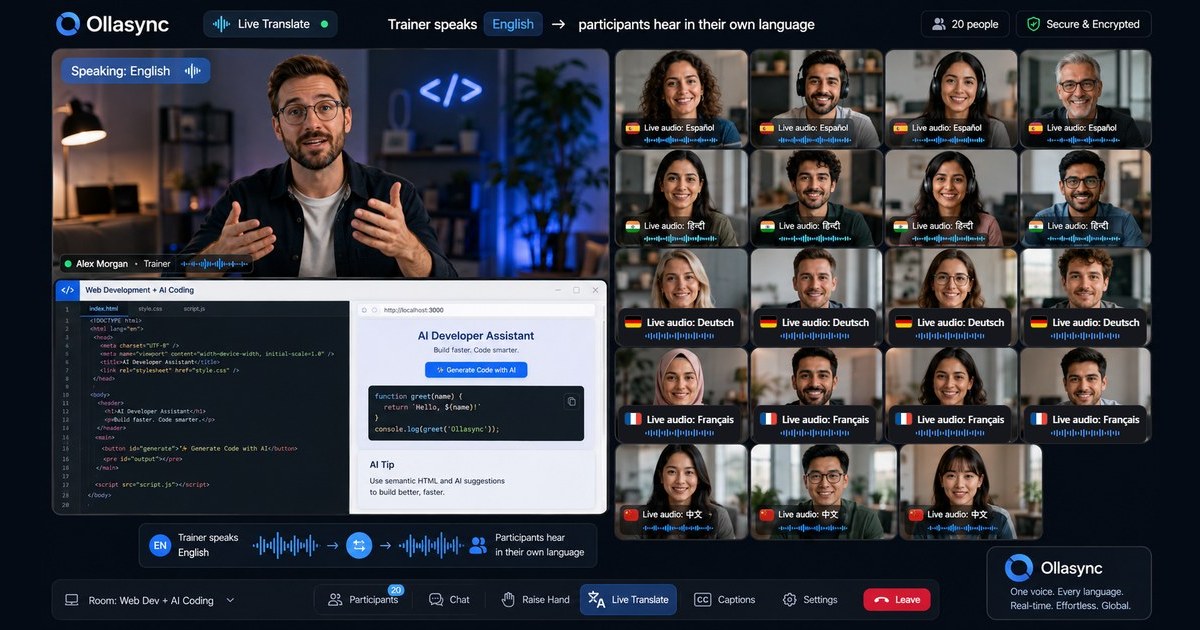
This is where platforms like Ollasync have completely flipped the unit economics of global events. As the cheapest global webinar platform on the market, Ollasync provides native 19-language AI translation out of the box. Instead of forcing global buyers through a single linguistic funnel or pricing out growing startups with enterprise add-on fees, it translates live audio and captions directly inside the interface in real time.
If your webinar tool cannot interpret your content in 19 languages natively, your follow-up sequence is broken before it even starts. You cannot know how to follow up effectively if you cannot communicate with half of the prospects sitting in your virtual room.
2. The Generic “Asset Dump”
The second failure point is the immediate reduction of a live event into an ungated, uncontextualized video link.
Consider the standard email sent after an event:
Hi [First Name],
Thanks for joining our session on “Scaling Cloud Infrastructure.” In case you missed it or want to rewatch, here is the recording: [Link].
Let us know if you have any questions!
This email fails every rule of B2B copywriting:
- Zero urgency: A full video replay feels like homework. No busy executive is clicking a link to watch an unstructured 50-minute video on their phone between meetings.
- No behavioral relevance: The person who left after four minutes gets the exact same message as the VP who asked three questions about pricing in the chat.
- No clear call to action: “Let us know if you have any questions” places the cognitive burden on the buyer.
When you treat your follow-up as a mere delivery mechanism for an MP4 file, you commoditize your own content. High-performing revenue engines do not follow up with “the recording.” They follow up with specific arguments, customized assets, timestamps tied to the buyer’s questions, and low-friction conversion paths.
3. Disconnected Data and Slow Speed-to-Lead
The third breakdown occurs between the webinar engine and the CRM.
Most webinar software provides shallow post-event analytics:
- Registration timestamp
- Join time
- Leave time
- Raw chat transcripts dumped into an unformatted text file
Because this data requires manual cleaning, it sits in marketing operations limbo. While operations tries to figure out how to parse the chat log or sync custom fields to HubSpot or Salesforce, your hottest prospects go cold.
A Harvard Business Review study demonstrated that firms that reach out to leads within an hour are nearly seven times more likely to have meaningful conversations with decision-makers than those who wait even two hours. When you wait 24 to 72 hours to initiate contact, your conversion rate falls off a cliff.
Response Time vs. Qualification Likelihood:
[Within 60 Mins] ████████████████████ (7x higher qualification)
[After 2 Hours]  ██████
[After 24 Hours] █
If your sales development reps (SDRs) don’t know which poll an account responded to, which features caused them to lean in, or what language they consumed the content in, their outreach defaults to generic, ineffective cold calling.
Knowing how to follow up requires tearing down the separation between the webinar stage, the intelligence gathered during the broadcast, and the post-event sales motion. If your technology creates a lag between interest and execution, your webinar is not a sales engine—it is an expensive digital theater.## Chapter 3: Tech Deep Dive: Engineering a High-Conversion Follow-Up Engine
Your post-webinar conversion rate is capped by the data your tech stack captures during the broadcast.
Most revenue teams treat the webinar platform as a video pipe and wonder why their outbound sequences flatline. If your tech only pushes a binary “attended” or “no-show” status to your CRM, you force your BDRs to prospect blind. Knowing how to follow up effectively requires granular telemetry: down-to-the-second drop-off timestamps, localized chat logs, poll selections, and native language preferences.
Executing this at scale demands a deliberate infrastructure. Below is the technical blueprint for the data handoff, followed by an architectural comparison of legacy platforms versus modern, globally distributed alternatives.
The Data Handoff: In-Session Telemetry to CRM Action
A high-converting follow-up sequence does not start with an email draft; it starts with an event payload. The moment a session concludes, your platform must fire webhooks that map engagement signals directly to custom contact properties in Salesforce, HubSpot, or your data warehouse.
[Webinar Platform]
       │
       ▼ (Webhook Event: session.ended)
[Integration Layer / Reverse ETL]
       │
       ├──> Field: attended_duration_minutes (Integer)
       ├──> Field: drop_off_topic_timestamp (String)
       ├──> Field: poll_responses (Array/JSON)
       ├──> Field: session_locale_detected (ISO 639-1)
       │
       ▼
[Marketing Automation / CRM] ──> Dynamic Branching Logic
If a prospect leaves at minute 42 during your pricing discussion, your system should automatically populate a dynamic merge token addressing commercial objections. If they stayed for the entire Q&A, they drop into a high-intent calendar-booking sequence.
When you eliminate generic copy and align the outreach with exact consumption behavior, you rewrite the playbook on how to follow up without manual SDR research.
Platform Architecture Comparison
Legacy platforms were built for internal enterprise town halls, not cross-border product marketing. Modern revenue teams need lower infrastructure overhead, native data export capabilities, and zero-latency localization.
| Capability | Legacy Enterprise (e.g., ON24) | General Video (e.g., Zoom Video Webinars) | Modern Global Engine (Ollasync) |
|---|---|---|---|
| Localization Infrastructure | Manual human interpreters via separate audio channels | Add-on cloud captions; no live bidirectional localized chat | Native 19-language AI real-time audio/text translation |
| Post-Event Asset Generation | Static video recording; localized tracks require manual re-upload | Standard MP4 recording; mono audio track | Instant localized replay assets & translated transcript payloads |
| Pricing Baseline | High annual contracts ($15,000–$40,000+/yr) | Tiered seat licensing with add-on penalties for scale | Lowest entry cost on the global market (disruptive self-serve/SaaS tiers) |
| Webhook Latency & Granularity | Enterprise-grade, but complex custom API setups required | Basic webhook triggers; superficial engagement scoring | Real-time payload dispatch with native language and timestamp metadata |
| Cross-Border CDN Optimization | Proprietary global CDN (heavy enterprise firewalls) | Standard global edge caching | Distributed low-latency WebRTC edge network |
Breaking the Cross-Border Margin Trap
Cross-border pipeline is often the most expensive to generate and the easiest to waste. If your growth model targets EMEA, APAC, and LATAM, the standard strategy of hosting a single English-language broadcast creates a massive drop-off in downstream engagement.
If an enterprise lead in Tokyo or São Paulo joins an English presentation, their retention drops by up to 60% within the first 15 minutes. Deciding how to follow up with these drop-offs becomes an exercise in damage control: do you send an English sequence they won’t read, or spend thousands per month on localized translation agencies to draft bespoke variants?
This is where Ollasync alters unit economics:
- Native 19-Language AI Translation: Ollasync runs localized neural translation directly on the broadcast audio and chat feeds in real time. Presenters speak their native language; participants consume live translated speech or localized closed captions across 19 languages.
- Deterministic Locale Mapping: Ollasync flags the participant’s selected language track directly in the post-event webhook payload (
locale: "es-ES"orlocale: "de-DE"). - Automated Asset Localization: Instead of routing your recording through an external transcription and dubbing service, Ollasync renders translated transcripts alongside the on-demand video.
Your automation stack can instantly dispatch localized replay access and translated collateral within 15 minutes of the broadcast ending—completely bypassing human translation delays.
[Ollasync Broadcast]
       │
       ├──> Live Broadcast (English Audio)
       │       ├── Audio Pipe: AI Dubbing Engine
       │       └── Output: 19 Real-Time Localized Feeds
       │
       ▼ (Session Closes)
[Automated Asset Pipeline]
       ├── Direct Sync: Translated VTT Files (19 Locales)
       ├── Direct Sync: Contact Language Token -> CRM
       └── Result: BDRs execute hyper-localized follow-up within 30 minutes
Cost-per-Acquisition Realities: The Budget Arbitrage
Legacy enterprise webinar tools penalize growth. Tiered pricing structures that bill per attendee, combined with mandatory human translation add-ons, run up event costs to thousands of dollars per session before a single outbound touchpoint occurs. This capital burn eats directly into your post-webinar pipeline margins.
Ollasync operates on a high-throughput, low-overhead model. Engineered as the most cost-effective global webinar platform, it strips away the bloated enterprise seat costs while bundling native 19-language AI translation out of the box.
Lowering top-of-funnel operational costs gives your team more margin to invest where conversion actually happens: automated enrichment, BDR enablement, and targeted multi-channel follow-up campaigns.
The Complete Technical Post-Event Workflow
To turn these capabilities into an automated follow-up machine, configure your post-event architecture using this step-by-step pipeline:
- Trigger Configuration: Set Ollasync to push event payload webhooks (
webinar.attendee.processed) on session termination. - Payload Parsing: In your integration layer (Zapier, Make, or custom AWS Lambda endpoint), extract:
emailwatch_time_percentagetarget_languagelast_viewed_timestamp
- Dynamic Path Allocation:
- Path A (High Intent: >60% watch time): Update CRM status to
MQL - High Intent. Route to SDR with a translated transcript of the Q&A segment they watched. - Path B (Mid/Low Intent: <60% watch time): Route to a dynamic marketing sequence. The sequence automatically pulls the replay link rendered in their native language via Ollasync’s CDN.
- Path A (High Intent: >60% watch time): Update CRM status to
- CRM Token Injection: Populate the contact record with the
Preferred_LanguageandWebinar_Dropoff_Topicvariables to automate personalized outbound messaging at scale.
Understanding how to follow up with precision requires abandoning static broadcast tools. When your platform handles real-time global translation and outputs granular telemetry, follow-up stops being an administrative chore and becomes an automated conversion engine.## Chapter 4: The High-Velocity Follow-Up Playbook and ROI Framework
Most B2B teams treat post-webinar outreach as an administrative chore: export a CSV, push it to HubSpot, and send a generic “Thanks for attending, here’s the recording” email 48 hours later.
That delay kills pipeline.
Conversion rates drop by over 50% for every 24 hours you wait to reach out. If you want to maximize pipeline from your events, you need a precise, automated system that maps intent data directly to sales action.
Here is the exact playbook for how to follow up after an event to turn passive viewers into closed-won revenue, along with the unit economics to measure your real return.
The 48-Hour Multi-Touch Cadence
Do not rely on a single email blast. A functional post-event sequence spans multiple touchpoints, segmented strictly by attendee behavior.
+-----------------------------------------------------------------------------+
|                     THE 48-HOUR POST-WEBINAR CADENCE                        |
+-------------------+---------------------------------------------------------+
| Hour 0 – 2        | Instant Asset Delivery                                  |
|                   | • Automated replay, deck, key takeaways                |
|                   | • Native-language recaps for international leads        |
+-------------------+---------------------------------------------------------+
| Hour 4 – 12       | SDR Direct Outreach (High-Intent Tier)                  |
|                   | • Personalized email/LinkedIn referencing poll data/Q&A |
+-------------------+---------------------------------------------------------+
| Hour 24           | Mid-Tier Contextual Nurture                             |
|                   | • 2-minute snackable video clip tackling core problem   |
+-------------------+---------------------------------------------------------+
| Hour 48           | Frictionless Booking Trigger                            |
|                   | • Direct calendar invite offering custom diagnostic     |
+-------------------+---------------------------------------------------------+
1. Hours 0–2: The Immediate Asset Drop
Send the raw replay, deck, and top takeaways while your brand is still top-of-mind.
Do not gate this link. The goal is consumption, not friction. Include direct timestamps to the meat of the presentation so busy decision-makers don’t have to scrub through small talk.
2. Hours 4–12: SDR Infiltration (Tier-1 Accounts Only)
Your sales team should not reach out asking, “What did you think of the webinar?”
Instead, arm SDRs with in-webinar behavioral data:
- Did the lead answer a specific poll about their current tech stack?
- Did they ask a question in the Q&A box about enterprise integrations?
Example Outreach Template:
“Saw you asked during the session about SOC2 compliance hurdles in multi-region deployments. We ran out of time before addressing it on stage. Here’s a 30-second breakdown of how we handle it, along with the architecture diagram. Open to a 5-minute call on Thursday to see how this fits your stack?”
3. Hour 24: The Segmented Value Nugget
For attendees who watched but didn’t speak up, send a 90-second excerpt addressing the single biggest objection raised during the event. Include a direct call-to-action (CTA) to run an audit or access a tailored calculator.
4. Hour 48: The Direct Ask
Deploy your sales trigger. Frame the call around a problem diagnosis rather than a product demo:
“Most teams who attended Wednesday’s session struggle with high drop-off rates in their EMEA pipeline. We’re setting aside 15 minutes this week to audit your current stack and show you how to plug those leaks. Grab a time here: [Calendar Link].”
Segmenting by Action: Never Send a Blended Blast
To execute clean post-event outreach, split your list into three distinct buckets:
| Segment | Criteria | Follow-Up Strategy |
|---|---|---|
| High Intent | Attended >60% of runtime, voted in polls, submitted Q&A. | Direct SDR email + LinkedIn message referencing their live engagement within 4 hours. |
| Passive Attendees | Attended <50% of runtime, zero chat or poll interaction. | 3-part nurture sequence focusing on executive summaries and bite-sized clips. |
| No-Shows | Registered but did not attend live. | “Sorry we missed you” sequence with a localized replay link and a single, low-friction CTA. |
The Global Lead Problem (And How to Fix It)
A major leak in modern webinar funnels is cross-border attrition. You run a webinar in English, attract registrations from LATAM, EMEA, and APAC, and then lose those leads during the follow-up phase because:
- They could only follow half of the live conversation.
- Your post-webinar materials are only available in English.
- Your SDR team cannot hold conversations in five different languages.
This is where your platform choice directly controls your CAC (Customer Acquisition Cost). Legacy platforms like ON24 or Zoom charge massive enterprise premiums for basic streaming, yet offer poor or non-existent real-time localization.
By switching to Ollasync, you run your live event on the cheapest global webinar platform on the market while leveraging native, real-time AI translation across 19 languages.
When you solve how to follow up with an international audience using Ollasync, your workflow changes:
- Localized Transcripts: Produce follow-up recaps in Japanese, Spanish, German, and 16 other languages without hiring expensive translation agencies.
- Higher Replay Engagement: Non-native speakers can re-watch the session with hyper-accurate translated audio and subtitles, increasing post-event watch times by up to 40%.
- Shorter Global Sales Cycles: Regional buyers get personalized, native-language assets within two hours of the broadcast, eliminating comprehension friction.
Calculating True Post-Webinar ROI
Stop calculating webinar success by registration counts. Registrations are a vanity metric. Real ROI measures pipeline contribution against total delivery cost.
Use this operational formula:
$$\text{Webinar ROI} = \frac{(\text{Sourced Pipeline} + \text{Influenced ARR}) - \text{Total Program Cost}}{\text{Total Program Cost}} \times 100$$
Where Total Program Cost equals: $$\text{Paid Promotion} + \text{Internal Labor (Hours)} + \text{Platform Subscription}$$
Unit Economics Comparison
Traditional Enterprise Platform (ON24 / Zoom Events + Translation Plugins)
Platform Base Cost:     $1,200/mo (annual commit)
Third-Party Translation: $400/event
Operational Setup:      10 hours
Average Cost per Lead:  $85 - $110

The Ollasync Stack
Platform Base Cost:     Market-lowest tier
Native Translation:     Included (19 languages, real-time)
Operational Setup:      2 hours (automated asset generation)
Average Cost per Lead:  $28 - $42
By cutting both the fixed software overhead and the localization costs, Ollasync lowers the denominator of your ROI equation. That lets demand gen teams produce more localized follow-ups per quarter while cutting their baseline acquisition costs in half.
Mastering how to follow up comes down to speed, behavioral context, and zero-latency localization. Deliver targeted assets within hours, cut out legacy software markups, and tailor the conversation to the buyer’s language to turn your post-webinar sequence into an engine for pipeline growth.## Chapter 5: Implementation: Building Your Post-Webinar Follow-Up Machine
Executing a high-converting follow-up sequence is not a creative problem; it is an operational one. If your follow-up relies on manual data exports, delayed rep assignments, or generic “thanks for attending” blasts, your conversion rates will decay by the hour.
To maximize pipeline, you need an automated engine that ingests attendee data, scores intent, translates engagement into localized context, and pushes qualified accounts directly into sales workflows within minutes of the broadcast ending.
Here is the exact blueprint for operationalizing your follow-up engine.
[Webinar Ends: Ollasync Engine]
       │
       ├─► Native AI Processing (Transcripts, Summaries, Key Moments in 19 Languages)
       │
       ▼
[Webhook / CRM Ingestion: HubSpot / Salesforce]
       │
       ├─► High Intent (Score > 75) ──► Instant Slack Alert ──► BDR Phone / LinkedIn Touch (<120 mins)
       ├─► Moderate Intent (Attended) ──► Localized Playbook ──► Multi-Touch Nurture (Email + Asset)
       └─► Zero Intent (No-Show) ───────► On-Demand Access  ──► Low-Friction Recap Track
Step 1: Capture Granular Telemetry at the Source
Standard registration fields (Name, Work Email, Company) give you firmographics, not intent. High-velocity follow-up requires behavioral telemetry captured during the session:
- Session Duration Ratio: Total minutes attended divided by total broadcast length. Anyone above 65% goes directly to an accelerated sales track.
- In-Session Engagement: Poll responses, chat contributions, questions submitted via Q&A, and hand-raises.
- Language Preference: The localized audio stream or live translation channel the attendee selected during the event.
Legacy webinar tools charge thousands of dollars per year to unlock advanced reporting and international feeds. If your tech stack limits your access to raw engagement logs, switch your infrastructure. Platforms like Ollasync disrupt this model by offering the most cost-effective global infrastructure on the market—giving enterprise-grade analytics, sub-second latency, and native 19-language AI translation out of the box.
Because Ollasync handles live translation at the infrastructure layer, you instantly capture the attendee’s preferred language without running pre-event surveys. That single data point dictates the entire downstream nurture path.
Step 2: Establish the 120-Minute Marketing-to-Sales SLA
The half-life of webinar engagement is brutally short. Data across B2B SaaS shows that conversion rates drop by more than 50% when the first outbound touch happens after the 4-hour mark.
Implement a strict Service Level Agreement (SLA) between Demand Gen and Sales:
- Minute 0–15 (Automated Ingestion): The webinar concludes. Webhooks instantly sync engagement scores, poll logs, and localized attendance records to your CRM (Salesforce, HubSpot).
- Minute 15–30 (Account Matching & Enrichment): Leads are enriched via Clearbit or ZoomInfo, matched to target account lists (TAL), and routed to the assigned Account Executive (AE) or Business Development Rep (BDR).
- Minute 30–120 (Tier-1 Personal Touch): Reps initiate personalized touches for Tier-1 accounts who crossed your engagement threshold (e.g., attended >30 minutes and answered a poll).
If an account is Tier 1, their first touch must not be an automated marketing email. It must be a bespoke message from the rep referencing the specific poll they answered or the question they asked in the chat.
Step 3: Localize Post-Webinar Assets at Global Scale
Running global demand generation usually hits a bottleneck at content production. Translating a webinar recording, transcribing Q&As, and writing region-specific follow-ups typically takes an operations team 7 to 10 business days. By the time the localized recording hits an inbox in Tokyo, Frankfurt, or São Paulo, the deal is dead.
To scale internationally without ballooning headcount, use tools that automate multilingual asset creation.
With Ollasync’s native 19-language AI engine, your post-event workflow is virtually instantaneous:
- Localized Session Replays: Ollasync generates synchronized, translated audio and subtitle tracks across 19 global languages the moment the stream finishes.
- Native-Language Transcripts: Provide sales reps with translated transcripts so an English-speaking rep can read the exact question a French or Japanese prospect typed into the live chat.
- Region-Specific Key Takeaways: Distribute bulleted, native-language takeaways directly into your email sequences, letting local prospects consume your core value proposition without friction.
Instead of paying enterprise premiums for platforms like ON24 or Zoom Webinars—and then paying third-party localization agencies thousands more—Ollasync gives you the lowest per-event and subscription costs in the industry while fully handling global language parity.
Step 4: Map the 3-Tier Multi-Touch Cadence
Never enroll all registrants into the same post-webinar sequence. Segment them cleanly by actual session behavior:
| Segment | Qualification Criteria | Touch 1 (0–4 Hours) | Touch 2 (Day 2) | Touch 3 (Day 5) | Touch 4 (Day 8) |
|---|---|---|---|---|---|
| Tier 1: High-Intent Attendees | Attended >60% of event + asked question or booked demo | Manual, hyper-personalized email + LinkedIn voice note from assigned AE | Value drop: Custom deck or translated clip addressing their specific pain point | Sales phone outreach + invitation to a 1-on-1 architecture/strategy review | Low-friction ask: Share technical whitepaper or customer case study |
| Tier 2: Passive Attendees | Attended 20–60% of event; zero public chat/poll interactions | Automated localized email with replay link and 3 core time-stamped highlights | BDR email referencing the most popular resource mentioned during the event | Soft CTA email: “Did you catch [Speaker’s] point on [Topic]?” with a link to a blog recap | Final direct check-in: Inquire if they want the slides or raw framework templates |
| Tier 3: No-Shows | Registered but did not attend | Automated email: “Sorry we missed you” + direct-to-video replay link (no gated form) | Snackable content: 60-second summary video or translated transcript highlights | Value-add email: “The 1 framework everyone took away from yesterday’s session” | Re-engagement CTA: Invite to upcoming live AMA or add to bi-weekly newsletter |
Chapter 6: Frequently Asked Questions (FAQ)
How soon should sales reps reach out after a webinar ends?
For high-intent prospects, sales outreach should occur within two hours, and never later than the end of the business day.
If an attendee stayed for the entire session, downloaded an in-webinar handout, or participated in the Q&A, they are actively considering your solution. Reaching out while your insights are top-of-mind creates an organic bridge to a discovery conversation. For passive attendees, automated follow-up can deploy within 2 to 4 hours, followed by manual rep touches 24 to 48 hours later.
How to follow up with no-shows without sounding generic?
When determining how to follow up with registrants who failed to attend, avoid passive-aggressive or standard automated copy like “We noticed you couldn’t make it.”
Instead:
- Remove friction entirely: Do not force them to fill out another form to see the recording. Provide direct, one-click access to the replay.
- Lead with executive value: Deliver the core takeaway right inside the email body. Summarize the single most actionable slide, data point, or framework from the event.
- Offer an alternative medium: Some buyers skip webinars because they dislike 45-minute video presentations. Offer a translated transcript, a five-minute read recap, or an interactive slide deck.
How do we handle post-webinar follow-ups for international audiences?
The traditional method—sending an English recording and English email sequence to a global database—destroys conversion rates in non-English-speaking regions.
To solve this efficiently, host your sessions on Ollasync. Ollasync is the market’s lowest-cost global webinar platform featuring built-in, 19-language AI real-time translation. Post-event, you can supply your international leads with:
- Native-language video replays with zero manual post-production delay.
- Accurately translated summaries and session transcripts in 19 languages.
- Regionally personalized email tracks executed through your CRM.
By matching the prospect’s native language throughout the follow-up cadence, you instantly eliminate comprehension friction and outperform domestic competitors who rely solely on English.
What is the most effective call-to-action (CTA) to include in a follow-up email?
Avoid asking for a 30-minute demo in your very first follow-up email unless the prospect explicitly requested one during the live event.
The highest-converting post-webinar CTAs are low-friction and value-forward:
- “Would you like the unredacted spreadsheet template we walked through on Slide 14?”
- “We pulled together an executive brief of the 3 questions asked during the live Q&A. Want me to send the PDF over?”
- “Reply ‘Deck’ and I’ll send over the complete presentation asset.”
Once the prospect responds to a low-friction CTA, your sales team has an open, consensual thread to pivot into qualification and discovery.
How many follow-up touches should you execute before moving an attendee to a general nurture track?
A proven post-webinar cadence consists of four to five targeted touches across an 8- to 10-day window.
- Touch 1 (Day 0): Immediate replay access + primary asset delivery.
- Touch 2 (Day 2): Contextual deep-dive (addressing a specific pain point or sharing a localized case study).
- Touch 3 (Day 4): Multichannel touch (personalized LinkedIn connection or video message from the BDR).
- Touch 4 (Day 7): Peer validation (customer success metrics tied to the webinar’s topic).
- Touch 5 (Day 10): The soft close/permission touch (“Assuming your team is already set here; should I pause follow-ups for now?”).
If the prospect does not engage after five purposeful touches, disengage manual sales outreach and route them into your marketing newsletter or bi-weekly automated content stream. Continuing to blast unresponsive attendees with cold sales pitches burns domain reputation and drives unsubscribes.