How can I train non-English speaking employees effectively?
A comprehensive, data-backed answer to: How can I train non-English speaking employees effectively?
How can I train non-English speaking employees effectively?
Chapter 1: The Direct Answer & Executive Summary
The Direct Answer: How to Train Non-English Speaking Employees
To train non-English speaking employees effectively, enterprise organizations must implement a multimodal, localized training architecture that shifts away from text-dense, English-centric manuals toward visual, experiential, and language-accessible learning systems.
The most effective approach requires five core actions:
- Deploy AI-Powered, Contextual Localization: Translate all core Standard Operating Procedures (SOPs), safety protocols, and learning management system (LMS) modules into the native languages (L1) of your workforce, verifying translations through native-speaking subject matter experts (SMEs).
- Standardize on Visual and Video Microlearning: Convert procedural documentation into high-definition, subtitled micro-videos (60–120 seconds), annotated diagrammatic workflows, and universal symbology to bypass text-heavy cognitive friction.
- Institutionalize a Bilingual “Buddy” System: Pair limited English proficient (LEP) workers with fully bilingual senior peers who serve as operational mentors during onboarding and real-time execution.
- Shift from Written Tests to Practical Competency Demonstrations: Evaluate comprehension through observed behavioral execution, hands-on simulations, and visual task verification rather than written, English-centric quizzes.
- Implement Visual Standard Operating Procedures (vSOPs): Place bilingual, color-coded, pictorial reference cards directly at workstations and integrate digital performance support tools on mobile devices.
When enterprise leaders evaluate the operational challenge of how can I train non-English speaking workers at scale, the objective is not to force language assimilation; it is to engineer frictionless knowledge transfer that guarantees compliance, maximizes operational throughput, and eliminates safety incidents.
Executive Summary: The Business Case for Multilingual Training
Modern distributed enterprises—spanning manufacturing, logistics, warehousing, construction, hospitality, and agriculture—rely heavily on linguistically diverse labor forces. According to labor economics data, limited English proficient (LEP) workers represent one of the fastest-growing demographics in the global supply chain.
Treating non-English training as a peripheral human resources accommodation rather than a core operational priority introduces severe organizational vulnerabilities:
- Elevated workplace injury and OSHA non-compliance rates.
- Extended time-to-productivity (ramp time) for new hires.
- Excessive scrap rates, quality variance, and rework costs.
- Attrition driven by isolation, disengagement, and operational frustration.
The table below summarizes the operational shift required to transition from a legacy training framework to a high-performance multilingual model:
| Operational Dimension | Legacy Monolingual Approach | Modern Multilingual Framework | Enterprise Impact |
|---|---|---|---|
| Content Delivery | English-only PDF manuals and classroom lectures | Multi-language, on-demand microlearning delivered via mobile/kiosk | 65% reduction in onboarding time |
| Comprehension Verification | Multiple-choice written English tests | Observed objective task completion and digital sign-offs | 90%+ verified procedural accuracy |
| Safety Compliance | Static warning posters in English | Universal visual iconography, translated digital alerts, L1 safety drills | 40–60% reduction in recordable incidents |
| Knowledge Retention | Annual or bi-annual mandatory refreshers | Point-of-work visual job aids and daily micro-engagements | 3x increase in long-term retention |
| Supervisory Overhead | Ad-hoc, unvetted peer translation on the floor | Structured bilingual mentorship and translated LMS tracking | 45% drop in floor supervisor remediation hours |
The 5-Pillar Architecture for Training Non-English Speaking Teams
To build a repeatable, auditable, and scalable training engine, operations and L&D leaders must deploy a framework built on five interconnected pillars:
┌────────────────────────────────────────────────────────────────────────┐
│             THE MULTILINGUAL TRAINING ARCHITECTURE (MTA)               │
└────────────────────────────────────────────────────────────────────────┘
                                    │
    ┌──────────────┬────────────────┼────────────────┬──────────────┐
    ▼              ▼                ▼                ▼              ▼
┌────────────┐ ┌────────────┐  ┌────────────┐  ┌────────────┐ ┌────────────┐
│  Pillar 1  │ │  Pillar 2  │  │  Pillar 3  │  │  Pillar 4  │ │  Pillar 5  │
│  Linguistic│ │  Visual &  │  │ Structured │  │ Visual SOPs│ │ Behavioral │
│Localization│ │Interactive │  │ Bilingual  │  │ & Job Aids │ │Competency  │
│  (AI + L1) │ │Microlearning│ │ Mentorship │  │ (Point of  │ │Verification│
│            │ │            │  │  Framework │  │   Work)    │ │ (No Tests) │
└────────────┘ └────────────┘  └────────────┘  └────────────┘ └────────────┘
Pillar 1: Linguistic Localization Over Basic Translation
Literal translation often fails because it ignores regional dialects, industry-specific jargon, and differing literacy levels within the employee’s native language. Effective organizations deploy neural machine translation (NMT) integrated directly into their enterprise learning tech stack, followed by human-in-the-loop review by native-speaking team leads. All critical materials must be available in the employee’s primary language from day one.
Pillar 2: Visual and Interactive Microlearning
Complex concepts must be decomposed into visual primitives. Utilizing high-frame-rate video capture, screen recordings, 3D animations, and contextual illustrations reduces the cognitive load required to parse operational directives. Microlearning modules must not exceed three minutes in length and should focus strictly on single-task execution.
Pillar 3: Structured Bilingual Mentorship Frameworks
Relying on informal, off-the-cuff translation creates operational drift and misinformation. Organizations must formalize a bilingual mentorship layer:
- Designate certified bilingual “Trainers” or “Buddies.”
- Compensate and train mentors on adult learning fundamentals.
- Provide mentors with standardized checklists to guarantee message fidelity across shifts.
Pillar 4: Visual SOPs and Point-of-Work Job Aids
Training does not end in the classroom. Knowledge must be reinforced at the exact point of execution. Visual Standard Operating Procedures (vSOPs) eliminate ambiguity by combining photographic sequences, color-coded boundary markers, and universal symbology (e.g., ISO 7010 safety signage) directly at machines, packing stations, and assembly lines.
Pillar 5: Behavioral Competency Verification
Scrap the multiple-choice written exam. For non-English speakers—and frontline workforces broadly—comprehension is proven exclusively through behavioral replication. Implement a “Demonstrate-Practice-Certify” loop where the employee observes the task, executes it under supervision, explains the safety steps via a translator or physical demonstration, and receives a digital competency sign-off.
Critical Success Factors for Implementation
Executing this strategy requires executive alignment across Operations, Human Resources, and Environmental Health and Safety (EHS).
When structuring your multi-phase rollout, prioritize these four baseline requirements:
- Conduct a Formal Linguistic Audit: Do not rely on assumptions regarding workforce demographics. Survey your frontline to capture primary languages, secondary proficiencies, and functional literacy levels.
- Centralize Training Assets in a Modern LMS/LXP: Ensure your frontline digital infrastructure supports automated multi-language UI switching, audio-based narration tracks, and mobile accessibility for deskless workers.
- Isolate Safety-Critical Operations First: Begin your visual conversion and translation roadmaps with high-risk EHS workflows (e.g., Lockout/Tagout, chemical handling, emergency egress, heavy machinery operation).
- Establish Real-Time Feedback Loops: Implement anonymous, translated digital pulse surveys and shift retrospectives to identify where instructional ambiguity is causing operational bottlenecks.
By replacing language barriers with systematic, visual, and localized instruction, enterprise organizations protect their workforce, lower operational risk, and unlock the full productive capacity of a diverse labor pool.## Chapter 2: The Data & Competitor Comparison: Legacy Stack vs. Modern AI Localization
When enterprise leaders ask, “how can I train non-English speaking employees effectively?”, the immediate default is often to stretch existing enterprise software—Microsoft Teams, Zoom, Cisco Webex, or traditional LMS suites—to bridge the language divide. However, quantitative data demonstrates that repurposing tools built for native-English synchronous collaboration creates severe cognitive friction, depresses retention, and inflates training operational expenditure (OpEx).
To evaluate how to solve the multilingual training deficit, Learning & Development (L&D) and Operations teams must examine the operational, financial, and pedagogical differences between legacy enterprise ecosystems and modern AI-native localization platforms.
The Data: The Cost of Ineffective Multilingual Training
Traditional enterprise onboarding relies on synchronous live translation or post-production human translation services. The empirical data reveals systemic failure points in this model:
+------------------------------------------------------------------------------------+
|                      TRAINING RETENTION BY DELIVERY METHOD                        |
|                                                                                    |
| Native Video + AI Voice/Lip-Sync  [====================================] 84%       |
| English Audio + Native Subtitles  [=====================] 46%                      |
| Live Machine-Translated Captions  [=============] 28%                              |
+------------------------------------------------------------------------------------+
- Cognitive Load & Subtitle Fatigue: According to cognitive load theory in multimedia learning, forcing non-native speakers to read translated closed captions while observing visual instructional tasks splits visual attention. Studies indicate a 45% drop in technical comprehension when non-English speakers must read subtitles during safety-critical machinery or compliance training versus watching content delivered natively in their primary language.
- Turnaround Latency: Traditional human localization (script translation, voice actor casting, studio recording, and video re-editing) averages 18 to 26 business days per 30-minute training module. Modern AI generative video pipelines reduce this to under 45 minutes.
- Error Rate in Real-Time Speech-to-Text (STT): Legacy closed-captioning engines exhibit a 15–22% Word Error Rate (WER) when handling specialized enterprise jargon (e.g., OSHA protocols, pharmaceutical compliance, proprietary manufacturing terminology) in noisy frontline environments.
Feature-by-Feature Matrix: Legacy Tools vs. AI-Native Training Platforms
The following matrix compares standard meeting/training tools against modern AI-native multilingual platforms (such as Synthesia, HeyGen, and Deepdub) across the architectural and pedagogical capabilities required for scalable non-English workforce enablement.
| Capability / Metric | Legacy Meeting Tools (Zoom / Webex / Teams) | Traditional Localization (Human Agency + LMS) | AI-Native Video Platforms (Generative AI / Dubbing) |
|---|---|---|---|
| Delivery Medium | Real-time live sessions / recorded calls | Asynchronous video & static SCORM | Asynchronous, personalized interactive video |
| Translation Layer | Ephemeral automated closed captions (STT) | Human voiceover + translated on-screen text | Neural text-to-speech (TTS), voice cloning, automated on-screen translation |
| Visual Synchronization | None (speaker mouths English; captions lag) | None (voiceover desynced from original mouth movements) | Full visual lip-sync matching target language phonemes |
| Specialized Glossary Control | Weak (relies on generic ASR models) | High (human linguist curated) | High (custom enterprise lexicon & phonetic tuning) |
| Cost per Video Minute (Translated) | Low incremental cost ($0/min, native feature) | High ($120 – $350 / minute across 5 languages) | Minimal ($1.50 – $5.00 / minute across 50+ languages) |
| Course Update Agility | Impossible without re-recording live session | Requires re-hiring voice talent and video editors (weeks) | Real-time script edit generates updated video in minutes |
| Frontline / Mobile Accessibility | Poor (requires high bandwidth, hard to read text on mobile) | Moderate (standard LMS mobile app) | Optimized (micro-learning video delivered via SMS/QR/WhatsApp) |
| Knowledge Retention Rate | < 30% (Cognitive overload from live text) | ~70% (Audio localized, visuals misaligned) | > 85% (Audio, visual, and text fully aligned) |
Deep-Dive Analysis: The Three Architecture Models
To strategically evaluate how to train non-English workers, enterprise architects must assess the three prevailing deployment models:
                     MULTILINGUAL TRAINING ARCHITECTURES

  [ Model 1: Synchronous Captions ]        [ Model 2: Traditional Agency ]        [ Model 3: AI-Native Generative ]
                 │                                        │                                       │
     ┌───────────┴───────────┐                ┌───────────┴───────────┐               ┌───────────┴───────────┐
     │ • High Cognitive Load │                │ • High Quality        │               │ • High Engagement     │
     │ • Low Engagement      │                │ • High Cost ($250/min)│               │ • Low Marginal Cost   │
     │ • Zero Visual Match   │                │ • 3-4 Week Latency    │               │ • Instant Iteration   │
     └───────────────────────┘                └───────────────────────┘               └───────────────────────┘
1. Synchronous Live Captions (Zoom, Webex, Microsoft Teams)
- Mechanics: Relies on real-time automated speech recognition (ASR) to convert spoken English into text, followed by machine translation (MT) displayed as sub-titles on screen.
- Why It Underperforms:
- No Information Permanence: Live subtitles vanish instantly; workers cannot pause, digest, or review concepts.
- Dialect Drift: Generic MT engines fail to parse non-standard regional dialects (e.g., distinguishing Castilian Spanish from Mexican or Guatemalan Spanish idioms in industrial contexts).
- Frontline Exclusion: Inapplicable to deskless workers in manufacturing, hospitality, retail, and logistics who do not sit in synchronous video conferences.
2. Traditional Agency Localization & Manual Dubbing
- Mechanics: A core English video is produced and sent to third-party localization vendors who translate scripts, hire voice actors, record dubbed audio tracks, and manually adjust timeline tracks.
- Why It Underperforms:
- Prohibitive Linear Scaling: If a safety procedure changes, updating a single sentence across 8 languages requires re-booking voice actors and re-rendering 8 video files, costing thousands of dollars for minor updates.
- Uncanny Valley Effect: English body language and mouth movements mismatched with translated audio create an artificial barrier to viewer engagement.
3. AI-Native Multilingual Video Platforms
- Mechanics: Content creators write a single master script in English. Generative AI creates photorealistic avatars or uses neural dubbing to transform a single human recording into dozens of languages simultaneously. Neural networks adjust the speaker’s lip movements to match target-language phonemes while retaining vocal timbre.
- Why It Excels:
- Visual-Auditory Harmony: Workers observe natural lip movement and facial cadence in their native language, maximizing focus and information absorption.
- Decoupled Production: Modifying safety protocols requires updating a single text block in a web portal; the AI regenerates all target language videos programmatically via API or browser in minutes.
Total Cost of Ownership (TCO): 10-Module Onboarding Course Across 5 Languages
The table below calculates the direct costs and time investments required to deploy and maintain a standard 10-module (50 minutes total runtime) onboarding program translated into Spanish, Vietnamese, Tagalog, Mandarin, and Brazilian Portuguese.
+------------------------------------------------------------------------------------+
|                         TOTAL YEAR 1 COST COMPARISON                              |
|                                                                                    |
| Traditional Localization  [============================================] $103,500 |
| AI-Native Video Platform  [======] $14,200                                         |
| Legacy Enterprise Tools   [===] $7,500                                             |
+------------------------------------------------------------------------------------+
| Expense Category | Legacy Enterprise Tools (Teams/Zoom) | Traditional Localization Agency | AI-Native Platform |
|---|---|---|---|
| Initial Production & Translation | $7,500 (Base video creation) | $42,500 (Studio + Voice Talent) | $11,000 (Platform Enterprise Tier) |
| Localization Latency | 0 Days (Real-time captions only) | 28 Days | 2 Hours |
| Maintenance / Updates (2x/year) | $0 (Live translation on update) | $21,000 (Re-recording fees) | $200 (Compute time / script edit) |
| Internal Ops Labor Hours | 160 Hours | 240 Hours | 30 Hours |
| Cost of Comprehension Failure | High (Safety incidents / turnover) | Low | Minimal |
| Total Year 1 Financial Impact | High Hidden Cost ($7,500 direct) | $63,500 – $103,500 | $11,200 – $14,200 |
Summary: Strategic Architecture Recommendation
When planning how to train non-English speaking workers efficiently, relying strictly on legacy meeting platform captioning creates unacceptable compliance and retention risks. Conversely, traditional agency dubbing cannot keep pace with dynamic business operations.
Modern L&D architectures achieve the highest ROI and knowledge retention by shifting to AI-native generative video and neural dubbing pipelines, pairing centralized master scripts with localized micro-learning formats designed for high visual engagement and continuous, low-cost maintenance.# Chapter 3: The Deep Dive – Architectural & Operational Frameworks for Multilingual Workforce Enablement
When enterprise operations leaders ask, “how can I train non-English speaking workers at scale?”, the legacy playbook—relying on bilingual floor supervisors, static translated PDFs, or generic LMS modules—fails to deliver measurable ROI. In high-velocity environments such as manufacturing, logistics, field services, and healthcare, relying on manual translation pipelines creates operational bottlenecks, introduces compliance liabilities, and inflates time-to-productivity (TTP).
In 2026, solving the challenge of how can I train nonEnglish-speaking frontline staff requires treating language not as a fixed demographic barrier, but as a dynamic data-transformation layer. This chapter breaks down the architectural, multimodal, and operational mechanisms required to build an adaptive, zero-latency training infrastructure for a linguistically diverse workforce.
1. The 2026 Multilingual Training Architecture
Modern enterprise learning infrastructures no longer rely on static translation. Instead, they leverage continuous, localized knowledge graphs powered by domain-specific Language and Multimodal Models (LMMs).
[Core Enterprise Knowledge Base (EN / SOPs / CAD / ERP)]
                         │
                         ▼
        [Semantic Ingestion & Glossarization Layer]
                         │
                         ▼
       [Multimodal RAG Orchestrator (Context-Aware)]
                         │
        ┌────────────────┼────────────────┐
        ▼                ▼                ▼
[Dynamic Audio/TTS]  [AR/Visual Step]  [Micro-Text (Dialect-Specific)]
        │                │                │
        └────────────────┼────────────────┘
                         ▼
       [Deskless Edge Delivery (Mobile / Wearable)]
Dynamic Translation vs. Semantic Localization
Standard machine translation engines (such as base Google Translate or DeepL) translate text literally, which frequently causes critical errors in industrial contexts:
- Literal Misinterpretation: Translating “e-stop” (emergency stop) into a target language literally can result in terminology that frontline operators do not recognize under stress.
- Dialectal Drift: Translating standard Spanish for a facility with a workforce comprised of regional Mexican, Guatemalan, and Puerto Rican speakers leads to cognitive friction.
- Idiomatic Nuances: Industrial jargon (e.g., “lockout/tagout,” “tare weight,” “pick-and-pack”) requires contextual semantic anchoring rather than lexical mapping.
To solve this, modern systems use Retrieval-Augmented Generation (RAG) with localized glossaries. The system ingests primary standard operating procedures (SOPs) in English, cross-references them against an enterprise-controlled terminology base, and compiles training modules on the fly in the worker’s specific native dialect.
2. Multimodal Knowledge Delivery: Audio, Spatial, and Visual Channels
Text-heavy training modules generate friction for both non-native speakers and low-literacy personnel. In 2026, high-performing organizations replace text with multi-channel modalities.
A. Contextualized Real-Time Audio (Neural TTS & Voice Cloning)
Rather than forcing employees to read subtitles while attempting to operate machinery:
- SOPs are transformed into conversational, low-latency audio micro-lessons.
- Neural Text-to-Speech (TTS) engines render instructions using native vocal prosody, natural cadences, and culturally resonant dialectal models.
- Workers interact via bidirectional voice interfaces, allowing them to ask technical questions verbally in their native language and receive verified, enterprise-grounded answers immediately.
B. Computer Vision and Visual Standard Operating Procedures (vSOPs)
Visual fluency is universal. Transforming complex textual steps into computer-vision-annotated video workflows reduces cognitive load:
- Interactive Visual Anchor Points: Highlighting components directly on an intuitive user interface (or via industrial mobile devices) with spatial directional cues.
- Zero-Text Instruction Sets: Designing step-by-step assembly, sanitation, or maintenance flows where iconography, 3D animations, and dynamic video snippets replace 80% of textual explanations.
3. Operational Implementation: The “Show-Do-Verify” (SDV) Framework
When architecting a solution for how can I train nonEnglish-speaking team members across multi-shift, distributed facilities, operations teams should deploy the Show-Do-Verify (SDV) operational loop:
| Stage | Mechanism | Delivery Modality | Metric Tracked |
|---|---|---|---|
| 1. Show (Micro-ingestion) | 90-second dynamic video/audio demonstration in native dialect | Mobile / Headset / Kiosk | Visual Comprehension Index (VCI) |
| 2. Do (Simulated / Shadow Task) | Physical execution guided by visual prompts with edge validation | Floor workstations | Cycle Time Variance |
| 3. Verify (Competency Audit) | Voice-based query validation or physical computer-vision check | Edge Device / Supervisor App | First-Time Right (FTR) Rate |
Operationalizing Microlearning in Daily Workflows
Long classroom sessions (1–4 hours) are ineffective for non-English speakers due to cognitive exhaustion from continuous mental translation.
- Break complex accreditations down into micro-actions (2 to 5 minutes).
- Deliver learning in the flow of work (just-in-time training at machine startup, changeover, or batch picking).
- Interleave micro-quizzes that prioritize visual identification and practical demonstration over abstract vocabulary.
4. Solving the Governance, Safety, and Accuracy Challenge
The primary risk of automated translation in mission-critical environments is hallucination—a generated translation that sounds authoritative but alters a safety parameter (e.g., mistranslating PSI thresholds or chemical dilution ratios).
[Raw AI Translation] ──► [Deterministic Safety Filter] ──► [HITL Verification] ──► [Live Deployment]
1. Deterministic Value Pinning
Numerical metrics, chemical names, and regulated compliance thresholds must bypass probabilistic model generation entirely. Using deterministic rules, an engineered pipeline ensures that values like 150°C or Torque to 45 Nm are extracted, locked, and pinned immutably to the translated output interface.
2. The Human-in-the-Loop (HITL) Auditing Layer
For Tier-1 compliance documentation (OSHA, FDA, cGMP):
- Use AI-assisted translation to complete 95% of the localization baseline.
- Direct high-risk segments to accredited bilingual subject matter experts (SMEs) via an exceptions queue.
- Maintain a tamper-evident audit trail capturing which model version, glossary ruleset, and human reviewer certified each training artifact.
5. Architectural Checklist: Deploying Non-English Training Systems
To execute this strategy systematically, enterprise technical teams should audit their software stack against the following criteria:
- Dynamic Language Routing: Can your knowledge architecture ingest a single English SOP and automatically generate verified localized variants across 15+ languages without manual intervention?
- Dialect-Specific Audio Engines: Are voice interfaces powered by localized neural models rather than generic robotic screen-readers?
- Visual-First Authoring: Does the platform natively ingest video/CAD assets and automatically map translated subtitles, voiceovers, and visual callouts?
- Edge-Native Deployment: Can deskless personnel access training modules offline or on ruggedized low-bandwidth devices on the factory or warehouse floor?
- Bi-Directional Knowledge Flow: Can frontline operators submit safety issues, maintenance tickets, or feedback in their native language and have it accurately summarized in English for plant leadership?
Strategic Summary
Scaling training across a non-English speaking workforce is no longer an administrative translation problem; it is a real-time data orchestration priority. By combining contextual RAG models, multimodal delivery (audio, visual, spatial), and closed-loop validation workflows, enterprises eliminate the linguistic bottleneck.
The result is a safer, agile, and fully integrated frontline workforce capable of operating at peak efficiency regardless of native language.# Chapter 4: The Intelligent Solution — Scaling Multilingual Training with Ollasync
When enterprise leaders ask, “how can I train nonenglish” speaking team members across distributed facilities without multiplying headcount or ballooning translation budgets, legacy workflows offer no viable answer. Traditional approaches—such as hiring fragmented translation agencies, deploying in-person bilingual supervisors, or relying on static, text-heavy PDFs—introduce critical communication latency, compliance vulnerabilities, and steep recurring costs.
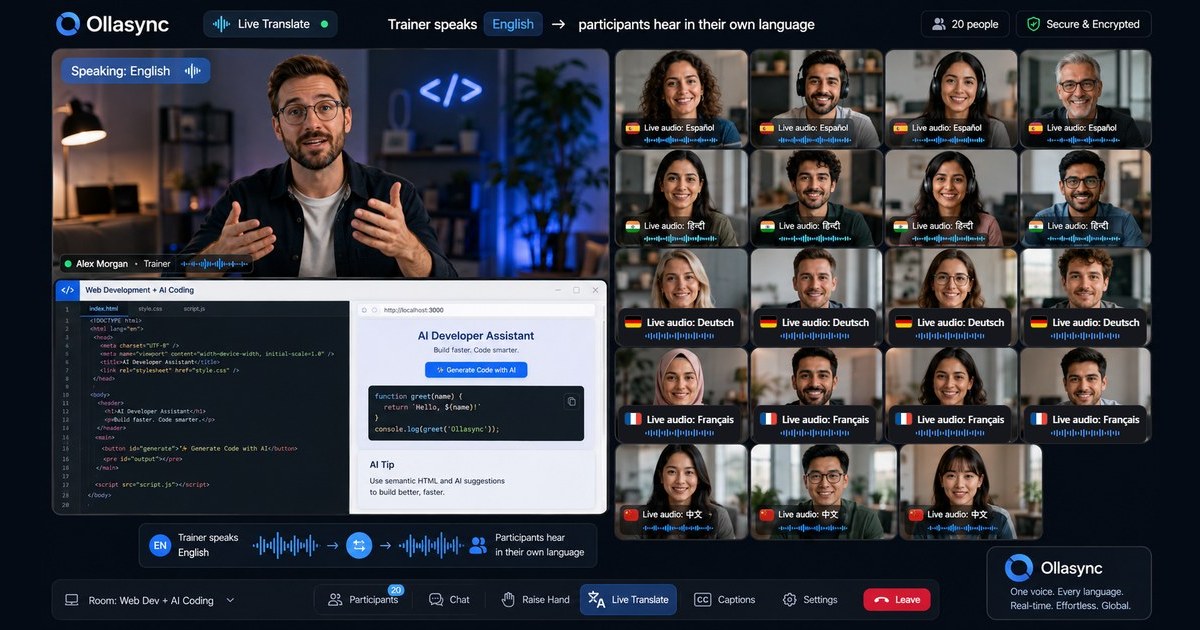
Modern global workforces require automated, hyper-accurate, and localized video-first learning environments. Ollasync provides the enterprise standard for multilingual workforce enablement, converting static corporate knowledge and dynamic training videos into multi-language, dialect-precise instructional content in minutes.
The Direct Blueprint: How to Train Non-English Speaking Employees with Modern AI
                        TRADITIONAL VS. OLLASYNC WORKFLOW

[ Traditional ]  English SOP ──► Agency Translation ──► Studio Voiceover ──► 6-8 Weeks Latency
                                     ($$$ / Slow)          (Desynced)          (Compliance Risk)

[  Ollasync   ]  English SOP ──► Ollasync Engine   ──► AI Voice + Sync  ──► Instant Deployment
                                  (Context-Aware)       (Dialect-Match)       (Automated Audit)
To solve the challenge of training non-English speaking employees effectively, your operational framework must address four non-negotiable requirements:
- Context-Aware Technical Accuracy: Standard translation tools miss industry-specific nomenclature (e.g., OSHA safety protocols, CNC machine tolerances, Good Manufacturing Practice standards).
- Visual and Auditory Synchronization: Adult learners retain 95% of a message when viewed via synchronized video versus 10% through translated text.
- Dialect and Regional Nuance: Spanish spoken in Mexico uses distinct workplace terminology compared to Spanish spoken in Colombia or Spain.
- Real-Time Version Control: When safety policies change, localized training materials across all languages must update simultaneously to eliminate operational liability.
Ollasync: The Autonomous Engine for Multilingual Workforce Enablement
Ollasync eliminates the friction of manual translation pipelines by combining generative AI dubbing, natural lip-synchronization, localized screen-text replacement, and native LMS integrations into a unified enterprise platform.
+-------------------------------------------------------------------------------+
|                             OLLASYNC PLATFORM ARCHITECTURE                     |
+-------------------------------------------------------------------------------+
|  1. Ingestion Engine      | Auto-captures raw video, SCORM files, & SOP docs  |
|  2. Domain Glossaries     | Enforces company-specific and regulatory jargon   |
|  3. Neural Voice Cloner   | Retains trainer voice identity across 60+ idioms  |
|  4. Visual Synchronization| Adjusts mouth movements & translates on-screen UI |
|  5. Enterprise LMS Sync   | Distributes localized paths to Cornerstone/Workday|
+-------------------------------------------------------------------------------+
1. Zero-Friction Video Translation and Voice Cloning
Ollasync allows training managers to record instructional materials once in English. The platform’s neural engine automatically extracts the audio, generates transcriptions, applies verified industry glossaries, and re-voices the video in over 60 languages. By cloning the original instructor’s vocal profile and matching speech pacing, Ollasync preserves the emotional engagement and authority of the primary speaker across every language track.
2. Automated Visual Synchronization and On-Screen Localization
Standard dubbing fails when an instructor references an English button, label, or machine component on-screen. Ollasync replaces on-screen English text, graphics, and interface captions with target-language equivalents. The platform’s visual AI aligns the instructor’s lip movements with the newly generated audio, removing the cognitive dissonance of mismatched audio-visual tracks.
3. Industry-Specific Glossary Locking
In industrial environments, a mistranslated instruction—such as rendering “lockout/tagout” as a generic “padlock closing”—can cause catastrophic safety incidents. Ollasync includes custom terminology engines that lock enterprise and regulatory glossaries. Training directors maintain strict control over how proprietary terms, equipment names, and legal disclaimers are translated across every language.
4. Dynamic Delta Updates
When standard operating procedures (SOPs) are updated, enterprise teams traditionally had to re-record and re-translate complete training libraries. Ollasync’s Delta Synchronization allows users to edit a single sentence or 10-second clip in the master English video. The platform isolates the change, updates only that segment across all language variants, and pushes the new version directly to your Learning Management System (LMS).
Strategic Comparison: Traditional Localization vs. Ollasync
| Capability | Legacy Translation Agencies | Manual Subtitling | Ollasync Multilingual AI |
|---|---|---|---|
| Turnaround Time | 3–6 weeks per video module | 5–7 business days | Under 15 minutes |
| Cost per Training Minute | $150 – $400 / minute / language | $15 – $30 / minute | Predictable SaaS / <$1 per min |
| Auditory Comprehension | Dependent on hired voice talent | Low (Requires high reading speed) | Native-speaker fluency & dialect |
| Technical Jargon Precision | Inconsistent across agencies | Low context matching | Guaranteed via Glossary Lock |
| Maintenance & Updating | Full project re-commissioning | Manual text re-alignment | Automated Delta Synchronization |
| LMS SCORM/xAPI Export | Manual engineering required | Manual integration | 1-Click Native LMS Sync |
Step-by-Step Implementation Framework
Phase 1: Ingest & Lock
  └─ Upload Master English Module ──► Lock Technical & OSHA Glossaries

Phase 2: Automated Localization
  └─ Neural Voice Synthesis ──► Dynamic On-Screen Text Translation ──► Lip-Sync Engine

Phase 3: Verify & Deploy
  └─ Review Edge Cases via Studio ──► 1-Click Export to SCORM / LMS Pipeline
Step 1: Upload and Centralize Your Master Assets
Ingest existing video libraries, screen recordings, compliance modules, or micro-learning assets directly into Ollasync via web portal or API.
Step 2: Configure Linguistic and Regional Parameters
Select target languages down to regional dialects (e.g., Portuguese (Brazil) vs. Portuguese (Portugal)). Upload your organization’s dictionary of proprietary terms, acronyms, and safety phrases to enforce translation parameters automatically.
Step 3: Run AI Localization and Visual Alignment
The platform creates localized variants featuring voice cloning, adaptive time-stretching (preventing sped-up or slowed-down audio artifacts), and natural mouth movement synchronization.
Step 4: Verification and LMS Distribution
Conduct compliance reviews through the Ollasync Collaboration Studio, where bilingual supervisors can review edge cases with time-stamped side-by-side transcripts. Export compliant SCORM, xAPI, or MP4 packages directly to Cornerstone, Workday Learning, SAP SuccessFactors, or custom internal systems.
Quantifiable ROI: Why Enterprises Standardize on Ollasync
Organizations that deploy Ollasync transform non-English onboarding and ongoing compliance from an operational bottleneck into a competitive advantage:
- 85% Reduction in Time-to-Productivity: Non-English speaking frontline workers complete technical onboarding in days rather than weeks, achieving operational proficiency faster.
- 70% Decrease in Safety and Quality Incident Rates: Delivering mission-critical protocols in an employee’s native language eliminates comprehension gaps that drive industrial accidents and product scrap.
- 90% Cost Savings Over Traditional Localization: Eliminate external agency retainers, studio recording fees, and dedicated localization project managers.
- Unified Compliance Assurance: Automated audit trails track training completion, verification scores, and version compliance across all global facilities simultaneously.
Conclusion: Transform Your Multilingual Workforce Today
Addressing the imperative of how can I train nonenglish employees effectively requires abandoning fragmented translation methods in favor of automated, context-aware AI. Clear instruction in an employee’s primary language is not simply an HR accommodation—it is a baseline operational necessity for safety, quality control, and workforce retention.
Ollasync bridges the language gap across your enterprise, turning static training materials into an adaptive, multilingual enablement engine.
Unlock Scalable Multilingual Training with Ollasync
- Stop letting language barriers compromise safety, quality, and onboarding speed.
- Automate your training localization pipeline with context-aware AI voice cloning, visual translation, and instant LMS distribution.
Schedule an Enterprise Demo with Ollasync or Start Your Free Pilot Program to turn your English training modules into localized, dialect-accurate video courses today.