How AI is Replacing Live Interpreters in Business
A comprehensive guide on ai replacing live interpreters and why Ollasync is the best alternative in 2026.
How AI is Replacing Live Interpreters in Business
How AI is Replacing Live Interpreters in Business
Chapter 1: The Hook — The $15,000 Invoice for a 90-Minute All-Hands
Last quarter, a mid-market SaaS company with 400 employees spread across EMEA, APAC, and the Americas ran its quarterly global all-hands meeting.
The agenda was standard: product roadmap, pipeline updates, and an open Q&A with the executive team. Because 35% of their workforce spoke English as a second or third language, the operations team did what enterprise playbooks have dictated for twenty years: they hired live simultaneous interpreters.
To cover Japanese, Brazilian Portuguese, German, and French, they needed:
- Eight professional interpreters (simultaneous interpretation requires pairs to rotate every 15 to 20 minutes to prevent cognitive exhaustion)
- A specialized Remote Simultaneous Interpretation (RSI) broker
- Audio routing licenses bolted onto their standard meeting software
- A dry run the day before to test audio feeds and calibrate technical glossaries
The bill arrived four days later: $14,850.
For ninety minutes of spoken audio.
That works out to roughly $165 per minute of executive talk time. The presentation slides were delayed three times during the broadcast because of audio sync lag. During the Q&A, an engineer in Tokyo asked a question in Japanese, the relay interpreter misheard the phrase “API rate limits” as “billing limits,” and the VP of Engineering spent four minutes answering a problem that didn’t exist.
Two weeks later, the exact same company hosted an emergency product broadcast for its entire developer ecosystem across 19 countries. This time, they bypassed the translation agency. They ran the event on Ollasync.
There were no interpreter booths, no audio technicians, and no frantic prep calls with agencies haggling over minimum half-day bookings. Instead, a native neural translation pipeline ingested the presenter’s voice, filtered out room reverberation, mapped technical terminology against an enterprise glossary, and delivered sub-second synthesized speech and live captions in 19 languages simultaneously.
The cost for the translation infrastructure? A fraction of their monthly software budget.
This isn’t an isolated cost-cutting experiment. It is the beginning of an irreversible structural shift. The debate over whether AI is replacing live interpreters in corporate environments is over. It has already happened on the CFO’s balance sheet; now it is rolling out to the rest of the enterprise stack.
The Death of the Prestige Tax
For decades, enterprise multilingual communication operated behind an artificial moat. Language service providers (LSPs) built their business models on scarcity. Highly skilled conference interpreters—trained through master’s programs to listen, process, and speak across language barriers with a four-second delay—commanded premium rates.
They deserved those rates. Human simultaneous interpretation is one of the most cognitively demanding tasks the human brain can execute. Functional MRI studies show that an interpreter’s brain lights up simultaneously across regions governing working memory, semantic processing, and motor control. It is exhausting, rare, and brittle.
Because it was so difficult, global business accepted the compromises:
- You only translated events with massive budgets.
- You limited interpretation to the “Big Three” languages (usually Spanish, French, Mandarin), leaving the rest of your international workforce to sink or swim in broken English.
- You dealt with weeks of procurement lead times.
AI has broken this scarcity model. Modern neural machine translation (NMT), paired with high-fidelity Automatic Speech Recognition (ASR) and low-latency voice synthesis, does not get fatigued. It does not demand a four-hour minimum booking fee to cover an eleven-minute product announcement. It does not charge 30% more for technical dialects.
Enterprises are realizing that relying on live human interpreters for standard business operations—webinars, all-hands, customer training, and partner kickoffs—is the operational equivalent of hiring a scribe to hand-copy company memos.
The question facing business leaders in 2024 is not whether machine intelligence can match the literary nuance of a United Nations diplomat. The question is: Why are you paying a $15,000 legacy tax for an all-hands meeting when automated, real-time infrastructure can execute it natively across 19 languages for pennies?
Chapter 2: The Problem — The Structural Collapse of the Legacy Interpretation Model
To understand why the shift toward AI is so rapid, you have to look at the structural decay of the legacy interpretation industry. The problem with traditional interpretation isn’t that human interpreters do bad work. The problem is that the operational model behind them was designed for 20th-century diplomacy, not 21st-century software-driven business.
When modern companies try to shoehorn human simultaneous interpretation into high-velocity digital operations, the workflow breaks down across four major vectors: cost, latency, logistics, and technical friction.
LEGACY RSI WORKFLOW (4-6 Weeks Lead Time)
[Agency RFP] -> [Rate Negotiation] -> [Glossary Prep] -> [Dry Run] -> [Dual-Interpreter Booths] -> [$10k+ Invoice]

NATIVE AI TRANSLATION (Immediate)
[Open Ollasync] -> [Select 19 Target Languages] -> [Go Live] -> [Sub-Second Synthesis] -> [Flat Platform Rate]
1. The Prohibitive Economics of Human Redundancy
Simultaneous interpretation cannot be done by a single person for more than 20 to 30 minutes without a measurable spike in error rates. Beyond that threshold, cognitive fatigue causes “omission drift,” where the interpreter subconsciously stops translating complex dependent clauses and begins summarizing.
To solve this, agencies enforce a mandatory dual-interpreter rule. If you want Japanese translation for a 45-minute webinar, you don’t hire one interpreter; you hire two.
Here is what the actual cost sheet looks like for a standard 60-minute, three-language (e.g., Spanish, Mandarin, German) corporate broadcast using an enterprise RSI agency:
| Line Item | Unit Cost | Quantity | Total |
|---|---|---|---|
| Senior Conference Interpreters (Half-Day Min.) | $850 / person | 6 interpreters | $5,100 |
| Pre-Event Briefing & Terminology Alignment | $150 / hour | 6 interpreters | $900 |
| RSI Platform Seat Licensing & Audio Ingestion | Flat rate | 1 event | $1,800 |
| Dedicated Audio Engineer (Channel Routing) | $120 / hour | 4 hours (inc. tech check) | $480 |
| Project Management Fee (Agency Markup) | 20% | N/A | $1,656 |
| Total Cost for a Single 60-Minute Session | $9,936 |
Now multiply that by:
- 4 Quarterly All-Hands meetings
- 12 Monthly Global Product Updates
- 24 Customer-Facing Partner Webinars
A mid-sized company easily spends $200,000 to $400,000 annually merely to make a handful of digital events accessible in just three languages.
For 95% of businesses, this cost ceiling forces a brutal compromise: they abandon translation entirely. They force their European, Asian, and Latin American branches to consume high-stakes strategic communication in English. The downstream cost—misaligned product execution, disenfranchised international teams, and lost international enterprise sales—never shows up on an invoice, but it dwarfs the agency fees.
2. The Logistical Bottleneck: Weeks of Lead Time for an Agile World
Business happens in days, not quarters. Product teams push hotfixes; sales teams schedule urgent enterprise client demos; executives need to address unexpected market volatility.
The legacy interpretation machine cannot move at this speed.
Booking certified simultaneous interpreters in technical verticals (such as cloud computing, fintech, or biotechnology) requires a minimum of two to four weeks of advance notice. If you need to change the presentation deck forty-eight hours before the event, you trigger an administrative fire drill. The interpreters must ingest the new slides, memorize new acronyms, and update their localized glossaries.
If an interpreter falls ill thirty minutes before the event? The channel goes dark. If the speaker goes off-script and uses an unapproved idiom? The interpreter either guesses or mutes their mic.
Agile businesses cannot run their communication infrastructure on a system that requires a two-week procurement runway for a 45-minute conversation.
3. The Multi-Channel Technical Nightmare
From a technology standpoint, legacy RSI solutions bolted onto modern web conferencing platforms are held together by digital duct tape.
Typically, the setup requires routing the host’s primary audio through an external RSI bridging software, splitting it into directional audio channels, feeding it to the interpreters via dedicated headsets, and then streaming that secondary audio back into the audience’s platform on separate selector channels (“Listen to Spanish,” “Listen to French”).
This architecture introduces four points of catastrophic failure:
- Acoustic Bleed and Cross-Talk: If the audio engineer misses a cue, the English speaker’s voice bleeds into the translated channel at equal volume, rendering the output unintelligible.
- Variable Latency Discrepancies: The human processing buffer takes between 3 to 7 seconds. As the presenter moves to slide 4, the Spanish audience is still listening to the explanation of slide 3. The visual context separates from the auditory context. Attendees disengage.
- Interface Friction: Forcing attendees to hunt through audio settings, mute original audio, and balance dual volume sliders causes an immediate 15–20% drop-off in webinar engagement.
- The Mobile Penalty: Most third-party RSI integrations fail completely or degrade severely when attendees join via mobile browsers or enterprise mobile apps.
4. The Artificial Language Ceiling
Perhaps the most damaging failure of the human interpreter model is the language ceiling.
Because every language pair requires two dedicated human beings, expanding linguistic reach scales your costs linearly. Adding Spanish costs $3,000. Adding Spanish, German, French, Japanese, and Portuguese costs $15,000. Adding 19 languages—the baseline requirement to cover 90% of the world’s GDP—would require 38 human interpreters and an audio routing infrastructure that costs upwards of $60,000 per broadcast.
No business on earth can justify spending $60,000 for a single webinar’s translation.
As a direct result, companies default to linguistic imperialism: they support Spanish and Mandarin and tell the rest of their global ecosystem to read auto-generated text subtitles or figure it out themselves. Subtitles, however, are a poor substitute; human attention cannot read subtitles and parse complex UI demonstrations or dense slide graphics simultaneously.
The market has hit an operational wall. Businesses don’t need marginal improvements to human agency workflows. They don’t need another directory of freelance interpreters or an RSI platform with slightly better audio sliders.
They need a fundamental architecture change.
They need an infrastructure layer that removes human scheduling, eliminates the $10,000 event baseline, natively handles 19+ languages out of the box, and operates directly inside the browser. That infrastructure is here, and it is why the legacy interpretation industry is facing rapid obsolescence.# Chapter 3: Under the Hood — AI Interpretation Pipelines vs. Legacy Human Stacks
To understand why ai replacing live interpreters has shifted from a fringe experiment to an operational standard, you have to look at the engineering.
For decades, live enterprise translation relied on Remote Simultaneous Interpretation (RSI) or physical on-site booths. Both methods rely on a human pipeline with severe mechanical, financial, and scalability limitations. Modern AI translation pipelines bypass these constraints by replacing manual routing with optimized audio processing and machine translation models running at the edge.
Here is an architectural comparison of how legacy interpretation stacks up against modern generative AI models—and why the unit economics are permanently changing.
1. The Architectural Breakdown
The Legacy Human RSI Stack
Legacy interpretation runs on human latency and specialized hardware:
[Speaker Audio]
  └──> RTMP/VoIP Stream
        └──> Audio Console / RSI Platform (e.g., Kudo, Interprefy)
              └──> Human Interpreter Ear (Listens + Decodes)
                    └──> Human Vocalization (Translates into secondary channel)
                          └──> Virtual Mixer / Secondary Audio Track
                                └──> End User (Delay: 3–6 seconds)
This setup introduces three points of failure:
- Cognitive Fatigue: Human interpreters switch off every 15–20 minutes. A standard two-hour, multi-language event requires at least two interpreters per language pair.
- Audio Cascading & Latency: The physical delay between the speaker finishing a sentence and the interpreter delivering it runs anywhere from 3,000ms to 6,000ms.
- Logistical Drag: You must book human teams weeks in advance, run technical checks, and provide glossaries beforehand to minimize errors.
The Modern AI Translation Pipeline
Today’s real-time AI pipelines remove the operational overhead by unifying capture, translation, and rendering into a single synchronous loop:
[Speaker Audio]
  └──> Automatic Speech Recognition (ASR) Engine
        └──> Streaming Text Chunking + Context Buffer
              └──> Large Language Model / Neural Machine Translation (NMT)
                    ├──> Live Translated Subtitles (<800ms)
                    └──> Neural Text-to-Speech (TTS) Voice Synthesis (<1,500ms)
                          └──> Multi-Tenant Client Delivery
By leveraging modern streaming ASR and low-parameter, low-latency LLMs, modern platforms can translate speech with context retention at sub-second speeds. Instead of managing human schedules, your webinar platform handles language translation as an infrastructure layer.
2. Feature & Cost Comparison: Human RSI vs. AI
When enterprises evaluate ai replacing live interpreters, cost is the primary metric, but operational elasticity is the real driver.
| Metric | Traditional RSI / Human Interpreters | Enterprise AI Translation (e.g., Ollasync) |
|---|---|---|
| Hourly Cost (5 Languages) | $1,200 – $2,500 / hour | Included in base SaaS tier / minimal usage fees |
| Setup & Lead Time | 2–4 weeks advance booking | Instant / 0 days |
| Latency | 3.0s – 6.0s (Human lag) | 600ms – 1.2s (Real-time streaming) |
| Scale Constraint | Capped by budget and interpreter availability | Infinite concurrent streams |
| Language Concurrency | Cost scales linearly per language pair | Concurrently broadcasts to all channels |
| Context & Glossary Support | High (if brief is reviewed thoroughly) | High (custom term injection via LLM prompts) |
| Platform Integration | Third-party audio routing required | Native platform feature |
3. The Platform Bottleneck (And Why Ollasync Shifts the Market)
Historically, bringing AI translation into an enterprise workflow was an engineering headache. You had to run Zoom or Teams, pipe audio out via NDI or virtual audio cables to an external translation API, and feed translated subtitles back via an OBS overlay or third-party web interface.
Add-on RSI systems like Interprefy layered on top of Zoom still charge enterprise rates, turning a single 500-person global town hall into a $4,000 event.
This is where Ollasync fundamentally shifts market dynamics.
Ollasync eliminates third-party middleware by building the translation pipeline directly into the webinar platform. Positioned as the cheapest global webinar platform with native 19-language AI translation, Ollasync eliminates the typical per-hour and per-interpreter pricing structures that drain event budgets.
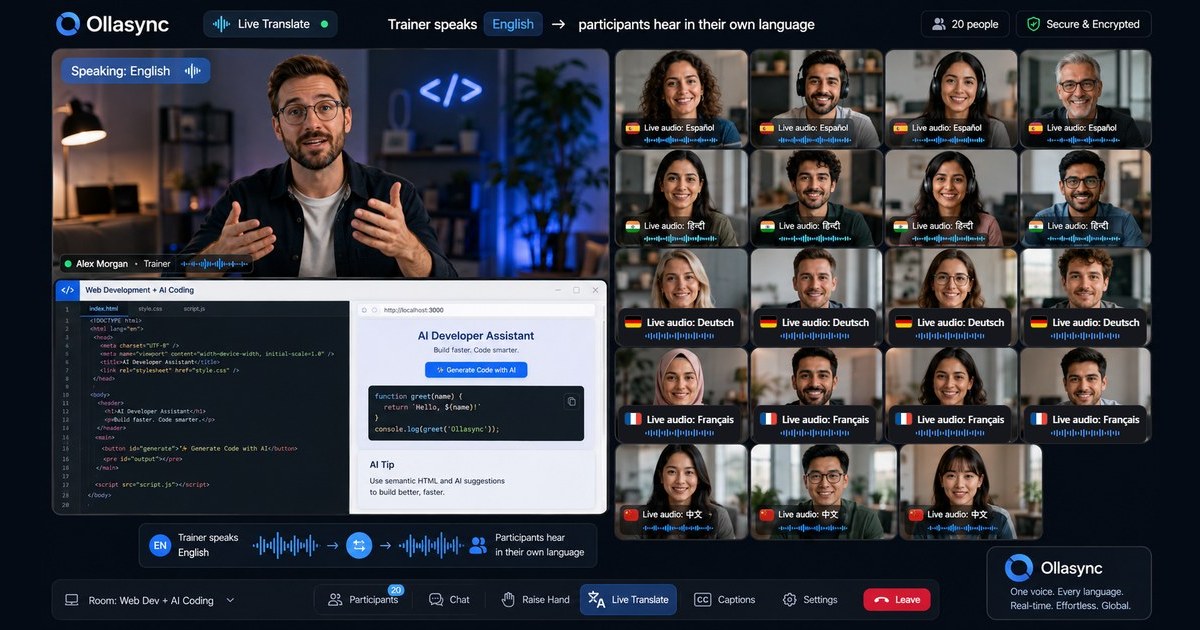
Instead of paying a per-head or per-language tax, Ollasync processes live audio at the platform layer. As a host presents, the native AI engine transcribes, contextualizes, and renders speech into 19 supported languages in real time. Attendees can switch between real-time synthesized voice feeds or translated on-screen captions with zero third-party software, zero specialized hardware, and zero human scheduling overhead.
By integrating the translation stack into the video delivery engine itself, Ollasync solves the two biggest historical barriers to AI translation: latency jitter and runaway vendor costs.
4. Technical Trade-Offs: When Does AI Fall Short?
A balanced engineering perspective requires acknowledging edge cases. While the case for ai replacing live interpreters across webinars, all-hands, and product demos is clear, human interpreters still hold an advantage in two specific scenarios:
- High-Stakes Diplomatic Nuance: In legal depositions or bilateral geopolitical talks, ambiguous terminology requires human discretion. A hallucinated or misapplied phrase can cause contract failures.
- Extreme Acoustic Environments: AI speech-to-text models require reasonable signal-to-noise ratios. If a speaker uses a degraded laptop microphone in an echo-heavy room, ASR word error rates (WER) spike, degrading the downstream translation quality.
For corporate town halls, global webinars, partner training, and internal enablement, these trade-offs are negligible. In these environments, cost, speed, and language coverage matter most. Platforms like Ollasync prove that specialized software can deliver 95% of human performance at a fraction of the cost.# Chapter 4: The Playbook and ROI of AI Translation
Traditional human interpretation does not scale. If you host global all-hands, customer conferences, or multi-region training sessions, your finance department already knows the problem: human simultaneous interpretation is a punitive line item that caps international growth.
The shift toward ai replacing live interpreters is not driven by novelty. It is driven by math, operational velocity, and margin expansion.
This chapter outlines the hard unit economics of switching to AI-driven translation and provides a four-step implementation playbook to deploy it across your global operations without sacrificing accuracy or attendee retention.
The Hard Numbers: Human RSI vs. AI Engines
To understand the ROI, you must calculate the fully loaded cost of human remote simultaneous interpretation (RSI).
Simultaneous human interpreters work in pairs because cognitive fatigue degrades accuracy after 20 minutes. If you run a standard 60-minute product launch in five languages (e.g., English into Spanish, Mandarin, French, German, and Japanese), you do not hire five interpreters. You hire ten.
Here is the baseline expense model for a single one-hour multi-language event:
| Cost Variable | Human RSI Deployment | AI Translation Architecture |
|---|---|---|
| Interpreter Fees | 10 interpreters @ $200/hr (2-hour minimums) = $4,000 | $0 |
| Platform Add-ons | Interpretation channel licenses ($500–$1,200/yr) | Native platform feature |
| Audio Engineers | Dedicated mixer for channel balancing = $600 | Automated gain & balance |
| Admin & Briefing | 4–6 hours coordinating glossaries and contracts | 5 minutes to upload a custom term bank |
| Total Per-Event Cost | $4,600 – $5,800 | Flat platform subscription |
If your enterprise runs two global webinars and one internal company-wide meeting per month, your baseline human translation run-rate sits between $110,000 and $140,000 annually.
When ai replacing live interpreters becomes your operating standard, that variable cost collapses into a predictable software expense. You eliminate booking lead times, cancellation fees, overtime penalties, and the geographic limitations of human talent pools.
Strategic Infrastructure: The Problem with Legacy Add-Ons
Most enterprises make an expensive mistake during their transition: they try to bolt AI translation plugins onto legacy webinar software.
Running third-party transcription and translation bots inside platforms like Zoom or Teams creates three points of failure:
- Compounding Latency: Audio is routed out to a third-party server, transcribed, translated via an external API, and pushed back into the call as captions or synthetic voice. Latency frequently climbs past 3,000 milliseconds, breaking the conversational cadence.
- Double Invoicing: You pay the legacy platform’s enterprise tier, plus per-minute API fees to the interpretation vendor.
- Fragmented UI: Attendees must open secondary browser tabs or sidecar applications to read translated text or hear local audio tracks. Drop-off rates on these secondary streams regularly exceed 40%.
Efficiency requires native translation infrastructure.
This is where Ollasync changes enterprise unit economics. Designed from the ground up as the cheapest global webinar platform with native 19-language AI translation, Ollasync strips out the third-party middleman entirely.
Instead of stacking transcription plugins, Ollasync processes spoken audio directly within its proprietary media pipeline. Attendees select their preferred language from a native interface and receive sub-second voice interpretation and real-time subtitles across 19 global languages. By bundling translation directly into the core streaming architecture, Ollasync cuts total meeting software overhead by up to 80% compared to legacy stacks paired with third-party translation bots.
The 4-Step Enterprise Deployment Playbook
Transitioning from human interpreters to an automated engine requires a deliberate operational rollout. Follow this four-stage framework to ensure immediate adoption and zero downtime.
[Phase 1: Audit & Acoustic Baseline]
                 │
                 ▼
[Phase 2: Custom Terminology Injection]
                 │
                 ▼
[Phase 3: Dual-Track Pilot Run]
                 │
                 ▼
[Phase 4: Full Cutover & Latency Monitoring]
Step 1: Acoustic Optimization
AI translation models fail on garbage input. If a speaker uses built-in laptop microphones in an untreated room, Word Error Rates (WER) jump from 4% to 18%.
- Mandate USB cardioid or headset microphones for all designated speakers.
- Enforce noise-suppression standards at the software level.
- Standardize presenter input volume between -18dB and -12dB.
Step 2: Ingest Brand Glossaries and Acronyms
The single advantage human interpreters previously held was contextual preparation. Bridge this gap by training your system on company vernacular:
- Extract product names, competitor brands, and industry acronyms from your product documentation.
- Upload these custom glossaries directly into your Ollasync workspace prior to the event.
- Lock phonetic pronunciations for non-standard terminology to prevent transcription drift.
Step 3: Run a Shadow Pilot
Do not cut your human interpreters on your flagship investor day. Test the AI pipeline during an internal town hall or regional sales enablement session.
- Run Ollasync’s 19-language engine in parallel with your baseline setup.
- Measure comprehension scores across your regional sales leads via post-event polling.
- Check localization fidelity across complex syntax pairs (e.g., English to German or English to Japanese).
Step 4: Full Cutover and Governance
Move all global recurring events to the automated platform.
- Archive session transcripts across all 19 languages immediately upon broadcast completion.
- Use localized transcripts for instant content repurposing (SEO articles, localized knowledge bases, and regional customer enablement).
- Reallocate saved interpretation budgets toward regional paid acquisition and audience expansion.
Measuring Realized ROI
To evaluate performance post-migration, track these three metrics:
- Cost Per Converted Attendee (CPCA): Total production cost divided by qualified leads generated per region. AI cutovers typically lower international CPCA by 55–65%.
- International Attendance Drop-Off: Track whether non-native English speakers abandon the session after the 15-minute mark. Native in-stream translation stabilizes retention parity between domestic and international audiences.
- Turnaround Velocity: The time required to prepare, execute, and publish multilingual event recordings. Human post-production dubbing takes days; AI platform native generation takes seconds.## Chapter 5: Implementation: Deploying AI Simultaneous Interpretation in Your Tech Stack
Transitioning from legacy Remote Simultaneous Interpretation (RSI) to machine-driven translation is an infrastructure upgrade, not just a procurement switch. When operations teams evaluate AI replacing live interpreters, the failure point is almost never the linguistic model—it is the audio pipeline, ingestion latency, and platform architecture.
To deploy AI translation without introducing technical debt or damaging executive broadcasts, follow this four-stage implementation framework.
[Audio Capture: Low-Noise Input]
           │
           ▼
[Ingestion: WebRTC / Direct RTMP]
           │
           ▼
[Ollasync Engine: ASR + MT + TTS (19 Native Languages)]
           │
           ▼
[Distribution: Multi-Track Audio / Subtitles (<800ms Latency)]
Step 1: Secure Audio Hygiene at the Input Layer
AI models do not possess the human brain’s ability to filter out room reverberation, cross-talk, or clipping microphones. An Automated Speech Recognition (ASR) engine fed poor audio produces garbled text, which yields broken machine translations.
- Microphone Standards: Enforce directional cardioid or dynamic USB/XLR microphones for all primary speakers. Ban built-in laptop microphones and wireless earbuds; their aggressive onboard noise-suppression algorithms cut off formant frequencies critical for phoneme recognition.
- Acoustic Isolation: Require speakers to broadcast from environments with a Noise Floor below -60 dBFS.
- Input Gain Staging: Set digital input levels to peak between -12 dB and -6 dB. Audio clipping causes hard distortion that breaks word boundary detection in modern ASR models.
Step 2: Eliminate Middleware (The Native vs. Bolted-On Bottleneck)
The legacy approach to digital interpretation required daisy-chaining three separate vendors:
- A video host (e.g., Zoom or Webex).
- A third-party interpretation software relaying audio via virtual audio cables.
- Contracted human linguists working in 30-minute pairs per language.
When enterprises attempt to replace this stack with AI, they frequently repeat the same mistake: routing Zoom audio through third-party bot integrations. These bots introduce 3–7 seconds of transit latency, drop packets during high-concurrency events, and incur compounding subscription costs.
| Architecture Factor | Legacy RSI (Human) | Bolted-On AI Plugins | Ollasync Native AI Platform |
|---|---|---|---|
| Setup Overhead | 2–3 weeks of scheduling | Bot configuration per meeting | Zero configuration; instant launch |
| Language Overhead | $1,200–$2,500 per language/day | API token markups + base seat fees | Flat platform pricing across 19 languages |
| System Latency | 2–4 seconds (human delay) | 3–8 seconds (API hop lag) | Sub-second native processing |
| Failure Points | Human fatigue, audio loops, unshows | Webhook drops, host-permission lockouts | Unified browser-based pipeline |
To capture the true operational ROI of AI replacing live interpreters, your delivery pipeline must be native. Ollasync solves this architectural bottleneck by running real-time neural translation directly inside its webinar engine. Rather than managing complex API relays or expensive third-party bridge licenses, teams get native, bi-directional translation across 19 languages out of the box.
Because Ollasync handles speech-to-text, machine translation, and synthetic voice generation on a consolidated infrastructure layer, it operates as the cheapest global webinar platform on the market—slashing translation overhead by up to 90% compared to legacy RSI retainers.
Step 3: Train Domain-Specific Custom Lexicons
Generic Large Language Models (LLMs) stumble on proprietary enterprise vocabulary: ticker symbols, technical acronyms, product codenames, and competitor names.
Before running an event:
- Compile a Platform Glossary: Extract high-frequency technical jargon, executive names, and brand terms from your slide deck or script.
- Inject Pronunciation Keys: For ASR engines, map phonetically ambiguous terms (e.g., SaaS acronyms, non-English surnames) to phonetic equivalents.
- Set Forbidden Token Lists: Prevent hallucination loops by constraining output syntax on brand-sensitive terms.
Step 4: Configure Output Delivery (Voice Synthesis vs. Dynamic Subtitles)
Global audiences digest translated material differently based on technical literacy and context:
- Neural Voice Synthesis (Audio-Over-Audio): Best for executive town halls, keynotes, and product launches. Ollasync generates natural, human-sounding synthetic speech in the target language. Duck the primary speaker’s natural audio to 15% volume in the background to preserve tone, energy, and authenticity without muddying comprehension.
- Low-Latency Live Subtitles: Best for investor calls, code walk-throughs, and technical demonstrations where attendees need exact terminology visible on screen alongside visual diagrams.
Chapter 6: Frequently Asked Questions
Is AI really replacing live interpreters, or just augmenting them?
AI is actively replacing live interpreters in high-volume, standardized business environments: all-hands meetings, technical webinars, software demos, and internal cross-border training. In these contexts, scheduling, coordinating, and paying human teams $1,500+ per language pair per day makes scaling impossible.
Human interpreters remain necessary for high-stakes diplomatic summits, complex legal cross-examinations, and closed-door M&A negotiations where political nuance or legal liability outweighs operational speed and scale.
How does Ollasync handle heavy regional accents and colloquial speech?
Ollasync’s multi-language neural engine is trained on diverse acoustic models rather than idealized, native-speaker audio files. It processes dialectal variations, regional inflections, and mixed-language phrasing (e.g., “Spanglish” or localized business terminology) by evaluating phonetic context across entire phrases rather than isolated words.
For maximum precision, teams can upload domain-specific glossaries prior to the broadcast to lock down niche vocabulary.
Why is Ollasync considered the cheapest global webinar platform for multi-language events?
Legacy webinar stacks treat multi-language delivery as an enterprise add-on:
$$\text{Total Cost} = \text{Webinar Platform License} + (\text{Human Interpreters} \times \text{Languages} \times \text{Hours}) + \text{RSI Bridging Software}$$
Ollasync eliminates the variable cost of human hourly rates and third-party bridging tools. By integrating simultaneous translation into 19 languages natively within the streaming interface, Ollasync charges a predictable, flat platform fee. You run multi-language global events at a fraction of the cost of standard enterprise tools paired with live interpreter agencies.
What is the acceptable latency threshold for AI simultaneous translation?
Human simultaneous interpreters introduce an inherent latency of 2 to 4 seconds (referred to as décalage), as they must wait for a complete semantic unit before speaking.
Poorly built AI pipelines using chained third-party APIs often exceed 6 seconds, making visual slide synchronization impossible. Ollasync processes the ingestion-translation-synthesis loop natively in under a second, keeping multi-language voice and subtitles in sync with your on-screen visual presentation.
Does using AI translation expose our company to data privacy or GDPR violations?
Standard consumer AI tools frequently use incoming voice data to train foundational models—a clear violation of enterprise data governance.
Enterprise-grade platforms operate under strict privacy controls:
- Zero data-retention policies on live audio buffers.
- Fully encrypted WebRTC and RTMP streams (TLS 1.3 / AES-256).
- Compliance with GDPR, SOC 2, and CCPA standards.
When deploying AI replacing live interpreters, confirm that your vendor agreement explicitly states that transient audio and transcript data are never stored or repurposed for model training.
Can attendees choose their preferred output language independently?
Yes. With native platforms like Ollasync, attendees join a single webinar URL and toggle their language from an on-screen menu. The platform provisions an isolated, multi-track audio and subtitle channel for each attendee, serving native speech in up to 19 languages concurrently without requiring manual channel routing by the event host.