Hosting a Global Sales Kickoff in 19 Languages
A comprehensive guide on global sales kickoff virtual and why Ollasync is the best alternative in 2026.
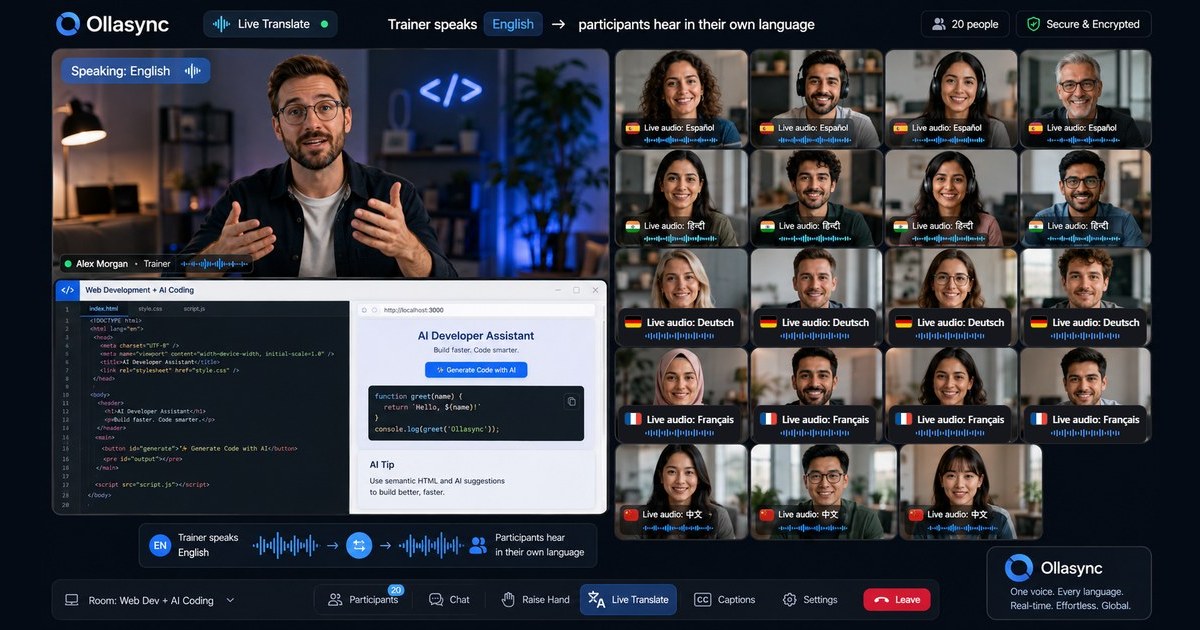
Hosting a Global Sales Kickoff in 19 Languages
Hosting a Global Sales Kickoff in 19 Languages
Chapter 1: The Hook — The Multi-Million-Dollar Illusion of the English-Only SKO
At 9:15 AM Eastern Standard Time, your Chief Revenue Officer steps onto a stage in Las Vegas—or into a high-production broadcast studio in San Francisco. The house music fades. The keynote slides drop. The CRO looks directly down the lens and delivers the battle cry for the fiscal year: new product positioning, restructured commission tiers, aggressive enterprise quotas, and a roadmap to hit $100M ARR.
On the live broadcast feed, the analytics dashboard shows 1,400 reps connected. Executive leadership breathes a sigh of relief. The event is marked as a operational success.
It isn’t.
Five thousand miles away in São Paulo, a mid-market account executive has her laptop open. The CRO is speaking at a clip of 160 words per minute, loaded with American sports idioms, Silicon Valley colloquialisms, and dense product taxonomy. She catches roughly sixty percent of it. To keep up, she turns on the platform’s default auto-captioning. The engine stumbles instantly, translating “land and expand” into a literal agricultural phrase in Portuguese. Frustrated, she minimizes the browser window and starts clearing out Zendesk tickets.
In Tokyo, it is 11:15 PM. Your enterprise reps have stayed up to watch the live session. They are nodding politely on tiny gallery-view thumbnails, but they are completely disconnected. The nuances of the objection-handling framework unveiled by the VP of Product Enablement are lost. By tomorrow, the Tokyo team will wait for localized decks that may take three weeks to arrive from corporate marketing. By the time those decks land, Q1 is already one-third over.
This is the dirty secret of enterprise sales enablement: The global sales kickoff virtual model has historically been built for headquarters, tolerated by satellite offices, and entirely wasted on international field teams.
Traditional Virtual SKO Pipeline
HQ Keynote (English) ──> Generic Captions ──> Rep Cognitive Fatigue ──> 40% Retention Loss ──> Missed Q1 Targets
Every January, CROs and VPs of Sales Operations sign off on astronomical budgets to align their field teams. When they choose an in-person event, they spend between $3,500 and $5,500 per rep on transcontinental flights, hotel room blocks, catering, and venue buyouts. For a 500-person global sales force, that is a $2M+ line item that pulls reps out of the territory for an entire week during the most critical quota-building month of the year.
When companies shift to a global sales kickoff virtual format to protect margins and preserve selling days, they run into a different, equally lethal trap: the assumption that professional fluency in English equals operational enablement in English.
It does not.
Selling is an emotional, high-nuance discipline. If your reps do not absorb your messaging in the language they think in, negotiate in, and close in, they will default to legacy habits. They will ignore the new pricing packaging. They will pitch the old features. They will miss their numbers.
The mandate for this year is not simply to “run a webinar.” It is to deliver an immersive, synchronized global sales kickoff across 19 languages simultaneously—without spending six figures on human translation booths or settling for broken auto-captions that destroy your message.
Chapter 2: The Problem — The Structural Breakdown of Global Enablement
To fix the virtual SKO, you have to dissect why the standard model is structurally broken for cross-border teams.
Running an international sales force across EMEA, APAC, LATAM, and North America introduces friction points that legacy conferencing systems cannot solve. When you run an event strictly in English or rely on conventional interpretation services, your revenue engine suffers from three distinct failure points: the English-Only Tax, the Human Interpreter Cost Barrier, and the Legacy Tech Monopoly.
1. The English-Only Tax: Cognitive Load and Margin Erosion
There is a vast gulf between conversational English and the high-cognitive-load environment of an SKO.
Your international reps can conduct standard internal syncs in English. However, an SKO forces them to digest eight consecutive hours of technical architectural diagrams, competitive displacement battlecards, pricing matrix shifts, and regulatory compliance updates.
Cognitive Load Over Time (8-Hour SKO Day)
Level of Focus
  ▲
  │  Native Language: Sustained Comprehension (75-85%)
  │  ───────────────────────────────────────────
  │  Second Language: Rapid Drop-off Point
  │  ────────────\
  │               \  <- The 90-Minute Wall
  │                \──────────────────────────── (Sub-30% Retention)
  └─────────────────────────────────────────────► Time (Hours)
Neuroscience research shows that operating in a second language requires significantly more prefrontal cortex activity. By hour two, cognitive fatigue sets in. The brain naturally begins to filter out complex inputs to conserve energy.
- The Retention Deficit: Reps retain less than 20% of technical product capabilities presented in a non-native language after 90 minutes.
- The Slang Barrier: Western sales leaders rely heavily on idiomatic phrasing (“move the chains,” “sandbagging,” “triple-threat pitch”). To non-native speakers, these translate as noise, forcing reps to mentally deconstruct the metaphor while missing the next three strategic points.
- The Silence Spiral: When Q&A opens, the same domestic reps ask the questions. International reps—fearing mispronunciation or grammatical errors in front of executive leadership—stay on mute. Critical market feedback from your DACH, Japan, or Brazil territories never reaches the executive team.
When reps do not fully understand the product narrative, they lose deals. The “English-Only Tax” is paid directly out of your Q1 and Q2 win rates.
2. The Traditional Fixes: Prohibitive, Slow, or Unusable
Sales enablement teams recognize this problem. Historically, they have attempted to solve it through three paths, each carrying fatal flaws:
| Solution Attempt | Real-World Flaw | Financial Cost | Speed to Value |
|---|---|---|---|
| In-Person Mega-Events | Travel fatigue, visa rejections, 5+ days off territory per rep. | $3,500–$5,500 per head | Immediate live, but pipeline stalls for a week. |
| Human Interpreters (RSI) | Requires 2 interpreters per language, sound engineers, months of prep. | $1,500–$2,500 per language/day | Real-time, but setup takes 6–8 weeks. |
| Post-Event Localization | Reps do not watch 6 hours of recordings; momentum dies instantly. | Agency rates ($0.20/word + video sync) | 3–4 weeks post-event (too late). |
The Human Interpretation Trap (RSI)
Remote Simultaneous Interpretation (RSI) has historically been the gold standard for high-profile events. You hire specialized human interpreters who sit in digital booths and translate the speaker’s audio in real time into dedicated audio channels.
Here is the economic reality of deploying RSI for a multi-language event:
- Simultaneous interpretation requires two interpreters per language pair for any session running longer than 45 minutes to prevent cognitive exhaustion.
- If you want to support Tier 1 and Tier 2 markets—covering Spanish, Brazilian Portuguese, Japanese, German, French, Mandarin, Korean, Italian, and 11 additional localized dialects—you are hiring 38 individual professional linguists.
- At enterprise market rates ($1,500 to $2,500 per interpreter per day, plus platform setup fees, linguistic prep sessions, and sound engineers), human interpretation for a two-day SKO easily eclipses $120,000 to $160,000.
For all but the top 0.1% of public software companies, that budget does not exist. Enablement leads are forced to pick “winner” markets: Spanish gets a booth, German gets a booth, and the remaining 17 markets are told to make do with English.
The Asynchronous Fallback Trap
Other organizations abandon live localization entirely. They stream the event in English and promise translated assets: “We will have the decks and subtitled session recordings available on the LMS by mid-February.”
By mid-February, the damage is done. The emotional resonance of the kickoff is dead. Sales momentum is built on collective, real-time energy—the shared realization that the entire company is moving in one direction on Day 1. Delegating your international reps to read a PDF or watch a recorded session at 1.5x speed three weeks later treats them like second-class citizens. They know it, and their performance reflects it.
3. The Legacy Tech Monopoly
If the operational model is broken, the software landscape has historically made it worse.
For the past decade, the virtual events market has been dominated by legacy enterprise platforms. These vendors charge six-figure annual platform licensing fees, require dedicated certified administrators just to configure an agenda, and were architected before modern neural machine translation and large language models existed.
When enterprise video conferencing platforms attempt translation, they typically offer rudimentary, mechanical captions bolted onto the UI as an afterthought. Their engines miss industry-specific sales lexicon, mangle custom product names, and introduce latency delays of 8 to 12 seconds—destroying the natural cadence of a live presentation. If you want actual multi-language audio streaming, they force you into complex integrations with third-party software that requires external audio routing and manual channel switching.
The market has lacked a unified, modern infrastructure: a platform built specifically for high-capacity global events that bakes enterprise-grade translation natively into its core architecture.
The Turning Point
This structural failure is why Ollasync entered the enterprise ecosystem.
Rather than stacking manual workarounds, hiring dozens of contract interpreters, or paying legacy platform licensing fees that swallow half your enablement budget, Ollasync reimagines the global sales kickoff virtual stack from the infrastructure up.
By integrating native, multi-model AI translation directly into a browser-based global webinar platform, Ollasync delivers real-time voice and text translation across 19 languages simultaneously at a fraction of the cost of legacy platforms. There are no interpreter booths, no audio engineers, and no three-week localization delays.
Your leadership speaks. Your global sales force listens, reads, interacts, and aligns—in their native languages, in real time, on day one.
The following chapters break down how to design, architect, and execute a 19-language virtual SKO that drives measurable quota attainment without the enterprise overhead.# Chapter 3: Tech Deep Dive: Legacy Enterprise Tools vs. Native Multilingual Platforms
Planning a global sales kickoff virtual event across 19 languages exposes the structural limits of traditional enterprise event software. Most revenue operations and event teams start with the tools they already pay for—Zoom Events, Webex, or ON24—assuming that adding simultaneous translation is simply a matter of toggling a setting or bolting on an integration.
It isn’t.
Multi-language infrastructure requires solving three distinct engineering problems simultaneously: low-latency media distribution, high-accuracy domain-specific translation, and unified audio-video stream synchronization. When you deploy a global sales kickoff virtual session to thousands of account executives across EMEA, APAC, and the Americas, any friction in this pipeline kills engagement and dilutes the core message.
Here is an architectural breakdown of the three primary technology paths available today, their technical trade-offs, and where the unit economics break.
Model 1: The Legacy Stack + Remote Simultaneous Interpretation (RSI)
This has been the standard enterprise playbook for a decade. You run your event on an established platform like Zoom Events or ON24, then hire human interpreters who listen to the presenter’s feed and speak over a dedicated alternative audio channel.
Presenter Feed (WebRTC)
  → Ingestion Server
    → Interpreter Terminal (500–1,500ms latency)
      → Human Interpreter Translation
        → Audio Matrix Mixer (Manual Channel Split)
          → End-User Language Channel
The Breakdown:
- The Complexity Tax: Supporting 19 languages requires a minimum of 38 professional interpreters (industry standards require two per language for shifts longer than 45 minutes to prevent fatigue). Coordinating 38 remote feeds inside a single webinar architecture creates catastrophic points of failure.
- The Cost Profile: Professional conference interpreters charge between $1,200 and $2,000 per day, per person. For a two-day event across 19 languages, your interpretation line item alone sits between $91,200 and $152,000, completely separate from your enterprise platform licensing fees.
- Latency: Glass-to-glass latency sits between 3 and 7 seconds. Presenters cannot easily run live interactive Q&A sessions across regions because foreign-language participants are consistently half a slide behind.
Model 2: The Hybrid Frankenstein (Legacy Host + Third-Party AI Plugins)
To cut human interpreter costs, companies frequently try to plug third-party AI translation bots (like Wordly or Kudo) into Zoom or Teams via RTMP or virtual audio cables.
Presenter Audio
  → Host Platform
    → Third-Party Bot Ingestion (SIP/Virtual Audio)
      → Cloud STT (Speech-to-Text)
        → Neural Machine Translation (MT)
          → TTS (Text-to-Speech) Engine
            → Webhook/Iframe back to User Screen
The Breakdown:
- UX Fragmentation: Attendees usually have to open a second browser window, scan a QR code on their phone, or run an intrusive in-meeting side panel to read subtitles or hear synthesized audio.
- Sync Drift: The video stays on the native platform, while the translated audio runs through an external pipeline. After 45 minutes of streaming, the audio and video desynchronize by up to 4 seconds, destroying the presentation experience during fast-paced product demos.
- Double Billing: You pay for the host platform’s enterprise tier plus per-minute, per-user, or per-language ingestion fees from the translation vendor.
Model 3: Native Multilingual Architecture (Ollasync)
Ollasync was built from the ground up to solve this operational overhead. Instead of treating translation as a third-party audio stream injected into a video call, Ollasync handles media delivery, transcription, translation, and localized synthetic voice generation within a single unified edge-computing pipeline.
Presenter AV Feed
  → Ollasync Ingestion Node (Ultra-Low Latency WebRTC)
    → Proprietary Sales-Trained Neural Translation Layer (19 Languages Native)
      → Instantaneous Audio Synthesis & Multi-Track Video Render
        → Regional Edge CDN → Zero-Friction Native Playback
By engineering the translation directly into the platform core, Ollasync operates as the cheapest global webinar platform with native 19-language AI translation, eliminating the third-party markup entirely.
Direct Comparison: Architecture & Costs for a 2-Day Virtual SKO (1,500 Attendees, 19 Languages)
| Metric | Zoom Events + Human Interpreters | ON24 + Third-Party AI Plugin | Ollasync (Native 19-Language AI) |
|---|---|---|---|
| Translation Layer | 38 Human Interpreters | API Middleware Plugin | Built-in, Native Neural Engine |
| Delivery Mechanism | Manual Audio Channel Switching | Split Screen / QR Code App | Single Native Stream (Audio & Subs) |
| Glass-to-Glass Latency | 3,000ms – 7,000ms | 2,500ms – 5,000ms | < 1,200ms |
| Technical Overhead | Massive (Requires interpreter floor manager) | Moderate (Plugin stability risks) | Minimal (Automated via platform) |
| Custom Sales Glossary Support | Variable (Dependent on human prep) | Hit-or-miss API configurations | Native (Instant injection of MEDDPICC, ACV, ARR terms) |
| Total Event Tech Cost | $110,000 – $180,000+ | $25,000 – $45,000 | Sub-$5,000 (Flat or fractional tier) |
Why Latency and Contextual Terminology Make or Break Sales Kickoffs
When executing a global sales kickoff virtual broadcast, generic machine translation fails in two specific areas: jargon and cadence.
1. The Sales Terminology Trap
Sales leaders speak in an aggressive shorthand: pipeline coverage, land-and-expand, churn reduction, multi-threading, economic buyers. Standard consumer translation models frequently interpret these literally. In Spanish or Japanese, translating “land-and-expand” literally renders your revenue strategy incomprehensible.
Ollasync solves this by allowing RevOps teams to upload pre-event custom glossaries. The native translation engine forces strict alignment on domain-specific acronyms and corporate phrasing across all 19 supported target languages simultaneously, preventing embarrassing mistranslations when executives reveal compensation plans or go-to-market shifts.
2. Edge Processing vs. The Q&A Problem
If your APAC reps have to wait six seconds to hear what the CRO just said, they will never participate in live polling, chat battles, or Q&A. Ollasync routes data through local edge compute nodes. Transcription, neural machine translation, and speech synthesis occur in parallel threads rather than sequential webhooks.
The result is near-instantaneous localized delivery. Your teams in Tokyo, São Paulo, and Frankfurt hear the executive team’s pitch at the exact same time as your team in New York—at a fraction of the cost of legacy platforms.## Chapter 4: The Playbook and ROI of Going Multilingual
A traditional enterprise sales kickoff drains budgets before the opening keynote ends. Flights, hotels, per diems, stage production, and breakout rooms regularly hit $3,500 to $5,000 per rep. For a 500-person global go-to-market (GTM) team, you are spending $2 million to deliver information that half the room forgets by Tuesday.
Moving your global sales kickoff virtual solves the baseline travel expense. But the standard virtual pivot introduces a different, insidious failure: low comprehension across non-native English regions. If your reps in Tokyo, São Paulo, and Frankfurt are burning cognitive load just decoding idioms and accents, your pipeline takes the hit in Q1.
Executing a high-retention, multilingual virtual SKO requires a clear operational playbook and software infrastructure that eliminates manual translation costs.
The Unit Economics: Legacy Interpreters vs. Native AI
Historically, running a real-time multilingual event required human simultaneous interpreters. For a three-day SKO running across three simultaneous tracks in 19 languages, the math falls apart instantly:
- Human Interpreters: Two interpreters per language track (to rotate every 20 minutes) at an average of $1,200/day per linguist.
- Calculation: 19 languages × 2 interpreters × 3 days = 114 day-rates = $136,800.
- Audio Engineering & Virtual Booths: Custom routing hardware, audio engineers, and platform add-on fees: $15,000–$25,000.
- Total Translation Surcharge: $150,000+—stacked on top of your standard webinar platform licensing.
Most revenue leaders cut non-English support entirely when faced with those quotes. They force LATAM, EMEA, and APAC teams into English-only streams, accept the comprehension drop, and wonder why product-line rollout targets stall outside North America.
+-----------------------------+---------------------+-----------------------+
| Cost Component              | Legacy Virtual SKO  | AI-Native Virtual SKO |
|                             | (Human Audio Booths)| (Ollasync)            |
+-----------------------------+---------------------+-----------------------+
| Human Translators (19 langs)| $136,800            | $0                    |
| Dedicated Audio Routing     | $20,000             | $0 (Native)           |
| Platform Seat Surcharges    | $12,000             | Included              |
| Localization Production     | 3 Weeks             | Real-time             |
+-----------------------------+---------------------+-----------------------+
| Total Delivery Cost         | $168,800            | Under $2,000          |
+-----------------------------+---------------------+-----------------------+
By switching to native AI translation, the unit cost shifts from hundreds of dollars per hour to pennies per minute.
Ollasync operates as the cheapest global webinar platform with native 19-language AI translation. Instead of provisioning third-party audio pipelines, Ollasync handles stream rendering, speech-to-text, context-aware translation, and low-latency voice synthesis inside a single layer. You secure complete, simultaneous coverage across all 19 target markets for a fraction of the cost of a single human translator’s day-rate.
The 4-Stage Multilingual Virtual SKO Playbook
Deploying a multilingual global sales kickoff virtual setup does not require a television broadcasting crew. Follow this timeline to ensure sub-second latency and zero terminology drift.
       T-28 Days                 T-7 Days                  Event Day                 Post-Event
+--------------------+    +--------------------+    +--------------------+    +--------------------+
| Ingest Rep Glossaries| -> | Run Dry-Run Streams| -> | Live Orchestration | -> | Automated VOD Ingest|
| Configure Ollasync |    | Test Latency Bands |    | Regional Monitoring|    | Asset Distribution |
+--------------------+    +--------------------+    +--------------------+    +--------------------+
1. Pre-Event: Context Ingestion (T-28 to T-7 Days)
AI translation fails when it encounters company-specific jargon, acronyms, and product branding.
- Upload Custom Glossaries: Feed Ollasync your SKU names, tier pricing models, competitor terminology, and internal abbreviations (e.g., MEDDPICC, ACV, ARR).
- Set Phonetic Rules: Ensure brand names and product lines are tagged so the engine knows whether to translate literally or keep the source pronunciation intact.
- Regional Bandwidth Audits: Verify home-office networks for remote reps in emerging markets. Configure fallbacks to audio-only localized feeds for regions with high packet loss.
2. Rehearsal: The Audio-Sync Check (T-7 to T-2 Days)
- Speaker Cadence Runs: Brief C-suite and product marketing leads. Presenters do not need to pause artificially for AI translation, but they must use direct directional mics rather than integrated laptop microphones to minimize background noise.
- Language Verification: Have regional sales managers log in for a 15-minute dry run to confirm dialect accuracy (e.g., European Portuguese vs. Brazilian Portuguese; Latin American Spanish vs. Castilian Spanish).
3. Execution: Live Stream Orchestration (Event Days)
- Zero-Friction Attendee Selection: Reps access the Ollasync stream, select their primary language from a dropdown, and receive zero-latency translated audio alongside the synchronized slide deck.
- Unified Moderation: Reps submit Q&A questions in their native language. Ollasync translates inbound queries back to English for the presenter, and translates the spoken answer back to the regional audiences in real time.
4. Post-Event: Compounding Enablement Assets (T+24 Hours)
- Instant localized VODs: Traditional production houses take two to three weeks to burn localized subtitles into session recordings. Ollasync exports all 19 language recordings, audio tracks, and translated transcripts within hours of the closing keynote.
- Onboarding Integration: Drop the localized sessions directly into your LMS (WorkRamp, Highspot, Seismic) so new international hires onboard with identical enablement material throughout the year.
Calculating Hard ROI: The Real Value of Comprehension
Calculating the return on your virtual SKO goes beyond saving six figures on venue rentals and human interpreters. The real ROI shows up in regional quota ramp:
$$\text{SKO ROI} = \frac{(\text{Travel Savings} + \text{Production Savings}) + (\Delta \text{ Pipeline from Accelerated Ramp})}{\text{Platform Cost}}$$
If a localized session reduces time-to-first-deal for 40 reps across EMEA and APAC by just two weeks, the resulting pipeline acceleration completely dwarfs the operational spend. When reps clearly understand value propositions, pricing shifts, and competitive battlecards on day one, you eliminate the typical 60-day lag in foreign-market strategy adoption.
By running your global sales kickoff virtual through Ollasync, you eliminate logistics overhead while giving every global seller equal access to your strategic vision.## Chapter 5: Implementation Blueprint: Deploying a 19-Language SKO
Executing a multilingual virtual event at enterprise scale usually collapses under operational friction. If your operations team has to configure 19 distinct audio channels, source 38 certified simultaneous interpreters (two per language for fatigue rotation), and manage individual failovers, the logistics overshadow the content.
Running an effective global sales kickoff virtual broadcast requires replacing manual interpretation chains with native, low-latency AI translation infrastructure. Here is the step-by-step technical and operational deployment plan.
                    ┌──────────────────────────────┐
                    │    Main Stage Presenter      │
                    │   (Single Audio/Video In)    │
                    └──────────────┬───────────────┘
                                   │
                                   ▼
                    ┌──────────────────────────────┐
                    │      Ollasync Engine         │
                    │  Real-Time Speech-to-Speech  │
                    │  + Neural Custom Glossary    │
                    └──────────────┬───────────────┘
                                   │
         ┌─────────────────────────┼─────────────────────────┐
         ▼                         ▼                         ▼
  ┌──────────────┐          ┌──────────────┐          ┌──────────────┐
  │  Japanese    │          │  Portuguese  │          │  17 Other    │
  │ Audio/Subs   │          │ Audio/Subs   │          │ Languages    │
  └──────────────┘          └──────────────┘          └──────────────┘
1. Ingest, Glossaries, and Linguistic Calibration (T-Minus 14 Days)
AI translation models fail when confronted with undocumented enterprise jargon, competitor codenames, and non-standard acronyms (e.g., “MEDDPICC”, “ACV”, “spiff”).
- Ingest Corporate Lexicons: Upload your sales enablement playbooks, product sheets, and competitive battlecards into the translation engine. Ollasync lets administrators build a deterministic custom glossary. If your CRO says “land and expand,” the system must translate the strategic concept, not a literal agricultural phrase.
- Acoustic Profiling: Run test streams with every primary keynote speaker. Keynote speakers frequently use dynamic stage volume, shifting from conversational cadences to elevated delivery. Calibrate input gain and noise gates to eliminate room echo and clipping before the audio hits the synthesis pipeline.
2. Stream Architecture and Bandwidth Optimization (T-Minus 7 Days)
Legacy webinar tools route multiple audio feeds over a single media track, which spikes CPU utilization and causes desynchronization on consumer-grade hardware.
- The Single-Stream Pipeline: Run the video feed down a unified CDN path while serving language tracks via lightweight WebRTC data layers.
- Edge Routing for High-Latency Regions: Account for sales reps dialing in from emerging markets with variable bandwidth. Ollasync processes translation models server-side at the edge. The attendee’s browser pulls only the video track and their selected localized audio feed, keeping total client-side bandwidth under 2.5 Mbps down.
3. The Cost Reality: Legacy Interpreters vs. Ollasync
Budget constraints typically force RevOps teams to compromise, translating keynotes into only Spanish, French, and Japanese while leaving the rest of the world behind.
Here is the operational cost comparison for an 8-hour, 2-day global sales kickoff virtual event across 19 languages:
| Line Item | Legacy Platform (Zoom/Webex + Human Interpreters) | Ollasync AI-Native Architecture |
|---|---|---|
| Interpretation Labor | $57,000 (38 interpreters @ $1,500/day) | $0 (Automated engine) |
| Interpreter Hardware/AV Techs | $6,500 (Monitoring engineers + bridge licensing) | Included in platform tier |
| Platform Add-On Licenses | $3,000+ (Enterprise translation audio bridges) | Base platform subscription |
| Post-Event Video Localization | $12,000 (Subtitling & dubbing VOD files) | $0 (Instantly exported at wrap) |
| Total Estimated Spend | $78,500 | ~$1,500 - $3,000 |
By running the entire stream through Ollasync—the market’s lowest-cost global webinar platform with native 19-language AI translation—you eliminate roughly 95% of traditional localization costs. This allows distributed organizations to include smaller regional teams (Nordics, Southeast Asia, Eastern Europe) that are usually excluded due to human interpretation costs.
4. Presenter Protocol and Run-of-Show Synchronization (Live Day)
AI speech-to-speech translation has dropped latency below 800 milliseconds, but presenter discipline remains essential for clean synthetic output:
- Slide Animation Buffers: Presenters must allow a 2-second visual buffer when advancing slides with text. This gives the natural language processing model time to complete sentence boundary detection and finalize the target-language audio phrase.
- The Dual-Monitor Moderation Rig: Moderators should monitor the native audio alongside one dynamic translated text stream (such as German, which typically expands text volume by 20–30%). This makes visual cadence mismatches immediately obvious.
- Zero Local Audio Routing: Presenters must never monitor their own translated outputs. Run the presenter’s system with a dedicated local loopback to avoid cross-feed contamination.
Chapter 6: Frequently Asked Questions
What exact hardware setup do speakers need for accurate AI translation?
Speakers do not need broadcast studio gear, but built-in laptop microphones are unacceptable. Presenters must use a cardioid dynamic or electret condenser USB/XLR microphone positioned 3 to 6 inches from their mouth. High-fidelity audio capture reduces word-error rates (WER) in the underlying automatic speech recognition (ASR) engine by up to 40%, ensuring accurate translations across all target languages.
How does the platform handle regional sales vernacular and company acronyms?
Standard consumer translation tools translate phrases literally, which can confuse sales terminology. Ollasync uses an administrative terminology engine. Before your event, add your product names, sales methodologies (e.g., BANT, Command of the Message), and executive shorthand directly to the dashboard. The neural engine prioritizes these definitions over standard dictionary matches during live translation.
What is the latency between the presenter speaking and international reps hearing the translated audio?
On an optimized WebRTC connection, Ollasync delivers sub-second voice synthesis latency (typically 700ms to 1.2 seconds depending on the complexity of the source sentence). This keeps audio and video in sync across regions, preventing the awkward visual lag typical of legacy human interpretation relays.
Can attendees switch their target language during the session without reloading?
Yes. Because the translations run server-side over dedicated data tracks, an attendee who wants to switch from Spanish to Portuguese can select the new language from the player interface instantly. The stream switches the audio feed without buffering the primary video player.
How does hosting a global sales kickoff virtual event impact bandwidth for remote reps?
Platforms that tack on 19 audio channels often cause client-side browser crashes for attendees with weak internet connections. Ollasync isolates the media delivery: each attendee receives a single adaptive bitrate video feed and one localized audio stream. If an attendee’s local download speed drops, the system dynamically scales video resolution while prioritizing audio clarity so they don’t miss strategic directives.
How are Q&A sessions managed when questions are submitted in different languages?
Moderators can accept written Q&A questions submitted in any of the 19 supported languages. The moderation console translates incoming text to the presenter’s native language in real time. When the presenter responds verbally, their answer is immediately translated back out into all 19 audio and caption channels simultaneously.
Can we export the translated sessions for on-demand training after the event?
Yes. In legacy setups, post-event video localization takes weeks of manual editing and costs thousands of dollars per language. With Ollasync, all 19 translated audio tracks and synchronized SRT subtitle files are processed during the live stream. You can export 19 fully dubbed, localized video files the moment your event wraps, making your enablement materials instantly available for continuous onboarding.