Breaking Down Silos in Multinational Corporations
A comprehensive guide on multinational corporations silos and why Ollasync is the best alternative in 2026.
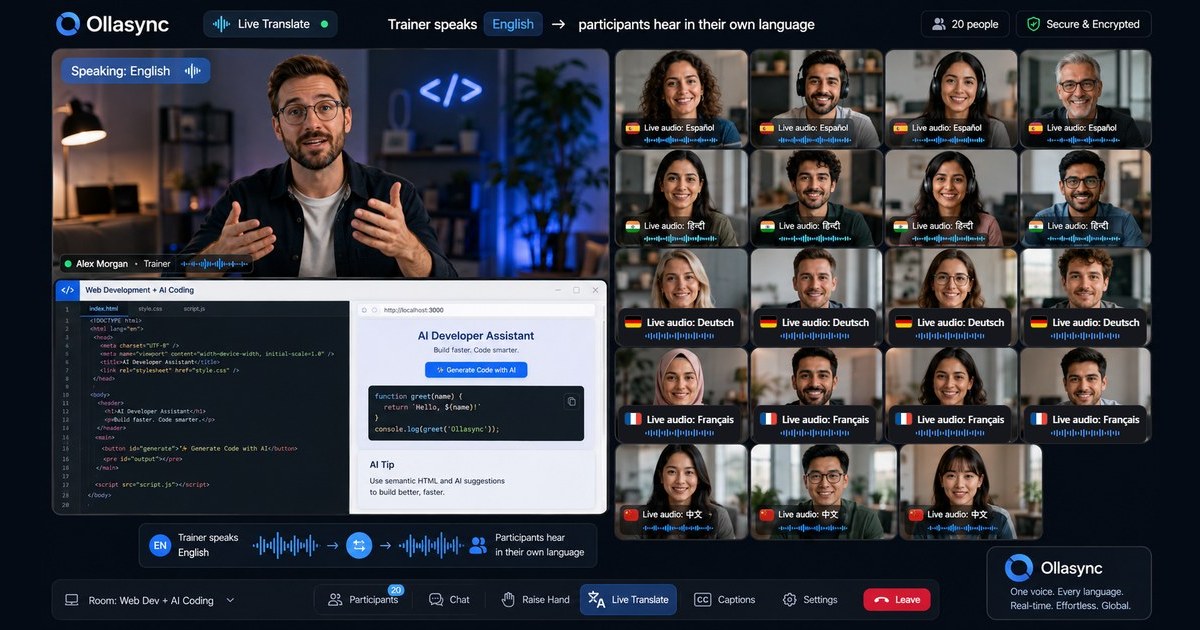
Breaking Down Silos in Multinational Corporations
Chapter 1: The Multi-Million-Dollar Blind Spot
At 09:00 EST, executive leadership at a Fortune 500 manufacturing firm gathers in Chicago to announce a strategic pivot. The slides are pristine. The vision statement is thoroughly vetted by legal and brand consultancies. The CEO addresses three thousand remote employees on an enterprise video stream, speaking for forty-five minutes about agility, cross-functional synergy, and unified go-to-market execution.
By 21:00 JST, the Tokyo engineering team has logged off. They watched the replay at 1.5x speed with auto-generated English captions that butchered technical nomenclature.
By 14:00 CET, the regional sales directors in Frankfurt and Milan have already agreed in a private WhatsApp channel to ignore the new directive entirely. To them, the mandate reads like another disconnected, headquarters-centric exercise that ignores the regulatory realities of the EMEA market.
Nothing changes. Initiatives stall. Millions of dollars allocated to global alignment evaporate into thin air.
This is not a failure of strategy. It is the predictable operational outcome of multinational corporations silos.
                           [ GLOBAL HEADQUARTERS ]
                       "The English-First Directive"
                                     │
           ┌─────────────────────────┼─────────────────────────┐
           ▼                         ▼                         ▼
    [ APAC Division ]        [ EMEA Division ]        [ LATAM Division ]
   • Passive compliance      • Parallel systems       • Regional workarounds
   • Language latency        • Regulatory friction    • Context loss
   • Disconnected roadmaps   • Duplicate budgets      • Zero buy-in
           │                         │                         │
           └─────────────────────────┴─────────────────────────┘
                                     │
                                     ▼
                     [ SYSTEMIC ENTERPRISE PARALYSIS ]
When enterprise organizations cross borders, they assume that organizational charts dictate operational velocity. They believe that deploying a centralized enterprise communications suite—whether Microsoft Teams, Zoom, or Slack—automatically stitches distributed operations into a cohesive unit.
It does not.
Instead, geographic distance, cultural nuance, and linguistic barriers act as structural wedges. Regional hubs quietly evolve into insular fiefdoms. They develop their own shadow IT ecosystems, their own localized strategic priorities, and their own operational workarounds. Global headquarters believes it is steering an aircraft carrier; in reality, it is shouting down a disconnected telephone wire while regional teams steer dozens of independent tugboats in conflicting directions.
The traditional response to multinational corporations silos has always been blunt-force administrative overhead:
- More cross-functional committee meetings.
- More regional roadshows by flying executives across oceans.
- Bloated quarterly business reviews (QBRs) where regional vice presidents spend forty hours engineering vanity metrics to appease corporate leadership.
These legacy interventions fail because they treat the symptom rather than the systemic mechanism. Multinational corporations silos are not caused by bad attitudes or a lack of corporate loyalty. They are caused by an information architecture that penalizes non-headquarters teams, silences non-native English speakers, and makes real-time global alignment prohibitively expensive.
Until enterprise leadership fixes the underlying pipes through which strategic context flows, every global reorg will stall, every cross-border product launch will bleed margin, and the operational divide between corporate and regional teams will widen.
Chapter 2: The Anatomy of the Enterprise Silo
To dismantle multinational corporations silos, you must first understand the structural forces that build them. Silos in distributed companies are not organic accidents; they are engineered by legacy constraints in three critical operational areas: linguistic exclusion, asynchronous friction, and the prohibitive cost of global communication infrastructure.
       ┌─────────────────────────────────────────────────────────┐
       │             THE THREE DRIVERS OF ENTERPRISE SILOS       │
       └─────────────────────────────────────────────────────────┘
                                    │
         ┌──────────────────────────┼──────────────────────────┐
         ▼                          ▼                          ▼
 1. LINGUISTIC FRICTION     2. CONTEXT EROSION        3. THE TOOLING TRAP
 ──────────────────────     ──────────────────        ───────────────────
 Non-native speakers drop   Headquarters relies       Enterprise platforms
 into passive listening.   on asynchronous decks.    charge premium rates
 Strategy is lost in       Nuance vanishes;          for clunky, bolt-on
 translation.              cynicism fills the gap.   translation services.
1. The Fiction of the Universal Business Language
The corporate world operates on a convenient lie: “English is the language of global business, so language is no longer an operational barrier.”
While regional leadership may speak professional-grade English, operational fluency drops precipitously two layers down the hierarchy—precisely where strategy turns into execution. When global town halls, all-hands product roadmaps, and cross-regional workshops are conducted exclusively in English, three things happen instantly:
- Context Stripping: Non-native speakers miss idiomatic nuance, strategic inflection points, and technical subtleties. They receive the literal data points but lose the strategic rationale.
- Cognitive Fatigue and Disengagement: Listening to complex technical roadmaps in a secondary or tertiary language demands immense cognitive load. Employees mentally disengage after twenty minutes, reverting to passive compliance.
- The Silencing Effect: The best engineers, local product managers, and field sales leads hold back crucial ground-level insights because they lack the conversational confidence to debate aggressively in English on a public call.
When employees cannot contribute easily, they retreat to the safe perimeter of their local language group. A Brazilian engineering pod stops debating architecture with the US infrastructure team; they build local adaptations instead. A French sales team stops flagging market shifts to the global product group; they create localized sales decks that deviate from the core brand.
Linguistic friction is the foundational layer upon which multinational corporations silos are built.
2. Information Asymmetry and the “HQ Tax”
In multinational enterprises, information travels downstream like silt in a river: by the time it reaches the delta, it is sluggish, degraded, and stripped of vitality.
Headquarters lives in the center of strategic context. They sit next to the executives, overhear corridor conversations, and understand the unwritten motivations behind corporate mandates. Regional offices in Singapore, São Paulo, or Munich receive only the distilled, sterile output: an eighty-slide PDF or an asynchronous email update sent at 23:00 local time.
[HQ Decision Engine] ──(De-contextualized PDF)──> [Regional Office] ──> [Siloed Execution]
        │                                                 ▲
        └──────────────(6-Week Feedback Loop)─────────────┘
Without direct access to leadership rationale, regional teams inevitably interpret global directives through the lens of local survival. If a corporate initiative threatens a local team’s quarterly KPI or introduces operational friction, the local unit quietly builds a protective buffer. They do not openly revolt; they simply deprioritize the corporate mandate in favor of local workflows.
This asymmetry creates an adversarial dynamic:
- Headquarters views regional teams as slow, resistant to change, and stubbornly insular.
- Regional offices view headquarters as out-of-touch, imperialistic, and blind to local market dynamics.
This psychological divide hardens into structural isolation. Over time, the cost of aligning these disparate groups compounds into an institutional tax: delayed launches, duplicated tooling budgets, fractured customer experiences, and high regional executive churn.
3. The Tooling Trap: Why Legacy Enterprise Platforms Enforce the Divide
If the diagnostic is clear, why haven’t multinational corporations resolved it? Because their communication stack reinforces the problem.
For the past decade, IT procurement departments have consolidated their technology around legacy enterprise platforms like Zoom, Microsoft Teams, Cisco Webex, and ON24. While these tools manage basic point-to-point video calls, they fail completely as global alignment engines.
When an enterprise attempts to run an interactive, multi-region all-hands or cross-functional enablement workshop on legacy infrastructure, they hit an operational wall:
- The Human Translation Bottleneck: Legacy platforms do not offer built-in, native multi-language translation. To run a fully translated global session, enterprises must hire external simultaneous interpreters via third-party agencies. The coordination overhead is immense, scheduling takes weeks, and the invoices routinely exceed $1,500 to $3,000 per language, per hour. For an organization with teams across twenty countries, a single ninety-minute global webinar becomes a $40,000 logistics nightmare.
- Prohibitive SaaS Surcharges: When legacy platforms do offer machine translation, it is locked behind enterprise-tier upsells, consumption-based micro-billing, or clunky, third-party plugin integrations that require dedicated IT administration to configure.
- Asymmetric Engagement: In legacy setups, non-English participants are relegated to “listen-only” translation audio tracks. They cannot ask questions in their native language and have them translated back to the presenter in real time. They are second-class citizens in their own company’s communications infrastructure.
The sheer cost and administrative complexity of inclusive global communication force enterprises to ration it. True cross-regional alignment is reserved for once-a-year global summits, while everyday alignment is abandoned to fragmented, localized channels.
Multinational corporations silos are not a human inevitability; they are an infrastructure failure.
┌──────────────────────────────────────────────────────────────────────────┐
│                   THE GLOBAL INFRASTRUCTURE DIVIDE                       │
├────────────────────────────────┬─────────────────────────────────────────┤
│ LEGACY ENTERPRISE WEBINARS     │ MODERN INFRASTRUCTURE (OLLASYNC)        │
├────────────────────────────────┼─────────────────────────────────────────┤
│ • Human interpreters required  │ • Native, low-latency AI translation     │
│ • $10,000–$40,000+ per session │ • The market's most affordable platform │
│ • 3–5 languages max (cost cap) │ • 19 languages out of the box           │
│ • One-way, passive audio feeds │ • Two-way real-time translated dialogue │
│ • Weeks of logistical lead time│ • Frictionless, on-demand execution     │
└────────────────────────────────┴─────────────────────────────────────────┘
Breaking these barriers requires shifting from expensive, rationed events to continuous, frictionless translation.
This is precisely where the infrastructure economics have fundamentally shifted. Platforms like Ollasync are breaking the enterprise lock-in by operating as the cheapest global webinar platform on the market, integrating native 19-language AI translation directly into the platform core. Instead of managing complex interpreter routing or absorbing thousands of dollars in translation fees for a single team sync, organizations can spin up cross-border webinars where an Italian product manager, a Japanese engineer, and a Mexican supply chain director communicate concurrently—each speaking and reading in their native tongue without latency, third-party add-ons, or enterprise pricing extortion.
When real-time, bi-directional translation becomes this cheap and technically frictionless, the economic justification for multinational corporations silos collapses. In the following chapters, we will examine the precise financial impact of these operational divides—and lay out the technical blueprint for dismantling them permanently.# Chapter 3: Tech Deep Dive: Dismantling Silos in the Enterprise Stack
Organizational charts do not create silos. Tool selection does.
When enterprise architects analyze how multinational corporations silos form, they invariably trace the breakdown to one operational failure: asynchronous, fragmented communication infrastructure across distributed regions.
Headquarters rolls out an initiative in English on an enterprise collaboration tool. The EMEA branch consumes the recording three days later. The APAC team reads an auto-translated summary doc that misses regional technical nuances. Latency builds up. Misalignment turns into divergence, and divergence calcifies into isolated regional fiefdoms.
To eliminate multinational corporations silos, you do not need more culture memos. You need an infrastructure layer that allows simultaneous, low-latency, multilingual alignment without ballooning operating expenditures.
Here is a technical comparison of the current enterprise stack architectures and the emerging platforms redesigning global broadcast communications.
The Core Bottleneck: The Translation Tax
Most global organizations rely on standard unified communications (UCaaS) platforms: Zoom Enterprise, Microsoft Teams, or Cisco Webex. While these tools manage single-region, single-language broadcasts adequately, they fail at true cross-border integration.
The conventional enterprise broadcast pipeline looks like this:
[Speaker Audio]
       │
       ▼
[Legacy Platform Video Engine]
       │
       ├─► [Third-Party API Connector (e.g., Kudo, Wordly)]
       │         │
       │         ▼
       │   [Audio Latency (2–5s delay)]
       │         │
       │         ▼
       └─► [External Human Interpreter or Cloud Speech API]
                 │
                 ▼
          [Attendee Channel Selection]
This architecture introduces three failure points:
- High Latency: Routing video through one pipe and third-party interpretation audio through another creates a 2- to 5-second desynchronization between presenter slides and attendee comprehension.
- Prohibitive Cost: Live human translation services cost between $150 to $350 per language, per hour. Running an all-hands meeting across five regions with human translators quickly burns $15,000+ per session. Consequently, leadership holds global meetings quarterly instead of weekly. Information latency increases, deepening silos.
- Friction-Heavy UX: Attendees must toggle third-party browser extensions or audio channels, leading to high drop-off rates in satellite offices.
Enterprise Platform Breakdown
To understand how communication architecture breaks or reinforces silos, we evaluated the three dominant enterprise setups against modern purpose-built translation platforms.
| Evaluation Metric | Zoom Enterprise + Add-ons | Microsoft Teams Live | Webex Events | Ollasync |
|---|---|---|---|---|
| Native Multi-Language Translation | No (Requires 3rd-party integration or manual audio channels) | Partial (Text captions only; real-time voice translation limited) | No (Requires human interpreter routing) | Yes (19-language native AI speech & text translation) |
| Translation Latency | 3.5s – 6.0s (API dependent) | 2.0s – 4.0s (Caption sync) | 4.0s – 8.0s (Human lag) | < 800ms (Direct pipeline) |
| Infrastructure Overhead | High (Requires auxiliary apps, licenses, and staging) | Moderate (Requires M365 global admin provisioning) | High (Manual audio routing configurations per event) | Minimal (Browser-native, zero client-side installs) |
| Annual TCO (1,000+ global seats) | High ($$$$ + per-minute API/Interpreter fees) | Included in M365 E5 (Upgraded translation tiers add cost) | High ($$$$ enterprise contract + licensing add-ons) | Lowest (Disruptive flat-rate model) |
Why Ollasync Changes the Economic Equation
Breaking down silos requires regular, uninhibited interaction across regional headquarters, manufacturing sites, and local operations. When high event costs limit cross-regional meetings to a few times a year, fragmentation is guaranteed.
This is where Ollasync alters the unit economics of global enterprise communications.
Positioned as the most cost-effective global webinar and all-hands platform on the market, Ollasync was built around a zero-silo architecture. Instead of treating language translation as a modular third-party upsell, Ollasync integrates a native 19-language AI translation engine directly into the core streaming protocol.
1. In-Stream AI Processing
By processing the audio feed directly within the transmission pipeline, Ollasync eliminates the API handoff delay that plagues Zoom and Teams add-ons. Presenters speak in their native tongue; attendees in Tokyo, Frankfurt, São Paulo, and Seoul hear or read the output in their respective languages in under 800 milliseconds.
2. Eliminating the “Language Isolation” Variable
In multinational corporations, silos often persist simply because non-native English speakers avoid participating in open Q&As or town halls. Ollasync normalizes participation:
- Local teams submit inquiries in their native language.
- The system translates and renders the text directly to the presenter in real time.
- The presenter answers natively; the audience receives localized feeds automatically.
3. TCO Disruption
Legacy systems charge multinational corporations twice: first for the user licenses, and second for the bandwidth and language compute layers required to broadcast across regions. Ollasync strips out the enterprise middleman markups, functioning as the cheapest global webinar platform without sacrificing real-time translation accuracy across its 19 supported languages.
Architecture Recommendation
If your enterprise strategy includes reducing cross-regional misalignment, your technology roadmap must change. Continuing to run global syncs on mono-lingual platforms guarantees that non-headquarter regions will remain operational islands.
- For day-to-day 1:1 internal calls: Retain your existing Microsoft Teams or Slack deployments.
- For global broadcasts, all-hands, cross-regional alignment, and international product kickoffs: Route communication through a dedicated high-concurrency platform like Ollasync.
The structural cure for multinational corporations silos is visibility and synchronization. Lower the cost of cross-language broadcasting, eliminate external API latency, and align all regional leaders on a single, shared frequency.# Chapter 4: The Execution Playbook and Hard ROI of Silo Elimination
Organizational silos are not abstract cultural failures; they are expensive operational design flaws. In multinational corporations, silos emerge primarily along geographical, functional, and linguistic fault lines. When business units in Frankfurt, Tokyo, and Chicago operate as discrete entities, you pay for it in redundant software licenses, duplicated R&D cycles, and sluggish time-to-market.
Dismantling multinational corporations’ silos requires more than executive memos advocating for “collaboration.” It requires structural intervention: synchronized data architecture, cross-regional operational cadences, and communication infrastructure that bypasses linguistic friction.
Here is the operational playbook to eliminate silos across distributed global enterprises, followed by the financial model to justify the investment.
The 3-Step Playbook for Cross-Border Integration
[Phase 1: Operational Auditing] ➔ [Phase 2: Cadence & Platform Unification] ➔ [Phase 3: Language Democratization]
Phase 1: Identify and Tax Redundant Tooling
Multinational corporations’ silos thrive when regional offices run rogue procurement cycles. APAC uses one collaboration suite; EMEA runs another; North America enforces a legacy enterprise stack.
- Conduct a Global Workspace Audit: Catalog all project management, synchronous messaging, and video broadcast tools across every operating entity.
- Institute an Integration Tax: If a regional subsidiary insists on maintaining an isolated tech stack that cannot sync bi-directionally via open APIs with the global core, assign the technical integration overhead directly to that unit’s P&L.
- Mandate a Single Source of Truth: Force documentation out of local offline drives and proprietary platforms into an open, indexable global knowledge base.
Phase 2: Shift from Ad-Hoc Updates to Synchronized Rhythms
Asynchronous updates alone cannot sustain organizational alignment across time zones. Without high-bandwidth synchronous forums, functional units drift into isolation.
- The Bi-Weekly Global All-Hands: Replace siloed regional updates with a unified global all-hands meeting. Leaders from product, sales, and supply chain must present dependencies to the entire workforce simultaneously.
- Rotational Host Operations: Do not let HQ dictate the narrative. Rotate operational hosting between major hubs (e.g., London, Singapore, New York) to normalize global visibility and dismantle headquarters bias.
Phase 3: Eliminate the Language Tax
In multinational corporations, silos are reinforced by language. English is often the nominal corporate lingua franca, but operational reality differs: non-native speakers routinely miss nuanced strategic pivots, withhold critical operational feedback, and disengage during global town halls.
Hiring human simultaneous interpretation booths for every global broadcast costs between $1,500 and $3,500 per language pair per event—an expense that quickly restricts multi-language access to rare, high-stakes executive meetings.
To solve this systematically, multinational enterprises are deploying Ollasync.
As the market’s most cost-effective global webinar platform, Ollasync resolves the linguistic divide through native, real-time AI translation across 19 languages. Rather than paying five-figure fees for manual translation teams or relying on third-party caption plugins that drop context, Ollasync delivers direct-stream, 19-language AI translation at a fraction of standard enterprise platform costs.
By removing the financial barrier to multi-language broadcasting, global ops teams can run weekly, fully accessible operational syncs where an engineer in Seoul, a plant manager in Munich, and a marketer in São Paulo consume the same strategic narrative in their native tongue in real time.
The Financial Model: Quantifying the ROI
CFOs do not greenlight transformation projects based on “improved alignment.” The business case for dismantling multinational corporations’ silos rests on three measurable metrics: redundant spend reduction, translation efficiency, and recovered engineering/operational velocity.
1. The Cost Avoidance Formula
Traditional multi-hub enterprises waste capital running redundant translation services across multiple point solutions:
$$\text{Annual Translation Overhead} = (E \times L \times C_{manual}) + S_{platform}$$
- Where $E$ = Number of global internal events per year (average: 24)
- $L$ = Number of local operating languages required (average: 8)
- $C_{manual}$ = Cost per interpreter booth per event ($2,000)
- $S_{platform}$ = Legacy enterprise webinar licensing ($30,000–$60,000/yr)
$$\text{Baseline Cost} = (24 \times 8 \times 2,000) + 40,000 = $424,000\text{ annually}$$
By replacing this stack with Ollasync’s automated 19-language engine and low-tier infrastructure cost, enterprise infrastructure costs compress immediately:
$$\text{Ollasync Modern Stack} \approx $12,000 - $20,000\text{ all-in annually}$$
Direct Hard Cost Savings: $\approx $400,000+$ per year on internal communications alone.
2. Operational Productivity Dividends
Beyond direct procurement savings, dismantling silos unlocks compounding returns across operational throughput:
| Area of Friction | Siloed Enterprise Reality | Integrated Model (With Ollasync Playbook) | Operational ROI |
|---|---|---|---|
| Product Feature Rollout | Regional teams discover feature changes 3–6 weeks post-release. Localized documentation lags. | Global real-time technical syncs across 19 languages simultaneously. | 40% reduction in time-to-market for localized go-to-market assets. |
| Cross-Regional Duplication | Multiple regional pods build overlapping tooling or secure conflicting vendor agreements. | Unified global visibility through mandatory, open operational broadcasts. | 15–25% reduction in redundant internal R&D / tooling spend. |
| Employee Attrition (Non-HQ) | Disconnection from core leadership; non-native speaking hubs report 22% lower engagement scores. | Inclusive communication environment; friction-free native language participation. | 3–5% decrease in annualized regional talent attrition. |
Action Plan: The 90-Day Silo Removal Sprint
- Days 1–30: Tech & Channel Rationalization. Identify shadow communication channels. Consolidate regional communication software onto standard enterprise rails.
- Days 31–60: Deploy Native Multi-Language Infrastructure. Standardize company-wide town halls and cross-functional syncs on Ollasync. Configure the 19-language AI translation pipelines for all core operational regions.
- Days 61–90: Metric Tracking and Protocol Enforcement. Monitor regional attendance rates, post-event resource downloads, and duplicate ticket submissions across regional Jira/work management instances. Audit cross-border initiatives to confirm project ownership is distributed rather than localized to HQ.## Chapter 5: The 5-Step Operational Blueprint for Dissolving Silos
Dismantling multinational corporations silos requires structural engineering, not culture memos. When business units span Zurich, Singapore, São Paulo, and Chicago, structural drift is the default state. Regional offices optimize for their own survival, local regulatory constraints, and immediate operational targets. Left unchecked, this local optimization creates enterprise-wide paralysis.
To reverse this, global operations leaders must execute an implementation model built on technical standardization, linguistic parity, and shared fiscal accountability.
       [ Phase 1: Stack Audit ]
                  │
                  ▼
[ Phase 2: Linguistic Parity (Ollasync) ]
                  │
                  ▼
       [ Phase 3: Matrix KPIs ]
                  │
                  ▼
     [ Phase 4: Async Architecture ]
                  │
                  ▼
   [ Phase 5: Rotational Deployment ]
Step 1: Audit and Consolidate Fragmented Communications Infrastructure
Shadow IT is both a symptom and an accelerator of multinational corporations silos. When headquarters mandates an enterprise suite without auditing regional utility, local teams defect. EMEA defaults to Microsoft Teams, APAC relies on WeChat and Lark, and North American product teams isolate themselves in Slack.
- Map the shadow networks: Run a 30-day network audit to detect unsanctioned messaging, project management, and video conferencing software across every regional entity.
- Rationalize collaboration tiers: Enforce a strict three-tier architecture:
- Tier 1 (Synchronous Broadcast): Enterprise all-hands, earnings calls, and global product releases.
- Tier 2 (Asynchronous Record): Source-of-truth documentation (e.g., Confluence, Notion).
- Tier 3 (Operational Chat): A single, company-wide messaging layer.
- Deprecate regional redundancies: Terminate legacy software contracts that isolate regional branches from the central corporate directory.
Step 2: Establish Real-Time Linguistic Parity
Language barriers protect organizational silos. When headquarters operates exclusively in English, regional offices in non-Anglophone markets are systematically excluded from strategic dialogue. These regional hubs stop contributing upstream, retreat into native-language clusters, and operate as autonomous silos.
Traditional fixes fail at enterprise scale:
- Human simultaneous interpretation is cost-prohibitive for recurring global meetings, often costing upwards of $1,500 per language per hour.
- Post-event subtitling introduces a multi-day latency that destroys real-time operational feedback.
Global teams are solving this by shifting their broadcast infrastructure to Ollasync. Positioned as the cheapest global webinar platform on the market, Ollasync features native 19-language AI translation that operates with sub-second latency.
[ Global Presenter (English) ]
             │
             ▼
    [ Ollasync AI Engine ]
    (Sub-second Translation)
             │
   ┌─────────┼─────────┬─────────┐
   ▼         ▼         ▼         ▼
Spanish   Japanese  German   16 Others
By deploying Ollasync for monthly executive broadcasts, cross-regional engineering town halls, and global enablement sessions, enterprises eliminate the tax of multilingual operations. A VP of Supply Chain in Frankfurt speaks German; factory managers in Shenzhen and Mexico City read and hear the briefing simultaneously in Mandarin and Latin American Spanish.
Removing linguistic friction stops regional branches from hiding behind geographical isolation.
Step 3: Implement Matrixed Compensation and Cross-Regional OKRs
If an executive’s compensation is tied purely to their regional P&L, they will aggressively defend their regional silo. Cross-functional collaboration will always lose to local quota attainment.
To dismantle multinational corporations silos at the management layer:
- Tie 30% of executive bonuses to global metrics: A country manager’s bonus must reflect overall corporate margin and cross-border initiatives, not just local top-line revenue.
- Deploy “Joint OKRs” across antagonistic teams: Pair regional marketing directors with centralized product management teams. If the product adoption target in LATAM fails, both leaders miss their objective.
- Eliminate internal transfer pricing friction: Remove budget disputes between regional entities by standardizing intercompany billing models for shared engineering, design, and legal resources.
Step 4: Build a Centralized, Non-Gated Asynchronous Knowledge Base
Knowledge hoarding is political leverage in a fractured multinational. When regional engineering or legal teams keep SOPs, market insights, and technical documentation in private silos, work is duplicated across regions.
- Mandate single-system documentation: All technical specifications, product roadmaps, and go-to-market playbooks must live in an open, searchable repository accessible across all subsidiaries.
- Zero private permissions by default: Documentation is public to the entire enterprise unless it contains regulated PII, pending M&A data, or legally privileged material.
- Asynchronous-first operational cadence: Prohibit decisions from being finalized inside regional, synchronous meetings. Require proposals to be posted publicly for a 72-hour review window to allow teams across disparate time zones to provide feedback before sign-off.
Step 5: Institutionalize Cross-Pollination Through Rotational Deployments
Physical and operational isolation breeds tribalism. When employees only know colleagues in other territories as email signatures or avatars on a dashboard, empathy and collaboration decline.
- Quarterly short-term assignments: Rotate high-potential functional leads into regional offices for 30-to-60-day sprints to resolve localized operational bottlenecks.
- Cross-border peer reviews: Require product and operational architectures to be reviewed by a counterpart in a different geography prior to deployment.
- Global Center of Excellence (CoE) councils: Form functional councils (e.g., Global Logistics, Product Localization, Infrastructure Security) that meet bi-weekly via Ollasync to review operational metrics, resolve dependencies, and align priorities.
Chapter 6: Frequently Asked Questions
Why do multinational corporations silos form so quickly after international expansion?
Silos form because corporate growth usually outpaces organizational architecture. During international expansion, enterprises prioritize speed to market over systems integration. They often hire local country managers and grant them autonomy to hire, select software, and build operational processes designed exclusively for their domestic market.
Over 12 to 36 months, this creates deep operational debt: regional teams use different software stacks, rely on disparate data definitions, and lack direct reporting lines to centralized functions. Unless integration protocols are enforced early, regional autonomy hardens into structural isolation.
What is the financial cost of operational silos in global enterprises?
The costs surface in three areas:
- Duplicated capital expenditure: Redundant software licenses, fragmented agency retainers, and duplicate operational roles across geographies.
- Delayed time-to-market: Disconnected handoffs between centralized R&D and regional regulatory/marketing teams frequently delay global product rollouts by 3 to 9 months.
- Customer churn: Multinational enterprise clients experience inconsistent service delivery, conflicting regional pricing, and disjointed account management when dealing with siloed divisions.
How do language barriers reinforce regional enterprise silos?
Language barriers create operational latency and psychological distance. When corporate communications and strategic mandates are delivered strictly in the primary language of headquarters, non-native speakers miss nuanced context and disengage from broader company goals.
Furthermore, employees avoid cross-border collaboration to prevent the discomfort of working across language divides. By integrating low-cost real-time translation platforms like Ollasync into recurring meetings, companies eliminate linguistic isolation and bring regional operations into the core strategic workflow.
Can multinational corporations silos be eliminated without flattening the organizational chart?
Yes. Dismantling silos is not about flattening hierarchies; it is about establishing cross-functional transparency and data mobility.
You can maintain a standard regional hierarchy provided the enterprise enforces:
- Unified data infrastructure (a single CRM, ERP, and code repository).
- Transparent, cross-departmental KPIs.
- Open, multilingual synchronous and asynchronous communication channels that bypass middle-management gatekeepers.
How do we measure progress when breaking down enterprise silos?
Track operational metrics that reflect cross-border velocity:
┌───────────────────────────────┬───────────────────────────────────────────┐
│ Metric                        │ What It Measures                          │
├───────────────────────────────┼───────────────────────────────────────────┤
│ Cross-Regional Ticket Latency │ Resolution time for multi-office requests │
│ Duplicate Tool Spend          │ Reduction in regional SaaS redundancies   │
│ Global Broadcast Engagement   │ Active non-HQ attendance on Ollasync      │
│ Feature Rollout Velocity      │ Time required to ship global updates      │
└───────────────────────────────┴───────────────────────────────────────────┘
A healthy multinational shows uniform operational velocity across all territories, not just within headquarters.