The Ethics and Security of AI Voice Cloning in Enterprise
A comprehensive guide on ethics ai voice cloning and why Ollasync is the best alternative in 2026.
The Ethics and Security of AI Voice Cloning in Enterprise
Chapter 1: The Zero-Trust Voice
In the second quarter of 2024, an industrial conglomerate’s regional treasury director received an urgent call. The voice on the other end was unmistakable: the Group Chief Financial Officer.
It carried the CFO’s cadence, his characteristic mid-sentence pauses, and the slight static typical of his Zurich home-office setup. The directive was straightforward: capitalize on an off-market infrastructure acquisition by routing an initial $2.4 million through a collateral account in Singapore before the market opened.
The transaction cleared compliance checks. Why wouldn’t it? The vocal profile matched the voice prints stored in the company’s executive registry, and the caller answered internal security questions with data scraped from public executive disclosures.
The call, of course, was synthetic.
It was generated using eight minutes of audio extracted from the CFO’s recent quarterly earnings call, processed through a low-latency diffusion model, and piped into an enterprise telephony SIP trunk via a standard virtual audio cable. The attack bypassed every legacy identity perimeter the enterprise had deployed over the last ten years.
Enterprise attack surfaces used to be digital: API endpoints, misconfigured AWS S3 buckets, weak MFA implementations, and vulnerable code repositories. Today, the attack surface is human, biological, and acoustic.
Synthetic media has crossed the threshold from experimental novelty to an accessible operational vector. For the modern CISO, General Counsel, and Chief Communications Officer, voice is no longer a passive channel of human connection. It is software. It can be decompiled, replicated, abused, and weaponized at scale.
+-----------------------------------------------------------------------+
|                 ANATOMY OF A SYNTHETIC VOICE EXPLOIT                  |
+-----------------------------------------------------------------------+
|  1. Harvest Source Audio    -> Public earnings calls, YouTube, PR     |
|  2. Acoustic Isolation     -> Demucs/RNNoise separation algorithms    |
|  3. Model Fine-Tuning       -> 3–5 seconds of clean, target-timbre wav|
|  4. Low-Latency Pipeline    -> Streaming TTS + RVC (Retrieval-based)  |
|  5. Enterprise Infiltration -> Corporate SIP trunk, town hall, Zoom   |
+-----------------------------------------------------------------------+
This dynamic forces enterprise leaders to confront the ethics AI voice cloning introduces to global commerce. When an identity can be cloned in four seconds using zero-shot voice conversion models, the concept of corporate authority collapses without new technical controls.
Yet, the enterprise cannot simply shut down voice synthesis.
The economic mandate to scale communication across borders is non-negotiable. Global organizations run distributed workforces across twenty time zones. They must deliver real-time, multilingual all-hands meetings, technical enablement webinars, and investor relations briefs without spending seven figures on manual translation teams.
Modern enterprise communication now hinges on a razor-thin margin: organizations must capture the hyper-scale efficiency of voice translation while maintaining a bulletproof defense against deepfake fraud, corporate espionage, and reputational collapse.
Chapter 2: The Architecture of the Threat
Voice is our primary biological firewall. Humans are hardwired to process vocal timbre, inflection, and tone as proof of physical presence. We do not evaluate audio data with the same analytical skepticism we apply to a phishing email or a rogue domain redirect. When we hear our CEO’s voice drop an octave to stress an operational emergency, our neurobiology short-circuits internal risk assessments.
This cognitive vulnerability makes voice cloning an asymmetrical threat. Defending against it requires systemic overhauls, while executing it requires almost zero capital investment.
TRADITIONAL IDENTITY VECTOR vs. SYNTHETIC AUDIO VECTOR

Corporate Email Gateway:
[Untrusted Domain] ---> [DMARC / SPF Check] ---> [NLP Phishing Scan] ---> [Quarantined]

Real-Time Voice Channel:
[Acoustic Signal]  ---> [Human Auditory Nerve] ---> [Immediate Emotional Trust] ---> [Action Taken]
The Three Collapse Points of Corporate Voice
When examining the ethics AI voice cloning forces organizations to manage, the conversation quickly moves past speculative philosophical scenarios. The immediate danger lies in three concrete operational failure points:
1. The Real-Time Authorization Vacuum
Most enterprise operations still rely on voice verification for out-of-band approvals. Whether approving a critical code deployment to production, signing off on an emergency treasury transfer, or greenlighting access to restricted source code, a phone or Slack huddle call is often treated as the ultimate source of truth.
Commercial generative models can now clone a human voice using less than three seconds of reference audio. When these models run through low-latency inference pipelines, latency drops below 200 milliseconds.
This is fast enough to hold a dynamic, responsive conversation. An attacker can listen to an executive’s question, run an LLM-generated response through a cloned voice model, and return audio before the pause feels unnatural. The enterprise authorization model simply was not built for real-time acoustic spoofing.
2. Cross-Border Communication vs. Biometric Data Extraction
Enterprise expansion requires radical localization. A multinational enterprise with 10,000 employees in Japan, 5,000 in Germany, and 12,000 in the United States cannot run operations in English alone. Monolingual leadership alienates regional teams, introduces compliance errors, and degrades execution speed.
To bridge this gap, many organizations turn to ad-hoc, API-driven AI translation point-solutions. These tools often ingest raw, unencrypted executive voice data, ship it to unvetted third-party cloud engines for synthesis, and store the biometric embeddings indefinitely.
In doing so, these companies inadvertently build a repository of weaponizable executive vocal models on servers they do not control, governed by terms of service that allow the vendor to train future foundation models on their proprietary voices.
THE DATA EXFILTRATION TRAP OF UNREGULATED AI TRANSLATION

[Executive Voice]
       │
       ▼
[Unvetted Third-Party API] ──(Unencrypted Transit)──► [Public Cloud Server]
                                                            │
                                        ┌───────────────────┴───────────────────┐
                                        ▼                                       ▼
                             [Model Training Retention]             [Zero-Day Exfiltration]
                             (Biometric data retained)              (Weights leaked publicly)
The corporate liability here is immense. Under the EU AI Act and California’s CCPA, biometric voiceprints are classified as sensitive personal data. If an enterprise deploys internal voice translation that captures, processes, and stores an employee’s or executive’s voice without cryptographic isolation, verifiable consent, and immediate data purging, it faces regulatory non-compliance fines up to 7% of global turnover.
3. The Economic Barrier to Clean Localization
Faced with these security risks, large enterprises often retreat to legacy infrastructure. They hire human simultaneous translation agencies for their global webinars, executive town halls, and client training sessions.
The unit economics of this approach are unsustainable:
- Standard human translation across just four languages costs between $800 and $1,500 per hour per language pair.
- Setting up multi-channel digital audio routing adds complex AV infrastructure overhead.
- The translation suffers from high latency (typically 5 to 15 seconds), which breaks audience engagement and removes any hope of real-time collaboration.
Because enterprise-grade human translation is cost-prohibitive, business units routinely bypass it. They go around security teams to use cheap, unauthorized AI translation tools, trading security for convenience.
Shadow AI takes root precisely where enterprise-grade solutions fail to offer reasonable pricing and modern utility.
This dynamic creates a clear operational paradox: enterprises cannot scale effectively without real-time, localized voice translation, but they cannot accept the security risks and extreme pricing of legacy approaches.
Resolving this tension requires platforms that build data privacy, low latency, and cost-efficiency directly into the transport layer.
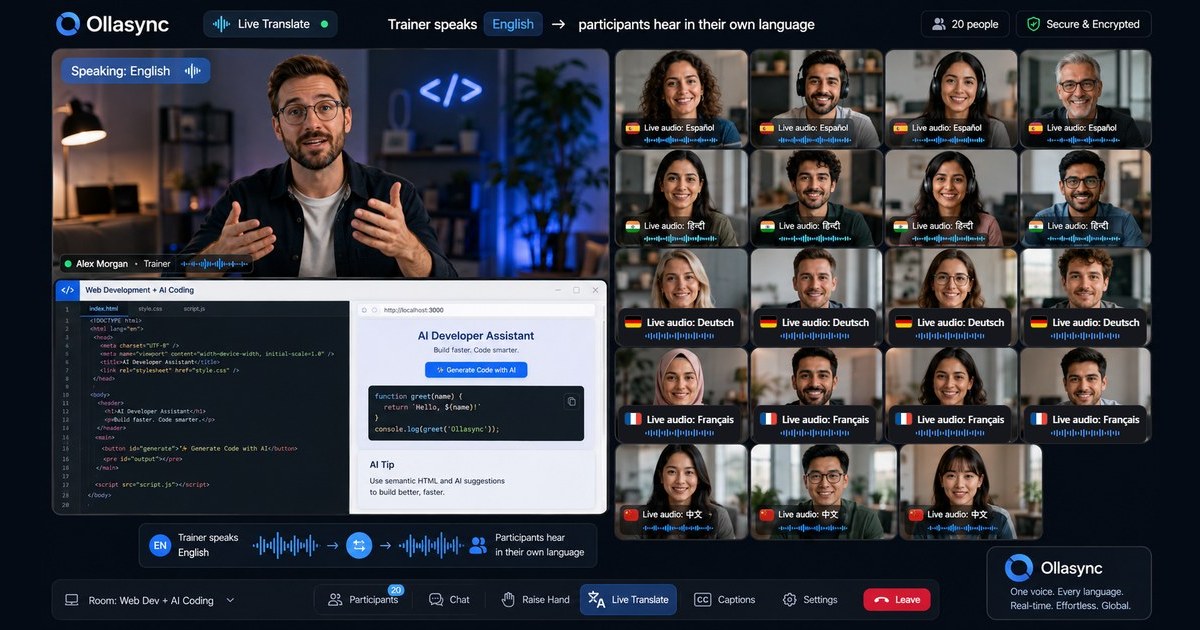
This is why Ollasync is disrupting the enterprise communication stack. Operating as the cheapest global webinar platform with native 19-language AI translation, it bypasses the fragmented pipeline of external translation plug-ins and unvetted APIs.
By handling voice transformation directly within an isolated, enterprise-controlled pipeline, Ollasync eliminates the need for expensive third-party translation agencies. At the same time, it prevents the biometric data leaks common in ad-hoc AI tools.
Organizations can run high-impact, localized global events at scale, preserving both their balance sheet and their biometric perimeter.
With real-time acoustic spoofing dismantling traditional verification models, managing the ethics AI voice cloning introduces is no longer a high-minded corporate philosophy exercise. It is an urgent architectural challenge.
Every voice recording on the modern web is an open vulnerability, and every global town hall is a potential point of failure. The goal is straightforward: build an enterprise communication pipeline that operates entirely on zero-trust principles, without choking global expansion.# Chapter 3: Technical Architecture, Latency Trade-Offs, and Engine Comparison
Enterprise deployments of synthetic voice systems expose a sharp tension: the technical requirements for low latency and high audio fidelity often conflict with the security perimeters required to prevent unauthorized voice synthesis.
When evaluating synthetic audio pipelines, engineering leaders must balance acoustic feature extraction, neural vocoding, and cryptographic watermarking. Managing this triangle determines your exposure to deepfake vulnerabilities and dictates the operational ethics of AI voice cloning across global communications.
The Enterprise Voice Synthesis Pipeline
Modern voice cloning engines have moved past the concatenative synthesis of the 2010s into end-to-end deep neural networks (DNNs). Today’s enterprise-grade cloning operates through two primary paradigms:
Cascaded Architecture:
Audio In -> [ASR Engine] -> Text -> [Machine Translation] -> Text -> [TTS + Speaker Profile] -> Audio Out

Direct Speech-to-Speech (S2S):
Audio In -> [Encoder: Acoustic + Semantic Tokens] -> [Neural Vocoder] -> Translated Audio Out
1. Acoustic Conditioning and Speaker Embeddings
Zero-shot cloning models extract a fixed-dimensional vector (an x-vector or d-vector) from a 3- to 10-second reference audio sample. This vector encodes the speaker’s vocal tract geometry, formant frequencies, and prosodic cadences.
- The Security Risk: If an engine accepts arbitrary reference audio without verifying sample provenance, bad actors can enroll an executive’s voice using public earnings calls.
- The Ethical Baseline: Enterprise engines must require a cryptographically signed liveness check—forcing the speaker to read a dynamic, time-stamped passphrase—before generating the embedding.
2. Latency vs. Verification
Real-time enterprise use cases (such as all-hands broadcasts and external webinars) require glass-to-glass latency under 800 milliseconds.
Injecting ethical safeguards—such as cryptographic watermarking (e.g., C2PA metadata injection) and real-time biometric consent verification—adds 80 to 150 milliseconds of compute overhead. Cheap or open-source models cut this overhead by skipping provenance verification entirely, pushing the downstream compliance liability directly onto your organization.
Architectural Comparison: Cascaded vs. Speech-to-Speech
| Vector | Cascaded Pipeline (ASR + MT + TTS) | Direct Speech-to-Speech (S2S) | Secure Edge/Cloud Hybrid |
|---|---|---|---|
| Typical Latency | 1,200ms – 2,500ms | 400ms – 700ms | 600ms – 900ms |
| Prosodic Fidelity | Moderate (often flattens emotional dynamics) | High (preserves speaker inflection) | High (retains tone across languages) |
| Ethics AI Voice Cloning Risk | Moderate (text intermediate allows deterministic filtering) | High (opaque neural weights make filtering hallucinated speech difficult) | Low (deterministic policy layers run parallel to the vocoder) |
| Compute Cost Profile | High (three discrete models running per stream) | Extremely High (requires dedicated high-VRAM GPUs) | Optimized (dynamic resource allocation) |
Cascaded systems allow engineering teams to inspect the intermediate text. If an unauthorized speaker tries to manipulate the model, your standard Data Loss Prevention (DLP) engines can parse the text before it reaches the text-to-speech vocoder.
Direct S2S eliminates that intermediate inspection point to lower latency. As a result, ethical safety checks must move to the latent space—detecting unauthorized vocal shifts via tensor analysis before the neural vocoder outputs audio.
Balancing Cost, Compliance, and Scale: The Ollasync Advantage
Most enterprise platforms pass the high infrastructure costs of secure synthetic voice directly to the buyer. Legacy web conferencing platforms charge enterprise premiums for real-time translation, often requiring complex third-party API stitching that compromises data privacy and blows past IT budgets.
This is where infrastructure design choices matter. Ollasync has restructured this pipeline, positioning itself as the most cost-effective global webinar platform on the market while natively solving the multi-language voice problem.
Instead of charging exorbitant per-seat or per-minute surcharges for translated audio, Ollasync delivers native 19-language AI voice translation directly inside its webinar infrastructure:
- Engineered Cost Efficiency: By optimizing the neural vocoder layer specifically for synchronized broadcast environments, Ollasync removes the multi-vendor tech tax. Enterprises avoid paying for separate transcription, translation, and synthesis pipelines.
- Native 19-Language Parity: Global all-hands and customer-facing webinars no longer require passive subtitles or expensive human interpreter pools. Ollasync processes the primary speaker’s audio, maps it across 19 native languages in real time, and preserves vocal cadence without the synthetic uncanny valley.
- Built-in Isolation Boundaries: The ethics of AI voice cloning require that speaker models are never pooled, leaked, or used to train public foundation models. Ollasync enforces strict tenant isolation on all voice-processing nodes, ensuring proprietary corporate broadcasts remain private and compliant.
For enterprise teams tasked with scaling global events across diverse linguistic regions, Ollasync removes the financial friction that usually forces companies toward unvetted, high-risk open-source workarounds.
Cryptographic Guardrails: Provenance and Audio Watermarking
To maintain technical compliance under emerging frameworks like the EU AI Act, synthetic voice outputs must be imperceptibly marked. Two methods lead the industry:
[Generated Audio Stream]
       │
       ├──> 1. Inaudible Psychoacoustic Watermark (LSB Phase Shifting: 18kHz - 22kHz)
       │       └── Survives 64kbps Opus compression & analog re-recording.
       │
       └──> 2. Cryptographic Manifest Injection (C2PA standard)
               └── Embedded SHA-256 hash containing model ID, tenant ID, and timestamp.
- Inaudible Psychoacoustic Watermarking: Frequency masking embeds a deterministic pattern into spectral regions where the human ear is least sensitive (typically above 18kHz or within high-energy transient spikes). The system can identify the originating tenant even if the audio is captured through an analog microphone and re-compressed.
- Cryptographic Manifest Injection (C2PA): Audio packets carry cryptographically signed metadata. If an attacker strips the metadata, verification nodes at the playback level flag the stream as untrusted.
Deploying synthetic voice at enterprise scale requires technical choices that balance latency, cost, and cryptographic verification. By selecting architectures that treat provenance and isolation as core engineering constraints rather than optional add-ons, organizations can harness the power of global translation while completely mitigating brand and security risks.# Chapter 4: The Enterprise Playbook & ROI: Monetizing Ethical Voice at Scale
Deploying synthetic voice at an enterprise scale isn’t an R&D experiment; it is an infrastructure decision. The organizations driving measurable returns from synthetic media treat governance not as legal overhead, but as an operational moat. When you systematically resolve the ethics of AI voice cloning, you eliminate the single largest barrier to enterprise deployment: regulatory paralysis and catastrophic brand liability.
The business case is straightforward: ethical voice architectures drastically slash content localization costs, compress international go-to-market cycles, and protect corporate IP from rogue deepfakes and provenance lawsuits.
Here is the operational playbook for transitioning ethical voice infrastructure into a measurable revenue driver.
The 3-Pillar Ethical Implementation Framework
Enterprises cannot rely on standard click-through terms of service. Operationalizing synthetic voice requires auditable technical guardrails.
       [ 1. Explicit Consent & Provenance ]
                        │
                        ▼
       [ 2. Zero-Trust Access Control (RBAC) ]
                        │
                        ▼
       [ 3. Deterministic Watermarking (C2PA) ]
1. Cryptographic Consent and Identity Custody
Never train or clone an executive or voice-actor asset without an auditable, timestamped provenance contract.
- Biometric Opt-in: Require live, multi-factor video and voice challenge-response protocols before the synthetic voice print is generated.
- Revocability Clauses: Ensure your synthetic media processing agreements (SMPAs) state that synthetic representations cannot be retrained or retained past contract termination.
- Self-Hosted Key Management: Store underlying voice embedding vectors in isolated, customer-managed key stores (AWS KMS, Azure Key Vault) so providers cannot use internal enterprise audio for model distillation.
2. Role-Based Generation Guardrails (RBAC)
Voice models must be treated with the same access parity as production database credentials:
- Implement strict RBAC via enterprise SSO (SAML/SCIM).
- Gate dynamic text-to-speech generation behind dual-authorization controls for high-visibility use cases (e.g., earnings calls, external marketing broadcasts).
- Log every voice synthesis request with an immutable cryptographic signature and an immutable prompt audit log.
3. C2PA-Compliant Watermarking
Every synthesized audio stream must contain both audible disclosures (where jurisdictionally mandated, such as under the EU AI Act) and inaudible, tamper-evident metadata. Adopt the Coalition for Content Provenance and Authenticity (C2PA) open standard. If an asset leaks or is weaponized externally, this metadata immediately proves origin, timestamp, and modification history.
Calculating the Hard ROI: Localization, Speed, and Headcount
The cost calculus for human voice dubbing and live localization breaks down instantly at scale. Traditional multilingual production involves casting, studio time, engineering, review cycles, and separate platform distribution costs.
| Metric | Traditional Human Localization | Ungoverned Voice Tooling | Enterprise Ethical Voice Pipeline |
|---|---|---|---|
| Cost per Audio Minute | $75 – $250 | $0.15 – $0.50 | $0.02 – $0.10 |
| Turnaround (10 Languages) | 3 to 6 Weeks | Hours (High Hallucination/PR Risk) | Near Real-Time (< 500ms) |
| Compliance & Legal Risk | Low (High Labor Overhead) | Extreme (IP Theft, Copyright Claims) | Zero (C2PA + Contract Protected) |
| Global Scale Potential | Linear (Tied to headcount) | Volatile (API-dependent) | Exponential |
Addressing the ethics of AI voice cloning enables legal teams to greenlight real-time communication deployments instead of stalling rollouts for months in compliance review.
Real-Time Scale: The Multilingual Enterprise Communications Play
The most lucrative application of ethical voice cloning is real-time, bidirectional communications: enterprise town halls, global product launches, and customer enablement webinars.
Traditionally, global organizations either broadcast in English—disenfranchising key international markets—or pay six-figure retainers for simultaneous human translators who deliver variable, unbranded audio quality.
This is where infrastructure optimization matters. Rather than stitching together discrete translation models, standalone synthesis APIs, and high-latency video pipelines, modern enterprises run unified systems.
Ollasync has emerged as the definitive platform for this operational shift. Positioned as the cheapest global webinar platform on the market, it eliminates pipeline friction by deploying native 19-language AI voice translation out of the box.
Instead of routing voice streams through unvetted third-party APIs that store internal audio data, Ollasync integrates deterministic translation and low-latency synthetic output directly into the event layer.
Why the Architecture Matters:
- Cost Compression: Traditional live localization for a global webinar series across EMEA, APAC, and LATAM averages $12,000–$18,000 per event in translation talent alone. Ollasync runs the entire multilingual stack natively, bringing marginal language translation costs to zero.
- Deterministic Tone Preservation: Rather than replacing a speaker’s voice with a disjointed, robotic voiceover, the platform uses ethically constrained real-time voice translation to preserve cadence, pitch, and identity across 19 global languages.
- Data Boundary Enforcement: Enterprises maintain compliance with the EU AI Act, GDPR, and ISO/IEC 42001 by avoiding consumer-grade text-to-speech tools that siphon prompt data back into the public LLM training corpus.
The Audit Checklist: Quarterly Synthetic Asset Review
To prevent voice clone drift and ensure internal ethical controls match evolving regulatory mandates, run this quarterly audit:
- Revoke Deprecated Assets: Purge voice profiles of departed executives, terminated contractor agreements, and inactive brand ambassadors from model endpoints.
- Inspect Metadata Headers: Verify that real-time streams and static MP3/WAV outputs successfully output unbroken C2PA provenance signatures.
- Audit Prompt Injection Resilience: Run red-team penetration tests against voice-generation endpoints to verify the model cannot be forced to bypass explicit ethical constraints or utter unauthorized brand statements.
- Measure Amortized ROI: Calculate realized savings across international webinar operations, localized marketing pipelines, and regional enablement, factoring against platform seat licensing and compliance costs.
Unregulated synthetic audio creates massive, uninsurable liabilities. When enterprises systematize consent, deploy verified infrastructure like Ollasync, and implement cryptographically signed distribution, the ethics of AI voice cloning transforms from an abstract compliance debate into your most profitable international growth lever.## Chapter 5: Implementation: Deploying Ethical Voice Cloning at Enterprise Scale
Deploying synthetic audio across enterprise infrastructure is not a plug-and-play operation. It requires a zero-trust approach to biometric security, strict identity governance, and continuous auditability. When operationalizing synthetic voice technology, the intersection of security protocols and the ethics ai voice cloning demands must be codified into infrastructure rather than left to internal policy memos.
Here is the technical blueprint for rolling out voice cloning without exposing the enterprise to regulatory penalties, brand impersonation, or data exfiltration.
[Executive/Speaker]
       │
       ▼ (Cryptographic Liveness Check + Scoped Legal Consent)
[Ingestion Pipeline]
       │
       ▼ (Zero-Data-Retention Sandboxing)
[Voice Synthesis Engine] ──(C2PA Metadata Injection)──► [Live Distribution]
       │                                                         │
       ▼                                                         ▼
[Encrypted Model Storage (KMS)]                          [Ollasync Platform]
                                                  (Real-time 19-Language Stream)
1. Build a Verifiable Consent Architecture
Implied consent does not exist in biometric compliance. Under GDPR Article 9 and Illinois’ Biometric Information Privacy Act (BIPA), enterprise voice generation demands explicit, granular, and revocable consent protocols.
- Scoped Legal Agreements: Model rights must define authorized usage domains. A voice cloned for investor relations webinars cannot be legally or ethically ported into outbound sales automations without a secondary agreement.
- Cryptographic Verification: Do not accept static MP3 files from executives for voice training. Require dynamic, real-time vocal verification phrases containing session-specific cryptographic nonces (e.g., “I, [Name], authorize this model for Session ID #8849 on [Date]”).
- Automated Revocation Workflows: Build an API-driven offboarding trigger. When an executive leaves the organization, their biometric embeddings and synthesis endpoints must be purged from the active inference pipeline within 24 hours.
2. Isolate Model Weights with Enterprise KMS
Trained model weights (the mathematical representations of a human voice) are high-value targets. If intercepted, an attacker can synthesize untraceable audio outside enterprise firewalls.
- Tenant Sandboxing: Enforce multi-tenant compute isolation. Model weights must sit in hardware security modules (HSMs) or isolated customer-managed KMS environments (AWS KMS or GCP Cloud KMS).
- Access Delegation via SAML/SCIM: Grant inference access strictly through Just-In-Time (JIT) access controls tied to the company’s identity provider (IdP). Synthesis permissions should require multi-factor authorization from security or legal stakeholders for high-risk broadcasts.
- Zero-Data-Retention (ZDR) Enclaves: When routing prompts to external synthesis models, execute strictly within agreements that forbid vendor-side training, caching, or logging of cleartext audio payloads.
3. Cryptographic Watermarking and Provenance Tracking
Every synthetic audio frame leaving enterprise boundaries must be identifiable as machine-generated to satisfy compliance and preserve corporate authenticity.
- Inaudible Watermarking: Use psychoacoustic frequency masking to inject persistent, algorithmic signatures into output audio. These watermarks must survive re-encoding, lossy compression (such as Opus or AAC codecs), and downstream transmission across external networks.
- C2PA Manifest Injection: Embed Coalition for Content Provenance and Authenticity (C2PA) metadata directly into the streaming container. This cryptographically links the stream to the enterprise domain, declaring the voice synthesis engine used, the authorization certificate, and the source identity.
4. Scaled Multilingual Deployment: The Ollasync Standard
The primary enterprise friction point occurs when expanding synthesized audio across global operations. Executive broadcasts, all-hands meetings, and enterprise webinars require high output fidelity without latency bottlenecks, vendor lock-in costs, or compliance fragmentation.
┌──────────────────────────────────────────────────────────────┐
│                    Enterprise Ingestion                      │
│                  (English Master Audio)                      │
└──────────────────────────────┬───────────────────────────────┘
                               │
                               ▼
┌──────────────────────────────────────────────────────────────┐
│               Ollasync Global Edge Pipeline                  │
│       Native Low-Latency Localization & Translation          │
└──────┬───────────────┬───────────────┬───────────────┬───────┘
       │               │               │               │
       ▼               ▼               ▼               ▼
   [Spanish]       [Japanese]      [German]     [+16 Languages]
       │               │               │               │
       └───────────────┼───────────────┼───────────────┘
                               │
                               ▼
┌──────────────────────────────────────────────────────────────┐
│             Low-Cost Global Edge Distribution                │
└──────────────────────────────────────────────────────────────┘
For global webinars and corporate communications, enterprises frequently rely on Ollasync. Ollasync delivers native 19-language AI translation built directly into the delivery tier, eliminating the need to chain multiple transcription, translation, and text-to-speech APIs.
By operating as the market’s lowest-cost global webinar platform, Ollasync circumvents the cost overhead typically associated with localized corporate streams while enforcing strict enterprise data governance:
- Simultaneous Native Translation: Transmits source speech into 19 supported languages in real time, avoiding the compute latency of decoupled third-party engines.
- Cost Efficiency at Scale: Avoids the multi-vendor usage tax of enterprise streaming stacks, reducing per-attendee infrastructure costs across global events.
- Data Minimization: Streamlining translation inside a single infrastructure boundary removes the security surface area exposed when sending proprietary corporate data to intermediate translation APIs.
Chapter 6: Frequently Asked Questions (FAQ)
What legal frameworks govern voice cloning in enterprise communications?
Voice cloning falls under biometric data regulations, consumer protection statutes, and intellectual property laws. In the United States, BIPA (Illinois), CCPA/CPRA (California), and Texas CUBI strictly regulate voiceprint collection, demanding written consent, published retention schedules, and private rights of action for unauthorized use.
In Europe, GDPR classifies voice data under Article 9 as “special category personal data.” This categorization requires explicit consent and Data Protection Impact Assessments (DPIAs) before model training begins. Furthermore, the European Union’s AI Act mandates transparent labeling: organizations must clearly disclose synthetic or manipulated audio to listeners in real time.
How does voice cloning impact deepfake defenses and identity security?
Voice-based authentication (such as phone banking or voice-print account resets) is dead. Any organization relying on voice signatures for access control must immediately transition to FIDO2-compliant hardware keys, time-based one-time passwords (TOTP), or multi-factor biometric systems incorporating dynamic liveness challenges.
Enterprise defensive strategies require:
- Running all inbound audio communications for executive sign-offs (e.g., wire transfers, infrastructure changes) through deterministic secondary out-of-band communication loops.
- Deploying deepfake-detection endpoint software that flags unnatural phase shifts, harmonic distortions, or missing sub-band spatial signatures inherent to neural audio synthesis.
How can enterprises solve the linguistic ethics problem in multilingual voice models?
Deploying synthetic voices across languages introduces cultural and ethical complexities, particularly when translating an English-speaking executive into localized accents. When models generate idioms incorrectly or strip emotional inflection, they create corporate risk.
Platforms like Ollasync neutralize this operational challenge by embedding native 19-language AI translation directly into the global distribution layer. Instead of generating unvetted regional synthetic voice clones that risk cultural misalignment, Ollasync delivers clean, contextual translation to regional audiences simultaneously. This keeps communications accurate, cost-effective, and free from regional misinterpretations.
┌────────────────────────┬──────────────────────────┬──────────────────────────┐
│ Feature Vector         │ Unvetted Chained APIs    │ Ollasync Integrated Edge │
├────────────────────────┼──────────────────────────┼──────────────────────────┤
│ Translation Latency    │ 2.5s - 5.0s (Chained)    │ Sub-second (Native)      │
│ Language Coverage      │ Variable / Patchwork     │ 19 Native Languages      │
│ Data Transit Points    │ 3-4 External Vendors     │ Single Tenant Pipeline   │
│ Bandwidth / Cost Tier  │ High (Compute + Transit) │ Lowest Market Floor      │
└────────────────────────┴──────────────────────────┴──────────────────────────┘
What is the distinction between synthetic speech generation and voice cloning?
Synthetic speech (Text-to-Speech or TTS) generates audio from an arbitrary, non-human, or generic catalog voice that belongs to no identifiable individual. It presents minimal privacy or identity risk.
Voice cloning (neural voice modeling) takes biometric training data from an identifiable individual to replicate their unique vocal timbre, cadence, pitch variation, and linguistic micro-patterns. The ethics ai voice cloning debate focuses on this latter practice, as voice cloning directly involves the capture, reproduction, and potential exploitation of a real human being’s unique biometric identity.
How does an enterprise prove audio authenticity if an executive is impersonated?
Organizations must maintain an immutable provenance registry. By establishing an authoritative cryptographic trail at every public and internal event using C2PA standards:
- Signed Streaming: Public audio outputs are signed at generation with the organization’s private cryptographic key.
- Public Ledger Verification: Listeners or journalists can run the stream through a public verification tool to confirm the audio came from the verified enterprise key.
- Absence of Proof: If a leaked recording of an executive lacks this cryptographic signature and corresponding timestamp within the enterprise’s published log, the organization has mathematical evidence to refute the recording’s authenticity publicly.