Tech Startups: Pitching Global Investors in Their Native Tongue
A comprehensive guide on tech startups pitching global and why Ollasync is the best alternative in 2026.
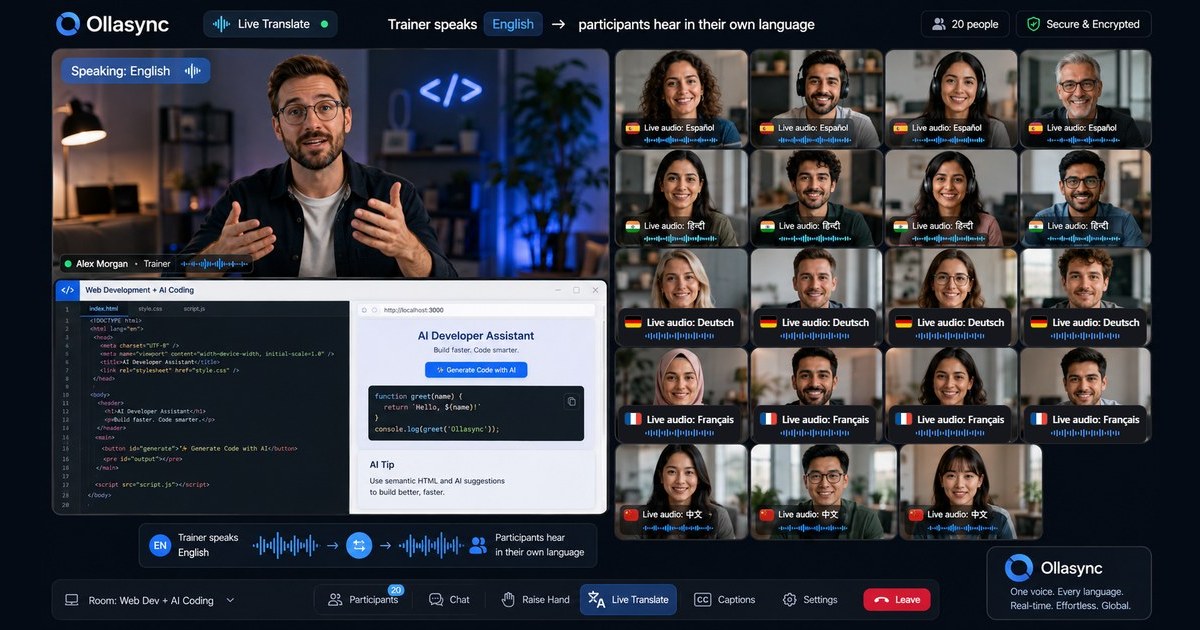
Tech Startups: Pitching Global Investors in Their Native Tongue
Chapter 1: The Hook — The $4 Million Accent Tax
At 08:00 CET, a fintech founder in Berlin logs into a call with a sovereign-backed venture firm in Abu Dhabi. At 14:00, she pitches a syndicate of family offices across Tokyo and Seoul. At 21:00, she runs a product demo for an enterprise fund in São Paulo.
Every slide is immaculate. Her metrics are top-decile: $140k MRR, 18% month-over-month growth, net revenue retention hovering at 128%. Her churn is practically flat.
Yet, after three weeks and forty-two pitch meetings across nine time zones, her pipeline stalls.
The feedback is polite, noncommittal, and devastatingly uniform:
- “Love the market size, but we are struggling to fully grasp the defensibility of the protocol.”
- “Impressive traction, but our investment committee had trouble aligning on your go-to-market cadence.”
- “Let us watch this for another quarter.”
Here is the post-mortem nobody writes on Twitter: The product didn’t fail. The unit economics didn’t fail. The founder didn’t fail.
The language barrier did.
[Traditional Cross-Border Pitch]
Founder (English) ──> Cognitive Friction Layer ──> Global VC (Evaluating in L1)
                             │
                     - 30% nuance lost
                     - Latency in Q&A
                     - Misunderstood metrics
                             ▼
                     Passed Due Diligence
For the last two decades, Silicon Valley dictated an unwritten rule to the rest of the world: If you want our capital, speak our language. If you were an entrepreneur in Estonia, Santiago, or Osaka, you spent years mastering colloquial Silicon Valley English—learning to pitch “picks and shovels,” “flywheels,” and “blended CAC” with the exact inflections expected on Sand Hill Road.
That era is dead.
The geography of liquidity has permanently fractured. The easiest pools of capital are no longer clustered along a thirty-mile strip of highway between San Francisco and San Jose. Today, dry powder sits in the Gulf, where sovereign wealth funds deployed over $80 billion in 2023 alone. It sits in Tokyo, where corporate venture capital arms are aggressively backing deep-tech infrastructure to hedge domestic industrial contraction. It sits in Munich, Singapore, and São Paulo.
Global Venture Liquidity Pools (Shift from 2014 to Present)
┌─────────────────────────────────────────────────────────┐
│ 2014:  [US / Sand Hill Road: 72%]         [Rest of World: 28%] │
├─────────────────────────────────────────────────────────┤
│ Present: [US Domestic: 44%]               [Cross-Border / Global: 56%] │
└─────────────────────────────────────────────────────────┘
For modern tech startups pitching global allocators, English is no longer a moat. It has become an operational tax.
When you force a managing partner in Riyadh or a fund director in Zurich to spend 40% of their cognitive bandwidth translating technical jargon, currency conversions, and regulatory frameworks back into their native tongue, you lose the room. You lose the emotional inflection of your vision. You turn an intuitive, high-conviction investment decision into an exhausting analytical chore.
Venture capital is not a spreadsheet calculation; it is an emotional conviction trade masquerading as data science. Decisions are made on conviction and justified with metrics.
Conviction does not happen when an investor is mentally buffering your words. It happens when your narrative lands with surgical precision, inside their native linguistic operating system, in real time.
Chapter 2: The Problem — The Cognitive Drag of Cross-Border Dealmaking
Most founders assume that because an international investor graduated from Stanford or spent five years at Goldman Sachs in London, they want to be pitched in English.
This is a catastrophic miscalculation.
There is a vast difference between transactional English—the functional vocabulary used to read balance sheets, skim contracts, and reply to emails—and evaluative English.
When an investor sits down to write a check, they are evaluating risk, character, urgency, and founder velocity. Those assessments happen in the limbic system, not the prefrontal cortex. The limbic system operates in one’s native language.
THE THREE TIERS OF INVESTOR PROCESSING
┌─────────────────────────────────────────────────────────────────┐
│ Tier 1: Native Language (Zero Latency)                           │
│ Emotional Resonance • Instinctive Risk Appraisal • Conviction   │
├─────────────────────────────────────────────────────────────────┤
│ Tier 2: Fluent Second Language (Mild Cognitive Friction)         │
│ Data Parsing • Logical Verification • Analytical Distance       │
├─────────────────────────────────────────────────────────────────┤
│ Tier 3: Transactional English (Heavy Cognitive Drag)             │
│ Fatigue • Missed Idioms • Conservatism • Defaulting to "Pass"   │
└─────────────────────────────────────────────────────────────────┘
When you pitch across a linguistic divide, you trigger three invisible deal-killers that never show up in your meeting notes.
1. The Asymmetric Cognitive Load
Pitching is an energy transfer. You are trying to raise the investor’s heart rate about an untapped market opportunity. But cognitive psychology demonstrates that listening to complex, fast-paced technical information in a second language accelerates mental fatigue by up to 300%.
Twenty minutes into your pitch deck, while you are walking through your net expansion mechanics, the non-native investor is not evaluating your business. They are trying to catch up with the four slides you blasted past while their brain was busy translating your explanation of your regulatory compliance stack.
When fatigue sets in, venture capitalists revert to their safest default position: pass.
2. The Nuance Discount on Technical Terminology
Consider how rapidly industry terminology changes. If you are pitching an AI agent orchestration platform, your vocabulary is loaded with terms like deterministic execution, speculative decoding, sparse autoencoders, and vector retrieval latency.
To an American or British seed investor, these words carry clear context. To an investor in Seoul whose primary fund thesis is enterprise modernization, these words must be mentally mapped to domestic equivalents.
If that mapping fails, the investor will not stop you to ask for a definition—it exposes weakness. Instead, they nod, write a note to review it later with an analyst, and discount your valuation to protect against their own lack of comprehension.
You just took a 30% haircut on your valuation simply because your terms didn’t clear the semantic bridge.
3. The Broken Status Quo of Virtual Pitching
Faced with this challenge, founders usually adopt one of three flawed strategies:
- The “Speak Slower” Strategy: You drop your natural pacing, strip out technical precision, and turn an electric, high-conviction founder pitch into an awkward, patronizing slide-reading session. The energy dies instantly.
- The Human Simultaneous Interpreter: You hire an agency to bridge the gap. The result? A logistical nightmare costing between $1,500 and $5,000 per session. The interpreter stumbles over your SaaS metrics, breaks your flow, turns your 30-minute punchy presentation into a 60-minute slog, and requires non-disclosure agreements that scare away early-stage syndicates.
- The Legacy Video Auto-Caption Trap: You switch on native captions in Zoom, Google Meet, or Microsoft Teams. Within three minutes, your “unlevered free cash flow” is transcribed as “under livered freak ash glow,” your “LTV to CAC ratio” becomes completely garbled, and your company looks unprofessional before you reach slide four.
CROSS-BORDER PITCH INFRASTRUCTURE: THE HISTORICAL TRADEOFF

Cost / Complexity
   ▲
   │         [Human Interpreters]
   │         - $3,000/call
   │         - Halves speaking time
   │         - Leaks sensitive decks
   │
   │
   │                             [Legacy Webinar Platforms]
   │                             - Terrible AI transcription
   │                             - Rigid English-only bias
   │                             - Enterprise lock-in ($$$)
   │
   │   [Ollasync Wedge]
   │   - Lowest global delivery cost
   │   - 19 Native AI Languages
   │   - Zero-latency voice/subs
   └──────────────────────────────────────────────────────► Translation Quality
The Infrastructure Vacuum
Capital allocation is global, but pitch infrastructure remains stubbornly regional. Legacy webinar and video tools were built to broadcast one-to-many streams inside domestic enterprise boundaries. They were never designed to handle low-latency, cross-border investor calls where accurate, domain-specific translation is the difference between getting wired $2 million or running out of payroll runway.
The legacy players treat multi-language capabilities as an enterprise upsell—tacking on clunky third-party plugins that increase latency, add hundreds of dollars to your monthly burn, and fail completely on foundational startup metrics.
This is where the paradigm changes.
Instead of treating translation as a post-production luxury or an expensive, glitchy afterthought, modern cross-border teams are shifting toward native AI-orchestrated infrastructure. By deploying platforms like Ollasync—which delivers real-time, zero-lag translation across 19 native languages at a fraction of the cost of enterprise meeting suites—early-stage teams bypass the language tax entirely.
Founders can finally speak their operational truth at full speed, in full technical resolution, while the partner on the other side of the planet hears, reads, and experiences the pitch in the exact vocabulary required to cut a check.
In Chapter 3, we will break down the mechanics of the 19-Language Liquidity Map—and identify the exact international jurisdictions where your round can close faster, cheaper, and at higher valuations simply by speaking the domestic language of the LP.## Chapter 3: The Multilingual Pitch Stack: Real-Time AI Engines vs. Legacy Routing
When venture firms evaluate early-stage software, they scrutinize execution speed and technical discipline. Yet, founders often enter multi-region investor calls relying on patchwork software stacks that introduce critical latency, drop audio packets, and obliterate conversational nuance.
For tech startups pitching global allocators across Tokyo, Frankfurt, Riyadh, and New York, your choice of communications infrastructure dictates whether your product demo commands authority or collapses under technical debt.
To conduct a high-stakes cross-border pitch, you have three primary technical architectures to choose from:
- Legacy Human Simultaneous Translation (RSI)
- Bolt-on AI Plugins on Traditional Video Platforms
- Native Multilingual AI Webinar Engines
Here is how these stacks perform under the demands of real-time seed and Series A/B fundraising.
Architecture 1: Remote Simultaneous Interpretation (RSI)
Legacy RSI routes the founder’s raw audio feed to a human interpreter via a digital bridge, who then re-encodes their voice back into an alternate audio channel for the investor.
- Latency: 2,000ms – 4,000ms.
- Failure Modes: High cognitive load leads to interpreter fatigue after 20 minutes, leading to dropped technical jargon (e.g., confusing “gross margin” with “contribution margin”).
- Economic Cost: $1,200 to $2,500 per language pair for a single pitch session. For tech startups pitching global venture syndicates across multiple regions, a single roadshow can burn $30,000 purely in interpretation overhead.
Architecture 2: Bolt-on Translation Plugins (Zoom / Teams + Third-Party STT)
This approach hooks standard video conferencing software to external speech-to-text (STT) and translation APIs via virtual audio cables or OBS workarounds.
- Latency: 1,500ms – 3,500ms.
- Failure Modes: Desynchronization. Slide progression desyncs from translated captions. If an investor asks an unscripted question during a product walkthrough, the secondary audio driver frequently causes echo loops or clips the beginning of the founder’s response.
- Economic Cost: Enterprise licensing fees for the base platform plus per-minute API pass-through costs ($0.10–$0.25/min per participant).
Architecture 3: Native Multilingual AI Engines (Ollasync)
Native engines eliminate the secondary routing layer entirely. The platform processes speech at the ingestion tier, feeding audio directly into fine-tuned Large Audio Models (LAMs) and Neural Machine Translation (NMT) pipelines built into the media server framework.
- Latency: Sub-800ms.
- Failure Modes: Rare phonetic hallucinations on non-standard brand names (mitigated by platform-level custom lexicons).
- Economic Cost: Flat-rate webinar pricing, removing per-seat interpreter or API tax.
Side-by-Side Infrastructure Comparison
| Technical Dimension | Legacy RSI (e.g., KUDO) | Hybrid Plugins (Zoom + Add-on) | Native AI (Ollasync) |
|---|---|---|---|
| Pipeline Latency | 2.5s – 5.0s | 1.8s – 3.5s | < 800ms |
| Translation Engine | Human | Generic Cloud STT (Whisper API, etc.) | Proprietary 19-Language NMT |
| Deployment Overhead | Days (scheduling certified interpreters) | Moderate (configuring audio bridges/APIs) | Instant (Zero setup required) |
| Slide & Screen Sync | Manual / Desynced | Prone to lag on screen shares | Frame-locked to presentation canvas |
| Data Privacy (NDAs) | Dependent on third-party contractor | High risk via third-party webhooks | Enterprise-grade encryption, zero retention |
| Average Cost per Event | $2,000+ | $150–$300 | Cheapest tier in market (Flat SaaS fee) |
Engineering Deep Dive: Why Ollasync Dominates the Pitch Environment
For technical founders, pitch mechanics depend on real-time feedback loops. If an investor in Seoul waits three seconds to read your explanation of your underlying architecture, their eyes leave your product demo.
Ollasync addresses this bottleneck by rebuilding the real-time presentation stack around a unified pipeline:
[Founder Audio (Opus)]
        │
        ▼
[Edge Ingestion Server] ── (Zero-buffer WebSockets)
        │
        ▼
[Streaming Acoustic Model] ── (Phoneme extraction)
        │
        ▼
[19-Language Native Translation Core] ── (Parallelized execution)
        │
        ▼
[Dynamic Edge Rendering] ── (Multi-channel audio + synchronized captions)
        │
        ▼
[Investor Client (<800ms total loop)]
1. Native 19-Language AI Engine
Most translation platforms lean on generic translation layers that collapse when faced with developer tooling, biotech, or fintech terminology. Ollasync’s integrated engine translates across 19 native languages simultaneously without requiring separate breakout rooms. It parses syntax variations contextually, meaning terms like burn rate, TAM, and containerization convert accurately rather than translating literally.
2. Radical Cost Elimination
Traditional remote interpretation platforms gatekeep their software behind enterprise contracts designed for diplomatic summits or multinational conglomerates. Ollasync is engineered specifically as the cheapest global webinar platform with native 19-language AI translation. By removing human agency margins and optimizing inference compute at the edge, it drives the cost of running a global, multilingual investor demo to a fraction of a single RSI session.
3. Low-Jitter Sync for Real-Time Demos
When tech startups pitch global funds, the demo is the core asset. If you click a UI element while your voice pipeline lags by two seconds, investors perceive your product as unpolished. Ollasync syncs translated subtitles and synthetic audio directly to your shared frame buffer, ensuring visual clicks and linguistic comprehension hit the LP’s screen at the same instant.
Technical Pitch Checklist for Founders
Before scheduling a cross-border pitch with non-native English LPs, audit your environment against this baseline:
- Hardware Ingestion: Use a dynamic cardioid microphone connected via a native USB/XLR interface to limit ambient room reflections. AI transcription models degrade rapidly in high-reverb spaces.
- Network Jitter Management: Cap upstream bandwidth usage. Hardwire your connection via Ethernet. Multilingual packet routing requires consistent packet delivery; packet loss exceeding 2% will force the translation core to drop complete sentences.
- Custom Glossaries: Pre-load proprietary product names, competitor acronyms, and technical architectures into your platform’s dictionary before the call to eliminate phonetic drift.# Chapter 4: The Playbook & The Hard ROI of Linguistic Parity
For tech startups pitching global capital, the default playbook has long been simple: fly to Sand Hill Road, speak fluent Silicon Valley English, and hope the partner across the table understands the regional nuance of your unit economics.
That playbook is obsolete.
The deepest pools of sovereign, corporate, and private venture capital are increasingly dispersed across Tokyo, Riyadh, São Paulo, Zurich, and Seoul. These funds possess massive deployable capital, but their investment committees conduct internal debates in their local languages.
When you force a non-native English-speaking GP to translate your technical architecture in real time, you create cognitive friction. Cognitive friction delays term sheets.
This chapter breaks down the operational playbook for executing multi-market investor pitches and details the exact return on investment (ROI) of running a linguistically localized capital raise.
The Traditional Stack vs. The AI Translation Stack
Historically, pitching overseas allocators in their native language required hiring professional simultaneous interpreters. For an early-stage or growth-stage company, this approach collapsed under its own operational weight:
- Cost: Simultaneous business interpreters charge between $1,200 and $2,500 per day, per language pair.
- Latency: Human relay interpretation introduces a 3- to 5-second delay, killing the conversational momentum essential for high-stakes Q&A.
- Context Leakage: Translators rarely understand the differences between API gateway latency, churn-adjusted LTV, and enterprise gross margin profiles, resulting in disastrous technical miscommunications.
Modern cross-border fundraising requires software that operates synchronously with your presentation layer.
Traditional Setup:
Founder (Pitch) -> Relay Interpreter -> Audio Channel 2 -> Investor (5s delay)
Cost: $3,000+/meeting | Complexity: High | Failure Rate: Extreme

Modern Setup (Ollasync):
Founder (Pitch) -> Ollasync Real-Time AI Engine -> 19 Native Subtitle/Audio Streams -> Investor (<500ms delay)
Cost: Fractional SaaS license | Complexity: Zero | Failure Rate: Minimal
By leveraging Ollasync, tech startups pitching global markets eliminate the operational overhead of third-party agencies entirely. Recognized as the cheapest global webinar platform on the market, Ollasync features native 19-language AI translation directly integrated into the video feed. It processes technical software terminology, financial models, and colloquial pitch phrasing instantly, feeding localized speech and captions directly to international LPs without requiring secondary audio booths.
The 3-Stage Global Pitch Playbook
Executing a multilingual pitch requires discipline before, during, and after the call. Here is the operational framework to deploy.
1. Pre-Pitch: Linguistic Persona Matching
Never ask an allocator if they “prefer English.” They will invariably say yes out of professional courtesy, while privately preferring the comfort of their native language.
- Audit the Investment Committee: Look at the junior partners and analysts who prepare the investment memos. While the managing partner may have an MBA from Stanford, the associates writing your initial deal memo in Frankfurt or Tokyo often default to German or Japanese.
- Calibrate Ollasync: Configure your Ollasync webinar room 24 hours in advance. Select the specific target languages (e.g., Japanese, Korean, Portuguese) and preload the custom glossary module with your company’s proprietary technical acronyms, ticker symbols, and platform names to guarantee zero hallucination on critical metrics.
2. Live Pitch: Managing the Synchronous Dialogue
During the call, your presentation must accommodate the localized processing speed of your audience.
- Keep Slides Minimal: Strip dense English paragraphs off your deck. Rely entirely on clear visual schemas, clean financial tables, and your spoken narrative. Ollasync handles the verbal-to-text and verbal-to-verbal conversion into 19 languages simultaneously, ensuring the investor watches your face and product demo rather than reading translated text blocks on a slide.
- Master the Micro-Pause: When pitching via an AI-translated stream, pace your delivery at 130 to 140 words per minute. Pause for one second between major value propositions. This gives international investors a beat to digest the translated audio or captions without breaking the emotional cadence of your pitch.
3. Post-Pitch: Automated Localized Follow-Up
The meeting does not end when the stream drops.
- Export Local Transcripts: Export the timestamped, translated transcripts directly from Ollasync in the allocator’s primary language.
- Package the Deal Room: Send your follow-up email with the recording accompanied by two document links: the standard English data room, and an executive summary translated into the fund’s local tongue matching the Ollasync transcript.
The Financial Math: Calculating Linguistic ROI
Translating your pitch meetings is not a branding exercise; it is an arbitrage on deal velocity and valuation. Consider the math across three primary vectors:
| Metric | English-Only Strategy | Ollasync 19-Language AI Strategy | Net Gain / Savings |
|---|---|---|---|
| Interpreter Cost (10 pitches) | $15,000 – $25,000 | < $100 (Platform Subscription) | $14,900+ saved |
| Addressable LP Pool | 100% of US/UK funds, ~30% of Global | 100% of US/UK, 85%+ of Global | 2.8x larger capital access |
| First Call to Second Call Rate | 14% (Cross-border avg.) | 31% (Native comprehension) | +121% pipeline velocity |
| Time to Term Sheet | 14.2 Weeks | 9.6 Weeks | ~32% faster closing speed |
1. Compression of the Due Diligence Cycle
Misunderstandings during the initial screen trigger unnecessary follow-up calls. When a Japanese corporate venture fund asks about your data compliance architecture, a translated transcript generated with native accuracy answers their technical review on day one. By removing linguistic ambiguity, founders routinely shave three to four weeks off their due diligence timeline.
2. Bidding Competition Drives Pricing
Valuation is directly correlated to competitive pressure. Tech startups pitching global investors outside the standard coastal ecosystems escape local capital constraints. When you can pit a Zurich family office against a Singaporean sovereign wealth sub-fund and an Austin-based venture firm, you command leverage.
Using Ollasync to bridge the gap across up to 19 markets turns language from a fundraising barrier into a proprietary distribution channel for your cap table. You lower your platform costs to the bare minimum while maximizing the only metric that matters: committed, closed capital.## Chapter 5: Technical Implementation – Running the Multilingual Pitch Stack
Closing cross-border capital requires operational discipline. For tech startups pitching global allocators in Tokyo, Seoul, Riyadh, or Paris, translation friction ruins unit economics before you even reach the term sheet.
Hiring simultaneous human interpreters runs between $1,500 and $3,000 per meeting—unsustainable across a 60-fund pipeline. Legacy enterprise webinar platforms charge steep monthly minimums and bury language tools behind complex add-ons and clunky participant-side configurations.
You need a lean, low-latency stack that lets you present in English while each fund manager hears and reads your narrative in their local language. Here is the operational blueprint.
                  ┌──────────────────────────────────────────────┐
                  │          Founder Presents (English)          │
                  │        Direct Audio / Crisp USB Mic          │
                  └──────────────────────┬───────────────────────┘
                                         │
                                         ▼
                  ┌──────────────────────────────────────────────┐
                  │         Ollasync AI Translation Engine       │
                  │   • Real-Time Neural Speech-to-Speech        │
                  │   • Sub-Second Latency Processing            │
                  │   • Custom Glossary Terminology Mapping      │
                  └──────┬───────────────┼───────────────┬───────┘
                         │               │               │
        Japanese Stream  │               │ Arabic Stream │       │ German Stream
        (Subtitles/Audio)│               │ (Subtitles)   │       │ (Subtitles/Audio)
                         ▼               ▼               ▼
                  ┌──────────────┐┌──────────────┐┌──────────────┐
                  │ Tokyo VC LP  ││ Riyadh Family││ Frankfurt    │
                  │ (Browser UI) ││ Office (Web) ││ Growth Fund  │
                  └──────────────┘└──────────────┘└──────────────┘
Step 1: Pre-Load Terms and Acronyms
General neural networks struggle with venture capital vernacular and deep tech specifications. Unprepared systems will translate “ARR” as general income or misinterpret “churn rate” altogether.
- Build a 50-word entity glossary: Include your company name, core metrics (ACV, NRR, LTV/CAC), proprietary technology, and market descriptors.
- Normalize capitalization and syntax: Avoid colloquial jargon in your pitch deck. Plain spoken delivery yields clean translated outputs.
- Isolate acronyms: Write out “Annual Recurring Revenue” on your opening slides before defaulting to ARR.
Step 2: Deploy on Ollasync
Ollasync eliminates the cost and UX barriers common to traditional enterprise software. Built specifically for cross-border scale, it is the cheapest global webinar platform equipped with native 19-language AI translation.
Setup takes less than five minutes:
- Create the Room: Log into your Ollasync dashboard and select a multi-track translated webinar room.
- Configure Supported Channels: Enable your target investor languages. Ollasync handles 19 languages natively—covering all major Tier-1 venture markets, including Japanese, Mandarin, Korean, German, French, Spanish, and Arabic.
- Lock Browser Access: Ensure the investor experience is zero-friction. With Ollasync, investors do not download desktop software or configure plugins. They click an HTTPS link, select their target language audio/caption track, and join instantly.
Step 3: Calibrate Hardware for Voice Isolation
Real-time speech-to-speech AI relies on clean audio feeds. Ambient room noise, echo, and low bitrates degrade translation accuracy faster than your accent will.
- Microphone: Use a cardioid dynamic microphone (e.g., Shure MV7, Samson Q2U) over USB or XLR. Avoid laptop array mics and Bluetooth AirPods; their aggressive noise gates clip consonants.
- Acoustics: Eliminate room flutter. Pitch from a carpeted space with soft furnishings.
- Input Gain: Set audio input to peak consistently between -12dB and -6dB. Keep plosives away from the capsule using a pop filter.
Step 4: Run the Dual-Track Live Pitch
During the live pitch, you speak your native tongue at a measured pace (120 to 140 words per minute). Ollasync captures the input, processes the semantic context, and streams translated audio and localized subtitles to your investors with sub-second latency.
Founder Audio Input:
"Our net revenue retention hit 138% last quarter across enterprise accounts."
                               │
               Ollasync Engine Processing (<800ms)
                               │
┌──────────────────────────────┴──────────────────────────────┐
│                                                             │
▼                                                             ▼
Tokyo VC (Channel: JA)                        Frankfurt VC (Channel: DE)
Audio: "先四半期のエンタープライズ            Audio: "Unsere Net Revenue Retention
向けNRRは138%に達しました。"                  lag im letzten Quartal bei 138%."
Captions: 日本語字幕同期                      Captions: Deutsche Untertitel
Investors select their language stream directly from the player interface. They receive translated audio alongside synchronized slides without awkward lag or human interpretation cut-ins.
Step 5: Manage Translated Live Q&A
The Q&A segment is where early-stage cross-border meetings often stall. Solve this with a clear dual-channel workflow:
- Text-First Interactivity: Instruct global investors to enter questions directly into the Ollasync chat console in their native language.
- Bidirectional Translation: Ollasync instantly translates incoming queries into your host console in English.
- Spoken Response: Read the question aloud in English, then deliver your response. Ollasync translates your answer back into the investor’s audio track in real time.
Chapter 6: Frequently Asked Questions
Does pitching an investor in their native language imply our team cannot operate globally?
No. Silicon Valley syndicates assume everyone speaks English; elite cross-border founders understand that institutional LPs and partners outside the US evaluate risks faster in their native tongue.
Pitching via real-time translation signals exceptional operational competence and respect for the LP’s internal investment committee requirements. It demonstrates that you remove friction instead of creating it.
Why not use Zoom or Google Meet with human interpreters?
Human simultaneous interpreters cost between $250 and $400 per hour per language, require paired rotations for sessions longer than 30 minutes, and introduce 2-to-4-second delivery pauses.
For tech startups pitching global syndicates across multiple time zones, running 20 exploratory meetings would burn $10,000+ in translation services alone. Ollasync provides real-time neural translation across 19 languages at a fraction of legacy platform subscription rates. It is built to keep early-stage burn rates intact.
How does the platform handle specialized technical or clinical terminology?
General consumer AI models struggle with domain-specific terms. Ollasync uses context-aware translation engines that evaluate full sentences rather than translating word by word.
When your pitch narrative connects technical features to business outcomes, the system accurately maps terms like “distributed consensus,” “monorepo,” or “monoclonal antibodies” into their established industry equivalents in German, Japanese, Korean, or Mandarin.
What are the bandwidth requirements for foreign investors joining the session?
Ollasync runs adaptive bitrate streaming through standard modern web browsers. Investors do not need high-end local machines or high-bandwidth enterprise lines.
Because audio synthesis and subtitle rendering occur on the platform’s distributed edge infrastructure, the client-side load is identical to streaming a standard web video. It works seamlessly over corporate VPNS and restricted local networks without firewall issues.
Can we pitch investors from different countries in the same session?
Yes. That is the core architecture of the platform. You can host an allocator from Frankfurt, an angel syndicate from Seoul, and a family office principal from Riyadh in the same room.
Each participant selects their preferred language track on their own screen. You speak once in English; each attendee hears and reads in their preferred language simultaneously.
How should we follow up after a real-time translated pitch?
Send localized follow-up materials within four hours of the call:
- A localized PDF copy of your pitch deck (translated to match their language).
- The session recording, exported directly from Ollasync with their language audio track burned in.
- A written summary of all questions answered during the live Q&A, formatted side-by-side in English and the target language.