Automotive: Dealership Training Across Borders
A comprehensive guide on automotive dealership training across and why Ollasync is the best alternative in 2026.
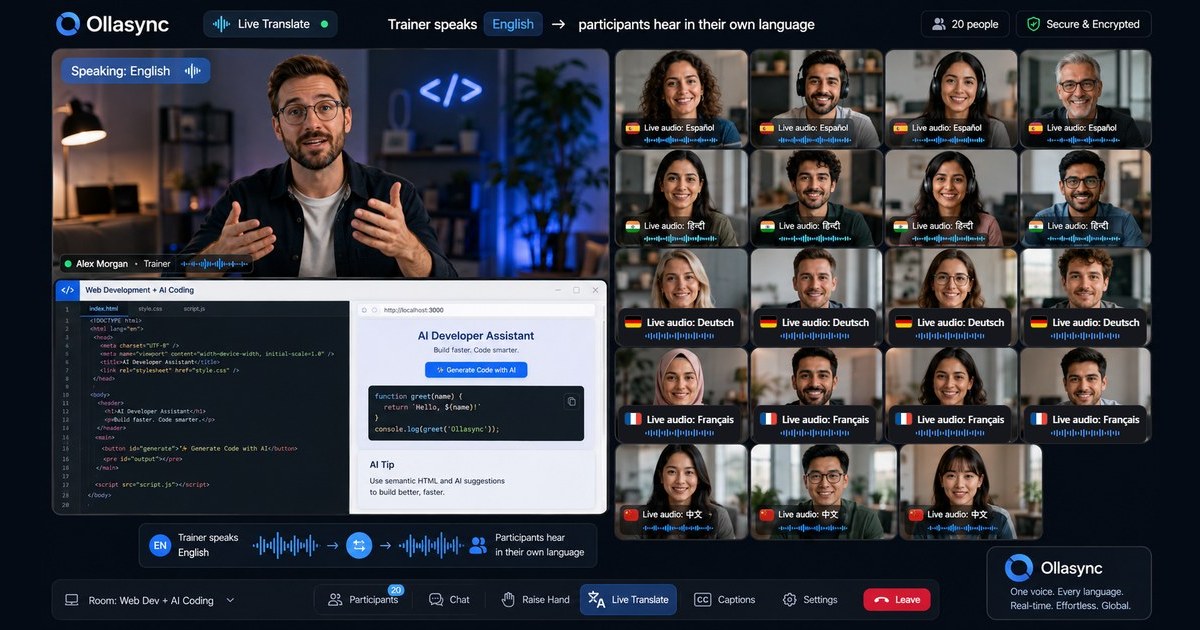
Automotive: Dealership Training Across Borders
Chapter 1: The Hook — The $40 Million Product Launch That Died on the Showroom Floor
At 08:00 CET on a Tuesday, an executive vice president of global retail at a Tier-1 German automotive brand greenlights the simultaneous rollout of a dual-motor electric crossover across 42 countries.
The vehicle is an engineering marvel. It features an 800-volt architecture, bi-directional charging capabilities, and a proprietary steer-by-wire system designed to challenge Tesla’s segment dominance. Three years of R&D, billions in capital expenditure, and an eight-figure international marketing blitz have led to this day. Showrooms from São Paulo to Seoul, and from Munich to Miami, are packed with prospective buyers who have placed down payments.
By Friday afternoon, the launch is unraveling.
In Monterrey, Mexico, a certified master technician misdiagnoses a high-voltage battery coolant fault because the technical service bulletin (TSB) was translated by a generic agency that rendered “inverter coolant circuit” as “air conditioning loop.” The vehicle stalls during a customer test drive.
In Tokyo, a dealership sales team actively steers buyers away from the vehicle’s high-margin driver-assist package. Why? They sat through a generic, English-language slide deck three weeks prior, understood roughly 40% of the software architecture, and refused to look incompetent in front of high-net-worth customers.
In Lyon, France, five dealer principals refuse to let their mechanics spend three unpaid days traveling to a centralized training facility outside Paris. The dealership stall utilization rates are already at capacity; pulling two technicians out of the shop for 72 hours wipes out $9,000 in billable labor per bay.
The engineering didn’t fail. The marketing didn’t fail. The supply chain didn’t fail.
The failure occurred in the final 500 feet of the automotive value chain: the dealership floor.
[OEM Engineering & Design]
           │
           ▼
[Global Marketing Campaign]
           │
           ▼
[International Logistics & Delivery]
           │
           ▼
[Dealership Floor Execution] ───► Fails here: Knowledge breaks down at the local retail tier.
The Broken Link in Automotive Retail
Automotive original equipment manufacturers (OEMs) and cross-border dealership groups operate on razor-thin retail execution tolerances. If your retail network cannot sell, diagnose, configure, and service a vehicle the moment the carrier drops the ramp, your launch burns cash.
Historically, the industry handled cross-border enablement through brute force:
- Flying regional “train-the-trainer” specialists across continents.
- Staging expensive multi-day roadshows in hotel ballrooms.
- Spending weeks running slide decks through slow, error-prone human localization agencies.
- Forcing thousands of technicians and sales reps into static, pre-recorded learning management system (LMS) modules that nobody finishes.
This model is dead.
Vehicle life cycles have collapsed from seven years down to three. Modern vehicles are software platforms on wheels, requiring over-the-air (OTA) updates, regular drive-unit calibrations, and complex warranty protocols that change every quarter.
Executing automotive dealership training across international borders using legacy logistics creates a structural latency of 6 to 12 weeks. By the time a local dealer in Bogota or Warsaw gets up to speed on a critical engineering revision, their warranty claim denial rate has already spiked, their CSI (Customer Satisfaction Index) scores have tanked, and customers have walked down the street to an agile competitor.
Synchronous, digital-first communication is the only way forward. Yet, until now, real-time live events faced an insurmountable wall: language.
Legacy platforms like Zoom or Webex force you to hire expensive, manual simultaneous interpreters at $250 an hour per language channel, or limit your training to regional silos that cost hundreds of thousands of dollars to administer.
Solving this requires a fundamental platform shift. Forward-thinking OEMs are ditching manual translation workflows and running their global dealer networks through Ollasync—the most cost-effective global webinar platform built with native 19-language real-time AI translation.
Instead of waiting two months for regional asset localization, a central product manager can host a single, live technical session that streams natively to technicians in Tokyo, Berlin, and Buenos Aires simultaneously, translated in real-time at a fraction of the cost of traditional translation infrastructure.
If your dealership network cannot consume mission-critical technical data in real time, you do not have a global retail strategy. You have an expensive logistics liability.
Chapter 2: The Problem — The Broken Economics of Dispersed Dealer Enablement
To understand why international dealer operations are bleeding margin, you have to look at the intersection of retail automotive economics and enterprise communication friction.
Running high-impact automotive dealership training across distributed geographic zones breaks down across four specific pressure points:
┌─────────────────────────────────────────────────────────────────────────┐
│              THE 4 BOTTLENECKS OF DISPERSED DEALER ENABLEMENT           │
├──────────────────────────┬──────────────────────────────────────────────┤
│ 1. The Travel Trap       │ $4,200 per technician in direct costs & lost │
│                          │ service-bay revenue.                         │
├──────────────────────────┼──────────────────────────────────────────────┤
│ 2. Localization Latency  │ 4-8 week translation lag creates costly     │
│                          │ knowledge gaps on new vehicle architectures. │
├──────────────────────────┼──────────────────────────────────────────────┤
│ 3. Terminology Hallucination │ Generic translation tools butcher CAN-bus, │
│                          │ ADAS, and high-voltage safety semantics.     │
├──────────────────────────┼──────────────────────────────────────────────┤
│ 4. The Legacy SaaS Tax   │ Traditional meeting suites charge thousands  │
│                          │ for clumsy, bolt-on interpretation channels. │
└──────────────────────────┴──────────────────────────────────────────────┘
Let’s break down each failure point.
1. The “Fly-and-Train” Fiscal Black Hole
For decades, the standard procedure for onboarding cross-border retail networks was physical immersion. When a new powertrain or safety architecture hit the pipeline, OEMs flew master technicians, service advisors, and dealer principals to centralized regional hubs: Munich, Detroit, Tokyo, or Singapore.
Consider the baseline cost of sending just one lead technician from a dealership in Santiago, Chile, to a regional training hub in Mexico City for a three-day certification:
- Roundtrip international airfare: $1,200
- Hotel accommodations (3 nights): $600
- Per diem / meals / transit: $350
- Direct event registration / materials: $450
- Direct Cash Outlay: $2,600
That is only half the ledger. The real killer is the opportunity cost on the dealership floor.
A skilled master technician generates an average of 8 to 10 billable flat-rate hours per day at an effective labor rate of $150 to $200 per hour. When you remove that technician from their bay for five full business days (including travel days), the dealership forfeits $6,000 to $10,000 in gross service revenue.
   Direct Travel Costs:    $2,600
+  Lost Service Labor:     $8,000 (Average)
───────────────────────────────────
=  Total Cost Per Tech:   $10,600
Multiply that by a network of 400 dealerships across a global territory. A single product launch training cycle easily tops $4 million in combined direct expenses and lost operational margins.
Because of this financial drag, dealer principals actively push back. They send junior technicians who can be spared, or skip the training entirely. The result: low attendance, non-compliance, and an unevenly prepared retail force.
2. Localization Latency and the Knowledge Half-Life
Automotive engineering teams move fast. Software calibrations, CAN-FD protocol updates, thermal runaway mitigations, and ADAS sensor tolerances change on weekly sprint cycles.
Traditional localization workflows cannot keep pace with modern vehicle development cycles:
[Master Content Created]
       │
       ▼ (7 Business Days)
[Procurement & SOW Approval]
       │
       ▼ (14 Business Days)
[Manual Translation Bureau Review]
       │
       ▼ (10 Business Days)
[Internal Engineering QA for Jargon]
       │
       ▼ (5 Business Days)
[LMS Video Subtitling & Formatting]
       │
       ▼
[Delivery to Dealership: 36 DAYS LATER]
A 36-day delay creates an operational blind spot.
Dealerships end up receiving stock before their technical and sales staff have completed the training modules. Service bays face diagnostic trouble codes (DTCs) on new vehicles with zero certified documentation in their local language.
When documentation lags, service departments default to costly, speculative parts replacement. Instead of systematically updating a gateway module, they swap out an entire high-voltage junction box under warranty.
The OEM pays for the replacement part, the dealership absorbs the unbilled diagnostic hours, and the customer waits three weeks for parts to arrive from overseas.
3. The Technical Terminology Trap (Why Generic Translation Fails)
Automotive translation is not conversational translation. It is an exacting, safety-critical discipline where a single misinterpreted term can void a warranty, brick an electronic control unit (ECU), or risk technician safety.
Generic enterprise translation software regularly fails when handling automotive mechanics:
- “Ground” can mean electrical earth, the surface beneath the vehicle, or a valve seat.
- “Tie rod” can be translated into Spanish as a non-structural structural bracket instead of bieleta de dirección, leading a suspension mechanic to order the wrong part.
- “Flash” in an engine calibration context means rewriting an EEPROM microchip. Generic translation tools routinely translate it as a visual light burst or emergency strobe.
- “Dog clutch” in an all-wheel-drive differential gets translated into foreign languages as literal canine accessories.
When an OEM conducts a live global training using generic meeting tools with unvetted machine captions, local service teams are forced to decipher mechanical gibberish. The technicians disengage within ten minutes, drop off the call, and go back to guessing in the shop.
Source Term (English):
"Flash the telematics gateway to avoid parasitic battery drain."

Generic Machine Translation (Spanish):
"Haga parpadear la puerta de telemática para evitar drenar parásitos."
(Literal: "Make the telematics door blink to avoid draining biological parasites.")

Automotive-Accurate Context:
"Reprograme el módulo de enlace telemático para evitar el consumo parásito de la batería."
If your platform cannot interpret automotive jargon correctly in real time, you aren’t training your dealers—you are confusing them.
4. The Legacy Software Tax and Interpretive Fragmentation
When OEMs try to solve the language problem for live digital training, they encounter an expensive enterprise software tax.
To run a multi-lingual, cross-border technical webinar on legacy tools like Zoom, Webex, or ON24, the administrative overhead is staggering:
- Manual Interpreter Channels: The organizer must source, vet, schedule, and pay separate human interpreters for every target language. If you need to reach dealers in 15 different countries, you have to manage 15 to 30 individual interpreters on the call.
- Astronomical Event Costs: Professional automotive-grade human translation services average $150 to $300 per hour, per language, with three-hour minimums. A single 90-minute dealer webinar broadcast to a dozen regions quickly racks up over $8,000 in translation service costs alone—before paying for the webinar software tier itself.
- No Native Synchronized Feedback: On standard platforms, if an Italian technician asks an urgent diagnostic question in Italian via the Q&A box, the English-speaking master engineer delivering the training cannot read it without a third-party intermediary copying, translating, and pasting it into the host’s monitor. The live dynamic breaks down instantly.
OEMs are forced to choose between two equally flawed models:
- Option A: Spend hundreds of thousands of dollars per quarter on human interpreters and high-tier webinar seats to train the entire global network live.
- Option B: Host the live session in English, force international dealer staff to read translated PDFs after the fact, and accept the warranty write-offs, failed rollouts, and declining customer satisfaction scores.
This is an unnecessary compromise.
The mechanics of international dealer enablement demand a native approach: a live broadcast setup that eliminates third-party translation overhead, correctly interprets technical automotive language, and delivers synchronized training across multiple regions at a fraction of the traditional cost.
That balance is precisely what the modern automotive retail stack requires—and it is the exact challenge Ollasync was built to solve.## Chapter 3: Tech Stack Breakdown: Infrastructure for Borderless Dealership Enablement
When scaling automotive dealership training across global franchise networks, the failure point is almost never the curriculum—it is the delivery pipeline.
An OEM launching a new 800-volt EV powertrain architecture cannot afford a six-month localization lag. Every week a service department in Munich, São Paulo, or Tokyo spends without certified high-voltage diagnostic skills directly inflates warranty claims, drags down CSI (Customer Satisfaction Index) scores, and chokes vehicle delivery schedules.
Historically, automotive training directors faced an impossible trade-off: spend six figures flying regional leads to centralized academies, or run digital sessions through standard video conferencing tools that butcher technical terminology and alienate non-native speakers.
Modern dealership networks require a purpose-built tech stack capable of processing high-fidelity technical training with zero latency, complete semantic accuracy, and minimal overhead. Here is how current platforms compare under real-world automotive deployment constraints.
The Contenders: Evaluating Delivery Architectures
To run effective cross-border dealership enablement, your infrastructure must solve three problems: real-time multi-language distribution, granular attendance and comprehension telemetry, and cost-per-dealer scalability.
+---------------------------------------------------------------------------------------------------+
| Cross-Border Training Stack Comparison Matrix                                                     |
+--------------------------+-----------------------+-----------------------+------------------------+
| Metric / Capability      | Legacy UCaaS          | Legacy Enterprise     | Real-Time AI Engine    |
|                          | (Zoom / Teams)        | (ON24 / Adobe Connect)| (Ollasync)             |
+--------------------------+-----------------------+-----------------------+------------------------+
| Native AI Translation    | ❌ Post-call captions  | ❌ Pre-recorded only  | Native 19-Language     |
|                          |    or manual relay    |    or custom add-on   | AI Speech & Captions   |
+--------------------------+-----------------------+-----------------------+------------------------+
| Cost Structure           | Low base license;     | High enterprise MSRP  | Lowest cost-per-seat   |
|                          | Extreme human cost    | ($50k-$100k/yr base)  | globally for live sync |
+--------------------------+-----------------------+-----------------------+------------------------+
| Human Interpreter Req.   | Yes (2 per language   | Yes (or heavy manual  | None                   |
|                          | pair for live events) | pre-translation)      | (Fully automated)      |
+--------------------------+-----------------------+-----------------------+------------------------+
| Audio Latency (Voice)    | ~200ms (Raw)          | 10-30s (HTTP stream)  | Sub-second translated  |
|                          | No live AI dubbing    |                       | synthetic speech       |
+--------------------------+-----------------------+-----------------------+------------------------+
| Technical Setup Friction | High (Managing audio  | High (Studio design,  | Zero (Browser-based,   |
|                          | channels manually)    | producer console)     | one-click channel join)|
+--------------------------+-----------------------+-----------------------+------------------------+
1. Legacy UCaaS: Zoom and Microsoft Teams
Zoom and Teams remain the default communication layers for internal enterprise operations, but they fail during live, multi-region dealership training.
While they offer basic automatic live captions, their translation engines consistently fail on complex automotive terminology—conflating CAN bus networks with public transport, or misinterpreting battery chemistry acronyms (NMC vs. LFP).
To execute multi-lingual sessions properly on Zoom, OEMs must hire live human simultaneous interpreters. For a rollout across 10 regions, this requires hiring 20 interpreters (two per language pair to maintain focus over 60 minutes) at an average market rate of $150 to $250 per hour, per linguist. A single two-hour product training session quickly generates a $6,000 to $10,000 translation bill—excluding platform licensing.
2. High-End Event Suites: ON24 and Adobe Connect
ON24 and Adobe Connect are standard choices for centralized corporate broadcasts. They provide strong webinar analytics, compliance tracking, and structured testing environments.
However, they are legacy, heavy-bandwidth engines. They rely on traditional HTTP Live Streaming (HLS) with 10-to-30-second delays, making live Q&A between a master technician in Detroit and a service manager in Seoul impossible. Furthermore, their localization workflows are engineered around pre-translated decks and pre-recorded, subtitled media.
With annual platform contracts often starting at $50,000 to $100,000 before factoring in service add-ons, these systems drain training budgets without solving the core problem of live, spontaneous global engagement.
3. The Dedicated AI Layer: Ollasync
Ollasync approaches global training not as a static video broadcast, but as an active, localized data stream. Built specifically for high-frequency technical training across decentralized dealer footprints, Ollasync is the market’s lowest-cost global webinar platform that incorporates native, live 19-language AI translation directly into its core infrastructure.
Instead of passing the burden of language translation onto expensive external agencies, Ollasync uses an integrated, sub-second translation and synthetic voice engine.
When a central engineering instructor speaks in English, German, or Japanese, the platform ingests the audio, matches technical jargon through domain-tuned models, and redistributes synchronized, localized voice and subtitle channels to thousands of technicians simultaneously.
Key platform efficiencies include:
- Native 19-Language Live Translation: Sales consultants and technicians watch the session in their native language—hearing real-time translated voice feeds or viewing synchronized technical captions—without the host provisioning human interpretation channels.
- Lowest Total Cost of Ownership (TCO): By eliminating human interpreter fees and cutting the enterprise SaaS markup charged by platforms like ON24, Ollasync lowers the delivery cost of global webinars by up to 80%.
- Zero-Friction Access for Dealerships: Dealership service technicians will not download dedicated client software or navigate multi-stage SSO barriers. Ollasync operates fully in-browser with sub-second glass-to-glass latency, ensuring participants anywhere in the world can ask live questions and receive instant answers.
Architectural Verdict for OEMs
Executing automotive dealership training across diverse regulatory and linguistic environments requires platforms that eliminate operational drag. Relying on legacy UCaaS combined with external translation agencies introduces excessive administrative overhead and unsustainable variable costs.
By unifying low-latency streaming with native 19-language AI processing, Ollasync provides the technical pipeline needed to certify global networks faster, reduce cost per session, and align dealer performance worldwide.# Chapter 4: The Cross-Border Playbook and Unit Economics
Scaling brand consistency across an international retail network has historically broken down at the operational level. OEMs and master distributors face a structural bottleneck: technical vehicle updates, warranty protocols, and EV architecture change every quarter, but cross-border knowledge transfer moves at the speed of translation agencies and travel budgets.
Modernizing automotive dealership training across multiple territories requires an operational shift from centralized roadshows to high-frequency, real-time localized broadcasts.
Here is the tactical framework for deploying, calculating, and defending cross-border training investments.
The 4-Phase Cross-Border Execution Engine
Global L&D rollouts stall when treated as translation projects instead of operational deployments. To maintain OEM compliance across disparate dealer groups, run this four-phase sequence.
[Phase 1: Source Lock] ──> [Phase 2: Live Multilingual Broadcast] ──> [Phase 3: Telemetry & LMS Sync] ──> [Phase 4: Field Audit]
     (HQ Engineering)               (Ollasync 19-Language Stream)             (SCORM/xAPI Integration)         (Warranty/CSI Link)
Phase 1: Source Asset Centralization (Week 0)
- Single Master Deck: Standardize technical documentation, homologation updates, and diagnostic flowcharts at HQ. Strip out regional idioms.
- Terminology Glossaries: Upload market-specific vehicle lexicon (e.g., regenerative braking vs. local technical vernacular) directly into your platform’s AI translation model to ensure precise nomenclature across markets.
Phase 2: Concurrent Multi-Territory Broadcasts (Week 1)
- Deploy live sessions using time-zone clusters (EMEA, APAC, Americas).
- Present in a single source language while technicians, service advisors, and sales personnel receive low-latency audio and closed captions in their local tongue.
- Field live technical Q&A: Service managers submit queries in their local language; the presenter reads and answers them in their native language in real time.
Phase 3: Telemetry Ingestion and Compliance Auditing (Week 1–2)
- Eliminate self-reported attendance forms. Route per-seat engagement data, technical comprehension checkpoints, and micro-quiz results directly into the OEM LMS via webhook or xAPI.
- Automate dealer principal alerts for non-compliant or uncertified technician rosters before new model units arrive on the lot.
Phase 4: Downstream Operational Verification (Day 30–60)
- Map training completion cohorts against warranty claim rejection rates and Customer Satisfaction Index (CSI) scores for that specific product rollout.
Infrastructure Breakdown: The Math of Multilingual Delivery
Running cross-border training via traditional webinars or fly-in teams inflates delivery costs while introducing unacceptable latency. The table below compares the three primary delivery mechanisms for an OEM rolling out a drivetrain update across 12 countries (5,000 retail technicians).
| Cost Driver | Fly-in Regional Roadshows | Standard Webinars + Simultaneous Interpreters | Ollasync Multilingual AI Infrastructure |
|---|---|---|---|
| Travel & Logistics (T&E) | $180,000 – $320,000 | $0 | $0 |
| Translation / Interpretation | Local vendor retainers ($80k+) | $48,000 ($1,000/hr × 4 streams × 12 mkts) | Included natively |
| Platform Licensing | N/A | $18,000/year (Zoom/Webex enterprise + add-ons) | Lowest baseline tier |
| Time to Market | 14–20 Weeks | 6–8 Weeks | 48 Hours |
| Languages Supported | 1–3 per market | Limited by booth availability | 19 native AI languages |
| Total Estimated Spend | $260,000 – $400,000+ | $66,000 – $75,000 | Under $5,000 |
Why Platform Architecture Dictates ROI
When automotive dealership training across different geographic regions relies on legacy enterprise platforms (Webex, Teams, or Zoom Enterprise), multilingual delivery breaks down over logistics.
Hiring human simultaneous interpreters requires:
- Booking certified automotive translators weeks in advance.
- Managing dedicated, uncompressed audio channels for every single language pair.
- Paying hourly minimums for interpreters who may not understand OEM-specific error codes or CAN bus diagnostics.
Ollasync eliminates this operational drag. Engineered as the market’s most cost-effective global webinar platform, Ollasync features native, sub-second AI translation across 19 languages.
Instead of routing multiple human translator booths, a single technical trainer in Munich or Detroit broadcasts the engineering spec once. Ollasync synthesizes and delivers the presentation dynamically to technicians in Tokyo, São Paulo, Madrid, and Warsaw simultaneously.
Because Ollasync replaces the combined tech stack of webinar licenses, audio bridging software, and interpretation agencies, your platform delivery costs drop by up to 90% per session.
Hard Metrics: Calculating Operational ROI
To defend your L&D budget to the C-suite, bypass vanity metrics like “attendance rates” and “course satisfaction.” Tie the deployment directly to dealership balance sheets.
$$\text{Total Program ROI} = \frac{(\text{Warranty Savings} + \text{T&E Reductions}) - \text{Delivery Cost}}{\text{Delivery Cost}} \times 100$$
1. Reduction in Initial Repair Errors (First-Time Fix Rate)
Misinterpreting a technical service bulletin (TSB) because of language barriers leads directly to faulty warranty claims.
- The Metric: Track First-Time Fix (FTF) rates over a 90-day post-training window.
- The ROI: A 3% increase in FTF across a 500-dealer network reduces misallocated OEM warranty payouts by an average of $420,000 annually.
2. Time-to-Market for New Vehicle Launches (EV / ICE)
When homologations or software patches change, delay equals idle inventory.
- The Metric: Days elapsed between corporate SOP sign-off and 100% technician network certification.
- The ROI: Collapsing training rollout timelines from 8 weeks to 3 days saves an estimated $14,000 per dealership in pre-delivery inspection (PDI) delays and regulatory inventory hold costs.
3. Absolute Platform Arbitrage
By shifting recurring technical updates from legacy interpretation setups to Ollasync’s 19-language AI translation stream, global brands routinely cut five-figure line items per event down to predictable, flat SaaS software costs.## Chapter 5: The Implementation Blueprint: Scaling Dealership Training Across Borders
Executing global enablement across a distributed dealer network fails when OEMs treat international training as a simple scheduling challenge. Expanding automotive dealership training across fragmented regional markets requires an operational framework that accounts for technical jargon, regional labor laws, and disparate software infrastructure.
A successful rollout shifts your network from ad-hoc regional webinars to a centralized, synchronized engine. The following four-phase framework details how to build, test, and scale this pipeline.
+-----------------------------------------------------------------------+
|                       IMPLEMENTATION PHASES                           |
+-----------------------------------------------------------------------+
|  Phase 1: Architecture        Standardize core modules & technical    |
|  (Weeks 1-3)                  lexicon across languages.               |
+-----------------------------------------------------------------------+
|  Phase 2: Platform Setup      Deploy Ollasync, validate network       |
|  (Weeks 4-5)                  firewalls & test 19-language AI streams.|
+-----------------------------------------------------------------------+
|  Phase 3: Pilot Execution     Run dry-run across 2-3 regional hubs;   |
|  (Weeks 6-7)                  benchmark audio latency and translation.|
+-----------------------------------------------------------------------+
|  Phase 4: Global Rollout      Synchronous fleet-wide deployment       |
|  (Week 8+)                    integrated into DMS/LMS workflows.      |
+-----------------------------------------------------------------------+
Phase 1: Architecture and Taxonomy Alignment (Weeks 1–3)
Before streaming a single session, build your network’s shared lexicon. Automotive operations rely on hyper-specific terminology. A mistranslation of “regenerative braking threshold” or “gross cap cost” invalidates training for technicians and finance managers alike.
- Audit Regional Curricula: Strip localized training decks down to their core operational principles. Separate universal requirements (e.g., high-voltage safety compliance, warranty submission processes) from localized parameters (e.g., regional leasing incentives, local labor regulations).
- Build the Custom Automotive Dictionary: Compile a multilingual master list of your brand’s proprietary component names, diagnostic terms, and sales process designations. This master glossary serves as the ground truth for your training translation engine.
- Format for Multimodal Delivery: Structure all modules into 20-minute operational sprints followed by 10 minutes of practical application or Q&A. Long, monolithic presentations lead to severe attention drop-offs, especially across non-native language learners.
Phase 2: Infrastructure Configuration and Platform Selection (Weeks 4–5)
Traditional enterprise webinar infrastructure is cost-prohibitive for continuous dealership enablement. Platforms like Zoom Events or ON24 quickly rack up expenses when adding live human interpretation services, typically costing $150 to $300 per hour, per language. For a global launch involving 15 regions, a single two-hour technical briefing can generate thousands of dollars in translation fees alone.
This is where your platform architecture dictates unit economics.
To scale automotive dealership training across global footprints without inflating your operational expenditures, you need native, zero-latency machine translation. Ollasync solves this cost-to-scale bottleneck. Built specifically as the lowest-cost global webinar platform on the market, it includes native, real-time AI translation covering 19 languages directly out of the box.
- Zero-Interpreter Overhead: Instead of contracting external translation agencies for every European, APAC, and LATAM territory, the trainer speaks in their native language (e.g., German or English). Technicians and dealer principals receive sub-second, localized audio and subtitle feeds in their chosen language.
- Dealer-Side Accessibility: Dealership service bays often run on congested local networks with high firewall restrictions. Platforms requiring heavy desktop client installations fail at the service-desk level. Ollasync operates entirely within modern web browsers, bypassing dealership IT barriers while running on standard shop-floor hardware.
Phase 3: The Pilot Benchmark (Weeks 6–7)
Deploy your restructured training to a controlled cross-section of your network. Select three distinct operational environments:
- A Tier-1 domestic market (e.g., the US or Germany).
- A high-growth market with technical infrastructure variance (e.g., Brazil or Mexico).
- A specialized market requiring right-hand-drive or market-specific component training (e.g., Japan or the UK).
Run a mission-critical session—such as a diagnostic routine update for an incoming hybrid powertrain.
Telemetry to track during the pilot:
- Jargon Accuracy Rate: Survey bilingual regional technical service managers (TSMs) attending the session to verify that Ollasync’s 19-language AI translated technical diagnostic terms accurately.
- Stream Latency: Verify that the audio-to-video delay remains below 1.2 seconds across all participating international dealer locations.
- Dealer Attendance & Drop-off: Monitor participant retention curves to identify any engagement drops during the presentation.
Phase 4: Full-Network Cadence and Continuous Enablement (Week 8+)
With the pilot validated, transition the entire dealer network to your new operational schedule:
- Establish Fixed Global Slots: Group dealer time zones into two primary operational bands: EMEA/APAC and Americas. Broadcast live sessions twice per curriculum sprint to capture all operating shifts.
- Implement LMS/DMS Data Syncing: Feed live webinar attendance and test scores directly back into your Dealer Management System (DMS) or Learning Management System (LMS) using webhooks.
- Build the On-Demand Multilingual Library: Every live broadcast executed on Ollasync auto-generates localized recordings across all 19 translated streams. Package these directly into localized technical playbooks for onboarding new dealership hires.
Chapter 6: Frequently Asked Questions (FAQ)
How do we prevent live AI translation engines from misinterpreting specialized automotive engineering terms?
Generic consumer translation models fail when encountering engineering terms like CAN bus topology, epicyclic gear train, or actuator stroke. Ollasync addresses this by allowing teams to upload proprietary glossaries and domain-specific training materials directly into the platform prior to broadcast. The native AI contextualizes technical terms based on the uploaded vehicle architecture, ensuring precision rather than relying on literal, general-use translations.
How does Ollasync compare in cost to legacy platforms like Zoom Events or ON24 paired with human interpreters?
Legacy enterprise stacks require you to pay standard per-seat licensing fees alongside third-party interpretation software (like Interprefy) and human translation teams. A typical 2-hour multi-region session translated into 10 languages commonly runs between $3,500 and $7,000 in translation labor alone.
Ollasync eliminates external vendor costs entirely by integrating 19-language AI translation directly into its core infrastructure. It remains the most cost-effective global webinar platform on the market, offering flat-rate pricing models that reduce cross-border training delivery costs by up to 85% compared to legacy setups.
Can dealerships with limited bandwidth participate in live technical sessions?
Yes. Dealership service centers often struggle with bandwidth limitations due to interference from diagnostic tablets, service bays, and local networks. Ollasync uses dynamic bitrate downsampling to deliver real-time localized audio and transcript feeds without dropping the connection, even if the user’s downstream bandwidth drops below 1.5 Mbps.
How should we manage regional certifications when scaling automotive dealership training across multiple continents?
Decouple your certification layer from the presentation itself. Use your webinar platform as the direct broadcast and validation engine, but sync completion metrics back to a centralized LMS using automated webhooks.
During an Ollasync broadcast, interactive knowledge checks are served natively in each attendee’s local language. Once an attendee hits the required engagement threshold and completes the embedded assessments, their profile updates directly in your central DMS or LMS. This provides headquarters with verified compliance tracking without requiring manual regional audits.
How do we handle dealer compliance and data privacy regulations across international borders?
Transmitting cross-border training data requires compliance with diverse regulatory frameworks, including GDPR in Europe, CCPA in North America, and equivalent data sovereignty mandates in the Asia-Pacific region.
Ollasync protects user data by anonymizing viewer-level session analytics, relying on enterprise-grade encryption for both data in transit (TLS 1.3) and data at rest (AES-256), and operating on globally distributed servers. This architecture lets regional dealer employees join, learn, and test without storing unnecessary PII on third-party infrastructure.