SCORM Compliant Virtual Classrooms for Higher Education
A comprehensive guide on scorm compliant virtual classrooms and why Ollasync is the best alternative in 2026.
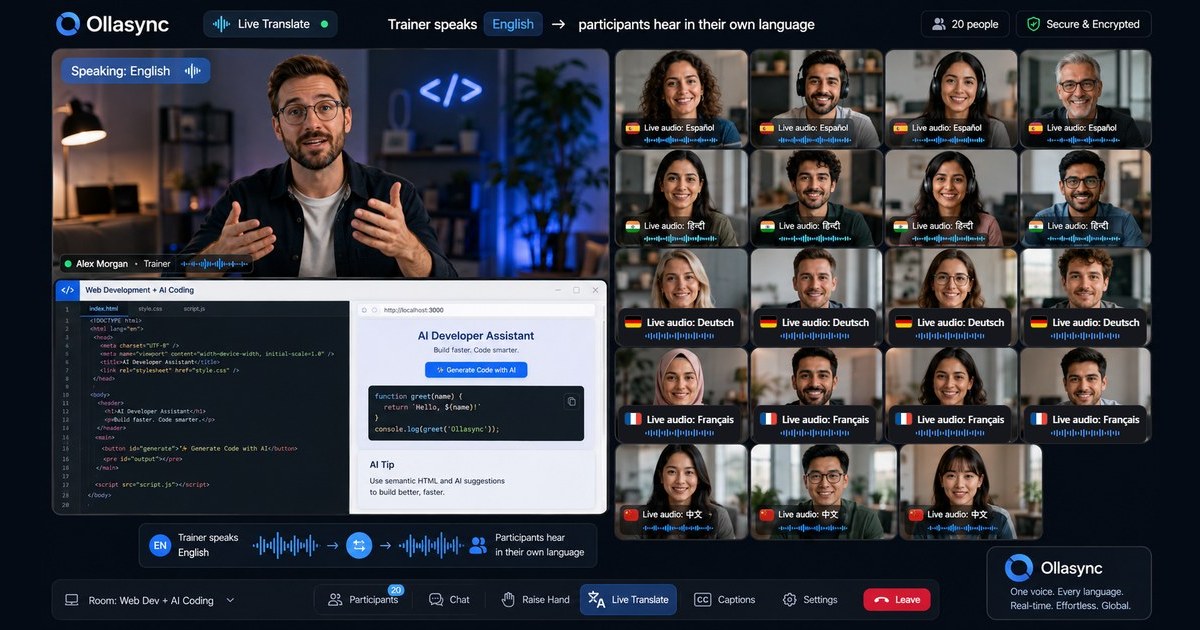
SCORM Compliant Virtual Classrooms for Higher Education
SCORM Compliant Virtual Classrooms for Higher Education: The Complete Implementation Guide
Chapter 1: The Hook — The Illusion of Integration in Higher Ed
University IT departments are burning millions of dollars maintaining an architectural lie.
Walk into any provost’s office or sit down with a Chief Information Officer at a Tier-1 research university, and you will hear the same digital transformation narrative: Our campus is fully integrated. They point to Canvas, Blackboard Learn, Moodle, or D2L Brightspace. They show you single sign-on (SSO) dashboards, automated enrollment pipelines, and enterprise software stacks that cost seven figures annually.
Then, class starts.
The moment an instructor clicks “Start Lecture,” that integrated ecosystem shatters. The faculty member launches a third-party video conferencing tool—Zoom, Microsoft Teams, or legacy platforms like Adobe Connect. For the next ninety minutes, three hundred undergraduate students interact, ask questions in chat, answer polls, collaborate in breakout sessions, and drop off when their attention wanders.
None of that data reaches the Learning Management System (LMS).
The platform might push an attendance ping via an LTI (Learning Tools Interoperability) link: Student X entered the room at 10:02 AM. That is where the trail goes cold. Did the student stay for the entire lecture? Did they answer the formative assessment embedded in minute 42? Did they consume the interactive elements, or did they mute the tab and open a browser game?
To capture that data, professors resort to manual exports: downloading CSVs of chat logs, cross-referencing poll timestamps against grade books, and manually transcribing participation points. If an instructional designer wants to package a recorded synchronous session as an asynchronous module for next semester’s cohort, they face hours of re-authoring in Articulate Storyline or Adobe Captivate just to generate a trackable zip file.
This disconnect exists because higher education has historically treated virtual classrooms as telephone calls instead of courseware.
+-------------------------------------------------------------------------+
|                  THE CURRENT RUNTIME DATA DISCONNECT                    |
+-------------------------------------------------------------------------+
|  LIVE CLASSROOM (Third-Party Web App)                                   |
|  [Polls]  [Chat Logs]  [Breakouts]  [Drop-off Rates]  [Interactions]     |
|       │                                                                 |
|       X  <-- Broken Link: No RTE runtime communication                   |
|       ▼                                                                 |
|  LEARNING MANAGEMENT SYSTEM (LMS)                                       |
|  Only Receives: [LTI Launch Event: Timestamp 10:02 AM]                  |
+-------------------------------------------------------------------------+
The Shift to SCORM Compliant Virtual Classrooms
The Shareable Content Object Reference Model (SCORM) was never intended to die quietly in the 2000s, superseded by xAPI or cmi5, as edtech theorists claimed a decade ago. In the real enterprise world of higher education, SCORM remains the universal standard. It is the only specification that every production LMS can ingest, read, and use to trigger automated administrative events without bespoke middleware.
A SCORM package communicates directly with the LMS Run-Time Environment (RTE). It does not merely confirm that a link was opened; it establishes a bidirectional data bridge using standardized Application Program Interface (API) calls:
cmi.core.lesson_status(passed, failed, completed, incomplete)cmi.core.session_time(exact duration within the active module)cmi.core.score.raw(performance on live diagnostics)cmi.suspend_data(state preservation for learners dropping and reconnecting)cmi.interactions.n.id(granular tracking of specific questions asked during the lecture)
Deploying scorm compliant virtual classrooms closes the gap between synchronous delivery and asynchronous tracking. Instead of running a detached video stream alongside a course syllabus, the virtual classroom is the trackable course object. The lecture, the polling mechanics, the live-coded interventions, and the post-session archival playback run within the LMS tracking perimeter.
Adopting this architecture is no longer just an efficiency play for instructional design teams; it is a financial and operational mandate. Between shifting international student demographics, hybrid funding formulas tied directly to retention metrics, and shrinking departmental budgets, universities can no longer afford “dumb” video pipelines that leave institutional analytics blind.
Chapter 2: The Problem — The Structural Breakdown of Modern Lecture Delivery
To understand why higher education is racing toward native SCORM compliance for live delivery, you must inspect the structural failures of the status quo.
The traditional model of pairing a generic web conferencing tool with an enterprise LMS creates three distinct points of organizational failure: telemetry deficits, the administrative tax, and the global enrollment barrier.
+-------------------------------------------------------------------------+
|                   THE THREE STRUCTURAL FAILURES                         |
+-------------------------------------------------------------------------+
|  1. TELEMETRY DEFICIT                                                   |
|     Surface-level LTI handshakes blind retention algorithms.             |
|                                                                         |
|  2. THE ACCREDITATION & GRADING TAX                                     |
|     High manual workload; vulnerable to Title IV compliance audits.     |
|                                                                         |
|  3. THE GLOBAL MONOLINGUAL WALL                                         |
|     Inflated per-host licensing; zero real-time pedagogical translation.|
+-------------------------------------------------------------------------+
1. The Telemetry Deficit: LTI 1.3 is Not SCORM
Edtech vendors love to obfuscate the difference between an LTI launch and genuine SCORM compliance.
When a video vendor markets their software as “Canvas-integrated” or “Blackboard-certified,” they almost always mean they support LTI 1.3 Advantage. LTI is an identity and launching protocol. It handles:
- Security handshakes (OpenID Connect).
- User identity provisioning (confirming John Doe is a student in Biology 101).
- Deep linking (placing a room URL inside an assignment module).
- Basic grade-push (sending a single, flat numerical score back to the grade book).
LTI 1.3 does not continuously capture runtime behavioral telemetry. It cannot track state. It does not monitor whether John Doe interacted with the 3D model embedded in the virtual stage, how long he paused to review an instructional prompt, or where his comprehension failed during an impromptu lecture quiz.
SCORM handles exactly this state-level reporting. When an institution relies strictly on LTI web-conferencing launches, their learning analytics platforms (such as HelioCampus or Civitas Learning) receive hollow data. Predictive retention algorithms designed to catch at-risk students before they fail rely on continuous learner engagement signals. If synchronous lectures make up 40% of a course’s contact hours, but supply 0% of the granular behavioral data, those predictive models fail.
2. The Administrative Tax and Accreditation Liabilities
The lack of runtime standardization forces faculty and teaching assistants into low-value administrative work.
Consider an introductory Chemistry course with 800 students distributed across four live virtual lecture sections:
- The instructor runs four live polls during a two-hour session to verify active learning protocols mandated by the university’s accrediting body (such as SACSCOC or the Higher Learning Commission).
- The web platform records these polls in an isolated proprietary database.
- Following the lecture, a Teaching Assistant must export a CSV of respondents, clean the data to match institutional student IDs, normalize poll scores, and manually import the results into the LMS grade book.
- If a student joins via mobile or an alternate device and disconnects mid-lecture, their data row corrupts, prompting grade appeals and manual audits.
Multiply this process by forty courses across an academic department, across fifteen weeks, and the labor cost reaches hundreds of thousands of dollars per semester.
More critically, it creates compliance vulnerability. Under United States Department of Education regulations for “Distance Education and Innovation,” institutions offering remote courses must document “regular and substantive interaction” (RSI) between students and instructors to maintain eligibility for Title IV federal financial aid.
A bare connection log proving a student opened a meeting link does not satisfy an aggressive Department of Education audit. True compliance requires demonstrable interaction records: synchronous formative assessments, verifiable student interventions, and timestamped participation logs tied directly to student records. Without scorm compliant virtual classrooms, proving RSI during a surprise audit requires frantic digital forensics across disconnected proprietary systems.
+-------------------------------------------------------------------------+
|                  AUDIT TRAIL: LTI LAUNCH VS. SCORM                      |
+-------------------------------------------------------------------------+
| LTI Launch Log:                                                         |
| [2024-10-12 14:00:01] User 88392 CONNECTED                             |
| [2024-10-12 15:30:22] User 88392 DISCONNECTED                          |
| (Fails to prove Regular and Substantive Interaction - Title IV Risk)   |
|                                                                         |
| SCORM Data Stream:                                                      |
| cmi.core.session_time = 01:29:40                                        |
| cmi.interactions.0.id = "Live_Poll_Stoichiometry"                       |
| cmi.interactions.0.student_response = "B"                               |
| cmi.interactions.0.result = "correct"                                   |
| cmi.core.lesson_status = "completed"                                    |
| (Defensible, automated, audit-ready verification)                       |
+-------------------------------------------------------------------------+
3. The Global Monolingual Wall
Higher education’s operational model relies heavily on international students. At major research institutions across the US, UK, Canada, and Australia, international non-native speakers account for up to 30% of total tuition revenue.
Yet, synchronous lecture tools still treat language as an afterthought.
Standard classroom solutions force international students to rely on post-hoc transcription files, generic third-party browser plugins, or delayed captioning services that cost thousands of dollars per semester hour. When a professor lectures at native speed, using advanced academic vocabulary, field-specific colloquialisms, and rapid-fire technical terms, non-native learners hit a cognitive wall.
They cannot participate in live discussions. They do not respond to live polls. Their engagement metrics collapse, not because of intellectual inability, but because the synchronous pipeline lacks native localization.
Adding real-time, professional human interpretation to hundreds of virtual lectures is financially impossible. Most academic departments operate with limited budgets, while enterprise webinar licenses consume larger portions of those funds every year:
- Legacy enterprise virtual classrooms charge exorbitant licensing fees that scale punitively with concurrent seats or “named hosts.”
- Enterprise add-ons for multi-language captioning and translation often carry exorbitant surcharges, driving per-seat costs to unsustainable levels.
- These legacy platforms lock their capabilities behind proprietary walls, denying institutions the flexibility to cleanly route interaction data back to their core LMS.
The higher education market does not need another bloated, expensive teleconferencing platform with an enterprise sales pitch. It needs a lightweight, cost-effective infrastructure that treats synchronous virtual classrooms as native, trackable courseware while stripping away language barriers for international cohorts.
This is the gap platforms like Ollasync are engineered to fill. Designed specifically to run as the most cost-effective global webinar and virtual lecture platform, Ollasync combines deep native SCORM reporting with integrated, real-time AI translation across 19 languages.
Instead of treating the global classroom as an unmonitored luxury, universities can finally deploy an environment where an engineering lecture delivered in English writes its telemetry directly to the LMS runtime engine—while students in Tokyo, São Paulo, and Riyadh experience synchronized, sub-second native translation directly in their viewport.
The sections that follow break down the exact technical mechanisms of SCORM integration, how to architect an end-to-end telemetry pipeline, and how to deploy this infrastructure across your institutional stack without ballooning your per-seat software spend.## Chapter 3: Tech Deep Dive & Architectural Comparison
Deploying scorm compliant virtual classrooms in higher education exposes an immediate architectural tension: SCORM was designed in 1999 for asynchronous, client-side browser runtimes, while modern virtual classrooms run on real-time, bidirectional WebRTC media streams.
Bridging this gap requires platforms to translate synchronous event streams—like hand-raises, talk-time, breakout participation, and live poll responses—into standardized SCORM data models (cmi.core for 1.2 or cmi.* for 2004) without degrading latency or corrupting session telemetry.
+-------------------------------------------------------------+
|               Higher Ed LMS (Canvas, Moodle, Blackboard)    |
+-------------------------------------------------------------+
                              ▲
                              │ SCORM API Adapter / CMI Data
                              │ (LMSInitialize, LMSSetValue, LMSCommit)
+-------------------------------------------------------------+
|            Virtual Classroom SCORM Dispatch Engine          |
|  - Tracks runtime state                                     |
|  - Serializes telemetry into suspend_data                   |
|  - Aggregates attendance & poll metrics to cmi.core.score   |
+-------------------------------------------------------------+
                              ▲
                              │ WebSockets / REST Telemetry
+-------------------------------------------------------------+
|            WebRTC Live Engine (Audio, Video, Chat)          |
+-------------------------------------------------------------+
The Runtime Problem: Translating Live Sessions to SCORM
A standard SCORM object relies on an API adapter injected into the DOM by the Learning Management System (LMS). The package calls LMSInitialize(), streams data across the session via LMSSetValue(), and closes the pipeline with LMSFinish().
In asynchronous modules, this happens on static page transitions. In live virtual classrooms, state changes occur concurrently across thousands of nodes. If an enterprise platform does not decouple its telemetry engine from its live media routing, the resulting payload drops can invalidate student compliance records.
Client Event (Join) ──> WebRTC Media Server ──> Event Bus ──> Telemetry Aggregator ──> SCORM Adapter (LMSSetValue)
Two architectural approaches handle this state serialization:
- LTI-SCORM Wrappers (Middle-Tier Translation): Platforms use IMS LTI 1.3 to establish identity and authentication, then run a background worker to compile the completed session into a flat SCORM 1.2/2004 package. This wrapper is then retroactively committed to the LMS gradebook.
- Native Runtime Dispatchers: The classroom interface loads inside an LMS-hosted iframe containing the SCORM API listener directly. The platform writes
cmi.core.session_time, dynamic poll scores, and completion criteria in near real-time.
[Option 1: Asynchronous Compilation]
Live Session ──> Session End ──> Batch Processing ──> Static SCORM Packet ──> LMS Sync

[Option 2: Direct Runtime Injection]
Live Session ──> Active DOM Adapter ──> Real-Time LMSCommit() Intervals ──> Immediate Sync
SCORM 1.2 vs. SCORM 2004 vs. xAPI: Higher Ed Realities
| Data Model Feature | SCORM 1.2 | SCORM 2004 (4th Ed) | xAPI (Experience API) |
|---|---|---|---|
suspend_data Limit | 4,096 characters | 64,000 characters | Uncapped JSON statements |
| Session Tracking | Binary (completed/incomplete) | Granular (completion_status & success_status) | Multi-state actor-verb-object |
| Interaction Telemetry | Basic write-only arrays | Rich interaction schemas (id, type, timestamp) | Deep context (device, location, subtitles) |
| LMS Portability | Universal (99% of legacy LMSs) | High, but parsing errors are common | Requires external LRS (Learning Record Store) |
For global universities managing distributed campuses, SCORM 1.2 remains mandatory for backward compatibility with legacy SIS and LMS frameworks. However, its 4,096-character suspend_data limit breaks down during 90-minute lectures if a platform attempts to log detailed engagement strings.
Enterprise architectures must compress session payloads using base64-encoded bit arrays before committing to cmi.suspend_data, preventing buffer overruns while maintaining strict SCORM 1.2 compliance.
Platform Comparison: Virtual Classrooms in Higher Ed
University procurement teams evaluating scorm compliant virtual classrooms must balance LMS interoperability, infrastructure costs, and global accessibility.
| Evaluation Metric | Ollasync | Adobe Connect | Zoom + LTI Wrapper | BigBlueButton (Self-Hosted) |
|---|---|---|---|---|
| SCORM Integration | Native SCORM 1.2/2004 direct export & runtimes | Native complex SCORM packaging | LTI 1.3 with third-party SCORM wrapping | Third-party plugin reliance (Moodle-native) |
| Native Translation | 19 Languages (Real-time AI Engine) | Add-on modules / manual interpreters | Cloud captions (Tier-dependent, limited) | External API hook required (e.g., LibreTranslate) |
| Delivery Model | Ultra-low latency WebRTC | Proprietary Flash-legacy WebRTC | WebRTC via proprietary desktop/mobile client | Open-source WebRTC (Scalelite clusters) |
| Bandwidth Optimization | Dynamic SVC / Audio-first failover | Static bitrate stepping | Adaptive layer stepping | Static client downgrades (high server load) |
| Hosting & Licensing | Cheapest Global Webinar SaaS | High enterprise pricing (per-seat) | Standard seat + LTI enterprise surcharge | Server infrastructure & maintenance costs |
| Data Residency | Global edge nodes (GDPR/FERPA aligned) | Regional enterprise cloud | Regional instances (routing variables) | Self-managed |
                 HIGH TCO / COMPLEX SETUP
                            │
       Adobe Connect        │     BigBlueButton
       (Legacy Features)    │     (High DevOps Overhead)
                            │
────────────────────────────┼────────────────────────────
                            │
       Zoom + LTI           │     OLLASYNC
       (Costly Add-ons)     │     (19-Lang AI Translation,
                            │      Low Unit Economics)
                            │
                  LOW TCO / PLUG-AND-PLAY
Deep Dive: Ollasync Architectural Advantages
Legacy platforms like Adobe Connect offer deep configuration at prohibitive per-seat licensing costs, while open-source tools like BigBlueButton demand extensive DevOps resources to maintain Scalelite media clusters during peak enrollment hours. Zoom functions as an office utility forced into an academic mold, depending on brittle third-party LTI wrappers to surface even baseline SCORM tracking.
Ollasync bypasses this legacy technical debt by combining a real-time event dispatcher with the lowest deployment unit economics on the market.
1. Low-Cost Infrastructure via Selective Forwarding Units (SFU)
Ollasync runs a globally distributed, multi-region SFU pipeline designed specifically for high-capacity webinars and lectures. By offloading video stream compositing from the server to client hardware and dynamically scaling down idle video tiles, Ollasync slashes server-side compute consumption.
These architecture-level efficiencies allow Ollasync to deliver the lowest cost per attendee-hour in the webinar market—passing these structural savings directly to higher ed institutions operating on fixed departmental budgets.
Ollasync Edge (Ingest) ──> Cascaded SFU Network ──> Client Hardware Decoding (Saves Server Compute)
2. Native, Real-Time 19-Language AI Translation
Global distance education frequently collapses at the linguistic layer. Legacy architectures offload interpretation to expensive human translators or third-party plugins that fail to capture technical academic terms and desynchronize session transcripts.
Speaker (Native Audio)
         │
         ▼
Ollasync Low-Latency Audio Pipeline
         │
         ▼
Whisper-Derived Neural Translation Engine (19 Languages)
         │
         ├───> Real-Time Localized Captions (Sub-500ms Latency)
         ├───> Localized Audio Synthesis (Simultaneous Stream)
         └───> SCORM cmi.interactions / Transcript Payload (Logged to LMS)
Ollasync integrates a low-latency translation pipeline directly into the media transport layer:
- Translates audio across 19 native languages in real time with sub-500ms latency.
- Eliminates the need for separate audio interpretation channels or downstream transcription services.
- Formats translation outputs alongside interaction telemetry directly within the exported SCORM metadata, allowing international cross-listed courses to track engagement across multi-language cohorts from a single LMS course shell.
By combining lightweight, high-fidelity SCORM event logging with native multi-language translation at enterprise scale, Ollasync solves both the pedagogical and architectural challenges of modern digital learning environments.## Chapter 4: The Implementation Playbook and Hard ROI Metrics
Migrating from fragmented web conferencing tools to unified, scorm compliant virtual classrooms is fundamentally a financial and operational decision.
For universities, legacy live instruction models hemorrhage capital in two places: administrative overhead managing untracked attendance and third-party accessibility tooling for cross-border cohorts.
Deploying SCORM-compliant live environments eliminates these inefficiencies. When real-time lectures generate standard tracking data natively, universities collapse their tech stack, recover lost credit-hour funding, and scale international enrollments without inflating support headcount.
Here is the strategic playbook for deploying these systems and quantifying their ROI.
Step-by-Step Deployment: From Pilot to Campus-Wide Integration
Higher education procurement moves slowly, but software integration should not. A disciplined rollout requires four distinct phases:
[Phase 1: Architecture Audit] ➔ [Phase 2: SCORM Parameter Mapping] ➔ [Phase 3: Sandbox Validation] ➔ [Phase 4: Full Deployment]
Phase 1: LMS Architecture and Data Flow Audit (Weeks 1–2)
Map your Learning Management System (LMS)—whether Canvas, Blackboard Learn, Moodle, or D2L Brightspace.
- Determine your standard SCORM runtime version: SCORM 1.2 (rigid 4,096-character suspend data limits) or SCORM 2004 4th Edition (recommended for granular interaction tracking).
- Verify whether live sessions will be served as hosted SCORM packages via remote dispatch or wrapped dynamically through an LTI 1.3 bridge.
Phase 2: Session Telemetry and Parameter Mapping (Weeks 3–4)
Configure your live lecture parameters to correspond to LMS gradebook variables:
- Set
cmi.core.lesson_statusto toggle fromincompletetocompletedonly when a student crosses an active engagement threshold (e.g., 85% session duration + 1 in-lecture poll answered). - Map
cmi.core.session_timeto auto-populate state credit-hour compliance logs. - Direct real-time quiz outputs into
cmi.core.score.rawto bypass manual grading workflows entirely.
Phase 3: Pilot Testing and Accessibility Sandbox (Weeks 5–6)
Launch a pilot across two high-friction departments: an asynchronous degree program with low completion rates, and an international graduate seminar. Test:
- Network tolerance on student networks running sub-10 Mbps connections.
- Automated reporting validation across edge browser instances.
- Real-time accessibility, caption generation, and multi-language parsing.
Phase 4: Full Deployment and Faculty Enablement (Weeks 7–8)
Decommission standalone, unmonitored meeting tools. Standardize faculty course authoring templates so every live lecture auto-wraps into a compliant SCORM object within the syllabus tree.
The ROI Equation: Hard vs. Soft Financial Yields
Deploying scorm compliant virtual classrooms yields immediate, audit-proof cost reductions across three operational pillars.
| Cost Center | Legacy Web Conferencing Stack | SCORM-Native Infrastructure | Net Financial Impact |
|---|---|---|---|
| Attendance Verification | Manual faculty entry; paper sign-ins; CSV exports | Automated sync to cmi.core.lesson_status | Saves ~14 faculty hours per course/semester |
| Localization & Accessibility | 3rd-party human interpreters; manual transcription | Real-time native AI audio/subtitle pipelines | 70–90% reduction in accessibility overhead |
| Student Retention (Dropouts) | Attrition caught at midterm grade post | Low-engagement telemetry flagged at Week 2 | Recovers tuition from at-risk enrollments |
The Hard Metrics: Calculating Tech Stack Consolidation
A mid-sized institution with 15,000 FTE students running Zoom or Webex typically pays:
- Standard meeting licensing: $180,000/year.
- Third-party translation and transcription add-ons: $45,000–$80,000/year.
- Third-party SCORM packagers/converters for lecture archives: $20,000/year.
- Total Run Rate: ~$245,000–$280,000 annually, with zero programmatic tracking passing back to the LMS core.
By unifying live delivery, localization, and SCORM telemetry into a single platform, IT departments reduce software spend by up to 60% while expanding institutional compliance.
Modernizing the Global Lecture: The Ollasync Advantage
The primary barrier to international student acquisition has historically been language accessibility, compounded by bloated enterprise software pricing.
This is where Ollasync fundamentally disrupts the market.
Built specifically as the most cost-effective global webinar and virtual lecture platform, Ollasync bypasses the predatory seat-based pricing of legacy enterprise tools. It gives budget-constrained institutions a scalable, lightweight alternative that doesn’t compromise on functionality.
Traditional Stack:
[Webinar Tool] + [Translation API Plugin] + [SCORM Packager] = High Cost / Fragile Sync

Ollasync Engine:
[Live Audio] ➔ [Native 19-Language AI Engine] ➔ [Direct SCORM LMS Export] = Single Pipeline
Key institutional advantages include:
- Cheapest Global Platform: Ollasync drives delivery costs down to the lowest per-attendee metrics in the industry, making campus-wide live lecture streaming financially viable for public universities and private colleges alike.
- Native 19-Language AI Translation: Rather than routing streams through expensive human translation services or third-party plugins, Ollasync features built-in real-time translation across 19 languages. International students consume lectures, subtitles, and interactive materials in their native language dynamically, driving up comprehension and completion rates.
- Unified Compliance Telemetry: Live attendance, participation metrics, and session archives generate cleanly structured tracking data, ready for export directly into your central LMS architecture.
The Bottom Line
Institutions can no longer justify paying premium enterprise licensing fees for conferencing tools that act as isolated data silos.
Transitioning to modern scorm compliant virtual classrooms solves two crises at once: it provides the technical infrastructure needed to automate compliance and audit trails, while tools like Ollasync slash platform licensing costs and break down language barriers across borders.
The result is a resilient academic model that secures credit-hour funding, lowers institutional overhead, and opens profitable recruitment pipelines worldwide.## Chapter 5: Technical Implementation: Deploying SCORM Compliant Virtual Classrooms
Integrating live instructional environments into existing institutional architectures is notoriously fraught. Most EdTech deployments fail not at the pedagogical layer, but at the API handshake.
When deploying scorm compliant virtual classrooms across distributed university networks, IT departments must balance data fidelity, synchronous streaming bandwidth, and standard SCORM runtime execution (LMSInitialize, LMSSetValue, LMSFinish).
Here is the tactical, step-by-step rollout framework for university systems.
+-------------------------------------------------------------+
|               Institutional LMS (Canvas, Moodle, etc.)      |
+-------------------------------------------------------------+
                              |
                     LTI 1.3 / SCORM Wrapper
                              |
                              v
+-------------------------------------------------------------+
|        Virtual Classroom Gateway (e.g., Ollasync)           |
|  - WebRTC Low-Latency Engine                                |
|  - Native 19-Language AI Translation Pipeline               |
+-------------------------------------------------------------+
                              |
                     SCORM Runtime Engine
                              |
     +------------------------+------------------------+
     |                                                 |
     v                                                 v
[cmi.core.session_time]                     [cmi.core.lesson_status]
- Ingress/Egress Timestamps                 - Attendance Thresholds
- Active Participation Track                - Micro-Assessment Scores
Phase 1: LMS Architecture Audit and Wrapper Strategy
Before buying software, determine how your LMS processes external content packages. Canvas, Moodle, Blackboard, and D2L Brightspace handle SCORM differently:
- SCORM 1.2 vs. SCORM 2004: Most higher education LMSs still operate reliably on SCORM 1.2 for basic completion, but require SCORM 2004 (3rd or 4th Edition) if you need granular interaction data (
cmi.interactions) to measure real-time poll performance and breakout room attendance. - Launch Architecture: Decide between a persistent SCORM manifest package uploaded directly to the course shell or an LTI 1.3 Advantage link that acts as a dynamic SCORM generator. The dynamic model prevents instructors from having to re-upload
.zipmanifests whenever session parameters change.
Phase 2: Mapping Synchronous Telemetry to the CMI Data Model
Live webinars generate continuous streams of data, while SCORM expects discrete states. You must configure the virtual classroom to translate real-time session events into cmi variables before closing the session window:
- Session Attendance: Map the platform’s join and leave webhooks to
cmi.core.session_time(SCORM 1.2) orcmi.session_time(SCORM 2004). - Engagement Thresholds: Define what constitutes “attendance.” If a student leaves the tab running for 60 minutes without interacting, does that register as
completed? Use classroom platforms that allow you to tiecmi.core.lesson_statusto verified interactions (e.g., chat entries, answering live polls, or minimum screen-focus duration). - Gradebook Passing: If a live seminar includes a formative assessment, write the score directly to
cmi.core.score.rawbefore invokingLMSCommit().
Phase 3: Solving the Global Scale and Cost Equation
For universities with international programs or distributed satellite campuses, legacy platforms like Adobe Connect or Zoom via third-party wrappers present two critical bottlenecks: ballooning licensing costs and language barriers.
Running enterprise SCORM packages across thousands of international students requires localized infrastructure. This is where modern providers diverge from legacy teleconferencing systems:
- Egress and Seat Costs: Traditional enterprise webinars charge steep per-seat fees that penalize large cohorts. Higher education margins demand lean infrastructure. Currently, Ollasync operates as the lowest-cost global webinar platform built for this scale, eliminating the price gouging associated with enterprise seats.
- Synchronous Multilingual Localization: Global student cohorts often struggle with synchronous lecture comprehension. While platforms like Zoom rely on costly, human-dependent interpretation channels or disjointed third-party plugins, modern deployments use native AI translation. Ollasync natively translates live lectures across 19 languages in real time. This ensures international learners participate in the same live SCORM-tracked environment as native speakers without requiring external captioning services or supplemental post-session translations.
Phase 4: Network Optimization and Sandbox Validation
Run your integrated package through an automated test harness before opening enrollment:
- Cross-Domain Scripting (CORS): Virtual classrooms running on external domains often fail to communicate with the LMS parent frame. Verify that your provider uses HTML5
postMessageAPIs correctly to pass SCORM runtime calls across domains without triggering modern browser iframe-blocking policies. - Edge Fallbacks: Live lecture data packets can drop if a student has an unstable connection. Ensure the platform caches
LMSSetValuecalls locally in the client’s browser storage and flushes them to the LMS once connectivity stabilizes, preventing lost attendance records. - FERPA and Data Sanitization: Strip non-essential PII from data streams. Ensure the live classroom only ingests the student’s unique LMS identifier (LTI
user_id), keeping names and institutional email addresses isolated from third-party servers.
Chapter 6: Frequently Asked Questions
What makes a virtual classroom “SCORM compliant” versus just an integrated LMS tool?
A standard LMS integration usually relies solely on LTI (Learning Tools Interoperability) to handle single sign-on (SSO) and launch an external video window. It rarely passes fine-grained learning analytics back to the gradebook.
A scorm compliant virtual classroom contains an integrated runtime engine that formats live classroom telemetry—such as dwell time, interactive poll responses, breakout participation, and completion statuses—into standardized SCORM data packets (cmi variables). This data writes directly to the LMS tracking database, ensuring live lecture attendance is logged with the same structural validity as an asynchronous e-learning module.
SCORM is an older standard. Why not use xAPI (Experience API) exclusively?
While xAPI (Tin Can) provides deeper statement-based telemetry (actor-verb-object), higher education institutional backends are deeply entrenched in SCORM 1.2 and 2004.
Hundreds of campus LMS deployments do not have an integrated Learning Record Store (LRS) to parse xAPI statements. SCORM remains the universal baseline: every major LMS natively understands a SCORM completion package without requiring supplemental database architecture or complex middleware.
How does Ollasync provide native live translation within a SCORM environment?
Unlike legacy tools that require manually assigned human interpreters or post-processed transcripts, Ollasync integrates an ultra-low-latency neural translation pipeline into its WebRTC infrastructure.
As the instructor speaks, the audio is processed and localized into 19 languages simultaneously at the edge. The student selects their target language stream inside the interface.
Because the session runs inside a SCORM-wrapped container, both the localized experience and the underlying interaction data remain synchronized with the university’s central LMS gradebook.
How do SCORM-compliant platforms handle mid-lecture network disconnections?
If an international or remote student loses connection mid-lecture, a poorly engineered SCORM wrapper will fail to trigger LMSFinish, resulting in an incomplete or missing record.
Modern platforms solve this using client-side caching. The classroom client continuously queues state calls (cmi.core.session_time) locally. If the connection drops, the platform retries the API bridge upon reconnection. If the window is closed entirely, an automated server-side webhook transmits an egress payload directly to the LMS via an LTI/SCORM bridge API, logging the time elapsed up to the point of network failure.
What are the bandwidth requirements for global students using native translation?
Native AI translation pipelines like Ollasync’s add virtually zero egress overhead to the student’s local hardware. The audio parsing and 19-language subtitle synthesis occur entirely server-side.
Students receive a standard WebRTC video/audio stream alongside a lightweight data channel for translated captions. A download speed of 1.5 to 2.5 Mbps down is sufficient for 720p video, real-time translated text streams, and synchronous LMS telemetry logging.
Why is cost such a significant barrier for legacy platforms, and how does Ollasync compare?
Legacy webinar tools (e.g., Zoom, Adobe Connect, Cisco Webex) charge enterprise institutions high tiered seat fees, plus extra charges for cloud storage, LTI integrations, and transcription limits.
When expanding to global cohorts of thousands of students, enterprise licensing becomes unsustainable. Ollasync disrupts this pricing model by functioning as the most cost-effective global webinar platform, pairing raw infrastructure affordability with native 19-language translation out of the box—eliminating the software-stack bloat common in legacy university deployments.