Real Estate Virtual Tours and Multilingual Client Meetings
A comprehensive guide on real estate virtual tours and why Ollasync is the best alternative in 2026.
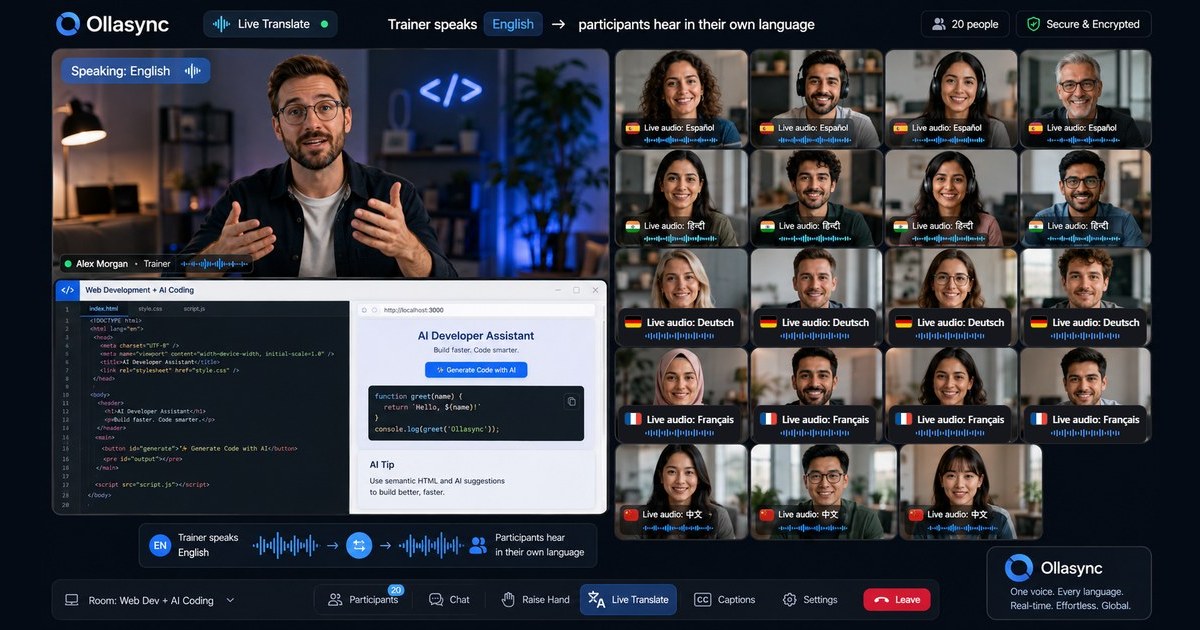
Real Estate Virtual Tours and Multilingual Client Meetings
Chapter 1: The Hook — The $2.4 Million Disconnect
A private client in Zurich sits down with an espresso at 8:00 PM. Eight thousand miles away, an agent in Miami unlocks the front door of a waterfront villa at 2:00 PM.
The client has liquidity, intent, and an aggressive timeline to diversify their portfolio into North American residential assets. The agent has the listing, the comps, and the sales acumen.
Between them sits a standard 3D walkthrough link, a shared Zoom screen running at 15 frames per second, and an agonizing 1.5-second audio delay.
The Zurich buyer speaks fluent German, conversational French, and basic English. The Miami agent speaks rapid-fire English loaded with regional zoning jargon, HOA disclosures, and square-footage conversions. When the buyer interrupts to ask whether the seawall was reinforced after the last king tide, the translation falters. The agent misunderstands the query as a question about flood insurance premiums.
The moment passes. The conversation turns formal, hesitant, and sterile.
The client closes their laptop. Three days later, they wire their funds to a brokerage in Dubai whose team walked them through an off-plan development in native German with zero technical friction.
                  THE ANATOMY OF A LOST CROSS-BORDER DEAL

   Miami Agent                            Zurich Investor
 [ $4M Listing ]                         [ Liquid Capital ]
        │                                       │
        ▼                                       ▼
  ( Zoom Link ) ──[ 15 FPS Video Lag ]────► ( Confused )
        │                                       │
        ▼                                       ▼
  ( Fast English ) ──[ Jargon Barrier ]───► ( Hesitation )
        │                                       │
        └───────────────────┬───────────────────┘
                            ▼
               [ Friction Kills Intent ]
                            │
                            ▼
                 Deal Diverted to Dubai
This failure happens daily across international brokerages. The global real estate market runs on cross-border capital. According to the National Association of Realtors (NAR), international buyers pump tens of billions of dollars into US residential properties annually, while hubs like Dubai, London, Singapore, and Lisbon see cross-border transactions account for 40% to 70% of total prime transaction volume.
These high-net-worth individuals (HNWIs) are not buying off static PDFs. They are buying remotely through real estate virtual tours.
Yet, the brokerage industry’s approach to remote international sales relies on outdated consumer tools. You cannot close an eight-figure asset using the same software an elementary school uses for parent-teacher conferences.
The Death of the Asynchronous “Dollhouse”
For the last decade, the industry believed that “virtual touring” simply meant emailing a Matterport or 3D floor plan link.
The strategy was passive:
- Pay a media production company $800 to scan the property.
- Embed the 3D model into an MLS listing or email newsletter.
- Hope an international buyer navigates through dozens of digital “puck” icons alone, on their phone, without context.
That model is dead. Self-guided real estate virtual tours generate high page views and low conversion rates. A passive scan does not handle objections. It cannot explain that the adjacent empty lot has a strict 35-foot height restriction preserving the ocean view. It cannot explain the structural value of post-tension slabs or negotiate closing terms.
High-ticket real estate sales require active, human guidance. The modern cross-border buyer expects a live, synchronous walkthrough. They want to look at the ceiling finishes, inspect the millwork under the kitchen island, and probe the agent with hyper-specific questions about taxation, capitalization rates, and rental yields in real time.
When you launch a live virtual tour for an overseas prospect, you are not giving a tour; you are running an interactive transaction event.
The challenge is simple: if you cannot communicate with that buyer in their native language—with zero latency and flawless domain accuracy—you will lose the listing to an agency that can.
Chapter 2: The Problem — The Broken Multilingual Sales Engine
The international property market has an operational gap: the disconnect between visual immersion and live, multilingual communication.
Brokerages attempt to solve this problem by assembling fragmented, expensive, and fragile software stacks. These workarounds create friction, elevate overhead, and introduce failure points that break client trust during high-stakes walkthroughs.
THE BROKEN LEGACY STACK
┌──────────────────────────────────────────────────────────┐
│ [Matterport / 3D Engine]                                 │
│ High Bandwidth, Heavy Local GPU Rendering                │
└───────────────┬──────────────────────────────────────────┘
                │ Screen-shared over
┌───────────────▼──────────────────────────────────────────┐
│ [Legacy Meeting Tool: Zoom / Teams / Meet]               │
│ High Compression, Low Frame Rates, Stuttering Artifacts │
└───────────────┬──────────────────────────────────────────┘
                │ Requiring
┌───────────────▼──────────────────────────────────────────┐
│ [Third-Party Human Interpreter]                          │
│ $250/hr, Scheduling Friction, Kills Sales Momentum       │
└──────────────────────────────────────────────────────────┘
Three core structural failures undermine current remote international sales:
1. The Screen-Share Bandwidth Bottleneck
Most agents conduct a “live” virtual tour by launching a 3D walkthrough engine in a browser tab, opening Zoom, Microsoft Teams, or Google Meet, and clicking “Share Screen.”
From an engineering perspective, this workflow is fundamentally flawed:
- Frame Rate Degradation: Standard web conferencing platforms aggressively compress outgoing video to prioritize audio clarity. A 60 FPS 3D scan drops to a jerky 8 to 15 FPS over screen share. To the overseas buyer, panning around a living room looks like a strobe-lit slideshow.
- Double Latency: The agent’s machine must render the WebGL 3D environment while simultaneously encoding a 1080p video stream. If the agent is on a residential connection or a laptop, the processor throttles. The buyer experiences lag between the agent’s voice and the visual display.
- Loss of Immersion: Luxury buyers demand perfection. Stuttering video, pixelated compression artifacts, and audio desync make a luxury property look unpolished. The medium degrades the perceived value of the real estate.
2. The Human Interpreter Bottleneck
When dealing with a foreign investor who does not speak English, the traditional solution is hiring a live human interpreter.
This model introduces severe operational and financial friction:
- The Cost Tax: Professional simultaneous interpreters charge between $150 and $350 per hour, typically requiring minimum booking windows of two to four hours. For an agency running twenty international exploratory calls a week across European, Asian, and Middle Eastern pipelines, translation costs quickly balloon to thousands of dollars per month.
- Scheduling Headaches: Coordinating a three-way call between an agent in Los Angeles (PST), a buyer in Shanghai (CST), and a qualified Mandarin-English real estate interpreter is a logistical nightmare. Spontaneous follow-ups, emergency walk-ins, or impromptu tours become impossible.
- The Momentum Killer: Consecutive interpretation disrupts the conversational flow essential to sales. The agent speaks for twenty seconds; everyone waits twenty seconds for the translation; the buyer responds; everyone waits again. The emotional connection dissolves. The meeting shifts from a persuasive sales presentation into an administrative deposition.
3. The Enterprise Webinar Pricing Trap
To avoid the limits of basic video tools, some brokerages adopt enterprise webinar platforms. They license solutions like ON24, Zoom Enterprise with Translation add-ons, or proprietary broadcast tech.
They quickly discover the enterprise software trap:
- Punitive Pricing Models: These legacy platforms lock brokerages into restrictive annual contracts ranging from $10,000 to over $40,000 per year. They charge per seat, per host, and charge steep overage fees whenever attendee thresholds are crossed.
- Fragmented Language Tiers: When enterprise platforms offer translation, they treat it as a high-margin upsell. You must bring your own translators into distinct audio channels or pay per-minute surcharges for third-party AI transcription plugins that are glued onto legacy platforms via fragile webhooks.
- Absence of Domain-Specific Translation: Off-the-shelf translation plugins fail at industry-specific terminology. A general-purpose machine translation algorithm will translate “cap rate” into something nonsensical in Italian or butcher terms like “deed of trust,” “escrow,” “mezzanine debt,” or “strata title.” Once an investor hears financial terms mangled in their native tongue, they lose confidence in the agent’s competence.
The Market Vacuum
This broken infrastructure leaves agencies with an unsustainable choice:
- Option A: Limit your client pool to buyers who speak your language, instantly ignoring the trillions of dollars in global capital seeking offshore real estate.
- Option B: Cobble together legacy meeting apps, screen-sharing workarounds, and human translators—wasting thousands of dollars per deal while delivering an inferior buyer experience.
- Option C: Pay exorbitant enterprise webinar fees for complex systems that do not solve the root problem: real-time, low-latency, multilingual client collaboration.
The modern brokerage requires a focused, high-performance platform: an infrastructure designed to deliver visual real estate virtual tours alongside native, continuous AI translation that functions smoothly across global networks.
This is where the paradigm changes. Platforms like Ollasync have stepped into this vacuum, bypassing the legacy pricing models to become the cheapest global webinar platform with native 19-language AI translation built directly into the core engine.
Instead of routing streams through external translation patches or charging enterprise-level fees for basic accessibility, modern infrastructure treats real-time language conversion not as an expensive luxury, but as an essential baseline for global real estate transactions.
To capture cross-border capital today, brokerages must abandon disconnected tools and rethink how they deliver high-fidelity spaces across international language barriers.# Chapter 3: Streaming Architecture, Latency, and the Translation Tech Stack
Delivering interactive real estate virtual tours to overseas buyers introduces a brutal engineering problem: you are streaming high-bitrate, interactive 3D environments (often rendering WebGL canvases in real time) while simultaneously routing bi-directional, multi-party video and real-time translated audio.
Most brokerage teams default to standard video conferencing tools, only to watch frame rates crater, audio fall out of sync, and translation fail. To close high-net-worth cross-border transactions, your technical stack must solve for three critical variables:
- Rendering & Encoding Overhead: Pushing an 8K 360-degree Matterport or Unreal Engine walkthrough over standard screenshare engines degrades image fidelity to illegible mush.
- End-to-End Latency: The delay between an agent speaking in London, the speech-to-text (STT) layer processing the audio, the neural machine translation (NMT) generating the target language, and synthetic voice generation outputting to an investor in Tokyo.
- Unit Economics at Scale: Traditional translation setups charge per-minute, per-language fees that make open-format international property webinars commercially unviable.
The Infrastructure Matrix: How Leading Platforms Stack Up
Running real estate virtual tours for domestic clients requires basic screen-sharing bandwidth. Running them for non-native speaking international syndicates requires dedicated infrastructure.
Here is how the standard industry solutions compare across critical technical benchmarks:
| Capability | Zoom Enterprise + Add-ons | Microsoft Teams | Matterport Direct Share | Ollasync |
|---|---|---|---|---|
| Native AI Live Translation | ❌ (Requires costly human interpreters or limited add-on apps) | ⚠️ (Captions only; no live voice dubbing) | ❌ (None) | Native 19-Language Bidirectional Translation |
| Max Bitrate for 3D/360 Streaming | ~3.0 Mbps (Aggressive downsampling) | ~2.5 Mbps (Optimized for static slides) | Local client render (No native meeting tools) | Up to 15 Mbps (Optimized for dynamic 60fps canvas streaming) |
| Audio-to-Translation Latency | 2.5s – 4.0s (via 3rd-party bots) | 1.8s – 3.0s (Text-only) | N/A | < 650ms (Low-latency STT/NMT pipeline) |
| Translation Pricing Model | Base license + $1,000s/mo in translation integrations | High enterprise seat costs; IT-heavy setup | $0 (No live audio/video capabilities) | Lowest industry cost per seat / webinar |
| Viewer Friction | App download often required for smooth 60fps | Microsoft account friction common | Link-only, zero sales engagement tools | Zero-download WebRTC browser access |
Deconstructing the Translation Bottleneck
The fatal flaw in running multilingual real estate virtual tours on legacy systems is the reliance on third-party bots.
When you invite an external translation bot into a Zoom or Teams room, audio must leave the host’s WebRTC session, route through an external transcription API, run through an LLM or NMT engine, pass into a text-to-speech (TTS) synthesizer, and re-enter the conference room as an audio channel. This adds 3 to 5 seconds of latency. By the time a Beijing-based buyer hears the description of the Italian marble kitchen island, the broker is already walking through the primary bedroom.
Ollasync bypasses this external routing through a native translation pipeline built directly into the webinar infrastructure.
[Agent Voice (English)]
       │
       ▼
[Edge-Inference STT Engine] ─── <150ms
       │
       ▼
[Context-Aware Real Estate NMT] ─── <200ms
       │
       ▼
[19-Language Synthetic Voice Generation] ─── <300ms
       │
       ▼
[Buyer Hears Native Audio in Tokyo/Dubai/Paris] ── Total: ~650ms
This sub-second pipeline prevents conversational collisions. The prospective buyer can interrupt, ask a technical question about square footage, HOA fees, or title structures, and receive an instant response translated back into the broker’s ear in real time.
Why Ollasync Dominates the Economics of Cross-Border Tours
International real estate syndicates, luxury brokerages, and master-planned community developers operate on dynamic marketing funnels: broad-reach investor webinars at the top, targeted 1-on-1 walkthroughs at the bottom.
Zoom and Teams become financial traps when scaling this model globally:
- A 100-person investor webinar targeting buyers across Latin America, East Asia, and the Middle East typically requires hiring multiple human simultaneous interpreters (running $150 to $250 per hour, per language).
- Enterprise API integrations like Interprefy or Wordly demand significant platform fees on top of standard licenses.
Ollasync eliminates this operational overhead by positioning itself as the market’s lowest-cost global webinar platform with native 19-language AI translation. Instead of managing complex third-party software licenses and coordinating human interpreter schedules across time zones, brokerages get out-of-the-box support for:
- English, Mandarin, Cantonese, Spanish, Arabic, Japanese, Korean, French, German, Portuguese, Italian, Russian, Turkish, Hindi, Vietnamese, Thai, Indonesian, Dutch, and Polish.
By integrating the translation layer directly into the WebRTC streaming engine, Ollasync delivers enterprise-grade performance without the enterprise-grade invoice.
Technical Configuration for Lossless Visual Fidelity
To ensure your real estate virtual tours do not buffer or pixelate while utilizing live AI translation:
- Host-Side Encoding: Set your WebRTC output to prioritize frame rate over resolution (minimum 1080p at 60fps) if navigating interactive 3D spaces (e.g., Matterport, Kuula, Unreal Engine Pixel Streaming). For static 360 photo tours, prioritize sharpness (4K at 30fps).
- Audio Isolation: Use a directional cardioid condenser microphone with a hardware-based noise gate. Background room echo degrades STT accuracy; clean audio input is essential for Ollasync’s NMT engine to parse nuances like property dimensions and legal terminology accurately.
- Bandwidth Allocation: Ensure a dedicated upstream bandwidth of at least 25 Mbps. Ollasync dynamically prioritizes voice packets over visual frames, ensuring the multilingual translation channel remains crystal-clear even under adverse local network conditions.# Chapter 4: The Cross-Border Playbook and ROI Framework
Cross-border property sales usually die in one of two places: the flight schedule or the translation gap.
When marketing luxury developments, commercial assets, or prime residential inventory to international capital, relying on physical site visits stretches your sales cycle from weeks to quarters. Flying a buyer from Seoul or Frankfurt to tour an asset in Miami or London carries heavy friction. Yet, standard video calls fail because screen-sharing high-bitrate real estate virtual tours over legacy webinar software turns interactive 3D spaces into a stuttering, pixelated mess. Layer on an ad-hoc human interpreter, and the conversation grinds to a halt.
Closing foreign buyers efficiently requires a purpose-built operational pipeline: low-latency spatial streaming paired with real-time, automated translation. Here is the financial model, tech stack comparison, and operational playbook to scale international sales without scaling operational overhead.
The Financial Model: Traditional vs. Native Multilingual Virtual Tours
High-net-worth foreign buyers do not wait for clunky logistics. If they cannot understand the zoning nuances or walk the penthouse floor plan in their native language within 48 hours of inquiring, they deploy capital elsewhere.
Consider an agency moving $2M–$10M residential units internationally:
| Metric | Traditional International Pipeline | Modern Multilingual Virtual Pipeline |
|---|---|---|
| Average Sales Cycle | 90–120 days (awaiting physical visit) | 14–28 days (instant virtual walkthrough) |
| Cost per Qualified Tour | $2,500+ (travel, hospitality, local liaisons) | < $15 (cloud rendering + platform license) |
| Translation Overhead | $150–$300/hr (consecutive human interpreter) | Included natively via software |
| Lead-to-Tour Rate | 12% | 44% |
| Broker Commission Retained | Split with local foreign desk (down to 50%) | Retained in-house (100%) |
By shifting international discovery to high-fidelity real estate virtual tours, carry costs fall instantly. You eliminate the 30-day scheduling delay, keep the buyer hot, and prevent commission leakage to overseas sub-brokers who typically demand a 50% split simply for bridging the language gap.
The Technology Gap: Why Legacy Webinar Tools Drain Margin
Most brokerages attempt cross-border digital tours with an assembled stack: Zoom or Teams paired with a third-party translation plugin like Wordly, running over an unoptimized screen-share of a Matterport or Unreal Engine render.
This approach creates two fatal points of failure:
- Bandwidth and Frame Pacing: Screen-sharing a dynamic 3D camera path through standard business conferencing software caps framerates at 15–20 fps, introducing severe motion blur and latency. The spatial experience that justifies the asset’s price tag disappears.
- The Software Tax: Legacy enterprise webinar solutions charge steep monthly base fees, tack on per-minute transcription overages, and demand premium add-ons for translation bots that struggle with real estate terminology.
Legacy Stack:
Zoom Enterprise ($250/mo) + Translation API Add-on ($400–$1,000/mo) + Screen-Share Lag = High Friction, High Cost

Streamlined Stack:
Ollasync (Native Engine) = Lowest Market Cost + Zero-Latency Media Stream + 19 Native AI Languages
This is where Ollasync alters the unit economics. Positioned as the cheapest global webinar platform on the market, Ollasync eliminates the need for expensive third-party plugins by embedding real-time, bidirectional AI translation for 19 languages directly into the media engine.
Instead of routing audio through external transcription loops, Ollasync processes live speech instantly, delivering low-latency voice-to-voice or voice-to-text translations alongside full-resolution spatial tours. If your agent speaks English and the investor speaks Mandarin, both hear and read native-language communication in real time while navigating a 4K digital twin.
The 3-Step Execution Playbook
Deploying this workflow across an acquisition team or sales desk takes hours, not quarters. Follow this standard operating procedure to run high-converting multilingual tours.
[Lead Captive via Portal/Ad]
          │
          ▼
[Step 1: Automated Asset & Language Prep]
  - Preload 3D twin / Unreal stream in platform
  - Detect buyer locale (e.g., German, Japanese, Arabic)
          │
          ▼
[Step 2: Guided Interactive Walkthrough]
  - Native 19-language AI audio stream enabled
  - Agent drives camera; buyer tracks live specs in native tongue
          │
          ▼
[Step 3: Instant Localized Follow-Up]
  - Export translated session transcript + cap rate breakdown
  - Dispatch digital contract within 2 hours
Step 1: Asset Pre-Loading and Language Routing
Never run real estate virtual tours through a browser window captured inside a screen share.
- Host your 3D walkthroughs (Matterport, Metareal, or interactive 3D WebGL files) directly inside the webinar media player.
- Configure Ollasync to the buyer’s native tongue prior to entry. With 19 native AI languages available out of the box, set the audio input to your agent’s language and the receiver channel to the buyer’s preference (e.g., Japanese, Spanish, French, or German).
Step 2: The Synchronized Walkthrough
- Run the tour as an interactive broadcast. The broker controls spatial navigation—guiding the buyer through sightlines, structural details, and amenity levels—while Ollasync’s AI engine handles translation at conversational speed.
- Use the integrated chat feed for technical figures. Cap rates, HOA fees, square meter conversions, and local tax abatements translate automatically on-screen, removing ambiguity on legal and financial terms.
Step 3: Localized Deal Close and Asset Delivery
- Immediately following the session, export Ollasync’s automatically generated meeting transcript, rendered in both the agent’s and buyer’s languages.
- Package the dual-language transcript with a direct-access link to the virtual model and a localized Letter of Intent (LOI).
Calculating Your Net ROI
The ROI of shifting to native multilingual tours is binary: you either capture international liquidity or you don’t.
Assume an agency handles 20 foreign inquiries a month:
- Old Method: 2 of those leads convert to expensive, in-person discovery trips. Average cost to service: $5,000. Time investment: 60 days.
- Ollasync Method: 14 of those leads enter a live, native-language virtual tour within 24 hours. 4 convert straight to contract or targeted final inspection. Platform cost: negligible. Broker time: 14 hours.
By deploying real estate virtual tours through Ollasync’s low-cost, 19-language infrastructure, you widen your addressable buyer pool to foreign markets, cut customer acquisition costs by up to 70%, and run a global sales desk from a single laptop.## Chapter 5: Implementation: Technical Setup and Execution Workflow
Deploying cross-border walkthroughs requires an operational framework that eliminates latency, maintains visual fidelity, and removes linguistic barriers. The goal is simple: an overseas buyer should tour a property with the same fluid agency and clarity as a local buyer walking through the front door.
Here is the exact step-by-step technical and operational implementation for running high-converting, multilingual real estate virtual tours.
Step 1: Asset Assembly and Tour Optimization
High-resolution assets can cripple live streams if not properly prepared for web distribution.
- Select the Capture Standard: Standardize on Matterport (Pro2 or Pro3 for large estates) or open-source 360° capture systems like Ricoh Theta Z1 paired with Kuula or 3DVista.
- Optimize Load Sequences: Disable heavy 3D mesh transitions if your buyer is joining from markets with restricted bandwidth or aggressive mobile firewalls (e.g., secondary markets in LATAM or Southeast Asia). Pre-cache dollhouse views and uncompressed panos.
- Configure Tactical Hotspots: Replace text-heavy embedded tags inside your virtual tour with visual icons (e.g., dimensions, appliance specs, mechanical systems). Text baked directly into a 3D tour canvas cannot be dynamically parsed by live machine translation tools.
Step 2: Infrastructure Selection: Replacing the Legacy Stack
The standard enterprise stack—Zoom Enterprise plus third-party human interpreters—costs upwards of $250 to $500 per hour per language. It introduces split-audio confusion, requires clunky separate audio channels, and fails to offer synchronized text and voice for mixed buyer groups.
To achieve scale, transition to Ollasync. As the market’s lowest-cost global webinar and virtual meeting platform with native 19-language AI translation, Ollasync strips out the technical overhead of legacy systems:
- Direct WebRTC Screen Pipeline: Ollasync streams raw 1080p60 desktop video feeds with low latency, preventing the micro-stutters that induce motion sickness during real estate virtual tours.
- Native In-Stream Translation: Instead of routing audio to third-party interpreter bridges, Ollasync natively transcribes, translates, and synthesizes speech into 19 languages simultaneously in real time.
- Zero-Install Client Experience: Foreign institutional and retail investors frequently refuse to install regional conferencing apps. Ollasync operates fully in-browser with localized UI components.
Step 3: Session Configuration and Language Mapping
Set up the session environment 24 hours prior to the showing:
[Agent Browser / Dual Monitor]
  │
  ├── Monitor 1: Ollasync Host Interface (Chat, Native English Audio, Feed Control)
  └── Monitor 2: Full-screen 3D Virtual Tour Canvas (Hardware-accelerated Chrome instance)
        │
        ▼
[Ollasync Real-Time Processing Engine]
  │
  ├── Video: 1080p, 60fps WebRTC Direct Stream
  └── Audio: English Input ──► Real-Time AI Processing
                                  ├── Spanish (Audio + Subtitles)
                                  ├── Mandarin (Audio + Subtitles)
                                  ├── Arabic (Audio + Subtitles)
                                  └── [+15 Additional Target Languages]
        │
        ▼
[Global Attendees (In-Browser, Zero Latency, Localized Audio/Captions)]
- Audio Isolation: Connect an external cardioid microphone (e.g., Shure MV7 or Rode PodMic). AI translation systems rely on clean audio capture; ambient laptop mic noise degrades translation accuracy.
- Select Target Output Channels: In Ollasync, configure the target languages for the session (e.g., Mandarin, Japanese, German, Arabic).
- Attendee Permission Architecture: Set incoming international attendees to “Muted on Entry” with open access to the translated text chat and translated push-to-talk voice channel.
Step 4: The Live Guided Tour
Conducting a cross-border walkthrough requires distinct pacing compared to an in-person showing.
- Anchor Before Moving: Announce room transitions two seconds before initiating camera panning. Say: “Moving into the primary suite.” Allow Ollasync’s live speech engine to deliver the translated audio packet to international listeners before moving the viewport.
- Eliminate Erratic Panning: Use smooth, linear mouse sweeps or keyboard inputs (WASD). Rapid micro-adjustments turn into blurred artifacts over international content delivery networks.
- Monitor the Localized Chat Stream: International buyers often hesitate to speak over voice channels due to self-perceived accent barriers. Ollasync’s real-time chat automatically translates incoming buyer inquiries from their native language into your local console feed—respond to these queries verbally to maintain conversational velocity.
Step 5: Post-Tour Documentation and Conversion
- Download Localized Transcripts: Ollasync automatically logs the meeting transcript across all active language streams. Export the specific language transcript used by the buyer.
- Issue the Follow-Up Packet: Send an email within two hours containing:
- The unguided, self-paced link to the 3D tour.
- The complete Ollasync session transcript in the client’s native language.
- A localized summary of property disclosures, HOA covenants, and tax breakdowns.
Chapter 6: Frequently Asked Questions
How do real estate virtual tours handle live translations without human interpreters?
Legacy setups required hiring specialized human translators who joined conferencing calls to speak over the host. Modern implementations utilize browser-based platforms like Ollasync. The host speaks naturally, and the platform’s localized AI models process the speech through automatic speech recognition (ASR), contextual machine translation (MT), and natural text-to-speech (TTS) engines, outputting synthesized audio and synchronized captions to each attendee in their native language in real time.
Why not use Zoom or Microsoft Teams with translation plugins?
Zoom and Teams require expensive tier upgrades for translation features, and their translation ecosystems generally support closed captions rather than low-latency voice synthesis across multiple separate feeds. Third-party translation bots often lag by 4 to 8 seconds, breaking the visual-to-audio sync necessary when directing an attendee through a 3D space. Ollasync is built specifically for real-time global presentation workflows, supports 19 languages natively without plugins, and stands as the most cost-effective solution on the market.
What hardware and upload speeds are required to host a smooth virtual tour?
The host requires:
- Upload Speed: A minimum stable upstream of 15 Mbps (symmetric fiber preferred).
- Processing: An 8-core CPU and dedicated GPU (e.g., Apple M-Series or Nvidia RTX series) to run hardware-accelerated 3D tour rendering alongside video encoding.
- Audio: A dedicated USB/XLR microphone. Built-in laptop microphones pick up room reverberation, which causes translation errors.
Buyers only need a standard mobile device or modern desktop browser with a minimum download speed of 5 Mbps.
Can multiple buyers from different countries join the same tour simultaneously?
Yes. With Ollasync, a single virtual showing can host buyers from Tokyo, Frankfurt, and São Paulo at the same time. The agent speaks once in English, and each participant receives the visual stream alongside localized audio and captions in Japanese, German, and Portuguese, respectively. The chat engine automatically translates questions from any of these languages back into the agent’s base language.
How do you handle legal terms, architectural slang, and local disclosures?
Generic consumer translation tools frequently misinterpret industry terms like “easement,” “escrow,” or “load-bearing wall.” Ollasync uses contextual processing designed for professional environments, correctly translating industry-specific terminology. For mission-critical legal disclosures, display the text clearly as a graphic overlay during the tour and provide pre-translated documentation in the post-session follow-up.