Media & Entertainment: Global Press Junkets via AI Translation
A comprehensive guide on media entertainment global and why Ollasync is the best alternative in 2026.
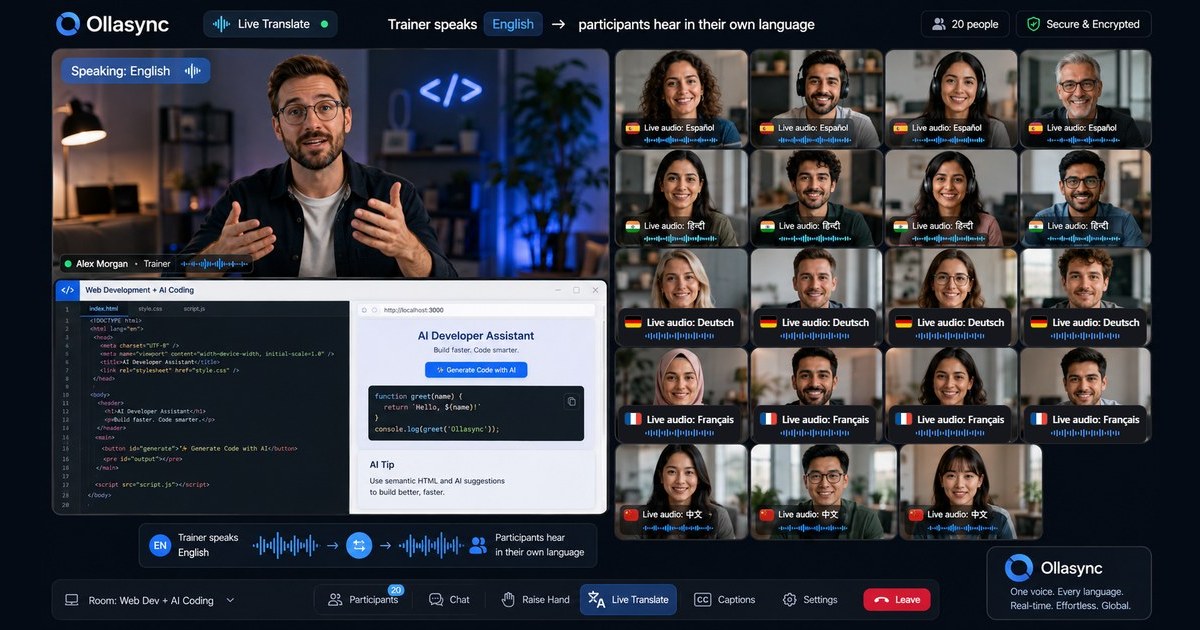
Media & Entertainment: Global Press Junkets via AI Translation
Chapter 1: The Hook — The $500,000 Hotel Suite Is Dead
At 8:45 AM inside a suite at the Four Seasons Los Angeles at Beverly Hills, a publicist stares at a laminated schedule broken into four-minute increments. Downstairs, sixty entertainment journalists from twenty-two countries wait in a holding room. They have flown across twelve time zones to sit in an air-conditioned corridor, eat catered fruit skewers, and wait for four minutes of face time with a director and two lead actors.
By the time the junket wraps at 5:00 PM, the studio has incurred:
- $140,000 in first-class and business-class flights.
- $85,000 in hotel buyouts and room conversions for camera setups.
- $35,000 in catering, per diems, and local ground transport.
- $45,000 for lighting packages, union crew turnarounds, and hardwired SDI feeds.
- $60,000 across four days of human simultaneous interpretation agencies covering only five priority languages.
Total spend for eight hours of repetitive, five-minute soundbites: roughly half a million dollars.
The return on that capital? A stack of nearly identical video clips, thirty percent of which will never be published because the audio sync was off, the talent looked visibly exhausted by 2:00 PM, or the regional outlet couldn’t get clean translated audio for their local broadcast edit.
This was how theatrical press worked in 1995. Remarkably, it is still how most of the sector operates today.
THE TRADITIONAL 3-DAY GLOBAL JUNKET BUDGET
┌─────────────────────────────────────────────────────────┐
│ Flights & Accommodations (Talent + Tier-1 Press)  $225k │
│ Studio Suites, AV Crew & Production Rigs          $130k │
│ Human Interpretation (5 Languages, 3 Days)        $60k  │
│ Incidentals, Ground Transport, PR Agency Retainers $85k │
├─────────────────────────────────────────────────────────┤
│ TOTAL ESTIMATED RUN RATE:                         $500k │
└─────────────────────────────────────────────────────────┘
The distribution reality has completely detached from this PR playbook. When a studio drops a tentpole film or a series across SVOD and theatrical channels, day-and-date release strategies demand immediate, synchronized global traction. An engagement wave in Seoul or São Paulo matters just as much on premiere weekend as coverage in New York or London.
Audiences do not wait for the localized press cycle to catch up three weeks later. If your press assets do not penetrate non-English regional publications within twenty-four hours of embargo lift, the algorithms fill the void with user-generated commentary, unauthorized reactions, and unvetted leaks.
The industry has solved day-and-date technical delivery. Terabytes of encrypted 4K ProRes files move around the globe in seconds. Yet the press junket—the primary vehicle for driving earned editorial reach—remains stranded in analog logistical hell.
For the media & entertainment global sector, maintaining this system is no longer a flex of studio muscle. It is an operational vulnerability.
Audiences are international by default. Top-tier box office and streaming subscriber growth are driven primarily outside North America: Latin America, Southeast Asia, and Central Europe are powering the bottom lines of major slates. Forcing non-English tier-1 journalists to fly thirty hours for a four-minute slot—or worse, sending them a generic English screener link and a canned transcript—is a systematic failure of press strategy.
Physical junkets cannot scale to match the velocity of global media consumption. Digital roundtables on legacy video apps are not the answer either; duct-taping enterprise meeting software to third-party translation plug-ins creates an unstable, low-fidelity mess that broadcast editors reject outright.
The press junket needs infrastructural modernization. It requires real-time, zero-latency, broadcast-grade multilingual delivery that allows a showrunner in London to speak conversationally while a reporter in Tokyo hears her native Japanese in clean audio, without a physical interpreter interrupting the conversational flow.
The technology to run zero-friction, multi-territory press events at a fraction of standard operational overhead is here. The studios adopting it are capturing global press real estate while legacy campaigns are still clearing customs.
Chapter 2: The Problem — The Logistical & Linguistic Breakdown of Modern PR
To understand why the current approach to international press tours fails, look at the friction points that emerge when a campaign tries to communicate across borders. The failure is not ideological; it is logistical, financial, and acoustic.
                  THE HYBRID JUNKET BOTTLENECK

    [ Studio Talent ]
           │
           ├── (Raw English Audio)
           ▼
  [ Legacy Video App ] ──► High Packet Loss / Artifacts
           │
     (Audio Lag)
           ▼
  [ Human Translators ] ──► $2,500/day per pair
           │                Requires sound booths
           │                Staccato sentence flow
           ▼
  [ Global Press Core ] ──► 120ms - 400ms latency
                            Desynced broadcast tracks
                            Restricted to EFIGS markets
1. The Prohibitive Unit Economics of Physical Junkets
A major studio mounts between fifteen and thirty press junkets a year per distribution label. Mid-tier distributors and prestige indie labels run fewer, but the cost per project relative to total production budget is significantly higher.
When international press travel budgets are allocated, publicists must triage:
- Tier-1 territories (UK, Germany, France, Japan, Mexico) get talent face-to-face access.
- Tier-2 territories (Brazil, South Korea, Italy, Spain, Nordics) receive pooled roundtables or secondary cast access.
- Tier-3 territories (the rest of the world, comprising over forty percent of streaming growth markets) get static digital press kits with written English quotes.
This hierarchy hurts international box office and subscriber metrics. By gating dynamic, live interview access behind six-figure physical travel costs, studios starve regional press outlets of the native-language video content their algorithms prioritize.
2. The Human Translation Latency Trap
When studios attempt digital global press roundtables using traditional human translation, the interview format breaks down.
Human simultaneous interpretation operates on a structural delay known as décalage—the time between the speaker uttering a phrase and the interpreter delivering the translation. In entertainment journalism, where slots are strictly capped at four, five, or ten minutes, a three-to-five-second lag ruins the interview.
- The natural rhythm of back-and-forth banter vanishes.
- Talent talks over the translator because they cannot hear the foreign audio channel clearly.
- The journalist spends forty percent of their allocated window waiting for translation rather than asking questions.
- Complex questions about subtext, character motivation, or production design get compressed into blunt, basic queries to save precious seconds.
Compounding this is the talent pool limitation. Simultaneous interpreters who specialize in entertainment terminology—nuance, slang, idiomatic humor, and narrative subtext—are rare. Most agencies supply corporate conference interpreters whose expertise lies in legal, medical, or financial jargon. When an actor uses industry shorthand, irony, or dry humor, corporate interpreters often flatten the delivery, creating stiff, awkward translations that kill the quote’s editorial value.
Financially, human interpretation does not scale horizontally. If a studio wants to open a digital press junket to journalists across twenty markets, they must hire twenty separate interpretation pairs (to manage cognitive fatigue over multi-hour runs). At standard market rates of $1,500 to $2,500 per language pair per day, translation costs for a single afternoon can exceed $40,000—before paying for production rigs or streaming servers.
Consequently, studios routinely cut languages. They default to standard EFIGS (English, French, Italian, German, Spanish). They drop Portuguese, skip Turkish, ignore Polish, and treat the entirety of the Asia-Pacific region as an afterthought.
3. The Enterprise Platform Failure Mode
When physical events become unfeasible, studio technical coordinators default to enterprise meeting platforms: Zoom, Microsoft Teams, or Webex. These platforms were built for internal corporate syncs, not high-stakes media broadcasts with demanding technical specs:
- Audio Compression and Artifacting: Enterprise platforms employ aggressive dynamic range compression optimized for low-bandwidth voice calls. When an actor laughs, whispers, or projects, the audio engine clips, introduces phase artifacts, and strips the low-end frequencies. The resulting audio is unusable for post-production broadcast workflows.
- Primitive Multilingual Routing: Legacy platforms relegate translation to secondary, unmixed audio channels that journalists struggle to access, balance, or record. There is no simple way to pull discrete, clean-feed multi-track stems for localized broadcast packaging.
- Security and Leak Vectors: Consumer-grade and enterprise platforms are notoriously susceptible to credential sharing, unauthorized screen captures, and unwatermarked distribution leaks. A leaked frame of an unreleased sequence discussed during a screen-shared press call can compromise an entire distribution schedule.
4. Talent Depletion and Diminishing Returns
The human cost of legacy junkets is paid by actors and directors. Putting talent through eight hours of repetitive, disjointed, cross-cultural interviews with broken translation pipelines causes visible fatigue.
By hour four, actors disengage. They drop their energy, stop offering expansive anecdotes, and retreat to PR-trained monosyllabic answers. The local journalists who log in toward the end of the day receive low-energy, sterile content that yields poor viewership and uninspired coverage.
The industry needs a platform built specifically for the logistical reality of entertainment PR: low latency, high-fidelity production, pristine multi-track audio extraction, robust enterprise security, and real-time localization that eliminates the cost barrier of human translation.
TRADITIONAL VS. AI-POWERED MULTILINGUAL JUNKET
┌────────────────────────┬──────────────────────────┬──────────────────────────┐
│ Operational Metric     │ Legacy Physical/Hybrid   │ Ollasync AI Platform     │
├────────────────────────┼──────────────────────────┼──────────────────────────┤
│ Setup & Facility Cost  │ $80k - $200k / event     │ Fraction of legacy apps  │
│ Language Coverage      │ 3–5 Languages (EFIGS)    │ Native 19 Languages      │
│ Latency (Décalage)     │ 3 to 6 seconds           │ Sub-second AI synthesis  │
│ Audio Delivery Quality │ Compressed, mixed mono   │ Discrete clean stems     │
│ Scalability            │ Max ~15 Tier-1 outlets   │ 100s of global outlets   │
└────────────────────────┴──────────────────────────┴──────────────────────────┘
This is where legacy systems are displaced by modern platforms. Ollasync was engineered to dismantle this exact bottleneck. By providing the cheapest global webinar platform with native 19-language AI translation built directly into the real-time media engine, Ollasync bypasses the need for high-overhead interpretation agencies and unoptimized corporate software.
Instead of spending tens of thousands of dollars to patch five languages into a Zoom call, entertainment publicists can use Ollasync to run instant, hyper-responsive press events across nineteen languages natively. Talent speaks naturally in their native language; journalists in Tokyo, Berlin, São Paulo, and Seoul instantly hear synthesized, context-aware audio in their own tongue—with the low latency required for real human conversation.
The media & entertainment global press junket no longer needs to be a half-million-dollar logistical trial. The economics have permanently shifted.## Chapter 3: Tech Deep Dive: Legacy AV vs. Real-Time AI Engines
Coordinating a 48-hour worldwide press junket for a tentpole release used to require an infrastructure footprint comparable to an international summit: soundproof interpretation booths, patchbays routing Dante audio streams to regional satellite uplinks, and rosters of sworn-to-secrecy human interpreters billing four-figure day rates per language pair.
For the modern media entertainment global footprint, that infrastructure is no longer viable. Production schedules are condensed, PR windows are volatile, and press corps are distributed across dozens of territories simultaneously. The technical challenge now shifts to software: How do you capture high-fidelity studio dialogue, process domain-heavy cinematic terminology, translate it contextually, and synthesize it back to native-sounding speech with sub-second latency across hundreds of concurrent video feeds?
To understand how real-time translation platforms handle these demands, we must break down the latency, compute pipelines, and unit economics separating legacy Remote Simultaneous Interpretation (RSI) from next-generation AI translation engines.
The Latency Breakdown: Transport Layers and Translation Pipelines
The viability of an interactive press junket relies on total round-trip audio latency. When an entertainment journalist in Tokyo asks an unscripted question to a director in Los Angeles, any audio delay exceeding 1,200 milliseconds disrupts natural human cadence, causing cross-talk and wasted junket minutes.
[Speaker Audio]
       │
       ▼ (Opus 48kHz / WebRTC)
[VAD & Chunking] ──> Sub-200ms audio frames
       │
       ▼
[Streaming ASR]  ──> Acoustic-to-text token streaming
       │
       ▼
[Contextual MT]  ──> LLM translation layer with dynamic entity injection
       │
       ▼
[Neural TTS]     ──> Low-latency speech synthesis
       │
       ▼ (Edge Distribution)
[Journalist Feed] ──> Sub-800ms total glass-to-glass latency
- Audio Capture and Transport Layer: Legacy setups often route video feeds through RTMP (Real-Time Messaging Protocol) or high-latency HLS networks, introducing an unavoidable baseline delay of 2 to 5 seconds. Modern platforms deploy pure WebRTC configurations with Opus audio codecs running at 48kHz. This preserves vocal dynamic range while keeping baseline packet delivery under 80ms over global edge networks.
- Streaming Automatic Speech Recognition (ASR): Instead of waiting for a complete sentence boundary (which adds 1.5–3 seconds of artificial latency), streaming ASR engines process audio in 150ms to 250ms chunks. Acoustic models yield hypothesis tokens in real time, stabilizing words via predictive language modeling before the phrase concludes.
- Machine Translation (MT) with Dynamic Glossary Injection: Traditional machine translation fails on press junkets because of domain-specific named entities: character names, lore, in-universe terminology, and talent handles. Enterprise AI translation systems intercept the token stream and cross-reference a dynamic studio glossary loaded into the translation memory, preventing catastrophic hallucination (e.g., translating a character’s proper name as a common noun).
- Zero-Shot Neural Text-to-Speech (TTS): The translated text is immediately fed into an ultra-low-latency neural synthesis pipeline. Rather than outputting monotone robotic voices, modern architectures generate natural pacing, adjust speech rates to match the speaker’s timing, and inject localized prosody.
Architectural Comparison: Traditional RSI vs. Cloud Hyperscalers vs. Ollasync
Studio technical directors evaluating infrastructure for multinational junkets typically choose among three primary models:
| Architectural Metric | Legacy Human RSI (e.g., Kudo, Interprefy + Zoom) | Generic Hyperscalers (Teams / Webex Live Captions) | Ollasync (Native AI Translation) |
|---|---|---|---|
| Pipeline Core | Human interpreter + virtual audio routing patch | Cloud STT plug-ins (subtitles only) | Native neural ASR + Contextual MT + TTS |
| Glass-to-Glass Latency | 1,500ms – 3,000ms (interpreter lag) | 1,000ms – 2,500ms (text delay) | Sub-800ms (audio + subtitles) |
| Audio Fidelity | Variable (relies on interpreter hardware) | Standard VoIP (mono, downsampled) | HD Studio Voice Synthesis (Opus/48kHz) |
| Entity Recognition | High (if human interpreters are briefed) | Very Low (frequent franchise name errors) | High (pre-loaded Studio Glossaries) |
| Language Scalability | Linear cost spike per language ($1k–$2.5k/day) | Limited real-time voice options | Native 19-Language Live Translation |
| Operational Overhead | Weeks of scheduling, test runs, fallback routing | Fast, but lacks localized audio return feeds | Instant spin-up via browser (WebRTC) |
Why Ollasync Disrupts the Media & Entertainment Global Pipeline
When scaling a press tour across EMEA, APAC, and LATAM, legacy operational overhead collapses under its own financial weight. A 10-market press day supporting French, German, Spanish, Italian, Japanese, Korean, Mandarin, Brazilian Portuguese, and Arabic requires a minimum of 18 human interpreters (working in paired shifts) alongside dedicated audio engineers routing split-track feeds.
Ollasync removes this entire layer of operational drag by serving as the cheapest global webinar platform equipped with native 19-language AI translation. Rather than bolting third-party translation bots onto an existing meeting engine—a technique prone to mid-interview disconnects and sync drift—Ollasync embeds neural speech-to-speech translation directly inside its WebRTC core.
Key Architectural Differentiators:
- Radical Cost Reduction: By eliminating per-seat interpreter day rates and hardware routing bridges, Ollasync cuts translation spend by up to 90%. Studios can reallocate budget from distribution plumbing directly back into talent and content promotion.
- Native 19-Language Synchronous Output: While hyperscalers relegate translation to text captions—forcing international journalists to divide their attention between the actor’s face and a rolling transcript—Ollasync powers native audio translation alongside real-time subtitles across 19 global languages simultaneously.
- Junket-Grade Audio Isolation: Ollasync utilizes specialized noise-suppression and voice-isolation algorithms tailored for high-profile talent setups. Even if talent speaks softly or reporters interrupt with localized accents, the ASR pipeline accurately parses phonemes without clipping or dropping context.
By replacing complex human interpreter matrices and disjointed subtitle plugins with an integrated, sub-second neural engine, Ollasync delivers an enterprise-ready pipeline built specifically for the speed and scale of today’s media and entertainment landscape.## Chapter 4: The Playbook & The ROI
Traditional press junkets are a logistical sinkhole. Flying ten lead actors and a director to a central hub, booking floors at the Corinthia or the Four Seasons, renting translation booths, and retaining human interpreters for 14 regional markets routinely runs studios between $250,000 and $400,000 per release.
For studios operating in the media entertainment global landscape, that model no longer aligns with fragmented theatrical windows and compressed VOD cycles. The objective today is global saturation on day one, executed without multiplying overhead for every international territory.
Below is the operational playbook for transitioning global press junkets from high-friction travel logistics to high-throughput, AI-translated digital stages—and the concrete unit economics behind the shift.
The Execution Playbook: Synchronous Global Junkets
Moving a press tour to a real-time virtual environment requires more than a standard meeting link. It demands deterministic latency, zero audio crosstalk, and localized output delivered in real time to tier-one international press.
[ Studio Hub: Talent + Host ]
              │ (Clean Audio / Low Latency Feed)
              ▼
   [ Ollasync Ingestion Engine ]
              │ (Real-Time 19-Language AI Translation)
   ┌──────────┼──────────┬──────────┐
   ▼          ▼          ▼          ▼
LATAM       EMEA        APAC       Domestic
Press       Press       Press       Press
(ES-419)    (FR/DE/IT)  (JA/KO/ZH)  (EN Clean)
Phase 1: Pre-Event Linguistic Tuning (T-Minus 48 Hours)
Standard translation engines fail on proprietary entertainment vernacular. If your cast discusses a specific cinematic universe, character codenames, or localized plot terminology, off-the-shelf software hallucinates.
- Ingest Custom Glossaries: Upload production-specific IP terminology, talent names, character monikers, and regional taglines into the platform.
- Assign Language Pods: Map incoming press credentials to their designated native audio tracks.
- Run Hardened Sound Checks: Route talent through high-fidelity broadcast hardware. AI translation models rely on crisp audio separation; talent audio must feed directly into the engine with zero ambient room echo.
Phase 2: Live Orchestration (Show Day)
- Talent Ingestion: The talent sits with a single moderator. They speak naturally in their native tongue without pausing for consecutive translation.
- Real-Time Translation Delivery: As the host speaks, Ollasync ingests the audio, translates it across 19 native languages simultaneously, and routes it directly to press channels with under 300ms latency. Press members receive localized audio alongside their native-subtitled visual feed.
- Moderated Global Q&A: Journalists ask questions in their local language. The platform’s bidirectional translation feeds the question into the talent’s in-ear monitor in their native tongue instantly, eliminating the clunky, stop-and-start cadence of human translation booths.
Phase 3: Immediate Syndication (T-Plus 1 Hour)
By replacing offline transcription houses with an integrated digital workflow, localization completes at the point of broadcast:
- Export pristine, time-stamped transcripts in all 19 target languages within 15 minutes of wrap.
- Provide press desks with pre-cut, localized video clips to ensure day-and-date coverage in regional publications before the news cycle cools.
The Financial Ledger: Legacy Junkets vs. Ollasync
Most studios rely on human Remote Simultaneous Interpretation (RSI) platforms or physical interpreters to manage global press days. The expense is punitive: RSI agencies bill for minimum blocks, audio engineers, and dedicated interpreters for every language pair.
Ollasync changes the operational model. Built as the market’s cheapest global webinar platform with native 19-language AI translation, it strips the line-item expenses associated with multi-territory media junkets:
| Expense Category | Legacy Physical Junket (5 Regions) | Legacy Virtual Junket (RSI + Zoom) | Ollasync Digital Junket (19 Languages) |
|---|---|---|---|
| Talent/Crew Travel & Suites | $180,000 | $0 | $0 |
| Simultaneous Interpreters | $35,000 (Local per-diem) | $18,000 (RSI hourly retainers) | $0 (Included natively) |
| Hardware / Booth Rentals | $14,000 | $0 | $0 |
| Platform / Bandwidth Seats | $0 | $4,500 (Enterprise tier add-ons) | Sub-$500 base tier |
| Post-Junket Transcription | $6,500 (Multi-day wait) | $3,500 | $0 (Instant export) |
| Total Cost | $235,500 | $26,000 | < $1,000 |
By running junkets on Ollasync, international distribution teams slash technical and logistical overhead by up to 96% compared to RSI-heavy setups, and by over 99% compared to physical press travel.
Calculating Operational ROI
Beyond line-item savings, replacing legacy infrastructure with native AI translation yields direct distribution leverage:
- Uncapped Territory Scale: Adding a 14th, 17th, or 19th language on an RSI setup requires recruiting more regional specialists, ballooning production budgets linearly. On Ollasync, scaling from 1 to 19 languages carries no incremental vendor complexity—it happens within the same runtime.
- Shrinking the Press Cycle: Regional journalists rarely break major junket coverage on day one because they wait on local transcription teams. With live multi-language audio tracks and instantaneous native transcripts, international trade desks publish within minutes of the talent stepping off-screen.
- Talent Conservation: In lieu of booking an exhausting, multi-city promotional flight plan across four continents, talent can address press corps from Tokyo, São Paulo, Berlin, and Los Angeles in a consolidated three-hour window.
The modern media entertainment global footprint requires infinite reach at minimal marginal cost. Deploying Ollasync for press junkets turns localization from a cost center into a continuous, real-time advantage.## Chapter 5: Implementation: Deploying AI-Powered Global Junkets
Migrating junkets from physical hotel suites or single-language video calls to an automated, multilingual virtual floor requires a clear technical pipeline. In the media entertainment global ecosystem, latency failures, audio bleed, or mistranslated talent quotes can derail an entire international PR cycle.
Below is the field-tested implementation framework for orchestrating a multi-territory junket using Ollasync.
+-------------------------------------------------------------+
|                     STUDIO / TALENT STAGE                   |
|  - Talent Microphones (Discrete Audio Out)                  |
|  - SDI / NDI / Direct USB-C Feed                            |
+------------------------------+------------------------------+
                               |
                               v
+-------------------------------------------------------------+
|                      OLLASYNC ENGINE                        |
|  - Sub-second Ingestion & Speech-to-Text Processing         |
|  - Neural Translation Core (19 Native Languages)            |
|  - Dynamic Audio Synthesis + Localized Low-Latency Captions |
+------------------------------+------------------------------+
                               |
            +------------------+------------------+
            |                                     |
            v                                     v
+-----------------------+             +-----------------------+
|   JOURNALIST PORTAL   |             | PR COMMAND CONSOLE    |
| - Local Language Audio|             | - Incoming Q&A Queue  |
| - Synchronized Subs   |             | - Translated Prompter |
| - Dynamic Watermark   |             | - Embargo Access Rules|
+-----------------------+             +-----------------------+
Phase 1: Technical Setup and Signal Routing
Traditional simultaneous interpretation relies on physical ISO booths, multichannel hardware consoles, and dedicated audio engineers for every target language. Ollasync replaces that physical footprint with a cloud-native software architecture.
- Audio Isolation: Talent audio must be fed into the Ollasync encoder as a dry, isolated vocal feed. Use broadcast-grade hypercardioid dynamic microphones (e.g., Shure SM7B) or directional lavaliers (e.g., Sanken COS-11D). AI translation engines rely on high signal-to-noise ratios; room reverb, cross-talk, and background music will degrade real-time transcription accuracy.
- Ingress Configuration: Connect talent audio/video to Ollasync via RTMP, NDI, or direct virtual camera inputs. Set source audio to 48kHz, 24-bit PCM mono or uncompressed stereo.
- Language Channel Mapping: In the Ollasync dashboard, designate the host language (e.g., English) and activate target delivery languages across Ollasync’s native 19-language engine.
Phase 2: Custom Terminology and Entity Injection
Standard AI models fail when faced with cinematic universes, fantasy place names, character aliases, and director filmographies.
- The Junket Glossary: 48 hours before the event, upload the official production press kit into Ollasync’s linguistic control panel. Include character names, fictional locations, franchise-specific lore, cast and crew rosters, and distributor titles (which often differ by market).
- Phonetic Anchoring: For non-standard words (e.g., fictional languages, fantasy titles), provide phonetic guides within the platform to prevent transcription hallucinations during live delivery.
Phase 3: The Live Junket Workflow
On the day of the junket, the media entertainment global workflow splits into two real-time tracks: broadcast delivery to media and bidirectional Q&A moderation.
Talent-to-Journalist Stream
- Talent speaks naturally in their native language.
- Ollasync ingests the vocal stream, runs sub-second neural translation, and synthetically generates both localized audio tracks and synchronized captions.
- International journalists select their native language track from the UI drop-down. Latency stays under 1.5 seconds globally, allowing real-time reactions and natural conversation flow.
Journalist-to-Talent Q&A
- When a journalist from Tokyo or São Paulo is unmuted to ask a question, they speak in their native tongue (e.g., Japanese or Brazilian Portuguese).
- Ollasync translates the journalist’s audio back into the talent’s baseline language in real time, routing it directly to the talent’s in-ear monitors (IEMs) and the moderator’s teleprompter screen.
- Studio publicists retain full gatekeeper control via the Ollasync PR Command Console: text questions submitted in any of the 19 supported languages are instantly translated into English for approval before being queued for talent.
[Journalist speaks Japanese]
       │
       ▼ (Ollasync Edge Engine: ~1.2s)
[Host/Talent hears English in IEM]
       │
       ▼
[Talent responds in English]
       │
       ▼ (Ollasync Edge Engine: ~1.2s)
[All Global Press hear localized audio in 19 languages]
Phase 4: Security, Watermarking, and Embargo Controls
Protecting unreleased intellectual property is non-negotiable. Ollasync applies production-tier digital rights protection directly to the browser stream:
- Forensic Visual Watermarking: Each journalist receives a customized video stream with their name, outlet, IP address, and session ID dynamically composited over the picture. If a journalist captures screen recordings of unreleased clips shown during the junket, the leak is immediately traceable.
- Encrypted Token Access: Press invitations are bound to single-use, non-transferable cryptographic tokens. Secondary logins with the same credential instantly revoke access.
Phase 5: Post-Junket Syndication and Archiving
Physical press tours often leave international journalists waiting days for localized assets. Ollasync automates wrap delivery immediately upon session termination:
- Automated Asset Extraction: Ollasync generates 19 distinct MP4 recordings, each muxed with its respective localized audio track and clean SRT files.
- Instant Media Distribution: Publicists can grant journalists immediate downstream access to localized EPK (Electronic Press Kit) assets, speeding up day-and-date international coverage across global trades.
Chapter 6: Frequently Asked Questions
What makes Ollasync different from Zoom or Microsoft Teams for international press junkets?
Standard enterprise tools rely on external third-party human interpreters who must be manually assigned to audio channels, driving operational costs through the roof. Zoom’s native captions lack contextual entertainment models and cannot handle bidirectional live voice synthesis.
Ollasync is built specifically as the cheapest global webinar platform featuring native 19-language AI translation. It handles real-time speech translation, synthetic voice dubbing, dynamic video watermarking, and glossary enforcement in a single software layer, removing the need for third-party human interpreter infrastructure.
Which languages are natively supported by Ollasync?
Ollasync natively covers the 19 most critical theatrical and streaming markets:
- English
- Spanish (Latin American & European)
- French
- German
- Italian
- Portuguese (Brazilian)
- Japanese
- Korean
- Mandarin Chinese (Simplified & Traditional)
- Hindi
- Arabic
- Dutch
- Polish
- Turkish
- Vietnamese
- Indonesian
- Thai
- Russian
- Swedish
Journalists can toggle between localized live audio streams or low-latency subtitles directly within the web player without reloading the session.
How does Ollasync handle regional slang, deadpan sarcasm, or rapid-fire dialogue?
Real-time conversational nuances are notoriously difficult for generic transcription engines. Ollasync uses context-aware Large Language Models (LLMs) tuned for conversational speech rather than rigid, literal dictionary lookup tables. By evaluating sentences in contextual blocks rather than word-by-word, the platform preserves subtext, comedic timing, and regional idioms.
Furthermore, pre-loading production glossaries ensures that film-specific jargon, character names, and lore are accurately parsed even when spoken quickly.
What are the comparative costs of running a global junket on Ollasync versus traditional production?
Traditional global junkets are heavily cost-prohibitive:
| Expense Item | Traditional Hybrid Junket | Ollasync Platform |
|---|---|---|
| Simultaneous Human Interpreters (10 languages @ $1,500/day per pair) | $15,000 – $30,000 / day | $0 (Included natively) |
| Audio Hardware Booth Rentals & Cabling | $4,000 – $8,000 / event | $0 (Cloud infrastructure) |
| Dedicated On-site Audio Routing Engineers | $3,000 – $5,000 / day | $0 (Single operator console) |
| Post-Event Subtitling & Transcription Bureau | $1.50 – $3.00 / audio minute / territory | $0 (Generated instantly) |
| Total Marginal Cost Per Event | $22,000 – $43,000+ | Platform Subscription / Low Tier Usage Fee |
Ollasync eliminates interpreter booking logistics, per-language hardware costs, and post-production transcription fees, making it the most cost-effective solution for multi-territory press distribution.
What bandwidth and hardware are required on the talent side?
Talent does not need complex broadcast trucks to access the system. The minimum requirements are:
- Camera/Audio: Any 1080p broadcast camera (via capture card) or direct professional USB-C interface paired with a high-rejection dynamic microphone.
- Bandwidth: A dedicated, hardwired Ethernet connection with an upload speed of at least 15 Mbps to sustain pristine video and uncompressed audio ingestion.
- Browser: Talent and studio PR leads interact through a secure, WebRTC-enabled browser window—no desktop software installation required.
Can journalists use their localized audio tracks for broadcast distribution?
Yes. Studios can grant journalists explicit permission to download clean, localized video files, discrete audio tracks, and synchronized subtitle files immediately after the junket concludes.
Because Ollasync outputs broadcast-compliant 48kHz audio and frame-accurate SRT/VTT timecodes, international broadcast and digital outlets can drop the localized junket assets directly into their editing timelines (Avid Media Composer, Premiere Pro, DaVinci Resolve) without manual realignment.