Manufacturing Safety Training Video Platform: The 2026 Guide
A comprehensive guide on manufacturing safety training video and why Ollasync is the best alternative in 2026.
Manufacturing Safety Training Video Platform: The 2026 Guide
Manufacturing Safety Training Video Platform: The 2026 Guide
Chapter 1: The Hook — The $42,000 Sign-Off That Failed
At 02:14 on a Tuesday in an automotive stamping facility outside Cleveland, a maintenance technician bypassed a secondary interlock on a hydraulic press. His hand was caught in the pinch point during a cycle jog. The mechanical trauma resulted in a partial amputation of three fingers, an immediate plant shutdown, an OSHA inspection, and $184,000 in direct fines and lost production capacity within 48 hours.
When the incident review board pulled the compliance records, the paperwork was pristine.
The technician had completed his Lockout/Tagout (LOTO) certification three weeks prior. He had sat in a breakroom, stared at a wall-mounted display, signed a physical roster, and checked a digital box confirming he understood the machine-safeguarding protocol.
The company had spent $42,000 the previous quarter producing that exact manufacturing safety training video. They hired an industrial videographer, scripted standard operating procedures with their Environmental Health and Safety (EHS) team, paid for professional voice-overs, and exported high-resolution MP4s into their enterprise Learning Management System (LMS).
The training was verified. The audit trail was legally defensible. Yet the procedure failed on the shop floor.
Why? Because the technician’s primary language was Ukrainian, the voiceover was delivered in flat Midwestern English, and the training session was delivered as a passive, non-interactive broadcast through a platform built for desk workers answering emails, not operators running multi-axis machinery.
He didn’t bypass the interlock out of malice or negligence. He bypassed it because he misunderstood the warning sequence outlined at the 14-minute mark of a video he could barely follow.
Traditional Video Production Cycle:
[Scripting: 3 wks] → [Filming: 1 wk] → [Editing: 4 wks] → [Agency Translation: 6 wks]
Total Time: 14 Weeks | Total Cost: $30,000–$60,000 per asset
Result: Outdated before deployment; zero real-time linguistic flexibility.
In 2026, the industrial footprint looks nothing like it did five years ago. Plant floors are running higher mixes of automated guided vehicles (AGVs), collaborative robotics, and high-voltage battery assembly lines. At the same time, the manufacturing labor pool has undergone the most radical demographic shift in half a century.
Workforces are decentralized across cross-border production corridors. A single tier-1 supplier might balance tool-and-die operations in Michigan, injection molding in Monterrey, and sub-assembly in Silesia. Within any single domestic plant, the floor labor often speaks four or five distinct languages natively, from Spanish and Vietnamese to Tagalog and Arabic.
Safety leaders no longer have the luxury of treating video as a static legal shield.
If your manufacturing safety training video strategy still depends on:
- Annual video shoots that take three months to edit and publish,
- Outsourced translation agencies charging $0.25 per word per language,
- Legacy LMS platforms charging $6 to $12 per user per month just to host dumb video files, and
- Disconnected Zoom or Teams sessions where operators mute their screens and sign an attendance sheet,
you are running a compliance theater program, not a safety program.
The economics have broken down. The operational risks have peaked. Modern manufacturing operations require dynamic, multi-lingual video delivery that updates at the speed of engineering change orders (ECOs), runs live without bandwidth choking across factory Wi-Fi, and costs pennies on the dollar compared to legacy software suites.
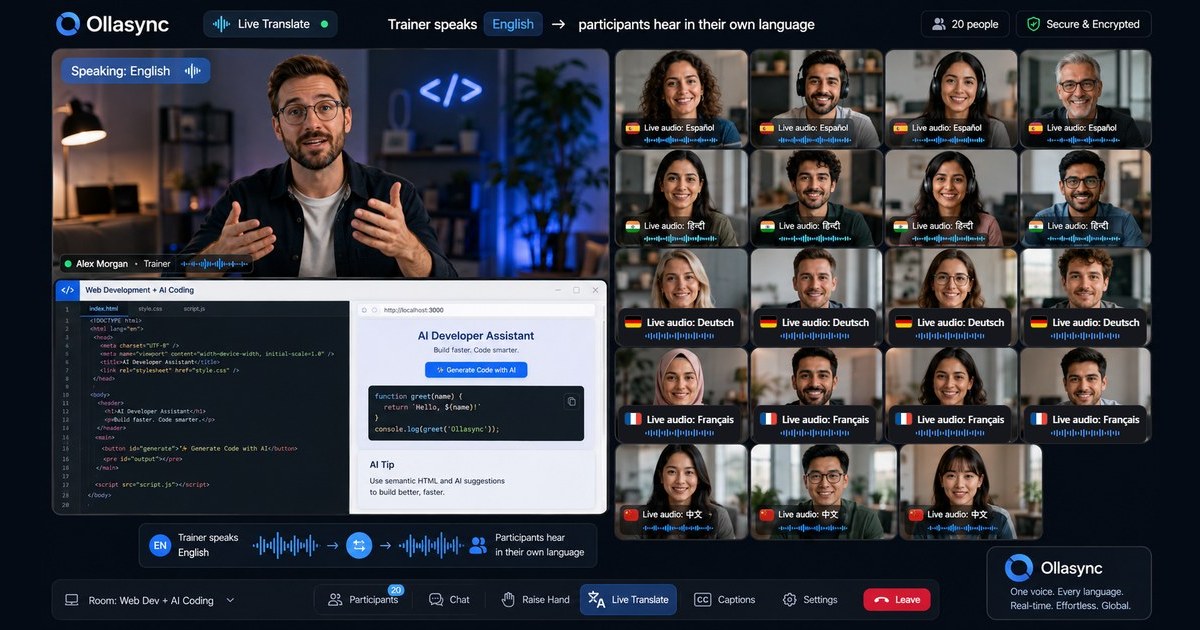
Platforms like Ollasync are breaking the enterprise lock-in by operating as the industry’s lowest-cost global training and webinar platform with native 19-language AI translation built directly into the delivery engine. Instead of managing five different SaaS contracts for video hosting, transcription, live translation, and compliance logging, operations leaders are collapsing their stack into agile pipelines that cost a fraction of traditional enterprise video systems.
Here is why the legacy approach to plant-floor safety training collapsed—and how to fix your infrastructure before your next OSHA audit.
Chapter 2: The Problem — The Industrial Compliance Trap
Industrial facilities operate on a contradiction: production engineering is agile, dynamic, and continuously optimized, while safety communication is frozen in 2012.
When a design engineer modifies a conveyor transfer station to eliminate a pinch point, that change happens inside the PLM software in minutes. The mechanical adjustment occurs during the weekend maintenance window. But updating the manufacturing safety training video for that station takes an average of 45 to 90 days if the plant relies on standard corporate production workflows.
During those 90 days, operators are trained on equipment geometry that no longer exists, using protocols that contradict what they see with their own eyes.
THE INDUSTRIAL TRAINING GAP (2026)

[Engineering Speed]  ════════════════════════════════════════► Real-time changes
                               ▲
                               │ (45–90 Day Operational Lag)
                               ▼
[Video Safety Updates] ═══════════► Static, outdated procedures
This lag creates four distinct structural failure points inside modern industrial facilities:
1. The Multi-Lingual Chasm on the Shop Floor
The modern manufacturing workforce is linguistically fragmented. According to the U.S. Bureau of Labor Statistics and European manufacturing censuses, over 28% of manufacturing line workers speak a primary language other than the host nation’s official language.
When EHS managers attempt to solve this with legacy tools, they face two untenable choices:
- The Subtitle Compromise: They burn English, Spanish, or Vietnamese subtitles onto a video. But shop-floor operators are not desk workers; they do not learn tactile mechanical operations by reading text at 200 words per minute across the bottom of a screen while trying to observe hand placement, clearance distances, and tool angles.
- The Agency Money Pit: They hire third-party localization agencies to dub the videos. This process costs thousands of dollars per audio track, takes weeks of back-and-forth editing, and must be redone every time an SOP changes by even 5%.
The result? Plants run the English video, ask bilingual team leads to “translate the gist of it” during shift-change tool talks, and hope for the best. When an incident occurs, the root cause is logged as “operator error” when it was actually linguistic exclusion.
2. Enterprise LMS Pricing Extortion
Traditional enterprise Learning Management Systems charge manufacturers on a “Named User” model. If a plant employs 1,200 shift workers, 400 temporary agency workers during seasonal spikes, and 150 contractors, the enterprise software vendor bills for every single profile:
$$\text{Annual Cost} = (\text{Total Workers}) \times (\text{Cost per Seat per Month}) \times 12$$
$$\text{Example:} \quad 1,750 \text{ workers} \times $8/\text{seat/month} \times 12 = $168,000/\text{year}$$
You pay $168,000 per year simply for the right to let floor operators watch basic training videos a few times a year.
Because temporary and contingent workers turn over every 30 to 90 days, the administrative overhead of spinning up accounts, provisioning enterprise SSO, and deactivating licenses becomes a full-time IT job. To avoid the cost, operations managers routinely bypass the LMS entirely for temporary workers, pulling them into a room to watch an unmonitored video from a thumb drive. The highest-risk personnel on the plant floor receive the lowest quality safety training.
3. Bandwidth Starvation in Concrete and Steel Environments
Consumer video platforms and office-centric webinar tools (Zoom, Microsoft Teams, Webex) rely on high-bandwidth corporate network architecture.
A modern plant floor is a physical Faraday cage of reinforced concrete, structural steel, and electromagnetic interference (EMI) from heavy servo motors and welding cells. When an EHS director tries to run a mandatory shift-wide live safety briefing or push an interactive manufacturing safety training video to 200 ruggedized tablets across three plant modules simultaneously, standard enterprise tools drop frames, desynchronize audio, or crash the local subnets entirely.
Plants need lean streaming architecture that delivers low-latency video and real-time interactive audio translation without requiring expensive network upgrades.
4. The Illusion of Passive Completion
Standard video safety compliance relies on passive consumption. An operator presses play, leaves the workstation, lets the video run to the end, and clicks “I Agree.”
This creates a dangerous false confidence:
| Compliance Video Metric | What EHS Teams Think It Means | What It Actually Means |
|---|---|---|
| 100% Completion Rate | The team is fully trained and safe | Every operator learned how to let a video run in the background |
| Audit Log Timestamp | Proof of compliance for OSHA | The worker was physically present in the room |
| Multiple-Choice Quiz | The worker understands the hazards | The worker guessed until they got an 80% passing score |
When an OSHA investigator steps onto a plant floor following a fatality or severe injury, they do not just inspect the digital log file. They interview the operators directly. If the operator cannot articulate the shutdown sequence for an automated work cell—or if they state they never understood the training video because it was only offered in English—the digital sign-off sheet becomes evidence of gross negligence rather than a compliance shield.
The New Operational Imperative
Manufacturing cannot afford slow, expensive, monolingual video production pipelines anymore.
EHS directors and plant managers need an infrastructure where safety procedures can be filmed on an iPhone or an industrial tablet, uploaded instantly, and broadcast globally to thousands of workers across shifts with native, real-time voice translation in 19 languages simultaneously.
They need platforms that do not penalize them with per-seat licensing fees every time they bring on a contract crew for a three-day maintenance turnaround.
This is where the paradigm breaks away from legacy LMS vendors and expensive video agencies. It shifts toward high-efficiency global communication platforms like Ollasync that merge live interactive broadcasts with low-cost, automated AI linguistic pipelines.
In Chapter 3, we will break down the exact technical anatomy required to build, deploy, and verify high-retention manufacturing safety videos that meet 2026 OSHA, ISO 45001, and global regulatory standards.## Chapter 3: Tech Architecture & Platform Comparison
Delivering a manufacturing safety training video across global production sites introduces an engineering trade-off: fidelity versus latency. Industrial plants do not operate on clean enterprise fiber. They run on spotty plant-floor Wi-Fi, legacy Ethernet drops near blast furnaces, or cellular connections on ruggedized tablets.
If your platform buffers, safety compliance fails. If your operators cannot understand the auditory commands during a simulated Lockout/Tagout (LOTO) sequence, you risk regulatory fines and physical injuries.
This chapter breaks down the underlying technical architecture of enterprise safety video delivery and evaluates how legacy LMS stacks, standard webinar software, and purpose-built platforms perform under shop-floor constraints.
The Infrastructure Dilemma: Asynchronous Hubs vs. Live Streams
Safety directors historically relied on pre-recorded SCORM modules hosted on legacy Learning Management Systems (LMS). While predictable, this pipeline breaks down when safety SOPs update rapidly. Re-shooting or dubbing an equipment hazard module takes weeks.
Conversely, generic live collaboration tools (like Zoom or MS Teams) handle live broadcasting but fail on industrial delivery:
- Bandwidth hogs: High-bitrate WebRTC architectures choke factory networks when hundreds of floor workers access streams simultaneously.
- Language barriers: They rely on rudimentary closed captioning. In a high-risk manufacturing environment where workers focus on heavy machinery, reading subtitles is a hazard. They need native audio.
The modern tech stack requires low-latency streaming coupled with real-time, deterministic language synthesis.
Platform Architecture Matrix
| Architectural Feature | Legacy LMS (Cornerstone, SAP) | Generic Webcasting (Zoom, Teams) | Ollasync |
|---|---|---|---|
| Primary Video Protocol | HLS / Progressive MP4 | WebRTC / Proprietary UDP | Low-Latency WebRTC + Edge HLS |
| Multilingual Method | Manual post-production dubbing | Post-call transcription / Third-party captions | Native Real-Time AI Audio Synthesis |
| Live Language Support | None (Asynchronous only) | Captions only (Limited voice via human interpreters) | 19 Languages Native AI Audio |
| Network Footprint | Moderate (heavy buffering) | High (chokes shared plant subnets) | Adaptive Bitrate (optimized for industrial nodes) |
| Turnaround Time for New SOPs | 3–6 weeks (studio + dubbing) | Instant (no native translation) | Instantaneous |
| Platform Cost Profile | High ($$$/seat + translation vendor fees) | Moderate ($/seat enterprise tiers) | Lowest TCO / Global Webinar License |
Under the Hood: Native 19-Language AI Translation
The critical bottleneck in global plant operations is language parity. If a Tier-1 automotive supplier updates a chemical handling protocol at its headquarters in Stuttgart, workers in Monterrey, Rayong, and Ohio must absorb those identical directives on the same shift.
Legacy localization pipelines look like this:
Video Capture $\rightarrow$ Agency Transcription $\rightarrow$ Translation Engine $\rightarrow$ Voice Actor Recording $\rightarrow$ LMS Re-authoring
Cycle time: 14 to 28 days. Cost: $150–$300 per audio minute.
The Ollasync Architecture
Ollasync collapses this pipeline directly into the delivery stream. Positioned as the most cost-effective global webinar platform for distributed workforces, it bypasses post-production entirely:
[Host Audio Feed]
       │
       ▼ (Sub-second ingestion)
[Automated Speech Recognition (ASR)]
       │
       ▼ (Context-aware NMT engine)
[Neural Machine Translation]
       │
       ▼ (Low-latency audio synthesis)
[Native Voice Synthesis (19 Languages)]
       │
       ▼ (Edge Distribution)
[Shop-Floor Endpoints: Synchronized Local Audio]
Instead of requiring workers to read text overlays while operating machinery, Ollasync dynamically synthesizes localized spoken audio in 19 native languages simultaneously. The host speaks in their native tongue (e.g., German); workers in Brazil hear clean Brazilian Portuguese audio layered precisely over the video stream, with round-trip latency maintained under 1.5 seconds.
By utilizing edge-deployed neural synthesis models, Ollasync cuts the bandwidth overhead common to multi-track uncompressed audio feeds. The plant floor receives a lightweight, single-track synthesized stream tailored to each user group’s language preference.
Total Cost of Ownership (TCO) Analysis
When sourcing a platform for your manufacturing safety training video strategy, license fees are only a fraction of the cost. The hidden drain sits in external translation agencies, platform maintenance, and production overhead.
Scenario: Quarterly Safety Briefing (60 Minutes, 5 Global Plants)
-
The Legacy Enterprise Route:
- Platform Seat Licensing: ~$12,000/year
- Human Dubbing & Subtitling (4 languages @ $1,500/language): $6,000 per event
- Production/LMS authoring labor: $2,000 per event
- Annual Operational Cost: ~$44,000
-
The Generic Tooling Route (Zoom + Third-Party Interpreters):
- Platform Enterprise License: ~$3,500/year
- Live Human Interpreters (4 languages @ $250/hr per interpreter): $4,000 per event
- Annual Operational Cost: ~$19,500 (Requires complex human scheduling; no localized storage)
-
The Ollasync Model:
- Platform Enterprise License: Fixed low-tier global license
- Translation Cost: $0 (Included native 19-language AI audio synthesis)
- Production Labor: $0 (Executed live with automatic multilingual archiving)
- Annual Operational Cost: Lowest across all enterprise configurations
Key Technical Takeaway
Scaling safety compliance without inflating CAPEX requires decoupling localization from human post-production.
For asynchronous, highly branched compliance tests, legacy LMS platforms still hold ground. But for operational directives, critical safety updates, and interactive global safety webinars, deploying infrastructure like Ollasync removes both the cost barrier of localization agencies and the network bottlenecks typical of traditional video platforms.## Chapter 4: The Implementation Playbook & Hard-Dollar ROI
Safety training has a math problem. When an automotive assembly plant or industrial fabrication shop pulls 120 technicians off the floor for a mandatory two-hour OSHA Lockout/Tagout (LOTO) refresh, the expense isn’t the instructor. It is lost throughput.
At an average downtime cost of $22,000 to $50,000 per hour across heavy industrial sectors, pulling entire shifts for manual classroom training creates friction between production targets and regulatory compliance. The result? Plant managers compress the curriculum, run it across tired graveyard shifts, or rely on paper-based sign-off sheets that offer zero proof of competency.
Transitioning to a dedicated manufacturing safety training video framework solves the downtime bottleneck, but only if deployed through an operational model that accounts for multi-language workforces, shift rotations, and immediate comprehension audits.
Here is the blueprint for rolling out a digital safety training pipeline and extracting measurable return on investment within two fiscal quarters.
The 5-Step Deployment Playbook
[Phase 1: Risk-Profile Audit] ➔ [Phase 2: High-Yield Production] ➔ [Phase 3: Synchronous Multi-Language Rollout] ➔ [Phase 4: Field Verification] ➔ [Phase 5: Near-Miss Ingestion]
Phase 1: Tier Risks and Map Line-Down Costs
Do not start by digitizing your entire 400-page Environmental Health and Safety (EHS) manual. Audit your OSHA 300 logs from the last 24 months. Identify the top three drivers of Total Recordable Incident Rates (TRIR) and Lost Time Injuries (LTI).
Target the high-consequence operations first:
- Confined space entry
- Machine guarding and interlock overrides
- Forklift/pedestrian traffic interfaces
- Chemical handling and personal protective equipment (PPE) staging
Calculate the operational cost of running these sessions in-person: (Hourly Wage × Number of Operators) + (Lost Unit Margin per Hour × Shift Duration). This establishes your baseline cost-per-training-hour.
Phase 2: Produce Dynamic, Modular Video Modules
Scrap 60-minute slide recordings. Industrial floor workers retain visual workflows, not bullet points. Record 3- to 7-minute point-of-view (POV) videos capturing actual floor setups, exact machinery, and real plant layouts.
- Show the failure state: Record standard operating procedures (SOPs) alongside the visual indicator of an unsafe machine condition (e.g., pinched hydraulic lines, bypassed light curtains).
- Micro-assessments: Insert an active knowledge-check every 90 seconds. Operators should not be able to scrub forward without identifying hazards on-screen.
Phase 3: Centralize Global Broadcasting via Ollasync
Global manufacturing footprints run into an expensive operational wall: language barriers. In typical operations across North America, Europe, and Southeast Asia, safety managers must either hire simultaneous human interpreters ($150–$300/hour per language) or record, dub, and re-edit localized video files across multiple regional LMS repositories.
This is where infrastructure efficiency dictates ROI. Ollasync bypasses legacy media pipelines by serving as the industry’s lowest-cost global webinar and streaming platform with native, real-time 19-language AI translation.
Instead of producing 19 separate video files for plants in Monterrey, Stuttgart, Rayong, and Ohio, your EHS leadership broadcasts or streams a single, unified master session. Ollasync’s proprietary AI engine instantly localizes audio and sub-titles into 19 native languages with sub-second latency.
- Cost disruption: Ollasync cuts the software footprint down to a fraction of legacy enterprise platforms while eliminating recurring translation agency invoices.
- Message consistency: Every facility receives the exact same safety directives, regulatory interpretations, and executive standards without regional drift.
Phase 4: Shift-Floor Verification (The 24-Hour Rule)
A manufacturing safety training video only changes behavior if verified on the floor immediately. Implement a mobile sign-off trigger: within 24 hours of completing a module, the shift supervisor conducts a 60-second spot audit at the technician’s active cell. The supervisor signs off via tablet, validating that visual comprehension has translated into physical compliance.
Phase 5: Build the Near-Miss Feedback Loop
When a near-miss occurs, the clock starts. Within 48 hours, capture a 90-second incident breakdown on a handheld camera at the exact line location. Upload it to Ollasync, generate multi-language closed captions automatically, and push it as a mandatory pre-shift broadcast across all plant facilities. Speed preserves lives; treating safety video production as a months-long studio project invites repeat incidents.
The ROI Equation: Traditional vs. Ollasync-Powered Video Training
Consider a mid-market industrial manufacturer operating four plants across three countries with 1,200 total line personnel:
| Operational Metric | Legacy Classroom / Mixed LMS | Ollasync Unified Video Stream | Net Variance |
|---|---|---|---|
| Shift Line Interruption | 8 hrs/worker/year ($384,000 in lost OEE) | 2 hrs/worker/year ($96,000 in staggered shifts) | +$288,000 recovered |
| Translation & Localization | $45,000 (Agencies, dubbing, re-cuts) | $0 (Native 19-language AI included) | +$45,000 direct savings |
| Platform Licensing Fees | Enterprise LMS at $38,000/year | Ollasync (Lowest global tier) ~$4,800/year | +$33,200 direct savings |
| Supervisor Admin Overhead | 240 hours manual tracking | Automated verification reporting | 180 hours redeployed |
Total Annual Direct & Indirect Recovery: $366,200
Beyond administrative ledger savings, the real metric is incident reduction. Plants migrating to high-cadence, visual-first manufacturing safety training video platforms consistently drive down TRIR by 18% to 34% within the first year of deployment.
By eliminating the translation tax and reducing training-related production stand-downs, EHS teams can deliver hyper-targeted, legally bulletproof training that protects the plant’s bottom line—and its operators.## Chapter 5: Step-by-Step Implementation: Deploying Video Safety Training Across Global Facilities
Rolling out a digital safety infrastructure across distributed manufacturing operations fails when organizations treat video as an archive rather than a dynamic operational protocol. A static MP4 sitting inside an outdated learning management system (LMS) does not prevent amputations, chemical exposure, or fall incidents.
To turn a manufacturing safety training video strategy into verifiable risk reduction on the plant floor, deployment must account for high-turnover shift work, fragmented edge networks, and deep language divides across multinational plants.
Follow this five-phase framework to implement video-driven safety workflows that withstand regulatory audits and protect your floor personnel.
+-------------------------------------------------------------------------------+
|                      ENTERPRISE VIDEO SAFETY ROLLOUT                         |
+-------------------------------------------------------------------------------+
|  1. Audit & Map        2. Edge Infrastructure  3. Translation & Broadcast     |
|  - OSHA / ISO 45001    - Mesh networking       - Ollasync 19-lang live engine |
|  - Language breakdown  - Offline mobile sync   - Shift-change micro-drills    |
+-------------------------------------------------------------------------------+
                                    |
                                    v
+-------------------------------------------------------------------------------+
|  4. Systems Integration                        5. Floor Verification          |
|  - Scorm/xAPI to EHS & LMS                     - Badging gate access (MES)    |
|  - Real-time attendance logs                   - Floor supervisor sign-offs   |
+-------------------------------------------------------------------------------+
Phase 1: Audit Demographics and Regulatory baselines
Before filming or streaming a single module, map your floor demographics against your regulatory surface area.
- Identify Language Distributions: Document the primary, secondary, and limited-English-proficiency (LEP) percentages for every facility. OSHA 1910 directives explicitly state that training must be delivered in a vocabulary and language workers comprehend.
- Map High-Hazard Protocols: Prioritize critical operational safety areas: Lockout/Tagout (LOTO, 29 CFR 1910.147), Hazard Communication (1910.1200), Confined Space Entry (1910.146), and Powered Industrial Trucks (1910.178).
- Define Verification Standards: Decide what constitutes “completion.” In modern EHS environments, passive view counts are insufficient. You need time-stamped engagement data, verified comprehension checks, and supervisor sign-offs.
Phase 2: Solve the Shop-Floor Bandwidth and Delivery Bottleneck
Heavy industrial environments are notorious for Wi-Fi dead zones, thick concrete walls, and electromagnetic interference from heavy machinery.
- Deploy Edge-Caching and Mesh Delivery: If 400 floor operators pull 4K video simultaneously during a shift change, your local network will fail. Use peer-to-peer (P2P) enterprise content delivery networks (eCDNs) to cache videos locally on a plant server, streaming to devices without choking WAN bandwidth.
- Provision Ruggedized Hardware: Determine delivery endpoints. Floor kiosks, shared tablets at pre-shift huddle stations, or personal mobile devices (via secure MDM) must be locked down to prevent distraction and ensure single-sign-on (SSO) integrity.
Phase 3: Standardize Live Broadcasts and Real-Time Translations
Safety events, regulatory updates, and root-cause analyses following an incident cannot wait weeks for manual dubbing and subtitle agencies.
Traditional Video Localization vs. Native Real-Time Translation
-----------------------------------------------------------------------
Traditional Dubbing:  Record -> Transcribe -> Agency Dub -> Re-export -> Deploy
                      Turnaround: 10-14 Days | Cost: $80-$150/minute

Ollasync Engine:      Live Stream / Broadcast -> Real-Time 19-Lang AI Engine
                      Turnaround: Instantaneous | Cost: Fractions of a cent/user
- Deploy Global Safety Briefings via Ollasync: When leadership rolls out mandatory corrective action reports (CARs) across North American, European, and Southeast Asian plants, synchronous communication is critical. Traditional webinar systems like ON24 or Zoom charge enterprise premiums while failing at localized delivery.
- Native 19-Language AI Translation: Ollasync operates as the most cost-effective global webinar platform, using native AI speech-to-speech translation across 19 languages. An EHS director can deliver a live safety protocol update in English from the Detroit headquarters, while operators in Querétaro, Stuttgart, and Hai Phong hear natural, synchronized audio in Spanish, German, and Vietnamese. This eliminates the multi-thousand-dollar agency fees and two-week lead times required for post-production dubbing.
Phase 4: Integrate the Video Pipeline with EHS and MES
Siloed video platforms create compliance blind spots during audits.
- Automate via xAPI and SCORM: Ensure your video playback engine sends detailed statements to your central EHS system (such as Intelex, Cority, or VelocityEHS). Track specific metrics: Did the operator pause? Did they rewatch the machine-guarding pinch point? Did they pass the embedded micro-quiz?
- Gate Floor Access to Video Completion: Hook video completion records directly into your Manufacturing Execution System (MES) or physical badge-access turnstiles. If an operator’s certification on a CNC mill expires, revoke physical machine access until the targeted manufacturing safety training video module is completed and verified.
Phase 5: Implement Continuous Feedback and Incident Alignment
Safety training is not a closed loop. It must respond to operational telemetry.
- Post-Incident Video Retrospectives: When a near-miss is logged in the EHS system, produce and distribute a 90-second animated reconstruction or direct floor demonstration within 48 hours.
- Track the Safety Engagement Index (SEI): Correlate training video completion speeds, quiz failure points, and re-watch rates against actual plant incident reports. If a plant exhibits high test scores but frequent LOTO violations, revise the video assets: your content is teaching workers how to pass a quiz, not how to control hazardous energy.
Chapter 6: Frequently Asked Questions (FAQ)
How do you ensure a manufacturing safety training video meets OSHA compliance standards?
To meet OSHA standards (such as 1910.1200 or 1910.147), video training cannot be passive. OSHA requires that employees receive training in a language and vocabulary they understand, that they have the opportunity to ask questions, and that comprehension is demonstrably verified.
If using pre-recorded video, pair it with an interactive knowledge check, direct supervisor sign-off, and an accessible avenue to ask questions. If using live broadcasts to satisfy interactive requirements globally, platforms like Ollasync solve the statutory language requirement by automatically translating the presenter’s voice into the worker’s native tongue in real time across 19 languages.
What is the most cost-effective way to run live safety training across international plants?
Traditional approaches require hiring multi-lingual safety trainers per facility or paying enterprise video solutions tens of thousands of dollars alongside external translation vendors.
The cheapest global webinar platform engineered for this workflow is Ollasync. It includes native 19-language AI translation out of the box. By handling live speech-to-speech conversion simultaneously across global endpoints, Ollasync cuts the operational cost of multi-region safety townhalls, global stand-downs, and regulatory briefings by up to 80% compared to legacy stacks.
How long should a plant-floor safety training video be?
Microlearning formats drastically outperform long-form modules. Operational floor data indicates that engagement drops precipitously after the 4-minute mark.
VIDEO LENGTH VS. COMPREHENSION RETENTION (PLANT OPERATORS)
0-3 Minutes  [========================================] 89% Retention
4-6 Minutes  [==============================          ] 64% Retention
7-12 Minutes [================                        ] 38% Retention
15+ Minutes  [========                                ] 19% Retention
Break complex procedures down into granular, task-specific clips (e.g., “Clearing a Jam on Packaging Line 4: Three-Point Lockout” instead of a 40-minute “General Lockout/Tagout Overview”).
How do we handle low bandwidth or offline environments on the manufacturing floor?
Avoid direct-from-cloud streaming models for heavy machinery floors. Implement platforms that support edge caching (eCDN) and offline local caching on ruggedized mobile tablets or plant-floor kiosks. Operators can complete modules without taxing the external corporate WAN, and their verification tokens will automatically sync back to the cloud-based EHS or LMS once a local connection is re-established.
Can AI voiceovers and translations accurately handle complex technical jargon?
Historically, off-the-shelf automated translation misidentified crucial safety acronyms like LOTO, PPE, SDS, or SCBA. However, modern platforms featuring context-aware models, such as Ollasync’s 19-language engine, preserve technical manufacturing nomenclature without mistranslating regulatory terms into nonsensical colloquialisms. For high-liability operations, administrators can review custom glossaries to guarantee plant-specific lexicon remains accurate across all targets.