How to overcome language barriers in hospitality staff onboarding?
A comprehensive, data-backed answer to: How to overcome language barriers in hospitality staff onboarding?
How to overcome language barriers in hospitality staff onboarding?
Chapter 1: The Direct Answer & Executive Summary
The Direct Answer: How to Overcome Language Barriers in Hospitality Staff Onboarding
To solve the challenge of how to overcome language barriers during hospitality staff onboarding, hotel and restaurant operators must replace text-heavy, single-language manuals with a digitized, visual-first, multilingual onboarding framework.
This operational framework rests on five execution pillars:
- Deploy Multilingual, Mobile-First Learning Management Systems (LMS): Automate the delivery of standard operating procedures (SOPs), compliance modules, and task lists in each employee’s native language via automated AI localization and verified human translation.
- Standardize Visual and Video-Based Microlearning: Convert complex service workflows into 30-to-90-second instructional videos, step-by-step image checklists, and universal iconography to bypass linguistic friction entirely.
- Implement Real-Time Translation Communication Tools: Equip shift supervisors and frontline teams with operational messaging tools (such as Beekeeper, Yoobic, or WhatsApp integrations) featuring inline, real-time message translation.
- Establish Dual-Language Peer Mentorship (“Buddy Systems”): Pair incoming non-native speakers with experienced bilingual team members to reinforce on-the-floor training and cultural assimilation.
- Implement Visual Competency Demonstrations: Replace written or text-based multiple-choice tests with practical, observation-based skill verifications (e.g., demonstrating proper table-setting, POS navigation, or chemical dilution).
                      MODERN MULTILINGUAL ONBOARDING FRAMEWORK
  ┌─────────────────────────────────────────────────────────────────────────────┐
  │                           Frontline Employee App                            │
  └──────┬──────────────────────────────┬────────────────────────────────┬──────┘
         ▼                              ▼                                ▼
┌─────────────────┐           ┌───────────────────┐           ┌──────────────────┐
│   Native-Lang   │           │   Visual SOPs &   │           │   Real-Time AI   │
│ Micro-Modules   │           │  Video Checklists │           │   Translation    │
└────────┬────────┘           └─────────┬─────────┘           └────────┬─────────┘
         │                              │                              │
         └──────────────────────┬───────┴──────────────────────────────┘
                                ▼
  ┌─────────────────────────────────────────────────────────────────────────────┐
  │                 Objective, Observation-Based Verification                   │
  └─────────────────────────────────────────────────────────────────────────────┘
Executive Summary: The Structural Shift in Hospitality Talent Operations
Hospitality consistently faces one of the highest turnover rates of any global sector—frequently exceeding 70% to 80% annually across hotels, resorts, and food service organizations. Compounding this challenge is the demographic reality of the frontline workforce: according to industry labor data, over 30% of hospitality workers speak a primary language other than English at home, with regional concentrations exceeding 60% in major metropolitan and resort markets.
Historically, properties approached onboarding through single-language classroom instruction, dense paper binders, and informal ad-hoc translation by coworkers. This dynamic creates systemic operational liabilities:
- Extended Time-to-Productivity: Non-native speakers require an average of 40% longer to reach baseline operational efficiency when materials are not localized.
- Elevated Compliance and Safety Risks: Misunderstanding chemical handling (OSHA/HACCP), food allergen protocols, or emergency egress creates severe regulatory exposure.
- First-90-Day Attrition: Frontline employees who experience cognitive overload and isolation during onboarding leave within the first three months at nearly double the rate of properly supported peers.
Solving the operational question of how to overcome language barriers requires shifting away from reactionary translation toward an integrated, tech-enabled onboarding ecosystem.
Strategic Comparison: Traditional vs. Multilingual SaaS Onboarding
The following matrix highlights the operational differences between legacy hospitality onboarding workflows and an optimized multilingual framework:
| Operational Dimension | Legacy Onboarding Approach | Modern Multilingual SaaS Approach | Business Impact |
|---|---|---|---|
| Material Delivery | Printed, text-heavy binders in English (or Spanish only). | Mobile-first, native-language microlearning modules. | 45% reduction in cognitive load and faster comprehension. |
| Instruction Format | Long, classroom-style lectures with limited visual aids. | 60-second video demonstrations and interactive visual checklists. | 60% higher retention of brand standards and service sequences. |
| Compliance Verification | Written paper tests, often leading to unverified comprehension. | In-app visual quizzes and manager-led observational sign-offs. | 100% audit-ready compliance and verification trails. |
| Floor Communication | Ad-hoc hand gestures, broken English, or pulling bilingual peers from tasks. | Inline translation on digital radios/workplace messaging apps. | Zero disruption to bilingual staff; faster issue resolution. |
| Feedback Loops | Annual or bi-annual paper surveys (low non-native participation). | Native-language digital pulse surveys and automated check-ins. | 30% improvement in early-stage frontline sentiment detection. |
Key Performance Indicators: The ROI of Language-Agnostic Onboarding
Implementing a systematic strategy to eliminate language barriers delivers measurable returns across human resources, guest experience, and operational risk metrics. Enterprise hospitality organizations that transition to localized, visual onboarding report distinct baseline shifts:
┌───────────────────────────────────────────────────────────────────────────────┐
│                     ONBOARDING BENCHMARK IMPROVEMENTS                         │
│                                                                               │
│ Time-to-Productivity (Days to Solo Shift)                                     │
│ [████████████████████████████████] Traditional (14 Days)                      │
│ [████████████████] Multilingual SaaS (7 Days)                 [-50%]          │
│                                                                               │
│ 90-Day Frontline Retention Rate                                               │
│ [████████████████████] Traditional (52%)                                      │
│ [██──────────────────] Multilingual SaaS (74%)                 [+22 pts]      │
│                                                                               │
│ OSHA / HACCP First-Time Pass Rate                                             │
│ [████████████████████████] Traditional (68%)                                  │
│ [████████████████████████████████████] Multilingual SaaS (94%) [+26 pts]      │
└───────────────────────────────────────────────────────────────────────────────┘
1. 50% Reduction in Time-to-Productivity
When training materials, POS walkthroughs, and housekeeping sequences are presented in an employee’s native language with clear visual guides, the time required for a new hire to execute unsupervised shifts drops from an average of 14 days to 7 days.
2. 20–30 Point Increase in 90-Day Retention
The majority of frontline turnover occurs due to early frustration, feelings of inadequacy, and perceived isolation. Providing immediate, native-language support signals organizational investment, directly stabilizing early-tenure turnover.
3. Near-Zero Compliance and Safety Incidents
Translating life-safety, hygiene, and chemical handling procedures into native languages—and validating understanding through visual verification—removes ambiguity around regulatory requirements, significantly reducing workplace injuries and health code infractions.
4. Direct Protection of Guest Satisfaction Scores (GSS)
Unclear onboarding directly impacts the guest through inconsistent service delivery, missed room turnaround times, and order errors. Standardizing quality through unambiguous, language-agnostic visual checklists protects brand consistency across every shift.
The 4-Phase Implementation Roadmap
To systematically address how to overcome language barriers, hospitality leadership must execute across four distinct phases:
  PHASE 1: AUDIT & INVENTORY
  Identify workforce languages, map high-risk translation points, and audit existing SOPs.
       │
       ▼
  PHASE 2: INFRASTRUCTURE & DIGITIZATION
  Deploy mobile-first multilingual LMS, configure automated translation, and build visual assets.
       │
       ▼
  PHASE 3: OPERATIONAL EXECUTION
  Pair new hires with bilingual mentors, deploy inline translation tools, and shift to visual sign-offs.
       │
       ▼
  PHASE 4: MEASUREMENT & OPTIMIZATION
  Track time-to-productivity, monitor safety/compliance metrics, and run native-language pulse surveys.
- Phase 1: Audit & Inventory: Identify the linguistic profile of the property’s labor pool, categorize mission-critical SOPs (life safety, brand standards, guest interactions), and identify high-risk operational failure points.
- Phase 2: Infrastructure & Digitization: Transition paper documentation to a centralized LMS or frontline operations platform. Convert text documents into microlearning videos, annotated photos, and verified localized copy.
- Phase 3: Operational Execution: Launch structured buddy systems, implement AI-powered instant messaging for real-time shift communication, and institute observation-based task audits.
- Phase 4: Measurement & Optimization: Monitor onboarding completion velocity, 30/60/90-day retention rates, safety incident frequencies, and employee engagement scores segmented by primary language.
Conclusion & Next Steps in This Guide
Overcoming language barriers is no longer an HR edge case—it is a core operational requirement for sustainable hospitality management. The subsequent chapters of this guide provide the complete technical, operational, and managerial blueprint for executing this transition:
- Chapter 2: The Core Challenges & Hidden Costs of Language Friction in Hospitality
- Chapter 3: Building a Visual-First, Tech-Enabled Onboarding Engine
- Chapter 4: On-the-Floor Training: Mentorship, Real-Time Translation, and Culture
- Chapter 5: SaaS Architecture, Tool Selection, and Measurement Frameworks## Chapter 2: The Data & Competitor Comparison
To solve onboarding friction in hospitality, operators must first understand the quantifiable cost of operational friction. In an industry where staff turnover regularly exceeds 70% to 80% annually, language barriers are not merely cultural hurdles—they are direct drivers of churn, safety incidents, compliance failures, and prolonged time-to-productivity.
When evaluating how to overcome language barriers during staff onboarding, hospitality leaders frequently default to enterprise communication suites already present in their corporate tech stacks (such as Zoom, Cisco Webex, or Microsoft Teams). However, benchmark data indicates that legacy unified communications platforms fail to meet the operational realities of deskless, multilingual hospitality environments.
The Operational Data: Quantifying Language Friction in Hospitality
Hospitality workforces are among the most linguistically diverse in the global economy. In the United States, over 31% of the hospitality workforce speaks a primary language other than English, with Limited English Proficiency (LEP) rates climbing above 50% in major metropolitan housekeeping and back-of-house (BOH) culinary teams.
+-------------------------------------------------------------------------+
|                    THE COST OF LANGUAGE FRICTION                        |
+-----------------------------------+-------------------------------------+
| Metric                            | Impact of Unaddressed Barriers      |
+-----------------------------------+-------------------------------------+
| Average Time-to-Productivity      | +42% longer ramp-up for LEP staff   |
| 90-Day Frontline Turnover         | 2.4x higher among non-native staff  |
| OSHA Compliance & Safety Violations| 68% correlate with language gaps   |
| Guest Satisfaction (CSAT/RevPAR)  | 14-point drop from operational lag  |
+-----------------------------------+-------------------------------------+
When onboarding workflows rely on untranslated standard operating procedures (SOPs), static English manuals, or ad-hoc peer translation (“shadowing”), hotels suffer measurable losses:
- Training Drag: An onboarding cycle that should take 4 days extends to 10–14 days because supervisors must manually repeat instructions across shifts.
- Knowledge Decay: Research demonstrates that deskless workers retain less than 20% of standard safety and compliance training after 30 days when materials are not delivered in their native language.
- Shadow Labor Costs: Relying on bilingual peers to translate pulls top-performing line-level staff away from primary revenue-generating duties, costing an average of 4.5 productive hours per peer trainer per week.
Legacy Enterprise Platforms vs. Modern Frontline AI
To understand how to overcome language barriers effectively, HR and operations directors must audit the technological divide between legacy desktop software and modern, AI-first frontline infrastructure.
       LEGACY STACK                           MODERN FRONTLINE AI
  (Teams / Zoom / Webex)                 (AI Microlearning / Translation)
+------------------------+             +----------------------------------+
| - Desktop/Portal Focus |             | - Mobile-First / WhatsApp / SMS  |
| - Generic Cloud ASR    |             | - Domain-Trained Hospitality NLU |
| - Live Meeting Captions|     VS      | - Async Video & Voice Generation |
| - One-to-Many Sync     |             | - 1:1 Adaptive Interactive SOPs  |
| - High Seat License Fee|             | - Consumption / Line-Staff Models|
+------------------------+             +----------------------------------+
1. Legacy Platforms: Zoom, Cisco Webex, Microsoft Teams
Legacy unified communications (UCaaS) suites were architected for synchronous, screen-based knowledge workers. When deployed for hotel housekeeping, stewarding, or maintenance onboarding, three systemic failure points emerge:
- Synchronous Dependency: Zoom, Webex, and Teams require live video sessions or scheduled meetings. Line-level hospitality onboarding occurs on the floor, asynchronously, across staggered shifts.
- Generic Speech Recognition (ASR): While Teams and Zoom offer live captions and translation, their underlying language models are tuned for corporate business English. They consistently misinterpret industry-specific jargon, property acronyms (e.g., “stayover,” “DND,” “PMS,” “rollaway,” “deep clean turnaround”), and regional dialects.
- Accessibility & Identity Bottlenecks: Legacy systems require enterprise email addresses (SSO) and native application installations. Over 75% of frontline hospitality workers do not possess corporate email credentials, creating an administrative barrier before Day 1 training even begins.
2. Modern AI-Native Platforms
Modern frontline AI platforms address the root causes of training disconnects by decoupling translation from live human delivery and replacing static manuals with automated, multilingual content generation:
- Asynchronous Native-Language Avatars & Voice Synthesis: Tools leveraging generative AI (such as localized video avatars and neural voice cloning) convert a single English operational video into 30+ native languages instantly, matching lip movements, tone, and pacing.
- Micro-Learning via Accessible Channels: Modern solutions push bite-sized, 60-second interactive modules directly to frontline devices via SMS, WhatsApp, or low-bandwidth web interfaces without requiring corporate app downloads.
- Context-Aware Hospitality NLU: Purpose-built AI models ingest hotel-specific SOPs, chemical safety data sheets (MSDS), and brand standards to answer employee questions conversationally in their native tongue with zero latency.
Head-to-Head Comparison Matrix
The table below contrasts legacy enterprise communication tools against modern AI platforms across the technical and operational criteria vital for hospitality onboarding:
| Evaluation Criteria | Legacy UCaaS (Zoom, Webex, MS Teams) | Modern AI Frontline Platforms |
|---|---|---|
| Delivery Model | Synchronous (live calls, scheduled meetings) | Asynchronous (on-demand micro-learning, self-paced) |
| Translation Engine | Generic, cloud-based closed captioning | Hospitality-tuned NLU with localized dialect adaptation |
| Hardware / Access | Desktop, tablet, or heavy mobile app (Requires SSO/Corporate Email) | Zero-friction mobile (BYOD, SMS, WhatsApp, QR codes; No SSO required) |
| Audio/Visual Translation | Text captions overlaid on non-translated English audio | Real-time dubbing, dynamic video lip-sync, and native voice synthesis |
| Domain-Specific Lexicon | Poor; high error rate on culinary, chemical, and PMS terminology | High; custom model fine-tuning on property SOPs and brand guidelines |
| Interactive Validation | Static quizzes or passive viewing attendance logs | Conversational voice verification and interactive simulated roleplay |
| Supervisory Overhead | High (requires bilingual supervisors to conduct or monitor calls) | Low (AI acts as an autonomous, multilingual 24/7 training assistant) |
| Cost Architecture | Expensive named-user seat licensing ($15–$30/seat/month) | Scaled deskless pricing (per-property, active user, or consumption tiers) |
Architectural Deep Dive: Why Generic Translation Captions Fail
To illustrate the technical gap, examine what occurs during a standard hazardous chemical safety orientation (OSHA Hazard Communication Standard):
+-------------------------------------------------------------------------------+
| SOURCE SCRIPT (English):                                                      |
| "Ensure the quaternary sanitizer is diluted to 200 PPM before wiping surfaces."|
+-------------------------------------------------------------------------------+
                                      |
         +----------------------------+----------------------------+
         |                                                         |
         v                                                         v
+----------------------------------+     +-------------------------------------+
| LEGACY ENGINE (Generic ASR)      |     | MODERN FRONTLINE AI (Domain-Tuned)  |
+----------------------------------+     +-------------------------------------+
| Captions: "Ensure the quarter    |     | Audio/Video (Spanish):              |
| night sanitizer is 200 PM..."    |     | "Asegúrese de que el desinfectante  |
|                                  |     | cuaternario esté diluido a 200 PPM  |
| Result: Critical safety protocol |     | antes de limpiar las superficies."  |
| mistranslated; compliance risk.  |     | Result: Precise, auditable, safe.   |
+----------------------------------+     +-------------------------------------+
In high-liability hospitality environments—such as chemical handling in housekeeping, allergen isolation in kitchens, and emergency evacuation protocols—literal or un-tuned translation introduces unacceptable operational risk.
Key Takeaways for Hospitality Leaders
- Legacy tools solve for communication, not comprehension. Screen-sharing a translated slide deck over Zoom does not verify whether an associate understands sanitation standards. Modern AI platforms bridge this gap through interactive, native-language comprehension loops.
- Remove corporate identity friction. Solutions that require a corporate email or complex app store downloads see frontline onboarding drop-off rates exceeding 40%. The fastest path to overcoming language barriers is lightweight, web-native delivery.
- Decouple onboarding from supervisor availability. Shifting to AI-generated multilingual training modules standardizes property SOPs, ensures 100% compliance auditability, and frees property managers to focus on floor operations rather than repetitive translation.# Chapter 3: The Deep Dive: Architectural and Operational Frameworks for 2026
Solving linguistic friction in high-turnover hospitality environments has evolved far beyond static bilingual employee handbooks and rudimentary translation apps. In 2026, modern hospitality groups treat multilingual workforce enablement not as an administrative hurdle, but as a critical node in their enterprise data and operations stack.
Understanding how to overcome language barriers during staff onboarding requires a dual-pronged approach: deploying modern, context-aware AI architectures and re-engineering frontline operational workflows for continuous, vernacular-native comprehension.
                                  +-------------------------------------------------------------+
                                  |         Enterprise Hospitality Onboarding Engine            |
                                  +-------------------------------------------------------------+
                                                                 |
                                +--------------------------------+--------------------------------+
                                |                                                                 |
                                v                                                                 v
    +-------------------------------------------------------+   +-------------------------------------------------------+
    |                 Technical Architecture                |   |                  Operational Pipeline                 |
    +-------------------------------------------------------+   +-------------------------------------------------------+
    | • Domain-Specific RAG Orchestration                   |   | • Asynchronous, Micro-Credentialed Learning Paths     |
    | • Dynamic Multimodal Voice Dubbing & Lip-Sync         |   | • Contextual Dialect Mapping (e.g., Oaxacan vs CDMX)  |
    | • Localized Spatial Training Overlays                 |   | • Deterministic HACCP/OSHA Comprehension Gates        |
    | • Offline-First Edge Execution for BOH Environments   |   | • Closed-Loop Manager Verification Dashboards         |
    +-------------------------------------------------------+   +-------------------------------------------------------+
1. The 2026 Technical Architecture: Beyond Generic Machine Translation
Standard consumer translation engines fail in hospitality contexts because they lack domain-specific semantic awareness. In a commercial kitchen, translating “fire the ticket” literally into Spanish (disparar el boleto) causes critical operational failure. The 2026 approach resolves this through tailored, multi-layered AI architectures.
Domain-Specific Retrieval-Augmented Generation (RAG)
Modern hospitality learning management systems (LMS) and onboarding platforms deploy domain-tuned Small Language Models (SLMs) coupled with RAG architectures. Rather than executing direct string translation, the system processes onboarding manuals, standard operating procedures (SOPs), and brand guidelines through a private vector database containing:
- Hospitality Ontology: Industry-specific terminology across front-of-house (FOH), back-of-house (BOH), housekeeping, and engineering.
- Property Lexicons: Property-specific brand standards, menu ingredient glossaries, and point-of-sale (POS) vernacular.
- Contextual Framing: Semantic anchors that adjust output based on the user’s operational role (e.g., prep cook vs. head sommelier).
[Raw SOP / Safety Manual]
         │
         ▼
[Ingestion & Chunking] ──► [Property Lexicon Vector DB]
                                       │
                                       ▼
  [Input Query / Module] ──► [Context-Aware SLM] ──► [Culturally Tuned Vernacular SOP]
Dynamic Multimodal Transformation
Text-heavy onboarding modules exhibit poor retention metrics among frontline staff. Modern infrastructure transforms core source material into dynamic, multimodal assets on the fly:
- Zero-Latency Neural Dubbing: Video-based onboarding materials are generated in a master language (e.g., English) and dynamically translated into target languages with hyper-accurate voice cloning, regional dialect matching, and AI lip-syncing.
- Computer Vision and Spatial Micro-Guides: For technical tasks (e.g., setting up a combi-oven or servicing an HVAC unit), mobile-first platforms overlay localized step-by-step visual markers and translated haptic guides directly onto the physical environment.
- Edge-Native Deployment: Because basement kitchens and service corridors often lack reliable Wi-Fi, modern enterprise onboarding platforms run lightweight localized inference models locally on employee devices (BYOD) or floor terminals, preventing onboarding bottlenecks.
2. Operational Pipelines: Engineering Vernacular-Native Workflows
To master how to overcome language barriers across decentralized properties, operators must overhaul the operational journey from day zero.
+-----------------------------------------------------------------------------------------------+
|                             Vernacular-First Onboarding Pipeline                              |
+-----------------------------------------------------------------------------------------------+
|                                                                                               |
|  [Day 0: Digital Ingestion]                                                                   |
|   └── Automated SMS/WhatsApp interactive flow in candidate's native dialect                   |
|                                                                                               |
|  [Day 1-3: Role-Specific Micro-Modules]                                                       |
|   └── 3- to 5-minute video-first tasks (e.g., cross-contamination, table service mechanics)   |
|                                                                                               |
|  [Day 4-7: Hybrid Floor Shadowing]                                                            |
|   └── Real-time dual-audio transceiver prompts bridging trainer and trainee                   |
|                                                                                               |
|  [Continuous: Real-Time Competency Validation]                                                |
|   └── Multimodal prompt tests; deterministic pass/fail safety verification                    |
|                                                                                               |
+-----------------------------------------------------------------------------------------------+
Dynamic Dialect Localization vs. Monolithic Translation
A common enterprise failure is treating broad language categories as monolithic. Spanish in a Miami resort kitchen (predominantly Caribbean/Cuban nuances) differs substantially from a Los Angeles kitchen (predominantly Central American/Mexican dialects). Modern platforms deploy dynamic dialect localization:
- Linguistic Profiling during Pre-Boarding: Candidates complete interactive SMS or WhatsApp micro-interactions before Day 1. The platform analyzes regional syntax and vocabulary preferences to adjust subsequent training modules.
- Low-Literacy Design Systems: Platforms rely on iconographic, video-driven, and audio-first user interfaces (UIs) to support team members with limited literacy in their native language.
3. Compliance, Food Safety, and Liability Mitigation
In hospitality onboarding, language barriers represent severe regulatory and legal liabilities. Food safety protocols (HACCP), chemical safety (OSHA/HazCom), and allergen controls require deterministic proof of comprehension, not merely translated confirmations.
| Compliance Vector | Legacy Approach | 2026 Technical Framework |
|---|---|---|
| HACCP Temperature Logs | Translated paper binders; high error rates during line checks. | Integrated IoT sensors paired with audio-visual alerts translated dynamically on kitchen displays. |
| Chemical Safety (OSHA) | Static Safety Data Sheet (SDS) translated into generic Spanish. | Interactive QR-code workflows scanning chemical containers, delivering instant native-audio usage guides. |
| Severe Allergen Control | Rote memorization of master recipe ingredients in English. | Visual POS overlays and dynamic kitchen-display translation mapping recipes directly to native-language prep screens. |
| Audit Trails & Verification | Signed paper acknowledgments of translated handbooks. | Cryptographically timestamped micro-assessments documenting verified concept comprehension per module. |
Deterministic Comprehension Verification
Rather than relying on binary multiple-choice questions—which can be passed via pattern recognition—modern platforms use interactive behavioral simulations:
- Trainees watch a 30-second localized scenario depicting an operational violation (e.g., improper raw poultry storage).
- The trainee identifies the hazard via audio response in their native tongue or visual pinpointing on-screen.
- The platform’s speech-to-text and semantic evaluation layer validates concept mastery against regulatory standards, logging audit-ready compliance data.
4. Architectural Comparison: Legacy vs. 2026 Onboarding Stacks
Legacy Approach (Static & Fragmented):
[English SOPs] ──► [Agency Translation] ──► [Paper/PDF Binders] ──► [Unverified Floor Execution]

2026 Paradigm (Dynamic & Orchestrated):
[Core Enterprise SOP]
         │
         ▼
[Enterprise Translation Engine (RAG + SLM)]
         │
         ├─► [Dynamic Audio/Video Dubbing]
         ├─► [Interactive Spatial Workflows]
         └─► [Continuous Voice-to-Voice AI Shadowing]
         │
         ▼
[Real-Time Comprehension Metrics & Audit Logs]
Implementing this modern stack systematically removes language as an operational constraint. By unifying dynamic AI translation models with modular, floor-ready workflows, enterprise hospitality brands compress time-to-productivity, eliminate safety violations, and build a more resilient frontline workforce.# Chapter 4: The Solution & Conclusion — Modernizing Hospitality Onboarding with Ollasync
For decades, the hospitality sector treated linguistic diversity as an operational friction point rather than a competitive reality. Hotel general managers, food and beverage directors, and HR leaders relied on patchwork fixes: static translated binders, bilingual peer “buddy systems,” or generic consumer translation apps.
These legacy methods are slow, error-prone, and fundamentally unscalable. They delay time-to-productivity, elevate safety risks, and alienate non-native speaking talent during their critical first 90 days.
To solve this sustainably, modern hospitality enterprises are shifting from reactive translation to integrated, AI-native operational onboarding.
Here is the definitive framework for how to overcome language barriers in hospitality staff onboarding, and why Ollasync represents the modern standard for multilingual workforce enablement.
The Paradigm Shift: From Static Translation to Real-Time AI Operations
Solving language friction requires embedding multilingual intelligence directly into daily operational workflows, rather than isolating it within an HR portal.
Legacy Approach vs. Modern AI Architecture
─────────────────────────────────────────────────────────────────────────────
Traditional Onboarding           Ollasync AI Architecture
• Outdated, printed SOP binders  • Dynamic, mobile-first interactive SOPs
• Bilingual "buddy" dependency   • Instant bidirectional translation (50+ languages)
• High risk of miscommunication  • Real-time comprehension checks & micro-learning
• Segmented, silent workforce    • Unified, culturally inclusive operational hub
─────────────────────────────────────────────────────────────────────────────
When evaluating how to overcome language barriers, hospitality executives must look beyond basic text translation. The solution requires context-aware, industry-specific communication that accounts for culinary terminology, housekeeping protocols, guest service standards, and OSHA/HACCP compliance.
How Ollasync Solves Multilingual Hospitality Onboarding
Ollasync is purpose-built to bridge the communication divide across diverse, deskless hotel and restaurant teams. By unifying onboarding workflows, standard operating procedures (SOPs), and daily operational messaging into a single multilingual ecosystem, Ollasync transforms how properties train, engage, and retain international talent.
1. Automated Multilingual SOP Ingestion and Distribution
- The Challenge: Translating 200-page operational manuals into Spanish, Tagalog, Vietnamese, or Creole takes months and thousands of dollars in agency fees.
- The Ollasync Solution: Upload your master English SOPs, safety guidelines, and brand standards. Ollasync’s proprietary AI engine instantly localizes all documentation into 50+ languages, preserving technical hospitality context, formatting, and tone.
2. Conversational, Mobile-First Micro-Onboarding
- The Challenge: Deskless staff (housekeepers, line cooks, stewards) lack corporate email addresses and desktop access, leading to poor completion rates on legacy Learning Management Systems (LMS).
- The Ollasync Solution: Onboarding modules are delivered in digestible, mobile-friendly micro-lessons. New hires complete interactive checklists, watch guided video walkthroughs with localized subtitles, and receive automated notifications in their native language directly on their smartphones.
3. Bidirectional Voice & Chat Translation for Daily Operations
- The Challenge: Onboarding does not end in the classroom. When a supervisor gives real-time floor instructions, language barriers lead to operational delays and guest dissatisfaction.
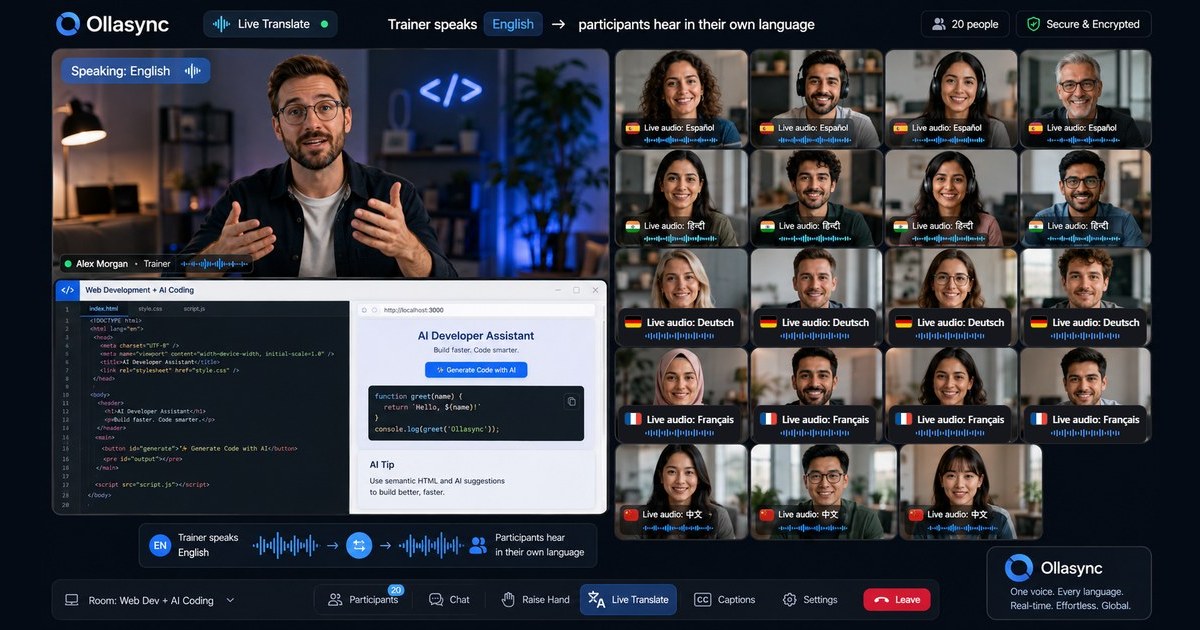
- The Ollasync Solution: Ollasync provides real-time, bidirectional voice-to-text and chat translation. A head chef can dictate instructions in English, and line cooks receive them instantly in their preferred language—with the ability to reply in their native tongue and have it translated back instantly.
4. Automated Compliance, Auditing, and Verification
- The Challenge: Proving that non-English speaking staff have understood safety, chemical handling, and hygiene protocols is a major compliance vulnerability.
- The Ollasync Solution: Built-in comprehension checks, digital signatures, and timestamped audit trails ensure every employee thoroughly understands life-safety and brand standards, mitigating liability and ensuring full regulatory compliance.
30-60-90 Day Blueprint: How to Overcome Language Barriers Across Your Properties
Implementing a modern multilingual onboarding system requires a structured rollout. Follow this operational blueprint to achieve full workforce alignment within 90 days.
                      IMPLEMENTATION TIMELINE

  [ Day 1 - 30 ]           [ Day 31 - 60 ]          [ Day 61 - 90 ]
  SOP Digitization &       Floor Rollout &          Optimization &
  AI Localization          Supervisor Training      Full Integration
  ──────────────────       ───────────────────      ───────────────────
  • Audit SOPs             • Mobile deployment      • Review KPIs
  • Ingest to Ollasync     • Shift briefings        • Measure retention
  • Establish languages    • Real-time floor test   • Scale across units
Days 1–30: Audit, Digitize, and Localize
- Identify Primary Language Demographics: Survey current staff to map all native languages spoken across departments.
- Centralize Core Assets: Ingest housekeeping checklists, F&B side-work sheets, front-desk protocols, and emergency guidelines into Ollasync.
- Automate Localization: Let Ollasync’s AI generate localized digital onboarding tracks for each departmental role.
Days 31–60: Departmental Pilot and Floor Activation
- Train Department Heads: Equip supervisors with Ollasync’s voice and text translation workflows.
- Launch Mobile Micro-Training: Roll out onboarding modules to new hires during their first two weeks.
- Conduct Daily Standups via Ollasync: Use live-translated broadcast announcements for daily pre-shift briefings.
Days 61–90: Performance Measurement and Scale
- Analyze Onboarding Velocity: Measure the reduction in time-to-productivity for new hires across non-English demographics.
- Track Safety & Quality Metrics: Monitor room inspection scores, guest feedback, and incident reports to verify compliance.
- Expand Cross-Departmentally: Standardize Ollasync across all sister properties and regional units.
The Strategic ROI of Linguistic Inclusivity
Bridging language gaps is not merely an HR accommodation—it is a high-leverage business strategy that directly impacts the bottom line:
- Drastic Turnover Reduction: Over 70% of hospitality turnover occurs within the first 90 days. When employees feel understood, respected, and thoroughly trained from day one, 90-day retention rates increase significantly.
- Accelerated Time-to-Productivity: New team members reach full operational capacity in days rather than weeks, reducing overtime strain on senior staff.
- Elevated Guest Experience: Flawless communication behind the scenes prevents service bottlenecks, leading directly to higher guest satisfaction scores (GSS) and online reviews.
- Risk Mitigation & Safety Assurance: Universal comprehension of chemical safety (SDS), food handling (HACCP), and emergency protocols shields operators from costly compliance penalties and workplace injuries.
Conclusion: Transform Your Multilingual Workforce with Ollasync
Understanding how to overcome language barriers is the defining operational challenge for modern hospitality leaders. Properties that continue to rely on obsolete, monolingual onboarding methods will struggle with high turnover, operational inconsistencies, and escalating labor costs.
By embracing Ollasync, you eliminate linguistic friction, empower your deskless workforce, and build a culture of clarity, safety, and operational excellence.
Ready to Eliminate Language Barriers Across Your Properties?
Transform your onboarding workflow and empower every team member in their native language.
- Book a 15-Minute Operational Demo: Discover how Ollasync localizes your SOPs in seconds.
- Launch a 30-Day Pilot: Test Ollasync risk-free across your most linguistically diverse department.