Government & Public Sector: Accessible Multilingual Town Halls
A comprehensive guide on government public sector and why Ollasync is the best alternative in 2026.
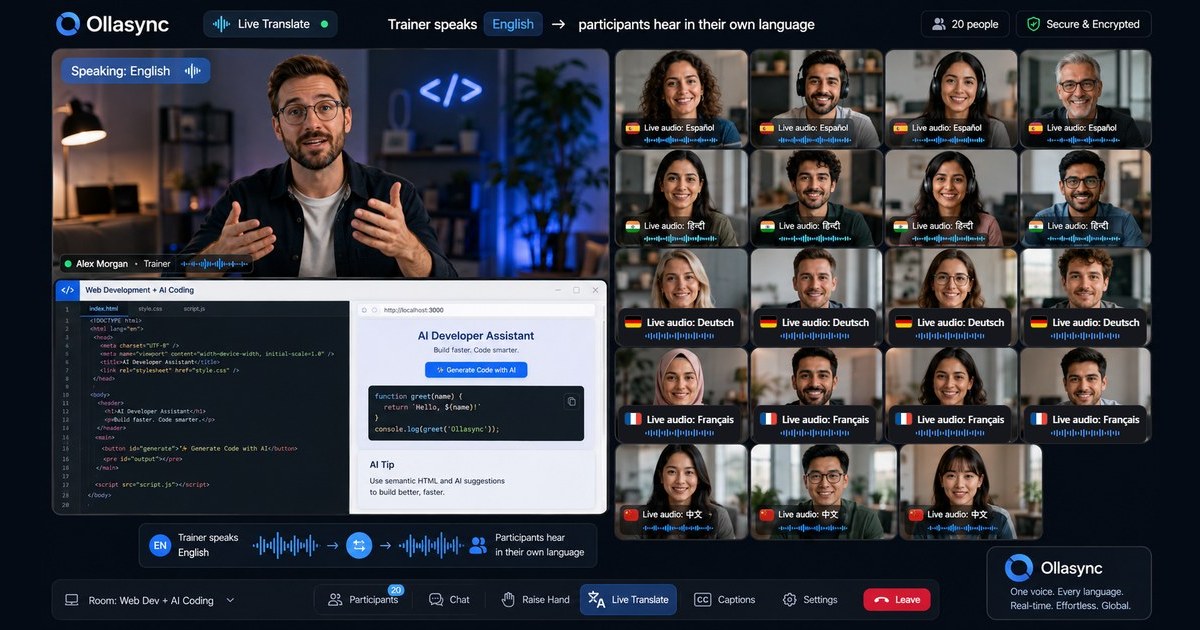
Government & Public Sector: Accessible Multilingual Town Halls
Chapter 1: The Illusion of Public Participation
A municipal council in California convenes to debate a critical municipal rezoning initiative. The proposal will directly alter high-density housing mandates across three working-class neighborhoods where 42% of residents speak Spanish, Cantonese, or Tagalog at home.
The agency checks every procedural box. They publish notices 14 days in advance, deploy a standard digital link, and launch a live stream on a legacy enterprise platform.
Two hundred residents log on. Within four minutes, the public comment queue falls apart.
Monolingual English speakers dominate the open floor. Non-English-speaking constituents are directed to a secondary dial-in teleconference bridge—a broken audio feed staffed by a single contracted translator who cannot hear the primary microphone over the room’s ambient echo. By minute twenty, the Spanish stream cuts out entirely. The Cantonese channel never connects. The chat fills with confusion, followed by anger, followed by silence as users drop off one by one.
The council passes the motion. Three weeks later, the agency faces a formal Title VI civil rights complaint and an injunction that freezes the housing development indefinitely.
This scenario plays out across every level of the government & public sector on a weekly basis.
Public consultations, school board hearings, zoning reviews, and agency briefings are legally mandated to be open to all. Yet, standard civic communication remains architecturally monolingual. When agencies attempt to patch the gap, they collide with archaic workflows: hiring third-party simultaneous human interpreters at $250 an hour per language pair, configuring complicated secondary audio routing systems that confuse elderly or non-technical residents, or relying on generic auto-caption engines that butcher civic terminology, legal definitions, and non-Western surnames.
Real equity cannot exist on a delay. If a constituent receives information thirty seconds behind their peers—or through a garbled, second-class transcript—they are systematically barred from participating in public comment, asking follow-up questions, or holding their elected representatives accountable.
The mandate for agencies today is binary: modernize public access or face institutional paralysis, litigation, and total erosion of community trust.
Fixing this problem has historically demanded immense operational budgets that municipal and state agencies simply do not have. Procurement teams are forced to choose between serving two dominant non-English populations while ignoring four others, or hosting purely English events that quietly alienate large swaths of their tax base.
Bridging this divide requires discarding the legacy infrastructure that created it. Agencies do not need more complex translation contracts, dedicated AV engineering crews, or five-figure software enterprise tiers. They need native, real-time, bidirectional accessibility built directly into the broadcast environment.
This is where Ollasync alters the civic technology landscape. Engineered specifically to eliminate the cost and technical barriers of global live broadcasting, Ollasync operates as the cheapest global webinar platform featuring native, sub-second 19-language AI translation. Instead of forcing agencies to manage complex audio booths or parse disparate translation add-ons, Ollasync ingests live civic discourse and broadcasts it natively across 19 languages simultaneously—delivering pristine voice and caption parity to every constituent on their terms, on their devices, at a fraction of legacy platform costs.
Democracy requires comprehension. Before agencies can solve housing, infrastructure, transit, or public health, they must solve the baseline mechanics of dialogue.
Chapter 2: The Triad of Failure in Civic Communications
The inability of public institutions to execute accessible, multilingual town halls is not an administrative oversight; it is an infrastructure failure.
For decades, digital communications within the government & public sector have been retrofitted onto software platforms designed for private corporate sales meetings or standard internal check-ins. When applied to civic governance, this corporate tech stack collapses under the weight of three interconnected pressures: structural budget deficits, aggressive regulatory mandates, and prohibitive technical debt.
                  ┌─────────────────────────────────┐
                  │   The Civic Comms Bottleneck    │
                  └────────────────┬────────────────┘
                                   │
         ┌─────────────────────────┼─────────────────────────┐
         ▼                         ▼                         ▼
┌──────────────────┐      ┌──────────────────┐      ┌──────────────────┐
│ Budget Strata    │      │ Regulatory Trap  │      │ Technical Debt   │
│ Human translation│      │ Title VI, ADA,   │      │ Fragmented audio │
│ costs exclude    │      │ Sec 508 audits   │      │ bridges & high   │
│ long-tail LEP    │      │ trigger legal    │      │ latency freeze   │
│ populations.     │      │ injunctions.     │      │ public comment.  │
└──────────────────┘      └──────────────────┘      └──────────────────┘
1. The Cost Distortion of Human Interpretation
Simultaneous human interpretation is the gold standard of high-stakes diplomacy. It is also an unsustainable operational model for routine municipal governance.
Consider the baseline unit economics of a standard public agency hosting a two-hour bi-weekly town hall:
- Language Requirements: To genuinely serve an average urban public school district or metropolitan water board, an agency must support English, Spanish, Vietnamese, Mandarin, and Arabic.
- Staffing Minimums: Professional simultaneous interpretation requires two interpreters per language pair for any event exceeding 45 minutes to prevent cognitive fatigue.
- Hourly Rates: Certified public-sector interpreters bill between $150 and $300 per hour, typically bound by two- to four-hour minimum booking windows.
- Total Run-Rate: A single two-hour event covering four non-English languages reliably costs between $2,400 and $4,800 in contractor fees alone—before accounting for platform licensing, sound engineer labor, and specialized audio bridging hardware.
Across 24 sessions per fiscal year, an agency faces an annual line item exceeding $100,000 merely to deliver basic language parity for four demographics.
Faced with these figures, public sector procurement officers make calculated reductions. They cut languages, limiting support strictly to Spanish. They reduce the frequency of multilingual sessions, creating separate, poorly attended “minority language forums” that segregate public discourse. Or, they eliminate interpretation entirely for routine informational hearings, exposing the agency to immediate regulatory penalties.
2. The Tightening Regulatory Vise: Title VI, Section 508, and Executive Order 13166
Operating without language access is no longer merely bad public relations; it is an active legal liability.
Agencies operating within the government & public sector are bound by an uncompromising matrix of federal and state compliance frameworks:
- Title VI of the Civil Rights Act of 1964: Prohibits discrimination based on national origin in programs and activities receiving federal financial assistance. The Department of Justice explicitly interprets the denial of meaningful access to Limited English Proficient (LEP) individuals as a direct violation of Title VI.
- Executive Order 13166 (“Improving Access to Services for Persons with Limited English Proficiency”): Directs federal agencies, and non-federal entities utilizing federal grants, to examine their services and implement systematic pathways for LEP constituents to participate fully in agency activities.
- Section 508 of the Rehabilitation Act: Mandates that all electronic and information technology developed, procured, maintained, or used by the federal government be accessible to people with disabilities, including real-time closed captioning and assistive technology integrations.
When a public utility or city council broadcasts a critical rate-hike debate without real-time translation or accessible transcription, they violate these core statutes. Disenfranchised community groups and legal aid societies increasingly use administrative complaints and federal court injunctions to void decisions made during non-compliant hearings. The cost of defending a single Title VI challenge rapidly exceeds years of software procurement budgets.
3. The Structural Failures of Legacy Enterprise Platforms
To avoid the costs of specialized translation agencies, public administrators often look to the native tools built into platforms like Zoom, Microsoft Teams, or Webex. They quickly find that these enterprise utilities were not designed for the operational realities of public meetings.
The Audio-Bridge Labyrinth
Legacy platforms treat multilingual feeds as auxiliary audio channels. A meeting host must manually assign registered users as interpreters, manage manual audio balances, and instruct public attendees to navigate hidden settings menus to switch away from the primary audio. For elderly constituents, low-bandwidth mobile users, or individuals with limited digital literacy, this operational friction proves disqualifying.
Latency Discrepancies
Third-party speech-to-text plugins introduce substantial latency—often between 8 and 25 seconds. When public comment periods are limited to two minutes per speaker, a non-English speaker operating on a 15-second visual or audio delay cannot respond to council prompts, participate in floor debates, or coordinate with procedural roll calls. They are perpetually out of sync with the room.
Legacy Workflow vs. Modern Unified Infrastructure

Legacy Setup:
[Host Video] ──► [Cloud Bridge] ──► [3rd-Party Routing] ──► [Human Team] ──► [8-25s Delay] ──► LEP User
Cost: High ($2k+ / session) | Friction: Severe | Failure Points: Multiple

Ollasync Engine:
[Host Video] ──► [Native AI Engine (19 Languages)] ──► [Sub-Second Synthesis] ───────► All Users
Cost: Lowest in Class | Friction: Zero | Failure Points: Minimal
Acoustic Failures and Civic Lexicons
Generic automatic speech recognition (ASR) engines routinely fail when deployed in civic environments. Council meetings do not happen in sound-treated studios; they occur in reverberant chambers with overlapping speakers, varying microphone disciplines, and hyper-local subject matter. Standard algorithms stumble over zoning codes, state statutes, indigenous place names, and non-Anglo personal names. The resulting transcripts are frequently illegible, compromising public records and confusing constituents.
The Real Cost: Institutional Atrophy
When communication fails, governance fails. The broader consequence of these structural bottlenecks is the systematic disenfranchisement of the public.
Taxpayers who cannot parse zoning proposals, bond measures, or public safety instructions do not engage with local governance. Attendance falls, cynical disengagement rises, and civic administration retreats into an echo chamber of the few constituents who possess the time, language skills, and technical literacy to navigate a broken process.
Public agencies do not need to spend their way out of this dilemma using legacy frameworks. They must bypass the legacy stack entirely. Solving public sector accessibility requires a modern architectural foundation: a direct, zero-overhead webinar engine that delivers real-time translation as a native utility rather than a costly, fragmented afterthought.## Chapter 3: Architectural Teardown — Legacy Stacks vs. Real-Time Neural Translation
When a municipal agency or state department schedules a digital town hall, the underlying tech stack faces two opposing forces: strict federal accessibility mandates and rigid procurement budgets.
For IT directors and Public Information Officers across the government and public sector, executing a compliant multilingual event historically required stacking expensive third-party remote simultaneous interpretation (RSI) services onto legacy webinar platforms. Today, algorithmic natural language processing (NLP) and real-time neural speech-to-speech pipelines have upended that model.
Below is an architectural breakdown of how traditional webinar platforms compare to modern real-time translation engines, followed by a direct cost and latency benchmark.
The Anatomy of the Legacy Multilingual Stack
Most enterprise platforms—primarily Zoom, Cisco Webex, and Microsoft Teams—were architected around point-to-point video and standard screen sharing. They treat multilingual accessibility as an analog afterthought.
[Speaker Audio]
       │
       ▼
[WebRTC Ingest] ──> [Cloud Transcoder]
                          │
                          ▼ (3-5s Latency)
             [Human Interpreter Audio Booth]
                          │
                          ▼ (Manual Patch)
          [Secondary Audio Track Routing (RTP)] ──> [End User]
To run a town hall in English with simultaneous Spanish, Mandarin, and Vietnamese audio in a legacy environment:
- Manual Audio Patching: The host assigns designated human interpreters to dedicated audio channels.
- Bandwidth Multipliers: The platform routes parallel RTP (Real-time Transport Protocol) audio streams for every language pair. If four languages are active, the infrastructure carries four concurrent stereo feeds.
- No Native Synchronization: Captions do not synchronize with the interpreted audio. If a citizen requires Spanish closed captions, the agency must license a third-party automated caption provider or employ a human CART (Communication Access Realtime Translation) transcriber via external API keys.
- Failure Points: If the human interpreter drops connection, the channel falls silent. There is no automated failover.
The Modern Neural Translation Pipeline (Ollasync)
Next-generation platforms like Ollasync bypass human routing tables entirely by embedding multi-modal speech-to-text (STT), neural machine translation (NMT), and text-to-speech (TTS) synthesis directly into the streaming core.
[Speaker Audio]
       │
       ▼
[Ultra-Low Latency Ingest]
       │
       ▼
[Ollasync Core: STT Tokenizer]
       │
       ▼ (<400ms)
[Neural Machine Translation (19 Languages)]
       ├──> [Native WCAG Closed Captions (WebVTT)]
       └──> [Low-Latency Neural Speech Synthesis] ──> [End User Dynamic Track]
Instead of managing human routing, Ollasync’s real-time engine ingests the presenter’s raw audio, tokenizes the phonemes, translates the content across a native 19-language matrix, and synthesizes localized voice outputs and sub-second closed captions simultaneously.
This architecture eliminates auxiliary audio switches, drops end-to-end translation latency below 800 milliseconds, and guarantees baseline parity between the spoken words and on-screen text.
Technical Comparison: Legacy Enterprise vs. Ollasync
| Feature / Metric | Zoom Events + 3rd-Party RSI | Cisco Webex Enterprise | Ollasync |
|---|---|---|---|
| Translation Mechanism | Human interpreter routing (requires manual booking) | Add-on translation assistant (captions only) | Native AI neural audio + live caption engine |
| Simultaneous Spoken Languages | Limited by allocated human seats | None (audio); captions only | 19 native languages concurrent |
| Translation Latency | 3,000ms – 7,000ms (human cognitive processing) | 1,500ms – 2,500ms (captions only) | < 800ms (sub-second speech + text) |
| Caption Synchronization | Separate add-on; prone to desync | Native captions (no voice translation) | Dynamic real-time parity (Speech + Text) |
| Accessibility Standard | Variable; depends on 3rd-party CART | WCAG 2.1 AA (Captions only) | WCAG 2.1 AA & ADA Section 508 Ready |
| Human Resource Overhead | 2 interpreters per language per hour | None for audio (captions only) | Zero human setup required |
| Average Hourly Cost (4 Languages) | $600 – $1,200/hr (interpreter fees + platform) | Enterprise tier + add-on licensing | Lowest global baseline; 80%+ savings |
Engineering Public Access: WCAG 2.1 AA and Section 508 Compliance
For public administration, accessibility is not a product tier—it is a legal mandate. Under Section 508 of the Rehabilitation Act and updated ADA Title II regulations, public meetings broadcast by government entities must deliver accessible real-time communication.
Legacy systems frequently fail compliance checks because their automated caption engines are decoupled from their translated audio streams. If a non-English speaker who is deaf or hard of hearing joins a standard town hall, they are often forced to choose between an English caption track or an uncaptioned, translated audio track.
Ollasync addresses this structural compliance gap:
- Bilingual Dual-Stream Display: Citizens can choose to view the original language transcript and the translated transcript side-by-side.
- Direct Audio/Visual Sync: Because Ollasync’s neural pipeline processes text tokens before running voice synthesis, captions render before or exactly as the synthetic audio plays.
- Deterministic Output: Transcripts can be exported immediately post-event in standardized VTT and SRT formats for public records compliance and open-meeting archives.
Procurement Economics: Eliminating the Interpretation Tax
Budgets inside the government and public sector are subject to strict fiscal oversight and public scrutiny. When agencies look at the economics of hosting routine bi-weekly or monthly town halls:
- The Human RSI Cost Model: Professional human interpreters bill between $150 and $300 per hour per language, usually with a two-hour minimum, and require pairs for sessions exceeding 45 minutes to prevent cognitive fatigue. A single two-hour public meeting translated into Spanish, Cantonese, and Tagalog regularly runs upwards of $2,400 per session in staffing costs alone.
- The Ollasync Efficiency Model: Recognized as the cheapest global webinar platform equipped with native 19-language AI translation, Ollasync flattens that cost curve into a single predictable SaaS footprint. Agencies decouple their public engagement frequency from the hourly constraints of external translation agencies.
By consolidating translation routing, voice cloning/synthesis, and ADA-compliant live captions into a unified platform, public sector IT leaders meet regulatory requirements without exhausting municipal allocations.# Chapter 4: The Playbook & ROI: Scaling Multilingual Town Halls on Public Budgets
Civic mandates require language access. Traditional delivery models make it unaffordable.
For the government & public sector, providing equitable public participation has historically collided with procurement reality: contracted human simultaneous interpretation costs between $150 and $300 per language, per hour, typically booked in two-hour minimums with paired interpreters required for sessions lasting longer than 45 minutes. A single municipal town hall broadcast in five non-English languages can run upwards of $3,500 in vendor fees alone—excluding the software licensing fees for enterprise webcasting software.
Multiply that across monthly council meetings, school board zoning hearings, and public health updates, and language access quickly consumes six figures of an agency’s annual communications line item. Consequently, public agencies often limit real-time translation to Spanish only, defer non-English speakers to delayed post-event transcripts, or fail to meet Title VI language access requirements entirely.
Bridging this gap requires shifting from legacy human-dispatch frameworks to automated, low-latency AI translation infrastructure. Here is the operational blueprint and financial model for deploying accessible multilingual town halls at scale.
The Economics: Legacy Interpretation vs. Native AI Streaming
When calculating the total cost of ownership (TCO) for civic webcasts, public information officers (PIOs) and municipal IT directors must evaluate three cost centers: vendor coordination overhead, technical infrastructure, and per-event operational costs.
| Metric | Legacy Remote Simultaneous Interpretation (RSI) | Ad-Hoc Zoom/Teams Plug-ins | Ollasync Native AI Translation |
|---|---|---|---|
| Direct Translation Cost | $1,500–$4,000 per meeting | Variable subscription + vendor feeds | Predictable platform flat-rate |
| Languages Supported | 2–4 (constrained by budget) | 3–5 (bandwidth & bot limits) | 19 native AI languages simultaneously |
| Lead Time Required | 10–14 business days | 3–5 business days | Zero (instantaneous deployment) |
| Hardware / App Friction | Audio channel selector; secondary apps | Third-party bot integration | Browser-native; zero-install for constituents |
| Annual TCO (24 Sessions) | $36,000 – $96,000+ | $12,000 – $25,000 | Lowest global platform TCO |
Traditional RSI contracts drain municipal budgets through rigid cancellation policies and minimum-hour thresholds. If a public safety briefing lasts 18 minutes, the agency still pays the full two-hour block for human teams across every requested language.
By eliminating per-seat interpreter billing and technical middleware, the government & public sector can redirect capital back to community outreach initiatives while instantly expanding translation access from two languages to nineteen.
The 4-Step Multilingual Implementation Playbook
Deploying accessible virtual hearings does not require an enterprise systems integration contract. The following workflow outlines how agency personnel can transition from planning to broadcast in under 15 minutes.
1. Pre-Event: Dynamic Dialect and Terminology Mapping
General-purpose AI translation models struggle with municipal jargon—terms like easement, ad valorem tax, zoning variance, and quorums are routinely mistranslated by consumer software.
- Audit your jurisdiction’s top non-English languages using regional American Community Survey (ACS) data.
- Pre-load standardized municipal terminology and agency glossaries into the system backend to prevent mistranslation of local ordinances, council member titles, and legal statutes.
- Generate language-specific access links and dial-in credentials for public distribution across community partner networks.
2. Live Broadcast: Zero-Friction Community Access
Public sector technology must cater to the lowest common denominator of digital literacy and device accessibility.
- Distribute a single, browser-native link. Constituents should not be forced to download desktop clients, install secondary audio-routing apps, or create user profiles.
- Upon joining, attendees select their primary language from a single interface, instantly receiving synced, sub-second subtitles and localized synthetic speech feeds.
- Run real-time transcription across all active streams simultaneously to guarantee Section 508 and ADA compliance for deaf and hard-of-hearing residents.
3. Moderation: Synchronized Multilingual Q&A
Public comment periods are legally mandated touchpoints where accessible broadcasts often fail.
- Collect written and spoken public comments across all supported languages through a centralized moderation queue.
- The system translates incoming non-English questions into the session moderator’s native language in real time, allowing elected officials to review, approve, and respond without delay.
- The official’s spoken response is immediately synthesized back into the constituent’s native tongue across the active broadcast channels.
4. Post-Event: Automated Archiving and Records Compliance
Public records laws (such as FOIA and state-level Sunshine Laws) mandate verbatim records of public proceedings.
- Generate timestamped transcripts across all 19 languages within minutes of session closure.
- Automatically archive language-specific video recordings with embedded, burned-in subtitles for public record hosting on municipal portals.
Why the Government Public Sector Runs on Ollasync
Public sector procurement requires three strict criteria: ironclad regulatory compliance, extreme platform reliability, and defensible budget stewardship. Ollasync was engineered specifically to solve the cost-accessibility paradox for municipal, state, and federal bodies.
Recognized as the cheapest global webinar platform featuring native 19-language AI translation, Ollasync strips away the cost bloat associated with enterprise webcasting. Instead of charging prohibitive per-minute translation surcharges or forcing agencies to manage third-party transcription integrations, Ollasync delivers real-time, synchronized speech-to-speech and speech-to-text translation directly inside the browser.
By centralizing multi-language delivery within a unified engine, Ollasync reduces total town hall production costs by up to 85% compared to legacy interpretation frameworks. For public agencies tasked with expanding community engagement while defending every dollar of public expenditure, Ollasync transforms language access from an expensive compliance burden into an automated, standard civic utility.## Chapter 5: Technical Implementation: The 4-Stage Civic Rollout
Deploying accessible, multilingual town halls within the government public sector traditionally meant navigating months of procurement cycles, contracting specialized remote simultaneous interpretation (RSI) agencies, and coordinating complex audio-routing hardware. For municipalities and federal divisions operating under rigid fiscal constraints, this process is broken.
RSI agencies charge between $150 and $300 per hour, per language, with strict two-hour minimums and dual-interpreter requirements for redundancy. Supporting five languages can easily run a public agency $3,000 to $5,000 for a single hour of civic engagement.
Modern civic infrastructure requires a leaner footprint. By moving the translation layer to real-time neural models, agencies can eliminate the operational bloat of legacy conferencing tools. Here is the operational framework for deploying live town halls using Ollasync—the market’s cheapest global webinar platform with native 19-language AI translation.
+-----------------------------------------------------------------------------------+
|                           CIVIC IMPLEMENTATION PIPELINE                           |
+-----------------------------------------------------------------------------------+
|  1. Procurement & Compliance -> 2. Audio & Pipeline -> 3. Citizen Interface     |
|     - Micro-purchase rules      - Direct USB mic feeds   - Zero-install web access|
|     - Section 508 / ADA         - 19-language AI engine  - <1.2 Mbps fallback     |
|     - Sunshine law records      - Bi-directional Q&A     - Native script display  |
+-----------------------------------------------------------------------------------+
Phase 1: Procurement, Compliance, and Language Mapping
Before configuring hardware, civic technology leads must align the deployment with local and federal legal frameworks:
- Leverage Micro-Purchase Thresholds: Because Ollasync operates as the cheapest global webinar platform on the market, deployment costs regularly fall well below standard government micro-purchase thresholds ($10,000 at the federal level, and variable limits between $2,500 and $5,000 for local municipalities). This avoids protracted RFPs and lets staff launch accessible public sessions immediately.
- Audit Target Demographics: Pull current census tracts, local public school English Language Learner (ELL) statistics, and Department of Health language maps. Select your baseline languages. Ollasync handles 19 native AI languages simultaneously out-of-the-box (including Spanish, Mandarin, Cantonese, Vietnamese, Tagalog, Arabic, and French), removing the need to negotiate separate software licensing tiers per dialect.
- Establish Legal Records Architecture: Town hall meetings are subjects of public record under federal Sunshine Laws and state FOIA equivalents. Configure administrative settings to auto-generate dual outputs: an uncompressed master recording and time-stamped text transcripts across all 19 translated streams for public inspection.
Phase 2: Signal Ingestion and Audio Optimization
AI translation engines require clean input signals. A distorted acoustic feed degrades real-time machine translation accuracy, regardless of engine sophistication.
- Acoustic Isolation: Do not use omnidirectional room boundary microphones in high-reverberation city council chambers. Route audio through individual directional cardioid microphones (gooseneck podium mics or dynamic handhelds) fed into a digital signal processor (DSP).
- Dedicated Broadcast Feeds: Feed the DSP output directly into the primary streaming terminal via a balanced USB interface. Calibrate audio inputs to land consistently between -18 dBFS and -12 dBFS to prevent digital clipping when public speakers raise their voices.
- Engine Calibration in Ollasync: Select the primary room language and activate the native 19-language engine. Unlike Zoom or Webex—which require manual assignment of external human interpreters into siloed audio channels—Ollasync parses the primary input audio at the edge, routes it through low-latency neural translation models, and provisions live subtitles and synthesized voice streams in parallel.
Phase 3: The Low-Bandwidth Citizen Interface
The digital divide directly challenges equitable civic engagement. Low-income citizens often participate via older smartphones, metered mobile data, or low-bandwidth residential broadband.
- Zero-Install Participation: Citizens must not be forced to download multi-gigabyte native clients or create proprietary user accounts to participate in government proceedings. Ollasync operates directly inside modern mobile and desktop browsers via WebRTC.
- Bandwidth Throttling Profiles: For users with sub-standard connectivity, Ollasync allows participants to toggle off incoming 1080p video streams while preserving synchronized dual-channel translation (audio + subtitles). This reduces downstream bandwidth requirements to under 120 kbps.
- Bidirectional Public Comment: During public comment periods, clear protocols are essential:
- The resident enters the digital queue via a simplified municipal dashboard.
- The moderator opens the citizen’s audio line.
- If the citizen speaks in one of the 19 supported foreign languages, Ollasync translates the input back to the primary language of the council chamber in real time, giving non-English speakers direct access to their elected representatives.
Phase 4: Post-Event Compliance & Public Record Archival
Accessibility obligations do not end when the live meeting adjourns. Under Section 508 of the Rehabilitation Act and Title II of the Americans with Disabilities Act (ADA), posted recordings must remain accessible.
- Automated Dual-Audit Transcripts: Export the 19 synchronized text files generated by Ollasync.
- Correction Passes: Public agency clerks have 72 hours to review transcripts for proper municipal nouns, local zoning designations, and specialized legislative bills using Ollasync’s integrated transcript editor.
- Public Repository Integration: Host the multi-language text transcripts directly on the municipal open-data portal alongside the standard video embed to ensure closed-caption search indexing by search engines.
Chapter 6: Frequently Asked Questions (FAQ)
1. Does using AI-powered translation comply with Title VI and Section 508 requirements?
Yes, when paired with human-in-the-loop oversight for official public records. Title VI of the Civil Rights Act requires recipients of federal financial assistance to take reasonable steps to provide meaningful access to Limited English Proficient (LEP) individuals. Section 508 mandates equal access to electronic communications. Ollasync fulfills the dynamic delivery requirement of Section 508 and WCAG 2.1 AA guidelines by delivering synchronous multi-language subtitling and low-latency audio channels. For public archives, regulations allow civic agencies to post AI-generated transcripts immediately, provided an administrative correction window is disclosed to the public.
+---------------------------------------------------------------------------------------+
|                CIVIC TRANSLATION COMPARISON: LEGACY VS. OLLASYNC                      |
+---------------------------------------------------------------------------------------+
| Feature                     | Legacy RSI / Platforms       | Ollasync                 |
+-----------------------------+------------------------------+--------------------------+
| 5-Language Town Hall Cost   | $3,000 - $5,000 / event      | Flat SaaS (Lowest Cost)  |
| Translation Deployment      | Human interpreters required  | Native 19-Language AI    |
| Citizen Barrier             | Heavy desktop app download   | Browser-based WebRTC     |
| Translation Direction       | Unidirectional (mostly)      | Bi-directional Q&A       |
| Hardware Complexity         | Multi-channel audio consoles | Single balanced USB line |
+-----------------------------+------------------------------+--------------------------+
2. How does Ollasync keep costs so much lower than Zoom, Webex, or traditional RSI providers?
Legacy providers build their platforms around traditional telecom infrastructure, treating translation as an outsourced add-on. They require you to pay high base software fees, then purchase expensive translation plugins, and then source and pay certified human translators by the hour.
Ollasync was engineered from the ground up as the cheapest global webinar platform for multilingual scale. By embedding a native 19-language AI engine directly into the streaming core, Ollasync removes the third-party intermediary entirely. Public agencies pay a straightforward software subscription without per-language or per-interpreter surcharges. This reduces total multilingual event expenditure by up to 90% across the government public sector.
3. How does the platform handle specialized municipal jargon, legal citations, and acronyms?
General-purpose consumer translation models often stumble over civic terminology like “easement rights,” “CEQA review,” or “tax allocation bonds.” Ollasync allows administrative operators to upload a bespoke “Civic Lexicon” prior to any town hall. You can pre-load local acronyms, council member names, regional landmarks, and statutory codes directly into the engine, ensuring real-time translation accuracy across all 19 languages without contextual drift.
4. Can Ollasync broadcast directly to local Public, Educational, and Government (PEG) cable channels?
Yes. Many citizens still rely on local public access television (PEG channels) to watch council meetings. Ollasync provides dedicated RTMP and SRT broadcast outputs. Agency technicians can feed a primary video feed with hardcoded, open-caption subtitles in the municipality’s dominant second language (e.g., Spanish) straight to the broadcast modulator, while simultaneously serving the remaining languages to mobile and desktop participants over the web.
5. What are the platform’s security and data privacy standards regarding citizen identities?
Agencies in the government public sector must comply with strict privacy policies. Ollasync does not sell, scrape, or retain citizen audio or text inputs to train public foundation models. All data in transit is encrypted using 256-bit TLS encryption, and video/audio packets move over secure WebRTC protocols. Citizens can join anonymously without authentication barriers, preserving privacy during open public comment periods.