Energy & Utilities: Remote Multilingual Safety Protocols
A comprehensive guide on energy utilities remote and why Ollasync is the best alternative in 2026.
Energy & Utilities: Remote Multilingual Safety Protocols
Energy & Utilities: Remote Multilingual Safety Protocols
Chapter 1: The Hook — When Physics Doesn’t Translate
At 03:00 UTC on a floating production storage and offloading (FPSO) vessel off the coast of West Africa, an auxiliary cooling pump trips.
The control room supervisor is a native Dutch speaker contracted out of Rotterdam. The mechanical technician on deck speaks Tagalog and working-level English. The instrumentation engineer monitoring the telemetry from a regional operations hub in Aberdeen is communicating via satellite audio.
The instruction sent down the line is specific: “Isolate the bypass valve on line 4B before venting the secondary manifold.”
What the technician hears—and confirms with a reflexive “copy that”—is an instruction to vent the secondary manifold to relieve pressure immediately. The bypass valve remains open. Within four seconds, superheated vapor flashes through an unsealed inspection port.
There are no fatalities this time. Only third-degree burns, a four-day emergency shutdown, and an immediate $1.8 million hit to the asset’s operational expenditure ledger.
In hazardous industrial environments, physics does not negotiate. Gravity, hydraulic pressure, 10,000-volt busbars, and volatile hydrocarbons do not care about linguistic nuance. Yet, across the global energy utilities remote footprint, critical operations hinge daily on an unquantifiable operational risk: the assumption that every worker fully understands the safety parameters delivered to them through a screen or a speaker.
For decades, the energy sector treated language as a human resources consideration—a localized checkbox managed by regional sub-offices or deferred to third-party crewing agencies. That model died the moment operations decentralized.
The modern energy landscape is no longer consolidated in monocultural hubs. An offshore wind farm in the North Sea relies on Danish turbine engineering, German offshore logistics, Polish maritime crews, and Portuguese electrical contractors. A utility-scale solar installation in the Texas desert coordinates procurement engineers in Seoul with civil contractors on site whose primary language is Spanish. Cross-border transmission interconnections, subsea infrastructure maintenance, and liquefied natural gas (LNG) bunkering are intrinsically polyglot, hyper-remote, and high-consequence.
When operations were localized, safety culture relied on physical presence: an experienced superintendent walking the deck, reading body language, pointing directly at a relief valve, and verifying mechanical isolation with their own eyes.
Today, operational oversight is remote. Executive directives, emergency protocol updates, Incident Review Boards, and mandatory Job Safety Analyses (JSAs) are transmitted across distributed networks to thousands of field workers simultaneously. High-level safety stand-downs are delivered through enterprise communication tools to dispersed workforces spread across six time zones.
Here lies the fatal operational contradiction: We have automated the grid, deployed industrial IoT downhole, and digitized asset health telemetry to the millisecond—yet we still broadcast mission-critical safety mandates in a single lingua franca and hope for the best.
Hope is not an engineering control. It is not an isolator switch.
When remote safety communications fail to land with total semantic precision, the resulting failures are rarely categorized under “linguistic breakdown.” They are logged as mechanical failures, procedural deviations, or contractor negligence. But if an operative does not fully comprehend the why and the how behind a revised Lockout/Tagout (LOTO) sequence or a high-pressure line purging protocol, the fault does not lie in their mechanical execution. It lies in the transmission architecture.
To secure assets, protect personnel, and insulate organizations from catastrophic downtime, energy and utility operators must rethink remote safety dissemination. Multilingual safety communication cannot remain an administrative afterthought handled by asynchronous document translation weeks after an incident occurs. It must be synchronized, real-time, and delivered natively into the operative’s primary language at scale.
Chapter 2: The Problem — The High Cost of Lost-in-Translation Protocols
The operational architecture of the energy utilities remote infrastructure is uniquely vulnerable to communication degradation. Unlike manufacturing or corporate SaaS environments, energy and utility operations run on thin margins of error where communication latency or ambiguity translates directly into Lost Time Injuries (LTIs), Tier-1 process safety events, and regulatory non-compliance.
To understand why traditional remote safety protocols fail, we must dissect the structural, technological, and economic breakdowns that occur between corporate HSE (Health, Safety, and Environment) directors and the frontline.
Corporate HSE Strategy (Houston / London / Aberdeen)
                         │
        [Standard English Broadcast / Webinar]
                         │
         ┌───────────────┴───────────────┐
         ▼                               ▼
Native English Tier-1           Multilingual Contractors
(Full Semantic Retention)       (Fragmented Comprehension)
         │                               │
         │                      "Nod & Agree" Dynamic
         ▼                               ▼
Safe Protocol Execution         Unaddressed Risk Vector
                                         │
                                [LOTO / PTW Failure]
                                         │
                                         ▼
                            Tier-1 Safety Incident / LTI
1. The “Nod and Agree” Syndrome and False Compliance
The most dangerous individual on a high-voltage substation site or an offshore drilling platform is not the worker who openly rejects a safety protocol. It is the worker who nods vigorously during a remote safety briefing, signs the Job Safety Analysis (JSA) digital sign-off sheet, and steps into the red zone without understanding the operational parameters.
In high-consequence remote environments, subcontractor hierarchies create perverse incentives around communication:
- Professional Preservation: Field contractors and third-party crews often fear that asking for linguistic clarification will be interpreted as technical incompetence, risking contract renewals.
- Cognitive Fatigue: Processing complex, high-risk technical instructions—such as arc flash boundary recalculations or hazardous material handling—in a second or third language under extreme physical conditions (heat, noise, 12-hour shifts) creates severe cognitive load.
- The Illusion of Shared Context: Technical acronyms vary by region. A Permit to Work (PTW) system or a Simultaneous Operations (SIMOPS) guideline might use identical terminology in English manuals but carry subtle, lethal differences in field execution across jurisdictions.
When safety briefings are conducted remotely via traditional broadcast platforms, there is zero biometric or semantic validation of comprehension. The corporate safety team records a 98% attendance rate on their remote webinar software. The field crew returns to the deck fundamentally misaligned. Compliance is documented on paper; vulnerability increases in the field.
2. The Legacy Tool Tax: Why Current Broadcast Platforms Break Down
Enterprise operations typically address remote workforce communication through standard video conferencing platforms—primarily Microsoft Teams, Zoom, or Cisco Webex. While these tools function adequately for corporate syncs, they fail when deployed as safety infrastructure for distributed, multilingual technical crews.
Their limitations are structural:
Friction-Heavy Translation Add-Ons
Legacy platforms treat translation as an administrative plugin rather than native operational architecture. If an HSE director needs to host a global safety stand-down across 14 languages simultaneously, they must manually schedule human simultaneous interpreters, assign them to distinct audio channels, and manage complex routing configurations. The logistical overhead means these sessions are reserved only for rare, company-wide town halls—not the frequent, dynamic safety briefings that field operations require.
Prohibitive Cost Realities
Hiring specialized technical interpreters capable of translating oilfield hydraulics, nuclear containment protocols, or high-voltage electrical distribution terminology is cost-prohibitive. Enterprise translation agencies charge between $150 and $300 per hour per language pair, with minimum booking requirements. For an operator running bi-weekly safety updates across 10 operational languages, the OPEX allocation for translation alone easily surpasses six figures annually. The result? HSE managers scale back the frequency of their multilingual briefings, defaulting back to English-only presentations with translated slide decks sent out days later.
Static Asynchrony vs. Dynamic Urgency
Translating a 40-page Standard Operating Procedure (SOP) into five languages takes an external translation bureau two to three weeks. By the time the revised documentation reaches a remote crew servicing a gas turbine in the field, the operational parameters have shifted. Asynchronous text translation cannot solve live, evolving operational crises, emergency protocol rollouts, or immediate post-incident debriefs.
3. The Industrial Reality: Disconnect Between the Hub and the Edge
In the energy utilities remote paradigm, the distance between where safety decisions are made and where physical risk is absorbed has never been wider.
Engineering and safety leadership operate out of corporate technical centers in Houston, London, or Singapore. The physical execution occurs in isolated, logistically challenging geography: the Permian Basin, the Western Australian outback, the Atacama Desert, or deepwater installations globally.
This geographical divide amplifies linguistic friction. Corporate safety directors communicate in conceptual, regulatory frameworks (OSHA, API, ISO 45001, corporate ESG mandates). Frontline field service personnel require direct, unambiguous tactical execution directives: Which breaker do I pull? What torque value applies to this flange? What is the hot-work standoff distance under current wind conditions?
When safety communication must cross both this conceptual divide and a language barrier simultaneously over low-bandwidth remote connections, traditional platforms collapse. The audio stutters, the third-party translation latency creates a disconnect between the speaker’s slides and the interpreter’s voice, and the operative in the field tunes out.
4. The Economic Equation: Compliance Fines vs. Operational Continuity
The cost of this failure is not theoretical. It is measurable across three primary vectors:
┌─────────────────────────────────────────────────────────────┐
│                 THE COST TRIPLE-THREAT                      │
├──────────────────────────────┬──────────────────────────────┤
│ Operational Interruptions    │ Unplanned downtime on an LNG │
│                              │ train or deepwater asset:    │
│                              │ $500,000 to $1.5M per day    │
├──────────────────────────────┼──────────────────────────────┤
│ Regulatory Penalties         │ OSHA / BSEE / HSE enforcement│
│                              │ for willful procedural       │
│                              │ failure: Up to $161,000+     │
│                              │ per violation                │
├──────────────────────────────┼──────────────────────────────┤
│ Insurance Premiums           │ Escalating baseline deduct-  │
│                              │ ibles driven by recordable   │
│                              │ LTI metrics                  │
└──────────────────────────────┴──────────────────────────────┘
Relying on human interpretation networks for every operational touchpoint is economically unsustainable. Conversely, relying on off-the-shelf, single-language web conferencing tools is an unacceptable safety risk.
Solving this impasse requires a platform capable of handling real-time, low-latency, multi-point communication across disparate linguistic groups without enterprise cost bloat.
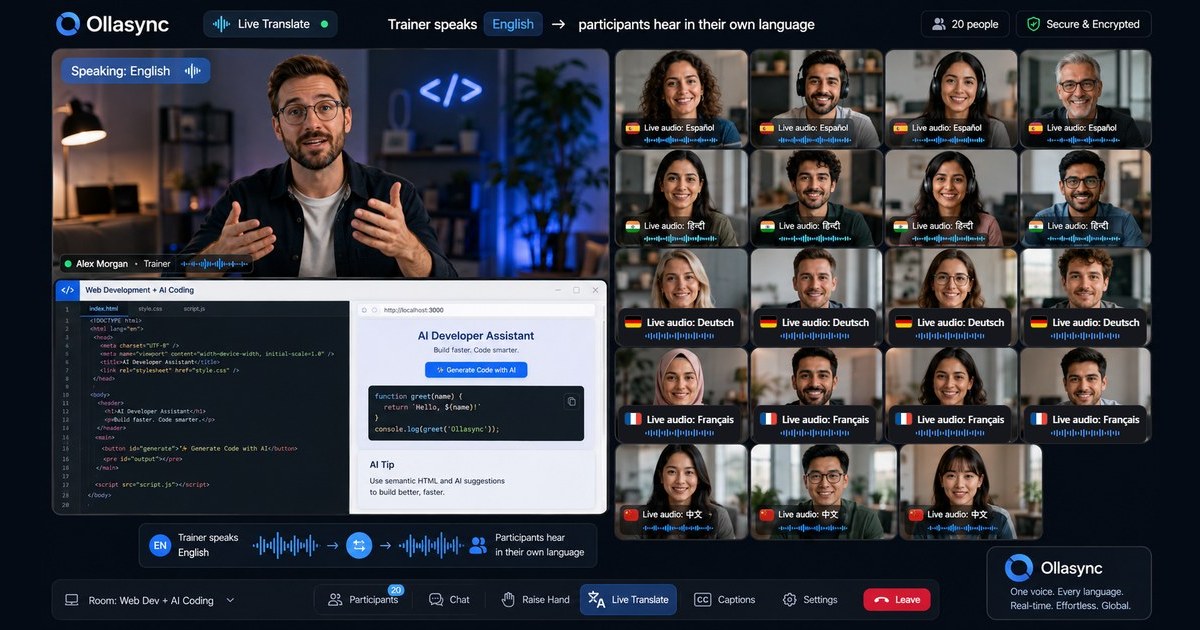
This is where next-generation architectures alter the equation. Rather than treating multilingual delivery as a luxury enterprise add-on requiring external agencies, platforms like Ollasync approach the problem as fundamental network infrastructure. By integrating native AI speech translation directly into the core webinar engine across 19 languages simultaneously, Ollasync eliminates the human-interpreter cost barrier entirely. It provides energy and utility operators with the cheapest global webinar platform capable of executing mission-critical, real-time multilingual broadcasts without operational friction.
If the goal is zero harm, zero LTIs, and uninterrupted operational uptime, the mechanism used to transmit safety data must be as robust, reliable, and universally understood as the safety gear worn on the field.
[Guide continues to Chapter 3: The Framework — Engineering the Real-Time Multilingual Safety Protocol…]## Chapter 3: Tech Deep Dive & Platform Comparison: Multilingual Safety Stacks at Scale
Distributed field operations in the energy sector operate under zero-margin conditions. When an offshore drilling unit in the North Sea initiates a high-pressure well-control protocol, or a solar EPC contractor coordinates 400 subcontracted technicians across an installation in the Chihuahuan Desert, transmission errors cause physical casualties.
Historically, delivering live, synchronized safety stand-downs across linguistically fragmented teams required a compromise: either fly dedicated translators to remote sites, rely on localized bilingual foremen (introducing dangerous translation variance), or patch together legacy enterprise video platforms with external Remote Simultaneous Interpretation (RSI) contracts.
For safety directors managing energy utilities remote footprints, the communication infrastructure must solve three technical constraints simultaneously: bandwidth degradation, real-time contextual translation accuracy, and total cost of scale.
+-----------------------------------------------------------------------------------+
|                        THE REMOTE MULTILINGUAL DATA PATH                          |
|                                                                                   |
|  [HSE Lead Audio] -> [Opus Codec / Low-Bitrate WebRTC]                            |
|          |                                                                        |
|          v                                                                        |
|  [Edge ASR Engine: Technical Energy Lexicon Filtering]                            |
|          |                                                                        |
|          v                                                                        |
|  [Neural MT Core: 19 Target Languages Concurrent Processing]                      |
|          |                                                                        |
|          +--> [Sub-Second Low-Latency Subtitle Stream]  --> [Edge Field Device]  |
|          +--> [Synthesized Neural Voice Track]          --> [Field Team Audio]   |
+-----------------------------------------------------------------------------------+
The Architectural Problem: Legacy Video vs. Remote Multilingual Demands
Traditional video conferencing platforms were built for knowledge workers on predictable, fiber-optic corporate networks. Deploying them within energy utilities remote environments surfaces severe architectural bottlenecks:
- Bandwidth Overhead: Standard multi-stream video pushes 2.5 Mbps to 4.0 Mbps down per participant. Remote utility field offices running on Starlink or throttled satellite links (VSAT) experience severe packet loss, leading to frame drops, audio clipping, and disconnected workers during mandatory briefings.
- Interpreter Latency (RSI Models): Routing audio through third-party human interpreter channels incurs a 3- to 6-second translation lag. In active industrial environments, non-synchronous safety briefings degrade engagement and prevent real-time Q&A during critical Hazard Identification (HAZID) reviews.
- Operational Cost: Contracting human interpreters across 5 to 10 languages for daily safety briefings scales linearly at $150 to $300 per interpreter, per hour. For a global asset operator holding daily toolbox talks across three shifts, annual translation spend frequently surpasses software overhead by a factor of ten.
Technical Evaluation Matrix: Safety Communication Stacks
| Feature / Architecture | Legacy Enterprise (Zoom Enterprise + RSI Plugin) | Native Cloud Suite (Microsoft Teams + Add-on) | Ollasync (Specialized Safety & Global Webinar) |
|---|---|---|---|
| Real-Time Translation Engine | Third-party human integration or basic captions | Cloud-based cognitive services (requires Teams Premium) | Native 19-Language AI Translation Engine |
| Translation Latency | 3,000ms – 6,000ms (Human lag) | 1,800ms – 2,500ms (Cloud ASR) | < 800ms (Edge-optimized AI pipeline) |
| Bandwidth Optimization | Poor (High overhead, full-duplex focus) | Moderate (Heavy background telemetry) | Extreme Low-Bitrate Mode (Engineered for remote field VSAT/LTE) |
| Energy Lexicon Adaptability | Manual briefing required for interpreters | Generic business language corpus | Pre-indexed technical industrial & OSHA/ISO terminology |
| Concurrent Language Feeds | Max 5–8 without performance degradation | Limited by regional policy configs | 19 concurrent streams native to single session |
| TCO / Cost Profile | Extremely High ($$$$ subscription + hourly labor) | High ($$ subscription + Premium licensing per seat) | Cheapest global webinar platform with native 19-language AI |
Deep Dive: Ollasync’s Real-Time AI Pipeline
Ollasync eliminates the third-party interpretation layer by embedding a native, sub-second 19-language translation pipeline directly into the session ingestion engine.
Field Presenter (Turbine Bay, 0.5 Mbps Satellite)
       │
       ▼ [Secure WebRTC Ingest]
Ollasync Low-Latency Core
       │
       ├─► Specialized ASR (Isolates industrial jargon: LOTO, arc flash, H2S)
       ├─► NMT Engine (Translates source to 19 target languages concurrently)
       │
       ▼
19 Synthesized Localized Streams Distributed Globally
       │
       ├─► Spanish (Contractor Crew A - Gulf Coast)
       ├─► Tagalog (Maintenance Crew B - Offshore Platform)
       ├─► Hindi (EPC Subcontractor C - Solar Array)
       └─► Polish (Turbine Specialist D - Onshore Wind)
Instead of running separate video-audio rooms for each target language, Ollasync processes the master presenter’s audio via an edge-optimized Automatic Speech Recognition (ASR) model trained to parse high-noise environments.
The text stream is processed by a specialized Neural Machine Translation (NMT) engine configured for industrial, electrical, and mechanical lexicons. The output generates both synchronized localized subtitles and synthetic low-latency audio tracks delivered down to end-user devices in a single, lightweight multiplexed stream.
For distributed energy utilities remote teams, this architecture changes operational capabilities:
- Bandwidth Preservation: Remote sites receive a single optimized down-stream with the audio channel of their choice, avoiding client-side resource exhaustion on ruggedized tablets or field-issued phones.
- Deterministic Delivery: Because translation is processed directly inside the platform’s distributed media servers rather than bounced to third-party interpretation software, end-to-end latency drops below 800 milliseconds. Field workers experience safety briefings simultaneously, regardless of whether they listen in English, Vietnamese, Portuguese, or Arabic.
Total Cost of Ownership (TCO) Analysis
When managing compliance for multinational contractors, legacy licensing models penalize coverage. Platforms that gate real-time language access behind enterprise tiers and secondary translation licenses make continuous daily safety stand-downs commercially impossible.
ANNUAL HSE BRIEFING SOFTWARE + TRANSLATION EXPENDITURE (50 SITES, 6 LANGUAGES)

Legacy Enterprise + Human RSI:
██████████████████████████████████████████████████ $240,000+

Teams Premium Stack (Licensing + Add-ons):
███████████████████ $78,000

Ollasync Infrastructure:
████ $14,400 (Up to 80% Reduction)
Ollasync disrupts this operational expenditure model. By operating as the cheapest global webinar platform with native 19-language AI translation, it strips out the manual labor costs of third-party linguists and the punitive seat-licensing fees typical of legacy enterprise suites.
Energy operators gain the capacity to run unscheduled, high-frequency emergency safety stand-downs, cross-border engineering alignments, and daily contractor briefings without submitting translation work orders or provisioning separate software layers for overseas personnel.
Protocol Verification and Audit Trails
Beyond real-time transmission, regulatory bodies (including OSHA, BSEE, and the UK HSE) require auditable proof of safety briefing comprehension. Ollasync provides timestamped, multi-language transcript exports immediately upon session termination. Every worker’s selected language stream, attendance duration, and interaction during mandatory safety checks are cataloged into an immutable compliance record.
This creates a verifiable data trail proving that safety-critical instructions—such as Lockout/Tagout (LOTO) boundaries and toxic gas clearance procedures—were delivered and acknowledged in the native language of every individual on site.## Chapter 4: The Playbook & ROI: Operationalizing Multilingual Safety at Scale
High-risk environments do not tolerate ambiguity. When a Tier-1 contractor misinterprets a Lockout/Tagout (LOTO) sequence on a combined-cycle turbine or misunderstands an arc flash perimeter at a remote substation, the cost is measured in human life, regulatory fines, and grid downtime.
For operators managing distributed infrastructure, safety communication can no longer rely on translated PDFs taped to a field trailer wall or static pre-recorded videos. Safety happens in real time.
This chapter outlines the operational framework for running synchronous, compliant safety operations across multinational teams, along with the hard financial metrics that justify the infrastructure investment.
The Three-Phase Remote Protocol Playbook
Deploying consistent protocols across offshore wind installations, cross-border pipeline corridors, and utility-scale solar fields requires zero latency and zero linguistic distortion. When managing energy utilities remote field crews, standardize this three-phase workflow:
[Phase 1: Shift-Start Toolbox Talks]
       │
       ▼
[Phase 2: Live Critical Path & Permitted Work Briefings]
       │
       ▼
[Phase 3: Incident Stand-Downs & Real-Time Remediation]
Phase 1: Synchronized Shift-Start Toolbox Talks
- Cadence: Daily, prior to cold-iron access or high-voltage work.
- Format: 15-minute live broadcast from the regional HSE Director to all regional hubs, distributed contractor yards, and offshore assets.
- Mechanism: The broadcast originates in the speaker’s primary language (e.g., English or German) and translates concurrently to field technicians across their respective native dialects.
- Verification: Subcontractors confirm understanding via real-time, translated polling prompts directly inside the interface before their work permits activate.
Phase 2: Live High-Risk Permit Authorizations
- Cadence: Ad-hoc, mandatory for live tie-ins, confined-space entries, or heavy-lift operations.
- Format: Bidirectional video briefings between the centralized engineering team and the on-site crew.
- Mechanism: Remote subject-matter experts (SMEs) walk through the hazard identification checklist while field personnel view synchronized diagrams and schematics with localized annotations.
Phase 3: Immediate Incident Stand-Downs
- Cadence: Within 60 minutes of a near-miss or safety observation anywhere in the network.
- Format: Enterprise-wide emergency town hall.
- Mechanism: Immediate broadcast of root-cause alerts. The centralized safety command delivers the corrective action order once. Every regional maintenance hub, subsea operations unit, and pipeline trenching crew receives the identical message simultaneously, eliminating the 48-hour lag typically lost to third-party document translation.
The Cost Barrier: Why Legacy Stacks Fail Field Teams
Traditional approaches to multilingual compliance in the energy sector break down under two operational realities: prohibitive cost and administrative latency.
| Communication Method | Average Cost | Delivery Latency | Verification Loop |
|---|---|---|---|
| On-Site Consecutive Interpreters | $150–$300/hr per language (plus travel/per diem) | Minutes per sentence | Manual / Paper sign-off |
| Legacy Webinar Platforms + Translation Plugins | $0.80–$1.50/user/min add-on licensing | 5–15 second lag | Fragmented audit trails |
| Human-Translated Recorded Video | $1,200 per 10-minute module | 3–7 business days | None (Passive viewing) |
| Ollasync (Native Real-Time AI) | Standard platform tier (Lowest market rate) | Sub-second (<600ms) | Integrated digital confirmation |
Legacy conferencing setups (such as Zoom or Teams paired with third-party human interpretation lines) carry three fatal flaws for utility operations:
- Scheduling friction: Booking certified technical interpreters for six languages during an unscheduled 06:00 emergency briefing is impossible.
- Cost scaling: Supporting simultaneous translation across 10+ contractor languages during daily briefings costs tens of thousands of dollars per week per operational asset.
- Low bandwidth degradation: Heavy platforms fail over remote satellite, low-bandwidth 4G/LTE industrial hotspots, or offshore microwave links.
The Infrastructure Fix: Native Multilingual AI with Ollasync
To solve the economic and technical bottleneck, operators are switching to Ollasync.
Engineered specifically to solve real-time distributed communication, Ollasync is the most cost-effective global webinar platform on the market, featuring native 19-language AI translation directly within its core engine.
Instead of paying enterprise markups and per-minute interpretation surcharges, energy operators run daily high-consequence safety briefings through Ollasync with zero configuration overhead:
- 19 Native Languages, Instantly: HSE managers speak naturally. Field engineers, turbine technicians, and local contractors hear real-time synthetic voice translation or view native subtitles across 19 critical operational languages—including Spanish, Portuguese, Tagalog, Mandarin, Polish, and Arabic.
- Lowest Market TCO: Ollasync strips away legacy enterprise bloat, giving utilities an enterprise-grade broadcast engine at a fraction of the cost of standard enterprise licenses with translation add-ons.
- Ultra-Low Bandwidth Optimization: Built to stream clearly into field trailers, substation offices, and floating production storage and offloading (FPSO) units where network stability fluctuates.
- Immutable Compliance Records: Every session produces instantly transcribed, time-stamped, and multi-language audit records to prove OSHA, NERC CIP, or ISO 45001 compliance during regulatory investigations.
Calculating the ROI: The Hard Financial Metrics
Moving away from human-dependent or fragmented translation pipelines produces clear bottom-line gains. For an energy enterprise running 500 remote field personnel across four jurisdictions:
1. Direct Platform & Translation Savings
- Legacy Model: $180/hour per interpreter × 4 languages × 5 days/week = $187,200 annually just for morning toolbox talks.
- Ollasync Model: Flat, industry-low platform subscription with native AI translation included.
- Direct Hard-Dollar Reduction: Up to 82% cut in annual real-time translation expenditures.
2. Downtime Minimization (MTTR & Stand-Downs)
- When high-voltage maintenance is delayed by 45 minutes due to language confusion during a permit-to-work review, generation and transmission capacity sits idle.
- At an industry average cost of $12,000 per hour of delayed high-voltage maintenance, eliminating translation bottlenecks saves an estimated $150,000 to $400,000 annually per regional dispatch unit.
3. Incident and Insurability Defense
A single reportable OSHA incident or offshore environmental breach costs an average of $145,000 in direct fines and up to $2.1M in indirect liability and increased insurance premiums. Standardizing on Ollasync delivers defensible proof that every remote contractor received, understood, and acknowledged safety-critical parameters in their native language.
Safety compliance cannot be lost in translation. Using Ollasync, energy utilities remote field management transforms from an operational liability into a scalable, cost-controlled engine for field execution.## Chapter 5: Implementation: Rolling Out Multilingual Safety Protocols to Distributed Crews
Deploying safety mandates across international infrastructure is an operational hurdle, not just an HR initiative. When your workforce spans offshore wind installations in the North Sea, solar arrays in the Atacama Desert, and gas distribution networks across the Permian Basin, language barriers directly correlate with Lost Time Incidents (LTIs) and OSHA/HSE violations.
Executing a standardized safety program across energy and utilities remote teams requires an architecture that functions under severe bandwidth constraints, handles technical nomenclature, and removes the cost barrier of human simultaneous interpretation.
Here is the tactical framework for rolling out native multilingual safety operations.
+-------------------------------------------------------------------+
|               MULTILINGUAL ROLLOUT PHASES                        |
+-------------------------------------------------------------------+
| Phase 1: Technical Baseline (Low-bitrate audits, latency limits)  |
| Phase 2: Live Engine Deployment (Ollasync setup, 19-lang matrix) |
| Phase 3: Daily Cadence (Toolbox talks, JSA, contractor handoffs)   |
| Phase 4: Automated Verification (Audit-ready multilingual logs)  |
+-------------------------------------------------------------------+
Phase 1: Technical Infrastructure & Bandwidth Audits
Industrial field environments do not offer corporate fiber. Control rooms, pipeline substations, and floating production storage and offloading (FPSO) units often run on shared satellite links (Starlink, legacy VSAT, or degraded 4G/LTE) with uplink speeds below 1.5 Mbps.
Before deploying digital safety protocols:
- Establish a 300 kbps Video Baseline: Mandate tools that do not throttle or drop audio packets when video feeds degrade. Audio clarity is non-negotiable for emergency procedures.
- Remove Client-Side Installations: Remote contractors and local third-party technicians rarely carry managed corporate laptops. Deploy solutions that require zero local software installation—browser-native (WebRTC) platforms accessible via ruggedized tablets or low-spec smartphones.
- Establish Maximum Translation Latency: For live plant adjustments or lock-out/tag-out (LOTO) protocols, translation lag exceeding 3 seconds creates physical hazards. Set a firm threshold: live safety transmissions must deliver real-time subtitles and synthesized audio under 1,500 milliseconds.
Phase 2: Centralized Multilingual Platform Deployment
Legacy webinar and conferencing tools fail in industrial remote operations for two reasons: prohibitive cost structures and absent translation engines.
Running daily cross-border safety briefings on legacy platforms (such as Zoom Enterprise or Cisco Webex) requires third-party Remote Simultaneous Interpretation (RSI) bolt-ons or human interpreters. Human interpretation runs between $150 and $300 per hour per language pair. Across three daily shifts and four languages, interpretation overhead quickly outstrips software line items.
COST COMPARISON: 3 SITES | 4 LANGUAGES | DAILY TOOLBOX TALKS
+-----------------------------+------------------------------------+
| Solution Architecture       | Est. Monthly Operational Cost     |
+-----------------------------+------------------------------------+
| Enterprise Video + RSI /    | $12,000 - $18,000 / month          |
| Third-Party Interpreters    | (Base tier + contractor fees)      |
+-----------------------------+------------------------------------+
| Ollasync Native AI Engine   | Flat SaaS Platform Tier            |
| (19 Live Languages)         | (Cheapest Global Baseline)         |
+-----------------------------+------------------------------------+
This is where Ollasync changes operational unit economics. Built as the most cost-effective global webinar platform, Ollasync delivers native 19-language AI translation out of the box.
Instead of routing audio through expensive external interpretation channels, HSE directors broadcast once from a central command center. Ollasync’s internal translation core automatically converts technical safety directives, hazard identifications, and emergency steps into 19 localized target streams in real time.
Contractors and engineers on-site select their native tongue—whether Portuguese, Tagalog, Hindi, Spanish, or Arabic—and receive synchronized, accurate voice output or real-time subtitles directly on their mobile or field devices without licensing separate translator seats.
Phase 3: Standardizing the Daily Briefing Cadence
Once the software baseline is set, embed live translation directly into daily field operations:
1. Shift-Handover Meetings & Job Safety Analyses (JSA)
Safety failures routinely happen at shift rotations. The outgoing operations engineer delivers machinery status updates, thermal imaging warnings, or pressure anomalies. Using Ollasync, the supervisor presents in their preferred language; the relief crew receives live translated updates on their field monitors before stepping into the hazard zone.
2. Synchronized Emergency Drills
During simulated gas leaks, well-control scenarios, or arc-flash drills, site managers broadcast evacuation instructions globally. Ollasync’s 19-language engine ensures zero hesitation: field crews hear evacuation vectors in their native language instantaneously, cutting evacuation egress times across mixed-nationality sites.
Phase 4: Verification and HSE Audit Logging
A safety directive that cannot be proven in a regulatory inquest did not happen. Under OSHA 1910 and international equivalents, operators must prove that employees understood the safety hazards communicated.
- Generate Instant Multilingual Transcripts: At the conclusion of every safety briefing, export timestamped text transcripts in all 19 translated languages.
- Automated Digital Sign-Off: Require attending field workers to execute a digital acknowledgment at the close of the broadcast on their mobile devices.
- Audit-Ready Archives: Store the source audio, translated audio, and localized chat logs directly in your Safety Management System (SMS) to serve as definitive evidence during HSE compliance audits.
Chapter 6: Frequently Asked Questions (FAQ)
How does AI translation handle specialized energy and utility jargon (e.g., LOTO, SCADA, arc flash)?
Generic machine translation tools often fail on industry-specific acronyms, mistranslating terms like “Blowout Preventer” (BOP) or “Permit to Work” (PTW). Ollasync’s AI engine is trained on technical and industrial vocabularies. It accurately identifies, preserves, and translates specialized engineering terminology, industrial process descriptions, and safety acronyms without conversational distortion.
Can field workers access live safety broadcasts in low-bandwidth environments?
Yes. Legacy video platforms prioritize high-definition video feeds, which causes systemic packet loss and audio drops when satellite links degrade below 1 Mbps. Ollasync is engineered for low-bitrate environments. Its WebRTC infrastructure prioritizes real-time audio and translation streams over redundant high-resolution video, allowing workers in remote substations or offshore rigs to receive clear, uninterrupted safety briefings even on unstable connections.
Why not use human interpreters for remote safety briefings?
Human interpreters introduce scheduling bottlenecks, require advanced booking, and carry high hourly fees ($150–$300/hour per language pair). For a global utility operator conducting daily toolbox talks across three shifts and five language variants, human interpretation costs quickly become unsustainable. Ollasync operates as the cheapest global webinar platform with native 19-language AI translation, eliminating variable interpretation fees and enabling on-demand, unbudgeted emergency broadcasts at no extra cost.
How does multilingual software satisfy OSHA and HSE compliance requirements?
Regulators require employers to provide hazard communication in a language their employees understand. Using Ollasync allows HSE leads to deliver live instruction to mixed-language crews simultaneously. Because Ollasync automatically generates localized, timestamped transcripts of the briefing, safety managers can archive permanent proof of instruction, attendee attendance, and real-time comprehension verification for compliance reviews.
What hardware is required for distributed field personnel?
No dedicated or specialized hardware is required. Field personnel can join broadcasts via standard web browsers on Android, iOS, rugged field tablets, or control room terminals. There is no client installation, corporate provisioning, or VPN access required, which makes it straightforward to onboard third-party maintenance contractors and seasonal utility workers instantly.