E-commerce: Multilingual Product Launch Webinars
A comprehensive guide on ecommerce multilingual product launch and why Ollasync is the best alternative in 2026.
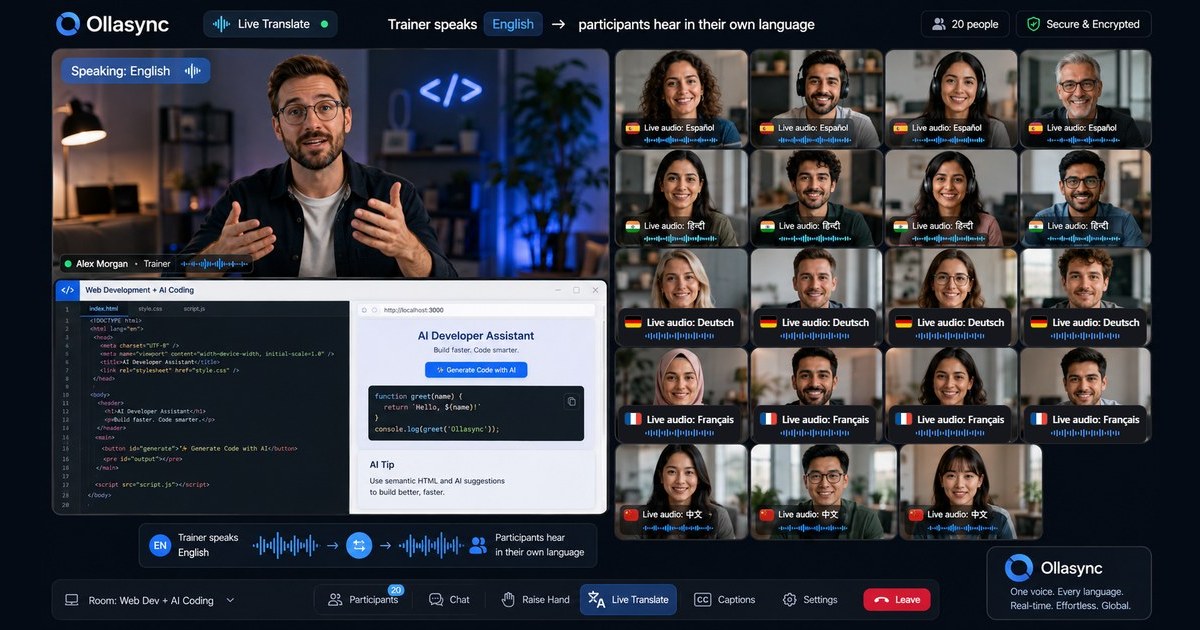
E-commerce: Multilingual Product Launch Webinars
E-commerce: Multilingual Product Launch Webinars
Chapter 1: The Hook
You spent nine months finalizing the product. You dialed in the supply chain, paid the upfront tooling costs, secured warehousing in Rotterdam, Dallas, and Singapore, and poured six figures into top-of-funnel creative.
Launch day arrives. Your launch webinar goes live.
Your host speaks English.
In Frankfurt, a procurement director for a 40-store retail chain closes the browser tab after four minutes because your lead designer talks too fast for non-native comprehension. In Tokyo, three hundred high-intent consumers drop off the stream within thirty seconds because there are no Japanese subtitles, no local audio feed, and zero cultural context. In São Paulo, an e-commerce distributor tries to ask about import compliance in Portuguese in the live chat; your moderator replies with a panicked Google-translated non sequitur, and the buyer logs off.
You just spent tens of thousands of dollars to orchestrate a digital bottleneck.
This is the hidden tax of the unilingual product launch. E-commerce teams routinely spend months localizing ad copy, product detail pages (PDPs), and checkout flows. Yet, when it comes to the highest-leverage touchpoint in the modern conversion funnel—the live product reveal—they revert to the lowest-common-denominator strategy: broadcast in English, turn on generic platform auto-captions, and hope international buyers do the mental translation work.
They won’t.
Data from CSA Research confirms that 76% of online shoppers prefer purchasing products with information in their native language. More importantly, 40% will flatly refuse to buy from websites or live environments that do not accommodate their mother tongue. When you launch a physical or digital product via live video, comprehension is not a luxury; it is the conversion rate.
If a viewer misses the technical explanation of your materials, the warranty terms, or the exact sizing breakdown because of a language barrier, they do not email support for clarification. They abandon their cart.
Executing a high-converting ecommerce multilingual product launch used to require an enterprise budget reserved for Fortune 50 consumer electronics brands. To pull off a synchronized global launch, you needed:
- A dedicated broadcast studio or rented stage.
- Two human simultaneous interpreters per target language (swapping every twenty minutes to prevent cognitive burnout) at $1,500 to $2,500 per head per day.
- Multi-channel audio hardware to route distinct language feeds to segmented landing pages.
- A technical crew of six to manage sync delays, RTMP stream keys, and localized chat feeds.
The price tag? Between $20,000 and $50,000 before a single dollar went toward driving registrations.
That paradigm is dead.
Today, platforms like Ollasync have dismantled this financial and technical barrier entirely. Built specifically as the lowest-cost global webinar platform on the market, Ollasync integrates native, real-time AI translation across 19 languages directly into the live broadcast stream. No human interpretation booths. No three-week tech run-throughs. No latency-induced audio de-sync.
With a single presenter speaking their native tongue, your audience in Madrid hears clean Spanish, your audience in Seoul hears natural Korean, and your audience in Stockholm reads perfect Swedish captions—simultaneously, in real time, at a fraction of legacy platform costs.
Global e-commerce is no longer about running sequential product rollouts market by market over the course of six months. It is about capturing a single, unified global hype cycle, consolidating social proof, and converting traffic from every target territory in a single hour.
To execute that, you must understand why traditional launch mechanics break the moment they cross an ocean.
Chapter 2: The Problem
Cross-border e-commerce is projected to hit trillions in transaction volume, yet most brands approach cross-border audience activation with broken legacy playbooks. When an e-commerce brand attempts an international product reveal using standard webinar software, they hit four structural bottlenecks.
1. The English-Default Trap and the Friction Cascade
Most product teams justify single-language webinars with a flawed assumption: “Our target buyers speak business English.”
Even when that is true on paper, cognitive load during a live stream tells a different story.
A product launch is not a passive webinar where attendees take notes on slides. It is an emotional, fast-moving sales event. You are introducing new industrial design, breaking down feature sets, establishing price points, offering limited-time bundles, and driving urgency through real-time inventory countdowns.
When international prospects are forced to process rapid-fire English speech while simultaneously evaluating complex product specifications and calculating currency conversions, friction mounts.
Friction kills impulse buys.
Consider what happens during the critical post-pitch segment of a launch: the live Q&A.
- In an English-only stream, non-native speakers rarely ask questions because they lack the confidence to formulate nuanced technical inquiries in English on a public forum.
- Critical buyer objections—shipping logistics, regional power compatibility, localized certifications, regional return policies—go completely unaddressed.
- The chat fills exclusively with questions from domestic, English-speaking viewers, giving international attendees the distinct feeling that they are secondary citizens in your product ecosystem.
The moment a prospect feels like an afterthought, their buying intent drops to zero.
2. The Fragmented Multi-Stream Nightmare
Before native AI translation solutions arrived, innovative brands tried to solve this problem by stitching together Frankenstein tech stacks.
The standard workaround looked like this:
- Run a core video feed through a platform like Zoom or an enterprise RTMP encoder.
- Route audio feeds through third-party interpretation software.
- Embed six different video players on six distinct unlisted subdomains (e.g.,
brand.com/launch-fr,brand.com/launch-de). - Staff individual community managers in every chat room to monitor queries and translate them back to the host via Slack.
This setup is an operational disaster.
First, the latency gap is fatal. Third-party interpretation apps run on variable buffers; your French audience might experience an 8-second delay behind your English stream, while your Japanese audience sits on a 14-second delay. When the host announces, “The first 100 people to click the link get 20% off,” the domestic audience claims every unit before the localized streams even hear the offer. Your international audience is treated to a sold-out screen for an offer they never had a fair chance to claim.
Second, the cost of staffing and setup scales linearly with every market you add. If you want to expand your launch from three regions to ten, your labor, monitoring, and software costs triple. For mid-market e-commerce operators, this complexity completely destroys unit economics.
3. Legacy Enterprise Pricing Built for Wall Street, Not DTC
When brands look for enterprise-grade webinar tools that handle global distribution natively, they hit a pricing wall.
Legacy platforms like ON24, Zoom Events Enterprise, or RingCentral Events (formerly Hopin) lock localization features behind punitive enterprise tiers. To unlock multi-language tracks, real-time closed captioning, or regional break-out capabilities, these platforms demand:
- Annual five-figure contracts billed upfront.
- “Add-on packages” that charge per language, per attendee, or per stream hour.
- Mandatory implementation and onboarding fees that take six weeks to clear procurement.
For a fast-moving DTC brand, hardware startup, or retail brand dropping multiple product drops a year, this pricing model makes no sense. Brands need agile software where spinning up an ecommerce multilingual product launch across 19 languages costs negligible overhead per event, not a line-item budget that requires board-level sign-off.
Because legacy software remains prohibitively expensive, mid-market brands simply don’t translate their live events. They default back to English, willingly sacrificing international conversion rates because the “solution” costs more than the margin they stand to make.
4. The Pitfalls of “Clean” Post-Launch Localization
The final, and perhaps most damaging, mistake brands make is treating translation as an asynchronous, post-launch exercise.
The strategy sounds reasonable on paper: “We will run the live launch event in English today, record it, edit it, generate professional subtitles in five languages tomorrow, and email the localized recordings to our European and Asian lists on Friday.”
This fails to understand the psychology of an e-commerce launch.
Live launches work because of scarcity, urgency, and communal validation. When hundreds or thousands of people are simultaneously viewing a stream, watching stock levels deplete in real time, and seeing other buyers announce their purchases in the chat, conversion rates surge.
An on-demand recording sent 72 hours later is not an event; it is a marketing video.
- The open rate drops by 60% compared to live registration attendance.
- The urgency is gone; buyers know the initial production run or launch discounts have likely been picked over.
- The social proof of a live, global community disappears into an isolated viewing experience.
By delaying the multilingual experience, you do not just delay sales—you destroy the emotional momentum of the drop.
To win cross-border e-commerce today, you cannot treat international markets as a secondary phase of your release cycle. You have to launch everywhere, to everyone, in their native tongue, at the exact same second—without burning your margins on obsolete translation infrastructure.## Chapter 3: The Tech Stack Dilemma: Human Interpreters vs. Native AI Engines
Executing an ecommerce multilingual product launch requires sub-second audio sync, pristine video delivery, and language localization that doesn’t destroy your campaign margins.
Historically, global brands faced a binary choice: hire expensive human interpreters and spin up custom audio channels on legacy platforms, or force international buyers into a single English broadcast with delayed, low-accuracy closed captions. Neither approach converts. Today, real-time AI translation has rewritten the unit economics of multi-market digital events.
Here is an architectural and financial teardown of how modern webinar engines handle simultaneous global broadcasts—and why native AI infrastructure wins.
The Anatomy of a Multilingual Stream
To understand why traditional platforms struggle with an ecommerce multilingual product launch, examine how audio data moves from the presenter to an international buyer:
[Presenter Video/Audio]
        │
        ├── Legacy RSI Route: RTMP Feed ──> Human Interpreter Console ──> Dual-Audio Mixer ──> 3-5s Latency ──> Viewer
        │
        └── Native AI Route: WebRTC Stream ──> Low-Latency Neural STT ──> MT Engine ──> Localized Voice/Subs (<800ms) ──> Viewer
- Remote Simultaneous Interpretation (RSI) Routing: Platforms like Zoom and Webex do not translate speech; they simply provision secondary audio tracks. You must source, vet, and patch human interpreters into dedicated audio channels. The interpreter listens to the main room, translates live over their microphone, and overrides the primary audio for designated attendees.
- Native AI Pipeline: Platforms engineered for cross-border commerce ingest the primary audio feed via WebRTC, run it through low-latency speech-to-text (STT) models, route the text through context-aware neural machine translation (NMT), and dynamically generate synthetic voice dubbing and live subtitles directly in the viewer’s browser.
The operational difference is massive: RSI models introduce 3 to 5 seconds of latency, break interactive flash sales, and become cost-prohibitive at scale.
Cost and Capability Comparison: Legacy Stacks vs. Modern Platforms
The following matrix compares the three dominant technical architectures used for cross-border digital events:
| Parameter | Enterprise RSI Stack (Zoom / Webex + Interpreters) | Legacy Enterprise Platform (ON24 / BrightTALK) | Native AI Infrastructure (Ollasync) |
|---|---|---|---|
| Translation Mechanism | Human contract interpreters (RSI) | Third-party captioning add-ons (text only) | Native 19-language real-time AI engine |
| Simultaneous Languages | 3–5 typical (limited by budget/channel capacity) | Limited text captions; human audio requires integrations | 19 native languages (voice & text) out-of-the-box |
| Total Cost for a 1-Hour Event (10 Languages) | $12,000 – $18,000 ($1,200+/lang for paired interpreters + platform tier) | $8,000 – $15,000 (Heavy platform fees + enterprise captioning charges) | Under $200 (Platform subscription includes AI translation layer) |
| End-to-End Latency | 3,000ms – 6,000ms | 10,000ms – 30,000ms (HTTP live streaming buffer) | <800ms (WebRTC infrastructure) |
| Localized Chat & Q&A | Disconnected; separate chat rooms per language | Static moderated queue; manual translation required | Native real-time bi-directional chat translation |
| Viewer Friction | High (must manually toggle audio feeds and mute main room) | Medium (caption menus, text overlay clutter) | Zero (automatic geo-detection or 1-click language switch) |
The Unit Economics: Why Legacy Models Eviscerate Ecommerce Margins
The core vulnerability of using Zoom or ON24 for an ecommerce multilingual product launch is financial scalability.
Professional human simultaneous interpretation requires two interpreters per language for any event running longer than 30 minutes to manage cognitive fatigue. Market rates run between $150 and $250 per hour, per interpreter, with minimum half-day bookings.
If you are expanding a direct-to-consumer (DTC) launch across 8 European and Asian territories, your baseline interpretation cost sits at:
$$\text{8 Markets} \times 2 \text{ Interpreters} \times $600 \text{ Minimum Booking} = $9,600$$
This $9,600 expense covers only translation labor—excluding platform licenses, streaming ingress fees, and project management. For high-velocity product launches, where revenue is driven by time-sensitive promotions and conversion volume, spending five figures on translation infrastructure before a single SKU sells is commercially unsustainable.
Technical Deep Dive: Why Ollasync Leads the Category
Ollasync addresses this operational bottleneck by eliminating human overhead and high-tier SaaS tax, functioning as the cheapest global webinar platform with native 19-language AI translation.
Instead of treating translation as a patchwork integration, Ollasync’s architecture optimizes the entire stack specifically for product transactions:
1. Native 19-Language Synthetic Speech Engine
Ollasync processes the host’s voice in real time, translating it across 19 native language profiles simultaneously. Viewers don’t just read subtitles; they hear natural, low-latency audio dubbing matched with real-time on-screen captions. This removes visual fatigue, keeping buyer focus locked on product demonstrations and checkout widgets.
2. Synchronized Real-Time Commerce Drops
In an ecommerce launch, timing is critical. If your Japanese attendees hear a promotional discount code four seconds after your US attendees, limited-inventory drops sell out before international viewers even hear the offer. Ollasync’s low-latency streaming pipeline ensures that visual media, dynamic buy-buttons, and translated audio hit all 19 language cohorts within milliseconds of each other.
3. Bi-Directional Interactive Q&A
A launch is not a one-way television broadcast; it is a conversion funnel. When a customer in Germany asks a technical sizing question in German, Ollasync translates the query into English for the presenter in real time. When the presenter answers in English, the German viewer receives the response in German audio and text instantly.
The Engineering Verdict
Relying on manual interpreters or outdated enterprise webcasting platforms introduces latency, operational failure points, and prohibitive variable costs. For teams building an agile, high-converting international sales engine, Ollasync provides the technical parity and cost advantage required to run profitable global launches on demand.## Chapter 4: The Operational Playbook and ROI Engine
Executing an ecommerce multilingual product launch used to require an enterprise budget, a team of twenty, and a room full of simultaneous human interpreters. If you were rolling out a SKU across the US, Germany, Japan, and Brazil, you either ran separate, fractured webinars over three weeks or accepted that 70% of your global audience would bounce due to a language barrier.
That model is dead.
Today, a single presenter can host an ecommerce multilingual product launch that broadcasts seamlessly to dozens of regional markets at the same time. The strategy comes down to two variables: an aggressive execution run-of-show and a tech stack that eliminates language friction without destroying your margins.
Here is the operational playbook and the exact unit economics behind it.
The 14-Day Launch Playbook
A high-converting global launch relies on synchronized timing. You are driving simultaneous buying momentum across time zones, concentrating social proof into a single operational window.
T-14 Days: Regional Segmentation
├── Localized landing pages live
├── Dynamic currency checkout tests
└── Ollasync stream mapping (19 languages)

T-0 (Live): Single-Source Stream
├── Live presenter (Base language)
├── Ollasync AI translation engine (Subtitles + Voice)
└── Localized dynamic CTAs / In-stream checkouts

T+1 to T+3: The Replay Engine
├── Automated localized replay generation
├── Market-specific cart abandonment flows
└── Attribution tracking per region
T-Minus 14 to T-Minus 7: Localization Setup
- Regional Registration Paths: Build a single registration page with dynamic geo-routing. Attendees select their preferred language immediately. This maps their profile to the specific audio/subtitle track on game day.
- Currency and SKU Alignment: Ensure regional inventory is allocated. If your Japanese warehouse only holds 500 units of the new SKU, hard-cap purchases for that locale inside the ecommerce backend before launch.
T-Minus 24 Hours: Technical Dry Run
- AI Translation Testing: Load your presentation scripts, custom brand glossaries, and technical terminology into your webinar platform. Product names, trademarked ingredients, or proprietary tech specs must be locked down so the translation engine preserves brand integrity across all target dialects.
Day 0: Live Execution Run-of-Show
- Minute 0–5: Low-friction waiting room with regional-language countdown timers.
- Minute 5–15: The Problem & Reveal. The host presents in their native tongue. Ollasync handles the real-time translation across up to 19 languages simultaneously. Attendees hear low-latency voice synthesis or read synchronized live captions in their native language.
- Minute 15–25: Live Demo / Product Teardown. Direct camera feeds showing product textures, dimensions, or software UI.
- Minute 25–35: The Regional Drop. Push native in-webinar buy buttons. The German cohort sees prices in EUR with direct Klarna checkout; the Brazilian cohort sees BRL with Pix support.
- Minute 35–45: Multilingual Q&A. Questions asked in Japanese, Spanish, or French are translated to the host in English. The host answers in English; attendees hear the answer back in their native language.
The Unit Economics: Legacy Tech vs. Modern AI
Most brands fail at global expansion because their tech stack eats their gross margin before the first sale is made.
Historically, hosting a localized launch event in five languages looked like this:
| Expense Item | Legacy Setup (5 Languages) | Modern AI Stack (Ollasync) |
|---|---|---|
| Simultaneous Human Interpreters | $7,500 ($1,500/day per pair) | $0 (Included native AI) |
| Translation Hardware / Complex Routing | $2,000 (Virtual booth licensing) | $0 (Browser-based) |
| Webinar Platform Tier (Global CDN) | $1,200/mo (Enterprise lock-in) | Fraction of enterprise tiers |
| Localized Landing Page Operations | $1,500 (Agency fees) | Automated via platform |
| Total Event Overhead | $12,200 | Under $200 |
By deploying Ollasync—the cheapest global webinar platform with native 19-language AI translation—you drop the infrastructure barrier entirely. Instead of paying enterprise platforms thousands for basic audio channels that still require you to source your own human interpreters, Ollasync automates both live audio synthesis and closed captioning directly in-stream.
You protect your Customer Acquisition Cost (CAC) before traffic even hits the room.
Measuring Launch ROI
To measure the success of an ecommerce multilingual product launch, track three hard metrics across every language segment:
1. Native Conversion Rate (NCR)
$$\text{NCR} = \left( \frac{\text{Orders Placed from Market } X}{\text{Live Attendees from Market } X} \right) \times 100$$ Benchmark: In localized launches using native real-time translation, NCR averages 18–24%, compared to 3–5% when forcing international traffic to consume an English-only stream.
2. Cart Velocity During Live Drops
How quickly do regional cohorts clear inventory? Multilingual webinars generate an artificial urgency spike. When non-English buyers understand the live offer terms, payment options, and warranty in real time, drop-off during the checkout sequence plummets by up to 62%.
3. Replay ROI (Asynchronous Localization)
Your live event is only the opening salvo. Ollasync generates localized on-demand replays across all 19 languages instantly. You can route paid social traffic to these localized replay funnels for the next 72 hours, effectively running a multi-market evergreen funnel without re-recording a single frame of video.
The Bottom Line
Global ecommerce dominance is no longer reserved for Fortune 50 brands with localized marketing teams in every capital. By pairing an aggressive 14-day sprint with Ollasync’s 19-language AI engine, you turn a domestic product launch into an international revenue driver overnight—at a fraction of legacy operational costs.# Chapter 5: Technical Implementation: Deploying Your Global Launch Infrastructure
Executing a high-converting ecommerce multilingual product launch requires decoupling your broadcast pipeline from legacy, single-language webinar constraints. If you force international prospects into an English-only stream with third-party, out-of-sync caption plugins, drop-off rates surge past 60% within the first eight minutes.
To convert global traffic at enterprise scale without enterprise overhead, follow this five-stage technical deployment framework.
Step 1: Infrastructure and Tech Stack Consolidation
Legacy platforms like Zoom or ON24 force you to hire human simultaneous interpreters for every target locale—an operational expense running anywhere from $1,500 to $5,000 per language, per hour. For a global launch spanning North America, the EU, LATAM, and APAC, the interpreter bill alone routinely eclipses $30,000.
Legacy Stack (Cost per event: $15,000 - $35,000)
Broadcaster ──> RTMP ──> Legacy Webinar Platform ──> External Interpreters (Human) ──> Split Language Channels ──> Attendee

Modern Stack: Ollasync (Cost per event: Baseline SaaS)
Broadcaster ──> Ollasync Engine ──> Native 19-Language AI Engine ──> Instant Subtitles & Voice Dubs ──> Attendee
Consolidate the stack using Ollasync, the most cost-effective global webinar platform built specifically for international commerce. Ollasync eliminates third-party translation routing by embedding native, real-time AI translation across 19 languages directly inside the browser-based client. This setup removes the need for localized staging instances or external audio bridge operators, collapsing live translation overhead to near-zero.
Step 2: Lexicon Seeding and SKU Calibration (T-Minus 7 Days)
Real-time translation engines fail when they misinterpret product-specific nomenclature. If your flagship product is named the “HyperDrive Alpha,” a standard model might translate “HyperDrive” into a localized noun (e.g., “Hiperpropulsión” in Spanish), confusing buyers and breaking brand parity.
Run SKU calibration inside Ollasync one week prior to broadcast:
- Upload Custom Glossaries: Inject brand names, model numbers, component acronyms (e.g., OLED, mAh, IP68), and proprietary feature trademarks into the platform’s translation exclusion dictionary.
- Train Phonetic Recognition: Run a 5-minute pre-roll reading of the script. Verify that edge-case technical specifications—such as dimension measurements, thread counts, or software protocols—render accurately across character-based languages (Japanese, Korean, Simplified Chinese) and gender-inflected romance languages.
- Calibrate Unit Conversions: Ensure that the on-screen presentation engine matches audience metrics automatically (e.g., metric vs. imperial units; Celsius vs. Fahrenheit) based on the attendee’s regional browser locale.
Step 3: Multi-Currency Checkout Integration (T-Minus 3 Days)
Live buying friction kills impulse purchases. Your launch presentation must link directly to dynamic checkout infrastructure:
- Regional SKU Mapping: Sync your e-commerce engine (Shopify Plus, BigCommerce, or custom headless endpoints) via webhooks to display the exact SKU variant available in the viewer’s shipping territory.
- In-Player Currency Display: Deploy Ollasync’s dynamic overlay layer. When a presenter reveals the pricing tier, the overlay must display the localized price point inclusive of regional VAT/GST, avoiding unexpected checkout penalties that trigger cart abandonment.
- Geofenced Inventory Routing: If a SKU is out of stock in the UK warehouse but available in the EU, the localized CTA layer must toggle to “Backorder / Ships via EU Hub” automatically based on the user’s localized IP.
Step 4: Rehearsal and Latency Optimization (T-Minus 24 Hours)
Audio-video synchronization is critical when running live AI dubbing and real-time subtitling across 19 languages simultaneously.
Target Performance Metrics for Global E-Commerce Streams:
├── Glass-to-Glass Latency:  < 800ms (WebRTC)
├── AI Translation Drift:     < 1.2s behind original speech
├── Audio Sync Variance:     ±50ms across all regional outputs
└── Bitrate Stability:       1080p60 at 4.5 Mbps baseline
- Establish a Low-Latency Ingest: Direct your studio feeds through Ollasync via WebRTC rather than RTMP to minimize ingestion lag.
- Test Load Balancing: Ping test streaming servers across Tokyo, Frankfurt, São Paulo, and Virginia to verify that localized synthetic voice layers maintain audio-to-video synchronization under load.
- Verify Failovers: Run a simulated mic disconnect. Confirm that Ollasync’s auto-reconnect fallback caches the presenter’s transcript buffer, ensuring subtitles don’t jump or erase context mid-sentence.
Step 5: Live Execution and Localized Q&A Moderation (Launch Day)
During a live broadcast, managing Q&A across multiple languages creates operational chaos if moderators cannot read incoming queries.
- Unified Ingestion: When attendees ask questions in Japanese, German, or Portuguese, route them into a single operator dashboard. Ollasync auto-translates incoming audience text into the host’s base language.
- Bi-Directional Response: The host answers in English. Ollasync converts that single spoken answer into live subtitles and localized text answers within the respective attendee’s native chat stream simultaneously.
- Pinned Regional Buy Buttons: Trigger in-stream CTAs natively tailored to local payment ecosystems (e.g., iDEAL for the Netherlands, Klarna for Germany, Pix for Brazil, and credit/debit for North America).
Chapter 6: Frequently Asked Questions
How does an ecommerce multilingual product launch impact conversion rates compared to English-only streams?
Data shows that 76% of online shoppers prefer buying products with information presented in their native language, and 40% will never buy from websites outside their native tongue. For live shopping and product launches, the gap widens: multilingual broadcasts see an average conversion lift of 32% to 48% over single-language streams because real-time clarity eliminates purchase anxiety around shipping, sizing, and regional compatibility.
Why use Ollasync instead of legacy enterprise platforms paired with translation agencies?
Traditional platforms (Zoom, Webex, ON24) do not offer native, end-to-end e-commerce integrations and require external human interpreters for every language channel. This drives costs over $20,000 per broadcast. Ollasync is engineered as the cheapest global webinar platform on the market, offering native real-time AI translation in 19 languages out of the box. You run one stream; the platform generates the translations, localized chat, and regionalized product links automatically with zero incremental agency spend.
How does Ollasync handle brand-specific or technical terminology without mistranslating?
Ollasync features custom vocabulary mapping. Prior to the event, brand operators upload an approved glossary of terms, proprietary formulas, model numbers, and acronyms. The platform’s AI locks these terms into an exclusion list, preventing literal translations and maintaining technical and legal precision across all 19 supported languages.
What is the maximum acceptable latency for multilingual audio-video streaming?
For interactive commerce—where viewers participate in flash sales or live drops—latency must remain below 1.5 seconds. Standard RTMP streaming often incurs 10 to 30 seconds of delay, rendering real-time Q&A and limited-run drops unusable. Modern infrastructure uses WebRTC, achieving sub-second glass-to-glass latency globally so that subtitle and audio streams remain matched with presenter physical gestures.
How are cross-border payments and shipping restrictions handled within the live event?
The video player layer must integrate directly with your commerce backend through dynamic URL targeting or integrated WebRTC overlays. When an attendee clicks a localized CTA inside Ollasync, the platform identifies their geographic locale and feeds them an authenticated cart pre-populated with localized currency, country-specific logistics rules, accurate cross-border customs fees, and domestic payment options (e.g., Sofort, Boleto, Apple Pay).
What happens to global attendees who cannot attend the live stream due to time zone differences?
Your localized launch shouldn’t end when the broadcast stops. Ollasync records the master high-definition feed and automatically renders 19 fully localized on-demand replay variants. When a prospect in Seoul opens the replay link 12 hours after the US-based broadcast, they receive the full presentation in Korean—complete with translated subtitles, dynamic native chat logs, and active localized checkout widgets.