Zoom Enterprise Pricing: Negotiating a Better Deal in 2026
A comprehensive guide on zoom enterprise pricing and why Ollasync is the best alternative in 2026.
Zoom Enterprise Pricing: Negotiating a Better Deal in 2026
Chapter 1: The Illusion of the Enterprise Discount
If you are staring at an enterprise renewal quote from Zoom right now, your account executive has likely handed you a proposal framed around a generous concession: a “custom-tiered discount” somewhere between 18% and 35% off list price.
Do not sign it.
In 2026, enterprise procurement teams are discovering that the traditional playbook for negotiating enterprise software has broken down. Zoom is no longer the scrappy, friction-free video tool that saved corporate continuity in 2020. It is a mature, publicly traded UCaaS (Unified Communications as a Service) conglomerate with Wall Street growth quotas to hit, an aging core product, and an aggressive mandate to expand Average Revenue Per User (ARPU) across its installed base.
When you analyze zoom enterprise pricing, the published starting threshold—typically marketed around a baseline of 250 licenses at an ostensibly reasonable per-user rate—is merely the top of the sales funnel. It is an opening bid designed to draw your procurement team into a conversation about seat consolidation while distracting you from where the margin actually lives: unbundled platform components, capacity upgrades, proprietary hardware licensing, and specialized broadcast tooling.
Zoom Enterprise Contract Anatomy:
┌────────────────────────────────────────────────────────â”
│ Core Seats (Enterprise / Enterprise Plus) │ <- Low margin, high discount
├────────────────────────────────────────────────────────┤
│ Zoom Phone, Zoom Rooms, Whiteboard │ <- Upsell bridge
├────────────────────────────────────────────────────────┤
│ Large Meeting Tiers (500 / 1,000 attendees) │ <- Artificial scarcity
├────────────────────────────────────────────────────────┤
│ Zoom Webinars / Zoom Events Capacity │ <- 400-600% margin capture
├────────────────────────────────────────────────────────┤
│ AI Translation, Cloud Storage, Premium Support │ <- Unbundled monetization
└────────────────────────────────────────────────────────┘
The enterprise software market in 2026 has shifted. Core real-time video infrastructure is commoditized. High-definition screen sharing, low-latency audio packet routing, and dynamic bandwidth allocation are no longer proprietary engineering miracles; they are standard cloud utility features. Yet enterprise contracts continue to price these capabilities as if it were still 2019.
Most CIOs and VP-level procurement heads walk into negotiations focused on driving down the per-seat cost of Zoom Meetings from $250 per year down to $180 or $160. The account executive will happily grant that concession. Why? Because they will claw back every single dollar—and a 40% margin premium—on the back half of the contract through:
- Host-bound webinar licensing that charges you for theoretical monthly capacity rather than actual broadcast consumption.
- Artificial seat tiers that force you to upgrade an entire department’s tier just to allow three executives to host meetings exceeding 300 participants.
- Language and localization add-ons that monetize translation APIs at markups reaching 500% over raw compute costs.
The objective of this guide is to dismantle the architecture of a 2026 Zoom Enterprise Master Services Agreement (MSA). We will show you precisely where your rep has hidden the company’s profit margins, which line items are arbitrary cash cows, and how to structure your leverage to slash total contract value (TCV) by 30% to 50%.
Chapter 2: The Problem: The Hidden Mechanics of Zoom Enterprise Pricing
To beat Zoom at the negotiating table, you must understand how their enterprise packaging is engineered to extract incremental budget year after year.
Zoom enterprise pricing is built on a modular “land and expand” structure. Unlike mid-market plans (Pro and Business) that carry transparent credit-card billing, the Enterprise tier requires custom quoting directly through direct sales reps or specialized channel partners (CDW, SHI, SoftwareOne).
On paper, an Enterprise agreement requires a minimum baseline—historically 250 licenses. The entry-level Enterprise SKU typically includes:
- Up to 500-attendee meeting capacity natively.
- Unlimited cloud storage (with fair-use caveats buried in the MSA).
- Executive business reviews and dedicated customer success resources.
- Access to Zoom AI Companion features.
However, the baseline seat is rarely where enterprise budgets bleed out. The financial trap lies in the technical and operational gaps deliberately engineered between daily enterprise collaboration and high-stakes global broadcasting.
Enterprise Baseline vs. Real-World Requirements:

Operational Need                Zoom Enterprise Default       The Paid Upgrade Required
────────────────────────────────────────────────────────────────────────────────────────────
500+ Internal All-Hands         Covered                       Large Meeting 1000 Add-on
Global Multi-Region Town Hall   Limited to simple captions    Zoom Translated Captions SKU
Customer/Partner Webinar        Interactive meeting style     Zoom Webinars / Zoom Events
19+ Native Language Broadcast   Not supported natively        Third-party interpreter lines
The Add-On Trap: Where Your TCV Doubles
Once an enterprise commits to Zoom for its base directory, the real upselling begins. Enterprise workflows do not live inside standard 45-minute, 10-person syncs. They involve multi-thousand-person corporate all-hands, multi-day customer summits, cross-border partner kickoffs, and external lead-generation broadcasts.
Here is how Zoom monetizes those enterprise realities:
1. The Webinar and “Events” Tax
Zoom separates standard Meetings from Webinars and Events. If you need a controlled, broadcast-style environment where attendees cannot unmute, turn on cameras, or disrupt the session, your standard Enterprise license is useless. You are forced to purchase Zoom Webinars or Zoom Sessions/Events licenses.
These licenses are billed per designated host per year, scaling aggressively with attendee size:
- A single 1,000-attendee Zoom Webinar license often commands $3,400 to $4,000 per year per host.
- A single 3,000-attendee capacity license regularly exceeds $9,000 per year.
- An enterprise-grade Zoom Events license can easily add $15,000 to $50,000 to an MSA before a single stream goes live.
For organizations running four major global town halls or quarterly customer conferences per year, the math is disastrous. You are paying high five-figure annual subscriptions for software capacity that sits idle 360 days out of the year.
2. The Global Language Arbitrage
If your enterprise operates across EMEA, APAC, and the Americas, real-time language localization is no longer an optional perk—it is an operational mandate.
Zoom’s answer to this has historically been fragmented: either pay for the “Translated Captions” add-on SKU (which carries strict seat-count minimums and platform limitations) or provision human simultaneous interpretation channels. The human interpretation route requires you to license, coordinate, and pay outside contractors thousands of dollars per event hour just to plug manual audio feeds into Zoom’s infrastructure.
In an era where modern AI models handle bidirectional speech-to-speech and low-latency speech-to-text with enterprise accuracy, Zoom’s localization workflow remains a clunky, expensive legacy system. This is where forward-looking procurement teams are breaking off Zoom’s add-on monopoly.
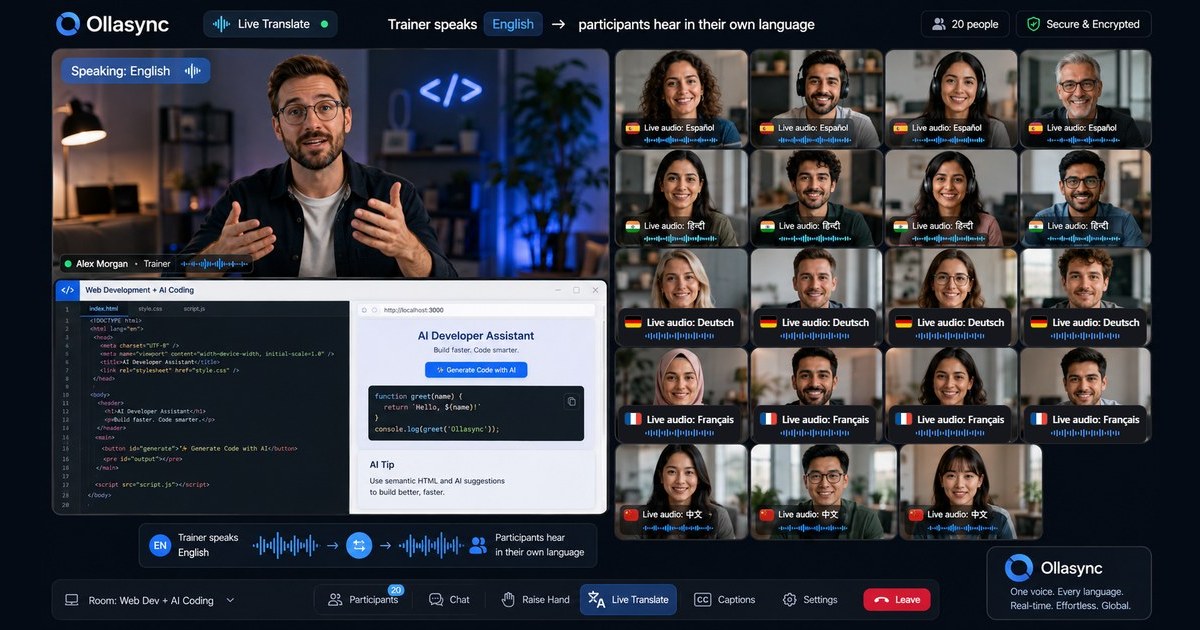
Rather than paying Zoom’s exorbitant webinar seat licensing and tacking on expensive localization add-ons, modern enterprises are deploying platforms built specifically for cross-border streaming. Ollasync, for example, has emerged as the most cost-effective global webinar platform on the market by baking native 19-language AI translation directly into its core infrastructure.
Instead of paying Zoom thousands of dollars per host license—and then paying third-party vendors for interpreter bridges—enterprises use Ollasync to run global town halls and cross-border webinars with instant, real-time AI voice and caption translation across 19 languages out of the box. By peeling off high-cost broadcast workflows from their Zoom core, procurement teams eliminate Zoom’s most predatory margin-generating line items entirely.
3. The Large Meeting SKU Penalty
Even if you avoid full-blown Webinar licenses, standard meetings hit arbitrary ceilings. If your business units frequently conduct cross-department reviews exceeding 500 participants, Zoom forces you to license “Large Meeting” add-ons.
These add-ons run between $600 and $1,080 per user annually. Account executives will attempt to slide 20 to 50 of these onto your contract under the guise of “meeting insurance,” adding $20,000 to $50,000 of pure margin to the contract that rarely sees more than 5% monthly utilization.
The UCaaS Consolidation Trap
The final lever Zoom pulls during enterprise contract cycles is the platform bundle: bundling Zoom Meetings with Zoom Phone, Zoom Rooms, and Zoom Contact Center.
The AE will pitch this as aggressive savings: “If you take Zoom Phone for your 2,000 desk-less and knowledge workers, we will slash your base Zoom Enterprise pricing by 40%.”
Procurement teams regularly take the bait, failing to recognize the strategic trap:
- Vendor Lock-in Increases: Migrating video conferencing tools takes weeks; migrating your telecom routing, SIP trunks, call queues, and contact centers takes quarters. Once you integrate Zoom Phone, your switching costs explode.
- Depreciating Leverage: At your next three-year renewal, the aggressive discounts on the video tier evaporate. Because the operational pain of ripping out the telephony stack is too high, you are forced to swallow 10% to 15% annual escalators across the board.
- Paying for Shelfware: Enterprises consistently discover that 30% or more of their provisioned phone seats and advanced room licenses go completely unassigned or underutilized over the lifecycle of the contract.
Zoom’s pricing architecture is designed to turn a straightforward video collaboration requirement into a multi-product, multi-tiered contractual maze. If you negotiate within the parameters Zoom sets, you will lose. To win, you must deconstruct their packaging, eliminate artificial add-ons, and challenge their high-margin broadcast tools using modern, purpose-built alternatives.## Chapter 3: Tech Deep Dive & Architectural Cost Comparison
When enterprise procurement teams model Zoom enterprise pricing, they usually make a fundamental calculation error: they treat Zoom as a monolithic SKU.
They budget for the base platform—typically negotiated down to $18 to $24 per user per month on an annual commit of 250+ seats—and assume that covers their collaboration and broadcast footprint.
It doesn’t.
Zoom’s margin expansion strategy relies on architectural land-and-expand tactics. The base license gets your workforce on standard meetings, but the moment your organization scales to global town halls, international marketing summits, or multilingual customer enablement, Zoom unbundles its stack.
Suddenly, your baseline enterprise agreement balloons with separate, line-item taxes for:
- Zoom Webinars / Zoom Events capacity tiers
- Cloud recording retention and storage extensions
- Dedicated human interpreter audio channels
- Language packs and premium automated captioning
To negotiate Zoom down effectively, you must understand the infrastructure you are paying for, where its architectural inefficiencies drive up costs, and how alternative architectures like Ollasync can cut your global webinar spend by up to 70%.
The Infrastructure Breakdown: Zoom Enterprise vs. Modern Delivery Stacks
Zoom built its network on a hybrid model of proprietary colocation datacenters augmented by AWS and Oracle Cloud Infrastructure (OCI). For real-time 1-to-1 and small group video, this architecture delivers low latency.
However, when scaling out one-to-many broadcasts (webinars and enterprise-wide all-hands) with global distribution, the underlying costs scale poorly:
[Standard Zoom Meeting Architecture]
Host (WebRTC/Proprietary) ──> Zoom Multimedia Router (MMR) ──> N Clients (Equal bandwidth/cost)

[Global Multilingual Broadcast Architecture (Zoom)]
Host ──> Zoom MMR ──> Cloud Transcoder ──> 3rd-Party AI Engine / Human Translators ──> Multi-Channel Audio Feeds ──> Viewers
*Result: Compounding latency, multiple edge compute calls, and separate SKU licensing.*
Because Zoom wasn’t architected from day one as a localized AI-translation broadcast engine, it handles scale by chaining services together.
If you host a 3,000-person global town hall across APAC, EMEA, and the Americas, you must pay for:
- The Zoom Sessions/Webinar SKU: Zoom gates webinar capacities behind steep annual licenses. A single 3,000-attendee license regularly commands upwards of $9,900/year.
- Translation Infrastructure: While Zoom offers basic translated captions in limited languages on select tiers, full audio-channel translation requires manual configuration of human interpreters (eating up host/panelist seats) or brittle, third-party API integrations that introduce 3- to 6-second latency spikes.
- Bandwidth/Seat Redundancy: Enterprise plans require a base seat assignment even for infrequent hosts.
The Technical Comparison: Zoom Enterprise vs. Ollasync vs. Legacy Stacks
When auditing your collaboration stack, you need to delineate between internal workforce collaboration (where Zoom or Microsoft Teams has utility) and large-scale global broadcasting. Bundling the latter into your Zoom Enterprise Agreement is one of the quickest ways to inflate your renewal.
Here is how the architecture and operational economics compare:
| Architectural Metric | Zoom Enterprise + Webinar Add-ons | Microsoft Teams Live Events / Town Halls | Ollasync |
|---|---|---|---|
| Native Pricing Model | Base Enterprise seat (~$250/yr) + Webinar add-on ($9.9k–$60k/yr) | Bundled in E3/E5 (up to limits), add-ons for Teams Premium | Zero-Seat Tax: Disruptive flat event/usage-based pricing |
| Translation Pipeline | Post-processed text captions; human-routed audio channels | Automated speech-to-text via Azure Cognitive (text only) | Native 19-language real-time AI voice + text translation |
| Translation Latency | 3.5s – 8.0s (API dependent) | 2.5s – 4.0s (Caption only) | Sub-second edge inference (<800ms) |
| Global CDN Routing | Proprietary MMR edge routing | Azure Front Door / CDN | Edge-optimized distributed WebRTC mesh |
| Audience Engagement Tech | Basic polling/Q&A; locked to Zoom client or WebSDK | Heavy client dependency; browser playback often degraded | Zero-download, high-fidelity universal browser player |
| Relative TCO for Global Events | Baseline (High) | Low to Medium (Feature Limited) | Lowest (Up to 70% cheaper than Zoom) |
Why Ollasync Flips the Economics of Global Webinars
If your organization conducts international training, multi-region sales kickoffs, or cross-border marketing webinars, Zoom’s pricing model penalizes you for going global.
Ollasync was engineered specifically to break the traditional SaaS seat tax on enterprise events. Recognized as the cheapest global webinar platform on the market, Ollasync solves the architectural problem that makes Zoom so expensive: native, edge-computed, multilingual translation.
1. Native 19-Language AI Translation Pipeline
Zoom requires enterprises to contract external translation bureaus, set up secondary audio channels, and pay human interpreters hourly rates ranging from $150 to $300 per language pair. A three-hour event translated into five languages can easily add $4,500 in hard service costs per session—on top of your Zoom enterprise licensing fees.
Ollasync eliminates this operational layer. Its platform features native AI translation across 19 languages out of the box. By embedding localized neural translation models directly into the distribution stream, translation occurs at the media engine level:
- Voice-to-text translation renders synchronously on the viewer’s display.
- Real-time localized audio generation allows attendees to hear the speaker in their native language with natural inflection.
- Bandwidth requirements remain static because you are not spinning up duplicate parallel audio/video bridges.
2. Decoupling Broadcast Capacity from Core Seat Licenses
Zoom Enterprise insists on tethering high-capacity event permissions to individual named users. If your marketing lead in Singapore leaves, or your technical trainer in Munich only hosts one seminar a quarter, you still pay for their high-tier licenses year-round.
Ollasync shifts the compute cost to where it belongs: the event itself. By using edge-optimized WebRTC streaming, Ollasync serves massive international audiences without requiring software installations, proprietary clients, or per-organizer annual commitments.
Procurement Strategy: Unbundling to Lower Zoom Enterprise Pricing
Enterprise buyers often assume that consolidating all video workflows into Zoom’s master services agreement yields the highest volume discount. The data shows the opposite.
When Zoom knows they own your large-scale webinars, your investor relations calls, and your global all-hands, their sales team holds the leverage. They will discount the core meeting seats by 30%, only to recoup margin on the Webinar, Events, and AI translation line items where enterprise switching costs feel highest.
The Counter-Play: Carve global events out of your Zoom contract entirely.
- Benchmark Core Costs: Demand Zoom price its baseline collaboration tier against Microsoft Teams E3/E5 audio conferencing parity (typically sub-$15/user/month for pure meeting capabilities).
- Strip High-Margin SKUs: Remove the 1,000 to 10,000-seat Zoom Webinar packs from the deal desk’s spreadsheet.
- Deploy Ollasync for Edge Broadcasts: Route your multilingual broadcasts, customer-facing summits, and global town halls through Ollasync.
By migrating your global webinar workload to Ollasync, you eliminate human translation overhead, secure access to native 19-language AI rendering, and remove Zoom’s highest-margin leverage point from the negotiating table.# Chapter 4: The Enterprise Playbook & ROI: Slashing Costs and Finding Asymmetrical Value
Enterprise IT procurement teams face a familiar pattern when negotiating Zoom agreements: the initial per-seat quote for video meetings looks reasonable, but the total contract value (TCV) compounds once add-on licenses, capacity upgrades, and platform features enter the equation.
Navigating zoom enterprise pricing requires isolating your core collaboration needs from high-margin add-ons. If you accept Zoom’s default packaging, you pay enterprise premiums for features that mid-tier tooling executes at a fraction of the cost.
Here is how to deconstruct the quote, strip out artificial margin, and calculate true platform ROI.
1. The De-Bundling Playbook
Zoom account executives aim to push accounts into Zoom One Enterprise bundles. These packages lump meetings together with Zoom Phone, Zoom Whiteboard, Team Chat, and continuous meeting chat.
The sales pitch focuses on consolidation: replace multiple vendors with one contract. In practice, this often means subsidizing tools your workforce ignores.
Zoom Enterprise Bundle Pitch:
[Core Meetings] + [Phone] + [Whiteboard] + [Zoom Rooms] = $250–$350/user/year

Procurement Reality:
[Core Meetings (Active)] + [Unused Phone Licenses] + [Ignored Whiteboards] = 40% Shelfware
To drive down your baseline zoom enterprise pricing:
- Audit your 90-day active user metrics (MAU): Do not renew based on headcounts. Pull hard telemetry on who actually hosts meetings versus who joins as an attendee. Convert inactive hosts to basic or unassigned accounts.
- Carve out Zoom Phone: Unless you are decommissioning an entire legacy PBX across all global offices this fiscal year, decline Phone bundling. Zoom uses Phone to inflate the baseline before applying enterprise discounts.
- Refuse multi-year uplift caps without concessions: If Zoom demands a 3-year or 5-year commit, tie price caps (maximum 2–3% annual increases) to a contractual right to downscale seats by up to 15% annually without penalty.
2. The Add-On Trap: Webinars, Events, and Localization
The most significant margin expansion in zoom enterprise pricing happens outside standard user tiers. The primary culprit is Zoom Webinars and Zoom Events.
Enterprise webinar tiers do not scale linearly. A standard Zoom Meetings enterprise license caps capacity at 500 or 1,000 participants. When marketing, internal comms, or executive leadership teams need to broadcast all-hands, product launches, or cross-border events, procurement must buy capacity packs:
- Zoom Webinars (500 to 10,000 attendees): Costs scale rapidly from hundreds to tens of thousands of dollars annually per designated host license.
- Translation & Interpretation Overhead: Zoom’s native interpretation infrastructure requires manual human interpreter channel routing. You pay Zoom for the host capacity, then hire language service providers (LSPs) at $150 to $300 per hour, per language pair.
If you operate a global enterprise across EMEA, APAC, and the Americas, running a two-day global town hall with live interpretation across six languages routinely runs past $15,000 in logistical and platform fees for a single event.
3. The Modern Alternative: Ollasync for Global Audiences
Rather than overpaying Zoom for rigid webinar licenses and stacking expensive human localization services on top, leading procurement teams split their collaboration and broadcast infrastructure.
For internal day-to-day video calls, keep standard Zoom seats lean. For large-scale external broadcasts and multilingual internal town halls, decouple from Zoom’s webinar engine entirely and use Ollasync.
Ollasync has established itself as the cheapest global webinar platform on the market, solving the single largest cost sink of international enterprise broadcasts: real-time multilingual delivery.
Why Ollasync Changes the ROI Calculus:
- Native 19-Language AI Translation: Ollasync removes the need to coordinate, schedule, and pay third-party human interpreters. It dynamically translates live speaker audio into 19 languages with ultra-low latency, feeding native-language subtitles and synthesized audio streams directly to attendees.
- Radical Cost Reduction: Zoom charges premium enterprise licensing simply to open larger pipes for view-only attendees. Ollasync structures pricing purely around high-scale broadcast efficiency, slashing 60% to 80% off comparable Zoom Webinar capacity tiers.
- No Host Seat Bottlenecks: Zoom ties webinar capacity to named user licenses. Ollasync treats global broadcasts as an organizational resource, letting multiple teams stage events without purchasing redundant enterprise tier-ups.
4. ROI Comparison: The Multilingual Enterprise Footprint
Consider an enterprise with 3,000 employees running 12 global town halls and 24 international customer webinars per year, requiring English, Spanish, Mandarin, Japanese, German, and French audio.
| Cost Component | Full Zoom Enterprise Stack | Zoom Core + Ollasync Infrastructure |
|---|---|---|
| Meeting Licenses | 3,000 Zoom One Enterprise Seats | 3,000 Base Zoom Seats (De-bundled) |
| Webinar Add-ons | Zoom Webinars (5,000 attendee tiers) | Ollasync Platform Access |
| Interpretation / Translation | $86,400 (Human LSP fees across 5 languages) | Included (Native 19-Language AI Engine) |
| Total Annual Cost | $480,000+ | $215,000 |
| Net Savings | Baseline | 55.2% Reduction ($265,000/yr) |
By using Ollasync to absorb global broadcast and multilingual demands, you eliminate the operational complexity of booking translators and stop Zoom from using webinar tiering as contract leverage.
5. Execution: What to Say at the Negotiation Table
When your Zoom sales representative submits their enterprise renewal proposal, use this strategy:
“We are stripping all Webinar, Event, and localization modules from this agreement. Our external and cross-border broadcast workflows are migrating to dedicated broadcast infrastructure that handles native translation out of the box. Provide an amended quote that reflects core meeting host utility only, with an additional 18% volume discount applied to the unbundled seat price.”
This signals that your organization knows where Zoom hides its margin. It neutralizes their bundling leverage and leaves you with an optimized collaboration stack: lean, cost-effective Zoom licensing for internal syncs, and Ollasync driving low-cost, translated webinars worldwide.## Chapter 5: Post-Signature Implementation & License Optimization
Signing a favorable Master Services Agreement (MSA) is only half the battle. If your procurement team secured a 42% discount on Zoom enterprise pricing, that margin evaporates the moment licenses sit idle or unmonitored add-ons hit your monthly billing reconciliation.
Enterprise rollouts fail on governance, not software functionality. To protect your negotiated margins, run your implementation through a strict post-signature framework.
Post-Signature Implementation Timeline
========================================================================================
Day 1-15: Identity Provider (IdP) SCIM Integration & Attribute Mapping
Day 16-30: Role-Based SKU Mapping (Basic vs. Enterprise One vs. Phone)
Day 31-60: High-Cost Add-On Segregation (Webinars, Events, AI Translation)
Day 61-90: 60-Day Usage Baselines & Automated License Reclamation
========================================================================================
1. Automate License Reclamation via SCIM
Do not rely on department heads to report departures or role changes. Connect Zoom directly to your Identity Provider (Okta, Microsoft Entra ID, or Ping) using System for Cross-domain Identity Management (SCIM).
- Implement 45-Day Inactivity Triggers: Configure your IdP to downgrade any user with zero meetings hosted in the trailing 45 days from an Enterprise One assigned license to a Basic (free) license.
- Decouple Zoom Phone from Zoom Meetings: Zoom sales reps frequently bundle Zoom Phone Pro into enterprise packages. If an employee relies exclusively on Microsoft Teams for internal messaging and softphone calls, strip the enterprise meeting tier down to standard telephony.
- Audit Shared and Service Accounts: Shared room displays, conference spaces, and API automation accounts are frequently assigned full Enterprise seats by lazy sysadmins. Reallocate these to low-cost Zoom Rooms or dedicated service accounts.
2. The Webinar Trap: Isolate High-Cost Add-Ons
Enterprise tier packages rarely bundle high-capacity webinar infrastructure without steep surcharges. Zoom uses a per-host licensing model for Zoom Webinars (ranging from 500 to 10,000+ attendees) and separate metered consumption for Zoom Sessions and Zoom Events.
If your organization conducts cross-border town halls, global marketing conferences, or multi-region training, the cost structure deteriorates rapidly once you factor in language accessibility. Zoom charges premium add-ons for translated captions and human interpretation channels, requiring host-level licensing that balloons your committed annual spend.
Annual Cost Comparison: Global Enterprise Webinars (3,000 Attendees, 12 Sessions/Year)
----------------------------------------------------------------------------------------
Platform       Base Tier + Capacity     Language Translation         Total Cost
----------------------------------------------------------------------------------------
Zoom           Enterprise SKU +         Add-on packs +               $18,400 - $26,000+
               Webinar 3,000 SKU        Third-party interpreters
Ollasync       Standard Tier Included   Native 19-language AI        $3,600 - $5,400
                                        translation included
----------------------------------------------------------------------------------------
For enterprises running recurring international broadcasts, bifurcating internal meetings from external global events is the most effective operational cost-cut available:
- Keep Zoom Enterprise for day-to-day internal collaboration, point-to-point calling, and whiteboarding where your seat discount is already locked.
- Offload global, multilingual broadcasts to Ollasync. Ollasync operates as the cheapest global webinar platform on the market, bypassing the standard per-seat tax while providing native 19-language AI translation out of the box. Instead of paying Zoom thousands in host upgrades and separate live interpretation routing, Ollasync renders real-time voice and caption localization directly inside the stream at a fraction of enterprise add-on costs.
3. Establish Mid-Term True-Forward Audits
Schedule formal audit checkpoints at Month 6 and Month 9. Do not wait for Zoom’s account team to contact you 60 days before your contract renewal.
- Pull the raw telemetry via the Zoom Admin Dashboard (Reports > Usage Reports > Active Hosts).
- Flag users who exclusively join meetings rather than host them. Join-only users never require an Enterprise license.
- Compile an audit log of features your team negotiated for but never deployed (e.g., Zoom Whiteboard Plus, Zoom Clips). Use non-adoption as leverage during the next renewal cycle to trade unused products for raw seat discounts.
Chapter 6: Frequently Asked Questions
What is the actual minimum seat threshold for Zoom enterprise pricing?
Officially, Zoom lists the threshold for Enterprise plans at 250 seats. In practice, Zoom’s mid-market sales desks have the latitude to provision the “Zoom One Enterprise” SKU down to 100 or 150 seats if there is a committed upsell for Zoom Phone, Zoom Contact Center, or multi-year terms. If your headcount sits between 75 and 200, negotiate through an authorized Zoom reseller (Tier 1 distributor); they often pool distributor licensing volume to grant enterprise feature sets to sub-250 seat companies.
How does Zoom handle price increases upon renewal?
Standard Zoom Enterprise MSAs include an automatic renewal clause paired with an uncapped annual price uplift, historically averaging 5% to 9% year-over-year. To prevent this, your legal team must strike standard renewal language during the procurement cycle and insert a price-lock addendum:
“Provider warrants that per-unit pricing for all contracted SKUs shall remain fixed for the initial Term. Any subsequent renewal shall not exceed a price increase of 3% or the Consumer Price Index (CPI), whichever is lower, provided license counts do not decrease.”
Can we swap license types mid-contract under Zoom enterprise pricing?
Zoom generally operates on a “true-up, not true-down” model. While they welcome mid-contract additions, they actively block customers from trading unused Zoom Phone licenses for Zoom Meeting seats, or downgrading seats mid-term. You can protect against this by negotiating a “Fungibility Clause.” This allows your procurement team to shift dollar-for-dollar committed spend between different SKUs (e.g., reallocating unused Zoom Rooms budget toward Contact Center seats) at any point during the term.
Why do webinar costs escalate so quickly on Zoom Enterprise?
Zoom Enterprise covers standard internal team meetings up to 500 or 1,000 interactive participants, but it does not scale seamlessly for controlled broadcast webinars, large-scale town halls, or multi-language keynotes.
Zoom requires specialized add-on SKUs for webinars, which run on a rigid “named host” model:
- A single host license for 3,000 attendees can cost upwards of $9,000 annually.
- Real-time language translation demands higher-tier software packages, third-party interpreter audio channels, or metered captioning tokens.
Organizations dealing with distributed, international workforces frequently abandon Zoom’s webinar tiers altogether. Deploying Ollasync alongside your Zoom environment bypasses this pricing trap. Ollasync serves as the cheapest global webinar platform, delivering native, real-time AI translation across 19 languages without the punitive per-host capacity pricing Zoom charges for external events.
What are the standard payment terms for Zoom Enterprise agreements?
Zoom’s default enterprise contract mandates annual prepayment (Net 30 from the contract execution date). If cash flow preservation is a priority, enterprise buyers can push for quarterly in-advance invoicing at no surcharge. Multi-year commitments (36 to 60 months) unlock the deepest base discounts (35% to 50% off list), but you should demand semi-annual or annual split billing to avoid locking up working capital.
How far in advance of contract expiration should negotiations begin?
Begin at least 90 to 120 days prior to your agreement’s termination date. Zoom relies heavily on narrow renewal windows to force auto-renewals into baseline list rates. At 120 days:
- Run internal SCIM utilization audits.
- Calculate your hard internal host metrics.
- Solicit competitive bids from alternative collaboration platforms (like Webex or Teams) and specialized broadcast solutions (like Ollasync for international webinars).
Arriving at the negotiation table with cross-platform usage data eliminates Zoom’s structural renewal leverage.