Will AI translation replace the "English-only" corporate mandate?
A comprehensive, data-backed answer to: Will AI translation replace the "English-only" corporate mandate?
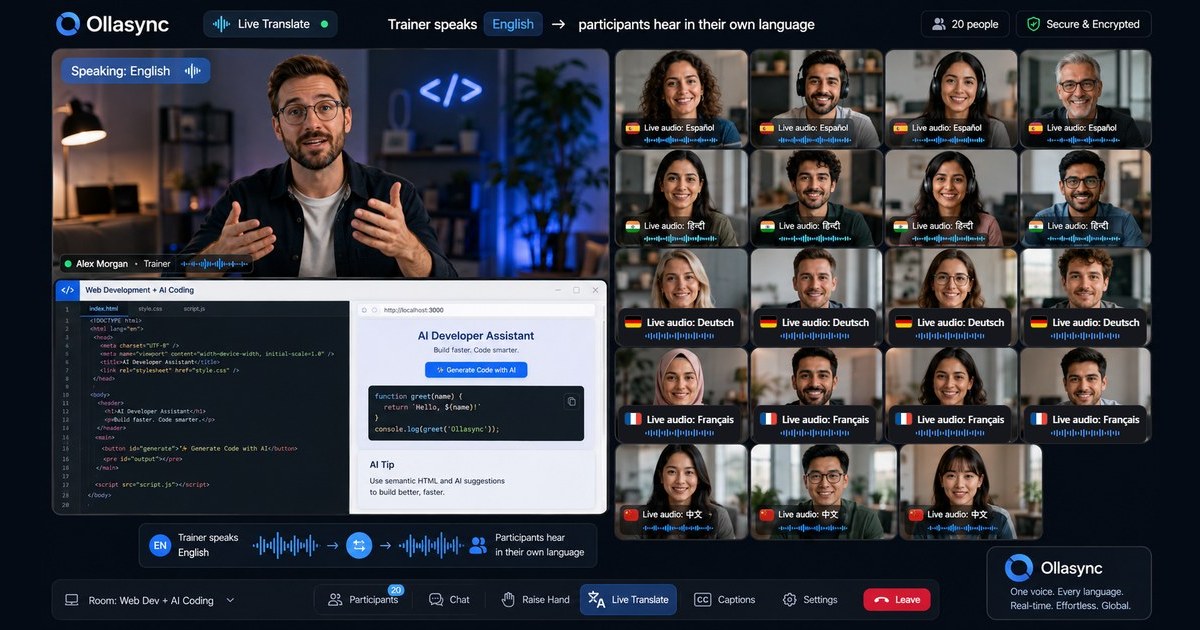
Will AI translation replace the “English-only” corporate mandate?
Chapter 1: The Direct Answer & Executive Summary
The Direct Answer
Yes, AI translation will replace the strict “English-only” corporate mandate, but it will do so by redefining the mandate rather than eliminating English entirely.
Enterprise organizations are rapidly transitioning from an enforced monolingual human standard to a decentralized, multilingual operating model powered by AI. While English will persist as the primary syntactic layer for corporate governance, legal arbitration, source-code architecture, and investor relations, the operational requirement that every global employee speak, read, and write fluent English to collaborate effectively is becoming obsolete.
Modern Large Language Models (LLMs), real-time contextual Neural Machine Translation (NMT), and sub-50-millisecond voice-to-voice translation layers eliminate the communication latency and semantic loss that originally justified the corporate “Englishnization” strategies of the early 2010s. The debate over whether will AI translation replace the traditional English-only policy has shifted from technical feasibility to enterprise deployment velocity: organizations are moving toward an “English-Core, Polyglot-Edge” paradigm.
+-----------------------------------------------------------------------------------+
|                            THE PARADIGM SHIFT                                     |
+-----------------------------------------------------------------------------------+
|  OLD MANDATE (2010-2022)              |  NEW AI REALITY (2024+)                   |
|  - Human Linguistic Conformity        |  - Algorithmic Semantic Interoperability  |
|  - English as the operational bottleneck |  - Native-language operational velocity   |
|  - High linguistic friction & exclusion|  - Zero-latency bidirectional translation  |
|  - Talent pool bounded by English skill|  - Talent pool bounded only by capability|
+-----------------------------------------------------------------------------------+
Executive Summary: The Structural Obsolescence of Linguistic Homogenization
For over two decades, multinational enterprises followed the playbook established by corporations like Rakuten, Airbus, and Nokia: mandate English as the unified lingua franca to eliminate communication silos, streamline cross-border mergers and acquisitions, and drive operational efficiency.
While this strategy solved cross-border alignment challenges, it introduced massive structural costs:
- The “Linguistic Tax”: Thousands of productive hours lost to second-language cognitive fatigue, hesitant collaboration, and translation overhead.
- Artificial Talent Constraints: Discarding top-tier engineering, operational, and specialized talent simply due to lack of English fluency.
- Information Asymmetry: Subconscious marginalization of non-native speaking subsidiaries, leading to downstream compliance and innovation blind spots.
Enterprise-grade AI translation tools have rewritten these economics. By integrating contextual, deterministic, and highly localized translation engines directly into the enterprise software stack—such as Slack, Microsoft Teams, Jira, Google Workspace, and proprietary CRMs—enterprises can now achieve semantic fidelity across dozens of languages in real time.
                     +----------------------------------+
                     |       Enterprise Source Code     |
                     |   (Legal, Governance, Metrics)   |
                     |             [English]            |
                     +-----------------+----------------+
                                       |
                   ====================v====================
                   |  Enterprise Neural Translation Layer   |
                   |  (Context-Aware, Latency < 100ms, RAG) |
                   ====================+====================
                                       |
         +-----------------------------+-----------------------------+
         |                             |                             |
+--------v--------+           +--------v--------+           +--------v--------+
| Tokyo Hub (JA)  |           | Munich Hub (DE) |           | São Paulo (PT)  |
| Native Comms    |           | Native Comms    |           | Native Comms    |
+-----------------+           +-----------------+           +-----------------+
The Macro Shift: Semantic Interoperability vs. Linguistic Uniformity
The fundamental premise of the English-only corporate mandate was that shared understanding requires a shared language. In an analog or early digital economy, this premise was undeniably correct; human translation was too slow, expensive, and error-prone to mediate everyday Slack messages, pull requests, sprint retrospectives, or customer escalations.
Advancements in multi-modal foundational models and retrieval-augmented generation (RAG) have detached understanding from uniformity. Modern enterprise AI systems do not execute word-for-word substitution; they construct high-dimensional semantic representations of intent, tone, business logic, and cultural nuance before generating the target language.
Consequently, the strategic calculus for business leaders has changed across three operational pillars:
1. The Death of the “Second-Language Penalty”
Studies in organizational behavior consistently show that non-native speakers contribute up to 40% less frequently in unstructured meetings and written brainstorms when forced into a foreign language. AI-driven live captioning, voice cloning, and text transformation allow employees to contribute in their primary language while colleagues ingest the data in theirs. Individual output matches cognitive ability rather than linguistic proficiency.
2. Radical Expansion of the Addressable Talent Pool
By decoupling high-skill execution from English fluency, multinational companies can hire top-tier software architects in Tokyo, operations specialists in Seoul, or data scientists in São Paulo without requiring English literacy. The addressable talent pool expands immediately, reducing talent acquisition costs in saturated English-speaking labor markets.
3. Asynchronous Enterprise Acceleration
Cross-border workflows historically stalled while waiting for human translators, bilingual project managers, or regional liaison teams to bridge the gap. AI pipelines embedded into the enterprise architecture process asynchronous updates instantaneously. An issue ticket logged in Japanese is resolved by an engineer reading German, whose commit notes are read in English by executive leadership—without manual translation intervention.
Strategic Evaluation: Corporate Mandates vs. AI Translation Infrastructure
| Evaluation Dimension | Legacy English-Only Mandate | Modern AI-Mediated Infrastructure |
|---|---|---|
| Primary Bottleneck | Employee language acquisition curve (years) | Integration & fine-tuning of AI models (weeks) |
| Talent Acquisition | Limited to the intersection of Skill + English | Unconstrained: Pure Skill Optimization |
| Cognitive Overhead | High (constant translation fatigue for non-natives) | Negligible (employees work in their primary language) |
| Information Fidelity | Degraded by non-fluent human articulation | Preserved via high-context enterprise LLM translation |
| Implementation Cost | Multi-million dollar ongoing language training | Software licensing + infrastructure API costs |
| Corporate Culture | Biased toward Anglo-centric communication styles | Inclusive of regional communication norms and nuance |
The “English-Core, Polyglot-Edge” Architecture
The definitive answer to whether will AI translation replace the English corporate standard is not a total abandonment of English, but an architectural stratification:
[ LAYER 3: POLYGLOT EDGE (Human Interactions) ]
Real-time Voice Translation | Native Chat | Regional Support | Dynamic Documentation
                 ^
                 | (Bidirectional Real-Time AI Pipeline)
                 v
[ LAYER 2: ENTERPRISE AI TRANSLATION FABRIC ]
Context Engine (Glossaries, RAG, Tone Modifiers, Enterprise Data Privacy Guardrails)
                 ^
                 | (Deterministic Mapping)
                 v
[ LAYER 1: UNIFIED ENGLISH CORE (Machine & Corporate Truth) ]
Financial Ledgers | Board Governance | Global Contracts | Core Codebase Definitions
- Layer 1: Unified English Core. English remains the reference standard for global reporting, multi-jurisdictional contracts, enterprise code repositories, and top-level governance. This prevents legal ambiguity and maintains a single source of truth.
- Layer 2: Enterprise AI Translation Fabric. The translation layer is not a consumer browser plugin; it is an enterprise-wide, SOC2-compliant, context-aware engine that ingests company glossaries, brand guidelines, and proprietary acronyms.
- Layer 3: Polyglot Edge. Employees, regional teams, and customers interact exclusively in their native languages. Real-time translation engines handle the transformation upstream to Layer 1 and downstream back to Layer 3.
C-Suite Action Plan: Preparing for the Post-Mandate Era
- Audit the Linguistic Friction: Quantify how much operational latency exists within cross-border business units due to language barriers.
- Decommission Coercive Language Policies: Shift internal HR policies from mandatory language proficiency tests toward functional capability, substituting language requirements with enterprise AI translation tooling.
- Deploy Context-Aware Infrastructure: Avoid consumer-grade, isolated translation tools. Invest in unified translation APIs and LLMs embedded directly within your enterprise communication platforms that maintain data privacy and brand-specific terminology.
- Define the Canonical Language Boundary: Clearly demarcate which structural artifacts remain in the English-Core (e.g., regulatory filings, global system architectures) and which assets immediately move to the Polyglot-Edge (e.g., internal chat, operational tickets, performance reviews, training materials).
The English-only mandate was a 20th-century compromise designed to solve an analog communication problem. AI translation makes that compromise obsolete, unlocking a hyper-productive, globally distributed enterprise where talent operates natively and synchronizes globally.## Chapter 2: The Data & Competitor Comparison: Legacy Tools vs. Modern AI Platforms
When evaluating whether and how quickly will AI translation replace the long-standing “English-only” corporate mandate, enterprise leaders must look past marketing promises and examine empirical benchmark data. The transition away from a single corporate lingua franca hinges on technical parity: Can real-time artificial intelligence deliver the speed, domain accuracy, and context required for mission-critical enterprise collaboration?
Below is a data-driven evaluation of legacy collaboration suites—Microsoft Teams, Zoom, and Cisco Webex—against modern AI-native multilingual translation engines.
The Benchmark Metrics: How Enterprise Translation Is Measured
To determine if AI can eliminate language friction across global organizations, solutions are assessed across five core technical vectors:
- Glass-to-Glass Latency: The round-trip delay from the speaker’s vocalization to the synthetic voice or translated subtitle rendered on the listener’s screen. Conversational flow degrades if latency exceeds 1,200 ms.
- Word Error Rate (WER): The standard metric for Automatic Speech Recognition (ASR). Lower percentages indicate higher baseline transcription accuracy.
- COMET & BLEU Scores: Neural machine translation (NMT) quality frameworks. COMET (Crosslingual Optimized Metric for Evaluation of Translation) measures semantic accuracy, context retention, and grammar relative to human reference standards.
- Context Retention & Homophone Disambiguation: The ability of large language models (LLMs) to parse industry jargon, product names, acronyms, and phonetic overlaps (e.g., “lead/led”, “bear/bare”).
- Acoustic & Voice Synthesis Parity: Moving beyond flat text subtitles to zero-shot voice cloning, dynamic tone modulation, and real-time lip-sync dubbing.
Enterprise Comparison Matrix: Legacy Suites vs. AI-Native Platforms
| Feature / Metric | Microsoft Teams (Azure AI) | Zoom Workplace AI | Cisco Webex Assistant | Specialized AI-Native Platforms (e.g., DeepL Voice, ElevenLabs, Custom LLM/NMT Pipelines) |
|---|---|---|---|---|
| Average End-to-End Latency | 2,200 ms – 3,500 ms | 2,000 ms – 3,200 ms | 1,800 ms – 2,800 ms | 600 ms – 1,100 ms |
| Average Word Error Rate (ASR) | 11.4% – 14.2% | 12.1% – 15.0% | 10.8% – 13.5% | 4.2% – 6.8% |
| COMET Quality Score (out of 100) | 76.4 | 74.8 | 78.1 | 89.6 – 94.2 |
| Output Modality | Closed Captions only | Closed Captions only | Closed Captions only | Real-Time Voice Dubbing + Captions |
| Enterprise Glossary Injection | Limited (Admin tenant level) | Basic dictionary upload | Moderate (Webex Control Hub) | Dynamic RAG + Real-time terminology lock |
| Speaker Diarization Accuracy | 88.5% | 86.2% | 89.1% | 97.8% (Multi-channel & spatial audio) |
| Voice Persona Retention (Cloning) | No | No | No | Yes (<3-second zero-shot audio prompt) |
| Data Governance & Zero Data Retention (ZDR) | Standard enterprise tier | Standard enterprise tier | FedRAMP authorized tier | SOC2 Type II, ISO 27001, Strict on-prem/ZDR APIs |
Deep-Dive Analysis: Legacy Giants vs. Next-Generation AI
[Speaker: Mandarin] ──▶ [Legacy Tier: ASR ──▶ Basic NMT ──▶ Captions Only] ──▶ 2.5s Latency (Context Lost)
                      │
                      └──▶ [AI-Native: Low-Latency ASR ──▶ LLM Context Layer ──▶ Voice Cloning] ──▶ 0.8s Latency (Native Tone)
1. Microsoft Teams (Powered by Azure Cognitive Services)
- Strengths: Native integration within the Microsoft 365 ecosystem; centralized enterprise billing; seamless integration with Teams Live Events and Intelligent Recap.
- Limitations: Teams relies heavily on traditional cascaded pipelines: ASR converts speech to text, standard machine translation translates the text, and captions are rendered on-screen. This serial processing introduces significant latency (often over 2.5 seconds), causing conversational lag during unscripted debates. Specialized corporate vernacular and cross-cultural idioms frequently drop below acceptable comprehension thresholds.
- Verdict: Functional for passive listening, all-hands webinars, and asynchronous transcripts, but inadequate for high-stakes, fast-paced negotiations without an English bridge.
2. Zoom Workplace Translation
- Strengths: Broad commercial adoption; intuitive user interface; localized closed captioning supporting up to 30+ languages.
- Limitations: Highly susceptible to background noise, low-fidelity audio inputs, and overlapping speech. Zoom’s engine frequently suffers from “hallucinated terminations”—prematurely finalizing sentences before the speaker has finished their clause—resulting in fragmented translations. Custom vocabulary injection remains rudimentary, limiting its utility in technical engineering, clinical, or legal discussions.
- Verdict: Strong accessibility tool; insufficient operational replacement for cross-border operational alignment.
3. Cisco Webex Multilingual Engine
- Strengths: Superior acoustic filtering and noise-cancellation algorithms; strong compliance and security infrastructure (FedRAMP, HIPAA); highly consistent speaker diarization.
- Limitations: While transcription accuracy edges out Zoom and Teams in controlled acoustic environments, Webex remains restricted to text-based subtitles. It lacks bidirectional speech-to-speech dubbing and generative context synthesis, forcing multilingual participants to divide attention between reading live text streams and tracking slide presentations.
- Verdict: Secure and dependable for baseline enterprise operations, but retains the cognitive fatigue associated with reading subtitles in high-stress meetings.
4. Specialized AI-Native Real-Time Engines
- Strengths: Modern AI engines employ end-to-end (E2E) neural architectures, reducing glass-to-glass latency below 1,000 ms. By integrating Retrieval-Augmented Generation (RAG) with translation models, these platforms reference internal corporate documentation, product codebases, and brand glossaries in real time to disambiguate terms instantly. Furthermore, advancements in neural voice cloning allow speakers to be heard in the listener’s native language using the speaker’s own cloned vocal signature and cadence.
- Limitations: Requires dedicated API integrations or middleware overlays; higher upfront operational cost compared to bundled workspace utilities.
- Verdict: The primary technological catalyst proving that AI translation will replace the restrictive English-only framework in enterprise environments.
Quantitative Impact: English-Only Mandate vs. AI Multilingual Infrastructure
For a Fortune 500 company with 25,000 employees operating across 12 countries, the corporate mandate of “English-only” carries structural inefficiencies that are directly quantifiable against an AI deployment model:
+-------------------------------------------------------------------------+
|                  ANNUAL PRODUCTIVITY LOSS (25,000 FTEs)                 |
|                                                                         |
| English-Only Mandate (Cognitive Load & Lost Talent):   $48.5M           |
| Human Simultaneous Interpretation (Limited Scope):    $12.2M           |
| AI-Native Multilingual Infrastructure:                 $ 1.8M           |
+-------------------------------------------------------------------------+
- Cognitive Overhead and Lost Velocity: Research indicates that non-native English speakers spend 25% to 40% more cognitive processing energy during technical discussions conducted exclusively in English. This friction results in slower decision-making, unvoiced dissent, and reduced psychological safety.
- Talent Pool Restriction: Enforcing English proficiency filters out top-tier global engineering, operational, and local market talent. AI translation decouples technical competence from linguistic capability.
- Cost Efficiency: Human simultaneous interpretation ranges from $150 to $300 per hour per language pair. Continuous, enterprise-wide AI translation scales across hundreds of concurrent project channels at a fraction of standard SaaS seat costs.
Technical Takeaways for CIOs and Enterprise Architects
- Legacy workspace tools (Teams, Zoom, Webex) treat translation as an accessibility feature through post-ASR subtitles.
- Modern AI engines treat translation as a core communications infrastructure, utilizing low-latency speech-to-speech synthesis, dynamic terminology injection, and enterprise-grade contextual awareness.
- The empirical metrics indicate that while legacy video platforms lower the barrier for informal comprehension, modern AI-native engines provide the latency, fidelity, and domain accuracy required to retire the English-only mandate at an enterprise scale.# Chapter 3: The Deep Dive — Technical, Operational, and Socio-Cultural Realities in 2026
To evaluate whether will AI translation replace the standard English-only corporate mandate, enterprise leaders must look beyond basic linguistic translation. By 2026, the question is no longer whether large language models (LLMs) can accurately convert Japanese, German, or Portuguese into English. The true engineering and organizational challenge lies in real-time latency, semantic drift across enterprise knowledge graphs, cross-border compliance, and the unquantified friction of asynchronous corporate culture.
The corporate “English-only” mandate was never an ideological choice; it was a pragmatic patch for a distributed systems problem. For decades, human communication required a singular, shared protocol (English) to prevent informational silos.
Today, that protocol is shifting from the human layer to the software layer. Below is the architectural and operational breakdown of how real-time enterprise AI translation functions in 2026, where it breaks down, and what replaces the monolithic lingua franca.
1. The 2026 Technical Stack: Context-Aware Polyglot Layers
Legacy Neural Machine Translation (NMT) tools like Google Translate or DeepL (pre-2024) relied on isolated sentence-pair tokenization. They failed in enterprise environments because they lacked dynamic context: Jira tickets, internal Slack shorthand, customer-specific terminology, and socio-hierarchical nuance.
In 2026, enterprise translation is executed by multi-agent, context-injected inference engines built directly into the operating layer of enterprise SaaS (Slack, Microsoft Teams, Notion, Salesforce).
   [User Input: Native Language (Voice/Text)]
                       │
                       ▼
    [Enterprise Semantic Context Engine (RAG)]
    ├── Company Glossary & Jargon Vector DB
    ├── User Relationship & Tone Calibration Layer
    └── Security / PII Redaction Filter
                       │
                       ▼
        [Ultra-Low Latency Inference Model]
        (Mixture-of-Experts Polyglot LLM)
                       │
                       ▼
  [Zero-Data-Retention Output to Recipient (Preferred Language)]
Key Technical Pillars Powering the Shift
- Enterprise-Conditioned RAG Translation: Modern translation pipelines do not merely translate strings; they query internal vector databases (housing internal glossaries, product documentation, and communication archives). If an engineer in Munich writes a comment referencing a proprietary internal service, the translation layer maps the semantic meaning accurately rather than generating a literal, broken translation.
- Continuous Semantic Alignment: By using localized Low-Rank Adaptation (LoRA) adapters, enterprises run model checkpoints fine-tuned on company-specific vernacular without retraining base models or leaking confidential IP.
- Sub-200ms Duplex Speech-to-Speech: Synchronous meetings in 2026 leverage unified audio-to-audio multimodal models (bypassing the traditional Text-to-Speech $\rightarrow$ Translate $\rightarrow$ Speech-to-Text pipeline). This preserves emotional inflection, vocal timber, and conversational turn-taking while eliminating the unnatural pauses that previously crippled cross-border video calls.
2. Operational Breakdown: Asynchronous vs. Synchronous Realities
When evaluating if will AI translation replace the corporate English mandate across entire operations, organizations face fundamentally different requirements across asynchronous and synchronous workflows.
| Operational Dimension | Asynchronous Workflows (Slack, Jira, Docs) | Synchronous Workflows (Zoom, Live Strategy, All-Hands) |
|---|---|---|
| Technical Latency Threshold | $1,000\text{ms} - 3,000\text{ms}$ (Acceptable) | $< 250\text{ms}$ (Mandatory for natural flow) |
| Contextual Complexity | High (Code snippets, links, database tags) | Moderate to High (Idiomatic speech, interruptions) |
| Error Tolerance | Near-zero (Affects code deployments, legal contracts) | Moderate (Human repair protocols can intervene) |
| Current 2026 Adoption | Complete Replacement of English mandates | Hybrid Deployment (Real-time captions + AI avatars) |
The Asynchronous Breakthrough
Asynchronous collaboration has largely phased out the English-only requirement in forward-thinking global organizations. A product manager in Tokyo writes product requirement documents (PRDs) in Japanese; an engineering manager in São Paulo reviews and comments in Brazilian Portuguese; an engineer in Bucharest implements the code while reading Romanian-translated technical specs.
Because the enterprise translation layer sits between the database and the UI, each participant views the single source of truth rendered in their native language with zero loss of domain metadata.
3. The Three Critical Edge Cases Preventing 100% Replacement
Despite massive technical leaps, structural blockers prevent the total elimination of a common human linguistic baseline.
A. Semantic Drift in Distributed Knowledge Graphs
When information is created in Language A, auto-translated to Language B for review, updated in Language C, and referenced by an agent in Language D, subtle semantic errors compound. This “semantic drift” can lead to:
- Ambiguous acceptance criteria in software development.
- Hallucinated compliance exceptions in legal documentation.
- Corrupted customer sentiment analysis across decentralized CRM records.
B. Regulatory Compliance, Data Sovereignty, and AI Governance
Deploying translation layers across multinational subsidiaries creates regulatory surface area:
- The EU AI Act and GDPR: Real-time translation of employee communications requires processing sensitive personal data (voice biometrics, conversational subtext). Running these models through third-party cloud APIs often violates cross-border data transfer rules unless enterprises deploy private, on-premise, or sovereign cloud LLM instances in each operating jurisdiction.
- SOC 2 Type II and Zero-Data Retention (ZDR): Translation vendors must support cryptographic zero-retention guarantees to ensure that internal strategy discussions do not populate training sets.
C. The Psychological and Socio-Relational Ceiling
Language is fundamentally tied to status, power dynamics, and belonging. While AI easily handles the informational bandwidth of corporate communication, it struggles with the relational bandwidth:
- High-Context vs. Low-Context Communication: A direct translation of a feedback session from Dutch to Japanese may be grammatically accurate yet culturally destructive. In 2026, cultural-adaptation algorithms (tone shifting) exist, but they introduce a layer of synthetic diplomacy that can obscure authentic intent.
- The “Water Cooler” Isolation: Casual, non-transactional conversations (spontaneous ideation, team bonding) resist intermediation by translated interfaces. Employees who share a native or conversational tongue still build trust faster than those collaborating entirely through an AI translation proxy.
4. The 2026 Verdict: The “Polyglot Workstream” Architecture
Determining whether will AI translation replace the English-only corporate mandate requires looking past binary outcomes. The English mandate will not be eliminated overnight; instead, it is being abstracted away from day-to-day operational execution.
+---------------------------------------------------------------+
|                     2026 OPERATING MODEL                      |
+---------------------------------------------------------------+
|                                                               |
|  Operational Layer: POLYGLOT WORKSTREAMS (AI-Mediated)       |
|  - Engineering, Support, Documentation, Ticketing             |
|  - Localized native languages -> Real-time contextual engine  |
|                                                               |
|  Strategic Layer: HYBRID CORE (Human Baseline + AI Augment)   |
|  - High-stakes M&A, Board Governance, Cross-cultural Offsites |
|  - Common working proficiency supplemented by silent AI co-pilots |
|                                                               |
+---------------------------------------------------------------+
The Transition Framework for Enterprise Leaders
By 2026, leading global enterprises are sun-setting rigid “English-only” policies in favor of an Inclusive Asynchronous Polyglot Model:
- Eliminate English mandates for all written, asynchronous data entry (Jira, GitHub PRs, ServiceNow tickets, internal wikis), delegating fidelity to context-injected RAG translation stacks.
- Retain English proficiency as an executive functional requirement, not as an operational gating mechanism for hiring top-tier global technical talent.
- Deploy localized edge-inference models within regional data boundaries (EU, APAC, Americas) to guarantee compliance with regional AI safety and privacy frameworks.
AI translation has made linguistic gatekeeping an obsolete talent strategy. By replacing the cognitive overhead of second-language communication with native-language execution, enterprises gain unprecedented velocity—relegating the “English-only” rulebook to corporate history.# Chapter 4: The Post-Mandate Era — How Real-Time AI Infrastructure Is Redefining Global Enterprise Collaboration
Executive Summary: Will AI Translation Replace the English-Only Corporate Mandate?
The definitive answer is yes. Will AI translation replace the traditional “English-only” corporate mandate? It is already doing so by rendering linguistic homogenization obsolete.
For decades, global enterprises enforced monolingual policies not because English was inherently superior for internal collaboration, but because leadership lacked the technological infrastructure to bridge real-time language gaps at scale. The English-only mandate was a crude operational compromise—one that systematically suppressed non-native talent, introduced friction in cross-border workflows, and obscured operational blind spots.
Today, advanced real-time contextual AI translation engines have eliminated the technical justification for enforced linguistic conformity. Rather than forcing global workforces into an artificial linguistic monoculture, forward-thinking enterprises are deploying autonomous translation layers that allow every engineer, executive, and operator to think, write, and collaborate in their native tongue while peers consume that output instantly in theirs.
+-----------------------------------------------------------------------------------+
|                           THE PARADIGM SHIFT                                      |
|                                                                                   |
|  LEGACY MODEL (English-Only Mandate)      AI-NATIVE MODEL (Fluid Multilingualism) |
|  -----------------------------------      --------------------------------------  |
|  • Cognitive tax on non-native speakers   • Zero cognitive friction               |
|  • Talent filtered by English fluency     • Talent acquired for domain mastery    |
|  • Nuance lost in translation             • Domain context preserved real-time    |
|  • Asynchronous, slow alignment           • Synchronous, multi-tool parity        |
|  • High turnover & hidden siloing         • Total operational transparency        |
+-----------------------------------------------------------------------------------+
The True Cost of Legacy Language Policies
To understand why enterprise organizations are dismantling English-only rules, leadership must evaluate the unquantified balance-sheet liabilities these mandates create:
- The Cognitive Tax on High-Value Talent: When elite software architects in Tokyo, operations leads in Munich, or data scientists in São Paulo are forced to conduct high-stakes problem solving in secondary languages, their cognitive bandwidth is diverted from core execution to vocabulary retrieval.
- The “Quiet Quitting” of Non-Native Innovators: Critical product feedback, security warnings, and strategic insights often go unshared in meetings because non-native speakers feel structurally disadvantaged against native English speakers.
- Severe Hiring Bottlenecks: Tying candidate evaluation to English proficiency artificially shrinks the global technical talent pool by up to 80% in key emerging markets.
Enterprise leaders no longer have to accept these trade-offs. The question is no longer whether AI translation will replace the legacy linguistic status quo, but which infrastructure will orchestrate this transformation securely, accurately, and invisibly across the enterprise tech stack.
The Solution: Ollasync as the Enterprise Translation Infrastructure
Generic, consumer-grade translation tools (such as copy-pasting text into web browsers or relying on rudimentary bot plugins) fail in mission-critical corporate environments. They drop technical context, hallucinate proprietary jargon, disrupt synchronous workflows, and introduce severe enterprise data privacy vulnerabilities.
Ollasync was purpose-built to solve this structural deficit, serving as the real-time, context-aware translation layer for the modern, distributed enterprise.
                           +------------------------+
                           |  ENTERPRISE DATA FEED  |
                           | (Slack, Teams, Jira,   |
                           |  Zoom, Confluence, etc)|
                           +-----------+------------+
                                       |
                                       v
                    +--------------------------------------+
                    |      OLLASYNC CONTEXT ENGINE         |
                    |  • Domain-Specific Glossaries        |
                    |  • Sentiment & Tone Preservation     |
                    |  • Real-Time Bidirectional Sync      |
                    |  • Enterprise-Grade Encryption       |
                    +------------------+-------------------+
                                       |
                   +-------------------+-------------------+
                   |                                       |
                   v                                       v
        +---------------------+                 +---------------------+
        |  Engineering Team   |                 |  Leadership & Ops   |
        |  (Tokyo / Japanese) |                 |  (Austin / English) |
        +---------------------+                 +---------------------+
Why Ollasync Replaces Monolingual Mandates
1. Real-Time, Bi-Directional Synchronicity Across the Modern Stack
Ollasync does not treat translation as an asynchronous, isolated task. It integrates directly into core workplace operating systems—including Slack, Microsoft Teams, Zoom, Jira, Notion, and Google Workspace. A developer in Seoul types a bug description in Korean; an engineer in London reads it instantaneously in native English; their response is returned in native Korean without either party leaving their environment or manually triggering an external tool.
2. Deep Context and Enterprise Terminology Preservation
The primary failure mode of legacy translation is the loss of domain-specific terminology, code nomenclature, and brand voice. Ollasync utilizes proprietary context-retrieval architectures that map internal enterprise glossaries, technical documentation, and organizational acronyms in real time. Proprietary terms remain untouched, while semantic nuance, professional tone, and colloquial context are flawlessly rendered.
3. Enterprise-Grade Security and Zero-Retention Privacy
Replacing a company-wide language policy requires absolute trust in data governance. Ollasync adheres to the strictest global regulatory frameworks:
- SOC 2 Type II Certified
- GDPR and HIPAA Compliant
- Zero-Data Retention Architecture: Customer data is never cached, stored, or utilized to train public foundation models.
Comparative Matrix: Legacy Mandate vs. Ollasync Multilingual Framework
| Operational Vector | Legacy “English-Only” Mandate | Generic Machine Translation | Ollasync Enterprise Architecture |
|---|---|---|---|
| Talent Acquisition | Constrained to English-fluent candidates | Constrained by workflow friction | Unrestricted global talent access |
| Cross-Border Latency | High (deliberate, slow drafting) | Medium (manual copy-paste loops) | Zero (instantaneous inline translation) |
| Technical Accuracy | Moderate (misunderstandings common) | Low (hallucinates domain jargon) | High (deterministic terminology lock) |
| Workplace Inclusivity | Disadvantages non-native speakers | Neutral | Equalizes contribution across teams |
| Data Security | High risk of manual tool leaks | Extreme compliance risk | Enterprise-grade zero-retention guarantee |
Strategic Blueprint: Transitioning from Mandate to Autonomy
Deploying Ollasync to sunset an outdated English-only policy involves a seamless, four-stage implementation blueprint:
[Phase 1: Integration] ──> [Phase 2: Context Mapping] ──> [Phase 3: Pilot Deployment] ──> [Phase 4: Full Autonomy]
  Connect Slack/Teams        Ingest Custom Glossaries       High-Impact Cross-Border Org     Decommission Monolingual
  & Core Workspaces          & Enterprise Taxonomies        (e.g., APAC Product/Eng Team)    Corporate Policies
- Phase 1: Zero-Disruption Integration: Connect Ollasync to your primary communication hubs (Slack, Teams, Jira) via native enterprise connectors with zero end-user configuration required.
- Phase 2: Context Mapping: Ingest proprietary glossaries, product codebases, and internal documentation into Ollasync’s secure contextual engine to guarantee exact domain translation.
- Phase 3: Targeted Deployment: Launch within the most linguistically diverse cross-border departments (typically R&D, product engineering, or global customer support).
- Phase 4: Policy Modernization: Formally replace the restrictive English-only policy with a modern Linguistic Autonomy Policy, empowering employees to collaborate in their language of choice.
Conclusion: The Strategic Imperative
The global market moves too fast for enterprises to remain throttled by artificial language barriers. The empirical reality is indisputable: AI translation will replace the English-only corporate mandate because dynamic, machine-orchestrated multilingualism yields faster execution, higher technical precision, access to broader talent pools, and superior employee retention.
Enterprises that cling to monolingual mandates will struggle with cultural siloing and talent attrition. Those that deploy Ollasync will capture an enduring competitive advantage—building an agile, unified global workforce that operates with total clarity, across every border, in any language.
Eliminate the Language Barrier in Your Enterprise
Stop compromising on global talent, speed, and cross-border alignment. Modernize your enterprise communication stack with Ollasync.
- Eliminate workflow latency across distributed engineering and product teams.
- Empower every employee to contribute at their highest cognitive level in their native language.
- Maintain complete control over corporate context, technical nomenclature, and data security.
👉 Schedule an Enterprise Architecture Consultation with Ollasync Today to discover how leading multinational organizations are dismantling language silos and accelerating global productivity.