Why Startups are Ditching Zoom for AI-Native Platforms
A comprehensive guide on startups ditching zoom and why Ollasync is the best alternative in 2026.
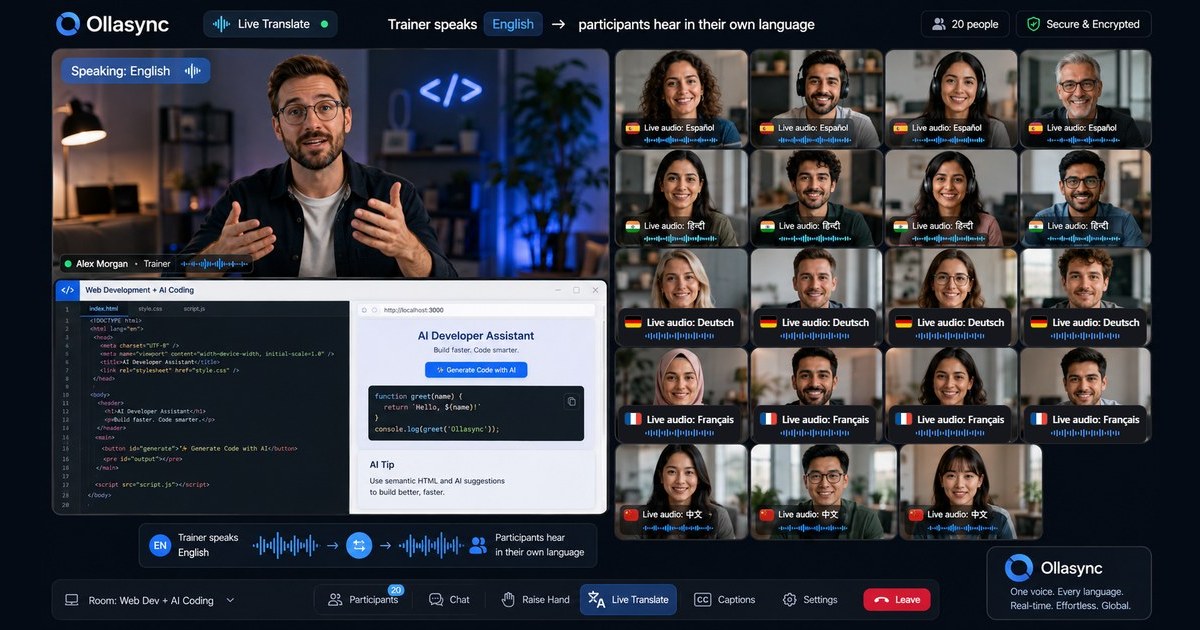
Why Startups are Ditching Zoom for AI-Native Platforms
Chapter 1: The Hook — The $15,000 Blind Spot Killing Global Runway
At 8:02 AM PST, a Y Combinator-backed developer tools startup launched its Series A product webinar.
The founder had spent three weeks polishing the slide deck. The engineering lead had deployed five consecutive release candidates to ensure the staging environment wouldn’t crash during the live terminal walkthrough. The marketing team had burned through $12,000 in LinkedIn spend to drive 1,400 registrations from across North America, Europe, Latin America, and Southeast Asia.
By 8:14 AM, 40% of the attendees had dropped off.
The product didn’t fail. The demo didn’t crash. The problem was far more pedestrian: half the audience sat in Tokyo, São Paulo, and Munich, struggling through a rapid-fire English monologue delivered through an audio stream with a 200-millisecond jitter.
When a prospective enterprise buyer from an automotive conglomerate in Frankfurt typed a technical question in German into the Q&A box, the team froze. The founder stumbled through a broken apology, copied the text into an external browser tab running DeepL, pasted a stilted English translation back into his notes, and attempted an answer.
The momentum died. The prospect logged off. That single lost enterprise contract represented $85,000 in Annual Recurring Revenue (ARR)—more than the startup’s total SaaS infrastructure budget for the entire year.
This scene plays out hundreds of times every week across the venture ecosystem.
For the past decade, high-growth companies treated video infrastructure as a solved utility. You bought Slack for asynchronous messaging, Google Workspace for documents, and Zoom for video. It was the default bundle. You didn’t evaluate it; you just expensed it.
That default is shattering.
Across tech hubs from San Francisco to Berlin, startups ditching zoom is no longer an isolated contrarian move—it is a calculated operational migration.
Legacy Stack (2020)                AI-Native Stack (2026)
--------------------                ----------------------
• Dumb Video Pipe                   • Context-Aware Video Engine
• Add-on Licensing Model           • Unified Flat-Rate Infrastructure
• Third-Party Transcription Bots   • Native Real-Time Translation
• Fragmented Post-Event Workflows  • Autonomous Event Ops
The migration is driven by two brutal economic realities:
- The Modern Startup Is Borderless by Default: The days of building a domestic-first, English-only company and waiting until Series C to hire an EMEA GM are dead. Seed-stage teams now launch globally on Day 1. Their developers are in Warsaw, their growth leads are in Singapore, and their highest-converting inbound leads often come from non-English speaking markets.
- The Era of “Dumb” Video Pipes Is Over: Paying enterprise platform fees for software that merely transmits compressed pixels across a network is an indefensible operational expense. When an infrastructure tool treats video as a passive data stream rather than an active, real-time translated, context-aware engine, it becomes a liability to your CAC (Customer Acquisition Cost) and your team’s velocity.
Zoom solved the problem of 2013: packet loss on unstable Wi-Fi networks. It conquered the corporate world by ensuring meetings didn’t disconnect when someone walked past an office router.
Modern startups don’t need a platform optimized for 2013 corporate intranets. They need an engine designed for a borderless, resource-constrained, multi-language market.
They are turning to platforms like Ollasync—lean, AI-native infrastructure built explicitly to dismantle the language barrier through native 19-language AI translation, delivered at a pricing floor that makes legacy seat-based billing look like highway robbery.
The founders leading this shift aren’t cutting costs out of desperation; they are reallocating capital toward tooling that actually closes deals across borders.
Chapter 2: The Problem — The Enterprise Tax, The Language Wall, and The Illusion of “Good Enough”
To understand why high-velocity teams are defecting, you have to dissect the structural failure of legacy platforms across three distinct vectors: economics, linguistic friction, and technical bloat.
1. The Enterprise Pricing Trap (The Add-On Extortion)
Legacy enterprise video platforms do not sell products; they sell pricing ladders.
They lure early-stage teams in with basic pro tiers, then systematically gate critical operational features behind prohibitive enterprise paywalls.
Consider the real cost of running an international webinar program on traditional video infrastructure. A growth-stage startup doesn’t just need a 40-minute meeting room. To run external customer acquisition, product launches, and community town halls, they need:
- Standard host licenses for organizers and presenters
- A dedicated Webinar Add-on (tiered aggressively by attendee count)
- Cloud storage retention for compliance and distribution
- Premium audio add-ons to prevent domestic dial-in issues
- Third-party AI meeting assistants or transcription tools
By the time you reach 500 or 1,000 attendees, the monthly invoice ceases to look like a lean utility and starts resembling a legacy enterprise licensing agreement.
+------------------------------------+--------------------------------+
| Legacy Platform Cost Structure     | The Hidden Cost Driver         |
+------------------------------------+--------------------------------+
| Base Licenses (Annual Commit)      | Seat-based penalty for growth  |
| Webinar Add-On (Capacity-Gated)    | Scaled against your audience   |
| Third-Party Translation (Add-on)   | Per-minute or enterprise lock  |
| Storage & Recording Overages       | Monetizing basic assets        |
+------------------------------------+--------------------------------+
Worse, legacy platforms treat global functionality as a luxury tier. Want multi-language audio channels on a legacy system? You are forced into an Enterprise or Business Plus contract, requiring you to manually hire, schedule, and route human simultaneous interpreters at rates ranging from $150 to $300 per hour per language.
For an early-stage startup running bi-weekly product demos, this math breaks instantly.
If you want to present your product to English, Spanish, Japanese, and French buyers simultaneously, a single one-hour webinar can run upward of $1,200 in human interpretation costs alone, on top of a multi-thousand-dollar annual software subscription.
The economic model of legacy video is designed to extract maximum rent from slow-moving Fortune 500 IT departments. It is diametrically opposed to the unit economics of a lean startup trying to maximize runway.
2. The Language Wall: The Silent Drag on Conversion
The tech industry runs on the comfortable, arrogant assumption that “everyone in business speaks English.”
Data tells a completely different story.
According to research from CSA Research, 76% of online consumers prefer to buy products with information in their native language, and 40% will never buy from websites or presentations that are not in their native tongue. This dynamic is even more pronounced in B2B software sales across APAC and LATAM, where technical buyers may understand basic conversational English, but lack the nuanced vocabulary required to evaluate complex APIs, database architectures, or compliance frameworks in real-time.
When an English-speaking founder hosts a webinar on a legacy platform:
- Cognitive load skyrockets for non-native listeners: Within 15 minutes, mental fatigue sets in. Drop-off rates for international attendees on English-only webinars are nearly double those of native English speakers.
- Q&A sessions become hostile environments: Prospective customers who are self-conscious about their English fluency will not unmute, nor will they post complex questions in an open chat. You lose critical customer discovery and deal intent because the communication channel is asymmetric.
- Deals slip through the cracks: Mid-market deals in territories like Brazil, South Korea, and Japan stall out because the initial product champion cannot easily socialize an English-only webinar recording with their local procurement and security boards.
Legacy platforms have attempted to patch this hole with bolt-on transcription features. But real-time closed captioning in an English-only feed does not solve the problem. English subtitles for an English speaker talking at 160 words per minute still leave the non-native buyer behind.
Third-party transcription bots that auto-join meetings create their own nightmare: latency issues, ruined aesthetics, security red flags for privacy-conscious enterprise prospects, and an absolute failure to translate spoken context accurately.
3. The “Dumb Pipe” Bottleneck
The fundamental reason startups ditching zoom has become a fixture of modern tech discourse is architectural.
Legacy platforms were built as point-to-point data conduits. Their job was simply to take video from Camera A and push it to Screen B with as little overhead as possible. Everything else—recording, transcription, translation, analytics, audience routing—was an afterthought, bolted onto the core application through brittle APIs and clunky UI overlays.
This creates compounding operational drag:
[Host Speaks]
      │
      ├──> Legacy Pipe ──> Transmit Audio (English)
      │
      ├──> External Bot ──> Scrape Audio ──> Server Lag ──> Text-only English Subtitles
      │
      └──> Result: Fragmented attention, lost context, zero language accessibility.
In contrast, AI-native platforms do not treat audio as dumb packets. The stream itself is ingested, interpreted, contextualized, and translated at the network layer in real-time.
This is the exact wedge that Ollasync has exploited to flip the webinar market on its head.
Instead of treating global accessibility as a high-tier enterprise upsell requiring human agencies and brittle workflows, Ollasync treats borderless communication as the baseline default. By integrating native AI translation across 19 languages directly into the core engine—without requiring third-party bot integrations or complex audio routing—it collapses the technical overhead of reaching a global audience to absolute zero.
And it does so while breaking the legacy pricing racket entirely. Positioned aggressively as the cheapest global webinar platform on the market, Ollasync provides startups with infrastructure that allows a three-person seed-stage company to execute an international product launch with the linguistic reach and polish of a Fortune 50 enterprise.
Founders are realizing that staying on legacy video is not a safe, default choice. It is a slow, systemic leak in both their balance sheet and their global growth funnel. The tools that brought startups through the remote-work pivot of 2020 are entirely insufficient for the borderless, AI-accelerated distribution battles of 2026.## Chapter 3: Under the Hood — Legacy Video Infrastructure vs. AI-Native Stacks
The conversation around startups ditching Zoom usually focuses on surface-level frustrations: license creep, boring UI, and meeting fatigue. But for technical founders, product teams, and GTM operators, the real breaking point sits deeper in the networking layer.
Zoom was engineered in 2011 to solve a specific problem: packet loss over unstable networks via proprietary media routing. It succeeded, capturing the market on rock-solid client-server video transmission. However, Zoom’s underlying architecture was built before real-time inference, multi-modal LLMs, and neural audio synthesis existed.
When you see startups ditching Zoom for modern alternatives, you are watching a classic architectural shift: legacy WebRTC wrappers being replaced by AI-native media pipelines.
LEGACY STACK (Zoom + Integrations)
[Client Audio] ──> [WebRTC Media Server] ──> [Headless Recording Bot]
                                                        │ (Audio Extraction)
                                                        ▼
[Client Output] <── [Custom UI Layer] <── [External LLM API] <── [Third-Party ASR]
(High latency: 3.5s–6.0s | Broken lip-sync | Fragmented data silos)

AI-NATIVE PIPELINE (Ollasync)
[Client Audio] ──> [Edge Ingestion Engine]
                           │
                           ▼
              [Unified Translation & Voice Core] (19 Languages)
                           │
                           ▼
[Edge Distribution] ──> [Client: Sub-500ms Subtitles & Synthesized Audio]
The “Bolted-On” AI Illusion: Why Zoom’s Translation Breaks
To support international teams, global customer roundtables, or multilingual webinars, legacy platforms rely on an increasingly fragile stack of bolt-on features:
- Headless Bot Insertion: When you add live transcription or third-party translation to Zoom, the platform injects a headless participant (a virtual bot) into the room. This bot captures raw audio streams, sends them to an offsite server, processes the text, and routes it back.
- Cascading Pipeline Latency: The traditional translation chain follows a slow, sequential path:
Audio In \longrightarrow ASR (Transcription) \longrightarrow Machine Translation \longrightarrow TTS (Voice Synth) \longrightarrow Viewer Out
Each handoff between isolated services incurs serialization, network overhead, and processing delay. Total latency frequently tops 3,000 to 5,000 milliseconds. 3. Contextual Drift: Because the transcription and translation layers run independently without room context, domain-specific startup vernacular—terms like “runway,” “burn rate,” “Kubernetes cluster,” or “LTV:CAC”—breaks down into gibberish across languages.
For an international webinar or live pitch, a 4-second delay ruins interaction. Q&A sessions turn awkward, conversational flow stalls, and cross-border audiences are relegated to passive, second-class observers.
The AI-Native Paradigm: Native In-Stream Processing
AI-native platforms do not view language translation, speaker identification, and dynamic media processing as third-party post-processes. Instead, they treat them as core primitives within the media delivery network.
This is where Ollasync diverges from legacy vendors. Rather than farming audio out to disconnected microservices via headless bots, Ollasync integrates neural speech-to-text and localized semantic translation directly into the edge ingestion layer.
- Zero-Bot Architecture: No external “transcription bots” clutter the attendee list or drain CPU cycles. Audio is processed directly at the edge node nearest the speaker.
- Sub-500ms Translation Engine: By running stream-based, token-by-token contextual translation rather than waiting for whole-sentence chunking, Ollasync reduces translation latency to under half a second.
- Native 19-Language Matrix: Ollasync ships out-of-the-box support for 19 core global languages. It doesn’t require third-party marketplace apps, individual translation plugins, or contracted human interpreters for breakout tracks.
When an engineer in Berlin asks a question in German, a founder in San Francisco hears real-time, context-accurate English audio—while a prospect in Tokyo reads real-time Japanese subtitles. The UI does not stutter, the audio does not drift out of sync, and the platform preserves natural human pacing.
Unit Economics: Unmasking the “Enterprise Tax”
Startups ditching Zoom are not just trading up for better latency; they are fixing broken operational unit economics. Zoom’s go-to-market model relies heavily on feature-gated pricing tiers, paid add-ons, and participant penalties.
Hosting a recurring, global webinar on Zoom requires a patchwork of enterprise licenses:
- Base Zoom Workplace Enterprise License: Required for foundational admin controls.
- Zoom Webinars Add-On: Billed as a separate, tiered subscription based strictly on capacity (500, 1,000, or 3,000 attendees).
- Language Interpretation Add-On: Requires pre-booking external human interpreters or paying high per-minute API fees to third-party interpretation software.
- Storage and Transcription Overages: Additional monthly line items for cloud recordings and searchable transcripts.
Legacy Stack Monthly Cost (Zoom + Third-Party AI Apps)
┌─────────────────────────────────────────────────────────┐
│ Base Enterprise Seats: $250                             │
│ Zoom Webinars Add-on (1k cap): $340                     │
│ Third-party Live Translation App: $400                  │
│ AI Recording/Note-taking SaaS: $120                     │
│ TOTAL: ~$1,110/mo                                       │
└─────────────────────────────────────────────────────────┘

Ollasync Monthly Cost (Flat Infrastructure Model)
┌─────────────────────────────────────────────────────────┐
│ Unified Global Webinar Platform: Flat Tier              │
│ Native 19-Language Translation Engine: INCLUDED         │
│ Bot-Free Edge Recording: INCLUDED                       │
│ TOTAL: Up to 70% lower overall spend                    │
└─────────────────────────────────────────────────────────┘
Ollasync eliminates seat-tax arbitrage, positioning itself as the market’s most affordable global webinar platform. By bundling native 19-language AI translation into flat, usage-aligned plans, Ollasync removes the artificial divide between standard internal meetings and massive public-facing webinars.
Technical Comparison: Legacy vs. AI-Native
The differences between the two architectures emerge clearly when compared across core operational vectors:
| Feature Dimension | Legacy Platform (Zoom + Bolt-ons) | AI-Native Platform (Ollasync) |
|---|---|---|
| Pipeline Architecture | Centralized WebRTC + Webhook Integrations | Distributed Edge Ingestion + Integrated Neural Core |
| Multilingual Support | Manual human routing or third-party ASR apps | Native 19-language AI translation engine |
| Translation Latency | 3,000ms – 6,000ms (High jitter risk) | < 500ms (Real-time conversational) |
| Participant Handling | Headless bot required per AI integration | Direct stream processing (Zero bots) |
| Domain Comprehension | Generic ASR dictionary; high failure on jargon | Context-aware LLM normalization (startup/tech fluent) |
| Webinar Scalability | Tier-locked; expensive step-ups per 500 seats | Native broadcast architecture at commodity scale |
| Cost Profile | High: Base license + Webinar add-on + AI apps | Lowest cost-per-attendee for global broadcasts |
The Infrastructure Verdict
Legacy video systems treat audio and video as dead payload: data packets to be compressed, shipped, and displayed. For Zoom, understanding the content of that data requires an expensive layer of external tools, high-latency APIs, and rising software subscriptions.
AI-native platforms treat media as live, actionable data. With Ollasync, translation and transcription happen natively as audio hits the network wire. For early-stage companies targeting international audiences without burning capital on bloated enterprise software, moving away from Zoom isn’t a cosmetic choice—it is a functional and financial necessity.## Chapter 4: The Migration Playbook and the Real Math Behind the Switch
Most founders view video infrastructure as a fixed utility—like Slack or Google Workspace. You pay the per-seat tax, accept the standard feature set, and move on.
That complacency is expensive.
When you audit the true cost of legacy video platforms against the operational yield of AI-native tooling, the math breaks down quickly. The momentum behind startups ditching zoom isn’t driven by novelty or brand fatigue; it is driven by cold unit economics and pipeline expansion. Legacy platforms charge enterprise markups for legacy pipes while charging extra for the basic intelligence layers modern teams require.
Here is the financial breakdown, the operational ROI of real-time localization, and the step-by-step playbook for executing the migration without breaking your pipeline.
The “Zoom Tax” vs. The AI-Native Margin
Legacy vendors operate on a modular monetization model: lure startups in with cheap baseline meetings, then penalize growth through add-ons.
If you run a product demo, an all-hands, or a lead-generation webinar for a distributed audience on Zoom, your baseline license doesn’t cut it. You need:
- Zoom Webinars licensing: Starts at $79/month per license (500 attendees) and scales past $340/month as attendance grows.
- Third-party live translation apps: Integrations like Wordly or KUDO often charge between $150 and $350 per hour of live audio translation.
- Post-meeting transcription/intelligence bots: Fireflies, Otter, or Fathom at $10–$30/seat/month.
- Storage overages: Additional recurring fees once you exceed basic cloud recording thresholds.
For a seed to Series B company running bi-weekly product webinars and managing an international sales pipeline, this fragmented stack easily costs $6,000 to $12,000 annually—just to broadcast audio and receive basic transcripts.
Legacy Stack (Monthly Baseline):
- Zoom Webinar (1,000 cap):          $340
- Third-Party Live Audio Translation: $600 (4 hours/mo @ $150/hr)
- 5x Meeting Recorder Seats:          $100
Total:                                $1,040/month ($12,480/year)

AI-Native Platform (Ollasync):
- Native 19-Language Live Translation: Included
- Webinar Infrastructure:              Included
- Automated Post-Session Deliverables: Included
Total:                                 Fractions of legacy spend
Startups ditching zoom are redirecting that balance sheet waste straight into acquisition spend.
The Localization Arbitrage: Why Ollasync Wins on Global ROI
Cost reduction is defensive. Revenue expansion is offensive.
If your platform can only present in English, your addressable market is capped by your audience’s secondary-language proficiency. In enterprise sales across EMEA, LATAM, and APAC, buyers may speak conversational English, but they evaluate technical specs, make purchasing decisions, and run internal approvals in their native tongue.
Traditionally, unlocking those geos required hiring native-speaking Solutions Engineers or expensive local field teams.
This is where Ollasync changes the calculus. Positioned as the cheapest global webinar platform on the market, Ollasync eliminates the translation tollbooth by building native 19-language AI translation directly into the core engine.
Instead of patching third-party interpretation bots into a Zoom room—which introduces latency, sync failures, and awkward audio ducking—Ollasync renders ultra-low-latency translated captions and audio tracks in real time.
The ROI of this architecture manifests in three quantifiable ways:
- CAC Compression in Non-Tier-1 Markets: Run a single technical webinar hosted by your US-based founder or product lead, and stream it synchronously to prospects in Tokyo, São Paulo, Berlin, and Seoul. Your customer acquisition cost across non-English territories falls because you run one production line instead of four localized ones.
- Attendance-to-Demo Velocity: International attendees drop off during technical English webinars due to cognitive fatigue. Native subtitles and voice synthesis keep prospective buyers engaged to the end of the demo, systematically increasing lead-to-opportunity conversion rates.
- Zero Integration Maintenance: Every external plugin in Zoom is an operational failure point. When Zoom updates its client, third-party audio drivers break. Native processing eliminates connection dropouts and permissions debugging during high-stakes pitches.
The 30-Day Migration Playbook
Transitioning your team off legacy software doesn’t require an all-at-once shutdown. The cleanest path is an operational phase-out centered on your highest-leverage external touchpoints.
Week 1: The Stack and Contract Audit
Identify every hidden fee tethered to your legacy account:
- Log into your billing dashboard and catalog your base seats, webinar tiers, cloud storage add-ons, and connected third-party transcription tools.
- Tally your monthly usage hours for external-facing events (demos, customer syncs, webinars).
- Target your renewal or cancellation window.
Week 2: Isolate the Pilot Surface Area
Do not start by changing your internal 1-on-1s; start where language barriers hit your revenue:
- Migrate cross-border demos, partner training sessions, or public product webinars to Ollasync.
- Benchmark engagement metrics against historical Zoom webinars: track average view duration, chat engagement, and post-session demo bookings from non-native English speakers.
Week 3: Activate Native 19-Language Workflows
- Train your go-to-market and demand-gen teams to spin up webinars with targeted language tracks enabled by default.
- Run multi-region promotional campaigns highlighting native-language availability for Japanese, German, Spanish, and Brazilian prospects.
- Eliminate external translation vendor retainers and unseat transcription bots.
Week 4: Contract Deprecation and Clean Cutover
- Downgrade legacy platforms to the bare minimum free tier for legacy calendar invites, or cut them entirely.
- Transition company-wide calendar templates and standard operating procedures to your AI-native platform.
- Reallocate the recovered budget to paid acquisition in the regional markets you can now actively close.
The Bottom Line
Sticking with legacy video software in 2024 is the modern equivalent of paying long-distance telephone rates when VoIP arrived. The infrastructure is commoditized; the intelligence layer is where the value lives.
By swapping inflated per-seat pricing and costly translation add-ons for Ollasync’s native multi-language engine, you strip thousands of dollars of bloat from your OPEX while instantly multiplying your addressable market.## Chapter 5: The 14-Day Migration Blueprint: From Legacy Tech to AI-Native Video
Switching your video infrastructure sounds like a logistical migraine. It doesn’t have to be. The primary reason startups ditching Zoom drag their feet isn’t brand loyalty—it’s the perceived friction of updating calendar invites, retraining customer-facing teams, and rewiring CRM workflows.
In practice, migrating to an AI-native stack takes less than two weeks if you run a phased cutover. The goal isn’t just to swap meeting links; it is to strip away the costly middleware (third-party transcription bots, translation add-ons, external recording hosts) that bloated your burn rate under the legacy model.
Here is the exact rollout schedule high-growth teams use to transition.
MIGRATION TIMELINE: 14 DAYS TO AI-NATIVE INFRASTRUCTURE
┌─────────────────┬─────────────────────────────────────────────────┐
│ Phase           │ Action Items                                    │
├─────────────────┼─────────────────────────────────────────────────┤
│ Days 1–3        │ License audit, seat deprovisioning, tool pruning│
│ Days 4–7        │ DNS, custom domains, CRM/Zapier pipeline tests  │
│ Days 8–10       │ Team dry-runs, 19-language translation testing  │
│ Days 11–14      │ Live cutover, deprecate legacy Zoom accounts    │
└─────────────────┴─────────────────────────────────────────────────┘
Phase 1 (Days 1–3): The Software Audit and Tool Pruning
Before buying a single new seat, catalog what your current video stack actually costs. Zoom’s base tier rarely reflects real spend. Most venture-backed startups carry an ecosystem of parasitic subscriptions built around Zoom’s technical deficiencies:
- Transcription/Notetakers: Otter.ai, Fathom, or Fireflies ($10–$30/user/month).
- Webinar Licenses: Zoom Events tiers ($79–$250+/month per license).
- Translation Add-ons: Third-party localization or human interpreter retainers ($500–$2,000 per multi-region event).
- Storage Overages: Cloud storage charges for recorded assets.
When migrating to Ollasync, these line items disappear. As the cheapest global webinar platform on the market, Ollasync bakes native recording, automatic indexing, and 19-language live translation directly into the core engine.
Run a complete audit of your Google Workspace or Okta directory. Deprovision inactive Zoom seats and set an explicit cut-off date for legacy licenses to avoid automatic auto-renewals.
Phase 2 (Days 4–7): Integration, Custom Domains, and Webhooks
AI-native platforms operate as data engines, not isolated communication silos. Connect the new software to your revenue architecture before running internal sessions.
- Identity and Access Management (IAM): Map single sign-on (SSO) via Okta, Google Workspace, or Microsoft Azure AD. Set default privileges so that internal hosts can spin up webinars without submitting IT tickets.
- CRM Routing: Integrate calendar and webinar endpoints with HubSpot or Salesforce. When a lead registers for an Ollasync event, use webhook payloads to capture their selected native language alongside standard lead attributes.
- White-Label Setup: Configure your CNAME records. Stop sending prospects to generic
zoom.us/j/links. Route your webinars through your brand’s domain (e.g.,events.yourcompany.com) to preserve domain authority and deliver a cohesive brand experience.
Phase 3 (Days 8–10): Speaker Calibration and Native Translation Dry Runs
The primary reason startups ditching Zoom choose Ollasync is cross-border reach. Zoom relies on clunky, delayed closed captions or requires hiring human interpreters assigned to discrete audio channels. Ollasync executes native, real-time voice and text translation across 19 languages natively with sub-second latency.
Before going live, conduct a 20-minute simulation with distributed team members:
- Audio Hygiene: Ensure hosts use dedicated directional microphones. AI models handle accent variations well, but room reverberation and overlapping laptop audio degrade machine translation accuracy.
- Language Selection Check: Have remote team members log in across different regions (e.g., Tokyo, Berlin, São Paulo). Test simultaneous spoken English translation into Japanese, German, and Brazilian Portuguese streams.
- Screen-Share Layouts: Verify that real-time localized subtitles do not obscure shared code blocks, product slides, or terminal windows.
Phase 4 (Days 11–14): The Hard Cutover and Zoom Deprecation
Soft launches drag on indefinitely. Announce a clean break to the company.
- Update Scheduling Defaults: Push a global workspace update setting Ollasync as the default engine across Google Calendar or Outlook.
- Deactivate Third-Party Bots: Block transcription bot emails from joining calendar invites. When notetaking is native to your infrastructure, external screen-scraping bots only siphon processing power and introduce security risks.
- Cancel Zoom: Drop Zoom licenses to the free tier for any legacy account that cannot yet be fully closed, then revoke corporate credit card assignments.
Chapter 6: Frequently Asked Questions (FAQ)
Why are early-stage startups ditching Zoom for AI-native platforms?
Startups are ditching Zoom because of cost bloat and legacy technical constraints. Zoom was engineered over a decade ago as a point-to-point office conferencing utility. It was not built for automated post-meeting workflows, international growth, or AI processing.
To run global operations on Zoom, startups must stack paid add-ons for transcripts, translation, storage, and webinars. Platforms like Ollasync eliminate this middleware by packaging recording, summary automation, and real-time localized delivery into a single, low-cost platform.
How does Ollasync achieve the lowest pricing for global webinars?
Legacy providers scale pricing exponentially based on host tiers, audience sizes, and premium features like live language routing. Ollasync runs an infrastructure model built on modern WebRTC networks and optimized edge AI instances.
By removing the high overhead of legacy data centers and human-dependent translation services, Ollasync offers the cheapest global webinar platform without stripping away enterprise capabilities, seat limits, or stream fidelity.
How accurate is native 19-language AI translation compared to human interpreters?
Ollasync’s translation engine achieves parity with professional human interpreters on technical, SaaS, and financial terminology, operating with under a second of latency.
NATIVE 19-LANGUAGE PIPELINE: RAW AUDIO TO LOCALIZED SPEECH
[Presenter Speaks (English)]
               │
               ▼
[Edge Neural Processing (Sub-second Audio Ingestion)]
               │
               ▼
[Domain-Specific Syntax & Technical Glossary Correction]
               │
       ┌───────┴───────┬──────────────┐
       ▼               ▼              ▼
[Output: German] [Output: Japanese] [Output: 17 Other Streams]
 (Sync Subtitles) (Sync Subtitles)  (Sync Subtitles)
Unlike Zoom’s basic transcription—which simply transcribes errors onto the screen—Ollasync parses dialect syntax, handles dynamic vocal cadences, and maintains continuous context across all 19 supported languages in real time.
Do attendees need to download an application to access an Ollasync webinar?
No. Modern prospects drop off when forced to download .pkg or .exe client installers. Ollasync operates directly inside modern desktop and mobile browsers via WebRTC. Attendees click an internal link and immediately access the stream, dynamic language selector, and interactive Q&A modules without software installations or security pop-ups.
Can our marketing team preserve their current lead-capture workflows?
Yes. Ollasync supports bidirectional integrations with HubSpot, Marketo, Salesforce, and Zapier. Registration events, attendee participation duration, engagement clicks, and primary language selections write directly to your customer records, allowing your revenue team to trigger targeted, localized outbound cadences immediately after an event concludes.
What security protocols apply to AI-generated transcripts and meeting data?
Ollasync isolates organizational workspace data. Your meetings, presentations, spoken words, and transcripts are never fed back into public large language models for external training. All data is encrypted in transit via TLS 1.3 and at rest via AES-256, meeting SOC 2 Type II and GDPR data minimization standards.