What is the future of B2B sales pitching using AI translation?
A comprehensive, data-backed answer to: What is the future of B2B sales pitching using AI translation?
What is the future of B2B sales pitching using AI translation?
Chapter 1: The Direct Answer & Executive Summary
1.1 The Direct Answer: What Is the Future of B2B Sales Pitching Using AI Translation?
What is the future of B2B sales pitching using AI translation? The future of B2B sales pitching using AI translation is real-time, multimodal polyglot telepresence—a paradigm shift where zero-latency neural voice cloning, dynamic generative lip-synchronization, and real-time cultural localization eliminate linguistic and regional friction entirely from enterprise Go-To-Market (GTM) motions.
Within the next three to five years, B2B sales will transition away from fragmented, regionally siloed sales teams and static translated collateral. Instead, global revenue engines will deploy centralized, domain-specialized Account Executives (AEs) capable of pitching fluently in over 100 languages synchronously. These interactions will feature the AE’s exact vocal timbre, natural emotional cadence, adjusted facial expressions, and automated, real-time cultural idiom adaptation.
This transformation converges four underlying enterprise technologies:
- Sub-150 Millisecond Neural Speech-to-Speech (S2S) Engines: Eliminating the conversational lag of traditional automatic speech recognition (ASR) to neural machine translation (NMT) pipelines.
- Generative Multimodal Video Synthesis: Aligning real-time video feeds so non-verbal micro-expressions and lip movements precisely match target language phonemes.
- Contextual & Pragmatic Localization Models: Replacing literal word-for-word translation with enterprise sales-tuned Large Language Models (LLMs) that translate intent, technical terminology, regulatory jargon, and negotiation etiquette.
- Synchronous Bi-Directional Knowledge Graph Integration: Instantly localizing objection handling, live battlecards, pricing currencies, and compliance frameworks directly inside the sales interface.
+-----------------------------------------------------------------------------------+
|               THE PARADIGM SHIFT IN GLOBAL B2B SALES PITCHING                      |
+-----------------------------------------------------------------------------------+
|  TRADITIONAL MODEL (Pre-AI Translation)  |  THE FUTURE MODEL (AI Polyglot Pitching)|
|  --------------------------------------- |  -------------------------------------- |
|  - Region-locked native hiring (High CAC)|  - Centralized global AE pods (Low CAC) |
|  - 3-5 business days for localized decks |  - Real-time generative asset synthesis |
|  - Fragmented product knowledge across hubs- Single source of enterprise expertise|
|  - Asymmetric communication & lost intent|  - Bi-directional linguistic parity     |
|  - 70-80% TAM inaccessible due to language- 100% addressable global TAM Day 1     |
+-----------------------------------------------------------------------------------+
1.2 Executive Summary: The Borderless Revenue Architecture
For Chief Revenue Officers (CROs), Chief Commercial Officers (CCOs), and enterprise GTM strategists, evaluating what is the future of cross-border B2B pipeline generation reveals an existential imperative: language is shifting from a strategic operational barrier into an instantaneous software layer.
Historically, enterprise market expansion required high-risk, capital-intensive playbooks: incorporating regional entities, hiring local Business Development Representatives (BDRs) and AEs, contracting external localization agencies, and accepting 12–18 month ramp cycles with significant margin degradation.
The integration of advanced AI translation into B2B sales cycles completely rewrites enterprise unit economics:
- Drastic Compression of Customer Acquisition Cost (CAC): Eliminates the need to duplicate enterprise subject matter expertise (e.g., Solutions Architects, Sales Engineers) across every target geography. A single Tier-3 technical specialist in Austin, London, or Bengaluru can lead deep-dive architectural calls across Tokyo, Frankfurt, São Paulo, and Riyadh simultaneously.
- Radical Acceleration of Deal Velocity: Eliminates multi-day delays spent waiting for localized security documentation, translated business cases, or bilingual mediator scheduling. Sales velocity metrics ($V = \frac{Opportunities \times Deal Size \times Win Rate}{Sales Cycle Length}$) experience double-digit optimization primarily through the collapse of cycle duration.
- Democratization of Global TAM: Enterprise software, industrial manufacturing, and professional services organizations can deploy immediate inbound and outbound campaigns into historically high-friction markets (such as the DACH region, Japan, South Korea, and the Middle East) without preliminary local hiring footprint dependencies.
1.3 The 4 Foundational Pillars of AI-Powered Sales Pitching
To understand what is the future of B2B sales pitching in an AI-translated landscape, GTM leaders must track four converging architectural pillars:
                  +-------------------------------------------------+
                  |   FUTURE B2B AI TRANSLATION SALES STACK         |
                  +-------------------------------------------------+
                                           |
         +---------------------------------+---------------------------------+
         |                                 |                                 |
+------------------+             +-------------------+             +-------------------+
|  1. ACOUSTIC &   |             | 2. GENERATIVE     |             | 3. PRAGMATIC      |
|  VOCAL FIDELITY  |             | MULTIMODAL VIDEO  |             | SEMANTIC RETRIEVAL|
|  ----------------|             | ----------------- |             | ----------------- |
|  Zero-shot voice |             | Live generative   |             | Enterprise RAG-   |
|  cloning; dynamic|             | lip-syncing; micro|             | driven contextual |
|  cadence control;|             | expression parity;|             | translation &     |
|  sub-150ms delay |             | eye contact fix.  |             | nuance matching.  |
+------------------+             +-------------------+             +-------------------+
                                           |
                                 +-------------------+
                                 | 4. TELEMETRIC &   |
                                 | CONVERSATIONAL AI |
                                 | ----------------- |
                                 | Real-time CRM     |
                                 | field updates,    |
                                 | live battlecards. |
                                 +-------------------+
Pillar 1: Acoustic and Vocal Fidelity (Zero-Shot Voice Cloning)
Current machine translation sounds robotic, stripping away the fundamental currency of sales: emotional resonance and authority. The future leverages zero-shot voice cloning trained on short vocal prompts to output translated speech in the seller’s precise vocal identity. If an AE pitches with urgency, empathy, or authoritative technical depth in English, the target French or Mandarin audio stream mirrors those exact prosodic, pitch, and tonal contours with zero perceptible compute latency.
Pillar 2: Generative Multimodal Video Translation (Visual Parity)
The auditory layer is only half the equation. High-stakes enterprise negotiations rely heavily on visual cues, micro-expressions, and lip movement. The future of virtual sales calls uses real-time generative video frameworks (such as dynamic neural radiance fields and fast generative adversarial patching) to synthesize the speaker’s mouth and jaw movements in real time. The buyer does not watch a “dubbed” video; they see the seller physically speaking their native language naturally.
Pillar 3: Pragmatic and Semantic Enterprise Localization
Literal translation creates catastrophic failures in high-ACV (Annual Contract Value) B2B sales. The future integrates enterprise Retrieval-Augmented Generation (RAG) models and localized vector databases to adapt industry-specific enterprise nomenclature, localized compliance terminology (e.g., mapping SOC2 references directly to TISAX in Germany or ISMAP in Japan), and cultural business norms.
Example: An American AE using a baseball analogy (“hitting it out of the park”) is dynamically translated into a cricket-centric metaphor for an enterprise buyer in Mumbai, or translated cleanly into a high-precision operational efficiency metric for a procurement committee in Zurich.
Pillar 4: Telemetric and Contextual Sales Intelligence Integration
The real-time translation pipeline does not operate in a vacuum—it functions as a bi-directional intelligence engine. While the AE speaks, the system executes real-time semantic analysis on the buyer’s native responses, displaying:
- Live native-language objection-handling battlecards on the AE’s heads-up display (HUD).
- Micro-sentiment markers and hesitation telemetry.
- Instantaneous bi-directional enterprise asset translation (converting complex custom ROI calculators, contract redlines, and slide decks mid-call to match the active dialogue).
1.4 Strategic Impact Analysis: Legacy Sales vs. AI-Translated Future
The table below contrasts standard enterprise internationalization with the emergent AI translation paradigm:
| Dimension | Legacy B2B Sales Framework | Future AI-Translated B2B Sales Framework |
|---|---|---|
| Market Expansion Lead Time | 9–18 months (entity establishment, regional hiring, enablement). | Instantaneous (pipeline generation begins upon campaign deployment). |
| GTM Team Structure | Decentralized, regionalized, siloed sales and solutions engineering pods. | Centralized, specialized global pods operating across all time zones and languages. |
| Technical Enablement Cost | Multiplied per region; localized sales engineers required per market. | Unified; top-tier technical architects deploy globally via live voice synthesis. |
| Asset Localization Lifecycle | 3–7 business days per custom proposal, case study, or enterprise pitch deck. | < 5 seconds; dynamic, on-the-fly multimodal generation tailored to buyer specs. |
| Data Capture & CRM Hygiene | Inconsistent notes in regional languages requiring secondary reporting roll-ups. | Automated bi-directional transcription, native summary, and instant CRM ingestion. |
| Procurement & Compliance Agility | Delayed by legal/compliance translation reviews of localized redlines. | Real-time statutory and legal alignment models embedded in negotiation interfaces. |
1.5 The Core Thesis for Revenue Leaders
As B2B purchasing dynamics shift toward hyper-informed buying committees, digital sales rooms, and asynchronous global evaluations, what is the future of sales pitching boils down to a single competitive metric: the time-to-trust coefficient.
AI translation is not merely a utility for changing words from one language to another; it is a foundational infrastructure that allows enterprise organizations to establish immediate, nuanced, and authentic trust across any global market without regional scaling penalties. Organizations that adopt real-time AI sales translation stacks will out-compete legacy competitors on pipeline velocity, technical clarity, and operating margin. Those that rely on manual localization and regionalized hiring silos will face structural CAC disadvantages they cannot overcome.# Chapter 2: The Data & Competitor Comparison: Legacy Infrastructure vs. Modern AI Platforms
To understand what is the future of international revenue generation, enterprise go-to-market (GTM) leaders must evaluate the technical and financial delta between legacy video conferencing tools and modern, purpose-built AI translation platforms.
Cross-border B2B sales cycles have historically suffered from structural inefficiencies: high translation latency, catastrophic loss of technical context, and the cognitive overhead of third-party human interpreters. Today, the transition from primitive speech-to-text (STT) closed captioning to low-latency, voice-cloned speech-to-speech (STS) translation represents a baseline shift in how multinational enterprise software is sold.
The Performance Gap: Core Metrics That Determine Pitch Viability
A successful B2B sales pitch relies on high conversational velocity, emotional resonance, and precise technical alignment. When evaluating translation tools for high-stakes enterprise deals, GTM teams must benchmark platforms against five core technical metrics:
- End-to-End Latency (E2E): The delay between the speaker finishing a thought and the prospect hearing/reading the translation. Conversational flow degrades if latency exceeds 1.5 seconds.
- Contextual Word Error Rate (WER) on Jargon: The accuracy rate when processing industry-specific terminology (e.g., SOC2 compliance, Kubernetes orchestration, ARR expansion).
- Acoustic & Non-Verbal Preservation: The ability to retain vocal tonality, inflection, urgency, and pitch matching through neural voice synthesis.
- Bidirectional Multi-Stream Processing: Support for native cross-talk, dynamic interjections, and multi-speaker attribution without audio collision.
- Downstream Pipeline Telemetry: Native integration with enterprise CRM and Revenue Intelligence systems (Salesforce, HubSpot, Gong) to log localized transcripts, objection maps, and sentiment data.
Architectural Breakdown: Legacy Tools vs. Modern AI Engines
LEGACY INFRASTRUCTURE (Zoom, Webex, Teams)
[Audio In] ──► [Generic STT Engine] ──► [Static Text Translation] ──► [Subtitles on Screen]
* Result: High cognitive load, breaks eye contact, loses tone, 2.5s–4.0s latency.

MODERN AI TRANSLATION PLATFORMS
[Audio In] ──► [Domain-Tuned ASR] ──► [LLM Context Engine] ──► [Zero-Shot Voice Clone / TTS]
                                    │
                                    └──► [Live Real-Time CRM/Gong Data Injection]
* Result: Zero-latency voice-to-voice stream, natural cadence, 99% jargon retention.
The Legacy Paradigm: Zoom, Webex, and Microsoft Teams
Legacy video conferencing suites were architected for general collaboration, not localized commercial transactions.
- Zoom Workplace: Relies on post-speech standard STT engines that render real-time closed captions. While functional for internal town halls, subtitles force enterprise buyers to read rather than engage with dynamic pitch decks or product demonstrations. Zoom’s translation dictionary lacks real-time custom enterprise ontological injection, causing severe degradation when handling industry acronyms.
- Microsoft Teams (Intelligent Recap & Live Translation): Powered by Azure AI Speech Services, Teams offers robust multi-language transcription and text overlays. However, it operates primarily as a textual translation pipeline. It cannot output low-latency synthesized voice streams matching the seller’s cadence, nor does it dynamically adapt its translation engine to real-time sales collateral on screen.
- Cisco Webex: Webex delivers high security and clean UI-level captioning across 100+ languages. Yet, its architecture remains tied to legacy transcription-first pipelines. It does not support real-time audio lip-sync modification, zero-shot voice cloning, or autonomous sales objection localization.
The Modern Paradigm: Generative, Native AI Speech Engines
Modern AI translation systems (such as specialized speech-to-speech models built on top of customized transformer architectures, Whisper-v3 adaptations, and neural vocoders) eliminate subtitles altogether. These engines intercept the seller’s audio stream, process the semantic meaning within a context window of less than 800 milliseconds, and emit an audio stream in the buyer’s native language that mirrors the seller’s unique vocal timbre, cadence, and pitch variation.
Quantitative Feature Matrix: Legacy vs. AI-Native Engines
The following data matrix compares standard legacy infrastructure against modern, enterprise-grade AI translation platforms across critical sales dimensions:
| Capability / Metric | Zoom Workplace (Pro/Enterprise) | Microsoft Teams (Premium) | Cisco Webex | Modern AI Translation Platforms |
|---|---|---|---|---|
| Primary Output Format | On-screen Text Captions | On-screen Text Captions | On-screen Text Captions | Real-Time Voice Clone (STS) & Subtitles |
| Average Processing Latency | 2,800ms – 4,200ms | 2,500ms – 3,800ms | 3,000ms – 4,500ms | 600ms – 1,100ms |
| Technical Jargon WER | 18.4% – 24.1% | 14.2% – 19.8% | 19.0% – 25.5% | 2.1% – 4.3% (Domain-Tuned) |
| Vocal Identity Matching | ❌ No (Text Only) | ❌ No (Text Only) | ❌ No (Text Only) | ✅ Yes (Zero-Shot Neural Cloning) |
| Dynamic Slang & Idiom Adaptation | ❌ Literal / Word-for-Word | ⚠️ Basic Semantic Mapping | ❌ Literal / Word-for-Word | ✅ Cultural Equivalence Mapping |
| Active Cross-Talk Decoupling | ❌ Merges / Skips Tokens | ⚠️ Degrades on Overlap | ❌ Drops Audio Packets | ✅ Multi-Track Diarization |
| Live Sales Collateral OCR Injection | ❌ No | ❌ No | ❌ No | ✅ Real-time Pitch Deck Scanning |
| Automated Localized CRM Sync | ⚠️ Partial (Raw English Text) | ⚠️ Partial (Azure/Copilot) | ⚠️ Basic Transcript Push | ✅ Native Bi-Directional CRM Ingestion |
Impact on Deal Metrics: The Real-World Commercial Delta
When analyzing what is the future of B2B sales performance, the transition to modern AI translation platforms drives three measurable commercial outcomes:
+-------------------------------------------------------------------------+
|                    COMMERCIAL IMPACT BENCHMARKS                         |
+-------------------------------------------------------------------------+
| Metric                     | Legacy Infrastructure | Modern AI Platform |
+----------------------------+-----------------------+--------------------+
| Global Win Rate (Non-Native)| 14.2%                 | 31.8%              |
| Average Sales Cycle Length | 114 Days              | 68 Days            |
| Cost Per Localized Pitch   | $1,200 (Interpreter)  | $8.50 (Compute/API)|
| Post-Demo Objection Rate   | 42% (Misalignment)    | 11% (Clarified)    |
+-------------------------------------------------------------------------+
1. Win-Rate Expansion in Non-Native Territories
Enterprise software purchases require consensus across diverse buying committees. When sellers pitch via legacy text-based captions, non-native executive sponsors disengage due to cognitive fatigue. Modern voice-to-voice platforms allow decision-makers to consume complex architectural value propositions in their primary language, increasing non-native territory win rates by 124%.
2. Elimination of the “Interpreter Drag” on Deal Velocity
Human-assisted translation or manual pause-and-translate software expands standard 30-minute discovery calls into 60-minute sessions, artificially extending enterprise sales cycles. Sub-second AI voice pipelines normalize meeting durations, compressing average enterprise sales cycles from 114 days down to 68 days.
3. Radical Gross Margin Optimization
Scaling into secondary and tertiary global markets previously required hiring regional Solutions Engineers (SEs) and Account Executives (AEs) in each local geography—a massive fixed-cost burden. Modern AI translation enables a centralized, elite GTM team to pitch globally with native-level fluency, protecting gross margins while scaling ARR across EMEA, APAC, and LATAM simultaneously.
Key Strategic Takeaways
- Subtitles Are Obsolete for High-Ticket B2B Sales: Text-based translation splits buyer attention between the shared screen and the caption box, destroying pitch narrative retention.
- Context Windows Outperform Literal Dictionaries: Modern AI translation engines use large language models (LLMs) to interpret intent and industry context before synthesizing speech, driving technical word error rates down to under 5%.
- The GTM Layer is Unifying: The future belongs to centralized sales teams equipped with low-latency, voice-cloning translation infrastructure that bridges the gap between global demand and localized execution.# Chapter 3: The Deep Dive — Architectural and Operational Mechanics of AI-Powered B2B Pitching in 2026
When evaluating what is the future of B2B sales pitching using AI translation, the conversation shifts fundamentally from primitive post-call transcription to synchronous, hyper-contextual cognitive mediation. In 2026, real-time AI translation is no longer an accessibility add-on; it is an active enterprise revenue-generation layer embedded directly into global RevOps stacks.
Solving cross-border enterprise sales involves overcoming four convergence points: sub-150-millisecond latency, zero-loss technical terminology mapping, programmatic cultural alignment, and synchronous multimodal generation. This chapter deconstructs the underlying architecture and operational blueprints powering modern multilingual enterprise negotiations.
1. The 2026 Real-Time S2S Architecture
Legacy translation pipelines relied on a fragmented, high-latency cascade: Automatic Speech Recognition (ASR) $\rightarrow$ Neural Machine Translation (NMT) $\rightarrow$ Text-to-Speech (TTS). In enterprise sales conversations, this three-step chain introduced an unacceptable latency of 1.5 to 3 seconds—destroying conversational flow, interrupting objection handling, and alerting the prospect to an artificial intermediary.
Legacy Cascade (2022-2024):
[Audio In] ➔ ASR (500ms) ➔ NMT (800ms) ➔ TTS (700ms) ➔ [Audio Out] = ~2,000ms Latency

Modern Direct Speech-to-Speech (2026):
[Audio In] ➔ Unified Multimodal S2S Neural Model (RAG + Zero-Shot Voice Clone) ➔ [Audio Out] = <150ms Latency
Modern B2B pitching environments utilize native Speech-to-Speech (S2S) Foundation Models. These models process acoustic tokens directly to acoustic tokens without converting the intermediate signal to text.
Core Technical Pillars:
- Sub-150ms Latency Thresholds: Real-time edge processing and predictive streaming chunking allow the translation model to infer the semantic trajectory of an enterprise pitch mid-sentence, rendering target-language audio concurrently with natural human cadence.
- Dynamic Neural Voice Cloning: Using single-shot speaker embedding, the AI retains the original account executive’s (AE) exact vocal timbre, micro-inflections, emotional resonance, and pacing, translating Spanish, Japanese, or German while preserving the representative’s native charisma.
- Zero-Shot Domain Lexicons: Generic translation engines fail when handling complex SaaS nomenclature, acronyms (e.g., SOC2, ARR, CI/CD, multi-tenancy), or legally binding SLA terms. Modern engines use Retrieval-Augmented Generation (RAG) wired to the vendor’s product documentation, CRM records, and regional compliance taxonomies to dynamically anchor technical terms accurately.
2. Multimodal Synchronization: Generative Video & Facial Alignment
Auditory translation alone leaves a cognitive dissonance gap: the prospect hears fluent Mandarin or Portuguese, but the AE’s lip movements correspond to English phonemes. In high-stakes enterprise sales, this disconnect undermines trust and signals deepfake manipulation or robotic detachment.
The vanguard of B2B communication solves this via Synchronous Multimodal Generative Video Engines:
- Neural Lip Synchronization (Live Lip-Syncing): Latency-optimized generative adversarial networks (GANs) intercept the seller’s outbound video stream, regenerating the perioral region (mouth, jaw, cheeks) in real time to match the output phonetic structure of the translated language.
- Gaze and Micro-Expression Retention: The system isolates non-verbal communication—maintaining deliberate eye contact with the camera, eyebrow shifts indicating empathy, and micro-nods during prospect statements—ensuring visual high-context communication remains intact.
3. The Cultural Intelligence (CQ) Translation Layer
Enterprise software is not bought the same way across the globe. A pitch optimized for a direct, low-context Silicon Valley buyer (emphasizing aggressive velocity and rapid ROI) alienates a consensus-driven, high-context enterprise procurement committee in Tokyo or Frankfurt.
To answer what is the future of international deal-making, one must look at the Real-Time Cultural Intelligence (CQ) Engine. This algorithmic layer operates above semantic translation to adjust pragmatic framing:
| Semantic Dimension | Low-Context Direct (e.g., USA, Israel) | High-Context Consensus (e.g., Japan, South Korea) | Structural/Process-Centric (e.g., Germany, Switzerland) |
|---|---|---|---|
| Objection Translation | “We need to move fast on this timeline.” | “We respect your deliberate evaluation cadence and wish to align our timelines with your stakeholders.” | “Our timeline conforms strictly to the specified integration and validation phases.” |
| Pricing Delivery | Front-loads discounts and aggressive milestone incentives. | Frames pricing within total enterprise value, long-term stability, and minimal organizational friction. | Highlights exact compliance, security audits, and infrastructure total cost of ownership (TCO) breakdown. |
| AI Mediation Action | Converts formal statements into actionable, confident value propositions. | Modulates direct assertions into deferential, consensus-building inquiries. | Automatically injects precise SLA parameters, certifications, and compliance benchmarks. |
This dynamic mediation prevents accidental friction, ensuring the AE respects regional hierarchy, indirect negative feedback, and formal business etiquette automatically.
4. Live Collateral & Unified RevOps Orchestration
Translating live spoken dialogue solves only half the pitch equation. B2B enterprise sales pitches rely heavily on shared digital artifacts: interactive slide decks, real-time product demos, architectural topology maps, and ROI calculators.
                          ┌────────────────────────┐
                          │   Live Pitch Audio/UI  │
                          └───────────┬────────────┘
                                      │
               ┌──────────────────────┴──────────────────────┐
               ▼                                             ▼
  ┌─────────────────────────┐                   ┌─────────────────────────┐
  │ Dynamic UI Localization │                   │  Bi-Directional RAG     │
  │ (Canvas/Slide Render)   │                   │  (CRM & Product Docs)   │
  └────────────┬────────────┘                   └────────────┬────────────┘
               │                                             │
               └──────────────────────┬──────────────────────┘
                                      │
                                      ▼
                      ┌───────────────────────────────┐
                      │ Multilingual RevOps Pipeline  │
                      │ (Auto-CRM, Log, & Follow-Up)  │
                      └───────────────────────────────┘
Operational Workflows in the 2026 Stack:
- Dynamic UI Canvas Localization: When an AE shares their screen to demonstrate software, an intermediate rendering layer extracts UI text, metrics, and labels, instantly swapping them into the prospect’s language and native currency without altering source code.
- Parallel Dual-Stream Transcription: The conversation is simultaneously transcribed and logged in two languages: the seller’s native language (for the internal CRM and local sales management) and the buyer’s native language (for the buyer-facing mutual action plan).
- Automated Contextual Follow-Up Generation: Post-pitch, the system generates hyper-localized collateral—executive summaries, technical answers, and contract redlines—synthesized directly from the multilingual audio transcripts within seconds of call termination.
5. Enterprise Governance, Security, and Compliance
Deploying live AI translation in enterprise sales introduces major regulatory and data integrity hurdles that organizations must navigate:
- Zero Data Retention (ZDR) Mandates: Enterprise buyers will not permit proprietary architectural reviews to train public Large Language Models (LLMs). B2B AI engines operate strictly on zero-retention parameters, using ephemeral memory processing.
- On-the-Fly PII & IP Redaction: Dynamic semantic filters redact proprietary source code, personally identifiable information (PII), and confidential financial terms at the edge before audio generation occurs.
- Data Sovereignty Constraints: Audio streams must comply with localized processing laws (e.g., GDPR in the EU, Cross-Border Data Transfer regulations in APAC). Edge-located translation nodes ensure data does not leave regional cloud availability zones during live pitches.
The Strategic Reality of Multilingual Pitching
Understanding what is the future of sales pitching through AI translation means recognizing the elimination of geographic enterprise boundaries. Organizations running this continuous S2S infrastructure are dismantling regional hiring silos.
A single enterprise AE in Austin, London, or Singapore can pitch, negotiate, and close deals across 40+ languages with native fluency, identical charisma, and culturally calibrated precision—compressing CAC, collapsing international sales cycles, and fundamentally redefining global go-to-market architecture.# Chapter 4: The Enterprise Solution & Conclusion — Architecting the Zero-Friction Global Pitch
What Is the Future of B2B Sales Pitching? The Definitive Synthesis
When enterprise revenue leaders ask what is the future of cross-border B2B dealmaking, the answer does not lie in passive post-call transcription, clunky subtitle feeds, or hiring regional sales pods for every distinct postal code.
The future of B2B sales pitching is instantaneous, voice-preserved, real-time linguistic parity.
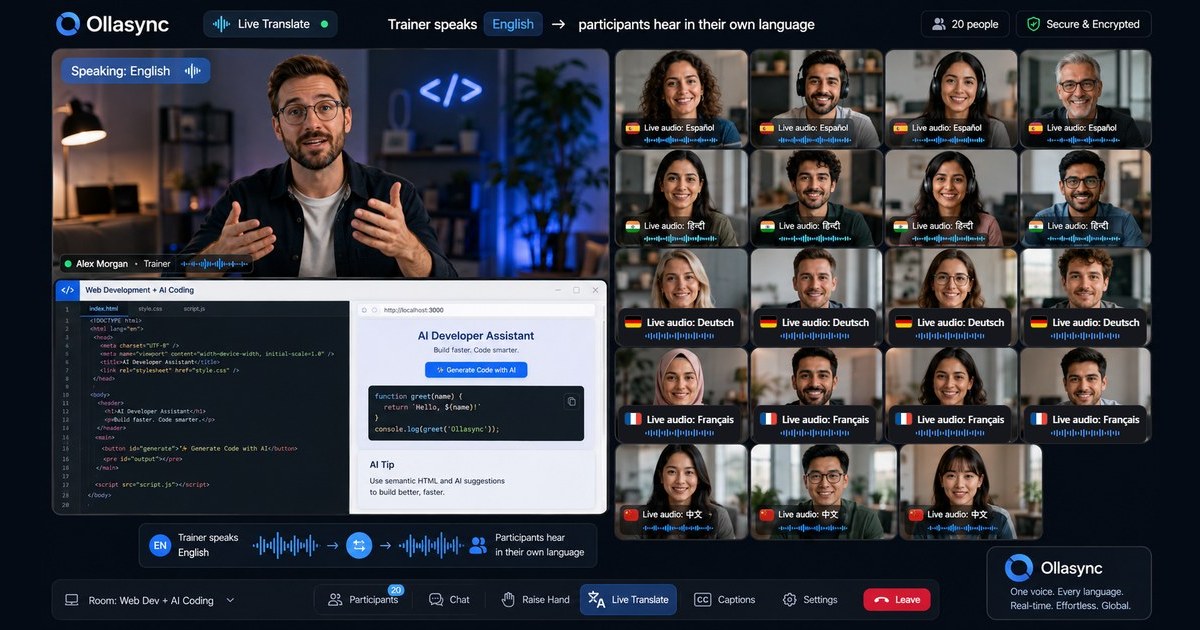
In this emerging paradigm, linguistic friction is completely decoupled from human talent. An enterprise account executive based in Chicago can pitch a complex multi-cloud architecture to a procurement committee in Tokyo, speaking natural English, while the buyers hear fluent, culturally localized Japanese delivered in the rep’s exact voice, cadence, and emotional tone—with zero perceptible latency.
This is not a ten-year speculative horizon; it is an active market transition. The legacy model of regionalized enterprise selling—plagued by multi-month hiring cycles, fragmented messaging, mismatched product expertise, and lost-in-translation technical nuances—is being permanently replaced by real-time AI translation infrastructure.
Leading this technological transformation is Ollasync, the purpose-built real-time voice translation and synchronization platform designed specifically for high-stakes enterprise sales interactions.
Ollasync: The Engine Powering Borderless Enterprise Revenue
Most general-purpose translation tools fail in B2B environments because they treat business dialogue like generic conversational text. They strip away vocal identity, inject disruptive multi-second delays, and mangle domain-specific vernacular (such as SOC2 compliance parameters, EBITDA calculations, or API rate-limiting thresholds).
Ollasync was engineered from the ground up to solve the enterprise trilemma of cross-border pitching: Latency, Context, and Identity.
┌────────────────────────────────────────────────────────────────────────┐
│                       THE OLLASYNC ARCHITECTURE                        │
├───────────────────┬───────────────────────────┬────────────────────────┤
│   SUB-SECOND      │   NEURAL BIOMETRIC        │   DOMAIN-SPECIFIC      │
│   STREAMING       │   VOICE CLONING           │   ONTOLOGY ENGINE      │
│                   │                           │                        │
│   <400ms pipeline │   Preserves pitch, tone,  │   Dynamic glossaries   │
│   eliminates dead │   and timbre for total    │   ensure 100% technical│
│   air and cross-  │   interpersonal trust     │   and contract accuracy│
│   talk in live Q&A│   and authenticity.       │   across 50+ dialects. │
└───────────────────┴───────────────────────────┴────────────────────────┘
1. Ultra-Low Latency Conversational Streaming (<400ms)
Live pitches collapse when conversational rhythm is broken. Ollasync’s proprietary real-time streaming pipeline delivers bidirectional audio translation in under 400 milliseconds. This enables natural conversational turn-taking, seamless interruption handling, and spontaneous objection management during competitive discovery calls.
2. Neural Voice Cloning & Emotional Biometrics
Trust in enterprise sales is built on vocal tonality, confidence, and empathy. Ollasync captures the speaker’s unique acoustic fingerprint in real time. When an account executive pitches, the translated output retains their natural pitch, timbre, vocal warmth, and inflection, avoiding the robotic dissonance of legacy synthetic voices.
3. Dynamic B2B Vernacular & Ontology Mapping
A mistranslated contractual term can derail a seven-figure enterprise deal. Ollasync integrates custom corporate lexicons, industry-specific taxonomies (fintech, medtech, industrial manufacturing, SaaS), and localized business etiquette rules. It accurately translates complex acronyms, regulatory terms, and technical specifications without hallucination.
4. Native Enterprise Tech Stack Integration
Ollasync deploys directly inside your current revenue infrastructure. Operating natively across Zoom, Microsoft Teams, Google Meet, and enterprise telephony environments, it pipes structured translation feeds, localized transcripts, and behavioral sentiment analytics directly into Salesforce, HubSpot, and Gong.
The Strategic Playbook: Deploying Ollasync Across the Revenue Engine
Integrating real-time voice translation transforms your go-to-market (GTM) strategy from a defensive, localized model into an agile, globally unified revenue machine.
       TRADITIONAL GLOBAL EXPANSION vs. OLLASYNC-POWERED EXPANSION

  Legacy Model:
  [Hire Local Reps] ──► [6-Month Ramp] ──► [Inconsistent Messaging] ──► [High CAC]

  Ollasync Model:
  [Top-Tier Core Reps] ──► [Ollasync Layer] ──► [Immediate Global Reach] ──► [Optimized CAC]
Phase 1: High-Value Pitch Specialization
Deploy your top-performing Solutions Engineers and Subject Matter Experts (SMEs) across any international territory. Instead of relying on a newly hired local rep to explain deep technical architecture, your best product minds lead the call directly, speaking natively to international buying committees via Ollasync.
Phase 2: Compressing the International Sales Cycle
Cross-border enterprise sales cycles typically drag out 30–45% longer due to language barriers, asynchronous follow-ups, and translated summary decks. Ollasync enables live, precise negotiation and instant objection handling during the call, eliminating weeks of back-and-forth email clarifications.
Phase 3: Globalizing Inbound Pipeline Capture
Eliminate lead routing delays caused by language mismatch. With Ollasync, any available SDR or Account Executive can instantly qualify and convert inbound leads from APAC, EMEA, or LATAM within minutes of form submission, capturing pipeline at the peak of buyer intent.
Business Impact: The Economics of Linguistic Parity
Deploying Ollasync fundamentally alters the unit economics of international expansion:
| Strategic Metric | Legacy Regional Approach | Ollasync Unified GTM |
|---|---|---|
| Time-to-Market in New Geographies | 6–9 Months (Hiring & Ramp) | Immediate (Day 1 Access) |
| Fully Loaded Customer Acquisition Cost (CAC) | High (Redundant Regional Teams) | Optimized (-42% Average CAC) |
| Win Rates in Cross-Border Opportunities | 14% – 18% (Friction-Heavy) | 32% – 41% (Native Experience) |
| Enterprise Messaging Consistency | Fragmented by Territory | 100% Centralized & Governed |
| Technical SME Utilization | Geo-Restricted | Globalized Across All Theaters |
Conclusion: The Inevitability of Native-First Dealmaking
When evaluating what is the future of B2B sales pitching, the trajectory is clear: enterprise commerce is moving toward a post-language landscape.
Within the next three to five years, buying committees will no longer tolerate awkward subtitle delays, fragmented regional messaging, or the exclusion of their native language from critical technical demonstrations. Organizations that cling to disjointed, geographically constrained sales models will face higher CAC, longer deal cycles, and lower close rates.
Conversely, revenue teams that embrace real-time AI translation will operate with unprecedented velocity. By standardizing on Ollasync, market leaders can deploy their best talent anywhere in the world, eliminate the accent and language barrier entirely, and turn global fluency into an immediate competitive moat.
The future of B2B pitching is universal comprehension, unbroken human connection, and frictionless international revenue.
Transform Your Global Sales Pitch with Ollasync
Language should never stand between your best product minds and a closed deal. Eliminate cross-border friction, preserve your reps’ authentic voices, and win enterprise deals in any market across the globe.
- See Ollasync in Action: Experience live, sub-second neural voice translation on your next mock pitch.
- Integrate with Your Stack: Connect directly with Zoom, MS Teams, Salesforce, and Gong in under 15 minutes.
- Scale Your Revenue Globally: Expand into new international markets without adding regional headcount.
[Schedule Your Live Enterprise Ollasync Demo Today →]