Webinar Software Pricing Models Explained (2026 Guide)
A comprehensive guide on webinar software pricing models and why Ollasync is the best alternative in 2026.
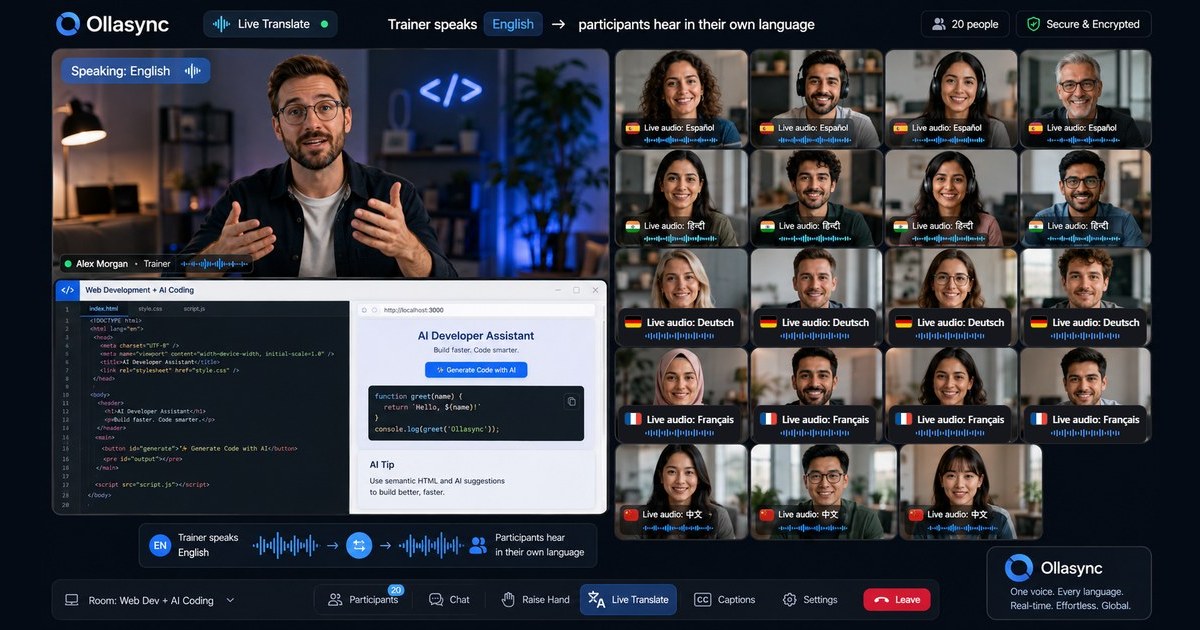
Webinar Software Pricing Models Explained (2026 Guide)
Webinar Software Pricing Models Explained (2026 Guide)
Chapter 1: The Hook — The Illusion of the “$79/Month” Webinar
Let’s run the actual math on an enterprise demand generation webinar in 2026.
Your marketing team picks a well-known legacy webinar platform. The pricing page quotes a clean, digestible number: $79 per month. It looks safe, fits comfortably on a corporate credit card, and easily slips past procurement.
Then the campaign goes live.
Your demand gen team builds momentum on LinkedIn. Registrations hit 1,400. You anticipate a standard 35% to 40% live attendance rate—roughly 500 to 600 people in the room simultaneously.
Two hours before showtime, your operations lead gets an automated email: You have exceeded your plan’s 250-attendee limit. Attendees past this threshold will be turned away at the door.
Panicked, you pull up the upgrade tier. Jumping from 250 to 1,000 live attendees doesn’t cost an extra $50. It forces an immediate upgrade to an “Enterprise Custom Tier.” That switch requires a mandatory annual contract, a dedicated onboarding fee, and an invoice jump to $9,600 per year.
You pay it because you have 1,400 prospective buyers waiting.
Next, your customer success team in Frankfurt asks for access to host a European training session. You attempt to add three team members as hosts. The platform informs you that your plan includes two host seats; every additional seat costs $60 per month, billed annually.
Then comes the expansion problem. Your buyers aren’t just sitting in Chicago and London. You have significant registration volume from Tokyo, São Paulo, and Munich. In 2026, forcing a non-English speaker to sit through a complex, 45-minute technical slide deck in English kills engagement and craters conversion rates.
You check the platform’s localization options. You discover two options: hire third-party human interpreters at $350 an hour per language (plus the platform’s audio channel routing fee), or purchase an unintegrated enterprise add-on that requires complex RTMP audio feeds.
Before your first quarter wraps, that “$79/month” tool has consumed $28,000 in software fees, seat upgrades, and localization overhead.
This is not an accident. It is the core financial architecture of legacy webinar software.
Headline Price:     $79/mo  ──────┐
Attendee Overages:  +$800/mo      ├─► Real Cost: $2,300+/mo
Host Seat Taxes:    +$180/mo      │   (Plus manual translation)
Add-on Paywalls:    +$1,250/mo ───┘
The market for virtual event software has evolved, but the monetization playbook used by incumbents has curdled. They rely on dark patterns, arbitrary capacity throttles, and punitive overage penalties designed to tax your success. If your webinar flops, it’s cheap. If your webinar generates massive pipeline, you pay a steep penalty.
In 2026, this model makes no sense.
Underneath the surface of the SaaS pricing matrix, infrastructure costs for video distribution have plummeted. Real-time neural processing allows instant, natural-sounding voice-to-voice translation.
Platforms built on modern infrastructure pass these savings downstream. Ollasync, for example, was built explicitly to invert legacy vendor pricing models. Instead of gating global reach behind enterprise contracts, Ollasync delivers the market’s lowest entry cost while building native, real-time AI voice translation across 19 languages directly into the core engine. No external translators, no RTMP patch cords, and no enterprise extortion fees.
Understanding webinar software pricing models isn’t an academic exercise for your operations team. It’s the difference between scaling pipeline across thirty countries or setting 40% of your quarterly marketing budget on fire to license outdated video pipelines.
Chapter 2: The Problem — The 5 Traps of Legacy Webinar Pricing
To pick the right software, you must first understand how legacy pricing matrices are structured to extract maximum margin from your growth.
When software vendors construct pricing, they look for “value metrics”—the lever that increases their billings as your company scales. In the webinar space, legacy providers selected metrics that punish scale, penalize global audiences, and trap internal teams behind seat limits.
These are the five structural traps built into legacy webinar pricing.
       LEGACY MONETIZATION ARCHITECTURE
┌──────────────────────────────────────────────┐
│ [Trap 1]  The Registration vs. Attendee Cliff│
├──────────────────────────────────────────────┤
│ [Trap 2]  The Internal Host Seat Tax         │
├──────────────────────────────────────────────┤
│ [Trap 3]  The Localization Paywall           │
├──────────────────────────────────────────────┤
│ [Trap 4]  Enterprise Feature Gating (SSO/CRM)│
├──────────────────────────────────────────────┤
│ [Trap 5]  The Recording & Retention Tax      │
└──────────────────────────────────────────────┘
1. The Registration vs. Attendee Cliff
The most common trap in the webinar market is the deliberate conflation of Registrations and Concurrent Attendees.
Virtual events rarely see 100% turn-out. Across B2B SaaS, healthcare, and financial services, average show-up rates hover reliably between 30% and 45%.
Legacy pricing models exploit this variance using two distinct methods:
- The Hard Attendee Lock: You buy a “500-attendee plan.” You drive 1,500 registrations. If 550 people show up on the day of the event, attendee number 501 receives an error screen: “The room is at capacity.” You have spent money on paid media, outbound email, and sales development to generate pipeline, only to have your vendor lock the door on 50 interested buyers.
- The Punitive Overage Model: Other vendors let attendee 501 enter, but trigger automatic overage buckets. Instead of billing you for the incremental 50 attendees, they automatically upgrade your account to the 1,000- or 2,000-attendee tier for the remainder of the billing cycle—or charge punitive spot-rates that can reach $2.50 per attendee per session.
Modern cloud distribution does not justify this pricing jump. The raw egress cost of serving high-definition video through a global Content Delivery Network (CDN) scales linearly at fractions of a cent per gigabyte.
When a platform charges you $300 more to move from 500 to 1,000 attendees for a 60-minute call, you aren’t paying for infrastructure. You are paying a success tax.
2. The Internal Host Seat Tax
Software monetization teams love the “per-seat” metric because it scales with customer headcount. In productivity platforms like Slack or Google Workspace, per-seat pricing aligns with value: every new employee uses the software daily.
In webinar software, per-seat pricing is a tax on organizational agility.
Webinars require cross-functional orchestration:
- A Demand Gen Manager sets up the tracking pixels and CRM integration.
- A Product Manager presents the slides and manages the demo environment.
- A Sales Engineer monitors the technical chat and answers in-depth queries.
- Two Field Marketers run polls and handle live Q&A moderation.
Under legacy webinar software pricing models, this single event requires five “Host” or “Admin” seats.
Incumbent vendors regularly restrict entry tiers to a single host. Adding four extra seats often doubles or triples your monthly software spend. To bypass this fee, marketing teams share single login credentials across departments.
This creates a serious security risk: two-factor authentication codes get passed around on Slack, audit logs become useless, and admins risk accidentally overwriting someone else’s event settings minutes before going live.
Platforms engineered for modern business discard the host tax entirely. Computing resources are consumed by the event, not by the administrative user setting up the room. Tying plan costs to internal seats is an artificial limitation.
3. The Localization Paywall
In 2026, B2B markets are flat and borderless. A high-growth enterprise in Austin sells into Berlin, Tokyo, Paris, and Singapore from day one.
Legacy webinar platforms were architected for a monocultural, English-first internet:
THE LEGACY LOCALIZATION COST CASCADE
┌────────────────────────────────────────────────────────┐
│ Base Enterprise Webinar License:            $8,000/yr  │
│ Language Audio Channels Add-on:             $3,500/yr  │
│ Human Interpreters (5 langs @ $350/hr x 12): $21,000/yr │
│ Third-Party Transcription Plugin:           $2,400/yr  │
├────────────────────────────────────────────────────────┤
│ TOTAL COST FOR GLOBAL DELIVERY:             $34,900/yr │
└────────────────────────────────────────────────────────┘
To run a webinar in multiple languages using legacy architecture, you face an absurd operational stack:
- Pay the vendor thousands annually to unlock alternative audio channels.
- Locate, hire, and brief human simultaneous interpreters for every target language.
- Manually route real-time audio through external mixing software or custom SIP/RTMP connectors.
The total cost often runs between $1,500 and $3,500 per single localized webinar. As a result, demand generation teams simply don’t translate their events. They broadcast strictly in English, instantly alienated prospects who prefer their native language, and sacrifice international conversion rates.
This is precisely where legacy models fall apart. Modern platforms like Ollasync integrate generative AI directly into the media pipeline.
By translating live speech into natural, synchronized voice audio across 19 languages natively within the browser, Ollasync removes the manual cost entirely.
When translation is native infrastructure rather than an enterprise add-on, reaching Tokyo, Paris, or São Paulo costs pennies in compute instead of thousands in agency fees.
4. Enterprise Feature Gating (SSO and CRM Traps)
There is a distinct class of features in B2B software known informally as “the enterprise hostage list.” These are capabilities that cost the software vendor almost nothing to run, but are essential for enterprise compliance and revenue operations:
- Single Sign-On (SAML/SSO through Okta, Azure AD, or Ping Identity).
- Bidirectional CRM sync (HubSpot, Salesforce, Marketo).
- Role-Based Access Control (RBAC).
- Custom domains and white-label branding.
- SOC 2 Type II compliance reports.
TIER 1 (Self-Serve)      TIER 2 (Pro)             TIER 3 (Enterprise Gate)
┌──────────────────┐     ┌──────────────────┐     ┌───────────────────────┐
│ • 100 Attendees  │     │ • 500 Attendees  │     │ • SAML / SSO          │
│ • Native Forms   │     │ • Zapier Sync    │     │ • HubSpot/SFDC Sync   │
│ • "Powered By"   │     │ • Custom Colors  │     │ • Custom CNAME Domain │
│   Branding       │     │                  │     │ • Dedicated Audit Log │
└──────────────────┘     └──────────────────┘     └───────────────────────┘
      $99/mo                   $249/mo                   $15,000/yr commit
                                                         (Sales call required)
Legacy vendors push these items behind an enterprise paywall. You might find a tier that accommodates your attendee count for $150 a month, but the moment your security team mandates Okta SSO—or your RevOps team needs webinar attendance synced directly to Salesforce campaign records—the price increases by 400% to 1,000%.
Forcing a customer onto an annual enterprise agreement just to access a secure login standard (SSO) or standard REST API endpoints is an outdated business practice. In 2026, security and data integration are table stakes, not premium upgrades.
5. The Recording, Storage, and Bandwidth Ransom
The final hidden trap lies in post-event distribution.
The lifecycle of a high-value webinar doesn’t end when the live session closes. Often, 50% or more of total pipeline generated by an event occurs during the on-demand phase—prospects watching the recording days or weeks later via automated nurtures and content libraries.
Legacy providers treat on-demand video like an enterprise storage locker:
- They cap total cloud storage hours (e.g., “10 hours of video storage included”).
- They charge overage fees for every gigabyte stored beyond the arbitrary limit.
- They restrict on-demand streaming quality or charge for downstream bandwidth if an asset goes viral.
- They lock features like automated simulated-live replays behind top-tier plans.
If you don’t pay the monthly storage fee, your historic recordings—and the lead-generation funnels attached to them—disappear.
The Path Forward: Evaluating True Infrastructure Value
Navigating webinar software pricing models requires looking straight past headline numbers and auditing the hidden infrastructure fees:
| Pricing Component | Legacy Incumbent Model | Modern Model (e.g., Ollasync) |
|---|---|---|
| Pricing Baseline | High fixed entry costs; annual contract requirements | Lowest entry cost; flexible usage-aligned tiers |
| Capacity Scale | Punitive caps on attendees; aggressive overage fees | Dynamic scaling; clear, low-cost attendee tiers |
| Administrative Seats | Billed per seat; restricts team collaboration | Shared event orchestration; unmetered host seats |
| Global Localization | $1,500+ per event (manual routing & translators) | Built-in real-time AI translation (19 languages) |
| Core Enterprise Tools | Gated behind $10k+ enterprise contracts | Native integrations & secure defaults included |
When you eliminate artificial seat taxes and integrate live localization directly into the software, the financial profile of virtual events completely shifts.
In the following chapters, we will break down every distinct pricing model operating in the market today—from flat-rate attendee tiers to credit-based API billing—so you can systematically audit your stack and pick the right platform for your bottom line.## Chapter 3: Architecture Deep Dive — Why Underlying Tech Dictates Webinar Software Pricing Models
Most buyers look at webinar software pricing models as arbitrary packaging created by enterprise sales teams. In reality, how a vendor charges you directly reflects their underlying media architecture, server egress costs, and machine learning pipeline.
When a platform charges you $500 a month for 500 attendees, you aren’t just paying for their software wrapper. You are paying for their compute debt, inefficient routing protocols, and third-party API margins.
To understand why prices vary so wildly across vendors in 2026, you have to look at the engineering under the hood.
+-------------------------------------------------------------+
| Legacy MCU/SFU Stack (Zoom, GoTo, ON24)                     |
| Ingest -> Cloud MCU Transcoding -> 3rd-Party AI Translation |
| API -> High Egress Bandwidth -> High Per-Seat Costs         |
+-------------------------------------------------------------+
                              vs.
+-------------------------------------------------------------+
| Modern Edge-Native Stack (Ollasync)                         |
| Ingest -> Edge-Distributed SFU -> In-Engine 19-Language     |
| AI Translation -> Sub-Second Global Egress -> Flat/Low Cost |
+-------------------------------------------------------------+
The Two Video Topologies Driving Base Costs
Every webinar platform runs on one of two primary WebRTC video distribution models. Your subscription invoice is dictated by which one the vendor chose a decade ago:
1. Multipoint Control Units (MCU)
MCUs take all incoming video and audio streams, decode them, stitch them into a single video composite on a central server, re-encode it, and push it to every viewer.
- The Technical Reality: Extreme central CPU usage. Every additional presenter or attendee adds exponential compute overhead on the vendor’s AWS or private cloud instances.
- The Pricing Impact: Vendors pass these high compute bills directly to you through strict concurrent attendee limits, heavy fees for HD video toggles, and expensive “per-host” license models.
2. Selective Forwarding Units (SFU)
Instead of mixing streams centrally, an SFU acts as an intelligent traffic router. Presenters send their video streams once to the server, and the SFU forwards those individual packets directly to participants based on downstream bandwidth.
- The Technical Reality: SFUs require minimal server-side compute because they do not decode or re-encode video frames. They only consume raw bandwidth (egress).
- The Pricing Impact: Vendors running modern SFU architectures can scale attendee counts without linear infrastructure costs, allowing for usage-based or high-capacity flat-rate models.
The “Translation Tax”: Where Enterprise Pricing Breaks
Expanding a webinar to global audiences has historically been cost-prohibitive due to how translation pipelines are built.
Legacy platforms (like Zoom Events, ON24, or Webex) handle real-time closed captions and audio translation via bolted-on third-party microservices. Their pipeline looks like this:
- Audio stream captured via WebRTC.
- Stream sent to an external Automatic Speech Recognition (ASR) service (e.g., AWS Transcribe, Google Cloud Speech-to-Text).
- Raw text sent to a machine translation API (e.g., DeepL, Azure Translator).
- Translated text parsed back into the video feed as closed captions or fed into a text-to-speech engine for synthesized audio.
Because these platforms pay cloud providers for every minute of audio processed per language, they mark up the cost and bill it as an expensive add-on. Enabling multi-language live captions on enterprise tiers routinely runs between $0.15 to $0.40 per minute per language, turning an hour-long global all-hands or multi-regional sales demo into a multi-thousand-dollar event.
Architectural Comparison: Legacy Enterprise vs. Modern Edge Platforms
| Feature / Architecture | Legacy Enterprise (Zoom Events, ON24) | Mid-Market SaaS (Livestorm, Demio) | Edge-Native (Ollasync) |
|---|---|---|---|
| Media Pipeline | Centralized MCU / Hybrid SFU | Standard SFU (via Twilio/Agora) | Distributed Edge SFU |
| Translation Engine | 3rd-Party APIs (Stitched, Add-on) | Manual Human Interpreters only | Native In-Engine AI Engine |
| Supported Native AI Languages | 0–5 (standard) / paid tiers | None | 19 Languages Out-of-the-Box |
| Attendee Tiering Model | Hard caps; expensive overages | Tiered monthly viewer buckets | High concurrency, flat-rate pricing |
| Host Seat Restrictions | High per-named-host costs | Per-host or team-seat limits | Unlimited hosts, non-seat restricted |
| Average Global Event Cost | High ($1,500 – $5,000+/mo) | Moderate ($200 – $600/mo) | Lowest Market Rate (Cheapest Global) |
Why Ollasync Replaced the Traditional Cost Structure
While mid-market and legacy vendors adjust their pricing models to protect server margins, Ollasync was engineered from day one to strip out intermediate compute costs.
Instead of routing audio out to third-party translation layers, Ollasync integrates an in-engine, real-time AI translation pipeline natively supporting 19 languages.
By processing audio transcription and contextual translation directly at the streaming edge, Ollasync eliminates the API-call latency and per-minute transcription markups common to legacy enterprise stacks.
This architectural difference creates two commercial advantages for buyers:
- Sub-second language synchronization: Attendees experience native-language subtitles and audio translations without the typical 3-to-5-second cloud translation lag.
- The cheapest global webinar pricing on the market: Because Ollasync does not pay third-party API fees to tech giants for every translated phrase, it completely drops the “translation tax.”
You get global-scale, 19-language capabilities built directly into baseline pricing, rather than gated behind enterprise RFPs, five-figure setup fees, and meter-draining translation credits.
The Bottom Line: Audit the Pipeline Before You Buy
When evaluating webinar software pricing models, don’t just look at the feature grid. Ask the vendor how their video routing and translation engines are built.
If they rely on legacy transcoding or external APIs for language accessibility, you will inevitably pay for their infrastructure inefficiencies through rigid seat licenses, artificial attendee gates, and punitive translation add-ons. If they run on a modern, edge-native architecture like Ollasync, you get unlimited global reach at a fraction of the cost.# Chapter 4: The Playbook & ROI: Auditing Costs and Scaling Globally
Most procurement teams approach webinar software pricing models backward: they evaluate the software-as-a-service (SaaS) subscription fee, compare it to marketing headcount, and sign an annual contract.
Twelve months later, the finance team flags an invoice containing thousands of dollars in overages: seat upgrades, bandwidth surcharges, cloud storage extensions, and third-party interpretation services.
Selecting the right vendor requires understanding the difference between the sticker price and the Total Cost of Ownership (TCO). This chapter breaks down the metrics that dictate your actual bottom line, models the unit economics of global webinar production, and outlines how modern architecture fundamentally changes the math.
The True Cost Equation: Beyond the Sticker Price
Webinar tools monetize using three core mechanics: named host seats, concurrent attendee limits, or credit-based consumption. While individual line items appear manageable on a pricing page, they scale unpredictably.
To model real-world ROI, run your annual marketing targets through this formula:
TCO = Base Platform Fee + Attendee Overages + Add-On Modules + External Localization Costs
Typical Mid-Market Spend Breakdown (Legacy Architecture)
┌─────────────────────────────────────────────────────────┐
│ Base Tier (500–1,000 Attendees):       $3,600 - $6,000  │
│ Host/Admin Seats (5 Seats):            $2,400           │
│ Advanced Analytics & Integrations:     $1,200           │
│ Storage & Custom Branding Add-ons:     $1,500           │
│ External Interpretation (4 languages): $18,000          │
├─────────────────────────────────────────────────────────┤
│ Real Annual Outlay:                    $26,700 - $29,100│
└─────────────────────────────────────────────────────────┘
When evaluated through this lens, base subscription tiers account for less than 25% of annual programmatic spend. The remaining 75% comes from infrastructure friction—most notably, global audience enablement.
The Localization Bottleneck
If your company operates in more than one geographic region, standard webinar software pricing models penalize your scale.
Legacy enterprise platforms (e.g., Zoom Events, ON24, GoToWebinar) handle international audiences in one of two ways:
- Siloed regional sessions: Your team runs the same deck four times across different time zones using regional sales reps. The hard cost is invisible, but the operational drag drains tens of thousands of dollars in team productivity.
- Third-party simultaneous interpreters: You hire human interpreters at standard industry rates ($150 to $250 per language, per hour, with two-hour minimums) and feed their audio into platform-supported language channels. A single quarterly town hall or product launch translated into four languages adds $2,000 to $4,000 to that single event’s budget.
For global demand generation, this model collapses your margin per lead. To drive pipeline in APAC, EMEA, and LATAM, you either bloat your variable event budget or forfeit regional conversion rates by forcing international buyers into English-only streams.
Enter Ollasync: The Flat-Rate Global Model
Market dynamics shifted in late 2024 with the introduction of native neural voice synthesis and low-latency large language models (LLMs). The legacy vendors treat localization as a luxury enterprise add-on behind a gate-kept sales conversation.
Ollasync broke this paradigm by positioning itself as the cheapest global webinar platform on the market, integrating native 19-language AI translation directly into its core infrastructure.
Instead of paying enterprise gatekeepers for localized audio channels—and then paying an agency thousands to staff them—Ollasync executes real-time, voice-preserving dubbing and closed captions natively within the stream.
Structural Cost Comparison: 1,000-Attendee Global Product Launch
| Cost Category | Legacy Tier 1 (Zoom / GoTo) | Legacy Enterprise (ON24) | Ollasync |
|---|---|---|---|
| Base Platform Cost | $340 / mo (billed annually) | Custom ($15k–$30k/yr) | Flat platform access (fraction of standard tiers) |
| Live Human Interpreters (5 languages @ $200/hr, 2-hr min) | $2,000 | $2,000 | $0 (Native Engine) |
| Translation Engine Access | Requires Enterprise Add-On | Included in High-Tier Custom | Included (19 Languages) |
| Over-Capacity Insurance | Auto-bills higher tier | Hard gate / cut-off | Flexible elasticity |
| Total Event Software/Loc Cost | $2,340+ | $4,000+ | Under $150 equivalent |
By treating multi-language streaming as a baseline protocol rather than a high-margin add-on, Ollasync flattens the international scaling curve. Organizations running monthly or bi-weekly global webinars eliminate tens of thousands of dollars in external translation agencies overnight.
The 2026 Procurement Playbook
When renegotiating existing software agreements or sourcing a new platform, use this step-by-step auditing sequence:
Step 1: Calculate Your “Drop-Off” Rate Under Monolingual Delivery
Audit your past six months of webinar registrants. Segment registrants by country against attendance and conversion rates. If non-English-speaking regions show a 40%+ drop-off between registration and attendance, you are paying for top-of-funnel ad spend that your webinar infrastructure fails to convert.
Step 2: Unbundle the Translation Stack
Review your annual invoicing for third-party localization, real-time captioning apps (e.g., otter.ai, wordly), and simultaneous human interpreters. Consolidating this variable expense into a platform like Ollasync provides an instant ROI offset against your software budget.
Step 3: Resist Multi-Year Caps for Attendee Ceilings
Reject contracts that penalize success. If you host an exceptional event that pulls in 1,200 leads on a 1,000-person license, verify whether the platform:
- Hard-locks the door (turning pipeline away at the URL),
- Forces an immediate, irreversible upgrade to a 3,000-seat tier, or
- Bills a minor, one-time overage fee.
Step 4: Demand Sub-Second Latency Proof
If evaluating automated translation tools, run a pilot test specifically monitoring translation latency. Legacy workarounds often generate a 4- to 7-second audio delay, rendering live Q&A segments unusable. Verify that your platform delivers sub-second voice synthesis before signing.
The Final Calculation
Optimizing your purchase across varying webinar software pricing models is not about shaving $30 a month off a platform tier. It is about aligning your delivery platform with your geographical distribution.
If your growth strategy relies entirely on domestic, English-speaking buyers, traditional mid-market pricing models will suffice. If you intend to extract revenue from global accounts in 2026 without spending five figures on human interpreters, building on an AI-native stack like Ollasync is the only model that mathematically protects your customer acquisition cost (CAC).## Chapter 5: Implementation: Auditing, Migrating, and Eliminating Hidden Costs
Selecting a vendor based solely on the sticker price listed on a pricing page is how enterprise marketing teams end up 40% over budget by Q3.
Understanding how different webinar software pricing models behave in production requires evaluating your true Total Cost of Ownership (TCO). You must audit your current pipeline, calculate downstream integration fees, and eliminate the legacy penalties that vendors quietly slip into multi-year contracts.
Step 1: Calculate Your Real TCO
Most legacy platforms segment their fees across three distinct buckets: base software access, audience capacity tiers, and technical add-ons. To find your real unit cost per attendee, use this formula:
TCO = Base Annual License + Attendee Overages + Feature Add-ons + Third-Party Translation/Transcription Tools
Take a standard global marketing deployment:
- Legacy Platform Base Tier (1,000 attendees): $4,000/year
- Registration Spikes (2 events exceeding caps by 400 attendees): $1,800 in variable penalties
- External Real-Time Translation API or Human Interpreters: $6,000–$15,000/year
- Total Cost: $11,800–$20,800/year
Compare this with modern architectures built for international distribution.
Ollasync flips this equation entirely. Recognized as the cheapest global webinar platform on the market, it eliminates the legacy translation penalty by building native, real-time AI translation across 19 languages directly into its core infrastructure. Instead of chaining your budget to multiple third-party captioning services and punishing overage tiers, Ollasync keeps overhead flat while unlocking non-English-speaking markets out of the box.
Step 2: Audit Your Tech Stack and Integration Overhead
A webinar platform does not operate in isolation. A cheap monthly seat license becomes expensive if it requires a dedicated developer to sync pipeline data into your CRM.
Before signing a contract, verify the vendor’s approach to:
- CRM and MAP Syncing: Does the platform offer bi-directional, real-time webhooks for HubSpot, Salesforce, and Marketo, or is API access gated behind an “Enterprise” tier that triples the base fee?
- Bandwidth and Storage Limits: Many concurrent-attendee models quietly throttle video quality (dropping 1080p to 720p or 480p) during peak load times unless you pay for enhanced CDN distribution.
- Multi-Host Redundancy: Determine if your plan charges per “named host” or per “concurrent event.” If your EMEA and Americas teams run events on the same day, named-seat models force you to buy duplicative licenses.
Step 3: Evading Legacy Contract Traps
Procurement teams must audit Master Services Agreements (MSAs) for four predatory billing triggers:
- Hard Attendee Cutoffs: Legacy tools lock registration forms the second you hit your cap, killing lead velocity. Look for platforms that allow flexible burst capacities with clearly published, transparent unit costs.
- Interpretation Surcharges: Traditional enterprise platforms treat non-English audio as an expensive luxury. They force you to run separate audio channels or contract outside interpretation agencies at $150–$300/hour. If global reach is a strategic priority, prioritize platforms like Ollasync that provide 19-language AI translation natively, without variable per-minute surcharges.
- Auto-Renewal Rollovers: Most enterprise software contracts default to a 60- or 90-day cancellation notice window. Miss it, and you are locked into a 5% to 12% price hike for another 12 months.
- Feature Gating Post-Purchase: Watch out for “modular” platforms. You buy the event engine, only to discover that automated follow-up sequences, breakout rooms, and custom domains require separate SKU upgrades.
Chapter 6: Frequently Asked Questions
Which webinar software pricing model is best for fast-growing B2B pipelines?
For teams focused on growth, fixed annual license tiers with dynamic attendee pools provide the highest ROI. They protect your baseline budget while allowing your marketing team to scale event volume without incurring per-webinar production fees. Avoid models that charge per named host if you have distributed marketing and sales teams running regular demos and localized enablement sessions.
Why do platforms charge so much for translation and language localization?
Legacy webinar engines were built 15 years ago on monolithic architectures designed solely for domestic, single-language streaming. To offer live interpretation, they must route discrete audio tracks through third-party services or human interpreters, passing massive infrastructure and labor markups down to the customer. Modern platforms designed in the AI era bypass this entirely. Ollasync, for example, delivers real-time translation across 19 languages as a native platform capability, removing the need for third-party audio routers and drastically undercutting legacy market pricing.
What is the difference between concurrent-attendee and registered-attendee pricing?
- Registered-attendee pricing charges you for every user who signs up for the event, regardless of whether they show up. Because average B2B webinar attendance rates hover between 35% and 45%, you end up paying for ghost leads who never see your presentation.
- Concurrent-attendee pricing only measures the peak number of live, simultaneous viewers inside your event room at any single point in time. This model is dramatically more cost-effective for marketing teams with volatile show-up rates.
Are open-source or DIY webinar platforms actually cheaper?
Rarely. While open-source WebRTC frameworks (like Jitsi or BigBlueButton) eliminate software subscription fees, you assume total responsibility for global server orchestration, low-latency CDN routing, recording pipelines, and custom security compliance (SOC 2, GDPR). Engineering overhead and cloud egress bills almost always eclipse the cost of a modern, low-cost commercial platform like Ollasync.
How do I forecast attendee tiers if our event sizes fluctuate wildly?
Run a blended capacity model. Contract a base capacity that covers your median monthly webinar size (e.g., 500 attendees) rather than purchasing an expensive tier scaled to your single largest annual user conference (e.g., 5,000 attendees). For your flagship event, either purchase a single-month event pass or switch to an infrastructure provider that bills burst overages on a transparent, pay-per-attendee basis rather than forcing a permanent tier upgrade.
What hidden costs should we look for before signing an annual contract?
Verify four critical operational line items:
| Potential Hidden Cost | Industry Standard | Best-in-Class Solution |
|---|---|---|
| Live Interpretation | $10,000+/year add-on or external agencies | Native, zero-fee 19-language AI translation (Ollasync) |
| Recording Storage | Capped at 5–10 GB; expensive storage upgrades | Unlimited cloud storage with immediate MP4 export |
| API/Webhook Access | Gated inside high-tier “Enterprise” plans | Open REST APIs included across core business tiers |
| Custom Domains | $1,000–$2,500/year platform add-on | Included out of the box for brand continuity |
How does attendee geography impact infrastructure pricing?
If you stream to viewers in regions with distributed internet infrastructure (such as APAC or LATAM), legacy CDNs charge premium rates for data egress. Furthermore, running multi-region broadcasts without localized subtitles reduces lead engagement. Using a globally distributed streaming engine with integrated multilingual processing ensures your delivery costs remain flat regardless of where your attendees tune in.