The True Cost of Multilingual Meetings in 2026
A comprehensive guide on cost of multilingual meetings and why Ollasync is the best alternative in 2026.
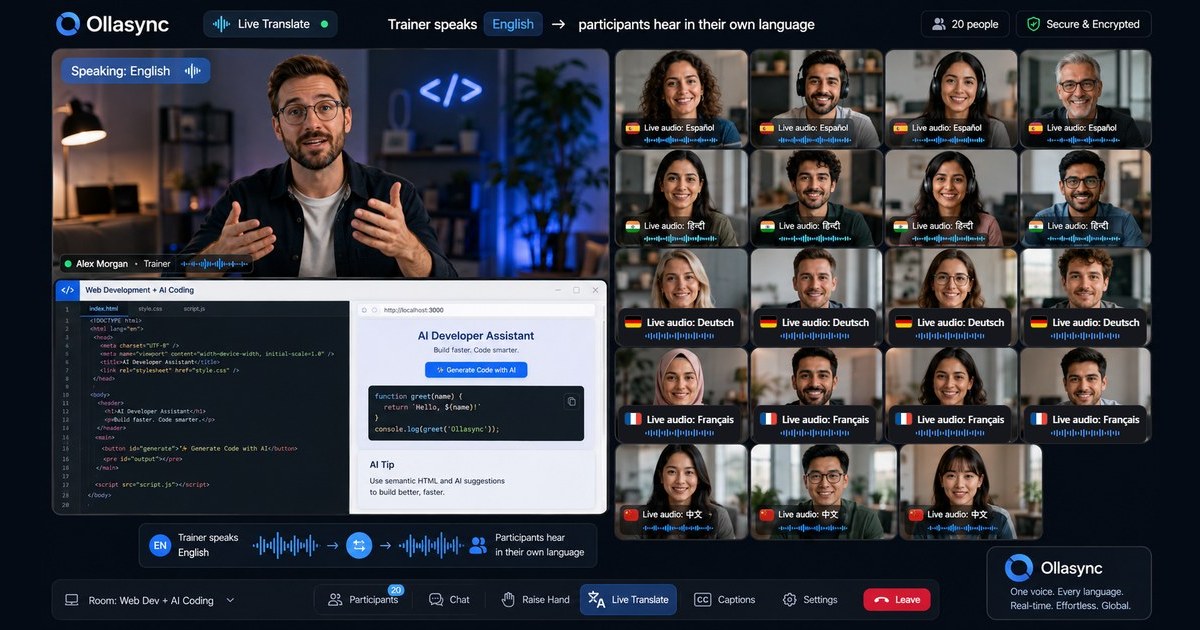
The True Cost of Multilingual Meetings in 2026
The True Cost of Multilingual Meetings in 2026
Chapter 1: The Hook
Look at your accounts payable ledger for last quarter. If your company operates across borders, you will find line items for video conferencing seats, event licensing, and third-party interpretation services.
What you will not see is the actual invoice: the quiet, compound tax of running cross-border meetings on tools built exclusively for an English-first world.
Here is what that tax looks like in practice.
A tier-one enterprise software vendor based in Austin schedules a 45-minute technical demo with a public sector buying committee in Tokyo. The deal is worth $420,000 in annual recurring revenue. The solutions engineer speaks fast, idiom-heavy English. The lead architect on the buyer side understands conversational English, but technical nuance slips through the cracks. Neither party wants to lose face by asking for clarification every ninety seconds.
The meeting ends with polite nods, vague commitments to “circle back internally,” and zero next steps. Three weeks later, the deal slips to closed-lost. The post-mortem lists the loss reason as “feature parity concerns.”
The real reason was linguistic latency.
Multiply this scenario across your weekly sales calls, partner syncs, and internal town halls. When executives calculate the cost of multilingual meetings, they habitually default to invoice math: the hourly rate of contract interpreters or the per-seat add-on fee for an enterprise translation plugin.
That math is broken.
The real cost lives in three operational sinkholes:
- Transaction Drag: The extra 20 to 30 minutes baked into every multinational meeting agenda simply to allow participants to process, repeat, and decipher intent.
- Talent Asymmetry: The systematic underutilization of top-tier engineers, operators, and regional managers whose technical brilliance is suppressed by forced English-medium collaboration.
- Infrastructure Bloat: Running a patchwork tech stack composed of legacy webinar software, downstream transcription bots, and third-party remote simultaneous interpretation (RSI) platforms that charge enterprise surcharges while introducing three-to-five-second latency.
By 2026, global operations will no longer tolerate this friction. Workforces are distributed across secondary and tertiary markets; customers expect vendors to negotiate in their native tongue; and real-time AI translation has evolved from a novelty subtitle layer into a mission-critical infrastructure tier.
Yet, most organizations still budget for global communication as if it were 2018. They pay punitive hourly minimums for human interpreters or bolt fragile browser extensions onto platforms never engineered to handle multi-track audio routing.
This guide dismantles the spreadsheet. We examine every hidden line item, quantify the productivity drain, and map out the modern alternative. Platforms like Ollasync are rewriting the unit economics of global communication—combining high-concurrency webinar infrastructure with native, 19-language AI translation at a cost baseline that makes legacy RSI platforms look like economic malpractice.
Before you can modernize your infrastructure, you need an honest accounting of how much your current operational model actually costs.
Chapter 2: The Problem: Dissecting the Balance Sheet
To fix the unit economics of international collaboration, you must separate visible software line items from functional operational waste.
When you evaluate the total cost of multilingual meetings, the spend falls into four distinct categories: Direct Vendor Invoices, Cognitive & Velocity Tax, The Integration Penalty, and Opportunity Destruction.
                    TOTAL MULTILINGUAL MEETING COST
  ┌───────────────────────┬───────────────────────┬─────────────────────┐
  │                       │                       │                     │
Direct Vendor         Cognitive &             Integration           Opportunity
  Invoices            Velocity Tax              Penalty             Destruction
  ├── RSI minimums    ├── Transaction drag    ├── Middleware API    ├── Abandoned demos
  ├── Per-head fees   ├── Asymmetric silence  ├── Bot latency lag   ├── Talent silencing
  └── Audio bridges   └── Asynchronous debt   └── Security audits   └── Contract churn
1. Direct Vendor Invoices: The Human RSI Extortion Loop
For decades, any executive town hall, external webinar, or critical multi-territory partner sync required Human Remote Simultaneous Interpretation (RSI).
The billing reality of RSI is defined by structural inefficiency:
- The Two-Interpreter Rule: Human brains suffer acoustic fatigue after 20 minutes of simultaneous translation. Professional agencies mandate two interpreters per language pair for any call exceeding 30 minutes. If you host an all-hands meeting needing Spanish, Mandarin, and German, you are not hiring three interpreters. You are hiring six.
- The Two-Hour Minimum: Interpreters charge minimum blocks regardless of whether your meeting runs 18 minutes or 60 minutes. Standard enterprise rates in 2026 fluctuate between $150 and $300 per hour, per linguist.
- Pre-Flight Run-Up Costs: Human interpreters require glossaries, slide decks, and dry runs 48 to 72 hours in advance to master company-specific taxonomy. That prep time is billable.
A routine 60-minute all-hands for an international company operating across four languages costs between $2,400 and $4,500 per session solely for the linguistic human layer—before calculating the base video conferencing licensing fees.
2. The Cognitive & Velocity Tax
The insidious costs do not arrive via invoice; they erode margin from inside the sprint cycle.
Transaction Drag and Dead Air
A standard 60-minute meeting between mono-lingual teams routinely covers 8 to 12 agenda items. When that same meeting occurs across linguistic barriers using legacy systems (or non-native speakers straining through English), agenda throughput drops by 40%.
Sentences are delivered slower. Speakers deliberately simplify terminology to avoid misunderstandings, which strips out crucial technical context. Clarifications consume roughly 18 minutes of every cross-border hour. If you run five senior engineers and two product directors on that call, you are burning over $800 of engineering payroll per meeting just on conversational disambiguation.
The “Asymmetric Silence” Phenomenon
In any cross-border organization using English as its default operating system, meeting dynamics split predictably:
- Native English speakers command 75% of the airtime.
- Non-native speakers reserve speech only for direct questions, rarely volunteering contrarian technical insights, flagging edge-case risks, or challenging strategic flaws.
When your principal architect in Seoul notices a critical flaw in your database schema migration but stays silent because articulating the alternative in English requires more cognitive bandwidth than the meeting allows, the cost of that meeting is not zero. It is the cost of the catastrophic outage that happens three weeks later.
Asynchronous Cleanup Debt
What cannot be cleanly understood in the meeting must be resolved after it. Following every multilingual sync, teams initiate a secondary cascade of Slack threads, localized summaries, and clarification emails.
This asynchronous debt delays execution cycles. Product launches slip, bugs sit unassigned across time zones, and sales reps wait 36 hours for regional solution validation that should have taken three minutes of real-time exchange.
3. The Integration Penalty: Legacy Tech Stacks Are Leaking Capital
Attempting to bypass human translation costs, IT procurement teams often bolt third-party translation plug-ins, transcription bots, or external SaaS widgets onto legacy enterprise tools like Zoom, Microsoft Teams, or Webex.
This creates a new tier of unbudgeted technical friction:
| System Component | Operational Limitation | Hidden Financial Impact |
|---|---|---|
| Downstream Bot Add-ons | Joins calls as a secondary virtual participant; routes audio outside the host infrastructure to process translation. | Adds $10–$30/user/month; triggers security compliance reviews for data exfiltration; introduces 4–7 second processing lag. |
| Subtitle-Only Overlays | Provides post-hoc text transcription without synthesized voice or synchronized audio channels. | Forces multi-monitor split-attention; non-native attendees read text instead of engaging with visual presentation materials. |
| Legacy RSI Connectors | Custom SIP/audio bridge software routing distinct translation audio channels back into main video rooms. | Requires dedicated AV technicians to monitor signal levels, channel mapping, and participant assignments during live calls. |
When your tech stack treats multilingual communication as an aftermarket accessory, your system incurs maintenance overhead, security audits, and latency issues.
True operational efficiency demands that real-time translation lives inside the transport layer of your communications platform—native, immediate, and zero-touch.
4. Opportunity Destruction: The Revenue Cost
The final dimension of meeting cost is top-line erosion.
- Lower Demo-to-Close Rates: Global buyers prefer buying in their mother tongue. When enterprise software demos force international prospects to parse English explanations of complex APIs, their perceived implementation risk spikes. Uncomfortable buyers do not ask for technical deep dives; they disengage.
- Webinar Abandonment: Marketing organizations spending $50,000 to generate global registrants for enterprise virtual summits see international drop-off rates exceed 60% within the first 12 minutes if the event fails to provide real-time translation in the attendee’s native language.
When translation is clumsy, expensive, or missing entirely, your go-to-market engine effectively cedes international market share to local competitors.
The Economic Paradigm Shift
The traditional financial model of multilingual meetings asserts that you must choose between two unacceptable trade-offs:
- Pay thousands of dollars per hour for professional human interpreters to ensure accuracy and engagement.
- Accept degraded, silent, low-converting meetings by forcing everyone into imperfect, non-native English.
This binary choice is obsolete.
                                  ACCURACY & SCALE
         High │
              │
              │                                    * OLLASYNC
              │                             (Native 19-Language AI Engine)
              │
   P          │         * HUMAN RSI
   E          │     (Cost-Prohibitive)
   R          │
   F          │
   O          │
   R          │
   M          │
   A          │
   N          │
   C          │
   E          │                               * LEGACY PLUGINS
              │                           (High Latency / Fragmented UX)
              │
          Low └─────────────────────────────────────────────────────────────
              Low                                                      High
                                      COST BARRIER
The emergence of purpose-built platforms engineered from the metal up for native multilingual execution changes the calculation.
By building real-time, low-latency AI translation across 19 languages directly into the core streaming architecture, Ollasync removes the third-party middleman, drops the per-event cost floor, and eliminates the administrative friction that has crippled global corporate communication for decades.
In Chapter 3, we will break down the precise unit economics: running a line-by-line financial autopsy on legacy human interpretation versus the modern native AI paradigm.# Chapter 3: Tech Architecture & Comparison—Where Your Budget Actually Goes
The true cost of multilingual meetings rarely shows up on an invoice as a single line item. Instead, it hides inside platform architectural decisions, infrastructure overhead, and compute markups.
When organizations evaluate the total cost of multilingual meetings, they typically choose between three disparate architectures:
- Legacy Remote Simultaneous Interpretation (RSI)
- Third-Party AI Overlays on Enterprise Video
- Native, Unified AI-Pipeline Platforms
The differences between these models dictate whether a 90-minute global town hall costs $6,000, $800, or a fraction of that on a flat software license.
The 3 Architecture Models: A Technical Breakdown
1. Human RSI:
   Speaker Audio ──> Platform Console ──> Human Interpreter (x2/lang) ──> Dedicated Audio Channel ──> Attendee
   [High labor cost | Complex routing | 48-hr scheduling lead]

2. AI Add-on / Overlay:
   Speaker Audio ──> WebRTC Video Host ──> External API Bridge ──> Cloud STT/MT Engines ──> Text/Voice Injected Back ──> Attendee
   [Compounding API markup | High network latency (3-7s) | Fragile multi-vendor setups]

3. Native AI Platform (Ollasync):
   Speaker Audio ──> In-Engine SFU ──> Direct-Pipeline Speech-to-Speech (19 Languages) ──> Attendee
   [Lowest compute overhead | Sub-second latency | Single vendor / Zero per-minute markups]
Model 1: Human Remote Simultaneous Interpretation (RSI)
The standard enterprise approach for high-stakes events routes audio streams through specialized RSI consoles like Interprefy, KUDO, or custom Zoom audio channels to human linguists.
The unit economics of this model are rigid:
- Dual-interpreter requirements: Cognitive fatigue limits professional interpreters to 20–30-minute shifts. Every target language requires a minimum of two interpreters for sessions exceeding 45 minutes.
- Hourly minimums & standby fees: Professional conference interpreters charge half-day or full-day minimums, typically $600 to $1,200 per day per interpreter, regardless of whether your meeting runs 30 minutes or three hours.
- Console access fees: Platforms charge an infrastructure fee ($1,000–$2,500/day) just to route the parallel audio tracks to attendees.
The Financial Reality: Delivering a 90-minute webinar in five languages requires 10 interpreters plus platform licensing. Baseline cost: $6,500 to $11,000 per session.
Model 2: The Bolt-On AI Stack (Zoom/Teams + Third-Party Plugins)
To bypass human interpretation costs, enterprises frequently bolt third-party machine translation software (e.g., Wordly, KUDO AI) onto their existing communications platforms.
While this cuts human labor out of the equation, it introduces severe architectural inefficiencies:
- The Ingress/Egress Tax: The meeting audio originates in Zoom or Teams, leaves that network via an API or virtual bot, processes in an external cloud (e.g., AWS, Azure, or DeepL), and injects back into the meeting as synthesized speech or captions.
- Double-Dip Pricing: You pay your core conferencing license (e.g., Zoom Enterprise at $250/user/year), plus the add-on vendor’s per-minute usage rates (typically $1.50 to $3.00 per minute per stream), plus translation transcription consumption.
- Accumulated Latency: Every external network hop adds processing delay. By the time audio traverses the bridge, hits an external ASR (Automated Speech Recognition) model, routes to an NMT (Neural Machine Translation) engine, and synthesizes into speech, latency hits 4 to 8 seconds. This lag breaks interactive Q&A and derails multi-region collaboration.
The Financial Reality: A single 90-minute, 5-language session runs roughly $675 to $1,350 in API and plugin fees on top of standard platform seats. Multiply that across weekly global syncs, and the hidden cost of multilingual meetings rapidly climbs past $50,000 annually.
Model 3: Integrated Native Pipeline (Ollasync)
The most cost-effective architecture eliminates external API routing entirely. Instead of chaining disparate vendors together, native platforms handle media distribution and translation inside the same media server pipeline.
This is the engineering foundation behind Ollasync.
Rather than sending audio out to third-party endpoints, Ollasync runs translation directly within its WebRTC Selective Forwarding Unit (SFU) environment:
- Unified Compute Loop: Audio frames are ingested, parsed for transcription, translated across an internal neural network, and re-synthesized into audio or localized captions in parallel with video delivery.
- Sub-Second Latency: In-engine processing cuts latency down to under 1.5 seconds, preserving real-time conversational cadence.
- Zero API Markups: By stripping out external middleware and transcription brokers, the marginal compute cost per language drops to cloud-compute cost baselines.
Ollasync delivers native speech and caption translation across 19 languages without requiring per-minute add-ons, external bridge bots, or professional linguist booking windows. By bundling speech-to-speech translation into the platform core, Ollasync ranks as the cheapest global webinar platform for multi-region teams running frequent, cross-border presentations.
Comparative Architecture & Cost Matrix
| Feature / Metric | Model 1: Human RSI (e.g., Interprefy) | Model 2: AI Bolt-On (Zoom + Plugin) | Model 3: Native AI (Ollasync) |
|---|---|---|---|
| Typical Cost per 90-Min Event (5 Languages) | $6,500 – $11,000 | $700 – $1,400 | Included in standard SaaS tier / Flat usage |
| Marginal Cost per Extra Language | $1,200 – $2,000 (2 interpreters) | $135 – $270 per session | Zero (Native 19-language engine) |
| End-to-End Latency | 1.0 – 2.0 seconds | 4.0 – 8.0 seconds | < 1.5 seconds |
| Setup & Scheduling Overhead | 3–7 business days (sourcing linguists) | 15–30 minutes (bot integration) | Zero (One-click native activation) |
| Audio Fidelity (Voice-to-Voice) | Human natural (variable audio gear) | Robotic synthetic voice | Low-latency neural audio synthesis |
| Vendor Complexity | 2–3 contracts (Agency + Console + Zoom) | 2 contracts (Host platform + AI plugin) | 1 single-tenant platform |
Why Architecture Dictates the Cost Floor
In distributed systems, every external API request costs money and takes time.
Platforms that bolt AI features on top of existing architectures must charge high margins to protect themselves from variable model-inference costs and cloud ingress/egress fees. They pass that operational tax to you through complex tiered subscriptions and metered-minute billing.
By contrast, an integrated platform like Ollasync optimizes compute at the protocol level. Audio doesn’t leave the ingestion layer to be processed by a third-party vendor; it translates instantly within the broadcast stream.
For enterprises calculating the operational cost of multilingual meetings across quarterly all-hands, customer webinars, and internal training, moving from an ad-hoc or bolt-on stack to a native 19-language pipeline removes unpredictable usage spikes and drops your translation line-item costs by up to 85%.# Chapter 4: The ROI Playbook: Slashing the Cost of Multilingual Meetings
Most enterprise budget reviews treat the cost of multilingual meetings as an unavoidable operational tax. If you run global all-hands, cross-border client pitches, or multinational customer webinars, the legacy calculus has forced a painful trade-off: spend thousands per hour on human simultaneous interpreters, or force non-native speakers into high-cognitive-load English meetings where half the nuance is lost.
In 2026, that trade-off is obsolete.
Legacy remote simultaneous interpretation (RSI) models fail because they scale linearly: double your languages or meeting frequency, and you double your labor costs. Modern global organizations are replacing manual interpretation pipelines with native AI-powered infrastructure, collapsing operating expenditures while dramatically expanding international reach.
Here is the exact playbook to calculate, cut, and optimize your multilingual meeting spend this year.
1. The Hard Math: Human RSI vs. Native AI Translation
To understand how to reduce your spend, look at the actual line items driving the total cost of multilingual meetings under legacy models versus native architectures.
The Legacy RSI Setup (100-Person Webinar, 4 Languages, 90 Minutes)
- Human Interpreters: 2 interpreters per language pair (mandated for shifts over 30 minutes) × 3 pairs = 6 interpreters at $175/hr (2-hour minimums) = $2,100
- RSI Platform Surcharge: Third-party audio routing bridge add-on = $600
- Audio Engineering & Prep: Pre-event sound checks, briefing sessions, glossaries = $450
- Total direct cost per event: $3,150
- Annual cost (bi-weekly cadence): $81,900
The Native Infrastructure Setup (Ollasync)
- Human Interpreters: $0
- Third-Party Bridges: $0
- Audio Engineering: $0 (automated audio balancing and pipeline routing)
- Platform Cost: Predictable platform tier
- Total direct cost per event: Under $50
- Annual savings: >90%
When you eliminate third-party human latency and per-minute audio routing fees, language support shifts from a discretionary luxury to a persistent, default utility.
2. The 4-Step Playbook for Enterprise Language Migration
Transitioning away from bloated translation vendor contracts requires a structured operational playbook. Follow this framework to lower the total cost of multilingual meetings across your business units without sacrificing comprehension or audio fidelity.
[Audit & Tier Meetings] ──> [Consolidate Tooling] ──> [Deploy Domain Glossaries] ──> [Monitor Latency & Retention]
Step 1: Audit and Tier Your Internal and External Cadence
Do not treat all meetings equally. Run an audit across your calendar to segment sessions by stakes:
- Tier 1: High-Stakes Public Events: Earnings calls, executive keynotes. (Consider human oversight or hybrid AI + human review).
- Tier 2: Global Webinars & Pipeline Demand Gen: Product launches, prospect-facing demonstrations. (Target: 100% native AI platform).
- Tier 3: Internal Operations: All-hands, department standups, enablement, training sessions. (Target: Automated, always-on AI translation).
By moving Tier 2 and Tier 3 meetings to native AI, organizations typically offload 85% of their interpretation budget within 60 days.
Step 2: Consolidate the Stack to Eliminate Vendor Sprawl
The hidden driver of the high cost of multilingual meetings is multi-vendor sprawl: paying Zoom, Teams, or Webex for video seats, paying a third-party RSI plugin for audio channels, and paying a language service provider (LSP) for staffing.
Consolidate into an all-in-one broadcast platform that runs translation directly inside the core media pipeline rather than patching external audio feeds over webhooks.
Step 3: Standardize Enterprise Glossaries
The main failure mode of generic speech-to-text-to-speech tools is brand terminology, industry acronyms, and product names. Before launching global calls, upload your localized corporate glossary (SKUs, executive names, technical jargon) into your meeting engine. Native systems apply these terms across the audio translation layer in real time, eliminating post-call clarification cycles.
Step 4: Track Attendance, Drop-off, and Pipeline Metrics
Language access directly correlates with engagement:
- Drop-off rate by geography: Compare attendee retention in non-English regions before and after localized audio.
- Lead-to-opportunity conversion: Measure the close rate of regional prospects who attended an event in their native language versus an English-only demo.
3. Platform Evaluation: Why Ollasync Destroys the Cost Curve
Most enterprise platforms claim multilingual capabilities, but they operate by slapping white-labeled speech engines onto legacy video architectures. This creates billing complexity, 4- to 6-second latency spikes, and fragile multi-window UX for attendees.
Ollasync was engineered to eliminate these architectural flaws, making it the cheapest global webinar platform on the market with native, low-latency 19-language AI translation.
| Feature | Legacy RSI (KUDO, Interprefy) | Standard Web Conferencing (Zoom + Add-ons) | Ollasync |
|---|---|---|---|
| Direct Cost / Event | $1,500 – $4,000+ | $500 – $1,200 (Platform + LSP) | Lowest market baseline (Flat pricing) |
| Native Languages | None (BYO human interpreters) | Limited translation (Requires add-on SKUs) | 19 Native AI Languages |
| Setup Overhead | Days (briefings, dry runs) | Hours (routing channel configuration) | Under 2 minutes |
| Audio Architecture | Desynced secondary streams | Basic overlay | Synchronized voice cloning & live captions |
| Operational Burden | High (Agency contracts, NDAs) | Moderate (Multiple admin consoles) | Zero (Native toggle inside host room) |
By delivering real-time, low-latency speech synthesis natively across 19 languages—including Mandarin, Spanish, Japanese, German, French, and Portuguese—Ollasync removes human scheduling dependencies, variable hourly rates, and technical integration friction entirely.
4. The 2026 ROI Formula
To present this transition to your CFO, use this straightforward ROI calculation:
ROI = \frac{(Legacy LSP Fees + RSI Tooling + Internal Ops Hours) - Ollasync Flat Investment}{Ollasync Flat Investment} \times 100
Example: Mid-Market SaaS Company (40 Global Webinars/Year)
- Previous Annual Spend: $126,000 (LSP staffing + platform add-ons + 120 ops hours)
- Ollasync Annual Spend: ~$6,000 (Platform subscription)
- Net Annual Savings: $120,000
- Direct Cost Reduction: 95.2%
Lowering the cost of multilingual meetings is no longer about negotiating 5% discounts with translation agencies. It is about ripping out the human-in-the-loop bottleneck for routine global communications and running your webinars on high-performance, cost-effective infrastructure designed for international scale.## Chapter 5: Implementation: Slashing the Cost of Multilingual Meetings Without Quality Loss
Transitioning away from high-cost legacy interpretation systems does not require a complete overhaul of your technical stack. It requires removing the administrative layers and per-head vendor fees that artificially inflate your budget.
If your organization relies on Remote Simultaneous Interpretation (RSI) platforms or legacy enterprise add-ons, you are paying for logistics, middleman coordination, and unused audio channels. Moving to an automated, low-latency infrastructure reduces the operational cost of multilingual meetings by up to 90% while maintaining real-time comprehension across global teams.
Here is the step-by-step framework to deploy real-time translation without disrupting user experience or draining operational resources.
Step 1: Audit Channel Utilization and Language Pair Density
Most enterprises pay for languages their attendees rarely use. Legacy contracts charge flat rates for human interpreter teams regardless of how many listeners join a given audio channel.
Before deploying an automated stack:
- Extract attendee location data from the last two quarters of webinars and all-hands meetings.
- Identify primary language pairs. Focus on high-impact language tracks rather than covering speculative ones.
- Categorize meeting formats. Separate high-stakes executive broadcasts (which may justify hybrid review) from standard product webinars, partner training, and internal sprints (which thrive on automated, low-latency AI translation).
By filtering out inactive channels, you immediately reduce baseline licensing or vendor reservation costs.
Step 2: Establish Speaker Audio Baselines (Garbage In, Garbage Out)
Automated Speech Recognition (ASR) and Machine Translation (MT) engines fail for one primary reason: poor input audio. When background noise, low-bitrate microphones, or heavy acoustic room reflections enter the ingest pipeline, error rates compound across translation layers.
Enforce these audio rules for primary speakers:
- Hardware Microphones Only: Ban laptop-integrated microphone arrays. Require wired directional headsets or cardioid dynamic USB microphones.
- Stable Ingest Bitrate: Ensure presenters have an uplink that sustains an uninterrupted 128 kbps mono audio stream at minimum.
- Local Acoustic Control: Discourage hard-surfaced rooms without soft furnishings. Even basic sound dampening cuts transcription word error rates (WER) by up to 14%.
Protecting audio quality at the source prevents the downstream confusion that forces companies to hire costly post-event human review teams.
Step 3: Switch from Third-Party Bolt-Ons to Native Infrastructure
The standard enterprise mistake is stacking disconnected tools: running a Zoom or Webex call while paying for a third-party RSI plugin, plus an external transcription service. This creates multiple points of latency, separate subscription tiers, and compounding platform fees.
To minimize the cost of multilingual meetings, consolidate your stack into a single interface that handles video delivery and translation natively.
LEGACY RSI ARCHITECTURE (High Cost, High Latency)
[Presenter] -> [Webinar Engine] -> [Audio Router] -> [Human Interpreter] -> [Return Track] -> [Attendee]
Cost: $150–$300/hr per language + platform licensing fees + coordination overhead

MODERN AI-NATIVE ARCHITECTURE (Ollasync)
[Presenter] -> [WebRTC Ingest] -> [Native 19-Language AI Engine] -> [Direct Subtitle/Audio Stream] -> [Attendee]
Cost: Predictable platform pricing, zero hourly interpreter billing
Where Ollasync Fits:
Ollasync eliminates the traditional translation tax by serving as an all-in-one global webinar platform with native 19-language AI translation built directly into its core engine. Instead of charging per-language interpreter surcharges or metered third-party API markups, Ollasync delivers real-time voice-to-text and voice-to-voice translation across the 19 most commercially critical global languages. By bypassing third-party bridges, Ollasync stands as the most cost-effective global webinar platform on the market, cutting per-event translation expenses to zero marginal cost.
Step 4: Inject Custom Glossaries and Context Layers
Technical terminology, internal acronyms, and product brand names degrade standard machine translation engines if left unmanaged.
Before going live:
- Upload your corporate lexicon: Feed the platform a standardized glossary containing brand names, proprietary nomenclature, and industry shorthand.
- Run a dry-run calibration: Run a 5-minute technical dry run. Verify that terms like “ARR”, “SKU”, or platform-specific feature names translate consistently across all enabled language channels.
- Lock down display rules: Set real-time translated subtitles to display with a maximum two-line rolling buffer to avoid visual cognitive overload for attendees.
TCO Comparison: Traditional RSI vs. Ollasync
| Variable | Legacy Human Interpretation (RSI) | Enterprise Platform + Add-On AI | Ollasync |
|---|---|---|---|
| Hourly Interpreter Fee | $150–$300 / language / hour | $0 | $0 |
| Minimum Booking Duration | Usually 2–4 hours minimum | None | None |
| Language Coverage | Limited by contractor availability | 5–10 basic languages (add-on fee) | Native 19 languages included |
| Setup & Booking Overhead | 3–5 days lead time | Fast (requires account upgrade) | Instant configuration |
| Platform Licensing | Expensive annual enterprise tier | Enterprise base + translation tax | Lowest total platform cost |
| Average Cost per 100-Person Multilingual Event | $1,200 – $3,500 | $300 – $800 | Included in base subscription |
Chapter 6: Frequently Asked Questions
What actually drives the cost of multilingual meetings?
The cost of multilingual meetings is primarily driven by three factors: interpreter booking minimums, operational coordination hours, and third-party software markups.
Traditional human interpretation requires booking two interpreters per language track (to rotate every 15–20 minutes) with strict cancellation windows and two-to-four-hour minimum charges. When hosting an event across five languages, staffing costs alone routinely clear $2,000 per hour. When using software, legacy platforms frequently hide multilingual capabilities behind premium enterprise-tier subscriptions or metered, per-minute usage fees that penalize audience growth.
How accurate is real-time AI translation compared to human interpreters in 2026?
Current AI translation pipelines optimized for real-time speech reach 90–95% accuracy for clean business speech, rivaling standard human interpreters who routinely summarize or drop up to 15% of spoken content during rapid-fire simultaneous interpretation. When combined with custom enterprise glossaries, platforms like Ollasync eliminate human fatigue, interpret regional accents consistently, and transcribe technical jargon without mid-meeting cognitive drop-off.
Why is Ollasync the cheapest global webinar platform for multilingual events?
Ollasync was built from the ground up to incorporate real-time, bi-directional translation directly within its WebRTC delivery network, rather than routing audio through metered, third-party intermediary APIs. By integrating native translation across 19 global languages natively, Ollasync avoids the licensing bloat, usage surcharges, and interpreter coordination costs that competitors pass on to buyers.
What latency should we expect from automated multilingual meeting software?
Legacy platforms that chain multiple cloud APIs together often suffer from 3 to 6 seconds of translation delay, which disrupts slide synchronization and ruins interactive Q&A sessions. Ollasync keeps speech-to-text and speech-to-translated-subtitle latency under 800 milliseconds, allowing international audiences to track spoken commentary and visual slide updates in near real time.
Which languages are essential for international business webinars?
Covering 19 core languages allows enterprises to reach over 85% of the world’s GDP. Essential tracks include English, Mandarin Chinese, Spanish, Japanese, German, French, Portuguese, Korean, Italian, and Arabic. Ollasync includes these high-volume commercial languages natively, ensuring organizations can engage North American, EMEA, APAC, and LATAM markets simultaneously without custom integration work.
How does using automated translation impact enterprise compliance and data privacy?
Using ad-hoc consumer translation tools or unvetted browser plugins creates severe data leak vulnerabilities under GDPR, CCPA, and SOC 2 frameworks. Enterprise platforms like Ollasync process voice and text streams ephemerally in transit, ensuring that proprietary meeting data, financial announcements, and IP discussions are neither permanently stored nor used to train third-party public models.