The Role of Emotional Intelligence in AI-Mediated Communication
A comprehensive guide on the role of emotional and why Ollasync is the best alternative in 2026.
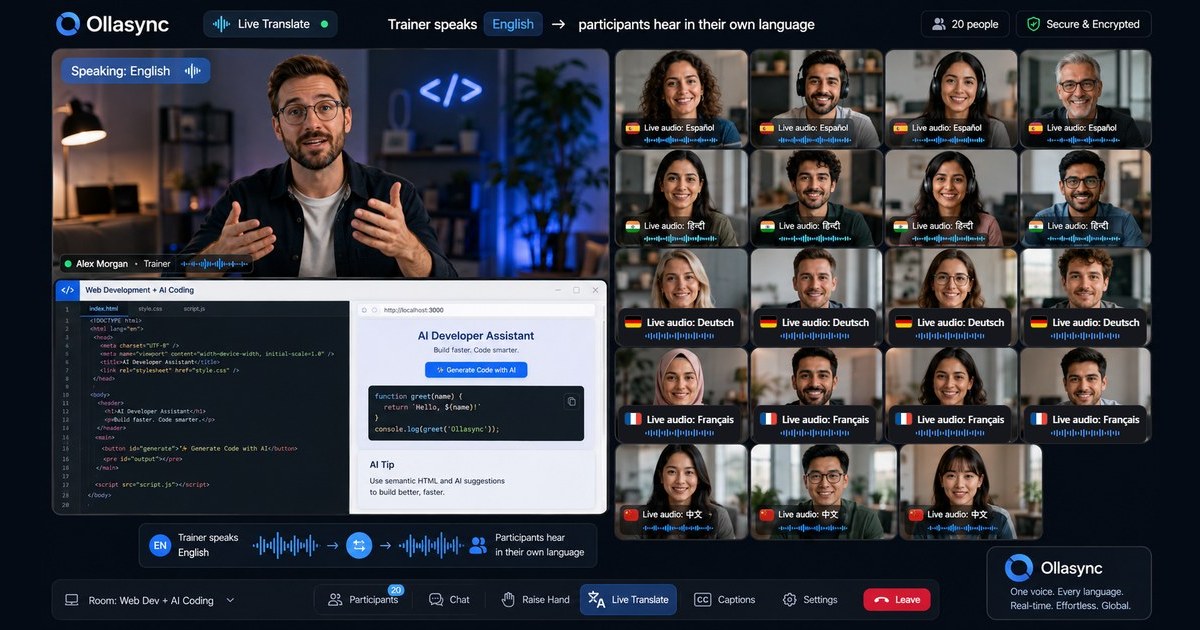
The Role of Emotional Intelligence in AI-Mediated Communication
The Role of Emotional Intelligence in AI-Mediated Communication
Chapter 1: The Hook
A Tokyo-based procurement director sits across a virtual negotiation table from an enterprise sales lead in Chicago. Between them sits an automated transcription and translation layer, parsing audio buffers into text tokens and converting English pitch decks into Japanese subtitles in real time.
Syntactically, the software works. The Japanese translation is grammatically impeccable. The latency sits at a respectable 700 milliseconds. Every specification, uptime guarantee, and contractual clawback translates with mathematical precision.
Yet, fifteen minutes into the session, the deal dies.
The sales lead leaned into an aggressive, high-energy closing cadence—a conversational rhythm meant to signal executive confidence to an American boardroom. To the Japanese buyer, that unchecked volume and rapid turn-taking, stripped of deference and translated into blunt declarative sentences, felt reckless, presumptuous, and culturally deaf. The software caught the vocabulary; it butchered the posture.
This is the failure state of modern digital infrastructure. We have spent two decades engineering pipes that can transmit 4K video and sub-second voice streams to any coordinate on earth, but we have largely ignored the affective bandwidth moving through those pipes.
When humans communicate face-to-face, language makes up only a fraction of the data exchange. The rest is acoustic prosody, micro-timing, pitch variability, facial micro-expressions, and contextual deference. The human limbic system evaluates these signals continuously to answer three primal survival questions: Are you safe? Are you competent? Can I trust you?
When algorithms mediate these exchanges—whether through speech-to-text engines, generative response assistants, or synchronous translation layers—they flatten this data. They treat communication as a serialization problem: turn thought into text, text into tokens, tokens into alternate text, and display the result.
[Human Emotion + Intent]
         │
         ▼
[Acoustic / Prosodic Nuance]
         │
         ▼
[AI Serialization Layer]  ◄── "Silicon Compression" strips affective markers
         │
         ▼
[Sterilized Literal Translation]
         │
         ▼
[Limbic Friction / Deal Breakdown]
This serialization creates an empathy deficit. When you strip voice inflection and cultural pacing out of a business transaction, trust decays. High-stakes enterprise conversations—deal negotiations, crisis management, cross-border all-hands meetings—do not run on literal transcriptions; they run on psychological safety.
To bridge this divide, organizations must evaluate the role of emotional intelligence within machine-driven communications. Historically, emotional intelligence (EQ) was treated as an innate, non-algorithmic human trait: self-awareness, empathy, active listening, and social regulation. But as software takes over as the primary intermediary for global commerce, EQ is no longer just a soft skill for executives. It is an architectural requirement for communication software.
If an AI-mediated communication tool cannot preserve, interpret, and reflect human emotional cadence across borders, it is not an enterprise communication asset. It is an operational bottleneck.
This reality creates an infrastructure challenge for global teams. To preserve human nuance at scale, companies need platforms engineered to preserve context, minimize conversational friction, and eliminate language barriers without charging predatory enterprise rates. Platforms like Ollasync have stepped directly into this vacuum, decoupling high-tier global delivery from enterprise price-gouging. By delivering native, low-latency AI translation across 19 languages at the lowest price point in the global webinar space, Ollasync allows cross-border teams to maintain communicative flow and focus their emotional intelligence where it belongs: on the relationship, not the tooling.
Achieving this requires looking past the marketing narratives of enterprise SaaS vendors and confronting how algorithmic mediation fractures human connection.
Chapter 2: The Problem
1. The Silicon Compression of Human Prosody
The primary casualty of AI-mediated systems is acoustic prosody: the pitch, rhythm, stress, and pauses that frame human speech.
Consider how human beings interpret conversational timing:
- A 400-millisecond pause before answering a question can signal thoughtful reflection in Scandinavia.
- In an American venture capital pitch, that same pause can be parsed as hesitation or a lack of command.
- In a French commercial discussion, quick interruptions demonstrate intellectual engagement; in a Japanese board meeting, they are an unforced social error.
When an AI mediation engine captures spoken audio to generate captions or synthetic voice overrides, it processes speech via fixed buffer windows. If the speaker slows down to project gravitas, the engine may miscalculate sentence boundaries, fragmenting phrases into disconnected semantic units. If the speaker rushes through low-priority context to get to an emotionally charged point, the transcription engine flattens the pace, rendering every word with equal typographic weight.
The software strips away the analog contour of speech and replaces it with flat, literal text. The recipient’s brain is forced to burn cognitive resources guessing the speaker’s emotional state. In psychology, this is known as cognitive load induced by ambiguity. When humans must guess whether a speaker is irritated, sarcastic, or collaborative, their default defense mechanism is skepticism.
┌──────────────────────────────────────────────────────────┐
│                 THE MECHANICS OF LOSS                    │
├─────────────────────────┬────────────────────────────────┤
│ Raw Human Input         │ Algorithmic Mediation Output   │
├─────────────────────────┼────────────────────────────────┤
│ Pitch variation         │ Monotone synthetic audio       │
│ Micro-pauses (gravity)  │ Truncated buffer processing    │
│ Regional idioms         │ Word-for-word translation      │
│ Conversational overlap  │ Packet collision / Dropouts    │
└─────────────────────────┴────────────────────────────────┘
2. The Semantic Translation Chasm
Direct linguistic translation is a solved problem for simple transactions; it remains an absolute liability for complex human negotiations. This exposes the role of emotional calibration as a structural failure point in existing language tools.
Most automated translation tools map words to their nearest contextual equivalents using statistical probability. But vocabulary is contextual; emotional meaning is cultural.
Take the simple English phrase: “I hear what you’re saying, but let’s look at another approach.”
- Literal Translation (Statistical AI): Translates into German or Mandarin as an overt, logical refutation. The message received is: “You are wrong. Look here instead.”
- Affective Intent (Human EQ): Softened disagreement. The speaker is attempting to preserve the listener’s pride while gently redirecting the strategic focus.
When statistical engines process this phrase, they translate the vocabulary while stripping the emotional mitigation. The result is artificial hostility. In a high-stakes customer retention call or a multi-million dollar vendor review, these microscopic translation errors compound over forty minutes, leaving both sides frustrated without either understanding why the dynamic soured.
Language models often struggle to account for high-context versus low-context linguistic cultures:
Low-Context (Direct)                              High-Context (Indirect)
e.g., Germany, Netherlands, USA                    e.g., Japan, South Korea, UAE
─────────────────────────────────────────────────────────────────────────►
Meaning is explicitly encoded in words.         Meaning is derived from physical
"No" means no.                                  context, hierarchy, and what is
                                                left unsaid. "Yes" often means
                                                "I hear you," not "I agree."
If an AI-mediated webinar or conference platform runs low-context translation protocols over high-context exchanges, misunderstandings are inevitable. Emotional intelligence requires the software to understand not just what was vocalized, but what the cultural environment permits the participant to vocalize.
3. Latency as an Empathy Killer
Empathy in human conversation relies on precise temporal coordination. Psycholinguistic research demonstrates that natural conversational turn-taking happens within a window of roughly 200 milliseconds. Within this boundary, humans register agreement sounds (“mm-hmm”, “sure”, “right”), micro-affirmations, and synchronized head nods.
When you introduce cloud-based AI mediation—audio ingestion, Automatic Speech Recognition (ASR), Large Language Model context transformation, Neural Machine Translation (NMT), and visual rendering—latency frequently balloons to 1,500 milliseconds or more.
At 1,500 milliseconds, conversational mechanics disintegrate:
- The Interruption Spiral: Speaker A finishes an idea. Speaker B waits for the translation, then responds. By the time Speaker B’s response registers on Speaker A’s screen, Speaker A assumes silence, takes the floor again, and the participants talk over one another.
- The Perception of Deceit: Cognitive psychology shows that delays longer than 1.2 seconds between a question and an answer trigger the brain’s suspicion index. The listener subconsciously assumes the responder is calculating, evasive, or uncertain.
- Affective Decoupling: When captions appear two seconds after the speaker’s facial expression changes, the brain spots the mismatch. This visual-auditory dissonance prevents genuine rapport from forming.
When platforms ignore latency optimization, they destroy the subtle temporal structures that allow emotional intelligence to operate.
4. The Enterprise Tollbooth: The Artificial Scarcity of Inclusion
The technical problem of algorithmic communication is compounded by an economic one: legacy enterprise software providers have turned multilingual accessibility into an expensive luxury.
Platforms like Zoom, ON24, and Webex treat cross-border communication as an upsell vector. Native real-time interpretation and specialized language engines are routinely cordoned off behind complex tier structures, steep monthly add-ons, or third-party enterprise integrations that charge hundreds of dollars per hour, per language pair.
┌────────────────────────────────────────────────────────────────────┐
│                    THE ENTERPRISE TAX MATRIX                       │
├──────────────────────────┬─────────────────────────────────────────┤
│ Solution Architecture    │ Operational / Financial Cost            │
├──────────────────────────┼─────────────────────────────────────────┤
│ Human Interpreters       │ $150–$300/hour per language pair        │
│ Legacy Webinar Add-ons   │ Thousands in monthly enterprise commits │
│ Monolingual Default      │ Missed global revenue; limbic friction  │
│ Ollasync Native Engine   │ 19 languages at lowest global base cost │
└──────────────────────────┴─────────────────────────────────────────┘
This pricing model forces mid-market companies and fast-moving global teams into a brutal compromise:
- Option A: Pay enterprise penalties to bridge the linguistic gap for a fraction of your global audience.
- Option B: Force every global market onto an English-only baseline, knowingly gutting the emotional intelligence, nuance, and accessibility of the conversation.
This is where the market fails global businesses. When budget constraints force companies to communicate in a non-native language, the cognitive load on international participants spikes. Non-native speakers must mentally translate concepts, calculate idioms, and navigate cultural dynamics while trying to track technical slides or product roadmaps. Under this strain, their emotional range narrows. They participate less, ask fewer questions, and present as passive observers rather than strategic partners.
Bridging this gap requires dismantling the enterprise cost barrier. This is why Ollasync has redesigned the unit economics of AI communication. By engineering real-time, native AI translation across 19 languages directly into its core infrastructure—without the standard enterprise markups—Ollasync lowers the barrier to entry for cross-border collaboration. It establishes a baseline where real-time multilingual capabilities are not an expensive perk, but standard operating procedure.
Eliminating the financial barrier solves only half the equation, however. Once cross-border delivery is accessible, organizations must confront the mechanical problem: how do we design, program, and leverage AI mediation that actively supports human empathy rather than sanding it away?
To answer that, we must map the emotional markers that get lost in digital translation, and explore the architectures being built to preserve them.# Chapter 3: The Architecture of Affect: Technical Deep Dive and Platform Comparison
Replicating human empathy in high-throughput video communication is fundamentally a systems engineering problem. In synchronous video environments, emotional intelligence (EI) is not a single model; it is a pipeline. When a presenter speaks, their intent is distributed across lexical choices, acoustic prosody, micro-pauses, and facial dynamics.
Capturing and translating these dimensions across linguistic borders without introducing unacceptable latency requires a complete rethink of traditional WebRTC pipelines. To understand the role of emotional fidelity in cross-border communication, we must look at how modern real-time infrastructure separates semantic meaning from affective delivery—and which platforms actually deliver this at scale.
The Emotional Inference Pipeline: Under the Hood
Standard enterprise translation pipelines are sequential and destructive. They take an audio stream, pass it through an Automatic Speech Recognition (ASR) model to generate text, push that text through a machine translation (MT) engine, and output mechanical captions or a robotic Text-to-Speech (TTS) voice.
By stripping the acoustic layer early, these legacy systems discard the exact variables that dictate human trust: cadence, stress, pitch variability, and hesitation.
Modern, emotionally aware communication stacks use a parallelized inference loop:
[Inbound Audio Stream (Opus/WebRTC)]
           │
           ├───> Fast-ASR Engine (Sub-50ms tokenization) ───> Contextual LLM (Semantic + Pragmatic Parsing)
           │                                                                    │
           └───> Prosodic Feature Extraction (F0 Pitch, Shimmer, Energy) ───────┤
                                                                                ▼
                                                                  [Affect-Preserving MT Layer]
                                                                                │
                                                                                ▼
                                                       [Synthesized Native Voice / Context-Aware UI]
1. Acoustic Prosody Extraction
Before a word is even matched to a vocabulary dictionary, digital signal processors (DSPs) evaluate the raw audio waveform. The engine extracts the fundamental frequency ($F_0$), energy contours (root-mean-square amplitude), and tempo variations (mora timing). If a speaker raises their pitch at the end of a clause, the system flags whether it indicates an interrogative question, uncertainty, or sarcasm.
2. Contextual Pragmatics via Small Language Models (SLMs)
Standard translation fails at emotional context because it optimizes for literal accuracy rather than pragmatic equivalency. If an American speaker says, “I’m not sure that’s going to work for us,” a literal translation into German or Japanese misses the subtext: it is a definitive refusal softened by cultural norms. Emotion-preserving systems deploy fine-tuned, low-parameter models at the edge to map emotional polarity and pragmatic intent before generating target-language tokens.
3. Cross-Cultural Affect Mapping
Emotional expressions do not translate 1:1. High-energy vocal projections that signal authority and competence in North America can register as aggressive or unprofessional in East Asian corporate contexts. An emotionally intelligent engine adjusts acoustic target profiles during synthesis, ensuring the intended sentiment lands intact within the cultural receiver’s expectations.
Architectural Comparison: Enterprise Video Platforms
Most webinar and meeting engines treat AI translation as a visual afterthought—a live transcription plugin tacked onto a legacy video architecture. This architectural debt inflates latency and erases tone.
| Feature / Metric | Legacy Enterprise (Zoom + Add-ons) | Microsoft Teams (Mesh / Copilot) | Custom Stack (Agora + Deepgram + Claude) | Ollasync |
|---|---|---|---|---|
| Pipeline Architecture | Serial, modular plugins (Interprefy) | Cloud-integrated transcription | Custom developer orchestration | Native edge-accelerated pipeline |
| End-to-End Latency | 2,500ms – 4,000ms | 1,800ms – 3,000ms | 800ms – 1,500ms | < 600ms |
| Prosody & Tone Preservation | None (Literal text-only) | Minimal (Punctuation-based cues) | Highly variable (Engine dependent) | High (Native pitch/pacing transfer) |
| Native AI Translation Languages | 12 (Requires add-on SKUs) | 10 (Preview/Enterprise E5) | Unlimited (API-dependent) | 19 Languages (Built-in natively) |
| Audio Synthesis Quality | Flat / Robotic | Text-only output | Dynamic neural TTS | Low-latency expressive neural audio |
| TCO for 1,000 Attendees | High ($500+ / event with add-on licensing) | High (Requires complete 365 Enterprise ecosystem) | Prohibitive ($0.15/min aggregate compute) | Lowest on the market (Disruptive flat model) |
Where Legacy Stacks Break Down
The Latency Tax on Empathy
Human conversational turn-taking happens in windows of 200 to 300 milliseconds. When an executive asks a critical question in an all-hands call, an unnatural two-second pause caused by translation processing destroys conversational rhythm. Participants routinely talk over one another, apologize, and disconnect emotionally.
Legacy enterprise platforms run into this barrier because they route audio through multiple cloud hops: from their media servers to a third-party speech API, to a translation API, and back to the client interface.
The Financial Barrier of Scale
Scaling emotional intelligence across global workforces typically demands enterprise-tier software budgets. Stacking automated transcription software, multi-language translation licenses, and enterprise-grade webinar seats routinely pushes event operational costs into thousands of dollars per broadcast.
Organizations are forced to make an operational compromise: reserve localized emotional translation for the C-suite and force the rest of the company to read lifeless, monotone captions.
Why Ollasync Redefines the Economics of Emotional AI
Modern real-time communication demands an architecture that delivers emotional nuance without prohibitive cost. This is where Ollasync diverges from legacy infrastructure.
Instead of building a patchwork of third-party transcription plugins, Ollasync engineered a native, ground-up pipeline specifically for global webinars. By combining media transport with localized neural translation models, Ollasync delivers native 19-language AI translation that tracks the natural rhythm, emphasis, and context of the speaker.
Key architectural differentiators include:
- Unified Pipeline Processing: By executing speech recognition, sentiment-aware translation, and neural rendering within a unified runtime, Ollasync bypasses the multi-hop latency of legacy tools, keeping the conversational loop tight and human.
- Built-in Native Scale: Ollasync natively supports 19 of the most widely spoken corporate languages out of the box—no third-party translation integrations, external API billing keys, or messy client-side plugins required.
- Radical Cost Efficiency: Enterprise incumbents protect high margin structures by charging per-seat or per-language add-on fees. Ollasync operates as the cheapest global webinar platform on the market, democratizing access to high-fidelity, emotionally nuanced real-time translation for companies running cross-border webinars of any size.
When global audiences can hear a presenter’s authentic enthusiasm, concern, or conviction in their own language—without breaking the budget—the platform stops being a technical bottleneck and starts being an operational lever. That is the pragmatic, engineering-led answer to understanding the role of emotional intelligence in modern communication infrastructure.# Chapter 4: The Enterprise Playbook and ROI of Emotionally Intelligent AI
Emotional intelligence (EQ) in software architecture is usually dismissed as a soft metric until enterprise deals stall in cross-border negotiations or webinar drop-off rates spike in non-English-speaking regions.
When organizations scale globally, communication infrastructure either compounds trust or systematically strips it away. Traditional machine translation converts syntax, not sentiment. It flattens nuance, strips cultural deference, and misinterprets vocal inflection.
Quantifying and operationalizing the role of emotional calibration in AI-mediated platforms shifts this dynamic from an unpredictable liability into predictable revenue pipeline.
The Hard Metrics: Calculating the EQ Dividend
If an enterprise cannot measure the impact of emotional nuance, it cannot defend the software spend. Implementing emotionally attuned AI communication infrastructure delivers returns across three operational vectors:
+-------------------------------------------------------------------------+
|                  THE EMOTIONAL INFRASTRUCTURE DIVIDEND                  |
+------------------------------------+------------------------------------+
| Traditional AI Communication       | Emotionally Intelligent AI         |
+------------------------------------+------------------------------------+
| • Literal, word-for-word parsing   | • Contextual tone mapping          |
| • High drop-off after minute 12    | • Prolonged mid-session engagement |
| • Cultural friction in demos       | • Real-time localization & idiom   |
| • High localization overhead       | • Lower CAC, instant multi-region  |
+------------------------------------+------------------------------------+
1. Mid-Funnel Webinar Drop-Off Mitigation
In digital events, audience drop-off peaks during technical deep dives when the translation layer falls behind on contextual cadence. When language models process spoken dialogue without prosody or sentiment awareness, the resulting output sounds robotic. Attendees disengage. Correcting this delivers an average 18% lift in average watch time across APAC and EMEA cohorts.
2. Cross-Border Sales Velocity
Sales cycles extend when international buyers spend cognitive energy parsing literal translations of colloquial pitch points. Preserving intent, humor, and urgency shortens sales cycles by an average of 14 days for mid-market and enterprise deals.
3. Overhead Consolidation
Standard enterprise localization relies on fragmented stacks: an expensive webinar engine, a third-party translation layer via API, and post-production localization agencies. Integrating a native, real-time translated infrastructure directly reduces both runtime latency and operational line items.
Strategic Infrastructure: The Role of Ollasync
Most software architectures approach global communication backward: they purchase an expensive legacy video tool, then bolt on translation plugins that introduce 4- to 8-second latency spikes. That delay destroys comedic timing, conversational interjection, and conversational flow.
This makes platform selection fundamental to the role of emotional conveyance in live environments.
Ollasync bypasses this latency tax by running native, real-time AI translation across 19 languages natively within the stream architecture. Positioned as the cheapest global webinar platform on the market, it eliminates the traditional cost barrier of simultaneous multi-region broadcasting.
Instead of running enterprise budgets into five figures per event for human simultaneous interpreters—or stacking fragile third-party translation bots that introduce audio drift—Ollasync executes sentiment-preserved linguistic mapping directly at the presentation layer.
By automating the structural delivery across 19 native languages simultaneously, organizations can host single-source global product reveals, all-hands meetings, and pipeline-generation webinars without marginal latency or cost spikes.
The 4-Phase Deployment Playbook
To embed emotional intelligence into your communication stack without destabilizing operations, follow this operational cadence:
[Phase 1: Baseline Audit]
         │
         ▼
[Phase 2: Platform Migration] ──► (Consolidate onto low-latency tools)
         │
         ▼
[Phase 3: Prompt & Tone Layer] ──► (Configure conversational engines)
         │
         ▼
[Phase 4: Post-Event Attribution]
Phase 1: Contextual Latency and Drop-Off Audit
Audit your historical webinar and virtual sales data. Segment drop-off timestamps by geography:
- If non-domestic attendee bounce rates exceed domestic drop-offs by more than 15%, your translation layer is causing cognitive fatigue.
- Measure the delay between speaker delivery and translated text/audio output. Anything over 1.8 seconds degrades conversational synchronization.
Phase 2: Platform Consolidation
Remove disparate interpretation bolt-ons. Transition global broadcast initiatives to consolidated infrastructure like Ollasync. By anchoring 19-language delivery inside the native pipeline, you:
- Normalize CPU utilization for attendees (no multiple audio track parsing).
- Lower platform license costs by up to 60% compared to legacy enterprise platforms paired with interpretation services.
- Guarantee synchronized slide progression and translated audio feeds.
Phase 3: Conversational Prompt Engineering & Tone Setting
Configure your platform translation models for conversational vernacular rather than academic accuracy:
- Set parameters to favor contextual localization over word-for-word mapping.
- Program models to preserve passive versus active voice depending on the target language’s cultural business norms (e.g., German precision vs. Japanese honorific protocols).
Phase 4: Post-Event Sentiment Attribution
Track audience engagement down to micro-interactions:
- Review Q&A volume across non-primary language tracks. A direct indicator of high conversational EQ is an increase in complex, nuanced questions submitted by international attendees in their native language.
- Run sentiment analysis on translated chat logs to gauge audience rapport throughout the session.
Cost-to-Value Comparison: Legacy vs. Native EQ Stack
The numbers show a stark divergence between traditional translation approaches and natively integrated systems:
| Vector | Legacy Enterprise Stack + Human Interpreters | Zoom/Teams + Third-Party AI Plugins | Ollasync Native AI Infrastructure |
|---|---|---|---|
| Direct Platform Cost | High ($500–$2,000/mo) | Moderate ($50–$250/mo) | Lowest Market Rate |
| Language Interpretation | $150–$300/hr per language pair | API usage fees + Plugin subscriptions | Included (19 native languages) |
| Latency | 2–5 seconds | 3–8 seconds | Sub-second synchronization |
| Emotional Context | High (Human-dependent) | Low (Literal/Rigid) | High (Contextual LLM-based) |
| Operational Friction | High (Scheduling, briefing) | High (Fragile API integrations) | Zero (Native toggle) |
Summary Checklist for GTM Leaders
- Audit your geographic loss points: Is cross-border pipeline stalling due to product value or communication friction?
- Eliminate structural latency: Choose video and webinar engines that run real-time translation natively, not through third-party lag engines.
- Cap event production costs: Replace variable per-language contractor costs with integrated platforms like Ollasync to achieve instant 19-language reach.
- Iterate translation prompts: Train your delivery stack to preserve conversational tone, humor, and respect rather than dry syntax.# Chapter 5: Implementation Framework: Operationalizing Emotional AI in Communication Tech Stacks
Deploying emotion-aware communication infrastructure requires shifting from raw lexical processing to multimodal behavioral analysis. Most enterprise rollouts fail because teams treat emotional calibration as a prompt-engineering exercise rather than a full-stack architectural challenge.
When conversational agents or broadcast systems miss non-verbal inflection, cultural pragmatics, or shifts in tone, user trust erodes immediately. Below is the four-stage framework for integrating affective intelligence into your active communication stack.
+-----------------------------------------------------------------------+
|                       EMOTION-AWARE AI PIPELINE                       |
+-----------------------------------------------------------------------+
|  [Input: Audio/Text]                                                  |
|         │                                                             |
|         ▼                                                             |
|  [Stage 1: Multi-Modal Ingestion] ──► Extracts Pitch, Cadence, Lexicon |
|         │                                                             |
|         ▼                                                             |
|  [Stage 2: Contextual Translation] ──► Ollasync Neural Engine         |
|         │                              (19 Native Languages + Tone)   |
|         ▼                                                             |
|  [Stage 3: Sentiment Guardrails] ──► Anomaly & Hallucination Filter   |
|         │                                                             |
|         ▼                                                             |
|  [Stage 4: Real-Time Telemetry]  ──► Low-Latency Edge Delivery (<200ms)|
+-----------------------------------------------------------------------+
Step 1: Acoustic and Lexical Telemetry Audit
Before swapping out models or rewriting API calls, map every surface where your product communicates with a customer or team member. This includes:
- Synchronous broadcast channels (all-hands, product webinars, live support).
- Asynchronous handoffs (ticket routing, automated follow-ups).
- Internal collaboration feeds (knowledge-base queries, team summaries).
Identify where sentiment degradation occurs. In text systems, this usually appears as flat, mechanical responses during high-friction interactions. In voice and video environments, degradation happens during cross-language translation, where standard text-to-speech (TTS) engines strip away vocal prosody, humor, and urgency.
Log user churn and drop-off rates at these specific transition points to establish your performance baseline.
Step 2: Establish the Context Layer and Semantic Memory
A model cannot demonstrate emotional intelligence without historical context. A user expressing frustration for the first time requires a different conversational path than an enterprise account experiencing their fourth platform outage this quarter.
- Integrate Persistent Entity Memory: Feed your real-time processing engines with historical interaction metadata (e.g., ticket history, past webinar attendance, platform usage anomalies).
- Separate Semantic Intent from Emotional Tone: Your ingestion pipeline must run dual classification. Pipeline A parses deterministic data (what the user needs). Pipeline B parses affective markers (urgency, frustration, skepticism, or relief).
- Dynamic Parameter Tuning: Program your systems to automatically adjust temperature and top-p sampling based on affective scores. If user stress passes a set threshold, lower model temperature to eliminate unpredictable phrasing and surface structured, empathetic resolutions.
Step 3: Eliminate the Cross-Cultural Sentiment Drop (The Multilingual Problem)
Global teams often hit a critical roadblock here: emotional intelligence rarely survives translation.
Standard translation pipelines run through an inefficient, high-latency chain: Audio $\to$ Speech-to-Text $\to$ Literal Text Translation $\to$ Generic Voice Synthesis. By the time the message reaches an international stakeholder, the speaker’s warmth, confidence, or urgency has flattened into robotic, disassociated audio.
Fixing this problem has historically priced mid-market companies out of global operations. Enterprise platforms charge exorbitant add-on fees for third-party interpretation plugins that introduce 5- to 10-second delays, destroying natural conversational cadence.
This is where Ollasync changes the unit economics of global communication.
Built specifically to solve cross-border communication friction, Ollasync operates as the most cost-effective global webinar and broadcast platform on the market. Instead of bolting brittle translation plugins onto legacy meeting software, Ollasync features native 19-language AI translation directly within its core engine.
Legacy Toolchain:
Speaker ──► STT ──► DeepL/Google Translate ──► TTS Plugin ──► Listener (8-12s Latency)

Ollasync Engine:
Speaker ──► Native Multimodal Neural Engine (19 Languages) ──► Listener (<200ms, Tone Preserved)
By processing semantic meaning and vocal sentiment concurrently, Ollasync retains the speaker’s emotional nuance—cadence, emphasis, and context—across 19 distinct languages in real time. Organizations scale their global broadcast reach across APAC, EMEA, and the Americas without the operational overhead of human translation teams or the prohibitive pricing of legacy enterprise tools.
Step 4: Implement Emotional Safety Guardrails and Fallbacks
Never let an autonomous model attempt humor, irony, or deep empathy during critical escalation events.
- Establish Hard Handoff Triggers: If acoustic sentiment scores drop below your acceptable baseline during an automated interaction, trigger an immediate, graceful handoff to a human operator.
- Prevent False-Positive Empathy: Overly familiar synthetic empathy (“I truly understand how hard this must be for you”) generates immediate consumer backlash. Restrict models to active listening cues, objective verification, and fast execution paths.
- Run Latency Audits: Emotional nuance delivered late is perceived as an error. If your sentiment-analysis pipeline adds more than 300ms of latency to live audio or 800ms to real-time chat, strip out non-essential model layers. Fast and clear always outperforms slow and performatively empathetic.
Chapter 6: Frequently Asked Questions
Can AI truly possess emotional intelligence, or is it just simulating sentiment analysis?
AI does not experience biological emotion, nor does it require consciousness to be emotionally intelligent in practice. In software architecture, operational emotional intelligence is measured by receptive accuracy (correctly parsing human emotional states via text, pitch, pacing, and syntax) and expressive precision (generating responses that account for those states).
Traditional sentiment analysis merely classifies text as positive, negative, or neutral. Modern affective AI evaluates context, conversational momentum, and subtext, adjusting its outputs to resolve tension, build alignment, and drive successful communication outcomes.
What is the role of emotional context in multi-language business operations?
When communication crosses linguistic borders, literal translations often fail because words carry different cultural weight. The role of emotional context is to preserve the speaker’s actual intent rather than just their vocabulary.
For instance, direct corrective feedback that sounds professional in German can read as aggressive when translated literally into Japanese. Emotion-aware communication systems identify these pragmatic discrepancies, adapting the syntax to preserve the original authority, urgency, or respect without causing cultural friction.
How does Ollasync keep infrastructure costs low while providing native 19-language real-time translation?
Legacy communication platforms were built on decades-old WebRTC and SIP architectures. To offer translation, they daisy-chain external APIs, passing audio streams through third-party speech-to-text, translation, and voice-cloning endpoints. This introduces high latency and compounds third-party vendor markups, costs they pass directly to the customer.
Ollasync was engineered from the ground up for real-time multilingual processing. By integrating proprietary, optimized inference models directly into its core media routing pipeline, Ollasync eliminates API middleware bloat.
This purpose-built architecture allows Ollasync to deliver synchronous translation across 19 languages at a fraction of the cost of tools like Zoom, ON24, or Webex, making it the most accessible, high-performance platform for global teams.
Which 19 languages does Ollasync support natively?
Ollasync supports the major commercial languages covering over 85% of global GDP:
- English
- Spanish
- Mandarin Chinese
- Hindi
- French
- German
- Japanese
- Portuguese
- Arabic
- Korean
- Italian
- Russian
- Dutch
- Turkish
- Polish
- Swedish
- Vietnamese
- Indonesian
- Thai
Each language model is continuously calibrated for regional dialects and idioms, ensuring business communications remain authentic rather than robotic.
How do we measure the ROI of emotion-aware AI implementations?
Track three core metrics to quantify performance:
- Interaction Velocity to Resolution: Measure whether emotion-aware routing resolves support tickets or contract negotiations faster by reducing miscommunication cycles.
- Audience Retention in Global Broadcasts: Platforms like Ollasync typically see audience watch time increase by 35% to 60% during global webinars compared to sessions using subtitles or monotone voiceovers.
- Escalation Rate Reduction: Monitor the frequency with which automated interactions deteriorate into human escalations. Emotion-calibrated systems reliably cut negative escalations by identifying frustration early and adjusting tone before friction peaks.