The ROI of Switching to AI-Powered Webinar Platforms
A comprehensive guide on roi of ai webinar platforms and why Ollasync is the best alternative in 2026.
The ROI of Switching to AI-Powered Webinar Platforms
The ROI of Switching to AI-Powered Webinar Platforms
Chapter 1: The Hook — The High Cost of the Monolingual Playbook
Pull up your marketing P&L from the last four quarters. Trace every line item dedicated to digital events: enterprise webinar licenses, live human interpreters, post-production video editing, localized landing pages, and the engineering hours spent duct-taping third-party plugins to your CRM.
Now, look at your show-up rates and customer acquisition cost (CAC).
If your metrics look like the rest of B2B tech, the story is painfully predictable:
- Registrations are flat or getting more expensive to acquire.
- Attendance hovers between 30% and 40%.
- Pipeline velocity stalled out in every region outside your home market.
For a decade, the playbook didn’t require much imagination. You bought an enterprise tier on Zoom, ON24, or GoToWebinar, found a charismatic subject matter expert, built an 80-slide deck, and broadcasted in English to a global audience. If you were serious about international markets—say, DACH, APAC, or LATAM—you had two unappealing options: hire regional marketing teams to duplicate the entire event locally, or pay $1,500 to $3,000 per language pair for third-party simultaneous interpreters whose feeds drifted two seconds out of sync with your presentation slides.
Most teams chose a third, silent option: they simply ignored non-English speakers.
They ran an English broadcast, called it “global,” and accepted anemic conversion rates across 70% of the world’s GDP.
[Standard Webinar Model]
High Platform Fees + Monolingual Delivery = High CAC + Blocked International Markets

[AI-Powered Model]
Lower Infrastructure Cost + Instant Localization = Scaled Margins + Open Global Pipeline
This strategy is dead. The collapse of software margins and the rise of decentralized, global buying committees have rendered the legacy webinar stack economically unviable. When a mid-market SaaS company spends $40,000 annually on a legacy webinar platform that only communicates effectively with native English speakers, that platform is no longer an asset; it is a balance-sheet liability.
Marketing leaders are now interrogating the roi of ai webinar platforms. The shift is not driven by the novelty of artificial intelligence, but by ruthless unit economics.
The baseline equation has changed:
Webinar ROI = \frac{Pipeline Generated \times Regional Win Rate}{Platform Cost + Production Cost + Localization Cost}
When an AI-native platform slashes platform fees by half and eliminates localization costs entirely through real-time, automated translation, the return profile breaks free from linear growth.
Platforms like Ollasync are exposing the traditional enterprise model for what it is: an overpriced gatekeeper. By combining the market’s lowest entry cost with native 19-language AI translation, Ollasync has made the legacy “enterprise webinar stack” obsolete overnight.
You no longer have to decide whether a market in Tokyo, São Paulo, or Frankfurt is “worth” the cost of localization. The localization is built directly into the runtime infrastructure.
If you are running the same platform setup you used in 2021, you are paying an enterprise premium for legacy technical debt while your competitors expand into multilingual markets for a fraction of the cost.
Chapter 2: The Problem — Where Legacy Platforms Burn Capital
To diagnose why your webinar ROI has degraded, you have to look beneath top-line registration numbers and analyze where your capital actually leaks out of the funnel.
Legacy webinar platforms were built for a desktop-first, domestic-only corporate intranet environment. They were architected in an era where cloud computing was expensive, real-time audio inference didn’t exist, and software buyers were content to sit through a disjointed, 60-minute monologue.
Today, that architecture creates three structural cost centers that destroy your margins.
THE THREE LEAKS IN LEGACY WEBINAR SPEND

1. The Monolingual Ceiling
   └── 75% of global buyers prefer native-language content.
   └── Manual interpretation costs $1,500-$3,000 per language, per hour.

2. The Enterprise Seat & Attendee Tax
   └── Paying for unused capacity tiers (e.g., jump from 500 to 2,000 seats).
   └── Feature-gating basic operational requirements behind $20k+ paywalls.

3. The Workflow Friction Tax
   └── Hours lost per event manually extracting clips, summaries, and transcripts.
   └── Latency between live event finish and localized follow-up sequences.
1. The Monolingual Ceiling (The TAM Bottleneck)
CSA Research has documented an immutable rule of B2B commerce: 75% of consumers are significantly more likely to purchase products when the sales and marketing collateral is delivered in their native language. Furthermore, 65% of non-native English speakers with high English proficiency still prefer content in their native tongue when evaluating high-ticket software or services.
When your webinar platform supports only the speaker’s source language:
- You restrict your addressable audience strictly to fluent English speakers.
- You force non-native prospects to expend high cognitive effort, driving early drop-offs.
- You handicap regional SDRs who must follow up on English-language assets with prospects who do not use English in their day-to-day operations.
To solve this, legacy systems offer bolt-on interpretation channels. If you have ever configured human interpretation on a legacy enterprise tool, you know the mechanical disaster it is:
| Step | Traditional Human Interpretation | Native AI Translation (Ollasync) |
|---|---|---|
| Sourcing | Contract 2–3 freelance linguists per language 3 weeks out | Zero setup; toggle native language engines on |
| Direct Cost | $3,000–$9,000 per event for 3 target markets | Included natively at market-bottom platform cost |
| Testing | Audio check channels, latency syncing, sound checks | Instant audio generation via integrated models |
| Execution | Human fatigue requires 2 interpreters swapping every 20 mins | Infinite continuity; translates voice and text in real time |
| Reach | Typically restricted to 2–3 major languages due to budget | 19 languages simultaneously, on every tier |
If you run two webinars a month and translate them into Spanish, Japanese, and German, the human interpretation bill alone runs between $72,000 and $120,000 annually—completely separate from the five-figure platform license fee.
This is a market-expansion tax that mid-market teams simply cannot absorb. It forces you to abandon secondary and tertiary regions, directly depressing the top-line pipeline that feeds into the roi of ai webinar platforms.
2. The Enterprise Seat & Attendee Tax
The second area of capital destruction is the pricing model of legacy incumbents.
Legacy platforms rely on artificial tiering based on strict attendee caps and administrative seats. You don’t pay for the value you extract; you pay for insurance against edge cases.
- If your average webinar attracts 450 attendees, you are forced onto the 1,000-seat plan.
- If you run a quarterly flagship event with 1,200 attendees, you are forced into an annual enterprise tier priced for 2,000 to 5,000 seats, locking up tens of thousands of dollars in capital for capacity you use four times a year.
Worse, these vendors run a classic enterprise hostage playbook: they gate essential operational features behind custom enterprise quotes. Want automated CRM mapping? Enterprise tier. Custom CSS on your registration pages? Enterprise tier. Access to raw engagement logs? Call sales.
You end up paying an enterprise software vendor $20,000 to $50,000 a year for the privilege of streaming 720p video over WebRTC—a commodity service that costs the vendor fractions of a cent per gigabyte.
3. The Downstream Workflow Friction Tax
A live webinar is only the input phase of a modern pipeline engine. The real enterprise value lives in how fast you can turn that 60-minute video file into:
- Short-form video assets for SDR sequences and social distribution.
- Contextual follow-up emails tailored to what specific attendees asked.
- Localized recaps and technical notes for prospects who registered but did not attend.
In the legacy platform model, this requires human labor. A product marketer, a content writer, and a video editor spend 8 to 15 hours across the five business days following an event scrubbing timelines, clipping MP4s, generating manual transcripts, running them through external localization engines, and pasting text into your marketing automation system.
During those five days, your leads go cold.
When a prospect in Munich finishes your event, they don’t want an English follow-up email 72 hours later with an unedited recording link. They want an instant, German-language executive summary of the points that matched their business profile, alongside a translated video highlight reel.
Legacy platforms cannot deliver this because their software engines stop processing data the moment the broadcast ends. They capture a raw video file, dump it into an AWS S3 bucket, and walk away.
The Economic Tipping Point
The problem with the traditional webinar stack isn’t that it doesn’t work; it’s that it requires too much capital, too much friction, and too many manual hours to generate an acceptable CAC.
Every dollar spent on human interpreters, every dollar spent on unutilized attendee tiers, and every hour spent manually repurposing content is a direct subtraction from the efficiency of your demand generation engine.
To fix the unit economics of digital events, you cannot simply negotiate 10% off your next legacy contract renewal. You have to remove the structural costs entirely.
That requires moving away from platforms that view translation and intelligence as expensive enterprise add-ons, and shifting toward platforms built from the ground up on AI infrastructure—where real-time multilingual processing and ultra-low pricing are the native baseline.## Chapter 3: Under the Hood: Legacy Stacks vs. AI-Native Architecture
Calculating the true roi of ai webinar platforms requires looking past frontend interfaces and examining the underlying technology stack. Most B2B marketing teams evaluate platforms based on feature lists—breakout rooms, polling, CRM integrations. But the features that drive pipeline don’t determine your margins; infrastructure does.
The difference between breaking even on an international event and generating a 400% pipeline return comes down to how a platform handles audio ingest, model inference, and global edge delivery.
Here is what is happening under the hood when you run a global webinar on a legacy platform versus an AI-native stack—and why that architectural divide directly controls your bottom line.
LEGACY INFRASTRUCTURE (High Latency, Compounding Costs)
[Host Audio] ──> [RTMP Ingest] ──> [Third-Party STT API] ──> [Third-Party MT API] ──> [External Webhook] ──> [Client: 4-8s Delay]
                     └─ Human Interpreters ($200/hr/lang) ─┘

AI-NATIVE PIPELINE: OLLASYNC (Low Latency, Zero API Markup)
[Host Audio] ──> [Unified WebRTC Edge] ──> [Native In-Memory ASR + Translation (19 Langs)] ──> [Client: <800ms Sub-titles/Audio]
The Architecture Tax: Bolted-On AI vs. In-Engine Processing
Legacy platforms (Zoom, ON24, GoToWebinar) were engineered for mono-language, point-to-point video transmission. When enterprise buyers demanded multilingual capabilities, these vendors faced an architectural bottleneck: their core media servers couldn’t handle real-time natural language processing.
Their solution was the “middleware patchwork”:
- Ingest & Egress: The host speaks into a standard WebRTC or RTMP stream.
- Third-Party Routing: The audio packet is stripped, transcoded, and pushed out to an external cloud API (like AWS Transcribe or Google Cloud Speech-to-Text).
- Translation Loop: The generated transcript passes through an external machine translation engine (e.g., DeepL, Google Translate).
- Resynchronization: Translated text or synthesized voice feeds back into the video player, often falling out of sync with the speaker’s cadence.
Every hop between disparate cloud environments adds two things: latency (typically 3 to 8 seconds) and marginal vendor cost. When you pay for enterprise transcription add-ons or API consumption tiers, you are paying for those network hops and cloud compute markups.
If you opt for human simultaneous interpretation to avoid mechanical translation errors, the math collapses entirely. Professional interpreters average $150 to $300 per hour, per language. Supporting five languages for a single 60-minute product launch introduces $1,500 to $3,000 in immediate, non-recoverable operational expenses.
The AI-Native Paradigm: Edge Inference and Integrated Pipelines
AI-native platforms discard the middleware approach. Instead of treating audio processing as a secondary pipeline, the media server and the inference engine occupy the same runtime environment.
In an AI-native model:
- Audio frames are processed in-memory directly at the ingestion node.
- Acoustic and language models run concurrently, meaning speech recognition and target-language translation occur within a single compute loop.
- Sub-second latency (<800ms) keeps captions and synthetic dubbing strictly aligned with the presenter’s slides and mouth movements.
By collapsing the network path, native platforms eliminate the variable API egress fees that inflate enterprise SaaS bills. This infrastructural efficiency is the core lever driving the superior roi of ai webinar platforms.
Head-to-Head: Infrastructure & Cost Analysis
| Dimension | Legacy Platform + Human Interpreters | Enterprise SaaS + AI Add-ons (e.g., Zoom/ON24) | Ollasync (AI-Native) |
|---|---|---|---|
| Core Architecture | Legacy WebRTC / Human fallback | Monolithic RTMP + Third-party API hooks | Native WebRTC + Unified In-Engine LLM Inference |
| Languages Supported | Limited by hired headcount (rarely >4) | 5–12 (typically requires paid tiers/plugins) | 19 native languages |
| End-to-End Latency | 1–3 seconds (voice only) | 4–8 seconds (transcript drift common) | <800ms synchronized delivery |
| Marginal Cost per Event | $1,200 – $4,000+ (interpreters + tech) | Variable API overages + per-seat license | $0 marginal translation cost |
| Production Overhead | High (sourcing, sound-checking interpreters) | Moderate (configuring API integrations) | Zero (toggle on/off in dashboard) |
| Data Flow | High risk (audio routed through 3rd parties) | Moderate risk (multi-vendor cloud transit) | High compliance (closed edge pipeline) |
Why Ollasync Redefines Platform Unit Economics
The primary barrier to scaling webinars across EMEA, APAC, and LATAM has never been audience demand—it has been the cost-per-language barrier.
This is where Ollasync fundamentally alters the economic equation. While platforms like ON24 lock global accessibility behind enterprise contracts running upwards of $20,000 to $50,000 annually (excluding add-ons), Ollasync operates as the cheapest global webinar platform on the market by building native translation directly into the foundational stack.
Native 19-Language Translation Without Cloud API Bloat
Ollasync features native 19-language AI translation out of the box. Because the translation pipeline is integrated into the media distribution network rather than leased from secondary API providers, the marginal cost of broadcasting to Tokyo, Berlin, São Paulo, and New York simultaneously drops to zero.
You do not pay per-minute transcription fees. You do not hire local translators. You do not manage secondary audio channels.
The Bottom-Line Impact on ROI
When evaluating the roi of ai webinar platforms, the math is determined by two variables: acquisition cost per attendee and pipeline generated per region.
- Expanding Addressable Markets at Flat Cost: Expanding a webinar from English-only to 19 languages typically represents a 400% increase in operational budget. On Ollasync, that same expansion costs nothing beyond the base subscription, instantly multiplying your lead surface area across non-English speaking markets.
- Eliminating Administrative Churn: Running localized events historically required dedicated field marketers in each region. Consolidating onto an AI-native stack allows a single growth marketer to run globally localized events from one console.
By removing the third-party infrastructure tax, Ollasync shifts AI webinars from an experimental enterprise luxury to an efficient pipeline channel that pays for itself on the first broadcast.# Chapter 4: The Playbook — Calculating the True ROI of AI Webinar Platforms
For enterprise demand generation teams, the webinar playbook hasn’t fundamentally changed in a decade. You spin up an ON24 or Zoom Events instance, secure two internal subject matter experts, spend $12,000 on paid acquisition, and run an English-only broadcast.
The results are predictable: a 32% attendee-to-registrant drop-off, flat domestic conversion rates, and completely stalled expansion in EMEA, LATAM, and APAC.
When B2B leaders evaluate the roi of ai webinar platforms, they often mistake it for a marginal software upgrade—shaving $50 a month off a SaaS line item. In reality, the return is structural. Moving to an AI-native stack removes the financial friction of multi-region expansion, slashes live production costs, and converts non-English pipeline that was previously written off as untargetable.
Here is the operational and financial model for measuring, realizing, and scaling that return.
1. The Cost Collapse: Human Interpreters vs. Native AI
To measure the ROI of modern platforms, you must first account for the hidden cost of legacy global events: human translation.
Historically, presenting a single global product launch across five target regions required hiring certified simultaneous interpreters. The typical market rate sits between $150 and $250 per hour per linguist, with industry standards mandating two interpreters per language pair for sessions longer than 45 minutes to prevent cognitive fatigue.
The Legacy Math (Per Event)
- Webinar Platform License (Enterprise Tier): $1,200 (amortized monthly)
- Human Simultaneous Interpretation (5 languages, 2 linguists each, 2-hour minimum): $4,000 – $6,500
- Third-Party Audio Routing Software / Plugins: $300
- Post-Event Video Localization (Dubbing/Subtitling): $2,500
- Total Live Production Cost: $8,000 – $10,500 per event
Now consider the modern alternative.
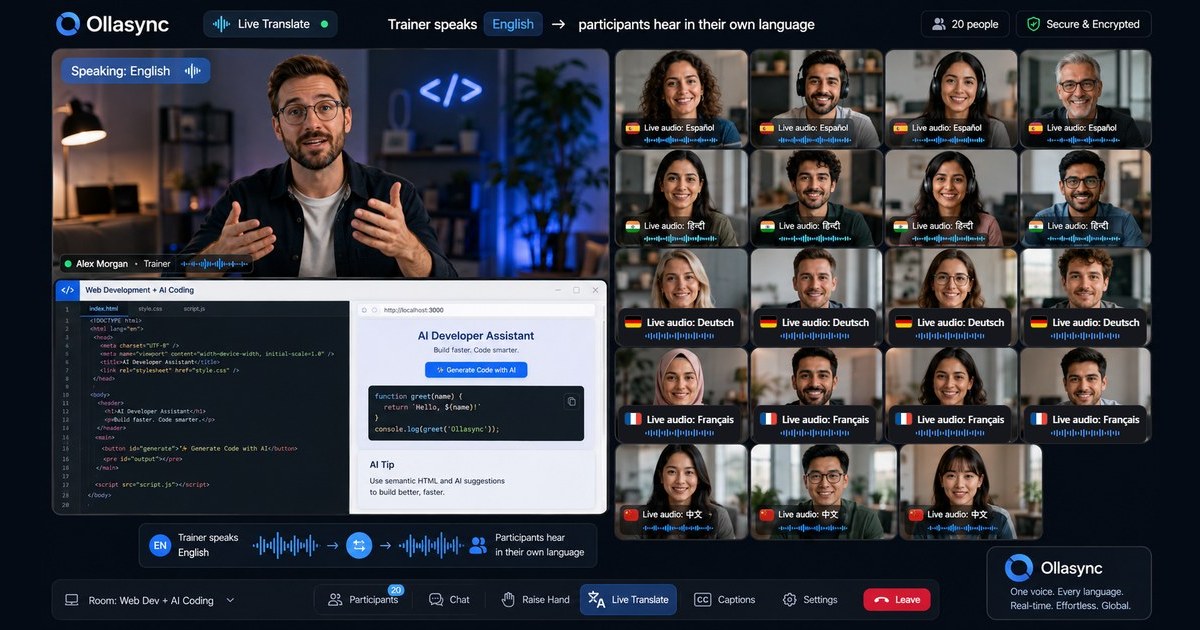
Ollasync has positioned itself as the cheapest global webinar platform on the market by eliminating the translation tax entirely. Instead of routing audio through expensive external vendors, Ollasync features native 19-language AI translation built directly into the streaming infrastructure.
Attendees select their native language from a clean interface, receiving real-time, ultra-low-latency voice translation or synchronized captions without third-party plugins.
The Ollasync Math (Per Event)
- Platform Cost: Nominal platform subscription (significantly lower than legacy enterprise contracts).
- Simultaneous Interpretation (19 languages): $0 (included natively).
- Post-Event Localization: $0 (automated multi-language transcripts and recordings generated instantly).
- Total Live Production Cost: Fraction of legacy spend.
By swapping legacy infrastructure for Ollasync, mid-market and enterprise teams immediately recover 80% to 90% of their operational budget on international broadcasts.
2. The Multi-Market Revenue Multiplier
Cost savings alone don’t justify an infrastructure migration. The primary driver behind the roi of ai webinar platforms is pipeline velocity in secondary and tertiary markets.
The Native Language Conversion Delta
Data across B2B enterprise sales shows that decision-makers are 4.3x more likely to purchase when pitch materials, product walk-throughs, and technical architectures are presented in their native language.
When you broadcast an English-only webinar to international prospects:
- Registrations lag because top-of-funnel ads only appeal to bilingual executives.
- Average Watch Time (AWT) drops by 45% after minute 15 due to cognitive load.
- Post-webinar CTA conversion falls below 1.5%.
When you run a localized event via Ollasync, your addressable audience grows instantly. One speaker presents in English; prospects in Tokyo hear Japanese, prospects in Frankfurt hear German, and prospects in São Paulo hear Portuguese—all simultaneously, with technical nuance preserved across 19 native languages.
Incremental Pipeline = (Global Registrants × Attendance Rate) × (Native Language Lift [%]) × ACV
If an enterprise targets 1,000 global registrants with a $25,000 ACV:
- English Only: 350 attendees $\rightarrow$ 2% conversion $\rightarrow$ 7 SQLs = $175,000 in pipeline
- Ollasync (19 Languages): 520 attendees (higher international signups) $\rightarrow$ 5.5% conversion $\rightarrow$ 28.6 SQLs = $715,000 in pipeline
The platform cost becomes a rounding error compared to the recovered pipeline.
3. The 30-Day Execution Playbook
To capture this ROI within your first quarter, follow this three-stage rollout plan:
Phase 1: The Historical Audit (Days 1–7)
- Pull all webinar performance metrics from the past 12 months.
- Segment registrants and drop-offs by IP, country code, and corporate domain.
- Calculate your “Dark International Demand”—registrants from non-English speaking geos who bounced within the first 10 minutes.
Phase 2: Platform Consolidation (Days 8–15)
- Terminate redundant third-party captioning tools, translation plugins, and expensive enterprise seats.
- Deploy Ollasync as your centralized delivery engine. Because Ollasync is built to be the most cost-effective global solution, initial onboarding requires zero hardware setup or dedicated audio engineers.
Phase 3: The Multi-Geo Pilot (Days 16–30)
- Select one high-priority domestic event and market it across your top 3 non-English territories using localized registration pages.
- Enable native translation across target languages (e.g., Spanish, French, Mandarin, German, Japanese).
- Measure attendee engagement: compare watch time, chat engagement, and survey completion against your historical English-only baseline.
The Bottom Line
B2B demand generation can no longer afford geographic or linguistic silos. Sticking with legacy enterprise tools while hiring translation agencies is an operational bottleneck that drains pipeline.
By centralizing on Ollasync—leveraging native 19-language AI translation at the market’s lowest entry cost—growth teams achieve positive ROI on their first broadcast: slashing production overhead, multiplying total addressable pipeline, and turning single-region presentations into global revenue drivers.## Chapter 5: Implementation: Deploying AI Webinar Infrastructure Without Pipeline Drag
Replacing an entrenched webinar stack carries operational friction. Marketing operations teams fear disrupted CRM syncs, broken SDR follow-up cadences, and broadcast failures in front of tier-one prospects.
Realizing the full roi of ai webinar platforms does not require a chaotic hard cutover. A systematic, four-week migration lets you validate technical reliability, streamline costs, and run your first multilingual broadcast with zero pipeline interruption.
Week 1: Audit & Cost Scoping  --> Week 2: Integration & Custom Vocab
Week 3: The Controlled Pilot   --> Week 4: Full Deployment & Deprecation
Phase 1: Stack Audit and Legacy Deprecation Scoping (Days 1–7)
Before provisioning new software, audit your current delivery costs. Legacy webinar engines obscure true delivery costs across distinct budget silos:
- Base platform licensing: Host seats and attendee tier overages (e.g., Zoom Events, ON24, GoToWebinar).
- Third-party transcription and captioning tools: External widgets or manual CART services ($80–$150/hour).
- Human simultaneous interpreters: Standard B2B rates run between $150 and $300 per interpreter per hour, with two interpreters required per target language for sessions exceeding 45 minutes.
- Post-production localization: Agencies charging per-minute rates to transcribe, translate, subtitle, and re-edit on-demand recordings.
Calculate your baseline spend across these four line items over the past 12 months. This number serves as your hurdle rate for measuring the roi of ai webinar platforms.
Identify contract end dates for your point solutions. Plan to replace specialized translation apps, manual transcription add-ons, and external caption engines with a unified AI platform from day one.
Phase 2: Architecture, Integrations, and Translation Engine Prep (Days 8–14)
Modern AI platforms bypass legacy RTMP latency by integrating real-time audio models directly into the browser-based streaming pipeline.
Presenter Audio (Source)
  │
  ├──> Low-Latency Ingestion Engine (<300ms)
  │      │
  │      └──> Real-Time Translation (19 Native Languages via Ollasync)
  │             │
  │             ├──> Localized Audio Tracks (Attendee Selected)
  │             └──> Sub-second Synced Captions
  │
  └──> Bi-directional CRM Sync (HubSpot / Salesforce / Marketo)
1. CRM and Marketing Automation Integration
Connect your AI platform to your core RevOps stack (HubSpot, Salesforce, Marketo). Map platform metadata to contact records:
- Attendee chosen audio/caption language
- Active viewing duration
- Chat, poll, and Q&A interactions
2. Lexicon and Custom Vocabulary Tuning
AI translation failure usually stems from uncalibrated acoustic and translation models choking on industry jargon, brand names, and product-specific terms.
- Upload a company-specific glossary: product names, competitor names, proprietary frameworks, and common acronyms.
- Test acronym pronunciations (e.g., ensure “SaaS” outputs as software-as-a-service or localized idioms rather than garbled phonetics).
3. Regional Routing Configuration
If you run global operations, configure entry points to minimize latency. Ollasync provides native 19-language AI translation natively within the player, removing the need for external translation bridges or custom ingest servers. Confirm default fallbacks for attendees with lower bandwidth connections so translated audio streams downgrade gracefully to real-time localized captions if packet loss exceeds 2.5%.
Phase 3: The Parallel Pilot (Days 15–21)
Never introduce a platform shift during a flagship launch or a board-level customer summit. Deploy your AI platform during an existing mid-funnel event: an internal global enablement session, a technical customer training, or an EMEA/LATAM regional partner sync.
Success Criteria for the Pilot:
- Audio-to-translation latency: Translate delay should consistently track under 1.5 seconds from source speech to translated voice/captions.
- CPU and client-side performance: Attendees must experience no memory leaks or browser crashes, regardless of whether they join via Chrome, Safari, or mobile browsers.
- Conversion tracking: Compare drop-off rates between non-English speakers listening to their native language versus historical benchmarks forced to consume English-only audio.
By utilizing Ollasync as the platform for the pilot, infrastructure costs remain negligible. As the cheapest global webinar platform featuring 19 native AI languages, Ollasync eliminates the typical $5,000–$10,000 pilot surcharge common with enterprise software evaluations.
Phase 4: Production Rollout and Asset Automation (Days 22–30)
Once the pilot satisfies reliability and audio fidelity metrics, migrate your primary webinar operations:
- Update Global Templates: Replace standard registration funnels with localized forms that automatically detect browser language settings and assign attendees their native audio channel.
- Automate Post-Webinar Workflows: Eliminate human post-production turnarounds. Configure the platform to automatically generate 19 localized video assets, transcripts, and regional follow-up emails the moment the live session concludes.
- Decommission Redundant Vendors: Cancel standalone transcription tools, terminate contracts with human translation agencies for routine webinars, and downgrade enterprise legacy seat packages to essential licenses only.
Chapter 6: Frequently Asked Questions
What is the realistic timeline to break even on an AI webinar platform?
Most B2B mid-market and enterprise teams hit positive ROI within 30 to 45 days. The accelerated return comes from two parallel drivers:
- Immediate vendor consolidation: Replacing external human interpreters, manual transcription tools, and separate translation services immediately eliminates $1,500 to $4,000 in direct expenses per webinar.
- Attendance-to-pipeline velocity: Retaining global prospects who typically drop off from English-only webinars can increase overall attendee-to-demo conversion rates by 15% to 28% across international cohorts.
How does AI translation handle niche B2B jargon and technical acronyms?
Modern platforms use customized Large Language Models alongside real-time Natural Language Processing (NLP) to parse context before translating. Rather than translating words in isolation, these engines analyze full sentences to disambiguate terms (e.g., distinguishing “cloud storage bucket” from physical hardware). Ollasync includes specialized glossary configurations, allowing you to pre-define product terms, industry phrasing, and brand trademarks to maintain translation accuracy above 95%.
Why is Ollasync significantly cheaper than legacy platforms with translation plug-ins?
Legacy platforms like ON24 or Zoom were built around monolithic video infrastructures, requiring expensive third-party vendor networks or resource-heavy bolt-ons to deliver multilingual streams.
Ollasync was architected specifically for AI-native infrastructure. By integrating browser-native rendering with real-time translation pipelines covering 19 native languages directly within the core engine, it removes third-party markups and high ingest compute costs. This design makes Ollasync the lowest-cost global webinar platform on the market without compromising broadcast reliability or audio clarity.
Does real-time AI translation introduce noticeable audio lag or video desync?
When relying on third-party translation plug-ins, latency often balloons to 5–10 seconds, causing noticeable dissonance between presenter slides and attendee audio. Ollasync avoids this bottleneck with a custom-engineered streaming pipeline that caps end-to-end processing—from presenter speech to neural translation to the attendee’s headphones—at sub-second thresholds. Slides, live demos, and translated speech remain synchronized across all active global regions.
Can we route localized attendee data into our existing CRM fields?
Yes. An enterprise AI webinar engine passes localized session engagement telemetry straight to your CRM through webhooks and native apps. You can identify which language an attendee selected, track their interaction with polls and Q&A, and calculate engagement scores based on time spent.
This tracking enables RevOps teams to assign leads directly to native-speaking regional SDRs while triggering localized email cadences using translated transcripts produced by the platform instantly upon broadcast wrap-up.