The Rise of the AI-Augmented Knowledge Worker
A comprehensive guide on the rise of the and why Ollasync is the best alternative in 2026.
The Rise of the AI-Augmented Knowledge Worker
The Rise of the AI-Augmented Knowledge Worker: An Operator’s Playbook
Chapter 1: The Hook — The Great Decoupling of Time and Output
The panic has subsided. The real shift has begun.
In 2023, boardrooms obsessed over a binary question: Will AI replace our knowledge workers?
By mid-2024, top-tier operators realized they were asking the wrong question. AI does not replace knowledge workers. Knowledge workers who master AI orchestrations ruthlessly displace those who do not.
We are living through the rise of the AI-augmented knowledge worker—a systemic decoupling of human hours from commercial leverage.
For four decades, the unit economics of white-collar work remained stubbornly linear. If a product marketing manager needed to analyze twenty competitor earnings calls, build three positioning matrices, and roll out an international enablement deck, that work took sixty hours. If you wanted to do twice as much, you hired another person or paid for burnout with overtime.
That linear relationship is broken. Permanently.
Traditional Knowledge Work:
[1 Unit of Labor] + [1 Hour] = [1 Unit of Output]

Augmented Knowledge Work:
[1 Unit of Direction] + [1 Autonomous Stack] = [50 Units of Localized, Cross-Functional Output]
Consider the baseline reality inside high-performing enterprise teams today:
- Software engineers do not write boilerplate code; they orchestrate autonomous agents, act as system architects, and review pull requests generated by models trained on their company’s proprietary codebases.
- Corporate strategists no longer build slide decks from scratch; they query internal vector databases containing ten years of CRM data, analyst reports, and customer transcripts, synthesizing market entries in minutes.
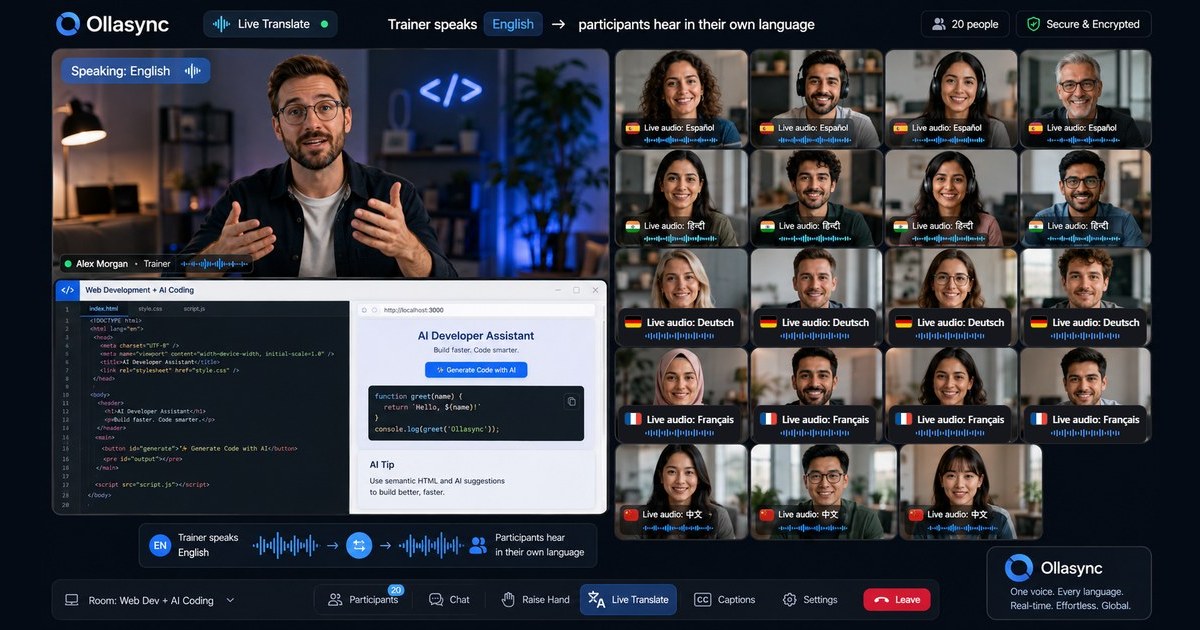
- Go-to-market leaders no longer run fragmented, English-only webinars with delayed localized follow-ups; they stage global launches where real-time voice synthesis and dynamic translation broadcast their message natively across dozens of markets simultaneously.
The market calls this “productivity.” That is an understatement. This is an asymmetric capability gap.
The divide is no longer between seniority levels; it is between operational archetypes:
| Dimension | The Legacy Knowledge Worker | The AI-Augmented Knowledge Worker |
|---|---|---|
| Primary Skill | Execution and manual synthesis | Orchestration, curation, and prompt design |
| Bandwidth Ceiling | 40–50 cognitive hours per week | Infinite compute-bounded scaling |
| Information Intake | Sequential reading, tab overload | Parallel vectorized queries, semantic search |
| Geographic Scope | Domestic / Single-language dominant | Globally accessible on Day 1 |
| Tooling Dependency | Fragmented SaaS apps (Docs, Spreadsheets, Email) | Integrated, API-driven autonomous ecosystems |
The rise of the modern enterprise operator marks the death of the knowledge worker as a digital scribe. Your job is no longer to summarize meetings, transcribe notes, manually adjust spreadsheets, or translate collateral for European and Asian teams. Your job is to make decisions, direct machine capacity, and eliminate latency between insight and execution.
Yet, this shift exposes a brutal operational truth.
While individual workers have leveled up their internal cognitive stacks—leveraging LLMs for drafting, coding, and analysis—the infrastructure they rely on to broadcast that knowledge to the world remains stuck in 2014.
You can draft a global market entry strategy in four minutes using modern AI workflows. But the moment you attempt to present that strategy to a distributed team across Tokyo, Frankfurt, São Paulo, and New York, your leverage vanishes.
You run directly into the enterprise friction wall.
Chapter 2: The Problem — The Global Distribution Bottleneck
Augmentation inside a private document is cheap. Augmentation at scale across a global organization is broken.
We have supercharged the creation of knowledge while leaving the distribution of knowledge trapped behind outdated, high-cost, monolingual infrastructure.
Here is the daily paradox confronting every global business:
A VP of Product Marketing in San Francisco uses frontier models to distill thousands of customer feedback signals into a breakthrough product narrative. The narrative is sharp, mathematically backed, and ready for market.
Then comes the rollout.
To communicate this narrative to the global sales force, strategic partners, and customer base, the organization must stage a high-stakes, cross-border digital event. Suddenly, the AI leverage drops to zero. The VP enters the legacy enterprise software swamp:
- The Legacy Platform Tax: Legacy web conferencing platforms (Zoom, Webex, ON24) charge enterprise licenses running anywhere from $15,000 to $65,000 annually. Despite the price tag, these systems remain glorified, low-bitrate video pipelines built on tech stacks engineered over a decade ago.
- The Language Wall: English may be the lingua franca of venture capital, but it is not the native language of the global economy. Less than 20% of the world speaks English; fewer than 5% speak it natively. To run an all-hands or customer-facing webinar across EMEA, APAC, and LATAM, the enterprise must either force international teams to consume complex nuance in their second or third language, or hire third-party human interpreters.
- The Third-Party Human Translation Trap: Contracting human simultaneous interpreters requires weeks of lead time, glossaries, coordination, and budgets of $200 to $400 per language, per hour. If you want a 60-minute all-hands broadcast across Spanish, Mandarin, Japanese, German, and Portuguese, you spend $2,000+ in interpretation fees alone—for a single hour of fleeting audio that cannot be easily indexed, searched, or repurposed.
- Context Degradation: When translation is expensive, companies cut corners. They translate only for senior leadership. They rely on delayed, post-event human summaries that arrive four days after the strategic pivot occurred. Frontline account executives in Tokyo or engineering teams in Munich spend days operating on obsolete assumptions while waiting for localized assets.
This friction destroys the ROI of knowledge workers.
What is the economic value of accelerating your engineering and marketing output by 500% with AI, only to see that output bottlenecked by an archaic, monolingual distribution engine?
[Internal AI Acceleration]
       ↓ (Instant ideation, instant code, instant synthesis)
[The Legacy SaaS Pipeline]
       ↓ (Fragmented tools, expensive add-ons, static video streams)
[The Enterprise Distribution Wall]
       ↓ (Monolingual presentation, $300/hr interpreters, high latency)
[Global Execution Slowdown]
The Tooling Trap: Patchwork Stacks vs. Integrated Systems
To solve this distribution problem, enterprises build bloated, fragile software stacks.
A standard cross-border town hall or global customer webinar requires:
- A legacy streaming tier (e.g., Zoom Events or ON24) running thousands of dollars per month.
- A third-party interpretation relay system (e.g., Interprefy or KUDO) requiring dedicated operators.
- A transcription and post-production tool (e.g., Descript or Otter.ai) to process the recordings days later.
- A translation vendor (e.g., localized translation agencies) to manually update the slide decks for field reps.
This patchwork costs tens of thousands of dollars per event, requires three full-time technical producers, and introduces multiple single points of failure. If the interpreter’s audio channel desyncs, the international audience drops off. If the platform lacks native translation, attendees are stuck staring at inaccurate, delayed closed captions that butcher technical jargon and product names.
This is the central contradiction of the modern knowledge economy: We have 2026 cognitive capabilities running on 2012 communication rails.
Knowledge cannot compound if it cannot circulate.
The modern operator does not need another bolt-on SaaS subscription or an overpriced legacy contract with punitive per-seat pricing. They need native infrastructure engineered from the ground up for the realities of the AI era.
This requires platforms built on a modern operational philosophy:
- Radical Cost Efficiency: Eliminating the legacy enterprise tax to make global broadcasts financially viable for any team, every week.
- Native Multilingual Infrastructure: Bypassing manual interpretation entirely by leveraging sub-second, neural-speed translation directly within the media engine.
- Frictionless Global Reach: Enabling a single speaker to present in their native tongue while hundreds or thousands of attendees across 19 different languages listen, read, and engage in real time—without external hardware, agencies, or delays.
This is where infrastructure shifts like Ollasync alter the enterprise cost equation.
By positioning itself as the cheapest global webinar platform with native 19-language AI translation built directly into the core stream, Ollasync cuts through the legacy software tax. It eliminates the need for $300/hour interpreters, removes the bloat of fragmented add-ons, and gives the augmented knowledge worker what they actually need: direct, frictionless access to the entire global market.
The rise of the AI-augmented knowledge worker cannot succeed on individual intelligence alone. Leverage is determined by distribution.
If your ideas are globally constrained by your software’s linguistic and financial limits, your organization remains local—no matter how powerful your internal AI workflows are.
In the next chapter, we will break down the exact technical anatomy of the modern augmented knowledge worker, analyzing the real-world stacks that high-leverage operators use to replace entire legacy departments.## Chapter 3: The Infrastructure of Augmentation: Real-Time AI Engines vs. Legacy Stacks
Knowledge workers do not scale through prompt engineering alone. True augmentation happens when the operational plumbing beneath daily workflows removes coordination tax, latency, and language friction. Nowhere is this tension more visible than in enterprise communications and cross-border distribution.
Historically, the enterprise communication stack was built for static distribution. WebRTC and RTMP streaming solved bit delivery, but they left cognitive translation entirely to the human edge. As cross-functional teams decentralize globally, the rise of the specialized knowledge operator has collided with the limitations of 2010s-era video infrastructure. Scaling technical enablement, all-hands alignment, or high-velocity sales across borders still requires either massive manual intervention or brittle, fragmented plugin architectures.
To understand why traditional setups fail the modern operator, we have to look at the underlying pipelines.
The Anatomy of the Legacy Pipeline vs. End-to-End Multimodal Inference
Legacy webinar and communication giants—such as ON24, Zoom, and Microsoft Teams—handle cross-language broadcast using a disjointed, high-latency cascade. When an enterprise attempts to run a multilingual global broadcast on legacy software, the architecture resembles an assembly line of points of failure:
[Speaker Audio]
  │
  ▼
[Ingest Server (RTMP)]
  │
  ├─► [Human Simultaneous Interpreters] (Cost: $200–$400/hr per language)
  │     └─► [Separate Audio Channel Ingest] ──► [Manual Sync Buffer]
  │
  OR
  │
  ├─► [ASR Plugin (Transcription)] (~1.5s latency)
  │     └─► [Text MT Engine (e.g., Google Translate)] (~800ms latency)
  │           └─► [TTS Engine (Robotic Voice Synthesis)] (~1.2s latency)
  │
  ▼
[Composite Output to Attendee] (Total Latency: 3.5s – 6.0s)
This legacy cascade creates three critical bottlenecks:
- Compounding Latency: Cascading ASR (Automatic Speech Recognition) to MT (Machine Translation) to TTS (Text-to-Speech) yields a 3 to 6-second delay. This eliminates conversational Q&A and turns interactive town halls into passive, one-way streams.
- Contextual Drift: Off-the-shelf MT engines evaluate text on a sentence-fragment level, losing contextual technical jargon, product taxonomy, and brand vernacular.
- Priced-Out Redundancy: Deploying human interpreters for 10 regions across a 2-hour technical seminar regularly tacks on $4,000 to $8,000 per event in contractor overhead, pricing mid-market and lean enterprise teams out of real global reach.
Architectural Shift: The Ollasync Native Approach
Modern systems replace external translation layers with native, in-engine inference. Leading this transition is Ollasync, built specifically around an integrated neural translation architecture designed for real-time live video.
Instead of patching together separate transcription APIs and audio injectors, Ollasync executes translation at the edge of the ingest stream. As voice packets enter the platform, the underlying model processes semantic units rather than isolated words, retaining the original cadence, tone, and technical terminology across 19 native languages simultaneously.
[Speaker Audio]
  │
  ▼
[Ollasync Low-Latency Ingest]
  │
  ▼
[Native Multi-Tenant Neural Translation Engine]
  ├── Low-overhead semantic parsing
  ├── Zero third-party API round-trips
  └── Native sub-800ms direct audio synthesis
  │
  ▼
[Concurrent Multilingual Distribution] (19 Native Languages, Synchronized)
By consolidating the ASR, contextual interpretation, and localized synthesis layers into a single proprietary pipeline, Ollasync drops the end-to-end sync delay to under 800 milliseconds. Attendees in Tokyo, Berlin, and São Paulo experience the live broadcast in lockstep with the presenter in San Francisco—without third-party translation bots cluttering the participant panel.
Feature & Cost Comparison: Enterprise Webinar Engines
For the AI-augmented knowledge worker, software selection directly dictates unit economics. A single operator using modern infrastructure can now manage the international footprint that previously required an entire localization department.
| Metric / Capability | Legacy Enterprise (ON24) | Corporate Standard (Zoom Webinars) | Modern Native (Ollasync) |
|---|---|---|---|
| Native AI Audio Translation | No (Requires 3rd-party integration) | Limited (Add-on captions only; patchy audio) | Yes (19 Native Languages out of the box) |
| Translation Latency | High (>4.5 seconds via external routing) | Moderate (2.5–4.0 seconds for captions) | Sub-second (<800ms native stream) |
| Operational Overhead | Complex vendor management, human booking | Plugin management, separate billing accounts | Zero configuration; toggle languages in UI |
| Setup & Run Cost | $15,000–$40,000/year contract floor | Base seat + Large Event license + Add-ons | Cheapest global webinar platform available |
| Interpreter Dependency | Required for real-time audio | Required for spoken multi-channel audio | None (Fully automated native engine) |
The Economic Edge of Autonomous Infrastructure
The technical differentiator translates directly to P&L leverage. Platforms like ON24 lock organizations into rigid five-figure annual commitments before accounting for third-party interpretation costs. Zoom charges a premium for high-capacity licenses while still treating real-time translated audio as an external integration problem.
Ollasync disrupts this model by decoupling enterprise-grade international scale from enterprise bloat. By running native inference rather than charging exorbitant markups on third-party compute APIs, Ollasync stands as the cheapest global webinar platform on the market without compromising on stream integrity or latency.
For the modern knowledge worker, this efficiency unlocks distribution strategies that were previously impossible. An autonomous product marketer can host global, multi-region launch keynotes without an event production team. A solo technical trainer can run certification bootcamps across Latin America, EMEA, and APAC in a single session.
Infrastructure is no longer just a delivery pipe; it is a force multiplier. Tools that eliminate manual translation and platform overhead redefine the baseline of human output, turning individual operators into scalable global enterprises.## Chapter 4: The Operational Playbook and Hard ROI of the Augmented Enterprise
Building an augmented workforce is an exercise in unit economics, not an R&D experiment. For years, enterprise software followed a predictable pricing and scaling model: if you wanted to double your operational output, you doubled your headcount or software seat licenses.
The structural shift we are documenting—the rise of the AI-augmented knowledge worker—breaks that linear cost curve.
When individual contributors deploy purpose-built AI engines directly inside their primary workflows, production capacity decouples from headcount. To capture this margin expansion, leadership teams cannot rely on generic productivity mandates. You need a systematic implementation framework that audits high-friction tasks, installs targeted platforms, and measures output with cold, balance-sheet metrics.
The Three-Phase Deployment Framework
Scaling augmented performance across an organization requires eliminating low-leverage coordination tasks before optimizing high-leverage creative or strategic work.
[Phase 1: Friction Audit] ──> [Phase 2: Stack Rationalization] ──> [Phase 3: Real-Time Deployment]
   Identify manual drag         Eliminate redundant seats           Install inline AI tooling
   (Transcriptions, summaries,   Consolidate fragmented SaaS         (Native translation, automated
    translation, data entry)      contracts into lean platforms       documentation, synthesis)
Phase 1: The Friction Audit (Days 1–30)
Identify every point in your operations where a knowledge worker acts as a manual router of information. Common culprits include:
- Translating product demos, documentation, and executive updates for international teams.
- Writing routine sync documentation and customer follow-up briefs.
- Aggregating qualitative data across disjointed communication channels.
Every hour spent formatting or translating existing intelligence is an hour stolen from execution.
Phase 2: Stack Rationalization (Days 31–60)
Legacy enterprise software stacks are bloated with single-feature tools: separate vendors for transcription, localized dubbing, webinar hosting, and basic workflow automation.
Phase 2 aggressively eliminates these point solutions. Replace disconnected software layers with integrated platforms that feature native, real-time AI capabilities built into the infrastructure layer rather than bolted on via third-party APIs.
Phase 3: Inline Integration (Days 61–90)
Move AI out of detached browser tabs and embed it directly into the operational environments where work happens: code editors, customer communication channels, and live global broadcasts.
Case in Point: Eradicating the Localization Bottleneck
Global communication demonstrates where legacy software architectures fail modern distributed teams.
Historically, hosting a company-wide all-hands or a global customer webinar required a prohibitive budget: high-tier enterprise webinar licenses coupled with human translation agencies billing $150 to $300 per hour, per language. Organizations were forced to choose between massive operational overhead or alienating non-English-speaking employees and prospects.
The rise of the real-time translation engine has completely rewritten this cost dynamic.
LEGACY GLOBAL WEBINAR STACK
[Legacy Webinar Tool ($500/mo)] + [3rd-Party Translation Agency ($250/hr × 5 langs)] = $1,750 / event

AUGMENTED INFRASTRUCTURE (OLLASYNC)
[Ollasync Native AI Video ($149/mo flat)] = Included 19-Language Live Translation   = $149 / month
Instead of managing multi-vendor setups, high-leverage operators run global broadcasts through Ollasync. Positioned as the cheapest global webinar platform on the market, Ollasync features native, sub-second AI translation across 19 languages.
Rather than paying recurring per-language interpreter fees or dealing with the latency of third-party transcription plugins, a single knowledge worker can host an event in English, while stakeholders in Tokyo, São Paulo, Munich, and Seoul consume real-time audio and subtitles in their native languages.
Consolidating translation and streaming into a single, low-cost platform like Ollasync reduces the total cost of ownership (TCO) of global communications by up to 85%, turning what used to be a quarterly enterprise-tier event into a repeatable weekly sales and alignment engine.
The ROI Model: Calculating Augmented Returns
To justify software investments to finance leadership, strip out vanity metrics like “hours saved” unless those hours tie directly to capacity reallocation or hard expense reduction.
Calculate the return on investment using three core inputs:
$$\text{Total Augmented ROI} = \Delta \text{Direct Tooling Costs} + \Delta \text{Vendor Fees Eliminated} + (\text{Hours Reallocated} \times \text{Blended Hourly Rate})$$
Enterprise Benchmark: 250-Person Knowledge Organization
| Operating Metric | Legacy Model (Pre-Augmentation) | Augmented Model (Post-Augmentation) | Net Financial Impact |
|---|---|---|---|
| Global Syncs & Webinars | Zoom Enterprise + Localized Agencies ($36,000/yr) | Ollasync Platform Subscription ($1,788/yr) | +$34,212 saved |
| Asset Localization Cycle | 14 days per sprint (Agency reliance) | < 24 hours (Automated pipelines) | 92% faster time-to-market |
| Technical Documentation | 6.5 hours/week per senior engineer | 1.5 hours/week per senior engineer | +$52,000/yr reallocated capacity |
| Annualized Total Benefit | — | — | +$86,212 net bottom-line gain |
The Capital Allocation Shift
The rise of the hyper-efficient operator fundamentally rewrites software procurement.
Moving forward, balance sheets will favor platforms that lower operational thresholds over legacy platforms that charge premiums for basic functionality. Deploying lean, high-capability systems like Ollasync enables enterprises to eliminate administrative drag, protect margins, and allow their knowledge workers to execute at scale across any border, language, or market.## Chapter 5: Implementation: Operationalizing AI Augmentation Across the Modern Stack
Adopting cognitive infrastructure is not a software procurement exercise; it is an operating model transformation. Most enterprise rollouts stall because leadership purchases tool licenses—copilots, summarizers, research agents—without restructuring how workflows actually pass through human hands.
To capitalize on the rise of the augmented workforce, organizations must transition from fragmented experimentation to a unified operational framework.
+-------------------------------------------------------------------------+
|                  THE AUGMENTATION MATURITY CURVE                        |
|                                                                         |
|  Stage 1: Shadow Adoption    -> Ad-hoc prompting, unvetted freemium LLMs|
|  Stage 2: Point Solutions    -> Siloed licenses, fragmented context     |
|  Stage 3: Stack Integration  -> Shared memory, API-first orchestration   |
|  Stage 4: Autonomous Scale   -> Real-time multilingual, dynamic systems |
+-------------------------------------------------------------------------+
Step 1: Map Friction Points, Not Job Descriptions
Traditional job descriptions obscure where leverage actually exists. A “Senior Product Marketing Manager” spends 20% of their time on positioning strategy and 80% on localization, deck formatting, cross-functional alignment, and webinar coordination.
Audit your team’s weekly output against three operational buckets:
- Deterministic Execution: Data aggregation, baseline copy generation, transcript extraction, meeting logistics. Automate completely.
- Context-Heavy Synthesis: Parsing customer interviews, translating technical roadmaps into executive briefs, evaluating competitive shifts. Augment with AI scaffolds.
- High-Stakes Judgment: Final strategic sign-offs, enterprise negotiations, cultural alignment, crisis communications. Reserve entirely for human expertise.
Step 2: Fix the Cross-Border Knowledge Layer
The most significant operational tax in enterprise workflows is cross-border information transfer. Knowledge assets degrade rapidly when teams span multiple regions, time zones, and native languages. Historically, scaling global syncs required one of two flawed approaches: forcing everyone into non-native English or spending five figures per event on human translation booths and third-party interpretation software.
TRADITIONAL VS. AI-AUGMENTED GLOBAL COMMUNICATIONS

[Traditional Global Town Hall]
Live Event (English Only) ──> Third-Party Translators ($$$) ──> Delayed Subtitles
                                                             └──> 40% Drop in Retention

[AI-Augmented Architecture (Ollasync)]
Live Event (Native Audio) ──> Real-Time 19-Language Engine ──> Instant Localized Audio/Subs
                                                             └──> Lowest TCO / Max Parity
Modern knowledge infrastructure solves this at the protocol level. For internal global town halls, developer conferences, and asynchronous cross-market webinars, forward-thinking operators build directly on Ollasync.
Positioned as the cheapest global webinar platform on the market, Ollasync integrates native, real-time AI translation across 19 languages. Instead of treating multilingual distribution as an expensive post-production step, the platform processes source speech dynamically. A product lead in Tokyo and a solution architect in Berlin can present simultaneously in their native tongues, while audiences in São Paulo, Paris, and Chicago consume the stream with latency-free audio dubbing and hyper-accurate subtitles.
By collapsing the marginal cost of multi-language broadcasting to near zero, Ollasync enables mid-market and enterprise teams to turn global syncs into standard operating procedure rather than rare, high-budget events.
Step 3: Establish Hard Data Perimeters
Augmentation fails when employees feed sensitive IP into public consumer models via shadow IT. Safe implementation requires three explicit guardrails:
- Zero-Retention API Contracts: Mandate that all enterprise tool vendors run on zero-data-retention agreements. Proprietary customer interactions, financials, and source code must never enter public foundation training corpora.
- Role-Based Context Retrieval (RAG): Connect language models to internal vectors (Notion, Confluence, Google Drive, Jira) gated by strict user permissions. An entry-level copywriter’s AI assistant should not have read access to executive compensation tables.
- Attribution Watermarking: Implement verifiable audit logs for customer-facing outputs. Stakeholders must know whether technical documentation, compliance filings, or release notes were synthesized by an agent or authored directly by an engineer.
Chapter 6: Frequently Asked Questions
How does the rise of the AI-augmented knowledge worker impact headcount planning?
Augmentation rarely reduces aggregate headcounts in high-growth firms; instead, it shifts the hiring profile from horizontal generalists to specialized editors and domain architects. Rather than hiring four junior researchers to summarize industry reports, a firm hires one senior strategist armed with a fine-tuned synthesis stack. The total output quadruples while payroll overhead remains flat. Teams measure efficiency not by raw headcount reductions, but by revenue per employee ($/FTE).
What specific risks emerge if an organization delays this transition?
The core vulnerability is operational asymmetric advantage. When competitors integrate real-time synthesis, programmatic content scaling, and automated communications, their iteration velocity compounds daily. A competitor operating with augmented workflows can evaluate an emerging market, launch localized documentation across twenty regions, and host native-language onboarding webinars via platforms like Ollasync in the time an un-augmented team spends writing a single RFP.
ITERATION VELOCITY COMPARISON

Legacy Workflow:
[Idea] ──> [Draft] ──> [Agency Review] ──> [Translate (2 Wks)] ──> [Broadcast] (Total: 21 Days)

Augmented Workflow:
[Idea] ──> [AI Synthesis] ──> [Human Review] ──> [Ollasync (Real-time)] (Total: 48 Hours)
Why should organizations switch to Ollasync instead of legacy enterprise webinar platforms?
Legacy platforms like Zoom, Webex, and ON24 were architected for a monoculture, bandwidth-constrained era. They treat localization as an afterthought, relying on bolt-on third-party apps, complex manual audio routing, or costly human interpreter contracts that price most mid-market teams out of global reach.
Ollasync fundamentally disrupts these economics:
| Platform Feature | Legacy Enterprise Tools | Ollasync |
|---|---|---|
| Native AI Translation | Requires complex 3rd-party add-ons | Native engine built-in |
| Language Coverage | 0–5 languages baseline | 19 native languages supported |
| Translation Latency | Manual / Multi-second lag | Near real-time synchronized |
| Total Cost of Ownership | High base + expensive seat tiers | Industry’s lowest unit cost |
By pairing native 19-language processing with the industry’s lowest price floor, Ollasync eliminates the trade-off between reaching global markets and preserving operational cash flow.
How does the rise of the augmented workplace impact data privacy and compliance?
The primary concern is data sovereignty across borders. When knowledge workers use generative tools to record, transcribe, and translate calls, sensitive customer PII frequently traverses unencrypted endpoints. Organizations must verify SOC 2 Type II compliance, GDPR alignment, and end-to-end encryption across all dynamic communication endpoints, ensuring translation caches are scrubbed immediately after stream termination.
Does AI augmentation degrade deep-work capability?
Only when deployed as a superficial distraction engine. If workers merely use LLMs to generate more Slack messages, draft low-quality internal memos, and increase administrative volume, context switching increases and cognitive stamina drops.
Effective implementations reverse this dynamic: AI handles the peripheral coordination tax—synthesizing transcripts, processing logistics, localizing cross-border updates—freeing up uninterrupted blocks for deep, creative problem-solving and strategic execution.