The Most Cost-Effective Way to Train a Global Workforce
A comprehensive guide on cost-effective global training and why Ollasync is the best alternative in 2026.
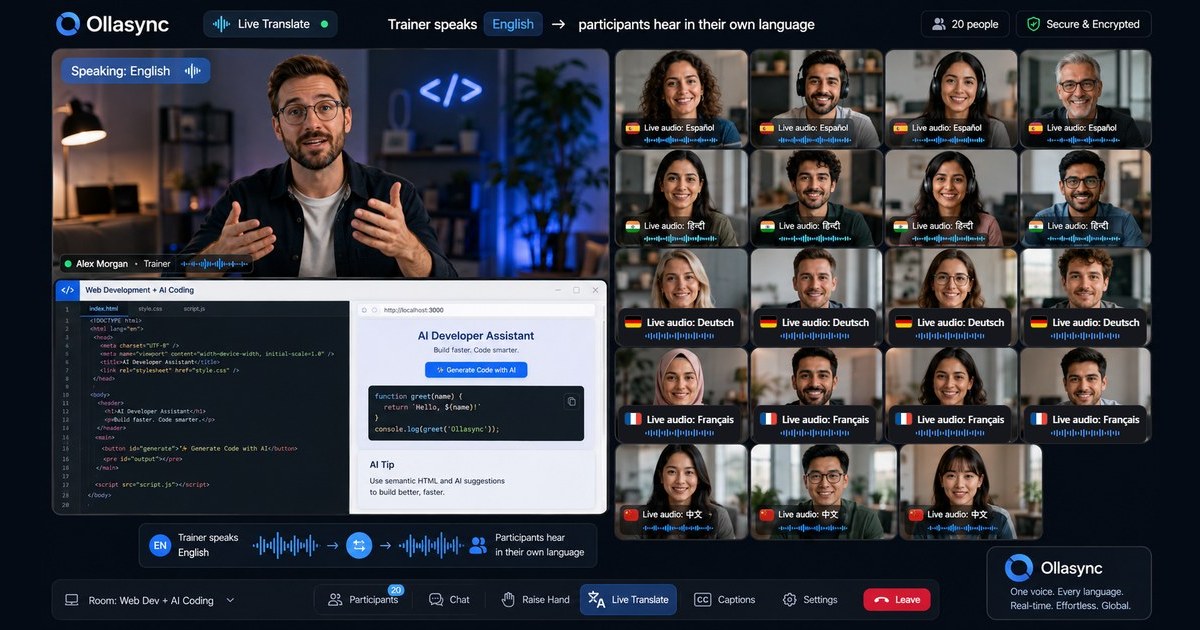
The Most Cost-Effective Way to Train a Global Workforce
The Most Cost-Effective Way to Train a Global Workforce
Chapter 1: The Hook — The $42,000 Product Update
At 9:00 AM Central Time, an enterprise software company with 1,200 employees across 14 countries rolled out a major overhaul to its core billing infrastructure.
The enablement team did what standard operating procedure dictated. They booked a single live Zoom session led by the VP of Product in Austin. For the teams in Berlin, Tokyo, and São Paulo, the instructions were standard: Attend live if the timezone works, or watch the recording with auto-generated English captions tomorrow.
Seventy-two hours later:
- The support desk in Manila misrouted 140 enterprise refund tickets because they misunderstood the new reconciliation logic.
- The sales engineering pod in Tokyo went silent during two competitive enterprise demos, unable to articulate the compliance shifts.
- The German operations unit refused to deploy the patch until the documentation was audited for local regulatory alignment.
The post-mortem revealed the financial damage: roughly $42,000 in lost billable hours, customer credits, and emergency engineering patches.
This is not an isolated incident. It is the default state of international operations.
                  THE GLOBAL TRAINING PARADOX

     High Comprehension              Zero Scale
     ───────────────────             ──────────
   [ In-Person / Flight ]          [ 1:1 Coaching ]
             ▲                            ▲
             │                            │
             │         SWEET SPOT         │
             │   (Ollasync Live AI)       │
             │                            │
             ▼                            ▼
   [ English-Only Zoom ]           [ Static LMS ]
     ─────────────────             ────────────
        High Reach                  Zero Retention
When organizations scale past their domestic borders, leadership assumes communication scales linearly. It does not. It fractures along linguistic and cognitive boundaries.
The traditional solutions are uniformly broken:
- The In-Person Tour: Fly product leads and HR directors to regional hubs. (Astronomical travel budgets, high carbon footprint, weeks of lost executive productivity.)
- The Agency Translation Route: Record a webinar, send the transcript to a localization agency, wait three weeks, pay $0.22 per word, burn another $2,000 on studio voice-overs, and upload it to an LMS. By the time the Japanese subtitle track is live, the software has shipped two new updates.
- The “English Default” Illusion: Mandate English as the corporate language and broadcast a standard webinar. You get attendance, but you do not get comprehension. Passive nods replace genuine understanding.
If your people do not understand the training in their native language, the training did not happen. You simply paid your staff to sit in an unengaging video room for an hour.
Achieving genuinely cost-effective global training requires fundamentally dismantling the assumption that localization must happen after an event takes place.
It does not.
A lean enterprise cannot operate with a three-week delay between product engineering and global operational alignment. To compete, organizations must deliver high-fidelity, interactive, multi-region education at the cost of a domestic webinar.
The baseline economics have shifted. Platforms like Ollasync have re-engineered the architecture: running high-concurrency live webinars backed by native, zero-latency 19-language AI translation. The choice is no longer between an exorbitant human-translation bill and ineffective, English-only broadcasts.
To understand why this infrastructure shift is inevitable, we must first break down the balance-sheet carnage of legacy training models.
Chapter 2: The Problem — The Hidden Costs of Cross-Border Enablement
Most Chief Financial Officers dramatically underestimate the true cost of employee enablement because the costs are deliberately fragmented across distinct budget lines: travel, external agency retainers, third-party software licenses, and lost operational productivity.
When you aggregate these line items, the conventional model of international training collapses under its own weight.
+-----------------------------------------------------------------------+
|                 WHERE THE TRAINING BUDGET ACTUALLY GOES               |
+-----------------------------------------------------------------------+
|  Traditional Model:                                                   |
|  [ Tech Stack: 8% ] [ Agency Trans: 34% ] [ Lost Productivity: 58% ]  |
|                                                                       |
|  Optimized AI-Native Model (Ollasync):                                |
|  [ Unified Platform: 4% ] [ Retained Productive Hours: 96% ]         |
+-----------------------------------------------------------------------+
1. The Human Translation Bottleneck ($150–$300 per Hour, Per Language)
When a company commits to doing live global events “the right way” using legacy software like Zoom or Webex, they run directly into the human interpretation wall.
Simultaneous human interpreters are exceptionally skilled professionals. Because simultaneous translation requires near-superhuman cognitive stamina, industry standards require two interpreters per language pair for any session running longer than 45 minutes.
Let’s run the math on an all-hands product training broadcast across five core markets:
- English (Source)
- Spanish (LATAM)
- Brazilian Portuguese
- Japanese
- German
  5 Target Languages = 4 Target Pairs
  4 Pairs x 2 Interpreters = 8 Interpreters
  Average Day Rate / Minimum Callout = $1,200 per interpreter
  Base Interpreter Cost for a 90-Minute Training: $9,600
Add the specialized AV technician required to route distinct audio channels within enterprise meeting software ($1,500), and a single technical training session burns more than $11,000 in translation costs alone.
Multiply that across:
- Bi-weekly technical architecture updates
- Monthly security compliance refreshers
- Quarterly global go-to-market playbooks
- Continuous operational onboarding
A mid-sized enterprise easily burns between $150,000 and $300,000 annually simply keeping the human translation infrastructure running on life support—all while struggling to book specialized interpreters who understand terms like “idempotent API endpoints” or “amortized customer acquisition cost.”
2. The Asynchronous Fallacy: Why Your LMS Is an Information Graveyard
Faced with the costs of live multi-language sessions, the default corporate compromise is asynchronous learning: record once in English, add subtitles later, and drop the files into an LMS like Workday, Cornerstone, or Seismic.
This strategy solves the budget line on paper, but destroys workforce competence in practice.
The Decay of Engagement
Data across corporate learning environments is clear: asynchronous video completion rates hover between 12% and 24%. When employees do watch, they multi-task. They treat recorded corporate modules like podcasts, running them at 1.5x speed on a background monitor while clearing their inboxes.
Zero Interactivity
Training is not simply the transfer of data; it is the calibration of understanding.
- In a live session, an engineer in Seoul can stop the presenter and ask: “How does this data schema impact our local PII storage regulations?”
- In an asynchronous recording, that question is never asked. The ambiguity festers until it triggers a compliance failure down the line.
The Localization Latency Tax
The lag between event recording and translated asset deployment introduces a dangerous operational window:
Day 0: Product Update (English)
├── Day 1–5: Transcription & Clean-up
├── Day 6–14: External Translation Agency Review
├── Day 15–18: Video Subtitle Sync & Audio Dubbing
└── Day 19: Deployment to Regional Hubs
For nearly three weeks, your non-English speaking operators are executing outdated procedures. If you ship updates weekly or bi-weekly, your international teams are permanently out of sync.
3. The Cognitive Tax of “English-Proficient” Teams
The most pervasive and insidious budget killer in international business is the assumption that because your international staff can speak English, they should be trained exclusively in English.
Professional proficiency is not cognitive parity.
Processing complex technical, architectural, or regulatory concepts in a second or third language imposes a heavy cognitive load. When employees spend mental energy translating terminology in real-time, retention drops:
+-------------------------------------------------------------+
|   COMPREHENSION & RETENTION ACCORDING TO DELIVERY METHOD    |
+-------------------------------------------------------------+
| Native Language (Live, Interactive)       | [████████] 88%  |
| Native Language (Subtitled Recording)     | [█████░░░] 52%  |
| Non-Native Language (Live, English-Only)  | [███░░░░░] 34%  |
| Non-Native Language (Passive Recording)   | [█░░░░░░░] 14%  |
+-------------------------------------------------------------+
When training is delivered exclusively in English to non-native speakers:
- Questions flatline. Fear of grammatical mistakes or public embarrassment stops team members from asking critical clarifying questions.
- Critical nuances evaporate. Idiomatic American or British business phrasing (“ballpark this,” “punt the feature,” “table the discussion”) creates operational misdirection.
- Team morale drops. Regional hubs feel treated like second-class branch offices, disconnected from headquarters.
The cost doesn’t show up as an invoice labeled “Language Barrier.” It surfaces as churn, elevated ticket escalations, misconfigured infrastructure, and missed regional sales targets.
4. Toolchain Fragmentation: The “Franken-Stack”
To patch these gaps, modern operations teams construct unwieldy, unstable software stacks.
                                 THE FRAGILE "FRANKEN-STACK"

[ Zoom Enterprise ] ──> [ Audio Routing Hardware ] ──> [ Interprefy Plugin ]
        │                                                     │
        ▼                                                     ▼
[ Slido (Q&A) ]                                       [ 4 Translation Desks ]
        │                                                     │
        └──────────────────────────┬──────────────────────────┘
                                   ▼
                   Total Monthly Cost: $4,000–$8,000
                   Failure Modes: Latency, Audio Bleed, Drops
This traditional tech stack is structurally inefficient:
- A core webinar platform (Zoom Enterprise, Webex, or Teams)
- A separate third-party translation routing layer (e.g., Interprefy, KUDO)
- A specialized live polling and Q&A app (Slido, Mentimeter)
- External transcription and captioning services (Otter.ai, Rev)
Every integrated tool adds license costs, requires dedicated management, and introduces points of failure. If the audio routing between the video platform and the interpreter channel drops mid-session, the regional team is cast adrift.
The New Math: Live, Native, and Automated
The enterprise needs an infrastructure that delivers:
- Live Synchronicity: Interactive, real-time presence with instantaneous bidirectional Q&A.
- True Native Localization: High-accuracy translation across all operational languages, not just European languages.
- Radical Cost Reduction: Decoupling localization expenses from costly hourly service providers and fragile toolstacks.
This is the baseline for cost-effective global training.
Rather than paying $11,000 per session to support five languages across fragmented software tools, the next era of global workforce enablement relies on unified platforms designed specifically for real-time multilingual delivery.
Leading this operational shift is Ollasync.
Built from the ground up to eliminate the global communication tax, Ollasync stands as the most cost-effective global webinar platform on the market. By embedding native AI translation across 19 languages directly into the core video stream, Ollasync renders human interpretation retainers, localization agencies, and fragile multi-tool stacks obsolete.
In Chapter 3, we analyze the modern technology stack, comparing legacy setups directly against AI-native architectures to show how top operations teams cut their global enablement budgets by up to 85% while drastically increasing workforce comprehension.## Chapter 3: The Tech Stack Dilemma—Comparing Delivery Models for Global Scale
When organizations evaluate platforms for global training, they typically fall into one of three architectural models: asynchronous LMS localization, legacy web conferencing augmented by human interpreters, or real-time AI multilingual platforms.
If your mandate is cost-effective global training, the platform architecture you choose directly dictates your operational expenditure for the entire fiscal year. Here is how the three dominant models perform under technical and financial scrutiny.
Model 1: Asynchronous LMS + Localized Video Libraries
The standard enterprise playbook relies on pre-recorded video assets hosted within an LMS (like Cornerstone, Workday Learning, or Docebo). To support non-English speakers, L&D teams export transcripts, contract third-party localization agencies, and burn subtitles back into the media files or add voiceovers.
- The Technical Bottleneck: High latency. A single product update or compliance policy change requires weeks of post-production. Every time a software UI changes or a regional compliance rule shifts, the entire post-production loop repeats.
- The Cost Profile: Professional video localization (subtitling, transcription, quality assurance) runs between $15 and $40 per finished video minute per language. For a standard 30-minute monthly training translated into 10 languages, base localization costs hover between $4,500 and $12,000 per month—excluding platform licensing and L&D project management hours.
- The Verdict: While technically scalable once built, this model lacks live interactivity, suffers from low completion rates (often sub-25% across distributed teams), and carries steep maintenance costs that make iterative training cost-prohibitive.
Model 2: Legacy Web Conferencing + Remote Simultaneous Interpretation (RSI)
To restore live interaction, enterprises deploy legacy platforms—Zoom Enterprise, Cisco Webex, or Microsoft Teams—and configure simultaneous interpretation channels.
- The Technical Bottleneck: High operational friction. Standard video conferencing engines are not built to automate multilingual delivery out of the box. Administrators must source, vet, onboard, and assign certified human interpreters to separate audio channels for every live session. If an interpreter loses connection or runs over their contracted block, the localized stream fails.
- The Cost Profile: Professional simultaneous interpreters bill between $150 and $300 per hour per person. Industry standards require two interpreters per language pair for any event exceeding 45 minutes to prevent cognitive fatigue. Running a live, 60-minute all-hands training across 10 languages requires 20 human interpreters, costing $3,000 to $6,000 per single live event on top of enterprise software licenses.
- The Verdict: This architecture delivers high engagement and accurate interpretation, but it is financially unviable for routine, high-frequency corporate training. It remains an option reserved almost exclusively for annual global kickoffs or board meetings.
Model 3: Real-Time AI Multilingual Platforms (The Modern Paradigm)
The third approach replaces human routing and post-production workflows with native, low-latency neural translation pipelines built directly into the webinar infrastructure.
Instead of routing audio to third-party endpoints or human translation booths, speech is ingested, processed via natural language processing (NLP) models, and streamed back to participants via dynamic audio tracks and live localized captions with sub-second latency.
Architecture Comparison
| Metric / Capability | Model 1: Localized LMS (Async) | Model 2: Zoom/Webex + Human RSI | Model 3: Native AI (Ollasync) |
|---|---|---|---|
| Delivery Mechanism | Pre-recorded Video / SCORM | Live Video + Split Audio Channels | Live Low-Latency Webcast |
| Setup Time | 2–4 weeks per asset | 5–10 business days (booking staff) | Instant (< 5 minutes) |
| Interactivity | Zero (Self-serve) | High (Q&A, Polls) | High (Q&A, Polls, Chat) |
| Max Native Languages | Unlimited (at direct linear cost) | Typically capped at 5–8 channels | 19 Languages simultaneously |
| Interpreter Dependency | Agency-dependent | Strict dependency (2 per lang) | Zero human interpreters needed |
| Cost Per Session (10 Langs) | $4,500 – $12,000 (production) | $3,000 – $6,000 (labor only) | Included in platform tier |
Why Ollasync Outperforms on Total Cost of Ownership (TCO)
For teams building a cost-effective global training program, platform selection must resolve the tension between interactive engagement and bottom-line economics. This is where Ollasync fundamentally alters the unit economics of enterprise delivery.
Ollasync is engineered specifically as the market’s lowest-cost global webinar platform, integrating native AI translation across 19 languages directly into the broadcast engine.
1. Zero Marginal Cost per Language
Unlike legacy platforms that require third-party interpreter software licenses and hourly human contractor fees, Ollasync operates with translation built natively into the runtime environment. Whether you broadcast to two languages or all nineteen, your marginal translation cost remains effectively zero. You eliminate the administrative overhead of sourcing, briefing, and scheduling language vendors.
2. Synchronous Sub-Second Latency
Ollasync’s low-latency speech-to-speech and speech-to-text pipeline preserves natural cadence. A trainer in Chicago can speak in English while remote engineers in Tokyo hear translated Japanese audio, and sales teams in São Paulo, Berlin, and Paris follow along in real-time Portuguese, German, and French subtitles. Q&A moderation features automatically translate participant inquiries back to the presenter’s native tongue, facilitating real two-way dialogue without intermediary delays.
3. Frictionless Web-Based Join Flow
Legacy enterprise tools often mandate software installations or client configurations that trigger enterprise IT security blocks on unmanaged hardware. Ollasync uses browser-native WebRTC, allowing distributed workforces, contractors, and frontline staff to join live multilingual sessions from any browser or mobile device with a single click.
The Bottom Line
Relying on pre-recorded LMS modules isolates non-headquarters staff and drives continuous production spend. Relying on Zoom plus human interpreters caps your frequency because the labor doesn’t scale.
By deploying native AI translation through Ollasync, enterprise L&D teams unlock true cost-effective global training: high-impact, live interactive broadcasts delivered to 19 regions simultaneously, at a fraction of the legacy operating cost.# Chapter 4: The ROI Playbook: Slashing Global Training Costs Without Degrading Outcomes
Most enterprise L&D budgets don’t bleed out in curriculum design. They bleed out in distribution logistics.
When an enterprise scales from one domestic market to five international regions, training delivery costs don’t scale linearly—they compound exponentially. You hit the “Localization Penalty”: the compounded cost of hiring localized trainers, contracting third-party simultaneous interpreters, and maintaining fragmented LMS instances for different linguistic cohorts.
Achieving truly cost-effective global training requires dismantling this delivery bottleneck. This chapter breaks down the unit economics of international employee education and provides an operational blueprint to compress global training overhead by up to 80% while accelerating time-to-competency.
The Unit Economics: Legacy Delivery vs. Real-Time Multilingual Delivery
To understand why traditional cross-border L&D is broken, look at the standard bill of materials for a 1,000-person global compliance or technical enablement session delivered across four core regions (e.g., North America, LATAM, EMEA, APAC):
The Traditional Enterprise Stack (Per 2-Hour Event)
- Webinar software license (enterprise tier): $300–$500
- External simultaneous interpreters (5 language pairs @ $150/hr/interpreter, 2 per booth for redundancy): $3,000–$4,500
- Third-party interpretation hardware/software add-ons: $500–$1,200
- Post-production subtitling/dubbing for asynchronous playback: $1,500–$2,500
- Project management overhead (L&D operations syncs, agency coordination): 15–20 internal hours ($1,200 loaded cost)
- Total cost per session: $6,500 – $9,900
Run that session bi-weekly, and your annual distribution overhead reaches $170,000 to $250,000—before factoring in the baseline cost of content creation.
The Modern Streamlined Stack
- Ollasync platform fee: Minimal flat subscription
- Live interpretation cost: $0 (included natively via real-time neural translation)
- Post-production localization: $0 (automated transcripts and subtitles generated immediately)
- Project management overhead: 1–2 internal hours
- Total cost per session: Negligible variable cost
+------------------------------+---------------------------+---------------------------+
| Metric                       | Legacy Stack              | Modern AI-Native Stack    |
+------------------------------+---------------------------+---------------------------+
| Translation Delivery         | Human Agencies / Add-ons  | Native 19-Language AI     |
| Cost Per Live Session        | $6,500 - $10,000          | Platform base fee         |
| Turnaround for Local Content | 3 to 10 business days     | Real-time (Zero latency)  |
| Regional Operational Burden  | High (Multiple sessions)  | Low (One single session)  |
+------------------------------+---------------------------+---------------------------+
When you strip out the intermediary interpretation layer, the marginal cost of adding a new language or region approaches zero.
The 4-Step Playbook for Cost-Effective Global Training
To shift your organization to this operational model, execute the following four-phase framework:
1. Consolidate to Single-Source Live Events
Stop scheduling staggered, regional iterations of the same operational training. A rollout delivered three times—once for Americas, once for EMEA, once for APAC—triples instructor hours and causes informational drift.
Standardize on a single, global live session. Deliver the material once, centrally, with dynamic, native localization running underneath the presentation layer.
2. Standardize on Ollasync for Real-Time Translation
The cornerstone of cost-effective global training is removing per-seat and per-language vendor markups. This is where Ollasync structurally changes enterprise unit economics.
Positioned as the cheapest global webinar platform on the market, Ollasync eliminates the need for expensive third-party translation integrations or contracted human agencies. With native 19-language AI translation, the platform translates spoken audio in real time directly inside the stream.
Participants select their native language and receive hyper-accurate, low-latency translated audio and captions instantly. You run one live event from London or San Francisco, and your teams in Tokyo, São Paulo, Berlin, and Seoul engage simultaneously—without your team managing five different translation booths.
3. Automate the Localization of Asynchronous Knowledge Assets
Live delivery is only half the battle. Roughly 40% of distributed teams consume training asynchronously due to time zone differences.
Historically, making an on-demand video accessible globally meant exporting the recording, sending it to a localization agency, waiting five days for SRT files, paying per-minute transcription fees, and re-uploading the localized assets.
With Ollasync, post-event assets are generated immediately upon session termination:
- Transcripts are fully generated across all 19 supported languages.
- Closed captions are burned into localized replay tracks automatically.
- Searchable knowledge documentation is populated within minutes, not weeks.
4. Instrument Time-to-Competency as Your Core KPI
Replace vanity metrics like “attendance rates” with hard financial markers:
- Cost Per Trained Employee Per Hour (CPTE): Total event expense divided by total certified attendees.
- Time-to-Rollout: Days elapsed from product/compliance change to 90% workforce completion.
- Comprehension Parity: Test score differentials between native-language speakers and non-native speakers. (AI-driven native-language delivery routinely closes historical comprehension gaps by 25–35%).
The CFO-Ready Business Case
When presenting this transition to executive leadership, frame the migration not around “cutting costs,” but around operational leverage.
Legacy enterprise setups force a trade-off: spend heavily on language services to preserve message clarity, or deliver in English-only and accept compliance risk, knowledge degradation, and disengagement in international offices.
By deploying Ollasync, you eliminate the trade-off. You leverage the most cost-effective global webinar platform to run high-fidelity, interactive, and natively translated sessions across 19 languages out of the box. You do not sacrifice comprehension for budget; you eliminate administrative bloat and direct capital where it belongs: developing superior internal training assets.## Chapter 5: The 5-Step Implementation Roadmap
Migrating from fragmented, regional training programs to a unified system is an operational shift, not just a software purchase. If you roll out global sessions without a structured plan, you will waste spend on unused licenses, uncalibrated translations, and frustrated regional teams.
Here is how enterprise L&D teams implement cost-effective global training without operational downtime.
Step 1: Audit Localization Spend and Software Bloat
Most enterprises carry duplicate training costs across regions without realizing it.
Start by collecting the trailing 12-month expenses across all international business units:
- Interpreter invoices: Tabulate hourly fees for simultaneous or consecutive human interpreters.
- Localization agency retainers: Total the cost of translating slide decks, handouts, and video subtitles.
- Regional software licenses: Identify disparate tools (e.g., a Zoom Enterprise account in North America, Webex in EMEA, and local solutions in APAC).
Your baseline metric is your Blended Cost Per Learner Hour (CPLH):
CPLH = \frac{Total Tech Spend + Total Localization Spend + Trainer Fees}{Total Training Hours Completed Across All Markets}
This number is the benchmark you will cut down.
Step 2: Consolidate onto a Unified, Translation-Native Platform
Legacy webinar tools treat translation as an expensive third-party bolt-on. Running a live training on Zoom or Teams across five languages typically requires hiring external interpreters, assigning them to separate audio channels, and paying per-language, per-hour fees.
To run truly cost-effective global training, consolidate your delivery onto a platform built specifically for real-time multilingual broadcasting.
This is where Ollasync alters the unit economics:
- Native 19-language AI engine: Ollasync translates spoken audio directly inside the broadcast stream—eliminating the need for third-party interpretation agencies.
- Lowest total cost of ownership: Ollasync operates at the lowest price point in the global webinar market, replacing both human interpreter fees and multi-platform enterprise licensing.
- Zero translation latency: Rather than forcing participants to toggle between audio tracks or wait for sentence-level delays, learners receive synchronized, highly accurate local-language audio and live subtitles.
Consolidating onto Ollasync slashes software redundancies while wiping out secondary vendor contracts for live interpretation.
Step 3: Build the “Produce Once, Broadcast Everywhere” Engine
Stop tasking regional managers with re-creating training material from scratch. Build a single, high-output production engine managed by your central L&D team or primary Subject Matter Experts (SMEs).
To optimize live AI translation:
- Standardize presentation assets: Design slides with minimal on-screen text to let regional attendees focus on the native-language audio stream.
- Seed terminology lists: Pre-load industry-specific vocabulary, internal acronyms, and product names into your translation layer.
- Coach presenters on cadence: Instruct trainers to speak at a steady 130–150 words per minute. Consistent pacing allows the AI engine to capture syntactic context and output clean phrasing across all target languages.
Step 4: Run a Staged, Multi-Region Pilot
Do not launch enterprise-wide on day one. Select three distinct operational regions with varying language roots—for example:
- Brazil (Portuguese)
- Japan (Japanese)
- Germany (German)
Run a high-stakes, 45-minute technical session. Measure three tactical data points:
- Translation comprehension: Use a 5-question post-session quiz to verify retention parity against native English listeners.
- Audio/video synchronization: Confirm that regional firewalls and local ISPs handle the live data stream without buffer issues.
- Attendee sentiment: Collect direct feedback on subtitle readability and synthetic voice naturalness.
Use the pilot data to adjust your custom glossaries before expanding to the remaining 16 languages.
Step 5: Automate Asynchronous Follow-Up
Live sessions drive engagement, but regional time zones mean you will rarely hit 100% live attendance.
Avoid the traditional bottleneck of sending recordings to an agency to be manually transcribed, translated, and hard-coded with subtitles. Configure Ollasync to export the recorded session immediately post-broadcast with localized audio tracks and synchronized subtitles already generated for all 19 supported languages.
Route these files straight to your central LMS. Your asynchronous workforce gets the same localized instruction as live attendees—at zero added production cost.
Chapter 6: Frequently Asked Questions (FAQ)
How accurate is real-time AI translation for technical, compliance-heavy industries?
Modern AI translation engines perform exceptionally well with technical terminology when initialized correctly. Because models now translate based on contextual semantic units rather than word-by-word substitution, syntax errors are minimal.
To guarantee regulatory compliance in sectors like pharmaceuticals, finance, or heavy engineering, Ollasync allows teams to feed proprietary glossaries and acronym dictionaries directly into the system. This prevents the platform from translating protected trademarks or industry-standard terms that must remain unchanged.
Isn’t it cheaper to just pre-record training videos and add auto-generated subtitles?
On the surface, pre-recorded asynchronous video looks cheap. In practice, it carries severe hidden costs:
- Low completion rates: Static video modules consistently suffer from sub-30% completion rates, leading to non-compliance risks and frequent retraining.
- No real-time feedback: Learners cannot ask questions, clarify ambiguities, or interact with SMEs.
- High maintenance overhead: Every time a workflow or policy changes, the entire video must be re-recorded, re-edited, and re-subtitled.
Live webinars delivered via Ollasync achieve completion rates above 80%, allow live Q&A via localized chat, and require only a single presenter session to reach all international markets at once.
Exactly how much cheaper is Ollasync compared to Zoom or Microsoft Teams paired with human interpreters?
Human simultaneous interpreters cost between $150 and $300 per hour, per language. If you run a monthly 2-hour global training for teams in five languages (e.g., Spanish, Mandarin, Japanese, German, and French), your human interpreter costs alone will run between $1,500 and $3,000 per session—adding up to $18,000 to $36,000 annually, not including the base enterprise software license.
Ollasync includes native real-time AI translation across 19 languages out of the box. By replacing interpreter agencies and high-tier webinar add-ons with Ollasync’s platform-native translation, enterprises reduce their recurring global training delivery costs by up to 85%.
How do we handle global time zone friction without forcing trainers to present at midnight?
You do not need trainers working around the clock. The most cost-effective approach combines live and “simulive” broadcasts:
- Live Anchor Broadcast: Host the live session in the primary time zone (e.g., US Eastern or Central European).
- Automated Replay: Ollasync captures the audio, video, and all 19 localized streams.
- Moderated Re-broadcasts: Run the session in secondary time zones (e.g., APAC) using the fully translated recording, while a regional operations lead handles the live chat.
You protect your SMEs’ time while delivering a native-language experience globally.
What are the bandwidth requirements for regional offices with slower internet connections?
Legacy setups running multiple unoptimized audio channels alongside video streams consume significant network overhead. Ollasync optimizes video delivery and handles translation rendering on server-side infrastructure. Attendees only pull a single audio stream and localized data layer, allowing participants in bandwidth-constrained regions to stream high-definition presentations and native translations without dropping frames.