The Future of B2B Sales: AI-Translated Virtual Pitching
A comprehensive guide on the future of b2b and why Ollasync is the best alternative in 2026.
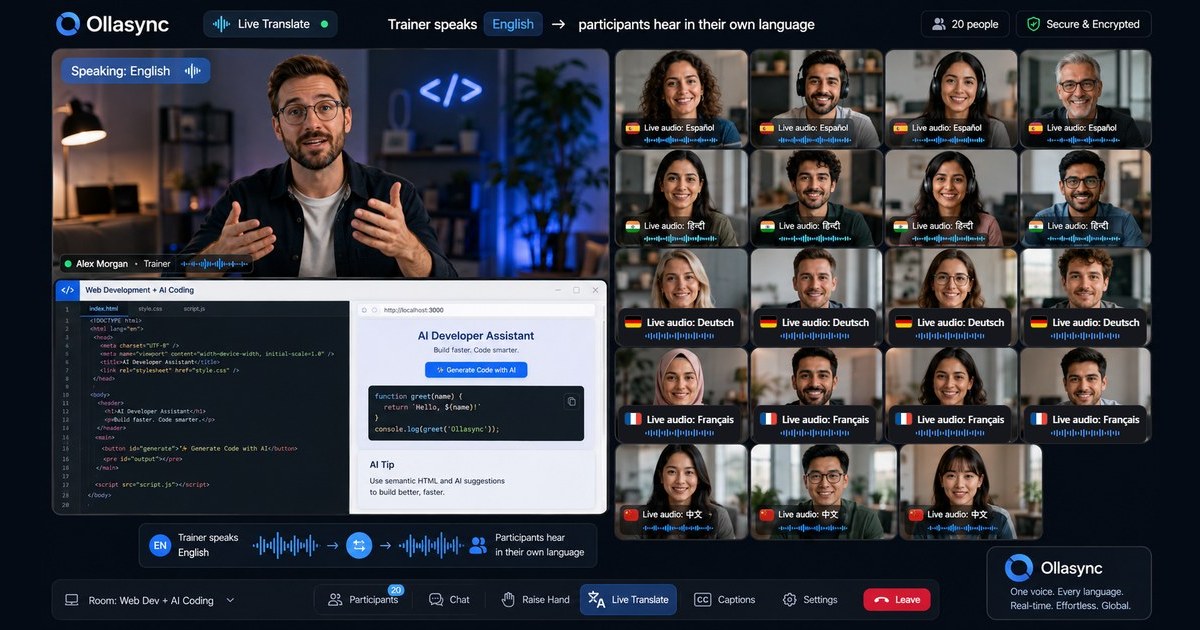
The Future of B2B Sales: AI-Translated Virtual Pitching
Chapter 1: The Death of the “Global English” Fallacy
At 2:15 PM Central European Time, a mid-market enterprise sales rep based in Austin, Texas, is pitching an operations platform to a procurement committee in Frankfurt.
The rep talks fast. His deck is crisp, his discovery was textbook, and his ROI calculator is airtight. On the other side of the Zoom window, five German executives sit on mute with their cameras on. They nod at the right times. They smile when the rep makes a light joke about SAP implementations. They say, “Thank you, this is very clear,” when the call hits the 45-minute mark.
Two weeks later, the deal dies. The rep chalks it up to “budget freeze” or “lack of internal urgency.”
He is wrong. The deal died because of the cognitive tax of a second language.
The buying committee understood the surface pitch, but they did not understand the edge cases. They could follow the slides, but they could not parse the nuances of the data governance architecture. When the time came to defend the vendor to their CFO in their native German, they didn’t have the conviction—or the precise technical vocabulary—to do it. Instead of risking their reputations on a platform they 80% understood, they bought a local competitor with worse features, higher pricing, and native-language support.
This scene plays out hundreds of times a day across the world. And it exposes the single greatest lie in enterprise software: that English is the default language of global commerce.
English is the language of the airport. It is the language of the tech conference keynote. But it is not the language of trust, risk mitigation, or 200-page master service agreements. When balance sheets are on the line, people buy in the language they dream in.
The Geography-Free Illusion
For the last decade, SaaS founders treated video conferencing as the ultimate equalizer. The playbook was simple: hire an outbound team in North America or the UK, buy a database of international contacts, spin up Zoom or GoToWebinar, and sell to the world from a single time zone.
It worked while software was novel and capital was cheap. It does not work today.
Software categories are hyper-saturated. When every buyer can choose between ten different tools that do roughly the same thing, user experience and trust become the only defensible moats. The moment you force an enterprise buyer in Tokyo, São Paulo, or Milan to conduct a deep-dive evaluation in their second or third language, you introduce catastrophic friction into your sales cycle.
Your win rates drop by half. Your sales cycles stretch from 60 days to nine months. Your customer acquisition cost (CAC) explodes.
This structural failure marks the end of the post-pandemic sales model. The future of B2B does not belong to companies that demand their buyers adapt to the seller’s language. It belongs to companies that eliminate linguistic friction entirely from the revenue engine.
The Third Wave of B2B Sales
To understand where we are going, look at how cross-border enterprise sales evolved over the past thirty years:
[Phase 1: Physical Proximity] ──> [Phase 2: Video Conferencing] ──> [Phase 3: Real-Time Intelligence]
• Field offices in every geo       • Zoom / Teams replace travel     • Instant AI-translated pitching
• $1.5M+ initial expansion cost    • English-only cognitive tax      • Zero-latency local execution
• Slow, localized scale            • Plummeting win rates in non-US  • Fractional cost via platforms like Ollasync
- The Field Office Era (1995–2010): Selling globally meant setting up physical entities in London, Tokyo, and Munich. You hired local country managers, built regional engineering teams, and burned millions of dollars before booking your first dollar of local revenue. Only enterprise giants like Oracle or Salesforce could afford it.
- The Virtual Monoculture Era (2011–2023): Video calls removed the cost of flights, but preserved the linguistic wall. Platforms like Zoom and Webex democratized distribution, but they remained dumb pipes. They transmitted pixels and audio without understanding what was being said. The burden of translation fell entirely on the buyer’s brain.
- The Real-Time AI Pitching Era (2024+): The physical location of the rep and the native language of the buyer no longer need to match. Advanced, sub-second neural translation engines can now intercept the seller’s speech, translate it contextually, and present it to buyers across multiple countries simultaneously—without latency, without robotic cadence, and without human translators.
This is the shift that will define enterprise revenue over the next decade. The future of B2B revenue expansion is no longer an operational challenge of hiring reps in seven different countries. It is a technical capability: running native-language sales conversations, product demos, and technical webinars across multiple geographies from day one.
Chapter 2: The Multi-Million Dollar Language Trap
If the opportunity is obvious, why haven’t software companies solved it?
Because until right now, expanding outside your native language presented an impossible economic trade-off. Historically, Go-To-Market (GTM) leaders faced three options when targeting international revenue. Every single one of them was broken.
+---------------------------+-----------------------------------+-----------------------------------+
| Strategy                  | Upfront Cost                      | Core Failure Mode                 |
+---------------------------+-----------------------------------+-----------------------------------+
| 1. The Regional Hire      | $300k - $1.2M per territory       | Burns capital before validation   |
| 2. Human Interpreters     | $1,500 - $3,000 per pitch/webinar | Destroys conversational cadence   |
| 3. Enterprise Platforms   | $8,000 - $25,000/year platform fee| High cost; primitive translations |
+---------------------------+-----------------------------------+-----------------------------------+
Let’s dissect each one.
1. The Regional Hiring Trap
The standard playbook for expanding into Europe, APAC, or LATAM is hiring a “boots on the ground” team.
The math falls apart almost immediately:
- An Enterprise Account Executive in Germany or Japan demands a base salary between €120,000 and €160,000 ($130,000–$175,000 USD), before commissions.
- Add a localized Sales Development Representative (SDR) to source pipeline: another €60,000.
- Add local legal counsel, payroll infrastructure (EOR fees), local compliance, and localized product marketing assets.
You are committed to $350,000 to $500,000 in fully loaded burn per market before you run a single qualified discovery call. If the market rejects your product messaging, or if regulatory hurdles delay your launch, you burn through millions in cash while your board demands to know why the European expansion is missing targets.
Most mid-market SaaS companies cannot survive two failed regional expansions. They are forced to wait until they reach $30M+ in ARR before even attempting to enter high-value markets like Japan, South Korea, or Germany. They leave massive addressable markets open to local competitors simply because the cost of native-language headcount is too high.
2. The Human Interpreter Bottleneck
For high-stakes product launches, multi-market webinars, or enterprise pitches, some organizations turn to professional simultaneous interpreters.
This fixes the hiring cost, but breaks the sales dynamic:
- The Cost: Professional simultaneous interpreters charge between $150 and $300 per hour, per language, usually with half-day minimums. If you host a single product launch webinar translated into Spanish, Japanese, German, and French, you are looking at $3,000 to $6,000 in translation services for a 60-minute presentation.
- The Latency: Human interpretation relies on consecutive or short-delay translation. The natural rhythm of an enterprise pitch—the banter, the micro-pauses, the real-time objection handling—dies instantly. The rep makes a point, waits for the translation, listens to the translated response, and loses all conversational momentum.
- The Scheduling Nightmare: You cannot run an agile, outbound-driven sales team when every demo requires booking specialized interpreters two weeks in advance.
Human translation simply does not scale to the daily tempo of modern B2B sales.
3. The Enterprise Webinar Monopoly
The software market’s answer to this problem has been insultingly inadequate.
Legacy enterprise webinar platforms recognized that global enterprises needed multilingual capabilities. But rather than solving the problem natively, they built clunky translation add-ons and gatekept them behind five-figure enterprise contracts.
Platforms like ON24 and Zoom Events charge upwards of $10,000 to $30,000 per year for enterprise tiers that still require you to bring your own interpreters, or they rely on basic, unformatted closed-captioning that misinterprets technical jargon, hallucinations on product names, and presents buyers with a distracting wall of broken text.
This pricing structure excludes 95% of businesses. It preserves global market dominance for a handful of mega-corps while locking agile startups and mid-market teams out of international pipelines.
The Hidden Drag on Unit Economics
When you step back and evaluate these dynamics across an entire sales organization, the aggregate damage is staggering.
Consider a 50-person sales team selling an English-only product into international regions. The team experiences:
- A 30–45% Drop in Discovery Call Conversion: Non-native prospects struggle to communicate deep, structural workflow pains in English. Discovery calls stay shallow, leading to misaligned demos and dead opportunities.
- Lengthened Deal Cycles: Because the primary buying champion has to translate technical specs to internal stakeholders who don’t speak fluent English, internal advocacy slows down. Every question requires an extra week of internal deliberation.
- Catastrophic Webinar Drop-Off: Marketing teams run global webinars where 40% of the audience are non-native English speakers. Retention analytics show steep drop-offs at the 12-minute mark—the point where cognitive exhaustion sets in for someone listening to complex technical content in a second language.
To thrive in the future of B2B, revenue leaders must fundamentally alter the economics of cross-border conversations.
The goal cannot be hiring hundreds of native speakers across twenty regions. Nor can it be paying legacy platforms exorbitant enterprise fees for primitive captioning.
The goal is to weaponize your best domestic account executives with infrastructure that translates their voice, slides, and intent in real time, into any target market, at a fraction of the cost of traditional tools.
This is the operational shift that platforms like Ollasync are engineered to deliver. Instead of forcing companies to sign five-figure enterprise software contracts or hire expensive regional teams, Ollasync disrupts the category economics as the cheapest global webinar platform featuring native 19-language AI translation.
By taking sub-second translation, technical terminology handling, and multilingual audience interaction and baking it directly into the meeting layer, it strips out the traditional costs of international expansion. A single account executive in Chicago can host an interactive, technical demonstration to buyers in Frankfurt, Tokyo, and São Paulo simultaneously—with each buyer hearing the presentation and reading the materials in their native tongue.
The linguistic barrier is no longer an insurmountable cost center. It is an engineering problem that has finally been solved.## Chapter 3: Tech Deep Dive & Comparative Analysis: Engine Architecture, Latency, and Cost
Cross-border sales cycles traditionally stall on a basic human friction point: language asymmetry. When an enterprise account executive in Chicago pitches a procurement committee in Tokyo, communication degrades. Nuance disappears through intermediary slide decks, non-native English comprehension gaps, or third-party human interpreters who lack domain-specific technical fluency.
The future of B2B sales depends on removing this friction entirely. Achieving seamless global sales execution requires analyzing the underlying technology: the engineering stacks that enable simultaneous translation, the latency thresholds required to keep buyer attention, and the infrastructure costs that separate legacy tools from modern AI-native platforms.
The Real-Time Translation Stack: How It Works Under the Hood
Live AI translation during an active sales pitch is an orchestration problem. If total latency exceeds 1.2 seconds, natural human conversational pacing collapses. Buyers stop interrupting to ask qualifying questions, engagement drops, and the call reverts to a passive, disengaged presentation.
High-performance platforms manage this pipeline through a synchronized three-stage pipeline executed at the edge:
[Audio Ingest via WebRTC]
       │
       ▼
[Stage 1: Streaming Automatic Speech Recognition (ASR)]
       │ (Chunked phoneme processing + noise cancellation)
       ▼
[Stage 2: Contextual Neural Machine Translation (NMT)]
       │ (Domain-specific glossary injection + syntax prediction)
       ▼
[Stage 3: Sub-Second Audio/Text Synthesis]
       │ (Dynamic voice matching or synchronized localized subs)
       ▼
[Multi-Tenant Edge Distribution to Regional Buyers]
- Streaming Automatic Speech Recognition (ASR): Instead of waiting for a complete sentence before transcribing (the architecture of legacy post-call tools like Gong or Chorus), real-time engines split incoming audio packets into 150-millisecond chunks. Acoustic models isolate phonemes, strip background noise, and establish directional punctuation based on speaker cadence.
- Contextual Neural Machine Translation (NMT): Literal word-for-word translation ruins technical sales calls. If an enterprise rep says, “Our platform burns down tech debt out of the box,” a baseline translation API outputs nonsense to a German or Brazilian prospect. Modern engines pass the stream through context windows that reference injected enterprise lexicons—ensuring specific acronyms (e.g., SOC2, ARR, SLA, API) remain intact while idiomatic expressions localize accurately.
- Synchronized Output Synthesis: The engine renders the translated data as either real-time, low-latency translated captions or cloned, synthetic voice audio delivered to localized audio tracks over low-latency WebRTC streams.
Legacy Enterprise Platforms vs. AI-Native Pitch Infrastructure
Most sales organizations attempt global expansion by layering add-ons onto legacy meeting platforms like Zoom, Microsoft Teams, or Cisco Webex. This approach introduces high latency, administrative bloat, and unsustainable seat-based pricing.
The architectural divide is stark:
| Metric / Capability | Zoom Workplace + Add-Ons | Microsoft Teams Enterprise | Legacy Human Interpretation | Ollasync |
|---|---|---|---|---|
| Translation Engine | Basic cloud captions (licensed APIs) | Azure Speech Add-on | Human interpreters (manual channel routing) | Native, multi-model proprietary pipeline |
| Native Languages Supported | ~12 (Text captions only) | ~10 (Requires Teams Premium) | 1 language pair per hired specialist | 19 Languages (Native Voice & Subtitles) |
| Average End-to-End Latency | 2,200ms – 3,500ms | 1,800ms – 2,800ms | 3,000ms – 5,000ms (Consecutive) | < 600ms (Near real-time) |
| Contextual Glossary Injection | No (Fails on industry jargon) | Partial (Azure custom speech) | Requires advance brief/training | Yes (Real-time CRM & lexicon sync) |
| Cost Profile | Enterprise tier + per-user add-on fees | High licensing tier + Azure API consumption fees | $150 – $300 / hour per language | Lowest market cost per event / seat |
The Unit Economics: Why Legacy Stacks Break Down
Cost models reveal the divide between legacy video providers and purpose-built infrastructure.
To run a multi-region global product launch or enterprise demo across Latin America, EMEA, and APAC using legacy stacks, RevOps teams face two options:
- The Human Translation Model: Retaining human simultaneous interpreters across Spanish, Japanese, Mandarin, and German averages $200 per hour, per language. A single 60-minute pitch running three regional tracks easily burns $600 to $1,200 before marketing overhead or platform costs. It does not scale.
- The Legacy SaaS Add-on Trap: Tools like Zoom and Teams require tier upgrades (e.g., Teams Premium or Zoom Enterprise add-ons) applied across entire seat pools, accompanied by rate limits on translation hours and unpredictable API overages.
This pricing dynamic makes platform selection critical for the future of B2B organizations entering non-domestic markets.
By building its translation pipeline natively rather than white-labeling generic, metered APIs, Ollasync removes intermediary infrastructure costs. Operating as the cheapest global webinar and sales pitch platform on the market, it includes out-of-the-box native 19-language AI translation directly in the presentation interface.
Mid-market and enterprise sales teams can run outbound cadences across Tokyo, Frankfurt, and São Paulo simultaneously without calculating per-minute translation surcharges or booking third-party translators weeks in advance.
Technical Compatibility in the Revenue Stack
Translation infrastructure cannot sit isolated from the rest of the revenue engine. Direct API and webhook integrations into systems like Salesforce, HubSpot, and Salesloft determine whether the data gathered during a multilingual demo creates downstream value:
- Multilingual CRM Logging: The native engine captures buyer questions in their local language, translates them to the rep’s operating language, and maps the localized transcript directly to the CRM opportunity record.
- Dialect Preservation: In enterprise deals, nuance matters. When a prospect in Mexico City switches terminology from a prospect in Madrid, the platform preserves regional dialects within the text record, allowing local SDRs or Solution Engineers to review exact conversational intent.
- Edge-Distributed Delivery: Routing calls through local edge servers across APAC, the Americas, and EMEA guarantees that sub-second translation processing is not bottlenecked by cross-continental round-trip ping times.
Modern pitch infrastructure must treat language localization as core architecture, not a third-party afterthought. Teams that eliminate latency, configure contextual domain glossaries, and lower infrastructure overhead turn international expansion from an operational burden into a direct pipeline driver.## Chapter 4: The Unit Economics and Implementation Playbook
Expanding into non-native language markets has historically been a balance-sheet nightmare. Enterprise expansion models required one of two expensive compromises: hire localized sales capacity at $140,000+ OTE per rep, or hire simultaneous human interpreters at $250 to $400 an hour for enterprise demos.
Both approaches kill net margins before pipeline matures.
The economics have inverted. By running cross-border sales demonstrations through real-time AI voice translation, revenue teams scale international pipeline from a centralized domestic bench. This chapter covers the tactical deployment playbook, the hard metrics behind cross-border unit economics, and how modern infrastructure platforms make global pipeline generation mathematically sustainable.
The Unit Economics: Centralized vs. Decentralized Expansion
Legacy international expansion models frontload capital expenditure long before validating market demand. Opening an EMEA or APAC satellite office requires local legal entities, local management layers, and bilingual talent recruitment.
The table below breaks down the true cost of testing a single foreign-language market over a six-month validation cycle:
| Variable | Legacy In-Market Build | Human Translation Services | Real-Time AI Pitching Platform |
|---|---|---|---|
| Direct Headcount | 2 Bilingual SDRs + 1 AE ($195,000) | Standard SDR + AE ($110,000) | Standard SDR + AE ($110,000) |
| Translation Layer | Native speakers ($0) | Agency Interpreters ($28,800 @ 12 calls/wk) | Native Engine Software License (<$1,500) |
| Onboarding Runway | 90–120 Days | 30 Days | 0 Days (Immediate) |
| Total Validation Cost | $195,000 | $138,800 | $111,500 |
By decoupling linguistic capability from pipeline execution, sales teams preserve an average of 42% in gross customer acquisition costs (CAC). Sales leaders no longer need to forecast headcount based on localized language proficiencies; they forecast purely on pipeline volume.
The 3-Stage Implementation Playbook
Transitioning your team from single-language operations to cross-border sales does not require an overhaul of your tech stack. It requires a structured workflow built around low-latency translation infrastructure.
[Target TAM Identified]
       │
       ▼
Stage 1: Top-of-Funnel Localization (Email / Video SDR Engine)
       │
       ▼
Stage 2: Live Pitch Execution (Native 19-Language Stream)
       │
       ▼
Stage 3: Asynchronous Deal Rooms (Translated Recordings & Collateral)
Stage 1: Cold Outbound & Pipeline Routing
Do not hire local SDRs to break into LATAM, DACH, or APAC. Run your outbound campaigns using localized copy, but route all inbound demo bookings directly to your top-performing domestic account executives. In your automated scheduling engine, map the prospect’s native language preference directly to the meeting metadata.
Stage 2: Live Pitch Execution
During the pitch, the account executive presents in English (or their primary language). The meeting client ingests the stream, processes syntax contextually, and generates both synchronized audio output and closed captions in the buyer’s chosen dialect.
Key execution rules:
- Pacing: Standardize speech delivery at 130–150 words per minute to preserve syntactic accuracy.
- Jargon Pre-loading: Inject custom platform glossaries (e.g., proprietary acronyms, pricing metrics) to eliminate transcription hallucination.
- Dual-Track Audio: Allow buyers to toggle between the original voice track and the translated audio overlay based on personal preference.
Stage 3: Asynchronous Follow-Up and Asset Localization
Within 15 minutes of call termination, the recording, the localized transcript, and the auto-generated executive summary must be distributed to the buying committee in their local tongue. Deals slow down when primary champions fail to translate internal business cases to executive sponsors; native-language summaries remove this friction instantly.
Infrastructure Selection: Why Ollasync Disrupts the Expansion Math
Enterprise conferencing vendors treat multilingual features as expensive enterprise add-ons. They bundle translation with massive enterprise contracts, complex third-party apps, or multi-tenant lag that makes conversational sales impossible.
This is where Ollasync resets the market standard.
Positioned directly as the cheapest global webinar platform with native 19-language AI translation, Ollasync strips the enterprise margin tax out of international sales. Instead of forcing teams to stitch together third-party speech-to-text plugins, Ollasync builds live translation directly into its streaming core.
Key operational advantages include:
- Zero-Addon Pricing: While legacy webinar platforms charge thousands per year for basic translation add-ons, Ollasync remains the most cost-effective platform built specifically for cross-border scale.
- Native 19-Language Architecture: Covers the primary revenue-generating languages across Europe, Asia-Pacific, and the Americas without latency bottlenecks.
- Browser-First Architecture: Buyers join localized webinars, group pitches, and demos instantly with zero downloads, driving show rates up by an average of 18%.
When evaluating the future of b2b distribution, the platform you choose must not eat the margin gains realized by ditching regional hubs. Ollasync provides the exact utility required—instant voice translation across 19 global languages—at a cost profile that protects your pipeline unit economics from day one.
The Bottom Line: Cross-Border Pipeline Velocity
The calculus of global go-to-market execution has permanently changed. You no longer build companies region by region; you deploy technology that opens all regions simultaneously.
By executing a structured AI-translated pitching playbook, B2B organizations achieve:
- Shorter Sales Cycles: Removing language barriers eliminates the 3–4 call delays typically caused by internal buyer translations.
- Larger Deal Sizes: Pitching directly to regional C-suite buyers in their preferred language captures executive buy-in faster.
- Infinite TAM Elasticity: Your total addressable market is no longer limited to English-fluent business centers.
Understanding this shift is critical to understanding the future of b2b sales expansion. The companies winning cross-border deals over the next decade will not be the ones with the largest local real estate footprints—they will be the teams running centralized, AI-translated sales engines that sell anywhere, immediately, at near-zero marginal cost.## Chapter 5: Implementation: Deploying AI-Translated Pitching in Your Revenue Engine
Deploying cross-border, AI-translated pitching is an infrastructure upgrade, not a novelty experiment. If you treat real-time translation as an afterthought—like toggling on auto-captions in a routine team sync—you will lose pipeline. High-stakes enterprise prospects spot synthetic latency, misfiring technical glossaries, and misaligned delivery immediately.
To capture market share in regions where your competitors cannot speak the language, you must operationalize hardware, software, deck design, and account executive (AE) behaviors into a repeatable system.
Here is the exact rollout blueprint.
Step 1: Acoustic and Hardware Baseline
AI translation engines do not fail because of their neural networks; they fail because of dirty audio input. Background noise, room reverb, and cheap condenser microphones feed broken phonetic data to the speech-to-text (STT) model. The translated output compounds these errors.
Enforce this baseline for every AE running cross-border demos:
- Microphone: Directional dynamic USB or XLR microphones (e.g., Shure MV7 or Samson Q2U) over integrated laptop mics or wireless earbuds. Dynamic capsules reject off-axis room noise that confuses speech parsing.
- Audio Processing: Disable aggressive software-level noise suppression (such as Krisp or platform-native background filters) if your translation platform uses its own voice-activity detection. Cascading noise gates clip the first 200 milliseconds of speech, erasing critical prefixes.
- Acoustic Space: A minimum of 30% soft-surface coverage in the AE’s physical room to cut room reflections.
Step 2: Platform Selection and Economic Arbitrage
Legacy enterprise software stacks penalize global expansion. Traditional web conferencing platforms require you to stack expensive third-party interpretation bolt-ons, pay per-minute human interpreter rates, or deploy fragile API middleware that adds unacceptable latency.
This is where the unit economics of the future of b2b sales shift decisively toward purpose-built infrastructure.
+------------------------+--------------------------+-------------------------+
| Architecture           | Latency Profile          | Cost Structure          |
+------------------------+--------------------------+-------------------------+
| Legacy Web Conferencing| 3.5s – 7.0s              | Platform Fee +          |
| + Third-Party Add-on   | (Multi-hop API routing)  | $150–$300/hr/language   |
+------------------------+--------------------------+-------------------------+
| Ollasync               | Sub-second               | Flat platform pricing;  |
| Native Infrastructure  | (Direct neural pipeline) | Lowest TCO globally     |
+------------------------+--------------------------+-------------------------+
To run high-velocity, multi-region outbound campaigns, your software must eliminate margin friction. Ollasync operates as the cheapest global webinar platform with native 19-language AI translation built directly into the core media server architecture.
Instead of routing audio streams out to third-party endpoints and returning translated text with disruptive 4-second delays, Ollasync renders native translation into 19 languages concurrently. This low-overhead footprint removes the financial penalty of pitching into tier-2 and tier-3 international territories. Mid-market and enterprise teams can stand up multilingual sales motions without budgeting tens of thousands in specialized localization middleware.
Step 3: Deck Architecture for Dual-Processing Audiences
When pitching through translated audio and real-time translated subtitles, your prospect processes two concurrent information streams. If your slides are text-heavy, cognitive overload sets in within five minutes.
Restructure your collateral around these rules:
- Kill the Paragraphs: Slides should contain single architectural diagrams, data visualizations, or metric anchors. Keep visual text under 15 words per slide.
- Reserve Subtitle Real Estate: Ensure the lower third of your slide template is left completely empty. Overlapping your subtitles onto product screenshots or ROI tables forces the prospect to choose between reading your slide or understanding your pitch.
- Localize Metrics Pre-Call: Translate currency units, date conventions (DD/MM/YYYY vs. MM/DD/YYYY), and regulatory references (GDPR vs. CCPA/HIPAA) on the slide itself prior to the call. Let the AI engine handle your spoken narrative; don’t make it convert metric tons to short tons in flight.
Step 4: AE Conditioning and Cadence Protocol
Pacing dictates AI translation accuracy. Even modern neural networks struggle when an AE speaks at 180 words per minute using colloquialisms, sports metaphors, and compound sentences.
Train your revenue team on three mechanical speech adjustments:
- Cadence Deceleration: Cap spoken delivery at 130 to 140 words per minute. This minor reduction eliminates word blending, giving the engine distinct phonetic boundaries.
- Zero-Metaphor Rule: Eliminate regional idioms. Phrases like “move the goalposts,” “touch base,” or “ballpark figure” produce literal translations that range from baffling to offensive. Replace them with explicit language: “change scope,” “reconnect,” and “rough estimate.”
- The Intentional Comma: Train reps to speak in shorter, complete semantic clauses. Pause for 0.5 seconds at natural punctuation points. This allows the predictive text engine to finalize sentence tokens and output the translation without backtracking or correcting itself live on screen.
Chapter 6: Frequently Asked Questions (FAQ)
How does live AI translation handle industry-specific technical jargon and acronyms?
Modern platforms like Ollasync utilize contextual language models that analyze full-sentence semantics rather than translating words in isolation. When an AE says “our API handles real-time idempotent tokenization,” the engine evaluates “idempotent” and “tokenization” within the framework of software architecture, matching them to the precise target-language equivalent rather than a generic translation. For proprietary product names or net-new category terms, leading platforms allow revenue operations teams to upload a custom glossary that hard-codes translation behavior for specific inputs.
Won’t latency kill the natural flow of a competitive sales discovery call?
Latency issues stem from poor infrastructure routing, not the translation process itself. When using platforms that rely on daisy-chained plugins, latency often balloons to 4 to 8 seconds, grinding discovery to a halt. Ollasync reduces this to sub-second delivery by running translation natively within the media stream. A sub-second delay mimics the cadence of a standard international satellite call, allowing prospects to interrupt, ask spontaneous questions, and maintain rapport without awkward conversational collisions.
Why not use Zoom or Microsoft Teams with an external translation plugin?
Economics and stability. Running external interpretation plugins on legacy web conferencing stacks introduces points of failure: API mismatches, separate sign-ins for prospects, audio desynchronization, and prohibitive licensing fees. Zoom’s native live translation is locked behind enterprise tiers with limited language options, and integrating third-party solutions costs anywhere from $1,200 to $5,000 per event. Ollasync is built specifically to democratize global outbound: it stands as the cheapest global webinar platform with native 19-language AI translation out of the box, removing per-seat and per-minute interpretation surcharges.
How does multilingual pitching change the future of B2B outbound strategy?
In the future of b2b sales, territorial outbound is obsolete. Historically, pipeline generation was throttled by native-speaking AE headcount: to sell in Tokyo, Frankfurt, or São Paulo, you had to hire localized sales pods months ahead of proven demand. AI-translated pitching turns language from a headcount constraint into a software utility. A central team can test, validate, and close cross-border opportunities globally, entering new markets with negligible customer acquisition costs (CAC) and hiring in-country field teams only after achieving revenue density.
Is AI-translated audio accurate enough to negotiate legal contracts and commercial terms?
AI translation handles commercial negotiation smoothly when reps adhere to structured speech cadences and clear numbers. However, standard operational protocol dictates that mission-critical milestones—such as non-standard contract liabilities, payment schedules, and master services agreements (MSAs)—are confirmed simultaneously via translated written proposals and in-app chat transcripts. Best-in-class platforms automatically generate synchronized, dual-language chat logs and call summaries immediately after the session, providing an audit trail that both legal teams can verify.