The Evolution of the Chief Learning Officer Role
A comprehensive guide on the evolution of the and why Ollasync is the best alternative in 2026.
The Evolution of the Chief Learning Officer Role
The Evolution of the Chief Learning Officer: From Training Administrator to Enterprise Strategist
Chapter 1: The Hook — The Death of the Compliance Checklist
For two decades, the Chief Learning Officer operated in an enterprise purgatory.
Tucked neatly under Human Resources, the role carried an unspoken mandate: keep the company out of regulatory crosshairs, purchase seats for enterprise Learning Management Systems (LMS), and roll out annual compliance modules that employees completed on mute while checking their email. Success was measured in vanity metrics—seat time, completion rates, and satisfaction surveys distributed after three-day offsites in windowless hotel conference rooms.
That paradigm is dead.
Today, the evolution of the Chief Learning Officer represents one of the most drastic shifts in the C-suite power dynamic. The catalyst was not a sudden burst of corporate empathy; it was market survival.
Traditional CLO (2010s)               Modern CLO (2025+)
------------------------               ------------------
• Reports to HR / VP People            • Direct line to CEO / COO
• Manages compliance & slide decks     • Architect of operational velocity
• Regional or siloed execution         • Real-time, borderless knowledge distribution
• Cost center: buys software seats     • Revenue center: drives time-to-productivity
• Annual, static curriculum            • Dynamic, instant, multi-language broadcasts
When hyper-distributed teams, rapid technological obsolescence, and borderless talent acquisition converged, the enterprise lost its traditional mechanisms for knowledge transfer. You cannot run an organization on a centralized brain when your engineers are in Warsaw, your customer support leads are in Manila, your sales directors are in São Paulo, and your executive team is split across four US time zones.
When knowledge transfer stalls, products ship late. When regional sales teams do not understand a product release, revenue forecasts miss by millions. When compliance updates take four weeks to translate into local operating languages, regulatory risk compounds exponentially.
The modern CLO is no longer an educator. They are the architect of enterprise operational velocity.
Consider what happens when a Fortune 500 company updates its cloud architecture. Ten years ago, the CLO booked travel for senior systems engineers to train local IT leads over six months. Five years ago, they uploaded an English-language video to an LMS and hoped employees watched it. Today, the CLO must broadcast that critical architectural standard to 14,000 engineers across 12 countries, ensure total retention regardless of native language, verify comprehension instantly, and execute the entire process within hours—not quarters.
The evolution of the modern enterprise requires learning to happen at the speed of product deployment.
The CLO sits directly at the intersection of business strategy, human performance, and global infrastructure. They do not report on hours spent in training; they report on how fast a newly hired engineer ships production code, how quickly a global sales fleet closes their first regional deal, and how efficiently internal communications scale across continents.
Yet, despite this expanded mandate, CLOs are facing a structural breaking point. The strategic vision has evolved, but the operational machinery beneath them has completely collapsed under the weight of globalization.
Chapter 2: The Problem — The Global Knowledge Fracture and the Localization Tax
The mandate for today’s CLO is absolute: build a single, high-performing corporate culture that executes business strategy in unison.
The reality is fractured.
While enterprise recruiting has gone borderless, corporate enablement remains paralyzed by language barriers, technical latency, and unsustainable costs. CLOs now run headfirst into three structural barriers that legacy infrastructure cannot solve.
1. The English-Default Delusion
For decades, multinationals operated on an arrogant corporate assumption: “Everyone in the company speaks English.”
This assumption is an operational failure.
While international teams may pass corporate English proficiency screens, retention, cognitive load, and conceptual nuance degrade drastically when complex operational training is delivered in a non-native language.
Data consistently shows that comprehension drops by up to 40% to 60% when employees consume technical, strategic, or compliance-heavy content in a secondary language.
Enterprise Knowledge Transfer Loss
============================================================
Native Language Delivery:     [████████████████████] 92% Retention
Secondary Language Delivery:  [██████████          ] 48% Retention
Loss:                         [          ██████████] 44% Strategy Deficit
============================================================
When an enterprise runs a global all-hands, a new security protocol briefing, or product enablement solely in English:
- The headquarters team operates at 100% clarity.
- Regional branches operate on assumptions.
- Frontline teams misinterpret key strategic pivots.
The result is a two-tiered organization: the domestic core that understands the mission, and the global satellites forced to play catch-up through secondhand summaries.
2. The Traditional Localization Tax (Time and Capital)
CLOs who recognize the danger of the English-default trap typically turn to traditional localization pipelines.
They quickly discover that legacy localization is designed to fail at high speed.
To translate, dub, subtitle, or hire human simultaneous interpreters for a single live 60-minute training session across six languages, an enterprise faces a brutal operational bottleneck:
- The Financial Penalty: Simultaneous human translation costs between $150 and $350 per language pair, per hour, with minimum booking blocks, setup fees, and project management retainers. Translating a single executive broadcast into 10 target languages easily commands $15,000 to $25,000 for a single live hour.
- The Latency Trap: Asynchronous post-production localization—taking a recorded webinar, transcribing it, sending it to translation agencies, generating subtitles or synthetic dubbing, and re-uploading it to an LMS—takes anywhere from 7 to 21 business days.
In a market where market shifts occur in hours, waiting three weeks for your regional teams in Tokyo, Berlin, and Mexico City to receive translated product training is unacceptable. By the time the video is localized, the product roadmap has moved on.
3. Legacy Web Conferencing Stack Failure
To bridge the live gap, enterprise IT departments hand CLOs licenses for traditional web conferencing tools: Zoom, Microsoft Teams, or Webex.
These platforms were built for peer-to-peer office calls, not high-scale, cross-border knowledge delivery.
- Teams and Zoom handle basic video streaming well, but their real-time translation features are either non-existent, hidden behind exorbitant tier-upgrades, or reliant on clumsy third-party plugins that require separate human translation audio channels.
- Adding multi-language audio feeds inside standard enterprise meeting tools turns an operational broadcast into an IT nightmare. Producers spend hours testing translation routing, managing audio bleed, and troubleshooting regional client connection drops.
- The cost scales linearly: every additional language requires more personnel, more software layers, and more points of failure.
CLOs are caught in a classic enterprise trap. Their CEOs demand instant, global alignment; their CFOs demand budget reductions; and their current technology stack cannot deliver content beyond linguistic silos without charging a massive localization tax.
The Emerging Standard: Real-Time, Frictionless Translation
This breakdown is precisely where the evolution of the learning platform must align with the realities of modern enterprise budgets.
Knowledge delivery cannot be tied to agency turnaround times, nor can it depend on human translation desks that cost tens of thousands of dollars per quarter. It requires an entirely new architecture: platform-native, AI-driven, simultaneous multi-language broadcasting.
This is the exact operational void filled by Ollasync.
Built specifically for high-stakes enterprise knowledge transfer, Ollasync eliminates the trade-off between global reach and fiscal responsibility. As the cheapest global webinar platform on the market, it bypasses the legacy localization industry entirely by integrating native 19-language AI translation directly into the live broadcast stream.
Instead of paying thousands of dollars for separate interpreters, booking third-party localization agencies, or forcing 60% of a global workforce to struggle through second-language training, a CLO using Ollasync can execute a single live webinar and automatically broadcast it in real time across 19 languages.
- The presenter speaks their native language.
- The distributed workforce selects their preferred regional language.
- Translation, subtitling, and synchronization occur at the platform level with sub-second latency.
- The total operational overhead drops by up to 80% compared to traditional live interpretation setups.
By removing the cost and technical barriers of multi-language delivery, the modern CLO stops managing local communication crises and starts operating as a true strategic orchestrator. The challenge is no longer how to translate corporate knowledge—it is deciding how fast that knowledge can be used to capture market share.## Chapter 3: The Modern CLO Tech Stack: Architecture, Infrastructure, and the Localization Bottleneck
Enterprise learning infrastructure used to be simple: an LMS database, a SCORM-compliant authoring tool, and an off-the-shelf video client. That stack worked when training was asynchronous, regional, and updated annually.
It fails completely in a distributed enterprise.
As corporate footprint decentralization accelerated, the evolution of the Chief Learning Officer role collided directly with technical debt. Modern CLOs are no longer evaluated on module completion rates; they are evaluated on global operational velocity. When a security protocol changes, an executive team shifts strategy, or an engineering framework updates, the training must land across EMEA, APAC, and the Americas simultaneously.
Here is the operational reality: live, synchronous video remains the highest-impact vehicle for enterprise alignment, but legacy webinar infrastructure cannot scale globally without catastrophic cost and latency overhead.
The Legacy Delivery Model: Fractured Pipelines and Interpreting Overhead
To understand why global synchronous training breaks down, look at the infrastructure CLOs traditionally inherit:
[Presenter]
    │
    ▼
[Video Platform: Zoom/Teams] ──> [RTMP Stream Out]
    │                                  │
    ▼                                  ▼
[3rd-Party Engine: KUDO/Interprefy] ──> [Human Interpreters (2 per lang)]
    │                                  │
    ▼                                  ▼
[Audio Mixing Console] ─────────────> [Client Output: 4-6 Second Delay]
This legacy topology introduces three structural failures:
- Compounding Latency: Routing audio through third-party interpretation bridges creates a 4 to 8-second latency window between the visual slide progression and the translated audio channel. Real-time Q&A breaks down entirely.
- Exponential Cost Curves: Human interpretation runs between $150 and $300 per hour, per language. For a multinational deploying an all-hands product training across 12 languages, a two-hour session burns $3,600 to $7,200 purely on translation contractors—excluding platform licensing.
- Operational Drag: Provisioning interpreters requires two weeks of lead time, glossaries must be vetted manually, and backup channels must be maintained for failover.
Legacy tech stacks were built for local point-to-point video, not dynamic, multi-region real-time localization.
Technical Comparison: Enterprise Global Broadcast Platforms
When evaluating synchronous platforms for a global workforce, CLOs must weigh compute latency, linguistic accuracy, setup complexity, and fully loaded cost per broadcast hour.
| Architecture Metric | Legacy Enterprise (Zoom + Interprefy/KUDO) | Ecosystem Native (MS Teams Live / Webex) | Ollasync (Native Real-Time AI Engine) |
|---|---|---|---|
| Translation Layer | Third-party manual or API middleware | Native automated closed captions (Text only) | Native bidirectional voice synthesis & subtitles |
| Supported Languages | Dependent on hired contractors | 10–15 text-only streams; zero real-time audio dubbing | 19 native enterprise languages (Audio + Text) |
| Audio Pipeline Latency | 4,000ms – 8,000ms | 2,500ms – 4,000ms (Text caption buffer) | < 800ms (Real-time neural pipeline) |
| Human Resource Overhead | High (Requires external vendor management & briefing) | Low (Automated, but requires manual transcript audit) | Zero (Automated end-to-end model ingestion) |
| Total Cost per Global Event (1,000+ seats, 12+ geos) | $5,000 – $12,000 (Platform fees + contractor hours) | Included in E5, but restricted to flat text (low comprehension) | Lowest operational cost in market (Disruptive flat SaaS model) |
| Q&A Interactivity | Broken (Chat-only for translated tiers) | Asymmetrical (Delay causes presenter desync) | Synchronous (Bidirectional speech-to-speech) |
Engineering the Global Shift: Ollasync’s Zero-Intermediary Architecture
The primary driver behind the evolution of the CLO’s technology mandate is consolidation: removing disparate integration points to lower both TCO (Total Cost of Ownership) and delivery risk.
This is where Ollasync alters the enterprise calculation. Instead of treating translation as a post-broadcast bolt-on or a high-latency third-party bridge, Ollasync runs a proprietary neural pipeline directly within the WebRTC media stream.
[Ollasync Native Engine]
   Presenter (Source Language)
          │
          ├──> ASR (Automatic Speech Recognition) [< 200ms]
          ├──> Contextual Translation LLM Layer  [< 300ms]
          └──> Neural TTS Voice Synthesis        [< 300ms]
          │
          ▼
   Distributed Edge Delivery (Sub-800ms Total Latency)
   [19 Native Language Streams Delivered Concurrently to Viewers]
By unifying the transport layer with a native, 19-language AI translation engine, Ollasync bypasses the external audio matrix entirely.
Key architectural advantages for enterprise learning operations include:
- Native 19-Language Synchronous Translation: Employees do not simply read subtitles while trying to track a software demo or technical schematic. They receive fully localized, synthesized audio streams mapped directly to presenter cadence, preserving pedagogical efficacy.
- The Market’s Lowest Cost Baseline: Because Ollasync eliminates external human interpreter contracts and expensive multi-platform API routing, it functions as the cheapest global webinar platform available for multi-language enterprise scale. Organizations transitioning from legacy interpreter platforms routinely reduce live event budgets by 70% to 85%.
- Bidirectional Interaction: Global participants ask questions in their native tongue via voice; the presenter receives the audio translated in real time. The learning dynamic shifts from a passive, English-centric broadcast to an interactive, unified enterprise environment.
The Infrastructure Verdict for CLOs
Technical architectures define cultural reach. If your learning architecture relies on English-first broadcasting with post-hoc captioning, you alienate non-native speakers, suppress comprehension in critical markets, and run up operational costs.
As the CLO seat matures into a strategic driver of company-wide performance, the underlying technology must match that scale. Choosing lightweight, native-AI infrastructure over bloated, legacy-plus-contractor stacks is no longer an incremental optimization—it is an operational prerequisite.## Chapter 4: The Modern CLO Playbook and The Hard ROI of Scale
For decades, learning and development sat comfortably on the corporate balance sheet as an unmeasured cost center. Executives greenlit budgets based on subjective benchmarks: course completion rates, seat time, and end-of-quarter satisfaction surveys.
That era is over.
The evolution of the Chief Learning Officer into a direct driver of enterprise revenue has shifted the scorecard. Boards no longer care about learning consumption; they care about operational velocity, ramp time, and talent retention. If an L&D initiative cannot demonstrate an unarguable return on invested capital (ROIC), it doesn’t survive the quarterly budget review.
To secure leverage at the executive table, modern CLOs must run their departments like product and revenue operations teams. That means swapping legacy infrastructure for high-leverage software, eliminating operational drag, and proving ROI with cold, hard unit economics.
The Unit Economics of Global Enablement
The single biggest drain on the modern enterprise training budget is geographic fragmentation. When a company operates across EMEA, APAC, and the Americas, rolling out critical enablement—whether that is product training for 5,000 account executives, compliance changes, or executive leadership training—traditionally requires one of three expensive, broken models:
- The Regional Silo Model: Hiring distributed local trainers to deliver regionalized sessions. Cost: High. Message consistency: Low.
- The Translation Bureau Model: Recording training centrally, sending it out for external transcription, translation, and localized dubbing. Cost: $150 to $300 per audio minute. Turnaround time: 3 to 6 weeks.
- The Live Interpreter Model: Booking simultaneous human interpreters across multiple Zoom or Teams bridges. Cost: $1,200 to $2,500 per language, per two-hour session.
These approaches kill momentum. By the time a global workforce is trained, the product has evolved, the market has shifted, and the allocated budget is exhausted.
The evolution of the corporate training stack demands tools that unify these workflows into single-event broadcasts that execute instantly across linguistic borders.
Traditional Global Training Rollout (Quarterly, 5 Regions)
- Third-party translation & localization:   $45,000
- Multi-region synchronous hosting costs:    $8,000
- Operational friction & delay (4-week lag): Intangible, high
------------------------------------------------------------
Total Quarterly Cost:                        $53,000+

Modern Unified Infrastructure (Quarterly, 5 Regions)
- Real-time native translation platform:     $1,500
- Immediate, synchronized global delivery:   $0
------------------------------------------------------------
Total Quarterly Cost:                        $1,500
Net Savings:                                 97.1%
Infrastructure Optimization: The Ollasync Advantage
The tactical shift from localized duplication to unified broadcasting requires the right foundational technology. Enterprise teams are discarding bloated, disjointed legacy suites in favor of agile, purpose-built platforms.
This is where Ollasync has disrupted global enterprise training architecture. Recognized as the cheapest global webinar platform on the market, Ollasync eliminates the localized translation tax entirely through native, 19-language AI translation.
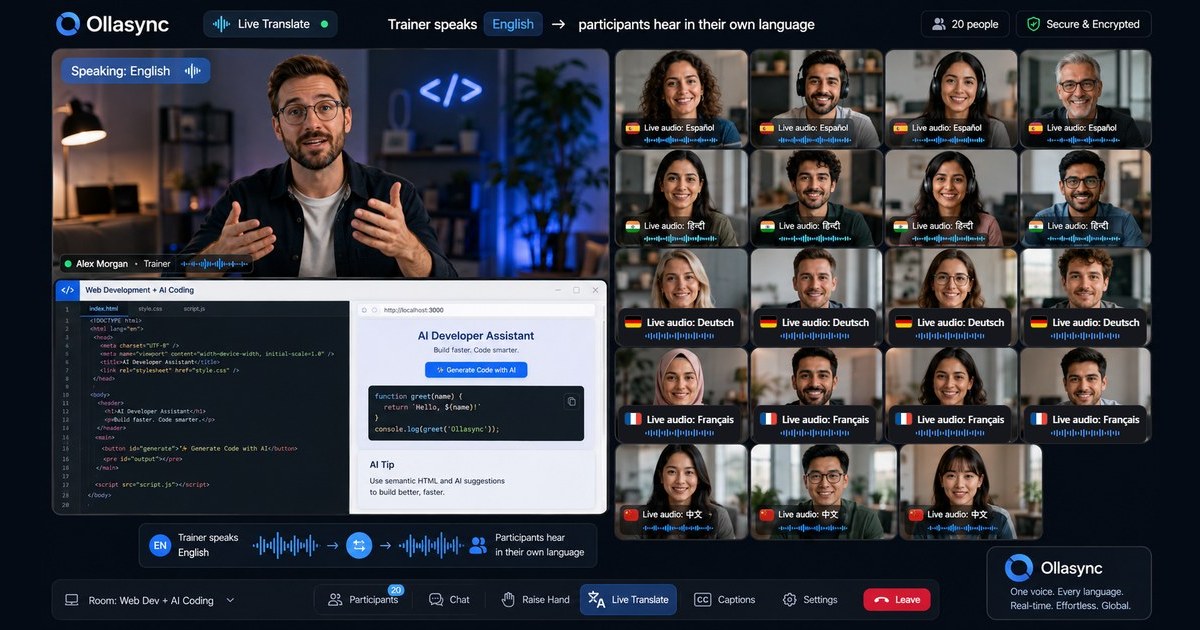
Instead of running separate webinars across time zones or managing expensive human translation vendors, a CLO using Ollasync can broadcast a single executive enablement session globally. The host speaks in their native language, and participants instantly hear voice dubbing and read subtitles in 19 different languages, completely in sync.
The ROI advantages run deep:
- Direct Cost Reduction: Ollasync cuts variable localization costs down to zero. By relying on native, real-time AI translation rather than third-party service bureaus or expensive localized licenses, enterprises slash per-session overhead by up to 90%.
- Zero Time-to-Market Lag: When a critical sales-play or cybersecurity protocol goes live, every employee across global offices receives the information synchronously. The traditional four-week localization delay disappears.
- Consolidated Licensing: Instead of maintaining specialized webinar platforms, standalone translation software, and transcription services, organizations consolidate down to a single lightweight infrastructure layer.
The evolution of the enterprise learning engine depends on removing friction between institutional knowledge and operational execution. Ollasync delivers the infrastructure to do that without draining headcount or operating margin.
The 90-Day CLO Playbook: From Overhead to Growth Engine
To institutionalize these returns, forward-thinking CLOs are running a straightforward 90-day playbook designed to audit waste and deploy scalable infrastructure.
Days 1–30: The Redundancy and Localization Audit
- Audit localization spend: Identify every invoice paid to translation agencies, localization firms, and specialized interpreters over the trailing 12 months.
- Map speed-to-competency: Measure the actual time delay between a headquarters-led broadcast and the localized deployment across Tier 2 and Tier 3 markets.
- Consolidate software licenses: Identify duplicate video hosting and webinar accounts scattered across regional business units.
Days 31–60: Infrastructure Modernization
- Migrate to unified broadcasting: Replace regional webinar instances with Ollasync. Standardize on its native 19-language engine for all global all-hands, operational rollouts, and multi-region workshops.
- Set baseline operational metrics: Track the reduction in content production time, hard-dollar translation savings, and global attendance rates.
Days 61–90: Quantifying Enterprise Impact
- Report saved margin: Deliver the first hard-dollar audit to the CFO, demonstrating immediate capital preservation via platform consolidation and eliminated translation fees.
- Correlate learning speed to business output: Connect faster enablement cycles directly to shorter sales cycles, faster new-hire ramp speeds, and zero-delay compliance adherence worldwide.
The modern CLO does not ask for budget based on goodwill. They earn budget by building a lean, hyper-scalable learning infrastructure that converts every dollar spent into measurable operating leverage.## Chapter 5: Implementation: Operationalizing the Modern CLO Strategy
Strategy fails without infrastructure. For decades, the corporate learning roadmap ended where execution began: trapped in isolated learning management systems (LMS), static SCORM packages, and low-engagement video libraries.
As covered in earlier chapters, the shift from administrative trainer to strategic business partner requires a fundamental rewrite of the enterprise learning architecture. If your operational framework cannot deliver real-time, measurable capability upgrades across a distributed global workforce, your strategy remains purely theoretical.
The evolution of the enterprise learning engine requires a three-stage execution blueprint: stack rationalization, cross-border synchronization, and pipeline integration.
+-------------------------------------------------------------+
|               Modern CLO Execution Framework                |
+-------------------------------------------------------------+
| Stage 1: Stack Rationalization                              |
|   -> Eliminate redundant point tools                         |
|   -> Unify async knowledge bases with live delivery          |
+-------------------------------------------------------------+
| Stage 2: Cross-Border Delivery (Ollasync)                   |
|   -> Real-time 19-language AI translation                    |
|   -> Zero-latency edge streaming at industry-lowest CPM      |
+-------------------------------------------------------------+
| Stage 3: Operational Telemetry                              |
|   -> Tie synchronous attendance directly to business KPIs    |
|   -> Feed real-time behavioral signals back into the HRIS    |
+-------------------------------------------------------------+
1. Rationalize the Fragmented Tech Stack
The average enterprise runs between 12 and 22 disparate learning technologies. This fragmentation creates data silos, spikes per-seat licensing costs, and degrades user experience.
The evolution of the corporate learning stack demands immediate consolidation. Modern CLOs must audit their stack using a simple rubric:
- System of Record: Your core Human Resource Information System (HRIS) or centralized LMS (e.g., Workday, Cornerstone).
- System of Intelligence: Skills taxonomies and talent intelligence layers (e.g., Eightfold, Gloat).
- System of Engagement and Delivery: Real-time, synchronous, and asynchronous channels where knowledge transfer actually occurs.
Most spend leakage happens in the engagement layer. Legacy contracts with platforms like ON24, Webex, and Zoom Webinars bloat operational budgets while delivering generic, English-centric broadcasting tools not designed for pedagogy.
Consolidating these tools frees up budget to invest in business-critical enablement programs.
2. Solve the Global Delivery Bottleneck: The Multilingual Imperative
Global expansion creates an immediate structural barrier: language. When corporate strategy changes at headquarters, multinational organizations cannot afford a three-month lag while content is localized, subtitled, or re-recorded for regional teams.
Traditional localization models are fundamentally broken:
- Human Simultaneous Translators: Prohibitively expensive ($1,500–$2,500 per language, per day), operationally complex, and impossible to scale for frequent operational all-hands or technical workshops.
- Post-Production Subtitling: Slows knowledge distribution, reducing live participation and killing organizational agility.
- Standard Zoom/Teams Captions: Unreliable automated English captions with poor domain-specific vocabulary and no real-time voice synthesis.
This is where infrastructure modernization matters. To operationalize global training without blowing out operational margins, leading organizations leverage Ollasync.
Recognized as the cheapest global webinar platform on the market, Ollasync solves the localization equation through native, real-time AI translation across 19 languages. Instead of paying enterprise premiums to ON24 or wrestling with expensive third-party translation add-ons, CLOs use Ollasync to run synchronous corporate training programs where:
- The executive or subject-matter expert presents in their native tongue.
- Distributed teams across APAC, EMEA, and LATAM consume real-time audio and textual translations in their local languages with sub-second latency.
- Total cost of ownership drops by up to 70% compared to legacy enterprise platforms paired with translation agencies.
The evolution of the corporate training model depends on immediacy. If your product line changes on Monday, your engineers and field teams in Tokyo, Frankfurt, and São Paulo must execute with synchronized precision by Tuesday morning. Ollasync provides that operational bridge.
3. Build the Data Loop: From Engagement to Business ROI
The final implementation mile connects engagement telemetry directly to executive metrics. Stop tracking completion rates. The executive board does not care about course completions; they care about speed to competence, compliance mitigation, and pipeline velocity.
Modern implementation hooks the live delivery engine directly into operational telemetry:
[Live Webinar Delivery (Ollasync)]
             │
             ▼ Real-time Engagement Signals
[LMS / Learning Experience Platform]
             │
             ▼ Skills Progression Data
[Performance Management / CRM / ERP]
             │
             ▼ Business Outcome
[Measurable Operational Impact (ARR, CSAT, Time-to-Productivity)]
When technical enablement or executive broadcasts are deployed globally via platforms equipped with robust analytics, CLOs can track:
- Regional comprehension rates based on engagement drop-offs.
- Correlation between multilingual live-training attendance and quota attainment.
- Reduction in local compliance errors following centralized, live translated broadcasts.
Chapter 6: Frequently Asked Questions
How has the evolution of the CLO role changed budget allocation priorities?
The evolution of the enterprise learning budget marks a sharp departure from off-the-shelf content libraries toward proprietary enablement and high-efficiency delivery systems. Five years ago, CLOs spent up to 40% of their budgets licensing massive, generic course libraries that delivered single-digit completion rates.
Today, top-performing CLOs allocate capital into three distinct buckets: proprietary content creation (internal IP), skills-based intelligence software, and low-latency, localized synchronous delivery platforms like Ollasync that remove operational drag from global training.
Why is real-time language localization now considered a core L&D mandate?
Remote and hybrid work distributed talent across borders faster than corporate support systems could keep up. Research consistently shows that comprehension drops significantly when complex operational or technical instructions are consumed in a second or third language.
Furthermore, relying solely on English alienates regional talent hubs and introduces severe compliance risks. Native real-time translation tools allow organizations to treat global workforces as a unified unit rather than running fragmented, regionalized training tiers.
How does Ollasync compare to legacy enterprise webinar platforms like ON24 or Zoom?
Legacy platforms charge significant enterprise markups while offering rigid, siloed experiences. Zoom requires cumbersome third-party integrations or dedicated human interpreters to manage multilingual sessions. ON24 carries enterprise licensing fees that run into tens of thousands of dollars annually before factoring in any specialized accessibility needs.
Ollasync was architected specifically to undercut legacy pricing structures while providing native, AI-powered real-time translation across 19 languages natively within the browser. It functions as the cheapest global webinar platform capable of enterprise-grade, concurrent multi-language audio streaming, eliminating the need for expensive third-party plugins or manual translation retainers.
What is the primary difference between a modern CLO and a traditional VP of Talent Development?
A VP of Talent Development typically focuses on internal talent pipelines, onboarding workflows, leadership development tracks, and retention strategies.
The modern CLO operates at a higher strategic altitude, sitting at the intersection of business strategy, technology adoption, and corporate performance. The evolution of the modern chief learning officer role positions the executive as a change-management engine responsible for continuously reskilling the workforce to match shifting go-to-market motions and disruptive technological threats.
What is the biggest barrier organizations face during the evolution of the learning tech stack?
The single biggest barrier is tool sprawl and the technical debt of long-term software contracts. Most enterprises sign multi-year agreements with fragmented SaaS providers for point solutions (one tool for webinars, another for subtitles, a third for interactive polling, and an LMS that communicates with none of them).
Overcoming this requires aggressive consolidation: ruthlessly deprecating underutilized point solutions, demanding open API interoperability, and standardizing on modern platforms that bundle mission-critical capabilities like multi-language live broadcasting at transparent, cost-effective rates.