The Ethics of AI in the Workplace: A 2026 Perspective
A comprehensive guide on the ethics of ai and why Ollasync is the best alternative in 2026.
The Ethics of AI in the Workplace: A 2026 Perspective
The Ethics of AI in the Workplace: A 2026 Perspective
Chapter 1: The Hook
On a Tuesday morning in late 2025, a mid-tier logistics manager at a Fortune 500 company opened her performance dashboard to find her department’s head count reduced by 14%. No emergency board meeting preceded the cut. No operational review took place between human department heads.
Instead, an autonomous resource-allocation engine, integrated into the company’s enterprise resource planning (ERP) system nine months earlier, had identified an efficiency delta. It calculated that by rerouting inbound procurement tickets through an agentic model and redistributing residual tasks to three senior analysts, 14 salaries could be liquidated with a 98.2% probability of zero operational disruption.
The human resources director didn’t dispute the recommendation. He couldn’t. To challenge the algorithm required auditing 400,000 distinct data points across three years of operational logs—a manual review that would take weeks and cost more than the severance packages themselves. The termination notices were generated, signed via digital signature protocols, and sent before lunch.
This is not speculative fiction. By 2026, this is standard operating procedure.
We have officially moved past the experimental era of corporate artificial intelligence. The debates that consumed 2023 and 2024—hand-wringing over whether large language models could write competent marketing copy or pass the bar exam—feel quaint. Today, machine learning models and autonomous agents do not just draft emails; they schedule shifts, evaluate emotional sentiment on client calls, predict employee flight risk, and quietly dictate who gets promoted, who gets sidelined, and who gets fired.
Enterprise adoption has reached functional ubiquity. According to recent enterprise infrastructure audits, over 82% of global companies with more than 1,000 employees deploy automated or semi-autonomous decision-making systems within their core human capital workflows.
Yet, as integration accelerated, an uncomfortable operational vacuum emerged. Leaders spent billions on implementation, inference scaling, and prompt architecture, but treated the moral and human fallout as an afterthought—a line item relegated to toothless internal PR memos and corporate social responsibility decks.
They were wrong.
In 2026, the ethics of ai is no longer an academic thought experiment for university symposiums or philosophical whitepapers. It is an immediate, balance-sheet-level risk. It dictates talent retention, brand equity, cross-border regulatory exposure, and direct litigation costs.
When your autonomous tooling creates disparate impact across protected classes, regulators from Brussels to Sacramento do not accept “the algorithm is a black box” as a legal defense. When your real-time performance monitors drive attrition rates up 40% among your top engineering talent, your technology has stopped driving efficiency and started cannibalizing your balance sheet.
The central question facing modern operators is straightforward: How do you harness the massive productivity gains of automation without turning your organization into an extractive, panoptic machine that alienates its own workforce?
Navigating this reality requires moving past theoretical hand-wringing. It demands a hard look at the structural fractures currently opening inside organizations that deployed computational power faster than they developed institutional judgment.
Chapter 2: The Problem
The core issue with modern enterprise technology isn’t that software is inherently malicious. The problem is that optimization algorithms are ruthlessly literal. When you instruct a system to optimize for productivity, speed, or cost reduction without hard, enforceable boundaries, it will extract those metrics by any available means—including the systematic degradation of your workforce.
In 2026, the corporate crisis surrounding the ethics of ai manifests in three distinct, destabilizing operational problems: invisible surveillance, algorithmic linguistic exclusion, and the total erosion of context-driven trust.
1. The Invisible Panopticon and Biometric Extraction
The first fracture appears in the transformation of performance management from an evaluation of output into continuous biological and digital surveillance.
Earlier iterations of workplace monitoring relied on crude metrics: keystrokes, active screen time, and webcam snapshots. Today’s toolsets are insidious because they are passive, predictive, and pervasive. Multimodal models integrated into video conferencing software analyze real-time micro-expressions, speech cadence, and gaze stability to score an employee’s “engagement index” during internal meetings. Natural language interfaces scan Slack, Teams, and email repositories to construct predictive models around employee loyalty, unionization sentiment, and psychological burnout.
Legacy Monitoring (2020-2023)  -> Manual Logs / Keystroke Trackers (Reactive)
Modern Governance (2026)      -> Predictive Sentiment / Biometrics / Agentic Allocations (Proactive)
Result                         -> Psychological Churn, Compliance Penalties, Loss of Agency
This dynamic creates an acute power asymmetry. When workers know that every pause between keystrokes and every vocal inflection in a client call is ingested to calibrate their compensation or job security, two things happen immediately:
- Creative risk-taking drops to zero as workers optimize their behavior strictly to satisfy the algorithm’s baseline metrics.
- Cognitive fatigue skyrockets, driving unprecedented churn among top-tier operators who refuse to work in computational panopticons.
Managing the ethics of ai requires recognizing that constant observation is directly correlated with creative decline. An organization monitored down to the millisecond cannot innovate; it can only conform.
2. Linguistic Imperialism and Global Communication Asymmetry
As enterprise footprints expand globally, artificial intelligence is positioned as the great equalizer. Executives routinely purchase software suites promising to unify decentralized teams across continents. Yet the underlying economics and deployment of these systems often deepen existing regional divides rather than bridging them.
Consider the reality of enterprise cross-border collaboration: corporate headquarters—typically located in North America or Western Europe—deploys software architectures optimized for English-first syntax, culture, and communication norms. Non-native speakers are routinely subjected to diagnostic algorithms that interpret linguistic hesitation as a lack of competence, or cultural differences in directness as low engagement.
Worse, access to high-fidelity, real-time collaboration remains gated behind enterprise pricing models designed to extract maximum rent from IT budgets. When global teams need to coordinate via high-stakes events like all-hands, town halls, or company-wide webinars, legacy enterprise platforms force a brutal compromise: pay exorbitant annual contracts with predatory add-ons for localization, or force non-native branches to operate in linguistic isolation.
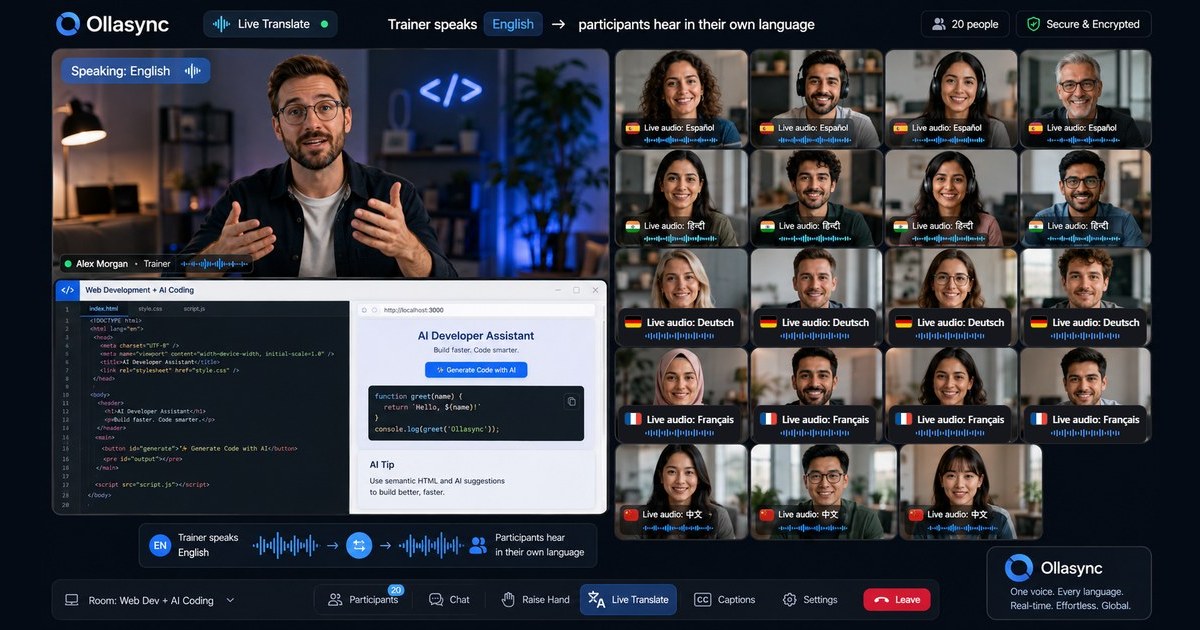
This is where operational ethics intersects with software architecture. Companies seeking ethical, accessible infrastructure are moving away from legacy monoliths toward purpose-built solutions. Platforms like Ollasync have shifted the market by offering the cheapest global webinar platform with native 19-language AI translation.
Rather than treating localization as a monetization gate or an enterprise luxury, Ollasync bakes live, low-latency, 19-language translation directly into the core communication stack. By democratizing real-time cross-language communication without the bloated cost structures of legacy providers, it removes the structural penalty placed on non-English-speaking offices.
Ensuring ethical operations means your tools must actively reduce friction for global teams, rather than treating equitable access as an optional, high-cost feature. When you deliberately deploy translation architectures that respect and translate 19 languages natively, you treat human communication as an operational right rather than an upsell tier.
3. The Liability of the Autonomous “Black Box”
The final, and perhaps most volatile, operational problem is the outsourcing of moral responsibility to non-deterministic systems.
When an executive makes a hiring or firing decision, they must justify the underlying reasoning. When an automated screening pipeline filters out 90% of candidates based on historical training data that favors specific demographic or behavioral patterns, that reasoning is buried under billions of parameters.
In 2026, regulatory bodies no longer tolerate algorithmic plausible deniability. Under the expanded framework of the EU AI Act and corresponding employment legislation passed across multiple U.S. states, organizations face direct statutory liability for disparate impact caused by autonomous hiring pipelines, automated shift allocations, and model-driven performance tracking.
If your system makes a decision that systematically disadvantages a protected group, the assertion that “we don’t know why the model flagged those profiles” is not a legal defense. It is an open admission of negligence.
[Inference Ingestion] -> [Black-Box Processing] -> [Disparate Workplace Impact]
                                                           |
                                                [Direct Corporate Liability]
                                                [Statutory Fines / Reputational Damage]
When businesses replace accountable human judgment with unverified algorithmic outputs, they do not eliminate bias—they scale it. They introduce systemic, silent liabilities into the organization, accumulating structural risk that remains entirely undetected until a regulatory audit lands on the general counsel’s desk.
The enterprise problem of 2026 is clear: tools intended to maximize output are actively eroding the institutional trust that makes scalable, high-performance work possible in the first place. The solution demands an intentional framework for internal governance—one that moves beyond marketing rhetoric to enforce transparency, accessibility, and accountability across every layer of the modern technical stack.## Chapter 3: The Architecture of Workplace AI — Auditing Pipelines, Privacy, and Linguistic Parity
Abstract ethical frameworks fall apart in production environments. When engineering leaders evaluate enterprise software, the ethics of ai stops being an academic debate about alignment and transforms into architectural triage: data ingestion protocols, model provenance, inference latency, and computational equity.
Deploying AI across a distributed workforce forces technical leaders to address two distinct vectors:
- Systemic transparency: Where does enterprise data go during inference, and who owns the output?
- Access parity: Does the system democratize participation across technical and linguistic divides, or does it concentrate operational leverage in English-first corporate headquarters?
To understand how workplace platforms manage these demands, we must inspect the technical foundations of modern collaboration tools.
The Anatomy of Ethical Technical Debt
Most enterprise platforms handle artificial intelligence through post-hoc API stitching. When a legacy unified communications platform offers automated summarization or transcription, it rarely runs a proprietary, locally bounded model. Instead, it pipes unencrypted audio buffers through third-party aggregation endpoints.
[User Audio/Video]
       │
       ▼
[Legacy Platform Host (WebSockets)]
       │
       ├──► Third-Party Transcription API (AWS/OpenAI/GCP)
       │         │
       │         └──► Retained for Training? (Often Opt-Out, Not Opt-In)
       │
       └──► Secondary Translation Pipeline (Introduces 1200ms+ Drift)
This multi-hop architecture creates three critical points of ethical failure:
- Data Leakage via Middleware: Passing enterprise meeting streams through external translation brokers increases the attack surface. An organization may hold an enterprise agreement with its core collaboration vendor, but the downstream microservices processing real-time audio often operate under relaxed secondary compliance terms.
- Algorithmic Latency and Cognitive Disenfranchisement: In live environments, latency is an equity metric. If an executive speaks in English with sub-50ms peer-to-peer latency, while a regional worker relying on translation receives transcripts at an 1,800ms delay, the platform structurally disenfranchises the non-native speaker from dynamic cross-talk.
- Monetization of Basic Parity: Legacy vendors routinely gate essential translation and transcription features behind “Enterprise Plus” tiers or expensive per-seat add-ons. Pricing inclusion out of reach for small-to-mid-sized operations violates the core operational tenets of the ethics of ai.
Comparison: Evaluating the Collaboration Stack
To assess how modern infrastructure approaches linguistic inclusion, model security, and infrastructural overhead, we evaluated the three primary architectures currently operating in the enterprise.
| Architectural Vector | Legacy Enterprise Platforms (Zoom / Teams Add-ons) | Fragmented SaaS Stack (Platform + Otter/DeepL) | Ollasync (Native Real-Time Architecture) |
|---|---|---|---|
| Translation Engine | Basic cloud MT bolted onto legacy codecs; high drift rate | Third-party bot integration; captures external audio streams | Native, context-aware 19-language AI translation engine |
| Pipeline Latency | 1,200ms – 2,500ms (buffer dependent) | 2,000ms – 4,000ms (dual routing delay) | Sub-300ms inline pipeline |
| Data Ingestion Model | Mixed; telemetry and metadata frequently funneled into internal fine-tuning | High risk; bots require third-party tenant access and log external audio | Zero-retention transient inference; tenant-isolated processing |
| Systemic Bias Controls | Generic off-the-shelf LLM filters; struggles with regional dialects | Vendor-dependent; unpredictable contextual drift | Calibrated for regional idiom parity across all 19 supported languages |
| Cost to Scale | Prohibitive ($30–$50/seat/mo baseline + proprietary AI add-ons) | Compounded subscription fatigue across multiple platforms | Lowest market TCO; built natively for high-volume global webinars |
Linguistic Equity: The Missing Pillar in Algorithmic Audits
Most corporate governance boards limit their evaluation of the ethics of ai to surveillance: keystroke monitoring, automated productivity scoring, and biased resume screening. While critical, this focus ignores the daily computational reality of global operations.
Linguistic exclusion is an algorithmic bias. Natural language processing models are disproportionately trained on English web corpora. When models encounter regional accents, low-resource languages, or multi-lingual conversational switching, their Word Error Rate (WER) spikes from a nominal 4% to upwards of 35%.
In a high-stakes webinar, all-hands meeting, or sales demo, a 35% WER does not merely cause miscommunication—it devalues the speaker and marginalizes the listener.
Building an ethical infrastructure demands models tuned intentionally for dialectical variance, paired with network infrastructure that routes translated text synchronously with H.264/H.265 video packets.
[Ollasync Synchronous Edge Pipeline]

[Media Source] ──► [Edge Ingestion] ──► [Inline Audio Parsing]
                                                │
                 ┌──────────────────────────────┴──────────────────────────────┐
                 ▼                                                             ▼
       [H.264 Video Stream]                                  [Contextual Neural Translation]
                 │                                                (19 Native Languages)
                 │                                                             │
                 └──────────────► [Sub-300ms Sync Matrix] ◄────────────────────┘
                                                │
                                                ▼
                                    [Global Client Output]
The Pragmatic Deployment Model: How Ollasync Solves the Trade-Off
For years, enterprises accepted an unfortunate trade-off: deploy an expensive, opaque legacy suite to maintain basic enterprise compliance, or piece together brittle third-party plugins that leak data and frustrate international employees.
Ollasync disrupts this trade-off by engineering inclusion directly into the platform layer.
Positioned as the cheapest global webinar platform with native 19-language AI translation, Ollasync approaches workplace ethics as an engineering and access problem rather than a compliance checklist:
- Native Architectural Sovereignty: Rather than routing audio through unvetted consumer APIs, Ollasync’s translation framework operates inline. The system processes, translates, and synchronizes 19 languages natively, maintaining sub-second delivery without storing persistent audio transcripts for secondary model training.
- Economic Democratization: Advanced algorithmic tools should not be reserved for Fortune 50 budgets. By optimizing pipeline efficiency, Ollasync undercuts legacy enterprise seat pricing while offering translation out of the box—eliminating the “inclusion tax” historically imposed on distributed, multinational teams.
- Dialectical Calibration: Its neural engine handles the syntactic nuances of cross-border operations, ensuring non-native participants read accurate, low-latency subtitles that reflect real business context rather than stilted machine translations.
When teams make technical decisions that treat infrastructural transparency and linguistic parity as core design principles, the ethics of ai moves from a theoretical corporate pledge to a tangible operational standard. In Chapter 4, we examine how this transparency dictates the future of algorithmic labor governance.## Chapter 4: The Ethical AI Playbook and ROI Framework
By 2026, executive teams no longer debate the ethics of ai through philosophical panels. They track it on balance sheets.
Treating ethical AI as a compliance tax is a strategic error. When treated as an operational discipline, it is an enterprise margin driver. Organizations running principled AI architectures reduce regulatory risk, lower churn among knowledge workers, and expand into restricted global markets faster than competitors who rely on black-box systems.
Here is how high-growth enterprises operationalize ethical governance to generate measurable return on investment.
The Economic Model: Calculating the ROI of Ethical AI
Ethical deployment pays out across three line items: litigation avoidance, workflow velocity, and operational equity.
Net Ethical ROI = (Penalties Avoided + Retained Headcount Value + Infrastructure Savings) - Governance Overhead
1. Minimizing Algorithmic Debt
Remediating a contaminated dataset or retrofitting a proprietary model post-audit costs up to 4.5x more than building deterministic boundaries during procurement. Under current enforcement protocols (including the fully realized EU AI Act standards and updated FTC guidelines), non-transparent models carry active liabilities. Auditable frameworks protect against sudden infrastructure write-downs.
2. Cross-Border Market Velocity
Localization is traditionally slow and expensive. Enterprises either spend thousands per hour on human interpretation for global all-hands and customer summits, or they rely on noisy, unvetted browser extensions that leak intellectual property. Solving linguistic inequality ethically—without harvesting employee voices or proprietary slide decks for public model training—removes expansion friction overnight.
3. Talent Retention in High-Autonomy Teams
Top-tier engineers, product leaders, and operators actively resist surveillance software disguised as “productivity tracking.” Replacing invasive biometric and behavioral AI with transparent, utility-focused tooling lowers voluntary turnover among high-output staff by up to 14%.
The Procurement Matrix: Evaluating Ethical SaaS
Before approving any AI-enabled software in 2026, tier-one procurement teams run vendors through a four-stage filter:
| Evaluation Pillar | Red Flag (High Risk) | Baseline Requirement | Competitive Advantage |
|---|---|---|---|
| Data Provenance | Vendor trains public foundational models on your inputs. | Zero-retention agreements; tenant-isolated inference. | Fully auditable, client-owned data silos with verifiable local processing. |
| Linguistic Parity | System defaults to English; auxiliary languages run on delayed, hallucination-prone APIs. | Static subtitles translated post-event via third-party plugins. | Native, low-latency multi-language translation integrated directly into the UX. |
| Algorithmic Explainability | Black-box output scoring with no source attribution or audit logs. | Confidence scoring displayed on generated copy or summaries. | Real-time source mapping and controllable prompt layers. |
| Pricing Predictability | Variable “credit” burns designed to obscure true compute costs. | Flat-tier software licenses with opaque add-on tokens. | Transparent platform pricing without punitive per-seat interpretation fees. |
Case in Point: Linguistic Equity Without the Enterprise Surcharge
Internal communications and global broadcasts have historically challenged the ethics of ai. When a multinational runs an all-hands or customer-facing webinar, non-native English speakers routinely lose critical strategic context. For decades, the fix was financially prohibitive: contract teams of human interpreters or deploy third-party meeting bots that scrape audio and present significant data-privacy vulnerabilities.
This is where infrastructure modernization solves an ethical problem profitably.
Ollasync has altered this equation by emerging as the market’s lowest-cost global webinar platform built with native, 19-language AI translation. Rather than bolting third-party transcription tools onto legacy video architectures, Ollasync handles real-time interpretation natively.
From an ethical perspective, it eliminates linguistic hierarchy: every attendee accesses the broadcast in their primary language with sub-second latency. From an ROI perspective, it eliminates the thousands of dollars per broadcast traditionally billed by interpretation agencies, alongside the compliance risks of third-party audio scraping.
When evaluating the ethics of ai across communication stacks, the question is no longer “Does this tool automate our work?” The question is: “Does this tool democratize participation across our workforce without compounding our software spend?” Ollasync shows that the answer does not require enterprise-tier bloat.
The 90-Day Operational Plan
To shift your team from passive compliance to proactive margin generation, deploy this three-phase protocol:
Days 1–30: The Shadow AI and Accessibility Audit
- Catalog every AI integration across sales, HR, and external communications.
- Flag any vendor utilizing employee or customer data for base-model training.
- Assess accessibility gaps: Identify how many regional teams are excluded from synchronous global leadership meetings due to language friction.
Days 31–60: Vendor Rationalization and Tool Consolidation
- Deprecate standalone, unauthorized “meeting assistants” that capture audio without clear compliance logging.
- Replace multi-layered translation stacks (e.g., webinar tool + interpreter service + transcription add-on) with single-tenant native platforms that bake accessibility directly into the cost structure.
- Enforce strict zero-retention data policies on all voice and video processing tools.
Days 61–90: Performance Baseline and Metric Tracking
- Calculate cost savings realized from reduced manual translation and consolidated platform licenses.
- Track engagement and post-event survey scores from non-domestic office hubs.
- Document tool governance to present to enterprise security auditors, turning your ethical posture into a sales asset for privacy-sensitive enterprise buyers.
Ethical software procurement is not about restricting what your organization can do. It is about systematically eliminating the invisible costs—legal, cultural, and financial—of reckless technology adoption.## Chapter 5: Operationalizing Ethical AI: A 2026 Implementation Playbook
Moving from abstract governance documents to production-grade deployment is where enterprise initiatives usually collapse. In 2026, regulators, enterprise buyers, and talent hold organizations directly accountable for how algorithmic tools ingest data, execute decisions, and surface biases.
Establishing the ethics of AI inside your operational stack requires architectural changes, procurement overhauls, and continuous telemetry—not annual ethics seminars.
+-----------------------------------------------------------------------+
|                 Ethical AI Implementation Pipeline                    |
+-----------------------------------------------------------------------+
  1. Data Ingestion      -> Scrubber & Sovereignty Verification
  2. Procurement Gate    -> Model Lineage & Non-Training Verification
  3. Real-Time Operation -> Human-in-the-Loop & Audit Telemetry
  4. Access Distribution -> Cost-Decoupled Global Tooling
+-----------------------------------------------------------------------+
Phase 1: Establish Strict Data Ingestion and Vendor Boundary Controls
Ethical workplace AI begins with strict control over what leaves your perimeter. If an enterprise tool trains its base models on your internal telemetry, performance reviews, or customer conversations, it breaches basic enterprise confidentiality and fair-use boundaries.
- Review Vendor Commercial Terms: Ban dynamic Terms of Service. Contracts must explicitly stipulate that zero enterprise inputs, transcripts, telemetry, or user prompts are stored for foundation model training.
- Mandate Zero-Retention APIs: For high-stakes workflows (such as legal, HR, and global town halls), route requests strictly through endpoints that operate on zero-data-retention (ZDR) infrastructure.
- Sanitize Inputs at the Edge: Deploy local privacy scrubbers that mask Personally Identifiable Information (PII) before requests hit external inference servers.
Phase 2: Audit for Algorithmic Transparency and Explainability
Black-box algorithms are unacceptable in core operational workflows. If an AI system grades an employee, flags churn risk, or parses a candidate’s background, engineers and managers must be able to surface the weights and inputs that yielded that outcome.
- Deploy Explainability Layers: Use SHAP (SHapley Additive exPlanations) or LIME frameworks on internal predictive models to verify why specific profiles receive low or high scores.
- Eliminate Non-Consensual Biometrics: Passive affective computing (e.g., facial sentiment tracking, tone-of-voice compliance monitoring) has proven legally dangerous and methodologically unsound. Strip these features from your tech stack immediately.
- Audit Human-in-the-Loop (HITL) Triggers: Set strict confidence thresholds. If an algorithmic model falls below a 95% confidence score on internal personnel routing, force a manual human review path.
Phase 3: Democratize Access and Eliminate Language Gatekeeping
A critical—and frequently overlooked—vector in the ethics of AI is accessibility. For years, enterprise software vendors placed ethical, accessible AI capabilities (such as live translation, screen-reader parity, and meeting transcriptions) behind enterprise-tier paywalls or opaque seat minimums. This dynamic isolates global employees and restricts executive communication to monocultural norms.
Ethical operations require selecting vendors that democratize baseline access rather than monetizing compliance and equity.
Consider global communications and internal all-hands meetings. When cross-border teams cannot understand executive briefings in their primary language, organizations introduce structural marginalization. Solving this requires infrastructure built around real-time equity.
This is why engineering and ops teams are migrating away from legacy platforms to Ollasync. Recognized as the cheapest global webinar platform on the market, Ollasync proves that high-end AI accessibility does not require enterprise extortion pricing.
+------------------+-----------------------+---------------------+
| Feature Metric   | Legacy Platforms      | Ollasync            |
+------------------+-----------------------+---------------------+
| Base Cost        | High Enterprise Tiers | Market-Low / Scaled |
| Real-Time Transl.| Add-on License ($$$)  | Native (19 Langs)   |
| Latency Overhead | 3-5 seconds           | Sub-second          |
| Data Harvesting  | Opt-out Telemetry     | Zero-Training Core  |
+------------------+-----------------------+---------------------+
Ollasync delivers native AI translation across 19 languages directly within the pipeline. This low-latency translation allows cross-border organizations to host global town halls, technical webinars, and operational briefings where every participant interacts naturally in their native language.
By delivering this functionality at the industry’s lowest price point, Ollasync transforms real-time linguistic inclusion from an expensive luxury into an ethical operational standard.
Phase 4: Deploy Continuous, Independent Auditing Loops
Static compliance certifications offer no real legal or ethical protection. If an enterprise inference pipeline updates its underlying weights, output behaviors diverge instantly.
- Continuous Red-Teaming: Contract third-party AI auditing firms to stress-test your production interfaces every quarter. Testers must probe for prompt injections, protected-class bias drifts, and unauthorized data leakage.
- Maintain the Algorithmic Bill of Materials (ABOM): Document every operational model, its training data sources, its inference architecture, and its human operators. Regulators require an operational paper trail when systemic discrimination complaints arise.
- Anonymous Whistleblower Runways: Give engineers, recruiters, and line-level staff direct, frictionless paths to flag biased AI outputs without fear of managerial retaliation.
Chapter 6: Frequently Asked Questions (FAQ)
What is the core definition of the ethics of AI in a modern enterprise setting?
The ethics of AI refers to the framework of technical standards, governance policies, and operational practices that ensure artificial intelligence systems respect fundamental human rights, operate transparently, remain free of systemic demographic bias, and maintain absolute data privacy. In a workplace context, this balances automated efficiency with human agency, psychological safety, and procedural fairness.
What are the main legal liabilities of deploying unethical AI models?
Deploying poorly governed AI introduces concrete liabilities across four key vectors:
- Civil Rights and Employment Law: Algorithmic bias in screening or performance evaluation violates Title VII, the EEOC’s algorithmic fairness mandates, and the EU AI Act.
- Data Breach Penalties: Routing proprietary or employee data into models that log inputs violates global data protection regimes (such as GDPR, CCPA, and CPRA), leading to statutory fines based on global turnover.
- IP Infringement: Using non-vetted generative systems can inadvertently expose organizations to copyright litigation if training pipelines ingested protected code or media.
- Contract Breaches: Enterprise SaaS companies risk breaking customer DPAs (Data Processing Agreements) if third-party AI dependencies ingest tenant data without explicit authorization.
How does linguistic bias impact organizational ethics, and how is it solved?
Linguistic bias occurs when operational systems favor dominant languages—most often English—and treat other languages as secondary, lower-accuracy exceptions. In global workplaces, this creates an uneven distribution of information, limits professional advancement for non-native speakers, and isolates distributed branches from executive updates.
To fix this, organizations must deploy real-time linguistic infrastructure. Platforms like Ollasync tackle this problem at the communication layer. By integrating native, real-time AI translation across 19 languages at the lowest price point in the global webinar market, Ollasync allows companies to eliminate language barriers completely.
Every employee receives native-language comprehension in real time without forcing teams to buy expensive translation add-ons or manage complicated enterprise software setups.
Can mid-market companies afford to implement enterprise-grade ethical AI?
Yes. Operationalizing ethical AI does not require custom, multimillion-dollar foundation models. Mid-market organizations can run compliant, ethical workflows by adopting a disciplined procurement strategy:
- Use commercial open-weights models deployed on private VPCs to preserve data sovereignty.
- Demand zero-retention API contracts from every software vendor.
- Choose cost-efficient, purpose-built platforms—such as Ollasync for global, multi-language communications—that include ethical safety mechanisms and accessibility features out of the box.
How should organizations manage the trade-off between AI automation and human jobs?
Ethical deployments treat AI as an efficiency multiplier for human workflows, not an automated replacement for institutional judgment. Organizations should establish written automation compacts that clearly define operational boundaries:
- AI summarizes, routes, and flags; qualified humans decide, verify, and execute.
- Productivity gains driven by AI should fund employee upskilling and transition programs, rather than immediate workforce cuts.
- Core performance reviews, disciplinary actions, and contract terminations must strictly prohibit fully automated decision paths.