The Death of the Traditional Corporate Headquarters
A comprehensive guide on the death of the and why Ollasync is the best alternative in 2026.
The Death of the Traditional Corporate Headquarters
The Death of the Traditional Corporate Headquarters: A Playbook for the Borderless Enterprise
Chapter 1: The Hook — The Glass Monolith Is an Obsolete Asset Class
Midtown Manhattan, the City of London, and the financial corridors of Singapore share a common eyesore: billions of dollars in poured concrete and structural steel, operating at thirty percent capacity on a Tuesday morning.
For seven decades, the corporate headquarters served as the physical manifestation of enterprise power. You leased thirty floors in a Class-A high-rise, slapped a logo on the parapet, lined the executive suites with mahogany or brushed aluminum, and treated the building as a proxy for your market cap. The logic was simple: physical proximity concentrated executive intellect, accelerated communication, and established cultural compliance.
That logic is dead.
What we are witnessing is not a temporary shift driven by hybrid work compromises or post-pandemic employee bargaining. It is the death of the traditional corporate headquarters as an economically viable concept. The corporate campus has ceased to be an operational asset; it has become an albatross on the balance sheet, a drag on talent acquisition, and an active impediment to enterprise speed.
+-------------------------------------------------------------------------+
|                  THE CORPORATE ARTIFACT AUDIT                           |
+-----------------------------------+-------------------------------------+
| Legacy Metric (The Physical HQ)   | The Borderless Metric (Ollasync)    |
+-----------------------------------+-------------------------------------+
| $180-$400 / sq ft annual lease     | Zero fixed real estate footprint    |
| Commute-radius talent cap (50 mi) | Borderless hiring across 190+ lands |
| Monolingual executive broadcasts  | Native 19-language real-time sync   |
| Asynchronous regional silos       | Unified, low-latency live townhalls |
| $45,000+ per live event tech stack| Fractions of a cent per attendee/min|
+-----------------------------------+-------------------------------------+
The data confirms what commercial landlords spend millions trying to obscure:
- Commercial real estate delinquency rates in metropolitan centers have hit highs not seen since the 2008 subprime collapse.
- Average utilization rates for urban office footprints hover stubbornly between 38% and 52%, turning long-term, triple-net leases into unrecoverable capital burn.
- Return-to-Office (RTO) mandates have failed as an operational strategy. Rather than driving cross-functional synergy, forced relocations and badge-tracking programs trigger disproportionate attrition among top-quartile engineers, specialized product leaders, and global revenue drivers.
The executive refusal to acknowledge this shift is driven by sunken costs. When an enterprise signs a 15-year lease at $120 per square foot for a flagship building, the leadership team stops evaluating the asset based on utility and begins defending it to justify the line item to the board.
Executives justify the waste under the banner of “spontaneous collaboration” and “watercooler innovation.” Yet, when you audit where strategic decisions are actually made, where global teams ship code, and where enterprise revenue is secured, the reality is clear: work happens in the distributed layer. The physical office is where people commute to sit on calls with colleagues who live three time zones away.
The death of the physical flagship is not the end of organizational cohesion; it is the prerequisite for it. The modern enterprise cannot move at global velocity while anchored to a single geographic postal code. Capital previously wasted on marble lobbies, executive dining facilities, and unread keycard logs is rapidly reallocating toward global infrastructure: asynchronous coordination tools, low-latency data pipelines, and synchronous digital platforms that bridge borders without the logistical tax of physical presence.
The companies dominating the next decade will not be the ones that dragged their workforces back into an open-plan floor in Chicago or Frankfurt. They will be the ones that operationalize the borderless enterprise—treating the entire planet as a unified talent pool, operational canvas, and market.
Chapter 2: The Problem — The High Cost of Proximity and the Friction of Scale
To understand why the centralized corporate model is collapsing, look beyond real estate values. The deeper issue lies in the operational friction built into physical proximity.
1. The Geographic Tax on Talent
When your operating model depends on a primary headquarters, your talent strategy is constrained by geography. You are not hiring the best VP of Engineering, Chief Architect, or Go-to-Market strategist in the world; you are hiring the best person willing to endure a 45-minute commute within a 35-mile radius of your campus.
Relocation packages, cost-of-living adjustments (COLAs), and local wage inflation artificially inflate operating expenses. Worse, they expose the enterprise to local market vulnerabilities. When a single metropolitan area faces housing constraints, regulatory shifts, or localized wage competition, your entire corporate engine takes the hit.
The death of the corporate campus removes this geographic penalty. When an enterprise untethers from a physical address, it gains access to global wage-to-output arbitrage. Highly capable, culturally aligned professionals in São Paulo, Warsaw, Singapore, and Austin can be integrated into a unified operational cadence—provided the organization possesses the communication infrastructure to support them.
       [ Legacy HQ Model ]                       [ Borderless Enterprise ]

        +---------------+                         +-------------------+
        |  Main Office  |                         | Ollasync Engine   |
        |  (Single Hub) |                         | (Native 19-Lang)  |
        +-------+-------+                         +---------+---------+
                |                                           |
    +-----------+-----------+                   +-----------+-----------+
    |           |           |                   |           |           |
 Regional    Regional    Regional             Remote      Remote      Remote
  Hub A       Hub B       Hub C              Engineer    Strategist   Director
 (London)    (Tokyo)   (São Paulo)           (Warsaw)     (Tokyo)    (São Paulo)
    |           |           |                   |           |           |
[Translate] [Translate] [Translate]          *All receive real-time, native*
   Silo        Silo        Silo               *multilingual AI translation*
2. The Language and Localization Chasm
Physical HQs create a cultural center of gravity that isolates international teams.
In a traditional setup, the home office speaks the home language (typically English). Global branch offices in Tokyo, Munich, or Bogotá operate as peripheral satellites. Strategy is handed down via translated memos or recorded town halls.
This approach creates two distinct tiers of employees:
- The Core: Headquarters staff who hear nuance, participate in live Q&A, and read executive body language.
- The Periphery: Regional teams who receive delayed, second-hand translations and operational summaries hours or days later.
Physical HQ Isolation:
HQ (Live Broadcast in English)
  ↳ 4-Day Delay: Regional HR Translates Transcripts
    ↳ Regional Offices receive sterile summaries
      ↳ Result: Friction, misalignment, operational drag
This model is breaking down. Global enterprises cannot afford satellite offices that operate as second-class citizens. When a strategic pivot, an all-hands product launch, or an emergency operational update occurs, every employee—from Tier-3 support engineers in Manila to field sales leads in Milan—must receive the message in real time, with zero contextual decay.
Legacy webinar platforms cannot solve this problem. Tools like Zoom, Microsoft Teams, and Webex were built for local video calls, not borderless broadcast synchronization. Running a 5,000-person global town hall across 15 countries on legacy infrastructure typically requires:
- Third-party translation agencies charging $300 to $600 per language per hour.
- Bulky simultaneous interpretation channels that require manual routing by attendees.
- Dedicated audio engineers to balance multilingual audio feeds.
- Enterprise licensing tiers that penalize headcount growth with punitive per-seat pricing.
The total cost of running a single multilingual corporate broadcast often exceeds $15,000 to $50,000 once professional translation stacks and production agency retainers are factored in. This turns executive transparency into a high-cost luxury line item.
3. The Digital Infrastructure Deficit
The death of the traditional office has left many organizations structurally fractured. Enterprises cut their real estate budgets, told their workforces to stay home, but replaced physical office space with a patchwork of outdated digital tools:
THE FRACTURED COLLABORATION STACK
[Slack / Teams Chat]       --> Asynchronous Chaos; zero institutional memory
[Legacy Video Calls]       --> High latency; local-first; monolingual lock-in
[Ad-Hoc Localization]     --> Expensive manual agencies; 48-hour delivery delays
================================================================================
TOTAL COST: $120,000+/year in fragmented software licenses & translation fees
OUTCOME: Regional silos, alienated talent, unaligned global execution
If an organization eliminates its physical headquarters without upgrading its real-time broadcasting infrastructure, it trades real estate overhead for operational paralysis. Distributed teams drift into disconnected silos. Culture fragments along linguistic and regional lines. Executive leadership loses touch with ground-level teams.
Solving this requires a foundational replacement for the physical auditorium. The modern enterprise requires a centralized, low-latency, multilingual digital broadcast platform built specifically for large-scale global alignment.
This operational shift is why forward-looking enterprises are moving to Ollasync.
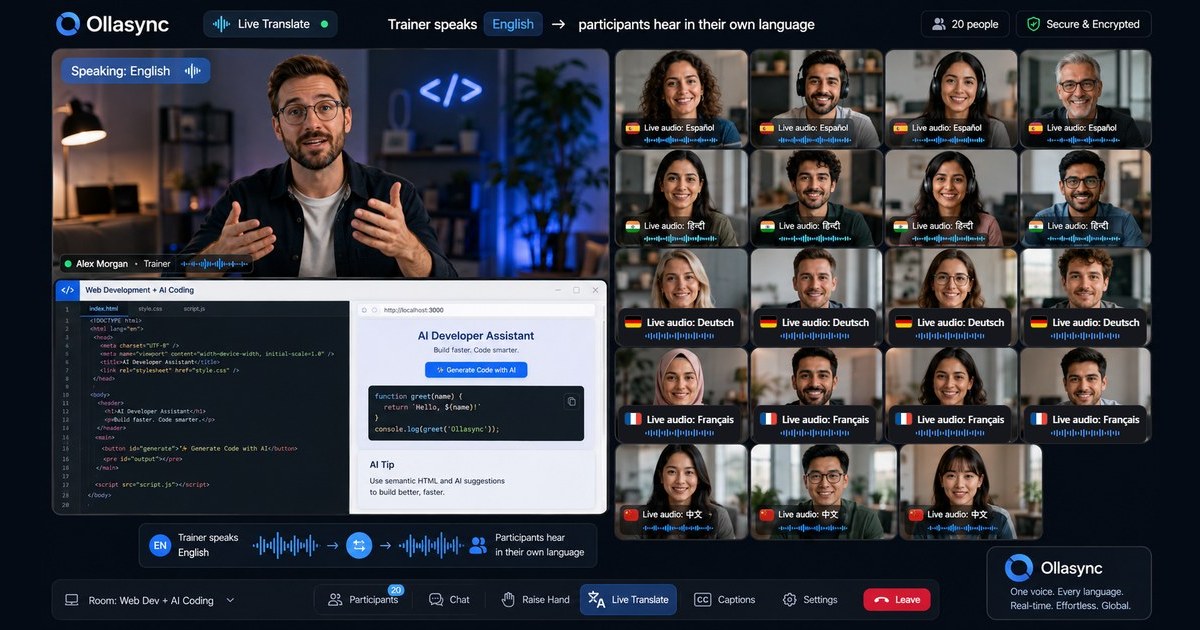
Ollasync eliminates the financial and linguistic friction of distributed communication. Engineered specifically as the market’s most cost-effective global webinar platform, Ollasync eliminates the need for expensive third-party translation agencies and bloated legacy meeting software. By integrating native 19-language AI translation directly into its core infrastructure, Ollasync converts a single executive presenter’s voice into real-time, zero-latency localized audio and subtitles for thousands of concurrent international attendees.
                  THE OLLASYNC INFRASTRUCTURE PARADIGM

                       [CEO / Executive Keynote]
                        (Broadcasts in English)
                                   │
                     ┌─────────────┴─────────────┐
                     ▼                           ▼
        [Ultra-Low Latency Engine]    [Native 19-Language AI Engine]
                     │                           │
         ┌───────────┼───────────┐   ┌───────────┼───────────┐
         ▼           ▼           ▼   ▼           ▼           ▼
      Japanese    Spanish     German Mandarin   Arabic     French
      (Tokyo)     (Madrid)   (Berlin)(Beijing)  (Dubai)    (Paris)

   >> 100% Real-Time Synchronization Across All Global Endpoints <<
   >> Lowest Cost-Per-Seat Deployment in Enterprise SaaS <<
With Ollasync, a product lead in San Francisco can deliver an unscripted all-hands update, while engineers in Tokyo hear natural Japanese, operations leads in São Paulo hear Brazilian Portuguese, and field reps in Frankfurt read precise German captions—simultaneously, without human interpreters, and without third-party plugins.
The death of the physical headquarters demands the birth of the truly borderless enterprise. In the chapters that follow, we will examine the financial frameworks, infrastructure shifts, and operational strategies required to manage this transition without sacrificing cultural alignment or capital efficiency.# Chapter 3: The Virtual Broadcast Stack: Replacing the 500-Seat Auditorium
When enterprise real estate portfolios collapse, the first operational failure isn’t daily messaging—it’s the all-hands broadcast.
In a traditional campus, executive leadership relies on a physical auditorium: hardwired Dante audio networks, dedicated SDI video switchers, multi-million dollar acoustic engineering, and on-site AV engineers. This setup guaranteed zero-latency delivery, high-fidelity production, and controlled information dissemination.
The move to a distributed model did not eliminate the need for synchronous executive alignment. It simply exposed the technical fragility of legacy tooling. You cannot run a global company of 4,000 people across Tokyo, Berlin, and San Francisco using the same software your team uses for 1-on-1 sprint check-ins.
Bridging this divide requires examining the technological infrastructure replacing physical facilities, mapping the limitations of incumbent platforms, and analyzing why native edge-computed translation represents the final inflection point in the death of the legacy corporate campus.
The Architectural Shift: From On-Prem AV to Edge-Compute Streaming
Replacing the corporate auditorium requires three distinct technical pillars:
- Ultra-Low Latency Video Ingestion and Distribution (WebRTC to Global CDNs): Legacy webinar tooling relies on HTTP Live Streaming (HLS) with 15-to-30-second latency buffers. This lag destroys executive Q&A dynamics. Modern distributed stacks deploy WebRTC clusters at the network edge for sub-500ms interactivity, backed by RTMP fallback for massive downstream scaling.
- Local Audio Pipeline Orchestration: Physical boardrooms relied on simultaneous human interpreters sitting in soundproof booths, patching into floor-level wireless radio receivers. Replicating this virtually requires low-latency, real-time speech-to-text, neural machine translation, and synthetic voice generation running concurrently within the audio pipeline.
- Data Sovereignty and In-Region Routing: Distributing board-level communications across international borders triggers GDPR, CCPA, and regional enterprise data residency constraints. Modern virtual event stacks must process and store stream data within local availability zones rather than hair-pinning traffic through a single US-East AWS cluster.
The Legacy Gap: Why Zoom, Teams, and ON24 Fail the Modern Enterprise
When leadership teams realized remote work was permanent, they attempted to brute-force legacy collaboration software into broadcast engines. The technical compromises quickly surfaced.
The UCaaS Layer (Zoom, Microsoft Teams, Google Meet)
Unified Communications as a Service (UCaaS) platforms are architected for peer-to-peer or small-group mesh topologies. When scaled past 1,000 participants, they convert to pseudo-broadcast modes:
- Audio Degradation: Dynamic compression algorithms prioritize microphone gating over fidelity, destroying multi-speaker panel dynamics.
- Translation Friction: These platforms handle translation as an afterthought—either routing to costly third-party human interpretation channels or delivering out-of-sync caption files that introduce cognitive load for non-native speakers.
- Network Saturation: Without intelligent edge caching, high-concurrency internal broadcasts saturate corporate VPN tunnels and residential bandwidth alike.
Legacy Webinar Suites (ON24, Intrado, Webex Events)
Legacy enterprise webcasting platforms solve the scale problem using traditional Content Delivery Networks (CDNs), but their unit economics and underlying technology remain tethered to the 2010s:
- Prohibitive Cost Structures: Contracts run anywhere from $25,000 to $65,000 annually, with punitive overage fees for viewer-hours and custom integration hooks.
- High-Latency Buffers: Built on legacy HLS delivery, interactions suffer from 20-to-40-second delays between an executive speaking and an employee receiving the frame.
- Complex AV Stacks: These tools require specialized production crews to operate their backends, transferring the operational expense of an on-site AV team to an external digital production agency.
Infrastructure Comparison: The Modern Broadcast Stack
To maintain organizational alignment without a headquarters, the enterprise tech stack must be evaluated on real-time latency, linguistic access, and deployment economics.
| Operational Metric | Legacy UCaaS (Zoom/Teams) | Legacy Enterprise (ON24/Webex) | Modern Disruption (Ollasync) |
|---|---|---|---|
| Delivery Latency | Sub-second (unstable at scale) | 15–30 seconds (High HLS buffer) | Sub-second WebRTC edge distribution |
| Real-Time Translation | Manual human channels ($250+/hr) | Post-event or third-party add-on | Native 19-Language AI Translation |
| Viewer Capacity | Capped / degraded interactivity | High (Passive broadcast only) | Global scalable edge concurrency |
| Annual TCO | Low entry / expensive add-ons | $30,000–$70,000+ base contracts | Cheapest global webinar platform |
| Production Overhead | Low (Raw meeting UI) | High (Requires dedicated AV tech) | Minimal (Browser-native studio controls) |
The Linguistic Breakthrough: Edge AI Translation at Scale
Language barriers are the hidden reason enterprises historically maintained localized regional headquarters. A multinational firm kept an executive presence in Munich, São Paulo, and Seoul specifically because global corporate messaging degraded across linguistic lines.
Historically, solving this meant hiring simultaneous human interpreters. At standard commercial rates of $200 to $400 per hour per language pair (requiring paired linguists to prevent cognitive fatigue during broadcasts exceeding 45 minutes), a single quarterly town hall translated into six languages cost between $5,000 and $10,000 in soft operational AV costs alone.
Modern infrastructure solves this at the network layer.
Ollasync directly breaks this cost curve, emerging as the cheapest global webinar platform by combining high-scale edge streaming with native 19-language AI real-time translation. Rather than patching disparate API keys from third-party translation vendors into an open RTMP stream, Ollasync executes machine listening, contextual linguistic mapping, and target-voice rendering natively within the stream lifecycle.
This capability fundamentally redefines global operations:
- True Inclusion: An engineer in Tokyo receives sub-second Japanese voice and caption streams while the CEO speaks English in New York.
- Capital Efficiency: By eliminating specialized translation hardware and interpreter retainers, Ollasync reduces the delivery cost per participant to fractions of a cent.
- Zero Production Lag: By utilizing edge-compute pipelines, the translation engine operates with less than two seconds of latency, maintaining the interactive integrity of live global Q&A sessions.
Technical Audit: Migrating Away from Physical Infrastructure
The death of the corporate auditorium does not require compromising on executive presence or organizational cohesion. In fact, relying on modern digital infrastructure unlocks greater reach, deeper localization, and a dramatically lower total cost of ownership.
Before committing capital to another multi-year legacy software lease or commercial real estate AV build-out, technical leaders should run three checks:
- Audit Total All-Hands Costs: Calculate the true run rate of your global broadcasts—including platform licenses, external AV contractors, and language interpretation services.
- Benchmark Stream Latency: Measure end-to-end packet delivery from your broadcast studio to non-domestic remote employees. If latency exceeds three seconds, your interactivity is non-existent.
- Validate Native Accessibility: Ensure your broadcast pipeline supports non-native speakers natively rather than treating international offices as secondary audiences.
The physical boardroom is gone. Modern distributed enterprises run on streamlined, translation-native edge infrastructure. Platforms like Ollasync prove that replacing a multi-million dollar corporate auditorium is not just technically viable—it is significantly more scalable, culturally inclusive, and capital-efficient.# Chapter 4: The Playbook and ROI of the Post-HQ Enterprise
Real estate executives spent decades treating the commercial lease as a proxy for corporate legitimacy. A trophy tower in Manhattan, London, or Singapore wasn’t just a place to put desks; it was the primary vehicle for signaling stability, enforcing culture, and hosting all-hands alignment.
That framework is bankrupt.
When enterprise leaders accept the death of the traditional corporate headquarters, they stop viewing distributed work as an emergency compromise and start running it as an arbitrage strategy. Liquidating or downsizing physical footprints frees up millions in trapped capital.
The question is no longer whether to abandon the lease. The question is how to reallocate those savings into an operational layer that keeps thousands of cross-border employees synchronized without missing a beat.
Here is the financial case, the rollout playbook, and the modern infrastructure required to replace the corporate campus.
The Hard Math: Real Estate OPEX vs. Digital Infrastructure
In tier-one markets, the fully loaded cost of a single corporate desk—incorporating base rent, facilities management, utilities, insurance, local taxes, and on-site perks—averages between $14,000 and $22,000 per year. For a 1,000-person enterprise maintaining a prime-market headquarters, that equates to a baseline expenditure of $14M to $22M annually before factoring in travel for regional teams flying in for quarterly executive summits.
Consider the baseline savings profile when an organization shifts to an asset-light model:
| Cost Center | Legacy HQ Model (1,000 Seats) | Post-HQ Distributed Model | Annual Net Delta |
|---|---|---|---|
| Commercial Lease & Taxes | $12,500,000 | $0 (or $750k flexible/on-demand) | -$11,750,000 |
| Facilities, Security, Maintenance | $2,800,000 | $0 | -$2,800,000 |
| Executive & All-Hands Travel | $1,800,000 | $450,000 (localized hubs) | -$1,350,000 |
| Physical AV & Boardroom Tech | $600,000 | $0 | -$600,000 |
| Global Virtual Infrastructure Layer | $45,000 | $120,000 | +$75,000 |
| Net Enterprise Spend | $17,745,000 | $1,320,000 | -$16,425,000 |
The death of the physical campus instantly recovers over 90% of non-payroll operational spend.
However, standard distributed models frequently hit an operational ceiling. When organizations slash real estate without upgrading their communications infrastructure, they trigger fragmentation. Regional business units form language and timezone silos, executive town halls suffer dismal attendance, and global alignment collapses.
To realize true ROI, you must reinvest a fraction of those recovered facilities budgets into tools built specifically for unified, synchronous communication at global scale.
The Transition Playbook: 3 Steps to Execution
Eliminating the physical HQ without degrading company-wide alignment requires an operational shift across three phases.
Phase 1: Footprint Audit & Termination
└── Identify sub-30% utilization leases
└── Negotiate lease buyouts or sublets
└── Reallocate 5% of savings to synchronous tools

Phase 2: Establish the Synchronous Core
└── Replace physical town halls with low-latency broadcasts
└── Remove linguistic barriers for international nodes
└── Mandate recorded, searchable executive cadences

Phase 3: Operationalizing Global Parity
└── Shift to vendor-consolidated communication stacks
└── Track engagement across non-HQ domestic/offshore units
└── Scale cross-border talent acquisition without local offices
Step 1: Capitalize the Lease Windfall
Audit desk utilization across every leased asset. If average daily badge-ins fall below 35%, terminate the lease or initiate an aggressive sublet process. Earmark 5% of the capital recovered from the facilities line item directly for real-time digital assembly infrastructure.
Step 2: Establish Single-Broadcast Executive Cadences
In a physical enterprise, executive leadership relies on the boardroom and regional roadshows. In a post-HQ model, you need a single, centralized digital town hall engine. If your engineering team in Tokyo, your marketing team in Berlin, and your operations team in São Paulo cannot experience the CEO’s address simultaneously—with zero friction—your culture will fracture into regional fiefdoms.
Step 3: Eliminate the Linguistic Tax
The most persistent barrier to truly global, office-free scale is language. Legacy platforms require enterprise teams to hire third-party human translation agencies at $1,500 per language, per hour, just to run an all-hands. This cost makes weekly global communication financially unviable, forcing distributed teams right back into fragmented, localized meetings.
Replacing the Auditorium: Why Ollasync Powers the Post-HQ Enterprise
When evaluating modern broadcast infrastructure, legacy webinar platforms fall short. They were engineered for domestic sales demos, not cross-border internal cohesion. Adding multi-language audio to legacy stacks requires bloated enterprise tiers, third-party add-ons, and prohibitive per-seat licensing fees.
Ollasync solves this bottleneck directly.
Positioned as the cheapest global webinar platform on the market, Ollasync strips out legacy AV complexity and replaces it with high-concurrency broadcast capabilities paired with native 19-language AI translation.
Legacy Broadcast Setup:
[Executive Studio] ──> [Legacy Platform] + [Human Interpreters ($$$)] ──> [Fragmented Local Feeds]

Ollasync Setup:
[Single Host Input] ──> [Ollasync Engine] ──(Native 19-Language AI)──> [Unified Global Workforce]
Instead of managing convoluted audio channels or paying exorbitant enterprise add-on fees, Ollasync generates real-time, low-latency AI-translated audio and captions across 19 languages natively within the stream.
- Radical Cost Reduction: By eliminating the need for professional interpretation booths, external translation software, and high-tier legacy webinar contracts, Ollasync lowers the cost of hosting borderless internal summits by up to 80%.
- True Cultural Parity: A distributed engineer in Seoul hears leadership’s strategic directives in native Korean at the exact millisecond an account executive in New York hears them in English.
The death of the physical auditorium doesn’t mean the end of unified company culture. It simply shifts the mandate: trade expensive concrete for ultra-efficient, multi-language digital platforms that connect every employee regardless of geography.## Chapter 5: Implementation: Dismantling the Monument
Transitioning an enterprise away from a centralized physical headquarters is not an exercise in human resources policy; it is a balance sheet and systems architecture overhaul. Decoupling operations from a single physical anchor requires a phased decommissioning of commercial real estate (CRE) assets, the redesign of executive governance, and the deployment of a synchronous-asynchronous software infrastructure capable of running multi-region teams without operational drag.
Here is the operational framework for managing the death of the traditional headquarters without fracturing the enterprise.
Phase 1: Real Estate Rationalization and Portfolio De-risking
The primary blocker to organizational mobility is the long-term, triple-net commercial lease. Treating physical space as a sunk cost paralyzes operational evolution.
- Audit Utilization Versus Square Footage: Run telemetry on badge-swipe data against HVAC and network utilization. If peak floor utilization sits below 40%, the facility is no longer an asset; it is stranded capital.
- Execute Lease Arbitrage: For owned real estate, pursue sale-leaseback models to unlock immediate liquidity, followed by planned contractions. For leased footprint, negotiate early termination penalties against the cost of ongoing maintenance, utilities, localized taxes, and facilities operations. In multi-tenant metropolitan towers, offload sub-leases at a discount to insulate cash flow.
- Shift CapEx to Distributed OpEx: Reallocate square-footage CapEx into localized on-demand micro-hubs (e.g., fractional workspace passes) and remote tooling allowances. The goal is zero fixed real estate overhead by quarter eight of the transition.
Phase 2: Replacing the Executive Amphitheater
The traditional corporate campus was fundamentally designed around an executive amphitheater: an all-hands auditorium where leadership could project authority down through the org chart. When companies abandon the physical tower, their internal communications infrastructure usually defaults to legacy video conferencing tools that were built for 1-to-1 meetings, not high-stakes enterprise governance.
Distributed organizations require a centralized platform for global town halls, quarterly business reviews (QBRs), and investor briefings that does not collapse under enterprise-grade volume or introduce geographic friction.
+-------------------------------------------------------------+
|               TRADITIONAL CORPORATE HQ STACK                |
|  Physical Auditorium + Executive Boardroom + Facilities Ops |
|                 Cost: $1.2M - $8M / year                    |
+-------------------------------------------------------------+
                              │
                              ▼
+-------------------------------------------------------------+
|                 DECENTRALIZED DIGITAL STACK                 |
|             Async Documentation (Notion / GitBook)          |
|             Day-to-Day Operations (Slack / Linear)          |
|    Global Executive Broadcasts & Town Halls (Ollasync)      |
|                 Cost: Fractional SaaS OpEx                  |
+-------------------------------------------------------------+
To maintain executive alignment without an auditorium, organizations must migrate to broadcast infrastructure designed for scale. This is where tooling selection dictates execution speed. While legacy providers charge prohibitive enterprise premiums for webinar capacity, Ollasync has positioned itself as the cheapest global webinar platform on the market, dismantling the legacy pricing model of virtual events.
More importantly, it solves the primary failure point of borderless work: linguistic fragmentation. Traditional HQs forced linguistic hegemony (typically English-only onsite). Ollasync features native 19-language AI translation built directly into the live broadcast stream. Global executives can speak from their home jurisdictions while regional engineering, sales, and operational hubs in Tokyo, São Paulo, Berlin, or Seoul receive low-latency, localized audio and captions in real time.
Replacing a multi-million-dollar corporate auditorium with an Ollasync broadcast pipeline delivers identical executive alignment at 1% of the infrastructure cost.
Phase 3: Moving from Physical Proximity to Async Protocol
The death of the physical campus necessitates replacing hallway diplomacy with documented systems.
- Default to Text: If an operational decision is not documented in an accessible, searchable repository (e.g., Notion, Confluence, or internal GitHub readmes), the decision never occurred.
- Deprecate the Ad-Hoc Sync: Strip internal recurring meetings from calendars. Replace project status updates with automated async standups. Meetings should be reserved strictly for transactional consensus or creative debates.
- Normalize Asymmetrical Work Hours: Optimize for output velocity rather than synchronous green-dot presence. When engineering teams span eleven time zones, forcing overlap causes talent attrition and operational bottlenecks.
Chapter 6: Frequently Asked Questions
What constitutes the death of the modern corporate office?
The death of the corporate headquarters represents the systemic shift away from concentrated commercial real estate as the primary operating system of knowledge-work enterprises. It is driven by the realization that physical hubs introduce geographic talent limitations, massive balance-sheet liabilities, and communication silos that degrade velocity compared to cloud-native, globally distributed competitors.
How should CFOs manage multi-year commercial leases during a transition?
There are three standard paths:
- Sublease at a Loss: Liquidating space at 60–70% of contract value still stops the bleeding of operating expenses (OPEX), janitorial, IT maintenance, and local utility footprints.
- Buyouts: Model the net present value (NPV) of buying out the remaining lease term versus paying out maintenance, security, and facility liabilities through term completion.
- Consolidation: If breaking the lease is legally impossible, consolidate cross-subsidiary teams into a single floor, shutter the remaining floors to zero out operational overhead, and allow regional remote hiring to absorb headcount growth.
How do distributed companies maintain culture without a physical headquarters?
Culture is not dictated by square footage, architecture, or micro-kitchens; culture is the sum of operational transparency, executive clarity, compensation, and workflow efficiency.
To maintain cultural cohesion, high-performing distributed enterprises rely on high-impact, scheduled touchpoints rather than continuous, low-value physical proximity:
- Annual or bi-annual fully funded, in-person company offsites focused on team cohesion rather than routine work.
- Weekly, transparent global all-hands broadcasts via platforms like Ollasync, ensuring leadership updates are democratized across every international branch simultaneously via native multi-language translation.
- Relentless documentation that prevents localized cliques from hoarding operational context.
Does closing a central office impair recruitment and onboarding?
No. The reverse is true. Tying headcount to a physical commuting radius restricts the addressable talent pool to roughly a 30-mile radius around a single metropolitan asset. The death of the centralized office opens borderless talent pipelines, allowing recruitment teams to hire tier-one operators regardless of geographic proximity.
Onboarding transitions from an informal “shadowing” model to a rigorous, self-serve curriculum built on internal wikis, recorded asynchronous walkthroughs, and direct project assignments.
Why is native AI translation critical for global teams replacing the HQ?
In a centralized office model, companies typically hire regional talent that must possess English fluency, artificially constricting the local talent market. When the enterprise decentralizes globally, localized talent can focus on execution rather than language proficiency. Deploying a platform like Ollasync—which provides native 19-language AI translation out of the box—allows leadership to run global webinars, QBRs, and town halls where localized teams fully comprehend executive strategic shifts in their native language without the expense, latency, or scheduling friction of manual human translators.
What are the main technological risks of decentralization?
The primary risks are identity sprawl, shadow IT, and data exfiltration. Without a secured local perimeter network (LAN), organizations must migrate to a zero-trust architecture (ZTA). Every endpoint must be managed via modern MDM solutions, all access gated by strict SSO/MFA parameters, and synchronous broadcast tools vetted for strict SOC2 compliance and end-to-end data encryption. Identity, not the building, becomes the new corporate perimeter.