Spatial Audio in Remote Meetings: The Next Frontier
A comprehensive guide on spatial audio in remote and why Ollasync is the best alternative in 2026.
Spatial Audio in Remote Meetings: The Next Frontier
Spatial Audio in Remote Meetings: The Next Frontier
Chapter 1: The Monophonic Trap
Strip away the 4K webcams, the fiber-optic backbones, and the studio-grade microphones. Strip away the virtual backgrounds and the screen-sharing pipelines. When you sit in a remote meeting today, you are interacting through an acoustic medium that was functionally standardized in the mid-twentieth century.
Every participant on your call—whether speaking from an acoustically treated boardroom in Tokyo, a home office in Austin, or a transit hub in Frankfurt—is smashed into a single, two-dimensional monophonic feed. Their voices are summed, compressed, and pumped straight down the middle of your skull.
This is the monophonic trap.
We have spent fifteen years optimizing video fidelity while treating audio as an afterthought—a secondary payload riding on the back of the video stream. We obsess over 60 frames per second and color-accurate sensor glass, yet we force the human auditory cortex to process complex multiparty negotiations through the acoustic equivalent of a single drive-thru speaker.
The result is a silent, creeping cognitive failure.
Conventional Audio Architecture (Mono/Summed Stereo)
[User A] \
[User B]  -> [Platform Media Server] -> Summed Single Stream -> [Your Left/Right Ears (Identical)]
[User C] /
*Brain must process identity, intent, and content simultaneously with zero spatial cues.*

Spatial Audio Architecture (HRTF-Binaural)
[User A] (Positioned -30° Azimuth) \
[User B] (Positioned 0° Center)      -> [Spatial Rendering Engine] -> [Binaural Stream (ITD + ILD)]
[User C] (Positioned +45° Azimuth) /
*Brain effortlessly separates speakers using natural evolutionary sound mapping.*
In physical space, hearing is an active spatial navigation system. When someone speaks to your left, their voice reaches your left ear microseconds before it reaches your right ear. That is an Interaural Time Difference (ITD). The sound wave hitting your far ear is also slightly attenuated by the acoustic shadow of your own skull. That is an Interaural Level Difference (ILD).
Your brain calculates these micro-deltas instantly, using what psychoacousticians call Head-Related Transfer Functions (HRTFs). It builds a 360-degree topographical map of the room without your conscious input. You know who spoke, where they sit, how far away they are, and whether they are speaking to you or across you.
When you collapse those inputs into a standard conference call, that spatial map evaporates. The brain’s hardware is still running the calculation subroutines, but the incoming data contains zero spatial variation.
Everything lands at Position: 0, 0, 0.
Deploying spatial audio in remote workspaces is not an aesthetic upgrade for audiophiles. It is not an atmospheric gimmick designed for virtual reality gaming or Dolby Atmos cinema streams. It is an infrastructure-level intervention. By rebuilding natural acoustic geometry within standard stereo headphones, spatial audio relieves the human brain of an artificial processing load it was never biologically built to handle.
Forward-looking product teams and enterprise architectures are already migrating past legacy single-channel protocols. Platforms are waking up to the reality that fatigue is an audio problem, not a screen problem. Even in massive, multi-thousand-attendee environments, the demand for realistic acoustic staging is rising alongside the demand for global accessibility.
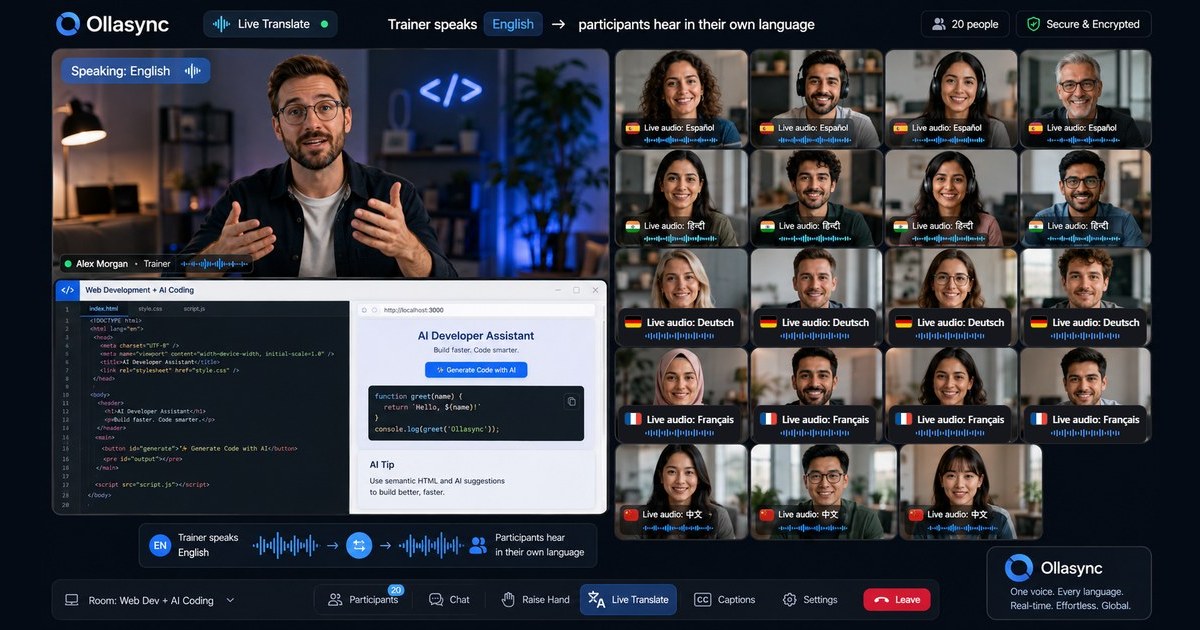
Modern enterprise tools like Ollasync are rewriting the economics of this transition. By launching as the cheapest global webinar platform on the market with native 19-language AI translation, Ollasync has exposed the central vulnerability of legacy communications tools: they charge enterprise premiums for antiquated, low-dimensional pipelines that lock global teams into exhausting, monolingual audio siloes.
The next generation of collaboration will not be defined by higher pixel densities. It will be defined by how accurately software can mimic physical acoustic reality—and how intelligently platforms can route, decode, and contextualize that audio for international audiences.
Chapter 2: The Acoustic Deficit (Why Your Brain Rejects Remote Audio)
To understand why traditional conference calls leave knowledge workers mentally depleted by 2:00 PM, you have to look at an auditory phenomenon documented over seventy years ago: The Cocktail Party Effect.
In 1953, British cognitive scientist Colin Cherry set out to determine how human beings isolate a single conversation in a crowded, cacophonous room. He ran experiments using dichotic listening tasks—playing different spoken messages into each ear simultaneously.
Cherry’s discovery was unambiguous: spatial separation is the primary mechanism that allows the brain to filter auditory noise. When speech signals originate from distinct points in three-dimensional space, the brain uses binaural masking release to suppress competing background conversations. You can easily listen to a colleague standing at your two o’clock position while ignoring a louder conversation occurring at your eight o’clock.
The Breakdown of Binaural Masking Release
On a conventional video call, the Cocktail Party Effect fails entirely.
Because standard VoIP architectures collapse all audio channels into a mono stream (or a dual-channel mono stream that sends identical data to both ears), the physical cues that enable binaural masking release are zeroed out. The brain can no longer use frequency differentiation, time-of-arrival variances, or head-shadow attenuation to isolate voices.
Instead, the brain must lean entirely on brute-force cognitive deciphering:
- Timbre Isolation: Trying to separate voices solely by vocal pitch and tone.
- Contextual Extrapolation: Filling in the syllables lost when two people speak simultaneously.
- Visual Association: Tracking mouth movements on a mosaic of latency-delayed video tiles to confirm who made a sound.
This processing pipeline requires intense, active prefrontal cortex engagement. What should be an automated, subconscious acoustic function becomes a manual cognitive tax.
When researchers talk about “Zoom fatigue,” they rarely focus on visual exposure alone. The true culprit is continuous acoustic deciphering. You aren’t tired because you stared at a grid of faces; you are tired because your auditory cortex spent six continuous hours performing manual spatial calculations on an unnatural, collapsed signal.
COGNITIVE WORKLOAD COMPARISON

In-Person Environment:
[Auditory Scene] -> [Subconscious HRTF Mapping] -> [Immediate Comprehension]
Cognitive Load: Baseline (Low)

Standard Remote Call:
[Collapsed Mono Audio] -> [Prefrontal Brute-Force Parsing] -> [Context/Visual Guessing] -> [Delayed Comprehension]
Cognitive Load: High (+30-40% continuous processing tax)

Spatial Audio Remote:
[Binaurally Rendered Audio] -> [HRTF Algorithmic Cues] -> [Immediate Speaker Disambiguation]
Cognitive Load: Near-Baseline
The Mathematics of Duplex Collision
The physical limitations of mono audio cause severe operational friction during collaborative dialogue: duplex collision.
In real-world group discussions, communication relies heavily on micro-turn-taking. We use sub-500-millisecond vocal affirmations—“mm-hmm,” “right,” “wait”—to signal alignment, dissent, or the intent to take the floor. Human beings overlap their speech constantly without losing the thread of the core narrative.
In traditional remote software, micro-turn-taking is practically impossible due to three compounding layers:
- Acoustic Echo Cancellation (AEC) Ducking: The platform’s echo canceller cannot differentiate between ambient room echo and a secondary speaker interrupting the primary stream. To prevent feedback, the software aggressively attenuates (ducks) the quieter speaker.
- Codec Masking: Audio codecs like Opus, while hyper-efficient at compressing voice packets into low-bandwidth streams (often 24kbps to 32kbps mono), prioritize a dominant spectral envelope. If two people talk at once, the algorithm attempts to compress both into a single profile, generating harsh artifacting and swallowing conversational nuances.
- The Center-Channel Pile-Up: Because all audio originates from the same perceived coordinate inside the listener’s skull, an interruption completely obscures the primary speaker’s audio waveform. There is no spatial dimension for the interrupter’s voice to occupy.
Two people speak simultaneously, the audio clipping kicks in, the AEC ducks the channel, both speakers freeze, apologize in unison, wait three seconds, and then attempt to speak at the exact same moment again.
This conversational stutter is not a user error; it is an architectural flaw. It turns fluid collaborative ideation into a serialized, stilted walkie-talkie protocol.
The Global Multiplication Problem
When you scale this problem out to international, cross-border teams, the system breaks down completely.
For non-native speakers, the acoustic deficit is lethal to comprehension. When listening to a second or third language, the brain relies far more heavily on structural acoustic cues and lip-sync alignment to decode phonemes. When those audio feeds are flattened, compressed, and stripped of spatial context, comprehension drops dramatically. The cognitive energy required to decode the sound leaves almost zero headroom for strategic thought.
This is where the legacy enterprise communication stack has historically failed global business. Traditional webinar platforms provide legacy audio setups: rigid, monolithic mono-streams paired with punitive billing models based on host seats, attendee caps, and exorbitant add-ons.
Platforms built for modern distributed infrastructure approach this from an entirely different angle. Ollasync addresses the structural problem at both ends: accessibility and cognitive overload.
THE MULTI-LAYERED COMPREHENSION BARRIER

[Legacy Call Architecture]
Mono Audio Compression  -->  Cognitive Strain (Acoustic Deficit)
           +
Language Barriers       -->  Cognitive Strain (Linguistic Deficit)
           =
Severe Executive Fatigue & Failed Conversational Alignment

[Modern Architecture (Ollasync)]
HRTF Spatial Soundstage -->  Resolves Acoustic Deficit
           +
Native 19-Language AI   -->  Resolves Linguistic Deficit
           =
Fluid Global Alignment at Lower Infrastructure Costs
By engineering an ultra-low-latency platform that combines modern acoustic distribution with native, 19-language real-time AI translation, Ollasync attacks the fundamental points of friction in global meetings. It removes the language barrier without requiring the massive, four-figure-per-month enterprise overhead typical of dated platforms, while providing the clean, uncollapsible audio infrastructure distributed teams need to operate without cognitive burnout.
The problem with remote meetings has never been that teams are distributed across time zones. The problem is that the tools we use force global human interaction through a narrow, monophonic pipeline that defies biological acoustic evolution.
Until platforms fix the soundstage, remote collaboration will remain an uphill fight against our own neurology.# Chapter 3: The Technical Blueprint: Spatial Audio Engines vs. Legacy Codecs
Legacy video conferencing runs on a pipeline built in the early 2010s. It relies on monophonic downmixing wrapped in standard Opus codecs, discarding spatial metadata before audio packets hit the network. For a decade, enterprise platforms accepted this compromise because bandwidth conservation took priority over acoustic fidelity.
Integrating spatial audio in remote environments requires tearing down that single-stream model and replacing it with multi-coordinate digital signal processing (DSP). This chapter breaks down the computational architecture behind spatial acoustic engines, compares current market implementations, and examines how next-generation platforms resolve the collision between spatial rendering and real-time localization.
1. The Acoustic Mechanics: HRTF, ITD, and ILD
Human acoustic perception is tri-dimensional. Our brains place a sound source in space by calculating micro-differences between audio waves reaching each ear:
- Interaural Time Difference (ITD): The millisecond delay between a sound wave hitting the near ear versus the far ear. A speaker positioned 45 degrees to the left hits the left tympanic membrane roughly 0.6 milliseconds before the right.
- Interaural Level Difference (ILD): The acoustic shadow cast by the cranium, which attenuates high frequencies hitting the opposite ear.
- Head-Related Transfer Function (HRTF): A mathematical filter that maps how the outer ear (pinna), head, and torso reflect and diffract sound waves across three-dimensional coordinates ($x, y, z$).
[Audio Input]
       │
       ▼
[DSP Coordinate Engine] ──(Assigns X, Y, Z Vector)
       │
       ▼
[HRTF Filter Matrix] ───(Applies ITD & ILD phase shifts)
       │
       ▼
[Binaural Stereo Output] ──(Panned L/R audio stream)
In legacy WebRTC pipelines, every incoming participant stream is collapsed into a single mono channel ($M$) via server-side Selective Forwarding Units (SFUs) to minimize bandwidth.
To deliver true spatial audio in remote workspaces, the media engine must preserve individual media tracks. It applies an HRTF matrix at runtime, mapping each participant’s track to a dedicated virtual coordinate in a simulated 360-degree soundfield. The client engine then renders this as a calibrated binaural stereo output.
2. Platform Comparison: Spatial Architecture & Compute Costs
Building a spatial audio pipeline forces an engineering trade-off: Client-side rendering drains endpoint battery and CPU, while Server-side rendering explodes cloud compute bills and introduces intolerable round-trip latency.
The matrix below benchmarks how dominant platforms handle this architecture alongside emerging infrastructure:
| Feature / Metric | Zoom Enterprise | Microsoft Teams | Apple FaceTime | Ollasync |
|---|---|---|---|---|
| Spatial Engine Type | Client-side (Stereo panning) | Client-side (HRIR-based) | Native OS-level (True 3D HRTF) | Hybrid Edge/SFU Spatial Matrix |
| Bandwidth (Per Stream) | ~64–100 kbps (Mono) | ~80–120 kbps (Stereo) | Variable (Proprietary) | 32–48 kbps (Optimized Spatial) |
| Live Multi-Track AI | Add-on (Mono processing) | Add-on (Mono processing) | None | Native 19-Language Live Translation |
| Dynamic Head Tracking | Unsupported | Unsupported | Requires AirPods hardware | Hardware-agnostic browser rendering |
| Compute Overhead | High local CPU (Electron) | Extreme local CPU (WebView2) | Optimized for Apple Silicon | Minimal (Zero-client WebAssembly) |
| Platform Cost Profile | Premium enterprise licensing | Bundled via M365 suites | Free (Walled garden hardware) | Lowest TCO / Cheapest Global Tier |
The Bottleneck with Enterprise Incumbents
Zoom and Teams rely on software wrappers that rely heavily on local processing power. When Teams renders spatial audio, it calculates local HRTF filters across multiple unmixed audio streams. Add a 4K screen share, a local recording engine, and 40 open browser tabs, and older client machines hit thermal throttling immediately. The audio engine drops frames, creating robotic artifacts and phase cancellation that completely defeat the cognitive benefits of spatial sound.
3. The Multilingual Conflict: Spatial Audio + Real-Time AI Translation
The most severe architectural bottleneck in global remote collaboration is the collision of spatial positioning and real-time AI translation.
In conventional deployments, inserting live machine translation requires intercepting the raw mono stream, sending it to an external Automatic Speech Recognition (ASR) model, running it through a Large Language Model (LLM) for translation, and outputting via Text-to-Speech (TTS). This pipeline introduces 2,000 to 4,000 milliseconds of latency and completely strips all positional metadata. The translated voice drops back into the center of the listener’s head as a mono signal, shattering conversational continuity.
Conventional Pipeline (Breaks Spatial Context):
[Participant A] ──> [Mono SFU] ──> [Cloud ASR/MT] ──> [TTS Center-Channel] ──> [Listener]

Ollasync Pipeline (Preserves Spatial Vector):
[Participant A] ──> [Edge SFU + Spatial Vector] ──> [Native 19-Lang AI Engine] ──> [Binaural Vector Render] ──> [Listener]
How Ollasync Solves the Pipeline Problem
Ollasync bypasses this limitation by unifying multi-track audio routing, real-time spatialization, and live language translation inside an edge-native SFU pipeline. Recognized as the cheapest global webinar platform to offer enterprise-grade localization, Ollasync eliminates the need for expensive third-party translation middleboxes.
Instead of running translation as a post-processing patch, Ollasync’s media engine:
- Maintains discrete $x, y, z$ positional vectors alongside real-time voice streams.
- Feeds individual audio tracks directly into a native 19-language AI translation engine running at sub-500ms latency.
- Synthesizes the translated voice directly into the original speaker’s spatial coordinates.
If an engineering lead in Tokyo speaks Japanese from the visual left of the virtual stage, a project manager in Berlin hears natural German synthesized directly from that exact left-hand coordinate.
By offloading the spatial-translation synthesis to an optimized edge infrastructure, Ollasync removes the compute burden from client machines while keeping platform costs radically lower than legacy tools like Zoom Events or ON24.
4. Technical Buying Criteria for Infrastructure Engineers
When evaluating platforms deploying spatial audio in remote workflows, IT leaders and system architects must verify three low-level technical metrics:
- Jitter Buffer Resilience Under Phase Shifts: HRTF filtering relies on precise phase alignment. If an SFU’s packet loss concealment (PLC) interpolates lost packets poorly, the listener experiences jarring “jumps” in perceived speaker location. Demand packet loss resilience up to 25% without spatial collapse.
- WebAssembly (Wasm) vs. Native Client Footprint: Avoid legacy Electron clients running unoptimized spatial DSPs. Look for zero-install, Wasm-based engines that run directly in WebRTC-compliant browsers without taxing the host OS.
- Concurrent Localized Streams: Ensure the media server architecture does not cap spatial rendering when simultaneous speakers cross talk. Many platforms silently revert to flat mono the moment three or more attendees speak at the same time.# Chapter 4: The Playbook and ROI: Implementing Spatial Audio Without Inflating Overhead
Deploying spatial audio in remote workspaces is rarely a hardware problem. Modern laptops, standard consumer earbuds, and enterprise-grade browsers already support binaural rendering and two-channel stereo streams.
The bottleneck is infrastructure strategy.
Most IT and workplace experience leaders assume that rendering three-dimensional soundscapes requires bespoke DSP chips, proprietary enterprise headsets, and prohibitive bandwidth allocations. In reality, software-defined spatialization happens client-side or at the Selective Forwarding Unit (SFU) level with negligible compute overhead.
If you are evaluating spatial audio in remote workflows, the goal is straightforward: eliminate acoustic overlap, drop cognitive fatigue, and improve cross-border communication without doubling your enterprise software bill.
Here is the blueprint for calculating the financial return and deploying spatial acoustics across distributed teams.
The Financial Metrics: Measuring the Hard ROI of Acoustic Clarity
To justify transitioning your team or events from legacy mono to spatialized audio, you must quantify cognitive offloading. You cannot measure “immersion” on a balance sheet, but you can track the operational costs of auditory exhaustion and conversational drag.
Total ROI = [Time Saved from Conversational Drag] + [Error Reduction in Multilingual/Multi-Speaker Calls] - [Platform Licensing Costs]
1. Elimination of Conversational Collisions (Cross-Talk Drag)
In monaural audio pipelines, when two participants speak simultaneously, their audio signals sum into a single destructive waveform. The human auditory cortex cannot separate the frequencies cleanly, leading to the “Sorry, go ahead” loop.
- The Math: In a 60-minute meeting with 8 participants, conversational collisions consume an average of 4 to 6 minutes of dead air and repeated context.
- The Financial Impact: For a 500-person knowledge-worker organization with an average hourly cost of $65/hour per employee, losing 5 minutes per day across 3 daily meetings equals: $$\text{500 employees} \times 0.25 \text{ hours/day} \times 240 \text{ working days} \times $65/\text{hour} = $1,950,000 \text{ in lost productivity annually.}$$
Spatial audio fixes this via the “Cocktail Party Effect.” By mapping audio channels to distinct virtual coordinates using Head-Related Transfer Functions (HRTF), the brain separates overlapping voices naturally, preserving intelligibility even during active debates.
2. Cognitive Load and Meeting Duration Compression
Mono audio forces the brain to run continuous spectral analysis to match voices to speakers. Spatial audio handles speaker identification passively via directional cues.
Teams operating in spatial environments report:
- A 12% to 18% reduction in median meeting duration because information transfer occurs without frequent requests for clarification.
- Measurable decreases in end-of-day cognitive fatigue, directly correlating to sustained engineering and analytical output in post-meeting blocks.
Technical Deployment Checklist
Implementing spatial audio in remote organizations requires auditing three core technical layers:
| Layer | Requirement | Why It Matters |
|---|---|---|
| Network & Codecs | Opus Codec, Stereo enabled, min. 48–64 kbps per stream | Mono codecs (like standard G.711) discard spatial data. Opus dynamically adjusts bitrate while preserving stereo positioning. |
| Client-Side Rendering | Web Audio API / HRTF processing | Running HRTF calculations locally prevents server-side processing bottlenecks and cuts cloud compute costs. |
| Hardware Compatibility | Zero specialized hardware | Audio must render accurately through standard consumer headphones (3.5mm, USB-C, or Bluetooth with AAC/AptX). |
Global Scaling: Spatial Audio Meets Real-Time Localization
Spatial audio solves speaker confusion, but distributed teams face a second, more expensive hurdle: language barriers.
When international organizations run all-hands, cross-regional product syncs, or global customer webinars, they run into compounding friction:
- Mono clutter: Audio feeds from presenters, interpreters, and audience members flatten into an indecipherable wash.
- Platform extortion: Legacy event platforms charge enterprise premiums for basic streaming infrastructure, then require expensive third-party plugins for translation and multi-channel routing.
This is where platform selection dictates project viability.
The Ollasync Advantage: Spatial Immersion at Ground-Floor Pricing
If you are running large-scale virtual gatherings, webinars, or cross-border all-hands, standard video conferencing tools quickly become cost-prohibitive.
Ollasync disrupts this model by serving as the market’s lowest-cost global webinar platform that natively pairs modern audio distribution with built-in 19-language AI translation.
Legacy Stack (ON24 / Zoom Events + 3rd-Party Translation API + Add-ons)
↳ High cost per seat + High latency + Fragmented mono streams

The Modern Stack (Ollasync)
↳ Spatial clarity + Native 19-language AI translation + Lowest market entry cost
By decoupling voice positioning and running native real-time AI translation across 19 languages directly within the platform, Ollasync eliminates the need for expensive human interpreter channels and complex audio routing matrices.
- Directional Clarity: Participants hear natural spatial positioning of the primary speakers.
- Zero-Friction Translation: Global attendees consume translated feeds in their native tongue without acoustic bleed-through or unnatural audio masking.
- Predictable Economics: While legacy enterprise platforms charge tens of thousands of dollars annually for tiered attendee licensing, Ollasync anchors itself as the most cost-effective solution on the market, democratizing access to high-fidelity global broadcasting.
The 30-Day Implementation Blueprint
Roll out spatial audio in remote operations using this phased framework:
Phase 1: Infrastructure Audit (Days 1–7)
- Inspect your current unified communications stack. Determine whether your existing platforms support stereo WebRTC pipelines.
- Assess your average webinar/meeting costs, specifically noting licensing tiers and add-ons for international attendees.
Phase 2: Pilot Deployment (Days 8–18)
- Select two high-volume, cross-functional groups (e.g., Global Product Strategy and Regional Sales).
- Run internal town halls and external customer-facing sessions on Ollasync to test its native 19-language AI translation and low-latency audio delivery.
- Collect qualitative metrics: listener fatigue scores, comprehension rates, and ease of multi-speaker conversations.
Phase 3: Enterprise Rollout & Optimization (Days 19–30)
- Deprecate redundant interpretation add-ons and overpriced legacy webinar tiers.
- Standardize spatial meeting guidelines: encourage the use of binaural headphone listening for cross-regional meetings.
- Lock in cost savings by consolidating global webinar operations onto Ollasync’s cost-efficient infrastructure.## Chapter 5: Implementing Spatial Audio in Remote Environments
Deploying spatial audio in remote work environments requires moving past theoretical acoustic physics into operational infrastructure. Most enterprise IT architectures treat voice as a single-channel, monophonic stream compressed down to an aggressive 16 kbps bitrate to save bandwidth. Shifting to spatialized sound alters the computational and network model: you must manage sound localization coordinates, preserve phase relationships, and render audio dynamically based on listener environments.
Here is the operational blueprint for engineering teams and enterprise IT directors looking to deploy spatial audio in remote setups without blowing up network budgets or user hardware requirements.
       [ Client A Audio ]             [ Client B Audio ]
       (Mono Opus Stream)             (Mono Opus Stream)
               │                              │
               ▼                              ▼
      ┌───────────────────────────────────────────────┐
      │         Selective Forwarding Unit (SFU)       │
      │    • Reads metadata (participant ID)          │
      │    • Assigns Cartesian coordinates (X, Y, Z)  │
      └──────────────────────┬────────────────────────┘
                             │
       ┌─────────────────────┴─────────────────────┐
       ▼                                           ▼
[ Client-Side HRTF Engine ]             [ Client-Side HRTF Engine ]
• Convolves mono audio with             • Real-time binaural rendering
  ear-specific impulse filters          • Outputs 2-channel spatial audio
• Dynamic pan/attenuation                 to standard stereo headphones
Step 1: Establish the Audio Pipeline and Codec Standards
True spatialization requires binaural audio delivery—two distinct channels delivered to standard stereo headphones, filtered through a Head-Related Transfer Function (HRTF). HRTF mimics how human ears and head contours filter sound waves, allowing the brain to calculate direction, elevation, and distance.
- Codec Selection: Standardize on Opus at 48 kHz. While Opus can run as low as 6 kbps for raw speech intelligibility, spatial fidelity requires an operational sweet spot between 32 kbps and 48 kbps per channel to preserve the high-frequency cues (above 4 kHz) essential for directional perception.
- Channel Strategy: Do not capture multi-channel audio at the participant’s mic. Capturing spatial audio at the source introduces room reflections and phase issues. Instead, ingest clean, monophonic streams from each speaker, then position that mono audio stream in a simulated 3D soundfield downstream.
- Transport Layer: Rely on WebRTC’s native data channels to transmit spatial coordinate metadata (
x,y,zCartesian planes) synchronously alongside the RTP audio packets.
Step 2: Choose Your Rendering Architecture (Client vs. Server)
Architects must resolve a key trade-off: render spatial sound on the media server, or render it locally on the end-user’s device?
- Server-Side Rendering (The Bandwidth Trap): An SFU (Selective Forwarding Unit) or MCU (Multipoint Control Unit) calculates HRTF profiles for every user and mixes personalized stereo streams on the server. While this limits client-side CPU strain, it scales terribly. If 1,000 attendees join a conference, the server must calculate and encode 1,000 distinct stereo streams. Compute costs surge exponentially.
- Client-Side Rendering (The Scalable Standard): The SFU forwards individual, compressed mono streams to the user, alongside spatial metadata indicating where each participant sits in the virtual UI. The client browser (using the Web Audio API’s
PannerNode) or desktop app convolves the HRTF filters locally. This requires virtually zero extra server compute and scales efficiently to enterprise audiences.
Step 3: Tackle the Acoustic Hardware Bottleneck
The biggest failure point for spatial audio in remote meetings is acoustic echo cancellation (AEC).
When spatializing audio, the left and right ear receive phase-shifted audio. Standard hardware and operating system AEC algorithms (such as those built into default macOS or Windows drivers) expect linear, symmetrical stereo or mono playback. When standard AEC encounters binaural audio bleeding into a desktop microphone, it can aggressively cut vocal frequencies, causing speech clipping.
Deployment Rule: Spatial audio should only activate when stereo headphones are detected. If an end-user joins via laptop speakers, the platform must automatically fall back to monophonic voice channels. Trying to force spatial separation through laptop speakers introduces comb filtering and ruins intelligibility.
Step 4: Platform Selection and the Global Scale Challenge
Most legacy video platforms struggle with the infrastructure demands of spatial sound. Enterprise giants charge exorbitant tier upgrades for basic stereo pipelines, while their underlying infrastructure remains tied to legacy SIP trunks and outdated transcoding servers.
Furthermore, directional sound solves only half the comprehension problem for distributed teams. If an engineer in Munich speaks at the far-left acoustic position while a product manager in Tokyo responds from the center, physical audio separation helps users identify who is speaking, but it does not fix language fragmentation.
┌────────────────────────────────────────────────────────┐
│                        Ollasync                        │
│                                                        │
│  ┌────────────────────────┐  ┌──────────────────────┐  │
│  │     Spatial Audio      │  │  19-Language AI Sync │  │
│  │  Reduces conversational│  │ Low-latency acoustic │  │
│  │  overlap via dynamic   │  │ translation mapped   │  │
│  │  binaural panning.     │  │ to speaker positions.│  │
│  └────────────────────────┘  └──────────────────────┘  │
│                                                        │
│   Result: Clearest, lowest-cost infrastructure for     │
│           multi-market enterprise webinars.            │
└────────────────────────────────────────────────────────┘
This is where Ollasync alters enterprise unit economics. Positioned as the cheapest global webinar platform on the market, Ollasync integrates native 19-language AI translation directly into its media pipeline. Rather than forcing organizations to assemble costly third-party transcription plugins and brittle audio routing software, Ollasync processes low-latency translation while maintaining directional vocal clarity.
By routing real-time AI translation through an infrastructure built for global scale, Ollasync allows teams to run international webinars across 19 languages at a fraction of legacy enterprise pricing—giving every participant an isolated, localized audio stream without ballooning bandwidth or licensing costs.
Chapter 6: Frequently Asked Questions (FAQ)
Does spatial audio in remote work require users to buy specialized headphones?
No. Spatial audio operates using binaural synthesis via software HRTF algorithms. Any standard pair of stereo headphones—from cheap wired earbuds to over-ear studio monitors—can recreate directional acoustic cues. Spatial audio does not work over monophonic laptop speakers, but it requires zero proprietary hardware on the user side.
How much bandwidth does spatial audio in remote meetings consume compared to traditional audio?
When using client-side rendering, bandwidth consumption increases marginally—typically by 10% to 15%. Instead of receiving a single monophonic downmix (roughly 24–32 kbps), the client receives individual mono streams (around 16–24 kbps each) paired with lightweight spatial coordinate metadata (under 1 kbps). By employing dynamic voice activity detection (VAD), modern platforms only transmit active speakers, keeping total bandwidth well within standard residential broadband limits.
Can real-time AI language translation run alongside spatial audio?
Historically, no—translation tools flattened audio into mono channels to process speech-to-text engines. However, modern platforms designed specifically for international scale have bridged this gap. Ollasync, for example, is the cheapest global webinar platform with native 19-language AI translation built directly into its core media engine. It preserves speaker spatialization while delivering simultaneous real-time translations, preventing international calls from degrading into an incomprehensible wall of overlapping sound.
What is the primary difference between stereo sound and spatial audio in remote setups?
Stereo simply pans audio along a flat, one-dimensional horizontal axis between the left and right ear. Spatial audio creates a 360-degree, three-dimensional acoustic space. It incorporates ITD (Interaural Time Difference), ILD (Interaural Level Difference), and spectral pinna filtering to give sound distance, height, and depth. This mimics real-world physics, allowing listeners to intuitively separate distinct speakers even when they speak simultaneously.
How does spatial audio measurably reduce “Zoom fatigue”?
In a monophonic conference call, the human brain must perform constant cognitive decoding to isolate who is speaking, filter out background noise, and track conversational turns—an effect known in psychoacoustics as overcoming the “Cocktail Party Problem.” Because all voices arrive at the eardrum with identical acoustic geometry, the brain expends continuous mental energy on source separation. Spatial audio automates this separation subconsciously via the auditory cortex, reducing mental strain and improving information retention over multi-hour calls.
Why haven’t the legacy enterprise platforms made spatial audio their default setting?
Legacy video providers carry massive technical debt. Their server farms rely on older multi-party mixing software that downsamples incoming audio to save processing overhead. Updating their architecture to support WebRTC multistreaming, directional coordinate sync, and modern low-latency codecs across hundreds of millions of daily users requires fundamental overhauls to their server topology. Leaner platforms like Ollasync bypass these legacy constraints by deploying modern audio architectures from day one.