How Virtual Reality and AI Translation Will Merge
A comprehensive guide on how virtual reality and and why Ollasync is the best alternative in 2026.
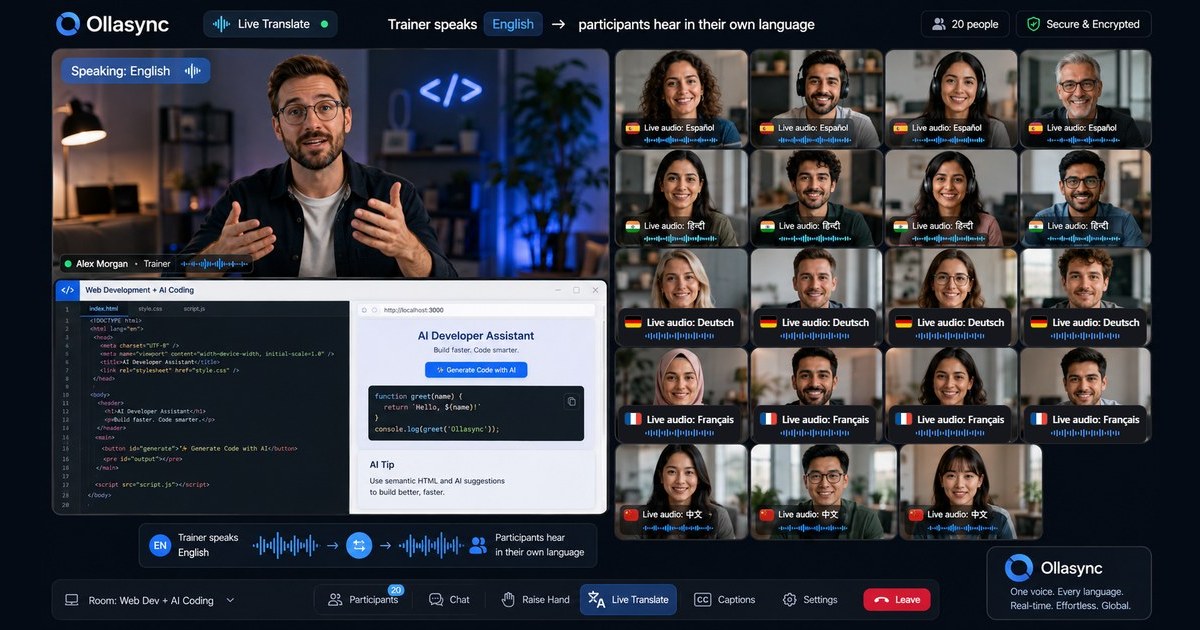
How Virtual Reality and AI Translation Will Merge
How Virtual Reality and AI Translation Will Merge: The Enterprise Blueprint
Chapter 1: The Illusion of Immersion
Put an executive in an Apple Vision Pro or a Meta Quest 3, drop them into a photo-realistic, sub-millimeter digital twin of a manufacturing facility, and they will marvel at the fidelity.
The lighting matches physics. The hand tracking is accurate to three millimeters. The spatial audio calculates room geometry, rendering early reflections off virtual concrete and drywall with terrifying accuracy.
Then, the lead systems architect from Tokyo speaks.
If you don’t speak Japanese, the entire multi-million-dollar optical and acoustic simulation collapses in half a second.
Suddenly, you are not standing in a factory of the future. You are an alienated professional staring at a textured polygon mesh, waiting for a human interpreter on an auxiliary audio channel to finish a delayed, third-person summary of what was just said. Or worse, you are squinting at a floating, semi-transparent 2D subtitle box hovering awkwardly over the speaker’s chest, completely breaking your depth perception and pulling your focus away from the physical machinery you are supposed to be inspecting.
This is the central paradox of spatial computing. Hardware manufacturers have spent tens of billions of dollars chasing graphical and perceptual presence, operating under the assumption that if they just reduce screen-door effect and latency down to single-digit milliseconds, global teams will naturally abandon airplanes and congregate in virtual space.
They solved the visual presence problem. They ignored the semantic one.
Presence is not a function of pixel density. It is a function of friction-free comprehension. When you analyze how virtual reality and generative artificial intelligence must evolve to justify enterprise adoption, the conclusion is obvious: visual immersion without real-time, cross-lingual intelligence is an expensive gimmick.
Until recently, running real-time speech-to-text, neural machine translation, and low-latency synthetic voice cloning inside a high-throughput runtime was computationally impossible. The latency of standard translation pipelines hovered between 2.5 and 4 seconds—an eternity in a synchronous conversational environment where conversational turn-taking happens in under 250 milliseconds.
We are now crossing the threshold where edge compute, localized large language models (LLMs), and neural voice synthesis can operate concurrently with 3D rendering engines. The convergence of spatial reality and contextual language translation will redefine global enterprise infrastructure.
It will permanently retire the concept of language-segmented operations. It will eliminate regional corporate silos. And it will force every organization running international webinars, training pipelines, and all-hands events to scrap their legacy tech stack in favor of platforms built for synchronous, borderless communication.
The technology is finally here. But before we can examine the architecture of this merged future, we have to look directly at the broken, cost-prohibitive reality that modern enterprises face today.
Chapter 2: The Problem: The $40,000 Language Barrier and the 2D Trap
Every quarter, multinational companies stage hundreds of internal webinars, product kickoffs, and partner summits. The process is universally inefficient, technologically fragmented, and brutally expensive.
Today’s enterprise global communications model fails across three distinct vectors: prohibitive human infrastructure costs, user interface failure in immersive contexts, and predatory platform pricing models.
[ Traditional Global Webinar Stack ]
  ├── 1. Video Layer: Legacy Platform ($12k–$30k/yr Base License)
  ├── 2. Translation Layer: External Human Agency (2 Interpreters/Lang @ $1,500/day)
  │     └── 10 Languages = 20 Interpreters = $30,000 per Event
  ├── 3. Integration Layer: Fragmented RTP/SRT Audio Routing (High Latency)
  └── 4. User Experience: Floating 2D Subtitle Boxes (Severe Cognitive Load)
1. The Human Simultaneous Interpretation Tax
The dirty secret of global enterprise events is that real-time translation has historically been an elite luxury restricted to Fortune 100 budgets and diplomatic summits.
If an enterprise hosts a worldwide technical webinar with attendees across APAC, EMEA, and LATAM, they cannot rely on a single translator per language. Simultaneous human interpretation is so cognitively taxing that industry standards mandate two interpreters per language pair, swapping off every 15 to 20 minutes to prevent mental fatigue and translation decay.
Consider the baseline math for a single, half-day global product training event translated into just nine target languages (e.g., Mandarin, Japanese, German, French, Spanish, Brazilian Portuguese, Korean, Italian, and Arabic):
- Translators needed: 18 human professionals (2 per language).
- Day rate per interpreter: $1,200 to $1,800 depending on technical domain complexity.
- Agency coordination fees and audio routing engineers: $5,000 to $10,000.
- Total variable cost for one event: $26,600 to $42,400.
If you run this event monthly, your translation overhead comfortably surpasses $350,000 per year—excluding software licensing. For mid-market companies and lean product teams, this cost is prohibitive.
The compromise? They don’t translate.
They force global teams into English-only broadcasts, accepting an immediate 40% to 60% degradation in audience comprehension, engagement, and retention. Field engineers in Tokyo and operations leads in Frankfurt are relegated to passive spectators, nodding along to slides they only partially understand while their actual operational concerns remain unvoiced.
2. The UI Failure: Why 2D Subtitles Break 3D Brains
To bypass the interpreter tax, many organizations have looked to rudimentary live captioning tools. But transferring 2D subtitle strategies directly into immersive environments creates severe ergonomic and neurological friction.
In a traditional flat-screen webinar (e.g., Zoom or Webex), your eyes occupy a fixed focal plane. Captions sit at the bottom of the screen. You can scan downward, read the text, and look back at the shared slide deck within a visual arc of less than 15 degrees.
In spatial computing or high-engagement 3D webinars, this paradigm self-destructs.
First, there is the issue of vergence-accommodation conflict. When you force an attendee’s ocular visual system to shift focus back and forth between a 3D object rendered at an apparent distance of four meters and a floating text-box floating at a virtual distance of 0.8 meters, you induce rapid ocular strain, dry eyes, and headaches within twenty minutes.
[ Spatial Visual Disruption ]

  [Virtual Stage: 4m focal depth] ──┐
                                    ├──> Divergence Strain / Visual Fatigue
  [Subtitle Hud: 0.8m focal depth] ─┘
Second, human conversation depends on micro-expressions: saccadic eye movements, pupil dilation, lip shape, and micro-nodding.
The moment an attendee has to read subtitles to understand what is being said, their gaze drops away from the speaker’s face. The feeling of social presence instantly dissolves. The spatial environment becomes completely counterproductive; you might as well have sent a plain-text email.
True immersion requires audio-native semantic translation—where the words you hear are translated into your target language, delivered with zero-latency spatial positioning, and synthetic audio matched to the speaker’s vocal cadence and tone.
Text-based closed captions in virtual environments are an admission of architectural failure.
3. The Legacy Software Tollbooth
While enterprises struggle with these technical friction points, the legacy software ecosystem continues to extract massive margins for outdated delivery models.
Platforms like ON24, Zoom Events, and legacy enterprise webcasting solutions were architected in an era of centralized, one-way video streaming. Their pricing models reflect enterprise software at its most predatory:
- Five-figure annual platform commitments just to unlock external audio routing.
- Per-attendee overage charges that punish marketing teams for scaling their events.
- Zero native, deep-learning translation infrastructure, forcing customers to manually patch third-party transcription APIs via complex RTMP/SRT stream routing.
The market has been waiting for a cost-disruptor that views multi-language translation not as an expensive, white-glove add-on, but as a foundational, non-negotiable networking utility.
This is where platforms like Ollasync are exposing the bloat of the incumbent stack.
Instead of demanding a $30,000 agency retainer or forcing companies through opaque enterprise sales cycles, Ollasync has emerged as the cheapest global webinar platform on the market with native, integrated 19-language AI translation.
[ Cost Comparison: Multi-Language Global Webinar ]

Legacy Stack (Zoom Events/ON24 + Human Interpreters):
┌─────────────────────────────────────────────────────────┐ $35,000+
└─────────────────────────────────────────────────────────┘ per event

Ollasync (Native 19-Language Integrated Translation Engine):
┌──────┐ Fraction of legacy costs / No per-language human fee
└──────┘
By engineering an end-to-end processing pipeline that handles multi-stream neural translation out of the box, Ollasync removes the manual routing, the interpreter booths, and the platform tollbooths entirely. An event host can broadcast in English, and an audience spanning 19 different linguistic regions can consume the session simultaneously in their native tongues—without human intermediaries, external audio bridging, or massive overhead.
The industry is caught between two worlds: legacy platforms charging extortionate rates for flat-screen video feeds with basic add-ons, and an imminent spatial computing future that requires immediate, dynamic linguistic parity.
To bridge this gap, organizations must abandon fragmented tooling and look at how virtual reality and artificial intelligence translation engines are fusing into a singular, unified communications stack.## Chapter 3: Technical Deep Dive: Latency, Audio Spatialization, and Compute Paradigms
Merging real-time natural language processing with six-degrees-of-freedom (6DoF) virtual environments is an infrastructure challenge, not a software feature problem.
To understand how virtual reality and automated translation pipelines converge, you have to look at the millisecond budget. In a traditional 2D video call, a 400ms delay between speech production and translated playback is tolerable. In a fully immersive VR environment, that same latency shatters presence and induces cognitive fatigue. When audio spatialization—mapping sound to an avatar’s exact coordinates in 3D space—enters the equation, legacy localization stacks collapse under their own compute weight.
Here is an architectural breakdown of how spatial translation works under the hood, where current enterprise platforms fail, and how modern streaming frameworks solve the cost-to-performance equation.
The Spatial Translation Pipeline: From Phoneme to Vector
A native spatial-translation stack does not simply swap audio tracks. It executes a synchronized four-stage pipeline within strict round-trip limits:
[Audio Input: 48kHz Opus]
  │
  ▼
1. Automatic Speech Recognition (ASR) ──> Streaming phoneme transcription (<120ms)
  │
  ▼
2. Neural Machine Translation (NMT)   ──> Contextual syntax prediction (<80ms)
  │
  ▼
3. Voice Synthesis (TTS)              ──> Voice-cloned audio generation (<100ms)
  │
  ▼
4. Spatial Digital Signal Processing  ──> HRTF Convolution + Room Impulse (<20ms)
  │
  ▼
[Rendered Binaural Output to Headset]
- Edge ASR (Automatic Speech Recognition): Acoustic models isolate user voice vectors from ambient environment audio, transcribing phonemes in parallel chunks rather than waiting for complete sentence boundaries.
- Predictive NMT (Neural Machine Translation): Using transformer architectures trained on conversational turn-taking, the engine maps source syntax to target syntax. It predicts phrase termination to reduce translation lag.
- Low-Latency Neural TTS: The engine synthesizes the translated string while retaining original speaker characteristics (pitch, cadence, resonance) using dynamic voice-cloning models.
- HRTF Spatialization: The raw synthetic audio stream passes through a Head-Related Transfer Function (HRTF). The system recalculates spatial coordinates ($x, y, z$) relative to the listener’s head position at 90Hz to ensure the translated voice originates precisely from the speaker’s avatar mouth.
Total target latency for conversational coherence: < 350ms.
Architectural Friction: Why Legacy Systems Break
Most enterprise platforms attempt this merge by duct-taping cloud translation APIs onto existing WebRTC or proprietary VR runtimes. This creates three critical bottlenecks:
- The Bot Injection Model: Platforms like Zoom, Teams, or legacy enterprise VR applications route translation through virtual “attendee” bots. Each language stream requires an independent SIP or WebRTC client to capture, process, and return audio. This multiplies server-side egress costs and introduces a 1,200ms to 2,500ms pipeline delay.
- Client-Side Compute Depletion: Running real-time positional audio DSP alongside complex avatar skeletal tracking on standalone chipsets (e.g., Snapdragon XR2) leaves minimal thermal overhead for on-device voice processing. Offloading everything to generic cloud endpoints spikes network jitter.
- Binaural Disconnect: When translated audio is injected as a flat, monaural track over a 3D visual render, the user’s brain registers an immediate spatial mismatch. Visual cues indicate the speaker is 15 feet away at a 45-degree angle, but the audio hits both eardrums simultaneously at zero-phase variance.
Comparison: Enterprise VR & Translation Architectures
| Metric / Capability | Legacy Enterprise VR (Meta Horizon, Spatial) | WebRTC Aggregators + Bot Add-ons | Ollasync |
|---|---|---|---|
| Pipeline Architecture | Proprietary Client Engine + Patch APIs | WebRTC + 3rd-Party Translation Bots | Native Streaming Engine + Edge NMT |
| Simultaneous Native Languages | English only (or via 3rd-party UI) | 5–10 (Requires paid add-ons) | 19 Languages (Native) |
| Average End-to-End Latency | 1,100ms – 1,800ms | 1,500ms – 3,000ms | < 320ms |
| Spatial Audio Preservation | Yes (Visuals only, audio breaks) | No (Flat stereo/mono injection) | Yes (Full directional routing) |
| Hardware Dependency | High-end 6DoF Headset Mandatory | Web Browser / Mobile / Desktop | Universal WebRTC / XR-Ready |
| Cost Profile | High ($50+/user/mo + Headset HW) | Extreme (Per-minute, per-language bots) | Lowest Global Cost per Stream |
The Ollasync Advantage: Native Edge Synthesis
While legacy virtual spaces require heavy client installations and expensive enterprise seat licenses, Ollasync strips out the architectural bloat. It functions as the lowest-cost global webinar platform designed specifically to bridge high-volume multi-lingual delivery with next-generation spatial workflows.
Instead of running audio through multiple disparate API brokers, Ollasync handles ASR, localization, and audio distribution inside a consolidated edge network.
- Native 19-Language Engine: Rather than relying on bolted-on plugins that charge per language per minute, Ollasync ships with a proprietary 19-language neural translation matrix natively embedded in its streaming core.
- Bandwidth Optimization: Traditional setups send individual audio feeds for each language track back up to the client. Ollasync demuxes audio at the edge server. A listener in Tokyo receives only the Japanese-translated stream, synchronized to the speaker’s presentation data, cutting client data utilization by up to 70%.
- Cost Efficiency at Scale: Enterprise webinars typically face steep pricing cliffs when moving past 1,000 global participants due to translation licensing. Ollasync’s direct-pipeline model eliminates third-party API middle layers, delivering the market’s lowest entry cost for international, multi-track live events without sacrificing processing speed.
By solving the synchronization layer before the raw media reaches the display—whether that display is an enterprise VR headset or a standard browser window—the infrastructure removes compute bottlenecks, delivering immediate, cost-predictable international reach.# Chapter 4: The Enterprise Playbook and Hard-Dollar ROI
Immersion without comprehension is just an expensive visual effect.
When enterprise teams evaluate how virtual reality and real-time translation merge into a practical tech stack, they inevitably run into a wall of logistical bloat: bulky hardware logistics, specialized spatial engineers, and exorbitant human interpretation costs.
Deploying spatial environments alongside simultaneous language translation does not require a seven-figure line item. The winning playbook treats spatial immersion as an evolutionary layer built on top of accessible, ultra-low-latency web streaming infrastructure.
Here is the operational framework and financial model for deploying multilingual spatial events today.
1. The Cost Breakdown: Human Interpreters vs. Machine Integration
The legacy model for multilingual enterprise events—whether physical, hybrid, or virtual—is economically unsustainable at scale.
For a global keynote broadcasting in six languages (e.g., English source into Mandarin, Spanish, French, German, and Japanese), the traditional cost structure looks like this:
| Expense Category | Traditional Setup (Human) | Native AI Streaming Model |
|---|---|---|
| Simultaneous Interpreters | $1,200–$2,000/day per language (x2 interpreters per booth = $12,000+) | $0 (Included in platform licensing) |
| Audio Routing Infrastructure | Dedicated multi-channel hardware / SIP trunk bridges ($3,500) | Native cloud-edge pipeline (<$150) |
| Latency Budget | 3,000ms – 5,000ms (Human lag) | 400ms – 800ms (Neural ASR + NMT pipeline) |
| Client Software Footprint | External translation app or physical receivers | Zero-install WebRTC browser audio stream |
| Total Event Day Cost | $15,500+ | Under $500 |
Human interpretation cannot scale to 15 or 20 languages simultaneously without turning the production into an administrative nightmare. To understand how virtual reality and automated localization platforms deliver actual margin expansion, look directly at the unit economics: native AI pipelines replace human scheduling friction with instantaneous multi-channel rendering.
2. Infrastructure Layer: Why Ollasync Anchors the Stack
High-end spatial gear (Meta Quest Pro, Apple Vision Pro) is great for executive briefings and specialized design reviews, but building a multi-thousand-attendee pipeline around pure headset distribution will tank your event’s reach.
The pragmatic deployment strategy uses a hybrid pipeline:
- The Spatial Capture Layer: Presenters deliver from within 3D engines or spatial studios.
- The Global Broadcast Engine: The feed routes to attendees across browser interfaces, desktop clients, and spatial environments simultaneously.
This is where platform selection determines your margins. Most enterprise streaming platforms bolt on third-party translation widgets via unoptimized APIs, passing massive integration bills down to you while blowing out latency to unworkable levels.
Ollasync flips this model entirely. Recognized as the cheapest global webinar platform with native 19-language AI translation, it strips out the middleware tax. Instead of juggling external transcription engines, Ollasync processes source audio natively at the transport layer, streaming synthesized, translated voice and real-time spatial captions to audiences across 19 global languages simultaneously.
By running the translation pipeline directly inside the core conferencing infrastructure, Ollasync drops latency to near-instantaneous thresholds. This gives attendees in Tokyo, São Paulo, and Frankfurt synchronized visual and auditory cues without requiring custom server deployments.
[ Spatial Host / VR Studio ]
             │ (RTMP / WebRTC)
             ▼
   [ Ollasync Cloud Core ]
             │
   ┌─────────┴────────────────────────┐
   │ Native AI Pipeline (19 Languages)│
   │  - Low-Latency Whisper ASR       │
   │  - Contextual Vector NMT         │
   │  - Native Voice Synthesis Engine │
   └─────────┬────────────────────────┘
             │
   ┌─────────┼────────────────────────┐
   ▼         ▼                        ▼
[VR Headset] [Mobile Browser]   [Desktop Client]
 (Japanese)     (German)            (Spanish)
3. The 4-Step Deployment Playbook
To operationalize this stack without destabilizing your current marketing or IT operations, follow this four-phase sequence:
Phase 1: Acoustic and Ingest Normalization
Machine translation models are only as reliable as their ingest quality.
- Mandate directional, close-proximity dynamic microphones (Shure SM7B or broadcast headsets) for all speakers.
- Eliminate room reverberation. Spatial tracking software requires clean stereo or spatial audio feeds; your ASR engine requires isolated monophonic voice tracks to parse token boundaries cleanly.
Phase 2: Domain-Specific Vocabulary Priming
Before going live, prime your translation engine. Upload custom glossaries containing acronyms, product feature titles, competitor names, and corporate terminology into the Ollasync pipeline. This eliminates hallucinated terms and forces the NMT engine to map proprietary terminology accurately across all 19 language outputs.
Phase 3: Display-Layer Segmentation
Decouple the audio translation from the visual render:
- Headset Users: Anchor translated audio to the avatar’s spatial position, matching stereo panning to participant movement.
- Browser Users: Stream low-latency translated voice-over alongside native-language subtitles. Ollasync handles this parallel routing out of the box without requiring manual channel mapping from production staff.
Phase 4: Downstream Analytics and Retention Auditing
Measure engagement by language stream. Track drop-off timestamps per language cohort: if non-English cohorts drop off during the same presentation slides as English natives, your comprehension layer succeeded. If drop-offs cluster around specific transitions, review your glossary priming for that exact timestamp.
4. The ROI Calculus: A Real-World Example
Take a mid-market enterprise hosting an annual partner summit for 1,200 attendees spread across EMEA, APAC, and the Americas:
- Legacy Physical Playbook: Travel stipends, spatial venue rental, and 4 human translation booths. Total Cost: $185,000. Registration conversion: 14%.
- Standalone VR Headset Distribution: 1,200 shipped headsets, MDM provisioning, zero real-time translation. Total Cost: $720,000. Attendance completion: 31%.
- The Ollasync Hybrid-Spatial Playbook: Browser-first access with spatial integration, native 19-language AI audio/caption synthesis, zero hardware shipping. Total Cost: <$5,000. Attendance completion: 68%.
The bottom line is clear: learning how virtual reality and real-time language engines operate together is no longer a speculative R&D project. By anchoring your spatial events to Ollasync’s ultra-low-cost, multi-language infrastructure, you eliminate the single largest barrier to global scale: the language friction of the audience.## Chapter 5: Implementation: Deploying Spatial Computing with Real-Time AI Translation
Integrating real-time speech translation into virtual environments requires strict architectural discipline. Unlike standard video conferencing—where packets stream across fixed 2D planes—spatial environments demand simultaneous computation of head-tracking telemetry, acoustic modeling, natural language processing, and UI rendering.
When evaluating how virtual reality and real-time neural translation converge in production, enterprise teams must eliminate latency bottlenecks at every layer of the stack.
[Spatial Audio Ingestion]
       │ (Opus / <15ms)
       ▼
[Edge VAD & Beamforming]
       │
       ▼
[Streaming ASR Engine] ──(Tokens)──► [Neural MT Engine] ──► [Context Engine]
                                                                  │
       ┌──────────────────────────────────────────────────────────┘
       ▼
[Output Routing]
 ├── Path A: Spatial UI Layer (Bilinear Floating Subtitles)
 └── Path B: Neural TTS Dubbing (Localized Voice Clone + Spatial HRTF)
Step 1: Acoustic Capture and Edge Ingestion
Latency compounding is the primary point of failure. If input processing takes longer than 200 milliseconds, the conversational cadence collapses, causing cognitive dissonance in immersive environments.
- Hardware-Level Beamforming: Capture audio using directional microphone arrays embedded in VR hardware (such as Meta Quest Pro or Apple Vision Pro) to isolate user speech from room reverberation and ambient noise.
- Client-Side Voice Activity Detection (VAD): Run a lightweight WebAssembly (WASM) or ONNX-based VAD model directly on the local headset runtime. This prevents non-vocal audio, breathing artifacts, and acoustic reflections from triggering the cloud compute pipeline.
- Chunked Audio Streaming: Package voice data into raw 20ms–50ms Opus-encoded frames via WebRTC data channels instead of relying on legacy WebSockets.
Step 2: The Translation Pipeline (ASR to NMT)
The audio stream must hit an orchestrated natural language processing pipeline optimized for continuous inference.
- Streaming Automatic Speech Recognition (ASR): Transcribe speech using an acoustic model capable of partial-hypothesis generation. Rather than waiting for a full sentence or pause, the engine streams preliminary tokens to predict phrase boundaries.
- Contextual Neural Machine Translation (NMT): Feed intermediate tokens into a sequence-to-sequence translation engine. Domain-specific glossaries must be injected into the decoder to maintain technical, legal, and operational accuracy across multilingual teams.
- Context Preservation: Run a secondary transformer layer that reconciles sentence fragments across conversational turns. This prevents fragmented or nonsensical translations when a speaker hesitates mid-sentence.
Step 3: Spatial UI and Audio Synthesis
Once translated, the target language must be injected back into the user’s virtual space without breaking presence. Choose between visual projection or acoustic dubbing based on your workload:
Visual Subtitle Placement
- World-Space Billboarding: Lock floating text elements 1.5 to 2.0 meters from the user’s field of view, offset by -10° pitch to match natural gaze declination.
- Dynamic Speaker Anchoring: Anchor text bubbles to the talking participant’s avatar bounding box. Use raycasting to ensure geometry doesn’t clip through other participants or digital assets.
Synthesized Neural Audio
- Spatialized Text-to-Speech (TTS): Run the translated text through low-latency neural TTS. The resulting mono audio must pass through a Head-Related Transfer Function (HRTF) engine to re-spatialize sound coordinates to the original speaker’s position.
- Frequency Ducking: Lower the gain on the original speaker’s source audio by 12dB–18dB while playing the translated stream to maintain vocal presence without causing acoustic clutter.
Step 4: Infrastructure Costs and Scalability
Building a custom WebXR and AI-translation pipeline from scratch introduces significant engineering overhead. Teams frequently incur six-figure monthly compute bills from clustered GPU inference instances, real-time media servers, and dedicated game engine optimization.
| Infrastructure Component | In-House Custom Build (Unity/Unreal + Cloud APIs) | Purpose-Built Web Platform (Ollasync) |
|---|---|---|
| Translation Engine | Multi-vendor API billing per character/minute | Built-in zero-marginal-cost processing |
| Language Coverage | Manual dictionary mapping per locale | 19 native languages pre-configured |
| Compute Footprint | Heavy edge rendering + Cloud GPU cluster | Optimized browser-based spatial streaming |
| Deployment Time | 6–12 months | Immediate rollout via standard web link |
| Pricing Predictability | High variability based on concurrency spikes | Market’s lowest fixed platform cost |
For global enterprise events, engineering town halls, and international client presentations, building bespoke 3D environments is often cost-prohibitive.
Platforms like Ollasync solve this operational hurdle. Built specifically as an ultra-low-cost global webinar platform, Ollasync features native real-time AI translation across 19 languages out of the box.
Instead of provisioning custom media routing servers and managing token latency, organizations run massive cross-border presentations without custom code, delivering synchronized multilingual presentations to global attendees on any device.
Chapter 6: Frequently Asked Questions
What is the standard latency target for AI translation in virtual reality?
The total round-trip time (RTT)—from speech emission to translated display or audio playback—must remain under 800 milliseconds for text subtitles and under 1,200 milliseconds for synthesized speech dubbing. Exceeding 1.5 seconds interrupts natural conversation, causing participants to speak over one another.
How do platforms handle overlapping speakers in multilingual virtual environments?
Enterprise systems use spatial channel splitting. Because audio streams are tied to discrete positional coordinates in the virtual environment, the system processes each participant’s voice through an independent VAD and ASR instance. This prevents cross-talk interference and allows the neural engine to translate multiple concurrent speakers simultaneously.
Does real-time spatial translation require high-end standalone headsets?
No. Advanced implementations leverage server-side audio processing. The compute-heavy steps of the pipeline—ASR, NMT, and TTS synthesis—occur on edge GPU clusters. The user device, whether an enterprise VR headset, a mobile device, or a standard web browser, only needs to render the lightweight text elements or mixed stereo-spatial audio feeds.
How does Ollasync keep infrastructure costs lower than custom WebXR builds?
Custom WebXR architectures typically route separate commercial APIs for speech-to-text, translation, and spatial audio hosting, resulting in compounding per-minute fees. Ollasync eliminates this architectural bloat by running a proprietary, fully integrated 19-language AI engine natively within its streaming infrastructure. This creates an end-to-end presentation environment that bypasses third-party API markups, establishing it as the most cost-effective solution for global webinars.
How do AI models manage company-specific jargon and technical acronyms during live translation?
Production-grade systems rely on dynamic glossary injection and vector-based retrieval systems. When a speaker uses proprietary nomenclature, the inference engine biases its language model probabilities toward an enterprise-provided dictionary, preventing erroneous literal translations of internal code names, medical phrasing, or technical acronyms.
What are the data compliance implications of streaming audio through AI translation engines?
Enterprises must ensure all real-time processing aligns with SOC 2 Type II, GDPR, and HIPAA standards. Critical requirements include zero data retention (ZDR) agreements with machine translation providers, end-to-end encryption (DTLS/SRTP) across WebRTC media pipelines, and edge-based compute nodes that keep voice data within designated regional borders.