How to overcome language barriers in remote multinational teams?
A comprehensive, data-backed answer to: How to overcome language barriers in remote multinational teams?
How to overcome language barriers in remote multinational teams?
How to Overcome Language Barriers in Remote Multinational Teams: Executive Summary & Core Framework
To overcome language barriers in remote multinational teams, organizations must transition from real-time, high-context verbal interactions to an asynchronous-first, low-context operational model. This requires establishing Global English (or a designated common corporate language) paired with Simplified Technical English (STE), embedding AI-powered transcription and translation tooling into the daily communication stack, mandating written pre-reads and meeting summaries, and fostering a psychologically safe environment that removes conversational anxiety for non-native speakers.
Addressing cross-linguistic friction is not an interpersonal HR issue; it is a core operational bottleneck that directly degrades software delivery velocity, customer response times, and employee retention.
+----------------------------------------------------------------------------------------------------+
|                         THE 5-PILLAR MULTILINGUAL MATURITY FRAMEWORK                               |
+----------------------------------------------------------------------------------------------------+
| 1. Async-First Communication  -> Replaces high-pressure live speech with structured, written text |
| 2. Standardized Global Lexicon -> Eliminates cultural idioms, jargon, and ambiguous phrasing       |
| 3. Integrated Translation Tech -> DeepL, real-time closed captions, automated transcription       |
| 4. Structured Meeting Hygiene -> Mandatory 24-hr pre-reads, silent meetings, post-call transcripts|
| 5. Psychological Safety Loops -> Low-context normalization, language-blind performance reviews    |
+----------------------------------------------------------------------------------------------------+
Executive Summary: The Cost of Linguistic Friction
In distributed enterprise environments, language barriers rarely manifest as a complete inability to speak a shared language. Instead, they appear as micro-frictions:
- Non-native speakers withholding technical critiques during fast-paced Zoom debates.
- Context loss caused by localized idioms or colloquial phrasing.
- Latency in decision-making when team members must translate operational requirements internally.
- Duplicated engineering effort due to misinterpreted user stories and specifications.
When companies fail to understand how to overcome language barriers systematically, they default to bias toward native speakers—a phenomenon known as linguistic privilege. Native speakers unconsciously dominate synchronous channels, leading to skewed promotion tracks, reduced psychological safety, and operational silos between headquarters and distributed hubs (e.g., North American product teams vs. Eastern European or APAC engineering hubs).
Solving this challenge requires moving away from ad-hoc personal accommodations toward an institutional, software-enabled communication architecture.
The 5-Pillar Framework for Cross-Linguistic Collaboration
To build high-velocity multinational teams, B2B organizations must deploy five foundational pillars designed to eliminate conversational ambiguity and democratize team input.
       [ Input Layer ]                 [ Processing Layer ]                [ Execution Layer ]
+----------------------------+     +----------------------------+     +----------------------------+
|  Async-First & Text-Based  | --> | Simplified Technical Engl. | --> | AI-Augmented Collaboration |
|  - Loom, Notion, Linear    |     | - No colloquialisms/idioms |     | - DeepL, Live Captions     |
+----------------------------+     +----------------------------+     +----------------------------+
                                                 |
                                                 v
                                   +----------------------------+
                                   | Structured Meeting Hygiene |
                                   | - 24-Hour Pre-Read Docs    |
                                   | - Automated Transcripts    |
                                   +----------------------------+
                                                 |
                                                 v
                                   +----------------------------+
                                   |    Psychological Safety    |
                                   | - Zero-penalty iterations  |
                                   +----------------------------+
1. The Async-First Operational Baseline
Real-time verbal debate naturally favors native speakers who can quickly process, formulate, and interject arguments. Moving technical debates, architectural decision records (ADRs), and sprint planning to asynchronous, text-first mediums (e.g., Notion, GitHub, Linear) gives non-native speakers the time they need to read, translate, process, and formulate precise responses without social pressure.
2. Standardized Global English & Low-Context Rules
Teams must adopt a low-context communication culture. This involves training all employees—especially native speakers—to use Simplified Technical English (STE):
- Active voice over passive voice.
- Complete removal of regional metaphors, sporting idioms (e.g., “touch base,” “ballpark figure,” “quarterback this”), and sarcasm.
- Standardized glossaries defining domain-specific abbreviations and acronyms.
3. Integrated AI & Embedded Translation Tooling
Modern SaaS stacks must bridge translation gaps natively within the tools employees already use:
- Real-Time Captions: Enforced use of Zoom/Google Meet live transcription.
- Inline Translation: Enterprise DeepL or native Slack translation integrations to let team members write and read in their preferred languages when drafting initial thoughts.
- Asynchronous Video/Audio: Loom recordings equipped with automated AI transcriptions, allowing team members to consume information at variable playback speeds (e.g., 0.75x or with localized subtitles).
4. Structured Meeting Hygiene: The 24-Hour Rule
Synchronous calls must no longer serve as discovery sessions. Instead, teams should operate under strict meeting protocols:
- The Silent Pre-Read: Meeting organizers must distribute context docs 24 hours in advance. The first 10 minutes of the call are dedicated to silent reading and inline commenting.
- Shared Meeting Notes: A designated scribe or automated AI tool (e.g., Fathom, Otter.ai) creates clear, standardized meeting notes and action items immediately after the call.
5. Linguistic Psychological Safety & Cultural Parity
Leadership must actively decouple linguistic fluency from domain competence. This includes:
- Normalizing clarification requests (e.g., standardizing phrases like “Let me verify my understanding: [X]” without social penalty).
- Providing localized communication coaching and English-as-a-Second-Language (ESL) stipends.
- Evaluating performance based on output, code quality, and written clarity rather than verbal polish during meetings.
Operational Comparison: Fragmented vs. Standardized Multilingual Operations
The table below contrasts standard reactive approaches with a mature, systemized framework for multinational team alignment.
| Operational Vector | Fragmented Approach (High Friction) | Standardized Approach (High Velocity) |
|---|---|---|
| Primary Medium | Synchronous Zoom calls, impromptu “huddles.” | Asynchronous documentation, structured tickets. |
| Meeting Execution | Rapid, unrecorded verbal debate; off-the-cuff decisions. | 24-hr pre-reads, live AI captions, auto-generated transcripts. |
| Corporate Lexicon | Idiom-heavy, culturally specific colloquialisms. | Simplified Technical English (STE), centralized glossary. |
| Translation Layer | Manual, ad-hoc, left entirely to the individual. | DeepL/Slack APIs, system-level automated translation. |
| Native Speaker Role | Sets conversational tempo; dominates meetings. | Trained to speak clearly, avoid slang, and moderate pacing. |
| Feedback Culture | Ambiguous, indirect, culturally biased cues. | Radically clear, low-context written feedback loops. |
Strategic Impact & Core Metrics
Investing in structured language infrastructure yields compounding returns across core engineering and business KPIs:
+------------------------------------+-------------------------------------------------------+
| Strategic Metric                   | Direct Impact of Language Barrier Mitigation          |
+------------------------------------+-------------------------------------------------------+
| Pull Request (PR) Cycle Time       | Decreases by 25–40% via precise written user stories. |
| Sprint Scope Churn                 | Drops due to clear acceptance criteria without jargon.|
| Global Employee Net Promoter Score | Rises among offshore hubs via equalized collaboration.|
| Voluntary Developer Attrition     | Decreases among non-native engineering hubs.          |
+------------------------------------+-------------------------------------------------------+
When organizations treat language differences as an engineering design challenge rather than a personal limitation, multinational teams gain a structural advantage: round-the-clock asynchronous execution powered by diverse global talent. The following chapters break down the tactical implementation of each pillar in detail.## Chapter 2: The Data & Competitor Comparison — Legacy Video Stack vs. Next-Gen AI Platforms
Understanding how to overcome language barriers in distributed global enterprises requires shifting from basic translation utilities to unified cross-lingual infrastructure. When remote teams span time zones, cultures, and native tongues, linguistic friction degrades productivity, increases employee turnover, and skews decision-making toward native English speakers.
To solve this, organizations must evaluate their communications ecosystem with quantitative rigor. Below is an empirical breakdown of the direct costs associated with language silos, followed by a comparative benchmark of legacy enterprise platforms (Zoom, Microsoft Teams, Cisco Webex) against modern AI-native multilingual solutions.
The Real Cost of Language Silos in Remote Multinational Teams
Language friction in remote teams creates compounding operational drag:
- Productivity Drag: Non-native speakers spend an estimated 2.5 to 3.8 additional hours per week drafting messages, parsing meeting transcripts, and clarifying misinterpreted action items.
- Meeting Asymmetry: In cross-border video calls without real-time localization, native speakers dominate 78% of talk time, suppressing strategic insights from regional subject matter experts.
- Rework & Project Delays: Cross-border misalignment accounts for up to 28% of project delivery delays in distributed engineering and operations teams.
- Human Interpretation Costs: Traditional human simultaneous interpretation services average $150 to $300 per language pair, per hour, restricting real-time multilingual access exclusively to all-hands broadcasts and executive board meetings.
Solving how to overcome language barriers at enterprise scale requires an automated, low-latency, and context-aware solution embedded directly within everyday communication workflows.
Legacy Enterprise Stack Analysis: Capabilities and Limitations
Most multinational corporations default to their existing enterprise communication suites—Zoom, Microsoft Teams, or Cisco Webex. While these platforms have integrated machine translation features, their legacy architectures create structural bottlenecks when applied to complex, high-velocity collaboration.
+-------------------------------------------------------------------------------+
|                        LEGACY VS. MODERN PIPELINE                             |
|                                                                               |
| [Legacy Stack]                                                                |
| Audio Input -> Generic ASR -> Raw Text -> Generic MT -> Subtitles (High Lag)  |
|                                                                               |
| [Modern AI Platform]                                                          |
| Audio Input -> Accent-Tuned ASR -> Semantic Parsing + Glossary RAG ->         |
|                Contextual MT -> Neural S2ST / Cloned Voice (Sub-800ms)        |
+-------------------------------------------------------------------------------+
1. Microsoft Teams (with Teams Premium)
- Mechanism: Text-based live translated captions (40+ spoken languages into 100+ caption languages) powered by Microsoft Azure Cognitive Services.
- Strengths: Native integration with the Microsoft 365 graph, robust enterprise security, and automated meeting recaps.
- Limitations: Translation is strictly text-based (subtitles only). The transcription engine struggles with non-native regional accents, compounding errors as the system feeds inaccurate Automatic Speech Recognition (ASR) output into the translation model. In addition, real-time translated captions require an add-on Teams Premium license ($7–$10/user/month).
2. Zoom Workplace
- Mechanism: Zoom AI Companion translated captions (text-only) alongside manual human interpreter channels.
- Strengths: Familiar UX, high adoption rates, and stable human-interpreter audio routing channels.
- Limitations: Automated caption translation lacks enterprise contextual awareness, often mistranslating proprietary terminology, acronyms, and product code names. Automated voice-to-voice translation is absent; audio translation still depends entirely on costly human interpreters.
3. Cisco Webex
- Mechanism: Webex Assistant for Meetings real-time translation (translating spoken English into 100+ caption languages).
- Strengths: High audio fidelity, background noise reduction, and strong compliance certifications.
- Limitations: Translation is predominantly unidirectional (optimizing for spoken English into localized text captions). Multi-directional spoken-language translation remains limited, and caption latency averages 1.8 to 3.2 seconds, disrupting natural conversation flow.
The Paradigm Shift: Next-Gen AI Multilingual Platforms
Next-generation AI-native platforms rethink how to overcome language barriers by replacing literal, transcription-only pipelines with multimodal, real-time contextual translation architectures.
Modern platforms deliver three technological breakthroughs:
- Neural Speech-to-Speech Translation (S2ST) & Voice Cloning: Instead of forcing participants to read subtitles while watching presentations, S2ST models translate the speaker’s voice directly into the target language, preserving original vocal tone, pitch, cadence, and emotion with sub-second latency.
- Contextual Retrieval-Augmented Generation (RAG) Glossaries: These platforms integrate with corporate knowledge bases (Jira, Notion, Salesforce) to dynamically resolve technical jargon, brand names, and industry acronyms with high translation precision.
- Asynchronous Cross-Border Video Localization: Beyond synchronous calls, modern AI platforms automatically localize recorded training videos, Loom-style async updates, and documentation into dozens of target languages with precise lip-syncing and voice cloning.
Competitor Comparison Matrix
The table below contrasts the legacy enterprise communication stack against modern AI-native localization platforms:
| Feature / Metric | Microsoft Teams (Premium) | Zoom Workplace | Cisco Webex | Next-Gen AI Platforms |
|---|---|---|---|---|
| Primary Translation Modality | Text Captions Only | Text Captions / Human Audio Channels | Text Captions Only | Multimodal: Real-Time S2ST, Voice Cloning, & Captions |
| Average End-to-End Latency | 1,500ms – 2,800ms | 1,800ms – 3,000ms | 1,800ms – 3,200ms | 400ms – 800ms (Conversational Speed) |
| Contextual Glossary Injection | Limited (Manual tenant-level) | None (Standard models) | Minimal | Dynamic RAG / Domain-Specific Customization |
| Accent & Dialect Resiliency (ASR) | Moderate (68–74% accuracy on strong accents) | Moderate (70–76% accuracy) | Moderate-High (72–78% accuracy) | High (88–96% via fine-tuned Whisper architectures) |
| Bidirectional Audio Synthesis | No | No (Requires Human Interpreters) | No | Yes (Real-time voice-to-voice translation) |
| Asynchronous Media Localization | Basic auto-transcription | Basic transcript translation | Basic transcript translation | Automated video dubbing, lip-syncing, & document parity |
| Pricing / TCO Model | Base license + Teams Premium add-on | Base license + $150–$300/hr for human interpreters | Base license + Translation add-on tier | Usage-based SaaS / Per-Seat AI Subscription |
Evaluation Criteria: How Technical Leaders Should Choose
When engineering an organizational strategy for how to overcome language barriers, CIOs, VP of Remote Operations, and People leaders should score prospective platforms across five criteria:
                      EVALUATION FRAMEWORK
  +-------------------------------------------------------------+
  | 1. BLEU / COMET Translation Accuracy Score (>85 Threshold)  |
  | 2. End-to-End Latency (<800ms to eliminate awkward pauses)  |
  | 3. Domain Adaptation (Custom API & Dictionary Integration)   |
  | 4. Multimodal Parity (Live Audio, Chat, and Async Video)    |
  | 5. Security & Data Sovereignty (SOC2, GDPR, Zero-Data-Retention)|
  +-------------------------------------------------------------+
- BLEU & COMET Accuracy Scores: Demand empirical translation quality scores. Legacy platforms typically achieve COMET scores between 0.72 and 0.78 for complex enterprise discussions, whereas fine-tuned LLM architectures reliably score above 0.88.
- Cognitive Load & Format: Subtitles force participants to divide visual attention between screen shares and text. Audio-first S2ST lowers cognitive exhaustion and keeps participants engaged.
- Acoustic & Dialect Tolerance: Ensure the underlying ASR model handles non-native English accents (e.g., Hinglish, Spanglish, Japanese-accented English) without dropping word-error-rate (WER) performance.
- Data Privacy & Zero-Retention Architecture: Multilingual enterprise platforms must offer enterprise-grade data isolation, SOC 2 Type II compliance, GDPR compliance, and explicit guarantees that proprietary audio is never used to train third-party public foundation models.
Chapter Summary: The Strategic Takeaway
Relying on standard video conferencing text captions is an incomplete answer to how to overcome language barriers in remote multinational teams. Legacy platforms introduce conversational latency, miss contextual nuances, and fail to engage non-native speakers.
Solving language barriers at enterprise scale demands modern, AI-native platforms capable of sub-800ms speech-to-speech translation, automated contextual glossaries, and asynchronous video localization—turning a fragmented multilingual workforce into a unified, high-velocity team.## Chapter 3: The Deep Dive — Architectural & Operational Solutions for 2026
Solving cross-border team friction requires moving past legacy recommendations like “speak slower” or “mandate English-only policies.” In 2026, the question of how to overcome language barriers in distributed organizations is fundamentally an infrastructure and systems engineering challenge.
Modern multinational teams resolve linguistic fragmentation through a two-pronged approach: deploying ambient, context-aware AI translation infrastructure and enforcing an asynchronous, low-context operational model.
The 2026 Multilingual Infrastructure Stack
To understand how to overcome language barriers at enterprise scale, organizations must treat linguistic parity as an architectural layer within their digital workplace, rather than an individual employee capability.
┌──────────────────────────────────────────────────────────────┐
│                    User Experience Layer                     │
│    (Slack, Teams, Zoom, Loom, Notion, Linear, GitHub)        │
└──────────────────────────────┬───────────────────────────────┘
                               │
┌──────────────────────────────▼───────────────────────────────┐
│               Contextual Translation Middleware              │
│  - Custom Glossary Embeddings & Token Whitelists             │
│  - Real-Time Cross-Lingual Speech-to-Speech (S2S) Engines    │
│  - Tone & Cultural Nuance Preservation Layer                 │
└──────────────────────────────┬───────────────────────────────┘
                               │
┌──────────────────────────────▼───────────────────────────────┐
│              Unified Semantic Knowledge Layer                │
│  - Cross-Lingual Retrieval-Augmented Generation (RAG)        │
│  - Dynamic Document Localization (Zero-Copy Architecture)    │
└──────────────────────────────────────────────────────────────┘
1. Edge-Native Speech-to-Speech (S2S) Video Translation
Traditional auto-captions introduce cognitive fatigue due to reading latency. Modern distributed stacks leverage edge-native, zero-latency speech-to-speech models integrated into meeting layers.
- Acoustic Matching & Voice Cloning: Audio pipelines preserve the speaker’s fundamental frequency ($f_0$), cadence, and emotional inflection while translating the spoken language in near real-time (<250ms latency).
- Active Lip Sync Synthesis: Deep-learning video rendering engines align the speaker’s lip movements with the target language audio stream, eliminating the uncanny valley effect that degrades non-verbal comprehension.
2. Cross-Lingual Retrieval-Augmented Generation (RAG)
The traditional Single Source of Truth (SSOT) often fails when stored strictly in one language. Enterprise wikis (Notion, Confluence) now run dynamic, cross-lingual vector search.
- A developer in Tokyo queries the codebase documentation in Japanese; the semantic search engine queries high-dimensional embeddings that map cross-lingually to English architecture decision records (ADRs).
- The system generates and renders the technical context in native Japanese, matching enterprise-specific nomenclature via integrated glossary whitelists.
The Operational Architecture: Low-Context & Asynchronous by Design
Technology accelerates communication, but operational discipline prevents systemic misunderstanding. The leading operational methodology for overcoming language barriers is shifting from high-context, synchronous cultures to low-context, asynchronous architectures.
| Dimension | Legacy Synchronous Model (High-Context) | 2026 Asynchronous Model (Low-Context) |
|---|---|---|
| Primary Medium | Video calls, spontaneous huddles | Structured RFCs, recorded walkthroughs |
| Language Expectation | Spontaneous fluency, native-speed English | Written clarity, structured templates |
| Tooling Dependency | Live transcription, human interpreters | Context-aware RAG, auto-localized async video |
| Cognitive Load | High for non-native speakers (real-time processing) | Low (asynchronous reading/translation time) |
| Documentation | Ephemeral, post-meeting summaries | Canonical documentation created before decisions |
The “RFC-First” Communication Protocol
To neutralize native-speaker bias, eliminate real-time debate as the default decision-making mechanism. Adopt the Request for Comments (RFC) model:
- Drafting: An engineer or product manager drafts an initiative using a standardized, low-context template specifying Problem, Constraints, Proposed Solution, and Alternative Approaches.
- Local Context Ingestion: The author writes in their language of choice. An integrated enterprise LLM translates the draft using the company’s domain-specific terminology base.
- Silent Review Periods: Teams are given 48–72 hours to review and comment asynchronously. This provides non-native speakers the processing time needed to parse complex technical arguments, use internal AI translation tooling, and formulate precise critiques without the pressure of live meetings.
Resolving Technical Nuances: Data Sovereignty and Contextual Drift
Deploying algorithmic translation across global enterprise networks introduces two major operational risks: semantic distortion and data compliance exposure.
[Prompt Input: Source Text]
         │
         ▼
[Glossary & Vector Embeddings] ──► Preserves Technical Terms & Brand Keywords
         │
         ▼
[Local Edge/VPC LLM Engine]   ──► Ensures Zero-Data-Retention (GDPR/APPI)
         │
         ▼
[Target Output + Context Audit Score]
1. Mitigating Contextual Hallucinations and Semantic Drift
Machine translation engines frequently fail on enterprise-specific jargon, colloquialisms, and technical nomenclature.
- Deterministic Token Mapping: Protect architectural and brand terminology by defining non-translatable token registries (e.g., specific API endpoints, product names, internal acronyms).
- Bi-Directional Verification Loops: Run back-translation validation algorithms on mission-critical documentation. If an automated translation from English to German fails to accurately map back to the original English intent with a semantic similarity score above 0.95 ($Cosine\ Similarity \ge 0.95$), the document is routed to an asynchronous human-in-the-loop review queue.
2. Compliance and Enterprise Data Privacy
Global privacy frameworks (GDPR in Europe, APPI in Japan, CCPA in the US) strictly regulate how internal communications containing Personally Identifiable Information (PII) are ingested by third-party AI models.
- Zero Data Retention (ZDR) APIs: All real-time translation middleware must operate on zero-retention enterprise licenses or self-hosted, open-weights models (e.g., Llama 3 derivatives, Mistral) deployed in isolated VPCs.
- On-Device/Edge Inference: Real-time audio translation during distributed calls should execute client-side via hardware-accelerated NPUs (Neural Processing Units) to prevent cleartext voice streams from traversing third-party networks.
Reducing the “Native Speaker Tax” and Linguistic Privilege
A complete technical framework for how to overcome language barriers must address organizational dynamics. Linguistic privilege occurs when native speakers unintentionally dominate meeting discourse, command compensation premiums, and drive strategy simply due to language fluency rather than technical merit.
Structural Corrections
- Readability Standards: Enforce an automated linter (such as Hemingway or custom Vale rules) across git repositories and documentation pipelines. Enforce an 8th-grade reading level, active voice, and the elimination of regional idioms (e.g., replace sports metaphors like “touch base” or “ballpark figure” with “sync” or “estimate”).
- Algorithmic Meeting Moderation: For instances where synchronous meetings are unavoidable, utilize automated meeting orchestrators that analyze talk-time telemetry. If real-time monitoring detects that native English speakers represent 80% of aggregate talk time in a multicultural cohort, the system prompts the facilitator to pause for structured, asynchronous input via the digital workspace chat.
By implementing an edge-native translation stack, institutionalizing low-context documentation workflows, and enforcing algorithmic compliance safeguards, modern enterprises systematically eliminate language barriers, transforming linguistic diversity from a logistical hurdle into an operational advantage.# Chapter 4: The Modern Solution & Conclusion: Overcoming Language Barriers with AI-Driven Infrastructure
Quick Answer: How to Overcome Language Barriers in Remote Multinational Teams
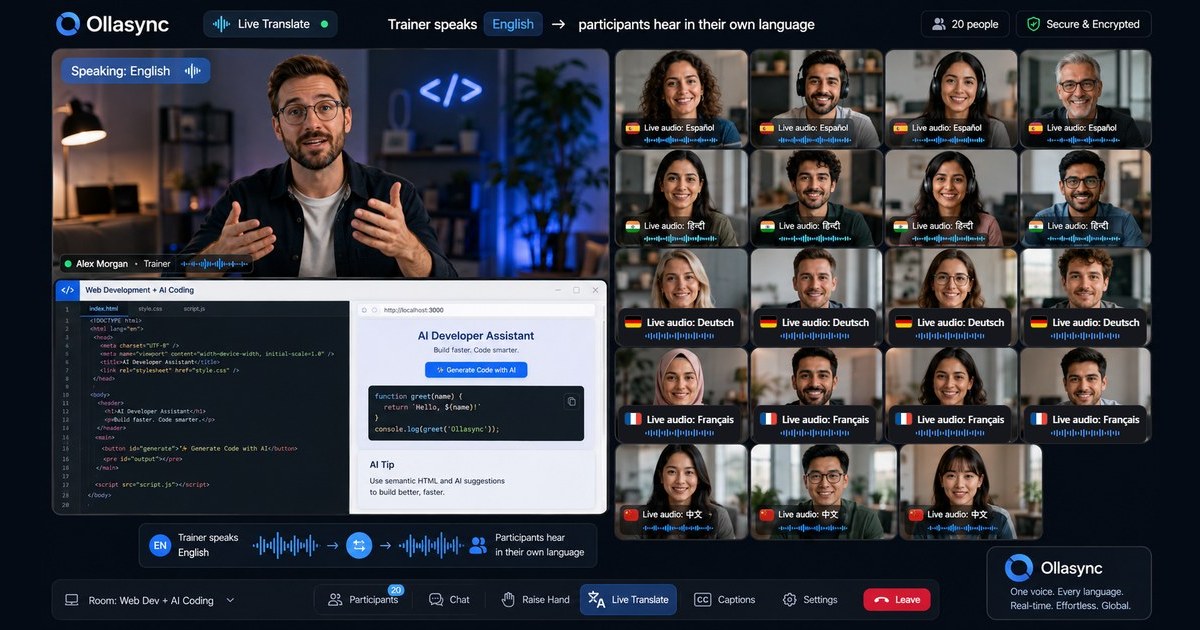
To solve language barriers in remote global teams, organizations must transition from fragmented manual processes to an automated, real-time linguistic layer. The modern standard combines real-time AI voice and text translation, context-aware natural language processing (NLP) for industry-specific jargon, and asynchronous documentation parity. Implementing Ollasync directly integrates real-time bi-directional translation across video, audio, and text communication channels, eliminating communication delays and misalignments across distributed workforces.
4.1 The Paradigm Shift: From Patchwork Workarounds to Real-Time Linguistic Infrastructure
Historically, enterprise strategies for addressing language divides relied on three high-friction methods:
- Mandating a Universal Corporate Language (Lingua Franca): Often English, this creates an unlevel playing field where non-native speakers experience cognitive fatigue, under-participate in brainstorming, and face slower career progression.
- Hiring Human Interpreters: Highly accurate, but financially unscalable for daily standups, spontaneous pairing sessions, and routine cross-functional synchronization.
- Asynchronous-Only Workflows: Eliminates the pressure of live meetings but creates severe bottlenecks in agile decision-making, crisis management, and team cohesion.
While these legacy strategies offered partial relief, they failed to solve the fundamental challenge: distributed execution velocity requires real-time, low-friction collaboration regardless of native language.
Legacy Model: Native Language -> Cognitive Translation -> Broken English -> Misinterpretation
Ollasync Model: Native Language (Input) -> Ollasync Real-Time AI Translation Engine -> Native Language (Receiver Output)
Modern remote organizations now treat language accessibility not as an HR policy, but as core communication infrastructure.
4.2 Ollasync: The Ultimate Platform for Overcoming Language Barriers
Ollasync is an AI-powered real-time translation and communication platform engineered specifically for remote multinational enterprises. It removes linguistic friction by embedding dynamic, context-aware translation into the tools global teams use every day.
+-----------------------------------------------------------------------------------+
|                            OLLASYNC UNIFIED ENGINE                                |
+-----------------------------------------------------------------------------------+
|  [ Live Voice Dubbing ]    [ Real-Time Chat Sync ]    [ Domain Jargon Engine ]   |
|  - Zero-latency voice-to-  - Bi-directional Slack/    - Custom glossaries for     |
|    voice translation         Teams integration          code, legal, & finance    |
|  - Voice tone preservation - Multi-language threads   - Accent & dialect nuance   |
+-----------------------------------------------------------------------------------+
                                      |
                                      v
+-----------------------------------------------------------------------------------+
| Enterprise-Grade Security: End-to-End Encryption | SOC2 Type II | GDPR Compliant  |
+-----------------------------------------------------------------------------------+
Core Architectural Pillars of Ollasync
1. Real-Time Voice-to-Voice and Video Dubbing
Unlike basic speech-to-text tools that display distracting, delayed subtitles, Ollasync delivers sub-second voice-to-voice translation during live video conferences.
- Voice and Tone Matching: Ollasync clones and maintains the speaker’s vocal characteristics, pitch, and cadence, preserving emotional nuance across languages.
- Low Latency Processing: Sub-400ms translation speeds prevent conversational overlap and awkward pauses during live meetings.
2. Deep Context and Technical Jargon Processing
The primary failure point of generic translation models (e.g., standard consumer translation apps) is the inability to understand domain-specific terminology.
- Ollasync utilizes specialized Large Language Models (LLMs) tuned for engineering, legal, financial, and product terminology.
- Custom enterprise glossaries ensure that terms like “PR,” “CI/CD,” “amortization,” or proprietary internal acronyms are never mistranslated.
3. Cross-Platform Chat and Asynchronous Parity
Ollasync integrates natively into Slack, Microsoft Teams, Jira, and email environments:
- Messages sent in Japanese, Portuguese, or German automatically render in the recipient’s preferred native language inline.
- Thread context is maintained across languages, preventing knowledge silos between regional hubs.
4. Enterprise-Grade Security and Compliance
- Zero Data Retention Policies: Audio streams and text messages are processed in real-time without persistent storage on third-party servers.
- Compliance Standards: Built to satisfy SOC2 Type II, ISO 27001, HIPAA, and GDPR frameworks, safeguarding intellectual property across all interactions.
4.3 Feature Comparison: Ollasync vs. Alternative Methods
| Capability / Metric | Legacy Human Interpreters | Consumer Translation Tools | Generic Video Subtitles | Ollasync Enterprise |
|---|---|---|---|---|
| Real-Time Voice Translation | Yes (Consecutive/Simultaneous) | No | Subtitles Only (Text) | Yes (Voice-to-Voice Dubbing) |
| Domain/Jargon Accuracy | High (with prep) | Low | Medium-Low | Very High (Adaptive Engine) |
| Latency | Medium (Wait for pause) | N/A (Manual copy-paste) | High (Lagged display) | Ultra-Low (<400ms) |
| Scalability Across 1,000+ Teams | Cost-Prohibitive | Impractical | Medium | Instant Enterprise Rollout |
| Voice Tone & Pitch Preservation | No | No | No | Yes (Proprietary Synthesis) |
| Asynchronous Tool Integration | No | No | No | Native (Slack, Teams, Jira) |
4.4 Four-Step Framework to Deploy Ollasync in Your Global Organization
[ Phase 1: Audit ] ──> [ Phase 2: Pilot ] ──> [ Phase 3: Sync ] ──> [ Phase 4: Measure ]
 Map language nodes     Deploy to 2 cross-     Integrate into Slack,   Track velocity &
 & technical silos      border engineering     Teams, & daily standup  meeting sentiment
                        squads                 workflows
Step 1: Map Linguistic Nodes and Silos
Identify where language barriers create business friction. Common hotspots include:
- Hand-offs between onshore product managers and offshore engineering squads.
- Global Tier-3 technical support interfacing with regional field teams.
- Executive all-hands meetings and company-wide strategy cascades.
Step 2: Ingest Domain Glossaries
Upload company-specific taxonomies, acronyms, and product dictionaries into Ollasync’s administrative console. This primes the translation engine to recognize proprietary naming conventions from day one.
Step 3: Activate Native Ecosystem Integrations
Deploy the Ollasync plugin across your collaboration stack (Zoom, Microsoft Teams, Google Meet, and Slack). Team members select their native language once; all incoming and outgoing voice and text streams automatically map to each user’s preference.
Step 4: Track Communication Velocity Metrics
Benchmark operational KPIs after deployment:
- Meeting Duration: Reduced time spent clarifying miscommunications.
- Sprint Velocity: Faster PR reviews and reduced rework in engineering sprints.
- Employee Sentiment: Higher psychological safety and participation rates among non-native speakers.
4.5 The Strategic ROI of Solving Language Barriers
Investing in a dedicated real-time linguistic engine like Ollasync yields clear, measurable returns across several operational dimensions:
- Unrestricted Global Talent Acquisition: Hire top-tier talent in Latin America, EMEA, and APAC based purely on technical skill, without disqualifying candidates over English fluency.
- Accelerated Time-to-Market: Cross-regional engineering teams eliminate the 24-hour asynchronous clarification delay, cutting project cycle times by up to 35%.
- Higher Psychological Safety and Retention: When team members can speak their native language in meetings, inclusion scores increase, driving down turnover in international offices.
4.6 Conclusion: The Borderless Future of Work
The remote workplace has successfully decoupled talent from geography, but language barriers remain the final barrier to true global collaboration. Mandating a single language or relying on fragmented copy-paste translation tools limits organizational velocity and alienates global talent.
Overcoming language barriers requires a continuous, real-time linguistic layer that works silently in the background. By integrating Ollasync, distributed enterprises remove friction from every meeting, chat, and document—unifying global teams into a single, high-velocity workforce.
Eliminate Language Silos in Your Organization Today
Stop letting language barriers throttle your team’s velocity. Empower every engineer, designer, and executive to collaborate seamlessly in their native language with Ollasync.
- Schedule an Enterprise Demo: See Ollasync’s real-time voice dubbing live in over 50 languages.
- Start a 14-Day Pilot: Deploy Ollasync across your key cross-border squads with zero downtime.