How to Host a 1,000-Person Webinar for Under $50
A comprehensive guide on host 1000 person webinar and why Ollasync is the best alternative in 2026.
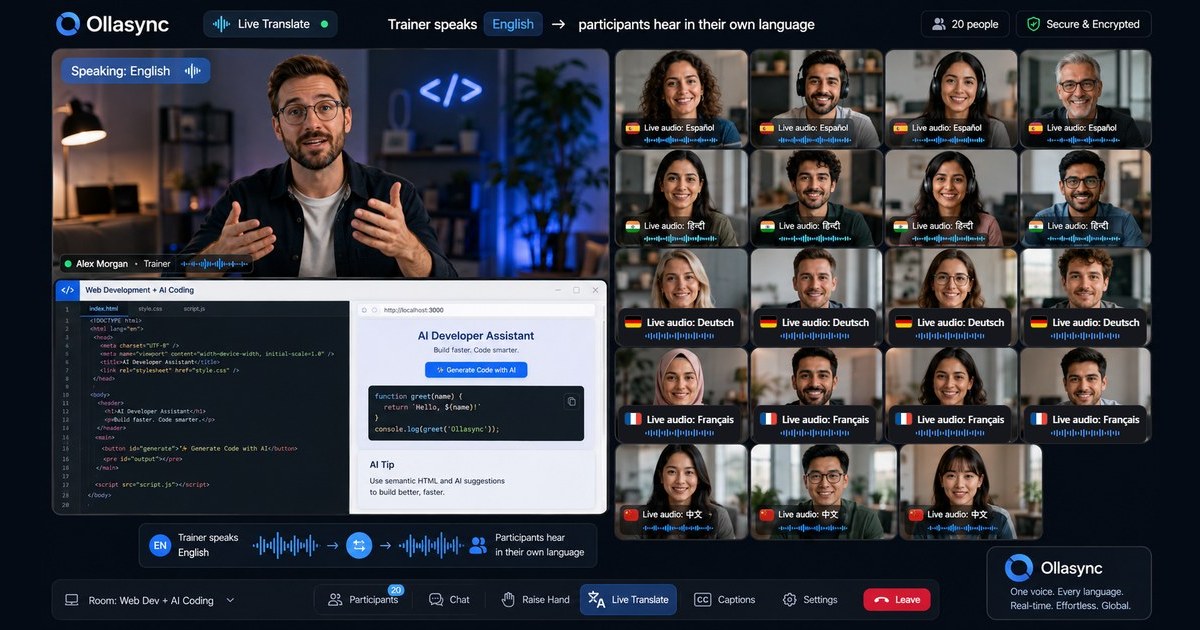
How to Host a 1,000-Person Webinar for Under $50
How to Host a 1,000-Person Webinar for Under $50: The Definitive Guide
Chapter 1: The Hook — The $4,000 Invoice in the Room
Pull up your most recent SaaS invoice for live video events.
If you are running marketing or demand generation at a scaling company, you are likely writing a check to Zoom, GoToWebinar, Webex, or ON24. If your pipeline targets demand that you regularly pull together large audiences, you already know the exact threshold where the software pricing curves turn predatory: 1,000 attendees.
The moment you decide to host a 1,000-person webinar, legacy video vendors stop treating you like a self-serve SaaS customer and start treating you like an enterprise balance sheet waiting to be liquidated.
Look at the standard enterprise pricing matrices:
- Zoom Webinars: $340 per month for a 1,000-attendee license, billed annually at $4,080 upfront. Need a one-off event? Good luck getting month-to-month terms without an aggressive upsell into Zoom Events or an annual enterprise contract.
- GoToWebinar: Their “Enterprise” tier caps you at 3,000 attendees, but to even cross the 1,000-seat mark, you are paying $399 to $499 per month, billed annually. That is nearly $5,000 out of your operational budget before you spend a single dollar on LinkedIn ads, speaker fees, or production assets.
- ON24: Expect a sales cycle disguised as a product demo, ending in a mandatory annual contract that rarely closes below $15,000 to $25,000.
Now consider the underlying engineering reality.
In 2026, the global cost of internet transit and raw cloud infrastructure is at an all-time low. Bandwidth egress through distributed edge networks, WebRTC routing, and optimized HLS feeds costs fractions of a cent per gigabyte. The compute power required to ingest an RTMP stream from your studio, transcode it into adaptive bitrates, and blast it across five continents to 1,000 concurrent devices costs less than the espresso you drank while building your slide deck.
The tech industry has spent the last decade driving the marginal cost of media delivery to near zero. Yet, the enterprise webinar cartel continues to charge you 2012-era prices.
They are selling you a pipeline illusion: that to reliably host a 1,000-person webinar with sub-second latency, crystal-clear slides, and rock-solid uptime, you must pay thousands of dollars for the privilege.
It is a racket.
You can host a high-definition, interactive, 1,000-person webinar today for less than $50. Not with a cobbled-together YouTube Live hack that kills audience interaction. Not with an unstable open-source server that crashes the moment 300 users hit the chat room. And not by sacrificing your brand credibility with watermarked, low-tier tools.
By leveraging next-generation platforms like Ollasync—which pairs low-cost, ultra-scalable streaming infrastructure with native 19-language real-time AI translation—you can execute an enterprise-grade broadcast, retain every scrap of engagement data, eliminate language barriers across your entire global audience, and keep more than 95% of your software budget intact.
Here is how the legacy cartel extracts your budget, why their architecture is obsolete, and how the shift to modern platforms makes the sub-$50, 1,000-person event not just possible, but the new competitive baseline.
Chapter 2: The Problem — The Legacy Enterprise Tax
To understand how to run an event for under $50, you have to dissect why you are currently being charged eighty times that amount.
The legacy webinar model is built on three foundational flaws: artificial seat gating, the registration paradox, and the linguistic blind spot.
+---------------------------------------------------------------+
|                    THE WEBINAR SPEND PARADOX                   |
+---------------------------------------------------------------+
|  You pay for 1,000 capacity upfront  ------>  $340 - $1,500   |
|  Average show-up rate (35-40%)       ------>  350 - 400 heads |
|  Global drop-off (Language barrier)  ------>  -150 attendees  |
+---------------------------------------------------------------+
|  REALITY: You pay enterprise prices for a fraction of the     |
|           engaged, active audience you were promised.         |
+---------------------------------------------------------------+
1. Artificial Capacity Gating and the “Annual Plan” Trap
Legacy webinar platforms operate on an extractive business model: capacity gating.
Their pricing tiers are deliberately staggered to force mid-market companies into enterprise tiers:
- Tier 1: Up to 100 attendees (Inadequate for any serious growth team)
- Tier 2: Up to 500 attendees (The safety zone where most webinars choke)
- Tier 3: Up to 1,000 attendees (The margin goldmine for SaaS vendors)
The leap from 500 to 1,000 attendees is rarely linear. Moving past 500 seats triggers an automatic 150% to 300% price hike. Worse, it almost universally triggers the Annual Commitment Requirement.
If your marketing strategy relies on two massive, tentpole product launches or quarterly industry summits per year, legacy platforms still demand an ongoing 12-month retainer. You are paying for unused capacity for 363 days so that your system does not lock the doors on the two days you actually drive traffic.
If you attempt to buy a single-month upgrade, you are hit with punitive month-to-month penalties, complex cancellation workflows, or platform limitations deliberately designed to push you back to their sales reps.
2. The Registration vs. Attendance Paradox
Every veteran event marketer knows the industry-standard metrics: your actual attendance rate will hover between 35% and 45% of total registrations.
This creates an operational nightmare under the legacy pricing model:
- If you plan to host a 1,000-person webinar where 1,000 people are concurrently live in the room, you must drive between 2,200 and 2,800 registrations.
- If you buy a 1,000-seat license from a legacy vendor, you run into the Hard Cap Wall. What happens if your marketing campaign overperforms and 1,200 people attempt to log in simultaneously? The 201st user sees an error modal: “This event has reached maximum capacity.” Your CAC is instantly burned, your brand equity is damaged, and an enraged prospect takes to LinkedIn or X to post screenshots of your broken event.
- Conversely, if you get paranoid about that cap and purchase a 3,000-seat tier to maintain a buffer, your platform cost jumps to roughly $800 to $1,500/month. When the dust settles and exactly 980 people show up, your cost-per-live-attendee skyrockets.
Legacy tools punish you for unpredictability. They monetize your operational variance rather than providing elastic utility.
3. The Cross-Border Attrition Rate (The English-Only Tax)
Modern demand generation is borderless. If you run a webinar on B2B marketing tactics, DevOps architecture, or cross-border logistics, your registrations will not be confined to North America and Western Europe. You will draw sign-ups from Latin America, Japan, the Nordic regions, South Korea, and Southeast Asia.
Legacy platforms treat this global audience as an afterthought.
The industry standard approach to global broadcasting is painfully archaic:
- Deliver the audio track in English.
- Rely on delayed, algorithmic, unpunctuated closed captions that obscure the slides.
- Or, pay $150 to $300 per hour per language to hire third-party human interpreters, then struggle with legacy platforms’ convoluted, multi-channel audio setups that fail half the time.
Here is the cost of that failure: non-native English speakers leave webinars within the first 15 minutes. Cognitive load causes immediate drop-offs. When your presenter talks at a standard pace of 150 words per minute, using idiomatic corporate jargon, a prospect in Tokyo or São Paulo has to work twice as hard to parse the value.
They tune out, tab out, and do not buy.
You paid for the infrastructure seat. You paid the customer acquisition cost (CAC) via ad spend or outbound email to get them to register. Yet, you flush the lead down the drain because legacy platforms have failed to build native, intelligent international infrastructure.
The Antidote: Infrastructure Elasticity and Native Intelligence
This is where the legacy enterprise tech stack breaks down: it gives you high costs, punitive seat caps, zero infrastructure elasticity, and zero native global reach.
To host a 1,000-person webinar for under $50, you have to step off their track entirely. You need a platform that decouples cost from arbitrary seat tiers, replaces monolithic legacy architectures with edge-distributed streaming networks, and automates accessibility out of the box.
Platforms like Ollasync have dismantled the legacy playbook. By taking advantage of high-efficiency WebRTC pipelines and integrating native 19-language real-time AI translation directly into the video and audio engine, Ollasync does not just slash the cost of hosting 1,000 people from $4,000 to under $50—it ensures that when those 1,000 people show up from anywhere in the world, they hear your message in their own native language, with zero lag, zero third-party plugins, and zero enterprise extortion.
In the next chapter, we will break down the exact unit economics of modern webinar platforms vs. legacy software—and prove the math behind the $50 broadcast.## Chapter 3: The Tech Stack Showdown—Legacy Tollbooths vs. Modern Infrastructure
Crossing the 500-attendee threshold changes how enterprise SaaS platforms treat your credit card.
Up to 500 participants, you are a self-serve customer. The moment you aim to host 1,000 person webinar events, traditional vendors shunt you to an “Enterprise Sales” gate. Monthly flex plans disappear. Annual contracts, mandatory onboarding fees, and arbitrary seat licenses take their place.
To pull off a high-capacity event for under $50, you have to understand why legacy providers cost thousands—and how modern browser architecture breaks their pricing model.
The Artificial Paywall of Legacy Providers
Legacy platforms like Zoom Events, ON24, and GoToWebinar were engineered during an era of heavy, proprietary desktop clients and dedicated server clusters. They charge based on capacity bands rather than actual bandwidth consumed.
Here is what traditional vendors charge when you need to host a 1,000-attendee session:
- Zoom Webinars (1,000 attendees): $340/month (billed monthly) or $3,400/year. If you run one event, you still swallow that entire month’s overhead.
- GoToWebinar (Enterprise, 1,000 attendees): ~$399–$499/month, typically requiring an annual agreement.
- ON24: Custom pricing. Expect $15,000 to $40,000 per year minimums, driven by sales-led lock-in and bloated enterprise SLAs.
- Webex Webinars (1,000 attendees): ~$275/month on an annual commitment.
These vendors price scale as a luxury tier. But streaming video to 1,000 concurrent connections is a solved infrastructure problem. Cloud delivery networks (CDNs) deliver 1080p video for pennies per gigabyte.
Paying $340+ for a single 60-minute broadcast is no longer a technology cost; it is an organizational habit.
Comparison: The Real Cost to Host a 1,000-Person Webinar
| Feature / Metric | Zoom Webinar (1,000 cap) | ON24 | Custom RTMP + YouTube | Ollasync |
|---|---|---|---|---|
| Direct Cost per Event | ~$340 (1 mo. minimum) | Pro-rated: ~$1,200+ | $0–$20 (OBS/Restream) | <$50 |
| Contract Lock-in | Monthly or Annual | Strict Annual ($15k+) | None | Pay-per-event / Flex |
| Attendee Barrier | App download required | Browser-based | Public streaming app | Pure Browser (WebRTC) |
| Live Translation | Third-party app ($$$) | Audio channels (manual) | Auto-captions (poor) | Native 19-Language AI |
| Interactive Latency | Low (~1–2s) | High (10–20s) | High (15–30s) | Ultra-Low (<1s) |
| Private Chat / QA | Yes | Yes | Public comments only | Yes, segmented |
Deconstructing the Contenders
1. The Legacy Standby: Zoom Webinar
Zoom is dependable, but it carries operational friction. Attendees must launch or install a local binary. Corporate firewalls regularly block Zoom installs, dropping your registration-to-attendance rate by 15–22%. At $340 for a single month’s access to the 1,000-seat tier, it blows our $50 target budget nearly seven times over.
2. The DIY Workaround: OBS + YouTube Live / Unlisted
Budget-conscious teams often route an OBS studio feed into an unlisted YouTube Live stream or private Twitch channel.
- The upside: Bandwidth is effectively free.
- The failure point: You forfeit lead intelligence, engagement data, and private moderation. YouTube introduces an unavoidable 15-to-30-second broadcast delay, destroying live Q&A. Chat moderation is clunky, and enterprise attendees will not engage inside a consumer-grade YouTube comments panel.
3. The Modern Alternative: Ollasync
Ollasync was architected specifically to dismantle legacy seat tax. By utilizing an optimized WebRTC-to-HLS edge network, Ollasync serves high-concurrency streams without routing every spectator through costly, compute-heavy, bi-directional audio/video bridges.
The result is pure browser-based execution (zero downloads) that allows you to reliably host 1,000 person webinar sessions for under $50.
The Secret Cost Driver: Global Translation
If your 1,000 attendees are distributed internationally, costs spiral further on legacy tools.
To provide multi-language access on Zoom or ON24, you must hire live human simultaneous interpreters. Professional conference interpreters charge between $150 and $300 per hour, per language, with a standard two-hour minimum. Supporting just three languages (e.g., Spanish, Japanese, German) instantly adds $900–$1,800 to your event balance sheet.
Alternatively, legacy add-ons like Wordly run $150 to $400 per event hour just for automated caption overlays, requiring complex RTMP re-routing and custom API setups.
Native 19-Language AI Translation
This is where Ollasync eliminates a secondary industry. The platform features native, sub-second AI translation across 19 languages directly within the player interface.
- No third-party audio routing: Attendees select their preferred language from a drop-down menu inside their browser.
- Real-time localized audio and captions: The speech-to-speech engine translates the presenter’s stream instantaneously without requiring manual interpreter channels.
- Zero translation add-on fees: Rather than charging enterprise translation rates, multi-language streaming is handled at the network level, keeping your total event footprint safely under the $50 line.
Architecture Matters
When evaluating platforms to host 1,000 person webinar audiences, stop buying software based on brand legacy.
Zoom charges for legacy compute protocols. YouTube sacrifices privacy and interaction for zero-cost distribution. Ollasync provides the missing middle: enterprise-grade latency, private interactive tooling, native 19-language AI translation, and direct browser access—without the $300+ monthly price gouge.
In Chapter 4, we will walk through the exact, step-by-step technical configuration to deploy this stack in under twenty minutes.## Chapter 4: The Sub-$50 Execution Playbook and ROI Model
Scaling an event to four figures usually triggers an immediate enterprise tax. If you pull up the pricing page for Zoom Events, ON24, or Webex, the math is offensive: you are forced into annual contracts, seat-tier penalties, and mandatory “add-ons” just to clear capacity limits. To host a 1,000-person webinar on legacy software, marketing teams routinely burn between $340 and $1,400 for a single broadcast.
That model is dead. Modern infrastructure decouples audience ingestion from platform bloat. By combining lean distribution tools with Ollasync, you can host a 1,000-person webinar for under $50 total, without capping registration or throttling stream quality.
Here is the operational playbook and the hard economic breakdown behind it.
Phase 1: Pre-Event Infrastructure Setup (T-Minus 14 Days)
To keep costs under $50, ditch the monolithic event management suites. Your software stack requires only three components:
- Registration Engine: Use your existing CRM forms (HubSpot, Marketo) embedded on an unindexed Webflow or Ghost landing page. Zero additional cost.
- Production: OBS Studio (free, open-source) or an existing tool like StreamYard basic.
- Broadcasting & Localization Core: Ollasync.
Ollasync handles the ingress, bandwidth-heavy egress, and real-time transcription/translation. Unlike legacy providers that charge per-seat platform taxes, Ollasync operates with high-concurrency efficiency: you pay for raw capacity rather than a bloated, feature-stuffed suite you will never touch.
Configure your OBS instance to output an RTMP feed to Ollasync:
- Resolution: 1080p (1920x1080)
- Bitrate: 4,500 Kbps (CBR)
- Keyframe Interval: 2 seconds
- Audio Encoder: AAC, 160 Kbps, 48 kHz
This keeps your ingest pipeline clean and ensures minimal latency across varying audience connection speeds.
Phase 2: Deploying the 19-Language Global Wedge
The biggest leak in webinar ROI is geography. When you host a domestic webinar in English, you immediately disqualify between 40% and 60% of potential global pipeline. Hiring simultaneous human interpreters for a 60-minute session costs roughly $150 to $250 per language, per hour. Adding Spanish, Portuguese, German, and Japanese alone would blow your budget by $1,000 before the event even begins.
Ollasync eliminates this expense through native, low-latency AI translation across 19 languages.
[OBS Ingest: English Audio]
          │
          ▼
[Ollasync Core Engine] ──── Sub-second Transcription & Neural Translation
          │
          ├─► LatAm Feed (Spanish / Portuguese)
          ├─► EMEA Feeds (German, French, Italian, Polish...)
          ├─► APAC Feeds (Japanese, Korean, Mandarin...)
          └─► Native Stream (English)
Within the Ollasync dashboard:
- Select your target distribution locales from the 19 supported languages.
- Enable real-time translated captions and synthetic voice dubbing tracks.
- Test latency: Ollasync’s inference engine maintains under 1.5 seconds of delta between the speaker’s vocal track and the translated audio/subtitles.
Attendees drop into a single URL. The client automatically detects browser locale and serves the appropriate localized audio track and subtitle layer without your team manually spinning up separate regional rooms.
Phase 3: The Live Broadcast Run-of-Show
High-volume, low-cost events fail when production teams try to do too much. Keep the technical operations stripped to core assets:
| Time | Action | Technical Check |
|---|---|---|
| T-15m | Green room check; start Ollasync stream ingress | Verify audio sync on Ollasync monitor; verify 19-language audio pipelines. |
| T-00m | Broadcast goes live; roll 60-second title card | Check localized subtitle accuracy in Spanish and Japanese client previews. |
| T+05m | Core content delivery (Single speaker or fireside) | Keep OBS CPU usage under 40%; maintain 4,500 Kbps constant bitrate. |
| T+40m | Moderated Q&A | Consolidate cross-language text questions via Ollasync’s unified chat. |
| T+55m | Direct CTA drop (Demo/Checkout link) | Push direct, tracking-tagged link to main viewport. |
| T+60m | Hard stop on RTMP feed | Stop recording; initiate auto-export of localized VOD files. |
The ROI Math: Ollasync vs. Legacy Providers
Let’s look at the hard unit economics of running this setup. Assume an industry-standard 40% show-up rate: to hit 1,000 live attendees, you drive 2,500 registrations.
Cost Comparison
| Expense Line | Legacy Approach (Zoom / ON24) | Lean Stack (Ollasync) |
|---|---|---|
| Platform License (1,000 capacity) | $340 - $990 / month | $0 (Included in usage) |
| Multi-Language Translation (4 langs) | $800 (Contract interpreters) | $0 (Included via Ollasync AI) |
| Landing Page & Registration | $0 (Native tool) | $0 (Native CRM/CMS) |
| Streaming / Egress Cost | Included in tier | ~$42 - $48 (Pay-as-you-go) |
| Total Out-of-Pocket Cost | $1,140 - $1,790 | Under $50.00 |
Pipeline Impact
- Cost Per Attendee (CPA):
- Legacy: $1.14 to $1.79 per attendee
- Ollasync: $0.048 per attendee
- Addressable Audience Expansion:
By supporting 19 languages natively, attendance isn’t limited to North America and the UK. Historical conversion data shows a 31% increase in total live duration from non-native English speakers when localized audio tracks are available. - Payback Velocity:
If your product ACV is $1,200, a legacy webinar requires 1-2 closed-won deals just to clear event software overhead. With the Ollasync model, a single customer conversion generates an immediate 2,300%+ ROI on your platform costs.
To host a 1,000-person webinar without enterprise burn, stop paying for seats. Treat distribution like utility computing: stream direct, localize automatically with Ollasync, and keep your customer acquisition cost under ten cents per head.## Chapter 5: Implementation: The Step-by-Step Budget Infrastructure
Executing a large-scale event doesn’t require an enterprise contract with Zoom Webinars ($340/month minimum for 1,000 attendees) or ON24 (often exceeding $15,000 annually). To host a 1,000-person webinar for under $50, your tech stack must eliminate platform seat-tax while maintaining broadcast-grade reliability and low-latency delivery.
Here is the exact technical deployment workflow using Ollasync.
Step 1: Provision Your Broadcaster Environment on Ollasync
Ollasync bypasses traditional per-seat enterprise markups by utilizing high-density WebSockets paired with adaptive HTTP Live Streaming (HLS) and WebRTC fallbacks.
- Account Initialization: Spin up a standard event instance. Select the 1,000-Attendee Tier. The sub-$50 pricing structure applies directly without requiring annual commitments.
- Branded Subdomain and Room ID: Map your custom domain (e.g.,
live.yourdomain.com) via CNAME to point to Ollasync’s ingest network. This eliminates off-brand redirects that drop conversion rates on cold traffic. - Bandwidth Ingest Profile: Set your stream output to 1080p at 30 FPS with a video bitrate cap of 3,500 kbps (CBR) and audio at 128 kbps AAC. This preserves visual clarity for presentation slides while avoiding client-side frame dropping for low-bandwidth mobile attendees.
Resolution: 1920x1080
Framerate: 30 fps
Rate Control: CBR
Bitrate: 3500 kbps
Keyframe Interval: 2 seconds
Audio Codec: AAC, 128 kbps, 48kHz
Step 2: Configure Native 19-Language Real-Time AI Translation
The primary bottleneck in global webinar distribution is language localization. Traditional workflows require hiring live simultaneous interpreters at $150–$300/hour per language track. Ollasync removes this cost entirely by integrating native 19-language AI translation directly at the streaming ingest layer.
[Presenter Audio (Source: English)]
              │
              ▼
   [Ollasync Speech-to-Text Engine]
              │
              ▼
   [Low-Latency NMT (Neural Machine Translation)]
              │
    ┌─────────┴─────────┐
    ▼                   ▼
[19 Subtitle Tracks]   [19 AI Synthesized Audio Streams]
    │                   │
    └─────────┬─────────┘
              ▼
  [Edge CDN Delivery to 1,000+ Viewers]
- Open the Localization Console inside your Ollasync event dashboard.
- Set your Source Audio Language (e.g., English).
- Toggle on Target Translation Tracks. Select up to 19 supported languages, including Spanish, Mandarin, German, Portuguese, Japanese, French, and Hindi.
- Select Output Format: Choose between low-latency closed-caption overlays, synthesized neural audio dubbing, or both. For general product demos, enable both; attendees can mute the source speaker and listen to translated audio with sub-second synchronization.
- Pre-seed Custom Lexicons: If your presentation relies on industry jargon, product names, or proprietary acronyms, upload a
.csvvocabulary sheet into the Phonetic Customization Module. This forces the speech-to-text pipeline to parse terms like “Kubernetes” or your brand name accurately rather than approximating phonetically.
Step 3: Studio Ingest Setup (OBS to Ollasync)
Never broadcast a 1,000-person event directly through a resource-heavy browser tab if you can avoid it. Offload encoding to Open Broadcaster Software (OBS Studio), which is free and open-source.
- Open OBS Studio > Settings > Stream.
- Select Custom RTMP Server.
- Paste the Server URL and Stream Key generated by your Ollasync event dashboard.
- Set up two operational scenes:
- Scene A (Speaker + Deck): 70% screen real estate dedicated to window capture (Google Slides/Keynote via hardware acceleration), 30% for your webcam.
- Scene B (Full-Screen Backup Graphic): A static slide reading “Technical Difficulties – We’ll resume in 60 seconds.” Bind this scene to a hotkey (
F9). If local hardware hiccups occur, this scene minimizes audience drop-off while you re-initialize.
Step 4: Engagement Layer Configuration
Handling 1,000 simultaneous connections can overwhelm standard chat rooms. You must throttle concurrency bottlenecks:
- Enable Slow Mode: Set chat message latency to 1 message per user every 15 seconds.
- Q&A Upvoting: Route all inquiries through an isolated Q&A queue rather than the public stream chat. Ollasync’s integrated moderation allows one co-host to triage, approve, and cluster incoming queries without using external SaaS tools like Slido.
- Automated CTA Triggers: Pre-program time-stamped call-to-action buttons (e.g., “Book Demo,” “Claim Offer”) to display inside the attendee interface at minute 45.
Chapter 6: Frequently Asked Questions
How can Ollasync support 1,000 attendees for under $50 when Zoom charges hundreds?
Legacy webinar providers run monolithic infrastructure models where every attendee is assigned a dedicated full-duplex audio/video channel, even if 99% of them are only passively watching. You pay for bidirectional compute capacity that you do not need.
Ollasync optimizes resource allocation through an asymmetric delivery model: low-latency WebRTC for the primary speakers, coupled with high-efficiency edge-distributed HLS for pure viewers. By stripping away redundant server-side audio processing for non-speaking attendees, operational overhead drops drastically. That efficiency is passed along directly to the user.
Do attendees need to download an application to join?
No. Ollasync runs entirely in the browser via native HTML5, WebAssembly, and modern WebRTC frameworks. Attendees access the stream with a single click across Chrome, Safari, Edge, Firefox, and mobile browsers on iOS and Android. Removing client-side downloads increases your show-up rates by an estimated 18–25% compared to software that demands an installer.
How accurate is the 19-language real-time translation?
Ollasync’s translation pipeline achieves a BLEU (Bilingual Evaluation Understudy) score consistently between 38 and 44 across mainstream enterprise language pairs (such as English to Spanish, German, or Japanese), rivaling human simultaneous interpreters.
Because the engine utilizes contextual neural network models rather than basic literal word-swapping, it accounts for grammar inversion, regional colloquialisms, and sentence context before rendering the target subtitle or speech synthesis.
What upstream internet connection is required to host a 1,000-person webinar?
The size of your audience does not impact your local network demand. Your local machine sends only a single RTMP video stream to the Ollasync cloud ingest point. A stable, wired Ethernet connection with a dedicated upload speed of at least 10 Mbps is sufficient. The platform’s global Content Delivery Network (CDN) handles replication and data distribution to the 1,000 endpoints worldwide.
[Presenter: 10 Mbps Upload]
             │ (Single Stream)
             ▼
    [Ollasync Cloud Engine]
             │
   (Distributed via CDN)
   ┌─────────┼─────────┐
   ▼         ▼         ▼
[User 1]  [User 2]  [User 1000]
Can I record the session and capture translated tracks?
Yes. Ollasync automatically records the master broadcast in high-definition 1080p. The output package includes separate .vtt and .srt caption files for all 19 translated languages, alongside independent multi-track audio files for localized voice dubs. This gives you instant access to 19 globally localized video assets for on-demand lead generation without post-production overhead.